Tag: development challenges south-south solutions

  • Innovation: Cairo’s Green Technology Pioneers

    Innovation: Cairo’s Green Technology Pioneers

    By David SouthDevelopment Challenges, South-South Solutions

    SOUTH-SOUTH CASE STUDY

    One thing is ubiquitous to every country, community and society: garbage. It’s a social and environmental problem, but far from being mere waste, rubbish has its uses. This by-product of the goods and foods consumed can also be a source of fuel. As such it has many advantages, including providing free fuel to cash-strapped households, independence from unreliable municipal services and a way to dispose of waste.

    An enterprising Egyptian man is showing his community how it is possible to lower the cost of gas and hot water while also avoiding the service disruptions common with municipal utilities. In the process, he is pioneering a local green innovation model that can be replicated elsewhere.

    Biogas (http://en.wikipedia.org/wiki/Biogas) generators — which can transform organic household waste into fuel — have been very successful in India and China. It is estimated there are 20 million small-scale urban biogas digesters in China and 2 million in India.

    Hanna Fathy’s roof in the Manshiyet Nasser neighbourhood, home to the Coptic Christian Zabaleen community of Cairo – the city’s traditional garbage collectors and recyclers – is now a utility system, providing biogas and hot water.

    The area is made of narrow streets and makeshift houses. Residents live cheek-by-jowl in a neighbourhood that is home to tens of thousands of people.

    The community was badly hit when the 300,000 pigs the Christian residents have kept for the past 30 years to eat Cairo’s vegetative waste — an effective garbage-disposal system — were slaughtered under government orders to prevent the spread of swine flu (H1N1) (http://en.wikipedia.org/wiki/Swine_influenza).

    One woman told U.S. National Public Radio about the hard life in the neighbourhood: “I’m working all the time. My hands get dirty, there’s no water. The price of food is too high. The gas has gone up to seven pounds (US $1.28) a bottle, so it’s expensive to heat.

    “Everything is so expensive, and I have to live like this?” she said.

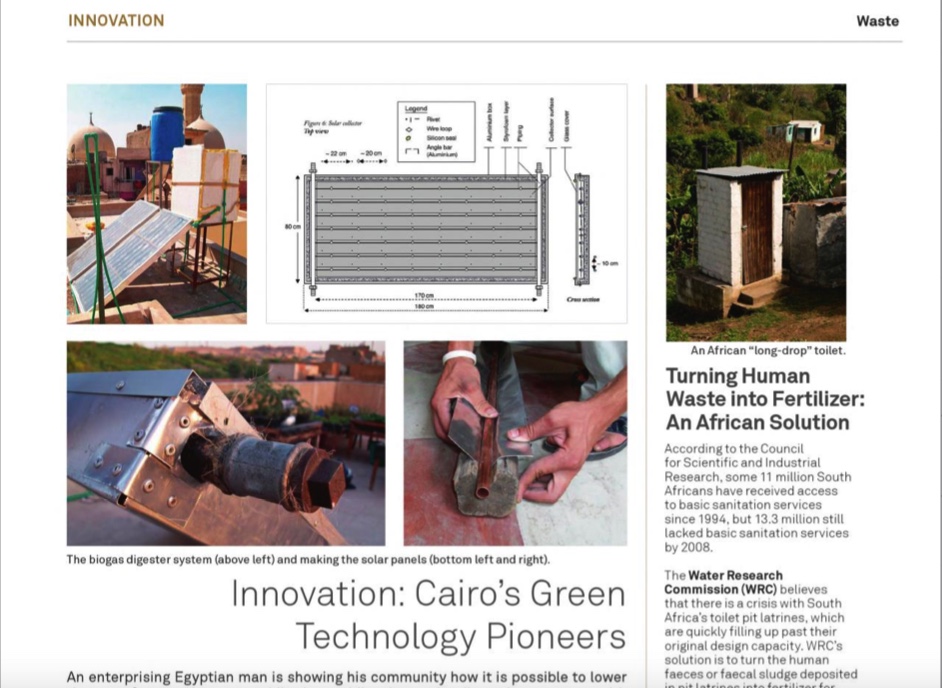
    Fathy plops kitchen scraps, stale tea and tap water into a jug which he pours into a homemade biogas maker on the roof of his house. The stew of waste mixes with water and a small quantity of animal manure used to start the process, and overnight makes biogas, which is then used for cooking. The digester is able to provide an hour’s worth of cooking gas a day in winter months, and two hours in the summer, from around two kilograms of waste. The remaining waste by product becomes liquid organic fertilizer for the garden.

    Fathy has been developing the biogas digester with the NGO Solar Cities (http://solarcities.blogspot.com), which provides designs, technical advice and support to Cairo citizens keen to embrace green technologies.

    What is interesting is not only the technology but how that technology is being developed. The approach is to innovate and adapt the technology to local resources and skills. This increases the chances of take-up and buy-in.

    The designs for the digesters and heaters have evolved through experimentation, brainstorming and availability of local materials.

    Each biogas system costs about US $150 for materials, a cost that is being picked up right now by donations. Solar Cities believes there are only eight biogas digesters in Egypt so far, most built in 2009.

    Solar Cities’ founder, Thomas Culhane, points out many urban dwellers do not believe they can generate biogas and associate it with rural systems that use animal manure. But the abundance of urban kitchen waste is in fact an excellent source material for biogas.

    Culhane believes the biogas digesters are an excellent solution to two problems: the vast quantities of garbage piling up in Cairo, which has had its traditional disposal system disrupted by the slaughter of the pigs, and the city’s emissions of greenhouse gases that contribute to climate change.

    Fathy has one goal: to be completely self-sufficient. He has been also prototyping a solar heater on his roof as well as the biogas digester. The solar water heater makes use of items that can be easily found: it recycles black garbage bags, has an aluminium frame and a glass cover. The whole thing rests on a Styrofoam block and uses copper tubes. The water is stored in a bright blue barrel.

    Biogas, solar power and other forms of green energy face many obstacles if it is to expand further in Egypt. The average cost of each unit will need to come down to match the income of the users and compete with the government-subsidized energy sector.

    Fathy has also found neighbours are skeptical and can’t believe biogas can be made this way.

    Another man, Hussain Soliman, had both a solar water heater and biogas digester on the roof of his apartment building before the crumbling building collapsed.

    The complete solar water heating system designed by Solar Cities can be assembled for under US $500. It uses two 200-litre recycled industrial shampoo barrels for the holding tank and back-up water supply. The solar panels need to be kept clean from dust every week, but other than that, Culhane insists the heaters require little maintenance.

    Now in temporary government housing, Soliman is still enthusiastic about the technology and is re-building a solar heater and biogas digester for his new home.

    “I’m planning to collect the organic waste from restaurants in the neighborhood to increase my gas output,” he told IPS News. “I’ll give the restaurants plastic bags and they can separate out the organics, and I’ll collect the bags at the end of each day.”

    Published: January 2010

    Resources

    1) Practical Action has technical drawings and guidelines for making a small biogas digester. Website: http://practicalaction.org/practicalanswers/product_info.php?products_id=42

    2)  The Anaerobic Digestion Community: Here is an excellent technical explanation of how a digester works, including a short film. Website: http://www.anaerobic-digestion.com/

    3) China boasts a fast-growing biogas economy using farm waste. Here is a full summary of their experience. Website: http://www.i-sis.org.uk/BiogasChina.php.

    https://davidsouthconsulting.org/2022/09/28/asian-factories-starting-to-go-green/

    https://davidsouthconsulting.org/2022/09/27/caribbean-island-st-kitts-goes-green-for-tourism/

    https://davidsouthconsulting.org/2021/01/25/creating-green-fashion-in-china/

    https://davidsouthconsulting.org/2023/02/03/environmental-public-awareness-handbook-case-studies-and-lessons-learned-in-mongolia/

    https://davidsouthconsulting.org/2021/02/01/ethiopia-and-djibouti-join-push-to-tap-geothermal-sources-for-green-energy/

    https://davidsouthconsulting.org/2021/08/29/indian-business-model-makes-green-energy-affordable/

    https://davidsouthconsulting.org/2021/10/22/innovations-in-green-economy-top-three-agenda/

    https://davidsouthconsulting.org/2021/08/07/mongolian-green-book/

    https://davidsouthconsulting.org/2022/04/14/prisons-with-green-solutions/

    https://davidsouthconsulting.org/2021/02/04/us-450-million-pledged-for-green-economy-investments-at-kenyan-gssd-expo/

    Development Challenges, South-South Solutions was launched as an e-newsletter in 2006 by UNDP’s South-South Cooperation Unit (now the United Nations Office for South-South Cooperation) based in New York, USA. It led on profiling the rise of the global South as an economic powerhouse and was one of the first regular publications to champion the global South’s innovators, entrepreneurs, and pioneers. It tracked the key trends that are now so profoundly reshaping how development is seen and done. This includes the rapid take-up of mobile phones and information technology in the global South (as profiled in the first issue of magazine Southern Innovator), the move to becoming a majority urban world, a growing global innovator culture, and the plethora of solutions being developed in the global South to tackle its problems and improve living conditions and boost human development. The success of the e-newsletter led to the launch of the magazine Southern Innovator. 

    https://davidsouthconsulting.org/2022/11/01/southern-innovator-magazine-2010-2014/

    Creative Commons License

    This work is licensed under a
    Creative Commons Attribution-Noncommercial-No Derivative Works 3.0 License.

    ORCID iD: https://orcid.org/0000-0001-5311-1052.

    © David South Consulting 2023

  • Online Free Knowledge Sharing

    Online Free Knowledge Sharing

    By David SouthDevelopment Challenges, South-South Solutions

    SOUTH-SOUTH CASE STUDY

    UNESCO’s Kronberg Declaration on the Future of Knowledge Acquisition and Sharing is blunt: the future of learning will increasingly be mediated by technology, and traditional educational processes will be revolutionized. Acquiring factual knowledge will decrease and instead people will need to find their way around complex systems and be able to judge, organize and creatively use relevant information.

    According to Abdul Waheed Khan, UNESCO’s Assistant Director General for Communications and Information, “Lack of access to knowledge increasingly accentuates marginalization and economic deprivation, and we need to join efforts to bridge these gaps”

    More and more initiatives are stepping in to break down barriers in the exchange of information and knowledge, and break out from the gatekeepers. The advent of Web 2.0 and its user-contributed resources is making this happen.

    Connexions sees itself as the partner to go with the free and low-cost laptops being distributed by the One Laptop Per Child Project to schoolchildren in the developing world. Connexions is a Web 2.0 website that allows teachers and educators to upload their learning materials by subject for sharing with anyone who wants them. All content is broken down into modules for easy access. The content can be mixed to build courses, and adapted to suit local conditions. It represents a cornucopia of knowledge, ranging from mathematics to engineering to music lessons.

    The content’s adaptability is its charm – users can add additional media like video and photos and modify and add on-the-ground case studies to really bring the material to life for students. The ability to re-mix and re-contextualise into the local circumstances is critical to get take-up of these resources argues Connexions.

    Open Educational Resources is a global teaching and learning sharing website. It is all about getting teachers to open up and share their knowledge with other teachers. It contains full courses, course modules, syllabi, lectures, homework assignments, quizzes, lab and classroom activities, pedagogical materials, games and simulations, It is run by ISKME,an independent, non-profit educational think tank whose mission is to understand and improve how schools, colleges, and universities, and the organizations and agencies that support them, build their capacity to systematically collect and share information

    Another excellent way to share information is the online publishing tool Lulu. While it is free to publish – whether a book, photo book, brochure, artwork, digital media, DVD and e-books – it does cost the person who wants to download or order a printed and bound copy. The creator of the content gets to choose how much should be charged and what is a fair price. The beauty of this website is the ability for anyone to publish and to bypass the limitations of traditional publishing.

    Once you have created your content, and taken the decision to share it with the world, you can also make sure it is copyright protected so that nobody accept you makes money from it. It is aimed at authors, scientists, artists and educators, and lets them protect their work for free. The Creative Commons initiative allows repeat use for free of the content as long as the user attributes its source to its original author. Any content you publish online will be given a logo clearly stating what rights it has.

    Published: August 2007

    Resources

    • Professor Richard Baraniuk explains his concept in a video: click here to view
    • The Creative Commons provides free tools that let authors, scientists, artists and educators to easily define what rights they will allow people to have who use their work. The website has all the tools (including logos) to get started licensing work: www.creativecommons.org
    • Kronberg Declaration: Kronberg Declaration.pdf

    Development Challenges, South-South Solutions was launched as an e-newsletter in 2006 by UNDP’s South-South Cooperation Unit (now the United Nations Office for South-South Cooperation) based in New York, USA. It led on profiling the rise of the global South as an economic powerhouse and was one of the first regular publications to champion the global South’s innovators, entrepreneurs, and pioneers. It tracked the key trends that are now so profoundly reshaping how development is seen and done. This includes the rapid take-up of mobile phones and information technology in the global South (as profiled in the first issue of magazine Southern Innovator), the move to becoming a majority urban world, a growing global innovator culture, and the plethora of solutions being developed in the global South to tackle its problems and improve living conditions and boost human development. The success of the e-newsletter led to the launch of the magazine Southern Innovator. 

    Creative Commons License

    This work is licensed under a
    Creative Commons Attribution-Noncommercial-No Derivative Works 3.0 License.

    ORCID iD: https://orcid.org/0000-0001-5311-1052.

    © David South Consulting 2023
  • Berber Hip Hop Helps Re-ignite Culture and Economy

    Berber Hip Hop Helps Re-ignite Culture and Economy

    By David SouthDevelopment Challenges, South-South Solutions

    SOUTH-SOUTH CASE STUDY

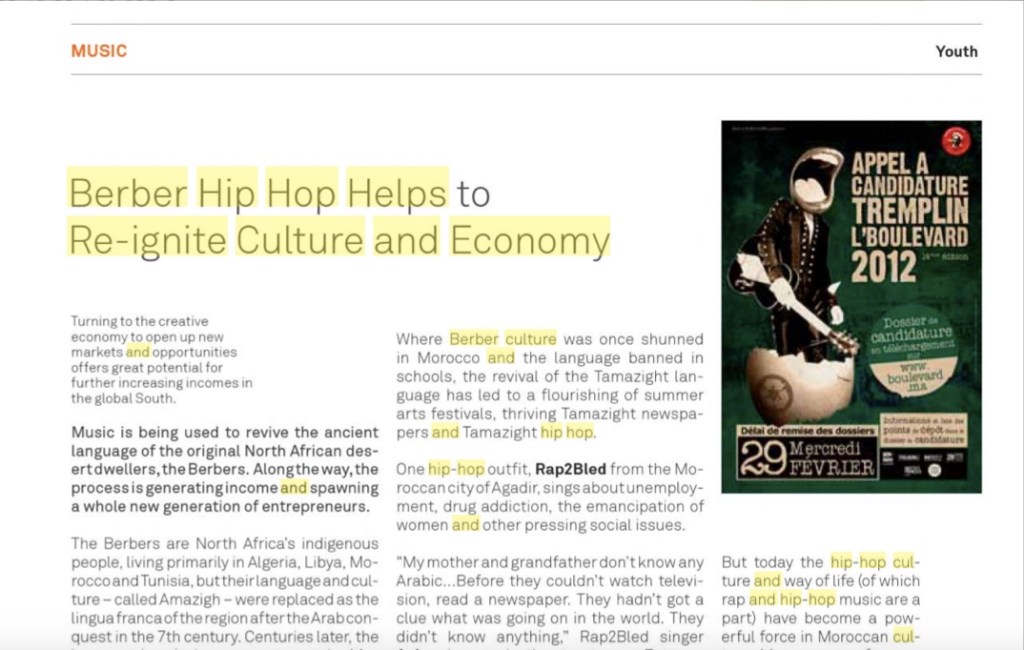
    Music is being used to revive the ancient language of the original North African desert dwellers, the Berbers (http://en.wikipedia.org/wiki/Berber_people). And in the process, it is spawning a whole new generation of entrepreneurs and generating income. 

    The Berbers are North Africa’s indigenous people, primarily living in Morocco, Algeria, Libya, and Tunisia, but their language and culture – called Amazigh – were replaced as the lingua franca of the region after the Arab conquest in the 7th century. But all these years later, the language is enjoying resurgence under Morocco’s king, Mohammed VI, who is helping to promote the language through television programming and a new law making teaching of the language compulsory in schools by 2010.

    Amazigh people – the name means “free humans” or “free men” – total more than 50 million. Their group languages, called Tamazight, are spoken by several million people across North Africa, with the largest number in Morocco.

    For young Moroccans, promoting the language is more interesting when hip hop (http://en.wikipedia.org/wiki/Hip_hop_music) is thrown into the mix. 

    Where once Berber culture was shunned in Morocco and the language banned in schools, the revival of the Tamazight language has led to a flourishing of summer arts festivals, thriving Tamazight newspapers _ and Tamazight hip hop.

    One hip-hop outfit, Rap2Bled from the Moroccan city of Agadir, stick to social issues, singing about unemployment, drug addiction and the emancipation of women.

    “My mother and grandfather don’t know any Arabic…Before they couldn’t watch television, read a newspaper. They hadn’t got a clue what was going on in the world. They didn’t know anything,” Rap2Bled singer Aziz, who goes by the street name Fatman, told to Radio Netherlands Worldwide.

    “But now there is a TV channel in our local dialect and a newspaper. But our aim is to put the language on the map by fusing it with hip hop. More than 60 per cent of young Moroccans only listen to rap and western music. So we thought why not fuse Berber with that and make it really accessible?”

    Just 10 years ago, rap and hip hop were virtually unknown in Morocco, with only a small group of hip hop aficionados listening to big American stars like Dr Dre, Tupac Shakur and Notorious BIG.

    But today hip hop culture and way of life (of which rap and hip hop music are a part) have become a powerful force in Moroccan culture. Moroccan rap focuses on local issues like unemployment and injustice and is ubiquitous on radio and TV.

    The Casa Crew, from Casablanca, has become so successful since their beginnings in 2003 that their fan base stretches to Spain and Algeria.

    “First of all, to designate rap simply as mere ‘music’ deprives it of its real impact,” Caprice from the Casa Crew (http://casa-crew-00.skyrock.com/), told the Arab Media News, Menassat. 

    “Rap is a life style, and mainly a culture of convictions. The fact that rap is spreading in countries like Morocco is an excellent sign. On the one hand, it’s proof that the youth are starting to react, to think they have the right to express themselves in any way they see fit, without anyone judging them or denying them of that right. On the other hand, the development of rap means that the space for artistic freedom is growing particularly when considering that a majority of Arab rappers are dealing with subjects that we were forbidden to speak about a few years ago.”

    The Amazigh revival industry centres around large music festivals. Timitar Festival in Agadir (http://www.moroccofestivals.co.uk/timitar.html) gets crowds surpassing 500,000, with more than 40 artists. Morocco’s biggest festival helps Amazigh artists meet world musicians and learn how to reach music fans outside of Morocco.

    Another pioneer of Morocco’s music industry is Mohamed ‘Momo’ Merhari, a young music entrepreneur and winner of the British Council’s International Young Music Entrepreneur of the Year award in 2008 (http://www.creativeconomy.org.uk/).

    Momo is a music consultant and co-founder of the “Boulevard des Jeunes Musiciens” (http://www.boulevard.ma/), the largest contemporary music festival in North Africa, featuring 50 bands over four days, and reaching a live audience of 130,000 people. The annual event showcases new talent from the worlds of hip hop, rock and jazz fusion from all over the region.

    In January, Morocco’s culture minister Touriya Jabrane promised to introduce a range of measures to financially support Moroccan musicians, composers and the industry as whole.

    Published: March 2009

    Resources

    https://davidsouthconsulting.org/2022/10/02/african-afro-beats-leads-new-music-wave-to-europe/

    https://davidsouthconsulting.org/2022/11/17/cashing-in-on-music-in-brazil/

    https://davidsouthconsulting.org/2022/12/18/disabled-congolese-musicians-become-world-hit/

    https://davidsouthconsulting.org/2021/11/09/mauritanian-music-shop-shares-songs-and-friendship/

    https://davidsouthconsulting.org/2020/12/17/mongolias-musical-entrepreneurs-led-way-out-of-crisis-2018/

    https://davidsouthconsulting.org/2023/02/07/mongolian-rock-and-pop-book-mongolia-sings-its-own-song/

    https://davidsouthconsulting.org/2021/11/09/ring-tones-and-mobile-phone-downloads-are-generating-income-for-local-musicians-in-africa/

    https://davidsouthconsulting.org/2021/11/09/taxis-promote-african-music-beats/

    https://davidsouthconsulting.org/2020/11/24/too-black/

    Development Challenges, South-South Solutions was launched as an e-newsletter in 2006 by UNDP’s South-South Cooperation Unit (now the United Nations Office for South-South Cooperation) based in New York, USA. It led on profiling the rise of the global South as an economic powerhouse and was one of the first regular publications to champion the global South’s innovators, entrepreneurs, and pioneers. It tracked the key trends that are now so profoundly reshaping how development is seen and done. This includes the rapid take-up of mobile phones and information technology in the global South (as profiled in the first issue of magazine Southern Innovator), the move to becoming a majority urban world, a growing global innovator culture, and the plethora of solutions being developed in the global South to tackle its problems and improve living conditions and boost human development. The success of the e-newsletter led to the launch of the magazine Southern Innovator. 

    Creative Commons License

    This work is licensed under a
    Creative Commons Attribution-Noncommercial-No Derivative Works 3.0 License.

    ORCID iD: https://orcid.org/0000-0001-5311-1052.

    © David South Consulting 2023

  • Building an Interactive Radio Network for Farmers in Nigeria

    Building an Interactive Radio Network for Farmers in Nigeria

    By David SouthDevelopment Challenges, South-South Solutions

    SOUTH-SOUTH CASE STUDY

    As solar power technology has improved, new pioneers have emerged to exploit this innovation. Several decades ago, solar power was seen as too expensive for wide-scale roll out in poor countries and communities. But today, an army of solar technology pioneers has fanned out across the world to show the new wave of innovations and how they make solar power affordable.

    More than 1.7 billion people around the world have no domestic electricity supply, of whom more than 500 million live in sub-Saharan Africa (World Bank). Without access to domestic electricity, these people need to fall back on expensive, battery-powered devices or use gas generators and lamps: a cost that eats into their income.  

    More than 90 percent of Nigeria’s estimated 155 million people (US Census Bureau) live on just US $2 a day. Many of them are small farmers in remote areas. Access to information is very poor, especially critical information that can improve farming methods and boost incomes.

    One of the most effective ways to communicate to a large number of people over a large territory is through radio.

    A clever use of solar-powered battery radios has enabled the building of a low-cost, two-way communications network for rural farmers. The Smallholders Farmers Rural Radio (http://smallholdersfoundation.org) network broadcasts to 250,000 listeners with 10 hours of daily programming. The communications network reaches 3.5 million farmers in around 5,000 villages in Imo State (www.imostate.gov.ng), southeast Nigeria. The programming tackles issues from sustainable farming practices to HIV/AIDS and how to open a bank account . The clever part is the two-way dialogue between the listeners and the radio station. This is done through mobile radios known as AIR devices. They are small, solar-powered radios that let listeners send voice messages to the radio station. The message is stored on the radio station’s computers and later broadcast during a programme, allowing farmers to share their experiences, ask questions and receive answers in their own language.

    The slim, hand-held silver-coloured radios have a small antenna and dials.

    The network was created by Nnaemeka Ikegwuonu, who won a 2010 Rolex Laureate award (http://young.rolexawards.com/laureates/nnaemeka_ikegwuonu). The awards seek to foster innovation in the next generation. Launched in 2009, it looks for “visionary young men and women at a critical juncture in their careers, enabling them to implement inventive ideas that tackle the world’s most pressing issues in five areas: science and health, applied technology, exploration, the environment and cultural preservation.”  

    Ikegwuonu hopes to bring the service to other parts of Nigeria.

    His radio studio is the height of simplicity and sophistication: a laptop computer, a microphone, a headset and a small control board to manage the sound levels. The radio signal is broadcast through a 30-metre-high antenna.

    Solar power is being creatively used in many countries to tackle energy poverty. This ranges from lamps and lights to cookers to small power packs for electronic devices, all the way to large hardware to power homes and communities.

    In India, whole villages are already using solar energy and improving their standard of living. Various companies and projects are selling inexpensive solar appliances – from cooking stoves to lanterns and power generators – across the country.

    A report by the International Finance Corporation called the sub-Saharan solar market the largest in the world – a market of 65 million potential customers, who could access off-grid lighting over the next five years (IFC). The report anticipated high growth rates of 40 to 50 percent for anyone entering the market, with less than one percent of the market currently being served.

    With a billion Africans using just four percent of the world’s electricity (The Economist), energy poverty is already harming further economic growth and development gains. As Africa’s population is expected to double to 2 billion by 2050, the gap between people’s needs and the power available will be stark: in Nigeria, out of 79 power stations, only 17 are working (The Economist). It will take innovators like Ikegwuonu to bring hope to this situation and transform lives despite the obstacles.

    Published: December 2011

    Resources

    1) ToughStuff has developed a modular range of affordable solar powered energy solutions to the three main power needs of poor consumers in the developing world – lighting, mobile phones and radios. Website:www.toughstuffonline.com

    2) Solar Power Answers is a one-stop-shop for everything to do with solar power. It has a design manual and guides to the complex world of solar power equipment. Website:www.solar-power-answers.co.uk/index.php

    3) How We Made It Africa: A website detailing success stories on businesses investing in Africa and how people are making the most of opportunities on the continent. Website:www.howwemadeitinafrica.com

    4) Solar Sister: A clever way to sell solar lamps and torches using a network of women. Website: www.solarsister.org

    5) D.light Design: Their lights use LEDs (light emitting diodes) (http://en.wikipedia.org/wiki/LED_lamp) and are four times brighter than a kerosene lantern according to D.Light Design. Website: www.dlightdesign.com

    6) Lighting Africa: Lighting Africa, a joint IFC and World Bank program, is helping develop commercial off-grid lighting markets in Sub-Saharan Africa as part of the World Bank Group’s wider efforts to improve access to energy. Lighting Africa is mobilizing the private sector to build sustainable markets to provide safe, affordable, and modern off-grid lighting to 2.5 million people in Africaby 2012 and to 250 million people by 2030. Website: www.lightingafrica.org

    7) A list of Nigerian companies selling solar-powered equipment and devices. Website: http://posharp.com/solar-energy-service-companies-in-nigeria-in-alphabetic-order_renewable.aspx?ptype=solar&btype=service&gtype=country_NG&xtype=ntype

    Development Challenges, South-South Solutions was launched as an e-newsletter in 2006 by UNDP’s South-South Cooperation Unit (now the United Nations Office for South-South Cooperation) based in New York, USA. It led on profiling the rise of the global South as an economic powerhouse and was one of the first regular publications to champion the global South’s innovators, entrepreneurs, and pioneers. It tracked the key trends that are now so profoundly reshaping how development is seen and done. This includes the rapid take-up of mobile phones and information technology in the global South (as profiled in the first issue of magazine Southern Innovator), the move to becoming a majority urban world, a growing global innovator culture, and the plethora of solutions being developed in the global South to tackle its problems and improve living conditions and boost human development. The success of the e-newsletter led to the launch of the magazine Southern Innovator. 

    Creative Commons License

    This work is licensed under a
    Creative Commons Attribution-Noncommercial-No Derivative Works 3.0 License.

    ORCID iD: https://orcid.org/0000-0001-5311-1052.

    © David South Consulting 2023