Tag: development challenges south-south solutions

  • Housing Innovation in South’s Urban Areas

    Housing Innovation in South’s Urban Areas

    By David SouthDevelopment Challenges, South-South Solutions

    SOUTH-SOUTH CASE STUDY

    As urban populations around the South increase, the quality of city housing will be critical to the quality of life and sustainability of improvements to living standards.

    Living in crowded and chaotic urban and semi-urban areas does not have to mean suffering poor quality housing. A variety of Southern architects are showing how new perspectives on common problems like cramped spaces, traffic noise, minimal green spaces and tight budgets can be addressed with clever thinking and new concepts.

    The bustling and crowded Brazilian city of Sao Paulo has evolved in a chaotic fashion over the years. As Brazilian photographer Reinaldo Coser admitted to design and architecture magazine Dwell (www.dwell.com) , in many places it is “very ugly.”

    Sao Paulo suffers from the downside of rapid urban and semi-urban development familiar to cities across the South: traffic gridlock, pollution, noise. It’s a toxic combination of factors that turns even simple tasks like buying groceries into depressingly long, stressful ordeals.

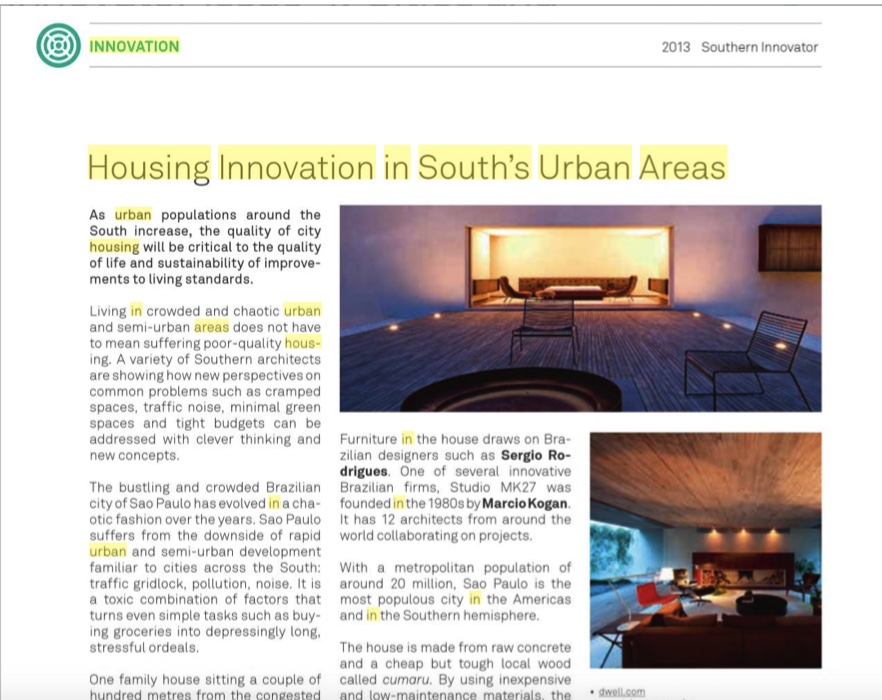
    Coser’s family home sits a couple hundred metres from the congested Avenida Brigadeiro Faria Lima (http://en.wikipedia.org/wiki/Avenida_Brigadeiro_Faria_Lima) , the city’s unofficial main street. Yet the dwelling has been cleverly designed to make living in the centre of this modern urban hurly burly a peaceful and calming oasis. Designed by Brazilian architects Studio MK27 (http://www.marciokogan.com.br) – and in keeping with the rich Brazilian modernist tradition pioneered by Oscar Niemeyer in the country’s capital, Brasilia (http://en.wikipedia.org/wiki/Bras%C3%ADlia) – the home uses clever techniques to build calm into chaos.

    The front and back gardens are level with the living room, creating an enormous living space that seamlessly flows from indoor to outdoor space. By using a large overhang over the gardens, even on rainy days the home can be lived in almost without walls.

    Furniture in the home draws on Brazilian designers like Sergio Rodrigues (http://www.sergiorodrigues.com.br).

    One of several innovative Brazilian firms, Studio MK27 was founded in the 1980s by Marcio Kogan. It has 12 architects from around the world collaborating on projects.

    With a metropolitan population of around 20 million, Sao Paulo (http://en.wikipedia.org/wiki/S%C3%A3o_Paulo) is the most populous city in the Americas, and in the Southern hemisphere.

    While it is easy to point out the downsides of rapid and chaotic urban development, Coser, a professional photographer, lives and loves Sao Paulo nonetheless because, like so many cities across the South, it is a vibrant and dynamic place to be.

    And by choosing a design for his home that is calming, he has been able to introduce balance into his family’s life while benefiting from the economic opportunities of the city.

    “This house has actually changed the rhythm of our lives,” he told Dwell. “We eat at home more. We go to bed earlier. We wake up earlier. We sleep more.”

    And how has the calm helped his two daughters? One is able to play without disturbing the neighbours, and the other can quietly study her books, which was difficult when the family lived in the noise and buzz of a small two-bedroom apartment.

    And – something often overlooked in development plans cooked up by economists and urban planners – the aesthetics of the house are very appealing. “Our house is so pretty,” says his wife, Sophia. “Sometimes I like to just look at it for a long time.”

    This calm home was created out of basic need. The family needed more space with a second daughter on the way, and had become frustrated with the congestion of the city and the lack of green space. Architect Marcio Kogan was consulted for a solution.

    “We wanted a place where we could just shut the door and travel,” says Reinaldo.

    The house is made from raw concrete and a cheap-but-tough local wood called cumaru (http://tinyurl.com/3y8kh8v) . By using inexpensive and low maintenance materials, the home is able to weather the environmental stresses of a polluted, tropical city with harsh sunshine.

    Kogan deployed his previous experience as a filmmaker to make the home feel and look more spacious and open than it is. He calls it “looking at the world through a wide-screen lens.” The design of the home is seen as a “narrative”, leading the occupant from the garden to the living room, up the stairs, past bedrooms to a rooftop deck with panoramic views of the city.

    Another innovative solution in Sao Paulo is USINA (http://www.usinactah.org.br) – a finalist for the World Habitat Awards (http://www.worldhabitatawards.org/about/?lang=00) – which brings people together to build high-density urban housing. It has aided more than 5,000 people to build with their own labour multi-storey buildings. These new apartments are not isolated from other services, but come with community facilities, childcare facilities, professional training courses and other employment-generating activities.

    It is estimated up to 15 percent of the city’s population live in slums. This community organising approach is in contrast to the existing ad-hoc building of homes in the slums – often with no technical assistance – or public housing projects built by developers looking for quick profits while ignoring quality and services. USINA’s approach has led to Sao Paulo being a pioneer in participatory housing policies.

    USINA provides the technical assistance to social movements looking to build housing for the poor. The cost for the buildings is borne by a combination of public funding and the labour of the residents (working 16 hours per week per household). The cost per housing unit tends to be between US $12,000 and US $15,000 (with land usually donated free by public authorities).

    Architectural innovation is also underway in Indonesia, another country that has experienced spurts of rapid economic growth and urbanization, and where a growing middle class is demanding a higher quality of life.

    The country’s capital, Jakarta (http://en.wikipedia.org/wiki/Jakarta) , with a population over 8 million, is a mixed bag of modern skyscrapers, crumbling colonial architecture, suburbs and slums.

    In the Jakarta suburb of Bekasi (population more than 2 million), Nugrohu Wisnu was looking for a little more space for his family.

    At first, the family encountered the downside of poorly designed housing. They bought a house which was infested with termites and was uncomfortable to live in. Frustrated, they began shopping around for something better. And they turned to Indonesian architects Djuhara + Djuhara (http://djuhara.com/home.html).

    “We thought that an all-steel house like the one that Mr. Djuhara had built just down the road would be termite resistant,” Wisnu told Dwell.

    Djuhara is a high-profile architect and chair of the Jakarta chapter of the Indonesian Institute of Architects (http://www.iai.or.id) and helped to modernize the city’s planning regulations.

    The stereotype of young Indonesian architects is that they only work on luxury hotels. But Djuhara was designing and building suburban homes and this grabbed Wisnu’s attention.

    Also against stereotype, Djuhara was actually attracted by a tight budget and the small space for the house. In a crowded city, using every bit of space efficiently is critical. The existing house was torn down and Djuhara set about building a new home. The majority of the building materials were sourced within the immediate area: an easy thing to do in Jakarta since there are many vendors selling building supplies on the streets.

    By buying local like this, shipping costs were eliminated from the cost of the house. The home’s cost, US $20,000, is just 2/3 of what a more conventional Indonesian home would cost.

    Djuhara revelled in the job: “Ad-hocism is my religion,” he told Dwell.

    The split-level design of the home uses the space well. The kitchen opens up into the garden.

    “Family breakfasts are great in here,” says Wisnu. “And the open kitchen encourages the kids to head out into the garden and run and play.”

    There is also a strong environmental component to the design. Airflow cavities in the ceiling are used in the bedrooms to cool them. The house also uses heavy wooden shutters to keep the house cool during the day: “The shutters are unusual, but they are thick and sturdy,” Wisnu explains.

    “They really shade the master bedroom to the extent that it feels mellow and cool. They let us reduce our air-conditioning consumption, even during the height of the day.”

    And Djuhara also has another difference from many other architects: he refuses to patent his design.

    “My friends have asked me why I don’t patent my low-cost houses,” he explains, “but they completely miss the point. I actually want my designs to be copied. I want Indonesian society to rethink its attitudes towards urban architecture.”

    Published: June 2010

    Resources

    https://davidsouthconsulting.org/2021/10/21/cities-for-all-shows-how-the-worlds-poor-are-building-ties-across-the-global-south/

    https://davidsouthconsulting.org/2022/05/23/debt-free-homes-for-the-poor/

    https://davidsouthconsulting.org/2021/11/11/decent-and-affordable-housing-for-the-poor/

    https://davidsouthconsulting.org/2021/11/11/housing-solution-for-worlds-growing-urban-population/

    https://davidsouthconsulting.org/2020/12/14/innovation-in-growing-cities-to-prevent-social-exclusion/

    https://davidsouthconsulting.org/2021/10/22/lima-to-delhi-what-can-be-learned-on-urban-resilience/

    https://davidsouthconsulting.org/2022/11/19/securing-land-rights-for-the-poor-now-reaping-rewards/

    https://davidsouthconsulting.org/2017/11/08/smart-cities-up-close-2013/

    https://davidsouthconsulting.org/2022/05/23/solar-bottle-bulbs-light-up-dark-homes/

    https://davidsouthconsulting.org/2021/10/22/south-south-cooperation-for-cities-in-asia/

    https://davidsouthconsulting.org/2021/03/05/southern-innovator-issue-4/

    https://davidsouthconsulting.org/2021/03/12/southern-innovator-magazine/

    https://davidsouthconsulting.org/2022/11/17/tiny-homes-to-meet-global-housing-crisis/

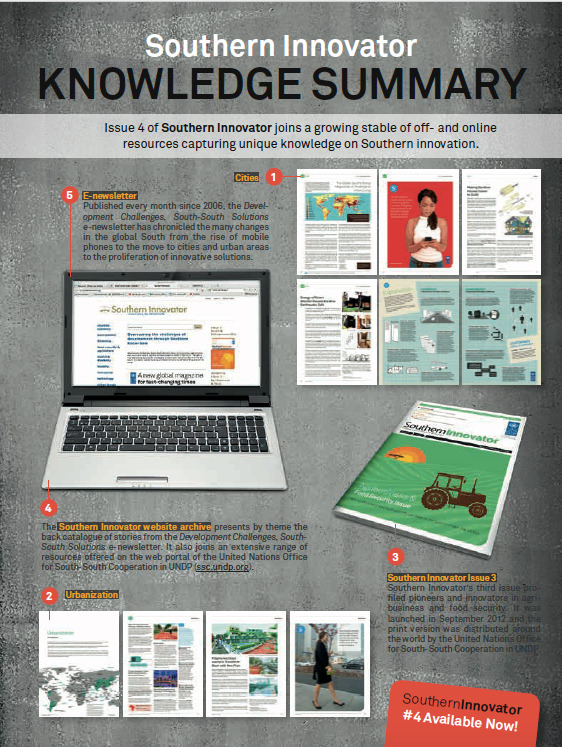
    Development Challenges, South-South Solutions was launched as an e-newsletter in 2006 by UNDP’s South-South Cooperation Unit (now the United Nations Office for South-South Cooperation) based in New York, USA. It led on profiling the rise of the global South as an economic powerhouse and was one of the first regular publications to champion the global South’s innovators, entrepreneurs, and pioneers. It tracked the key trends that are now so profoundly reshaping how development is seen and done. This includes the rapid take-up of mobile phones and information technology in the global South (as profiled in the first issue of magazine Southern Innovator), the move to becoming a majority urban world, a growing global innovator culture, and the plethora of solutions being developed in the global South to tackle its problems and improve living conditions and boost human development. The success of the e-newsletter led to the launch of the magazine Southern Innovator. 

    Creative Commons License

    This work is licensed under a
    Creative Commons Attribution-Noncommercial-No Derivative Works 3.0 License.

    ORCID iD: https://orcid.org/0000-0001-5311-1052.

    © David South Consulting 2023

  • Favela Fashion Brings Women Work

    Favela Fashion Brings Women Work

    By David SouthDevelopment Challenges, South-South Solutions

    SOUTH-SOUTH CASE STUDY

    A highly successful cooperative of women in Brazil has shown that it is possible for outsiders to make it in the fast-paced world of fashion. Despite being based in one of Rio de Janerio’s slums, or favelas (http://en.wikipedia.org/wiki/Favela), the women have developed a reputation for high-quality merchandise and even put on fashion shows.

    Fashion earns big money around the world: The global clothing industry is estimated to be worth more than US $900 billion a year. But fashion also has a reputation for relying on sweat shops, poor pay and poor working conditions. The poor are the most at risk of exploitation in the industry – upwards of 90 percent of sweatshop workers are women (www.feminist.org).

    Yet the COOPA-ROCA cooperative (www.coopa-roca.org.br/en/index_en.html) – or Rocinha Seamstress and Craftwork Co-operative Ltd – has pioneered a way to involve poor women in the business, build their skills while creating high-quality products, and be flexible enough to make time for their families’ needs. It particularly helps single mothers.

    The cooperative was founded by Maria Teresa Leal in Rocinha – the largest favela in Rio, home to over 180,000 people. After visiting her housekeeper’s home in the favela, Leal was impressed by the sewing skills of the women but found they weren’t making any money from their work. She decided to found the cooperative in 1981 and start making quilts and pillows. By the early 1990s, the cooperative had attracted the attention of Rio’s fashion scene. And in 1994, it jumped into making clothes for the fashion catwalks. Fashion designers in turn taught the women advanced production skills and about fashion trends.

    Today, the coop has established a hard-won reputation for quality and sells its clothes to the wealthy elite of Rio. Its success has led to contracts with major clothing stores, including Europe’s C&A.

    “Creativity is an important tool for transforming people and raising their consciousness,” Leal told Vital Voice. “My great passion is beauty. Beauty has the capacity to inspire, to touch individuals in a more subtle way. For this reason, I like to make beautiful things with the artisans of COOPA-ROCA.”

    Leal realized that most small businesses helping the poor fail despite their best intentions. They often make the same mistakes: they fail to produce high quality goods, they fail to do market research and understand who they are selling to, they fail to develop the skills of their workers, and most importantly, they fail to see that they have to compete in a global economy with lots of other enterprises. How many people have seen crafts and knickknacks for sale that nobody really wants?

    Slum dwellers are on the increase across the South. As the world becomes a more urban place – and 70 million people move every year to the world’s cities (UN) – the growing population of poor women and households presents a dilemma: how to provide meaningful work so they do not fall risk to exploitation? Without work opportunities, women can feel pressured to turn to prostitution, or even be trafficked by gangs for work or sex. And women in slums experience greater levels of unemployment than those who live elsewhere (UNHABITAT).

    Women now make up the majority of the world’s poor: 70 percent of the world’s poor are women, as are a majority of the 1.5 billion living on less than US $1 a day (UNESCO).

    Established in 1981 from a recycling project for local children, COOPA-ROCA started with finding ways to use thrown away scraps of cloth to make clothing. It eventually evolved into a cooperative. It focused on improving traditional Brazilian decorative craftwork skills like drawstring appliqué, crochet, knot work and patchwork.

    “COOPA-ROCA works with traditional handicraft techniques that are widely used by women around the world,” explains Leal. “As COOPA-ROCA works with fashion, and fashion is always linked with media, the COOPA-ROCA artisans inspire other women who recognize in themselves the potential to do the kind of work that COOPA-ROCA does.”

    For its first five years, COOPA-ROCA concentrated on building the organization and the skills of the artisans. Once a production structure was in place, quality control workshops were set up to increase the quality of the products so they could compete better in the marketplace.

    “Many social projects believe that money is the only resource required to begin their work. The COOPA-ROCA case proves that social organizations must use a more entrepreneurial vision to understand the concept of resources.”

    The cooperative’s mission statement is to “provide conditions for its members, female residents of Rocinha, to work from home and thereby contribute to their family budget, without having to neglect their childcare and domestic duties.”

    By doing this to a high standard, the profile and reputation of traditional crafts has been raised.

    The COOPA-ROCA hopes the work shows others how they can increase income in poor communities. The cooperative has 150 members and has partners in the wider fashion and decorative design markets.

    The women equally share responsibility for production, administration and publicity. While they work at home, they come to the office to drop off the completed pieces and pick up more fabric.

    The success of the cooperative has led to donations of funds to build a new headquarters designed by architect Joao Mauricio Pegorim.

    Despite the cooperative’s success, it is still not easy to work with partners. “There are many negative preconceptions about Rocinha and the people who live there, both within and outside of Brazil. COOPA-ROCA is consistently rejected when it applies for loans,” Leal said. “Furthermore, the cooperative’s commercial partners usually do not enter the favela themselves, and I must serve as a bridge between the two worlds.”

    But Leal is still ambitious for bigger things: “I envision COOPA-ROCA expanding to include 400 women artisans, producing for commercial partners, selling their own brand in Brazil and abroad, and carrying out fashion and design projects in the new headquarters in Rocinha.”

    Published: March 2010

    Resources

    1) The online service CafePress is a specially designed one-stop shop that lets entrepreneurs upload their designs, and then sell them via their online payment and worldwide shipping service. Website:http://www.cafepress.com/cp/info/sell/

    2) Tips on how to start your own t-shirt business. Website: http://www.pioneerthinking.com/dy_tshirt.html And how to do it online: Website:http://www.ehow.com/how_2135779_start-network-online-tshirt-company.html

    3) Once inspired to get into the global fashion business, check out this business website for all the latest news, jobs and events. Website:http://us.fashionmag.com/news/index.php

    4) iFashion: This web portal run from South Africa has all the latest business news on fashion in Africa and profiles of up-and-coming designers. Website:http://www.ifashion.co.za/index.php?option=com_frontpage&Itemid=1

    5) Kiva: Kiva’s mission is to connect people, through lending, for the sake of alleviating poverty. Website:http://www.kiva.org/

    6) Betterplace: Is another great way to solicit funds for NGOs or businesses in the developing world. Website: http://www.betterplace.org

    7) Viva Favela: The first Internet portal in Brazil. Viva Favela has a team made up of journalists and “community correspondents” – favela residents qualified to act as reporters and photographers. Website:http://www.vivafavela.com.br/publique/cgi/cgilua.exe/sys/start.htm?infoid=40489&sid=74

    8) Women in Poverty: A New Global Underclass by Mayra Buvinic (1998). Website: http://www.onlinewomeninpolitics.org/beijing12/womeninpoverty.pdf

    Development Challenges, South-South Solutions was launched as an e-newsletter in 2006 by UNDP’s South-South Cooperation Unit (now the United Nations Office for South-South Cooperation) based in New York, USA. It led on profiling the rise of the global South as an economic powerhouse and was one of the first regular publications to champion the global South’s innovators, entrepreneurs, and pioneers. It tracked the key trends that are now so profoundly reshaping how development is seen and done. This includes the rapid take-up of mobile phones and information technology in the global South (as profiled in the first issue of magazine Southern Innovator), the move to becoming a majority urban world, a growing global innovator culture, and the plethora of solutions being developed in the global South to tackle its problems and improve living conditions and boost human development. The success of the e-newsletter led to the launch of the magazine Southern Innovator. 

    Creative Commons License

    This work is licensed under a
    Creative Commons Attribution-Noncommercial-No Derivative Works 3.0 License.

    ORCID iD: https://orcid.org/0000-0001-5311-1052.

    © David South Consulting 2023

  • Brazil’s Agricultural Success Teaches South How to Grow

    Brazil’s Agricultural Success Teaches South How to Grow

    By David SouthDevelopment Challenges, South-South Solutions

    SOUTH-SOUTH CASE STUDY

    Inflation, environmental stresses and population and economic growth are testing the world’s food supply systems. There is a strong need to boost yields and improve the quality of food.

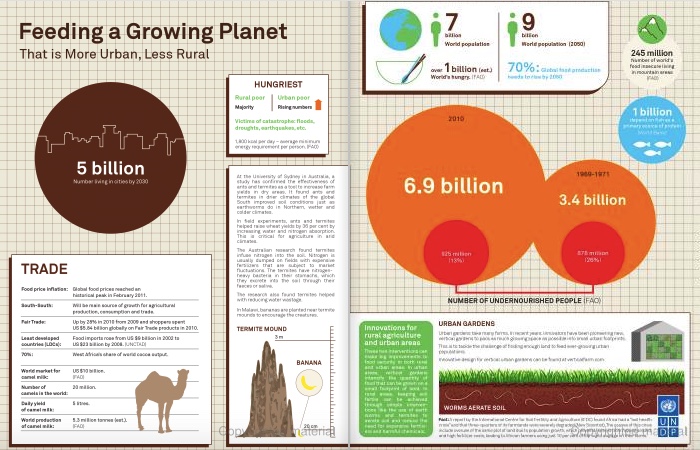
    Between now and 2050 the world’s population will rise from 7 billion to 9 billion. Urban populations will probably double and incomes will rise. City dwellers tend to eat more meat and this will boost demand.

    The UN’s Food and Agriculture Organization (FAO) reckons grain output will have to rise by around half but meat output will have to double by 2050 to meet demand.

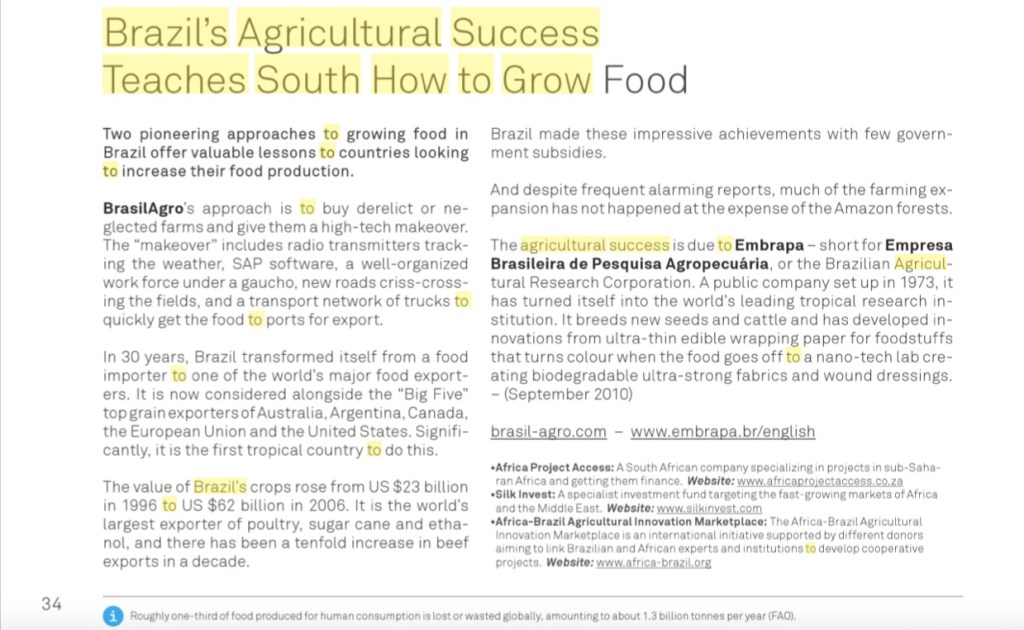
    Two pioneering approaches to growing food in Brazil offer valuable lessons to countries looking to increase their food production.

    One is taking place in Bahia state in north-eastern Brazil. On Brazil’s cerrado (savannah) (http://en.wikipedia.org/wiki/Cerrado), enormous farms grow cotton, soybeans and maize. One of them, Jatoba farm, has 24,000 hectares of land: vastly larger than comparable farms in the United States.

    On the Cremaq farm in the north of the country in Piaui state, a transformation has taken place. Once a failed cashew farm, it is now a highly modern operation. Owned by BrasilAgro, it is benefiting from clever agricultural innovation that gets results.

    BrasilAgro’s approach is to buy derelict or neglected farms and give them a high-tech makeover. The ‘makeover’ includes radio transmitters tracking the weather, SAP software (http://en.wikipedia.org/wiki/SAP_AG), a well-organized work force under a gaucho (http://en.wikipedia.org/wiki/Gaucho), new roads criss-crossing the fields, and a transport network of trucks to quickly get the food to ports for export. Piaui is an isolated place with few services: it can take half a day to get to a health clinic. Dependence on state welfare payments for survival is the norm for many residents.

    Brazil, over 30 years, transformed itself from a food importer to one of the world’s major food exporters. It is now considered alongside the ‘Big Five’ top grain exporters of America, Canada, Australia, Argentina and the European Union. Importantly, it is the first tropical nation to do this.

    The value of Brazil’s crops rose from US $23 billion in 1996, to US $62 bn in 2006. It is the world’s largest exporter of poultry, sugar cane and ethanol, and there has been a tenfold increase in beef exports in a decade.

    Brazil made these impressive achievements with few government subsidies. According to the Organization for Economic Co-operation and Development (OECD), state support accounted for just 5.7 percent of total farm income in Brazil from 2005-07. In the US it was 12 percent, while the OECD average is 26 percent and the level in the European Union is 29 percent.

    And despite frequent alarming reports, much of the farming expansion has not happened at the expense of the Amazon forests.

    The agricultural success is down to Embrapa (http://www.embrapa.br/english) – short for Empresa Brasileira de Pesquisa Agropecuária, or the Brazilian Agricultural Research Corporation. A public company set up in 1973, it has turned itself into the world’s leading tropical research institution. It breeds new seeds and cattle and has developed innovations from ultra-thin edible wrapping paper for foodstuffs that turns colour when the food goes off to a nano-tech lab creating biodegradable ultra-strong fabrics and wound dressings.

    Its biggest achievement has been turning the vast expanses of the cerrado green for agriculture. Norman Borlaug, an American plant scientist often called the father of the Green Revolution, told the New York Times that “nobody thought these soils were ever going to be productive.” They seemed too acidic and too poor in nutrients.

    Embrapa uses what its scientists call a “system approach”: all the interventions work together. Improving the soil and developing new tropical soybeans were both needed for farming the cerrado. The two together also made possible the changes in farm techniques which have boosted yields further.

    Many believe this approach can be applied to Africa as well. There are several reasons to think it can. Brazilian land is like Africa’s: tropical and nutrient-poor. The big difference is that the cerrado gets a decent amount of rain and most of Africa’s savannah does not (the exception is the swathe of southern Africa between Angola and Mozambique).

    Another approach that Brazil has been pioneering is making small, family farms sustainable and productive for the 21st century.

    There has long been a tension between those who believe in very large farms, agribusiness and mono-crops (http://en.wikipedia.org/wiki/Mono-cropping), and those who believe in having a large number of smaller farms with a wide variety of crops and animals.

    But small farms have endured. The livelihoods of more than 2 billion people depend on the 450 million smallholder farms across the world. With their families, they account for a third of the world’s population.

    Family farms are critical to weathering economic crises and ensuring a steady and secure food supply. The International Fund for Agricultural Development (IFAD) (www.ifad.org)called in 2008 for small family farms to be put at the heart of the global response to high food prices and uncertain food security.

    In Brazil, this call is being answered by a bold initiative to create what is termed a “social technology”, combining a house building programme with diverse family farms.

    The Brazilian farmers’ cooperative Cooperhaf: Cooperativa de Habitacao dos Agricultores Familiares (http://www.cooperhaf.org.br) – a World Habitat Awards winner – combines housing and farm diversification to support family farmers.

    “Family farming is very important for the country – 70 percent of food for Brazilians comes from family farming,” said Adriana Paola Paredes Penafiel, a projects adviser with the Cooperhaf. “The government wants to keep people in rural areas.”

    “We see the house as the core issue,” she continued.  “The farmers can improve their productivity but the starting point is the house.”

    Started in 2001 by a federation of farmers unions, the Cooperhaf works in 14 Brazilian states with family farmers. In Brazil farmers have a right to a house in the law and the cooperative was formed to make sure this happened.

    “We promote diversification to make farmers less vulnerable: if they lose a crop in macro farming, they lose everything. We encourage diversification and self-consumption to guarantee the family has food everyday. We help to set up a garden.”

    The concept is simple: a good quality home acts as an anchor to the family farm, making them more productive as farmers. The farmers receive up to 6,000 reais (US $2,290) for a house, and can choose designs from a portfolio of options from the Cooperhaf.

    As in other countries, the Cooperhaf and other co-ops encourage markets and certification programmes to promote family farmed food and raise awareness. Penafiel says promoting the fact that the food is family farmed is critical: to the consumer it is healthier, fresher and contains fewer chemicals than imported produce.

    “Most agri business is for export,” said Penafiel. “If we don’t have food in the country, food for poor communities would not be available. This enables farmers to be more autonomous, not having to buy fertilizers and equipment and take on too much debt. That approach is not sustainable as we saw with the so-called Green Revolution.”

    Published: September 2010

    Resources

    • Africa Project Access: A South African company specializing in projects in sub-Saharan Africa and getting them finance. Website:http://www.africaprojectaccess.co.za/
    • Silk Invest: A specialist investment fund targeting the fast-growing markets of Africa and the Middle East. Website:http://www.silkinvest.com/
    • Olam: A global food supply company in ‘agri-products’ that got its start in Nigeria  and shows how a Southern brand can grow and go global and overcome the difficulties of cross-border trade. Website: www.olamonline.com

    Development Challenges, South-South Solutions was launched as an e-newsletter in 2006 by UNDP’s South-South Cooperation Unit (now the United Nations Office for South-South Cooperation) based in New York, USA. It led on profiling the rise of the global South as an economic powerhouse and was one of the first regular publications to champion the global South’s innovators, entrepreneurs, and pioneers. It tracked the key trends that are now so profoundly reshaping how development is seen and done. This includes the rapid take-up of mobile phones and information technology in the global South (as profiled in the first issue of magazine Southern Innovator), the move to becoming a majority urban world, a growing global innovator culture, and the plethora of solutions being developed in the global South to tackle its problems and improve living conditions and boost human development. The success of the e-newsletter led to the launch of the magazine Southern Innovator. 

    Creative Commons License

    This work is licensed under a
    Creative Commons Attribution-Noncommercial-No Derivative Works 3.0 License.

    ORCID iD: https://orcid.org/0000-0001-5311-1052.

    © David South Consulting 2022

  • Palestinian Olive Oil’s Peaceful Prosperity

    Palestinian Olive Oil’s Peaceful Prosperity

    By David SouthDevelopment Challenges, South-South Solutions

    SOUTH-SOUTH CASE STUDY

    The economic devastation of the conflict between Israel and the Palestinians (http://en.wikipedia.org/wiki/Palestine) has brought much hardship to the Palestinian people. The United Nations under the UNRWA mission has been working to lesson the hardship for over 60 years (http://www.unrwa.org). But there is only so much it can do.

    However, several business initiatives are creating strong Palestinian food brands to improve the reputation and awareness of Palestine around the world. In particular, Palestinian olive oil has led the way and enjoyed strong sales in countries like the United Kingdom.

    Since 2004, the Palestine Fair Trade Association (PFTA) (http://www.palestinefairtrade.org) has been leading the movement of fair trade producers in Palestine, linking small Palestinian farms in fair trade collectives and cooperatives across the country.

    Zatoun (http://www.zatoun.com) – or Zaytoun (http://www.zaytoun.org) as its known in the UK – are olive oil and soap brands using the Arabic word for olive. Olive oil (http://en.wikipedia.org/wiki/Olive_oil) is a popular cooking and seasoning oil and is sought after for its health benefits. Most of it is cultivated in the Mediterranean region, with Spain the largest single producer. Like wine, the quality of the olive oil varies greatly and the bouquet and viscosity of the oil play a big role in how consumers select a brand. The trend in the past 10 years has been for consumers to be more selective about the olive oil they buy and to be more informed about the choices available. This increasingly sophisticated consumer choice is what is helping the Palestinian oil succeed.

    Another factor is the growing global popularity of the traditional Mediterranean diet. Research has linked it to the prevention of cancers, obesity and cardiovascular diseases, and an aid to food digestion. Olive oil and olives make up one of the six key groups of foods that are part of the Mediterranean Diet. The other elements are grains, fruits and vegetables, legumes and nuts, dairy products and fish.

    The Zatoun brand of olive oil uses its profits to help olive tree farmers and their families in Palestine.

    The brand is also hoping to alter public perceptions of Palestine. As its website states, “Zatoun helps to create a context based in ordinary everyday life to view and discuss the situation in Palestine-Israel. No longer is it an abstract geopolitical issue involving power elites and undefined national interest.”

    The Zatoun brand is led in Canada by Robert Massoud, winner of the 2004 YMCA Peace Medallion. Zatoun is sold in Canada through peace groups and social justice and faith groups and is “intended as a tool to help promote their work and bring home the message that the struggle of Palestinians is ultimately one of human rights and social justice.”

    The olive oil is certified fair trade under the Institute for Marketecology (IMO) (http://www.imo.ch/index.php?seite=imo_index_en) in Switzerland. The brand is operated as a not-for-profit with volunteer labour and the entire cost of the product goes to the farmers, customs and shipping costs, and promotion and administration. Each 750mL bottle sells from between CAD $15 (US $14) and CAD $17.50 (US $17.22) and each bar of soap is CAD $5.00 (US $4.90).

    In the U.K., the Zaytoun brand was started by British women Heather Masoud and Cathi Pawson, also in 2004. The Palestinian olive oil has benefited from sales promotion during the United Kingdom’s annual Fair Trade Fortnight: a highly publicized promotion over two weeks that has consistently raised the profile of all Fair Trade products. Palestinian products were profiled during the 2009 event.

    The Zaytoun brand is certified with the World Fair Trade Organization (www.wfto.com) and has been able to break through to sales in British supermarkets as a result. Having this certification is key to being accepted for display on the supermarket shelves. By being certified, the farmers are able to get guaranteed above market prices for their olives. This makes it easier to plan and invest in the farm and the community and avoid the wild fluctuations of market prices. It is common around the world for farmers to be bankrupted and impoverished when market prices crash and fall below the cost of growing and harvesting the product.

    “We have been working for the Fair Trade certificate for four years,” Nasser Abufarha, chairman of the Palestinian Fair Trade Association told the Guardian newspaper. “Fair Trade will increase our sales, and bring us new markets and widen our reach.

    “We have given farmers hope,” he said. “An economic exchange that recognises Palestinian farmers’ rights and respects the value of their connection to their land, after marginalization under Israeli occupation, is a major accomplishment.”

    Olives are Palestine’s biggest crop, and critical to the local economy. The industry employs more than 100,000 people and its economic health affects many more. But the ongoing conflict has harmed the olive industry in many ways, from the bulldozing of orchards to make way for the Israeli security fence – over 1,100 hectares olive orchards were cut off by the fence in the West Bank village of Anin alone – to clearing fields for the building of new settlements.

    For some of the farms, fair trade has meant access to outside markets they haven’t had for 40 years.

    The Palestinian olive oil is in a market with fierce competition. In the UK, the oil can retail for £14.49 (US $23) a litre, while some Italian olive oils can be had for just US $9. But the Palestinian olive oil has a number of advantages in the marketplace: consumers have shown a willingness to pay the premium to support the farmers and Palestine, and most importantly in the competitive world of food sales, food connoisseurs rave about it. Food and wine writer Malcom Gluck called Zaytoun olive oil “one of the aggressive yet pungently attractive olive oils I have tasted”. He believes it easily ranks alongside the best Sicilian, Cretan and northern Spanish oils.

    Another Palestinian company having success with the olive products is the Anabtawi Group (http://www.anabtawigroup.com/index.php?a=1&lid=3&lid1=24). Based in Nablus in the West Bank, it started in 2008 the Al-Ard Palestinian Agri-Products Company and sells Al-Ard extra virgin olive oil, virgin olive oil and an olive oil soap. Operating on a large scale, the group has the largest olive oil storage facility in Palestine and provides training and support to the farmers. It also undertakes marketing of the products in new markets including Latin America.

    Ziad Anabtawi, the company’s president and CEO, told the Brazil-Arab News Agency “Palestinian olive oil is known worldwide for its high quality and its very striking aroma. It is ‘premium’ and organic by nature. Farmers grow the product the traditional way. They do not irrigate the olive trees, [irrigation] comes from rainwater and we do not use any chemicals.”

    The Palestinian experience shows it is possible to create new economic opportunities for farmers under even the most arduous political and security conditions.

    Published: October 2010

    Resources

    Development Challenges, South-South Solutions was launched as an e-newsletter in 2006 by UNDP’s South-South Cooperation Unit (now the United Nations Office for South-South Cooperation) based in New York, USA. It led on profiling the rise of the global South as an economic powerhouse and was one of the first regular publications to champion the global South’s innovators, entrepreneurs, and pioneers. It tracked the key trends that are now so profoundly reshaping how development is seen and done. This includes the rapid take-up of mobile phones and information technology in the global South (as profiled in the first issue of magazine Southern Innovator), the move to becoming a majority urban world, a growing global innovator culture, and the plethora of solutions being developed in the global South to tackle its problems and improve living conditions and boost human development. The success of the e-newsletter led to the launch of the magazine Southern Innovator. 

    https://davidsouthconsulting.org/2021/03/05/southern-innovator-issue-3/

    Creative Commons License

    This work is licensed under a
    Creative Commons Attribution-Noncommercial-No Derivative Works 3.0 License.

    ORCID iD: https://orcid.org/0000-0001-5311-1052.

    © David South Consulting 2022