Tag: development challenges south-south solutions

  • Fashion Recycling: How Southern Designers are Re-using and Making Money

    Fashion Recycling: How Southern Designers are Re-using and Making Money

    By David SouthDevelopment Challenges, South-South Solutions

    SOUTH-SOUTH CASE STUDY

    With the rising awareness of the importance of doing fashion in an ethical and sustainable way, more and more fashion designers in the South are getting very creative. Fashion earns big money around the world: The global clothing industry is estimated to be worth US $900 billion a year.

    In Paris, the Ethical Fashion Show, now in its fifth year, showcases fashion that respects people and the environment while still being glamorous, luxurious and trendy. It has attracted designers from around the world, including Mongolia, Thailand, China, Peru and Bolivia. The show demands that all participants adhere to International Labour Organization conventions – including banning forced and child labour – respect for the environment, creating local employment and working with craftspeople to ensure skills are retained and the fashion reflects the diversity of the world’s cultures.

    In Abidjan, Ivory Coast, Felicite Mai is using pride in her nation’s top export commodity, cocoa (Ivory Coast is the world’s number one exporter of cocoa), to make smart fashion wear at affordable prices. She has turned the beige-coloured jute sacks used to ship cocoa beans around the world into clothes for men and women.

    “Ivory Coast’s economy is based on agriculture, especially cocoa and coffee. So I decided to promote these crops by creating these fashion designs,” Mai, whose real name is Maimouna Camara Gomet, told the Reuters news agency.

    “For me, it’s a way of drawing the whole world’s attention to cocoa and coffee,” she said

    Mai comes from a family of cocoa planters and is a graduate of a sewing school. She works out of a studio-cum-shop in the Treichville suburb of Abidjan.

    The clothes are usually beige, but some are dyed dark brown or blue. They include skirts, tops, trousers, shirts, waistcoats, caps, bags and accessories; she gets the sacks – most emblazoned with “Product of Ivory Coast, Cocoa” — from the city’s port warehouses. She cleans the jute cloth first, before creating the fashions.

    “I had this idea from when I was still at sewing school in 1987. Then I opened my own workshop in 1996 and I first launched these kind of designs in 2003 during a fashion contest at Divo (in the south of Ivory Coast)” said Mai, who has several assistants at her shop.

    She has been able to attract as clients local celebrities, artists and musicians and even a few from abroad.

    In Brazil, it is footwear that is getting the recycled-look treatment. The brand Melissa specializes in plastic shoes that are eco-friendly and made from 100 percent recycled materials. They use a plastic called melflex made from recovered plastic. The shoes are made in injection molds and the factory is so efficient, it has next to no waste as a byproduct. It recycles all the waste and water used in the production process. And as a plus, they make a point of paying the workers well, and supporting social and environmental causes in Brazil.

    Their secret to putting zing into recycled plastic shoes is to have high-profile, celebrity designers design some of the shoes. So far, they have had UK fashion mistress Vivienne Westwood, the Campana Brothers, and the UK-based, Iraqi-born architect Zaha Hadid. Hadid is a controversial figure who always stirs up debate, and her rubber shoes have brought attention to the brand.

    The Chilean studio Modulab has turned to recycled rubber from the car industry to make bags. The rubber comes in sheets so it is easy to cut and shape into bags, thus reducing the amount of time and energy used to make the bags. The line is called RTA (ready to assemble) and includes three types of bags: an envelope, a handbag and a messenger bag. Each sheet of recycled rubber comes with the specific slots and pins for the consumer to put the bag together at home, without any glue or sewing involved. Energy used in the making of the entire bag is 100 percent human, except in the production of the material itself.

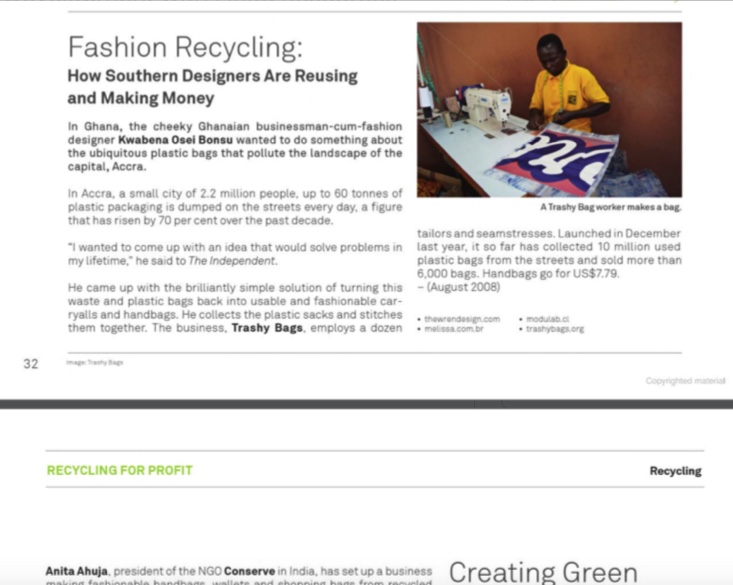
    In Ghana, the cheeky Ghanaian businessman-cum-fashion designer Kwabena Osei Bonsu wanted to do something about the ubiquitous plastic bags that pollute the landscape of the capital, Accra.

    In Accra, a small city of 2.2 million people, up to 60 tons of plastic packaging is dumped on the streets every day, a figure that has risen by 70 per cent over the past decade.

    “I wanted to come up with an idea that would solve problems in my lifetime,” he said to the Independent.

    He came up with the brilliantly simple solution of turning these wasted and damaging plastic bags back into usable and fashionable carryalls and handbags. He collects the plastic sacks and stitches them back together. The business, Trashy Bags, employs a dozen tailors and seamstresses. Launched in December last year, it so far has collected 10 million used plastic sachets from the streets, and sold more than 6,000 bags. Handbags go for US $7.79.

    Ghana’s huge quantity of discarded plastic water bottles are gathered up for recycling too. A storage room overflows with more than 3 million sachets that have been collected and cleaned ready for recycling.

    Bonsu’s business has turned into a source of income for local people, who receive US $3.89 for 1,000 sachets – a good return where the average yearly income is US $495

    “I collect sachets because I am jobless and this gives me money,” said Hadiza Ishmael, a 55-year-old grandmother who has delivered 4,000 plastic bags. “It also makes the place look nicer.”

    Published: August 2008

    Resources

    • The Re: Fashion Awards show is a brand new fashion phenomenon, set to transform social and environmental standards in the fashion industry within a decade. The RE:Fashion Awards will take place in London in November 2008. The glittering event will see major faces from the fashion world come together to recognise the most significant development in the fashion industry of the 21st century. The deadline for budding fashion designers to enter their contest is August 20th.
      Website: http://www.refashionawards.org/
    • A photogallery of the cocoa fashions:
      here: Photogallery 1
      and here: Photogallery 2
      And a video of Mai making the garments here: Video
    • Ethical Fashion Show: Isabelle Quehe, who established the event, said “You almost never see designers from developing countries doing shows in Paris, so this brings together natural products, local fair labour, respect for the environment and finding sales outlets in Paris.” Potential designers and exhibitors can contact the Ethical Fashion Show by sending collection photos and a brief explanation on how the fashions contribute to the ethical fashion movement.
      Send contributions to: 4, rue Trousseau 75011 Paris
      Email: unilove@wanadoo.fr
    • Once inspired to get into the global fashion business, check out this business website for all the latest news, jobs and events.
      Website: http://us.fashionmag.com/news/index.php
    • A creative agency specialising in the promotion of African culture to the world. They organise RUNWAY AFRICA—Africa’s annual Fall Fashion Show featuring five of Africa’s most promising rising design stars on the runway.
      Website: http://inspirationafrica.org/aboutus.html
    • Green fashion must really be making an impact–the BBC, Britain’s venerable public broadcaster, has started an on-line fashion magazine. Called Thread. Fashion Without Victim, it is dedicated to bringing the “latest of eco-fabulous style”. Through a “unique mix of affordable fashion, exclusive videos, photo galleries and thought-provoking features” the site is committed to promoting all aspects of ethical fashion.
      Website: http://www.bbc.co.uk/thread/
    • Traidcraft fights poverty through trade, helping people in developing countries to transform their lives. Established in 1979 as a Christian response to poverty, we are the UK’s leading fair trade organisation.
      Website: http://www.traidcraftshop.co.uk/default.aspx

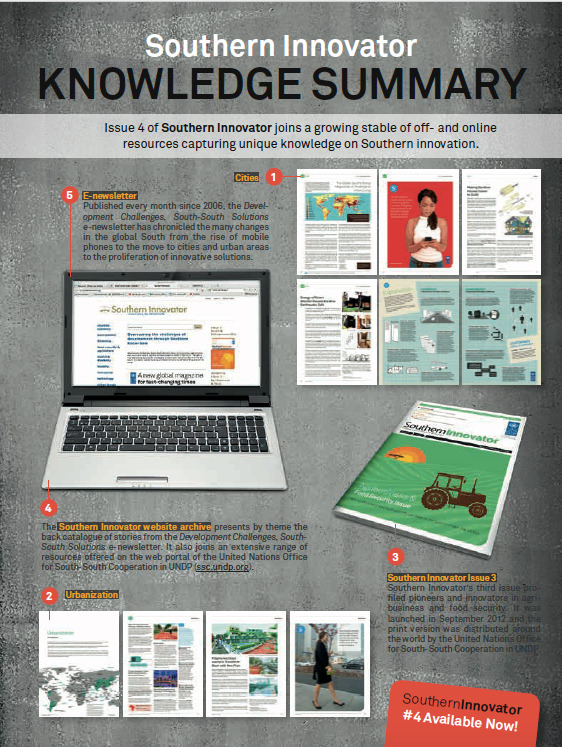
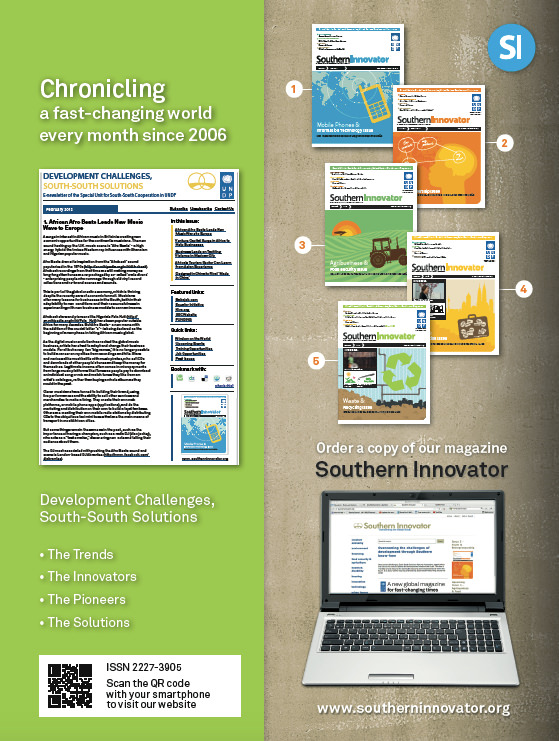
    Development Challenges, South-South Solutions was launched as an e-newsletter in 2006 by UNDP’s South-South Cooperation Unit (now the United Nations Office for South-South Cooperation) based in New York, USA. It led on profiling the rise of the global South as an economic powerhouse and was one of the first regular publications to champion the global South’s innovators, entrepreneurs, and pioneers. It tracked the key trends that are now so profoundly reshaping how development is seen and done. This includes the rapid take-up of mobile phones and information technology in the global South (as profiled in the first issue of magazine Southern Innovator), the move to becoming a majority urban world, a growing global innovator culture, and the plethora of solutions being developed in the global South to tackle its problems and improve living conditions and boost human development. The success of the e-newsletter led to the launch of the magazine Southern Innovator. 

    Creative Commons License

    This work is licensed under a
    Creative Commons Attribution-Noncommercial-No Derivative Works 3.0 License.

    ORCID iD: https://orcid.org/0000-0001-5311-1052.

    © David South Consulting 2023

  • Tiny Homes to Meet Global Housing Crisis

    Tiny Homes to Meet Global Housing Crisis

    By David SouthDevelopment Challenges, South-South Solutions

    SOUTH-SOUTH CASE STUDY

    More than 1 billion people around the world lack decent shelter. Of these, the majority live in urban areas, usually in slums and informal settlements (UN-HABITAT).

    The world’s megacities – like Mumbai, India, where more than 22 million live in the metropolitan region – have to find a way to provide housing that is both affordable and does the minimum possible amount of harm to the environment.

    About one-third of the world’s urban dwellers live in slums, and the United Nations estimates that the number of people living in such conditions will double by 2030 as a result of rapid urbanization in developing countries.

    The fast pace of growth of India’s cities presents an enormous challenge: how to house so many people with dignity and to a good standard. India’s city slums are notorious and recently became the subject of the Oscar-winning film Slumdog Millionaire (http://www.slumdogmillionairemovie.co.uk/).

    With a population of 1.2 billion, India needs to find 25 million homes a year to meet current demand, according to McKinsey and Co.

    Housing prices have risen by 16 percent a year for the past four years. While the middle class – estimated at over 300 million people – has piled into high-end apartments and houses, it has been the country’s low-income people who have been frozen out of the option of quality homes.

    The concept of targeting those at the ‘bottom of the pyramid’ (BOP) (http://en.wikipedia.org/wiki/The_Fortune_at_the_Bottom_of_the_Pyramid) has drawn attention to the estimated 23 million poor urban dwellers in India, and 180 million rural families, who have savings and want to own a home. Monitor India (http://www.monitor.com/in/) believes these people have annual earnings between US $1,400 and US $3,000.

    The Indian manufacturing powerhouse Tata – which this year launched a BOP-focused car, the Tata Nano – has designed and is building, Nano Homes – small apartments outside Mumbai for US $8,600 (http://tatahousing.in/pages/home.php). It also hopes to expand to other major Indian cities as well.

    The Nano homes are built on a modest scale: there are three sizes with the smallest measuring 67 square metres. They consist of a single room that doubles as a bedroom by night with a sink, bath and toilet behind a partition.

    Criticisms include location – on the edges of major cities – where residents would have to commute long distances to get to their jobs.

    Even so, Nano apartments are so popular buyers are being chosen by lottery.

    “India’s housing crisis lies in the fact that the poor in the cities are priced out of the market,” Sundar Burra, an adviser to the Society for the Promotion of Area Resource Centre, a Mumbai-based housing rights organization, told Canada’s Globe and Mail newspaper.

    “State supply of housing for the poor is woefully inadequate in relation to the need. Slums proliferate as a solution to this state of affairs.”

    People can get a mortgage for the homes from Tata Home Finance.

    Tata is not the only company targeting this market. India’s Matheran Realty (http://www.tmcity.in/) is building what it claim is India’s largest affordable housing project, Tanaji Malusare City, in the villages of Shirse and Akurle of Karjat (http://en.wikipedia.org/wiki/Karjat). The 15,000 homes would house 70,000 people and would sell for US $4,698.

    Another developer, Godrej Properties (http://www.godrejproperties.com/), is building a BOP housing development outside the city of Ahmedabad with apartments costing US $11,749.

    “(Property) developers have recognized that the real demand no longer lies in the premium segment and are opting to build smaller, no-frills apartments,” said Deepak Parekh of the Housing Development Finance Corporation (http://www.hdfcindia.com/).

    It estimates the affordable housing market will be worth US$ 110 billion in India by 2013 and will account for 80 percent of India’s housing market.

    “Affordable housing is not about box-sized, budget homes in far-flung places where there is no connectivity to workplaces and little surrounding infrastructure,” Parekh told HDFC’s shareholders. “Affordable housing has to be able to cut across all income segments and has to make economic sense in terms of proximity to the workplace.”

    Published: November 2009

    Resources

    1) Building and Social Housing Foundation: BSHF is an independent organisation that works both in the UK and internationally to identify innovative housing solutions and to foster the exchange of information and good practice. Website: http://www.bshf.org/home.cfm

    2) Tiny House Design Blog: The blog is full of ideas and plans for making small homes cheaply. Website: http://www.tinyhousedesign.com/

    3) A blog detailing the Tata dwellings in diagrams and photographs. Website: http://www.tslr.net/2009/06/tatas-nano-homes.html

    https://davidsouthconsulting.org/2022/05/23/debt-free-homes-for-the-poor/

    https://davidsouthconsulting.org/2021/11/12/energy-efficient-wooden-houses-are-also-earthquake-safe/

    https://davidsouthconsulting.org/2022/10/26/making-bamboo-houses-easier-to-build/

    https://davidsouthconsulting.org/2021/02/12/rammed-earth-houses-china-shows-how-to-improve-and-respect-traditional-homes/

    https://davidsouthconsulting.org/2021/02/12/rebuilding-after-chinese-earthquake-beautiful-bamboo-homes/

    https://davidsouthconsulting.org/2022/11/19/securing-land-rights-for-the-poor-now-reaping-rewards/

    https://davidsouthconsulting.org/2017/11/08/smart-cities-up-close-2013/

    https://davidsouthconsulting.org/2022/05/23/solar-bottle-bulbs-light-up-dark-homes/

    https://davidsouthconsulting.org/2022/09/26/3d-home-printing-landmark-10-houses-in-a-day/

    Development Challenges, South-South Solutions was launched as an e-newsletter in 2006 by UNDP’s South-South Cooperation Unit (now the United Nations Office for South-South Cooperation) based in New York, USA. It led on profiling the rise of the global South as an economic powerhouse and was one of the first regular publications to champion the global South’s innovators, entrepreneurs, and pioneers. It tracked the key trends that are now so profoundly reshaping how development is seen and done. This includes the rapid take-up of mobile phones and information technology in the global South (as profiled in the first issue of magazine Southern Innovator), the move to becoming a majority urban world, a growing global innovator culture, and the plethora of solutions being developed in the global South to tackle its problems and improve living conditions and boost human development. The success of the e-newsletter led to the launch of the magazine Southern Innovator. 

    Creative Commons License

    This work is licensed under a
    Creative Commons Attribution-Noncommercial-No Derivative Works 3.0 License.

    ORCID iD: https://orcid.org/0000-0001-5311-1052.

    © David South Consulting 2023

  • SOS Shops Keep Food Affordable for Poor, Unemployed

    SOS Shops Keep Food Affordable for Poor, Unemployed

    By David SouthDevelopment Challenges, South-South Solutions

    SOUTH-SOUTH CASE STUDY

    As the global downturn bears down on country after country, governments around the world are introducing austerity measures to try to keep their economies going. Many countries are now facing financial crisis and the need for loans and support from the International Monetary Fund (IMF).

    Formerly comfortable people are going from regular employment to unemployment or erratic employment, and growing numbers of people are finding it hard even to afford basics such as food.

    In Balkan nation Serbia, trade unions have come up with a solution: they are called SOS Shops and they feature food and other products priced at as much as 70 percent less than regular shops. By cutting back on the profit margin for the products, the store can make drastic cuts in prices.

    In the capital, Belgrade, the shops are run by trade unions in partnership with a local retail chain, Jabuka. The Association of Free and Independent Trade Unions uses Jabuka to run the stores. Anyone with an income below 20,000 dinars (US $280) a month can receive a special card to shop at the SOS stores.

    In Jabuka’s other stores, the profit margin is 20 percent, and in rival stores it can be over 30 percent. Jabuka also makes savings by sourcing locally and suppliers offering discounts of between 15 percent and 25 percent.

    “The prices there are 30 to 50 percent lower than in major supermarkets,” Jabuka manager Milorad Miskovic told IPS. “It’s a hard time for many people, so we decided to lower our margin of profit to only five percent at the SOS shops.

    “SOS shops are intended for the socially handicapped. SOS shops offer goods at lower prices to Serbian citizens earning minimum wages or pensions lower than RSD 20,000, to the unemployed, to the displaced from Kosovo and the citizens on the dole (welfare).”

    Hard hit by the global downturn, Serbia has seen its recent boom times disappear quickly. The country had enjoyed average yearly growth since 2000 of 6.7 percent.

    The country is currently negotiating bridging loans with the IMF (www.imf.org). The conditions for the loan mean severe cuts to public sector wages and tax rises.

    According to the Serbian Statistical Office, Serbia has lost 10,000 jobs a month since the beginning of 2009. The official unemployment rate is 14 percent, and the government believes half a million people now live below the official poverty line, out of a population of 10 million.

    “Many people have lost their jobs and the main problem is that the middle class is now poor. That is the real problem,” Nebojsa Rajkovic of the Association of Independent Trade Unions told the BBC. “The government prepared a social programme to deal with the economic crisis in Serbia, but it was not enough and that is the reason the union devised this project.”

    This month, the Jabuka trade company opened its third SOS shop in Belgrade. The shop, the largest SOS shop so far, will be opened in the Mirijevo neighbourhood of Belgrade, and it will offer a wider range of products.

    The unions plan to open 100 social supermarkets this year. Basic staples like bread, milk and potatoes are the cheapest goods. Unlike other supermarkets, the stores feature local brands and products made in Serbia: a boost to local producers in the economic downturn.

    In order to stop hoarding of the cheap food or people buying a lot and then selling it for a profit, the amount that can be bought on one shopping trip is limited. For example, just three bottles of cooking oil are allowed each time.

    “Most people in Serbia are finding things difficult financially. We only have maybe five or 10 percent of the population who don’t have financial problems,” continued Rajkovic.

    One customer, 26-year-old Milica Marjanovic , found the shops provided much-needed support to her unemployed family. “My mother, my sister and I are unemployed. We don’t get any social benefits,” she said to the BBC.

    “There are a lot of unemployed people in Serbia, life is hard for a lot of people and they can hardly manage.

    “Many families don’t even have what is basic for living. So, these shops are welcome.”

    Published: May 2010

    Resources

    The Co-operative Food: This pioneering network of supermarkets offers both affordable food prices for customers and good prices and terms for suppliers. They are a founding member of the Ethical Trading Initiative (ETI). This is an alliance of companies, trade unions and non-governmental organisations (NGOs) working together to improving working conditions in supply chains.
    Website: http://www.co-operative.coop/food/

    Development Challenges, South-South Solutions was launched as an e-newsletter in 2006 by UNDP’s South-South Cooperation Unit (now the United Nations Office for South-South Cooperation) based in New York, USA. It led on profiling the rise of the global South as an economic powerhouse and was one of the first regular publications to champion the global South’s innovators, entrepreneurs, and pioneers. It tracked the key trends that are now so profoundly reshaping how development is seen and done. This includes the rapid take-up of mobile phones and information technology in the global South (as profiled in the first issue of magazine Southern Innovator), the move to becoming a majority urban world, a growing global innovator culture, and the plethora of solutions being developed in the global South to tackle its problems and improve living conditions and boost human development. The success of the e-newsletter led to the launch of the magazine Southern Innovator. 

    https://davidsouthconsulting.org/2021/03/05/southern-innovator-issue-3/

    Creative Commons License

    This work is licensed under a
    Creative Commons Attribution-Noncommercial-No Derivative Works 3.0 License.

    ORCID iD: https://orcid.org/0000-0001-5311-1052.

    © David South Consulting 2022

  • Book Boom Rides Growing Economies and Cities

    Book Boom Rides Growing Economies and Cities

    By David SouthDevelopment Challenges, South-South Solutions

    SOUTH-SOUTH CASE STUDY

    Along with growing economies, the global South is seeing growing numbers of readers and a newly flourishing publishing industry. The creative economy – of which book publishing is part – is experiencing a jolt from a combination of expanding economies and urbanizing cities. Just as the first settled cities of ancient Mesopotamia (today’s Iraq) spawned literature and learning, so the rapidly urbanizing South is changing dynamics and creating the space and demand for books.

    The creative economy is seen as the “interface between creativity, culture, economics and technology in a contemporary world dominated by images, sounds, texts and symbols” (UNCTAD). It has been shown to be an effective way for emerging economies to leapfrog into high-growth areas in the 21st century world economy.

    Telling stories about local conditions and people’s rapidly changing lives is proving a commercial success formula. Fast-growing India is forecast to become the largest market for English language books within a decade. India’s economic boom, which saw 6.7 percent growth in 2009, and its expanding middle class are driving demand for books. India saw the number of literate people pass 66 percent by 2007.

    “It is a forward-looking generation,” said Manish Singh, country manager for publisher Harlequin Mills and Boon, to The Guardian newspaper.

    Estimates of India’s book reading market put the number of readers at just 5 million out of a population of over 1 billion people. But according to Anantha Padmanabhan, the director of sales in India for publisher Penguin, “that is set to increase dramatically.”

    A survey by Tehelka (http://www.tehelka.com) found Indians are favouring stories about local conditions and set in the places where they live.

    India’s most popular current writer is Chetan Bhagat, a former investment banker. He has sold more than 3 million books in the last five years. His latest, Two States, sold a million copies in four months.

    Bhagat writes about the country’s aspiring middle class. His publisher, Rupa (http://www.rupapublications.com/Client/home.aspx), believes he appeals to a “pan-Indian, pan-age group.”

    Bhagat puts his success down to the way the stories are written. “This is not like the mature English literature market,” he said. “It needs an English that is highly accessible, simple, and with stories that are still interesting and relevant.”

    Book prices in India have stayed affordable for the middle classes. A book can cost from US $1.85 to US $2.65 for a paperback – still a high cost for the poor, however, who live on a dollar a day.

    In Egypt, around 30 percent of the population is illiterate and book reading has been historically very low: it has been claimed an average literate Egyptian reads a quarter of a page of a novel per year. From this low base, a best seller only needs to sell a few thousand copies.

    However, in Egypt small-scale independent publishers are starting to make an impact. Mohamed Hashem – founder of the Dar Merit publishing house (http://www.zoominfo.com/Search/ReferencesView.aspx?PersonID=1007104230) – has built from scratch in 12 years one of the country’s most critically acclaimed publishers: all from a tiny apartment in a rundown Cairo building.

    “We can’t compete with the big firms in terms of profits,” he told The Guardian, “but the new wave of authors will always be sitting here. Yes, we have poverty and limited resources. But we also have the future.”

    Launched to counter what Hashem felt was an unimaginative book market, his stable of authors have shaken up the Arabic fiction world. The global success of Alaa al-Aswany’s The Yacoubian Building (http://en.wikipedia.org/wiki/The_Yacoubian_Building) is proof Hashem’s gamble on edgy talent was correct: rejected by two government-run publishing houses, the book went on to be a hit in English and Arabic and has been made into a film.

    Hashem is being credited with unleashing a wave of new talented authors that has pushed literature out from being the preserve of a select group.

    One of its successful authors, Hamdi Abu Golayyel – winner of the country’s top literary prize, the Naquib Mahfouz medal – believes “Merit has changed the way pioneering literature emerges in Egypt.”

    “Before, you had the innovative writers – there are normally no more than five or six in a generation – meeting together in mutual isolation, because popular opinion rejected them.”

    Merit “had the drive and ambition to support and distribute new and younger authors properly. Today innovative writing is wanted by the people.”

    Hashem’s secret in attracting talented writers has been more than just business savvy: he also gives them “the freedom to write in my own way,” according to writer Ahmed Alaidy.

    The writers also have a credibility advantage: they are writing about their circumstances rather than just imagining what it would be like. Writer Hani Abdel Mourid comes from Cairo’s traditional garbage-collecting neighbourhood; another author, Mohamed Salah Al Azab, has written a book named after the folding seats on Egypt’s lively minibuses.

    Demographic changes and Cairo’s relentless expansion are being cited as the catalyst for the new writing.

    “The fact that the city has grown the way it has,” says Samia Mehrez, a literature professor in Cairo, “the fact that what we used to call the periphery is now the centre, that is very important.”

    “The year we started, we published five titles and the number of people interested could be counted in the dozens,” he told The Guardian. “Now we have 600 titles under our belt, and thousands are interested. It’s my duty to try and expand that circle. We’re chipping away at a wall, and slowly we’re making progress.”

    Published: May 2010

    Resources

    1) Creative Economy Report 2008. An economic and statistical assessment of creative industries world-wide as well as an overview of how developing countries can benefit from trade in creative products and services produced by UNCTAD and the Special Unit for South-South Cooperation in UNDP. Website: http://www.unctad.org/en/docs/ditc20082cer_en.pdf

    2) Global Creative Economy Convergence Summit 2009: The summit is about the successful and emerging creative technologies and initiatives that are driving economic growth locally, nationally and internationally. Website: http://www.gcecs2009.com/

    3) A directory of Indian publishers. Website: http://www.publishersglobal.com/directory/publishers-by-country.asp?publishers-of=India

    4) Full Circle Publishing: A successful Indian publishing company. Website: http://www.atfullcircle.com/

    5) Jaipur Literature Festival: Described as the ‘greatest literary show on Earth’, the Jaipur Literature Festival is a sumptuous feast of ideas.The past decade has seen it transform into a global literary phenomenon having hosted nearly 2000 speakers and welcoming over a million book lovers from across India and the globe. Website: https://jaipurliteraturefestival.org/

    https://davidsouthconsulting.org/2021/09/23/david-south-consulting-books-1997-2014/

    https://davidsouthconsulting.org/2022/06/15/e-books/

    https://davidsouthconsulting.org/2022/11/23/publications/

    https://davidsouthconsulting.org/2022/10/26/south-gets-reading-bug-with-more-festivals/

    Development Challenges, South-South Solutions was launched as an e-newsletter in 2006 by UNDP’s South-South Cooperation Unit (now the United Nations Office for South-South Cooperation) based in New York, USA. It led on profiling the rise of the global South as an economic powerhouse and was one of the first regular publications to champion the global South’s innovators, entrepreneurs, and pioneers. It tracked the key trends that are now so profoundly reshaping how development is seen and done. This includes the rapid take-up of mobile phones and information technology in the global South (as profiled in the first issue of magazine Southern Innovator), the move to becoming a majority urban world, a growing global innovator culture, and the plethora of solutions being developed in the global South to tackle its problems and improve living conditions and boost human development. The success of the e-newsletter led to the launch of the magazine Southern Innovator. 

    Creative Commons License

    This work is licensed under a
    Creative Commons Attribution-Noncommercial-No Derivative Works 3.0 License.

    ORCID iD: https://orcid.org/0000-0001-5311-1052.

    © David South Consulting 2022