Tag: development challenges south-south solutions

  • Teenager Uses Technology to Protect Livestock from Lions

    Teenager Uses Technology to Protect Livestock from Lions

    By David SouthDevelopment Challenges, South-South Solutions

    SOUTH-SOUTH CASE STUDY

    In Kenya, a teenage Maasai (http://en.wikipedia.org/wiki/Maasai_people) inventor has developed a way to chase lions away from livestock that doesn’t harm the lions. It is a common practice to kill lions when they threaten or kill livestock, and this has led to a precipitous drop in the local lion population at Nairobi National Park (http://www.kws.org/parks/parks_reserves/NANP.html/), near the country’s capital, Nairobi. Lions are a significant tourist attraction for Kenya and the population decline is a threat to the future of the tourist industry.

    Trying to find the right balance between livestock and wild animals is a problem across the global South. As populations rise, and the number of animals kept for domestic food markets increases, so does conflict between farmers and predatory wild animals looking for an easy meal. And there is no more tempting easy meal than domesticated animals tamed and kept in herds.

    According to Reuters, 13-year-old Richard Turere has developed a system of flashing lights to scare off lions at night. The LED (light-emitting diode) (http://en.wikipedia.org/wiki/Light-emitting_diode) bulbs were gathered from broken flashlights. Turere then wired them to a solar-powered car battery used to power the family’s TV.

    Turere has placed the lights on poles surrounding the enclosure where the cattle stay at night.

    “Lions were eating our cattle at night, which made me very annoyed,” he told Reuters. “And I thought that I have to come up with an idea of making bulbs. Because I knew that the lions were afraid of something moving.

    “When someone wakes up at night and moves with a torch, they are afraid. So I made the bulbs which flash at night and keep away lions.”

    Nairobi National Park is wild and unfenced, leaving lions free to wander on to farmland. Tragically for the lions, increasing numbers are being killed by farmers protecting herds. Conservationists say Kenya’s lion population has plummeted from 15,000 to just 2,000 in a decade. Since October 2011, Wildlife Direct (http://wildlifedirect.org/) has documented 169 killings of livestock by lions in the location near Turere’s farm.

    Kenya depends heavily on tourism to the national parks where people want to see lions. Kenya has been enjoying significant growth in tourism and has the goal of reaching 2 million international tourists in 2012 (Kenyan Ministry of Tourism). Earnings from international tourism are the second largest source of foreign exchange for the country and the services sector – 63 per cent of GDP (gross domestic product) – is dominated by tourism (Brand Kenya). So-called ‘photo safaris’ to the country’s national parks and game preserves are the main attraction for international tourists.

    But farmers need to have their herds protected since livestock are a critical income source for them, as well as a food source for the country. Cattle herding has long been an important income source and livelihood for the Maasai people.

    According to conservationist Dr. Paula Kahumbu, executive director of Wildlife Direct, other herding families would like Richard to set up the light system on their farms too.

    Since Richard installed the lights, his family has not lost any cattle to lions. This bright idea has also dramatically altered Turere’s life. The attention he has received for the invention has led to him being funded by local environment groups to attend a prestigious private school, Brookhouse International School (http://www.brookhouse.ac.ke/) in Nairobi. Things are truly looking bright for Turere!

    Published: August 2012

    Resources

    1) Experience Kenya: The web portal packed with information on Kenyan tourist attractions and investment opportunities. Website: http://www.experiencekenya.co.ke/index.php

    2) Brand Kenya: The official Brand Kenya website shows how the country is weaving together all things Kenyan to create a strong global brand for the country. Website: http://brandkenya.co.ke/

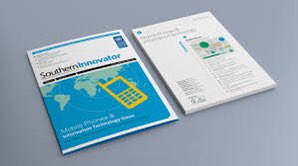
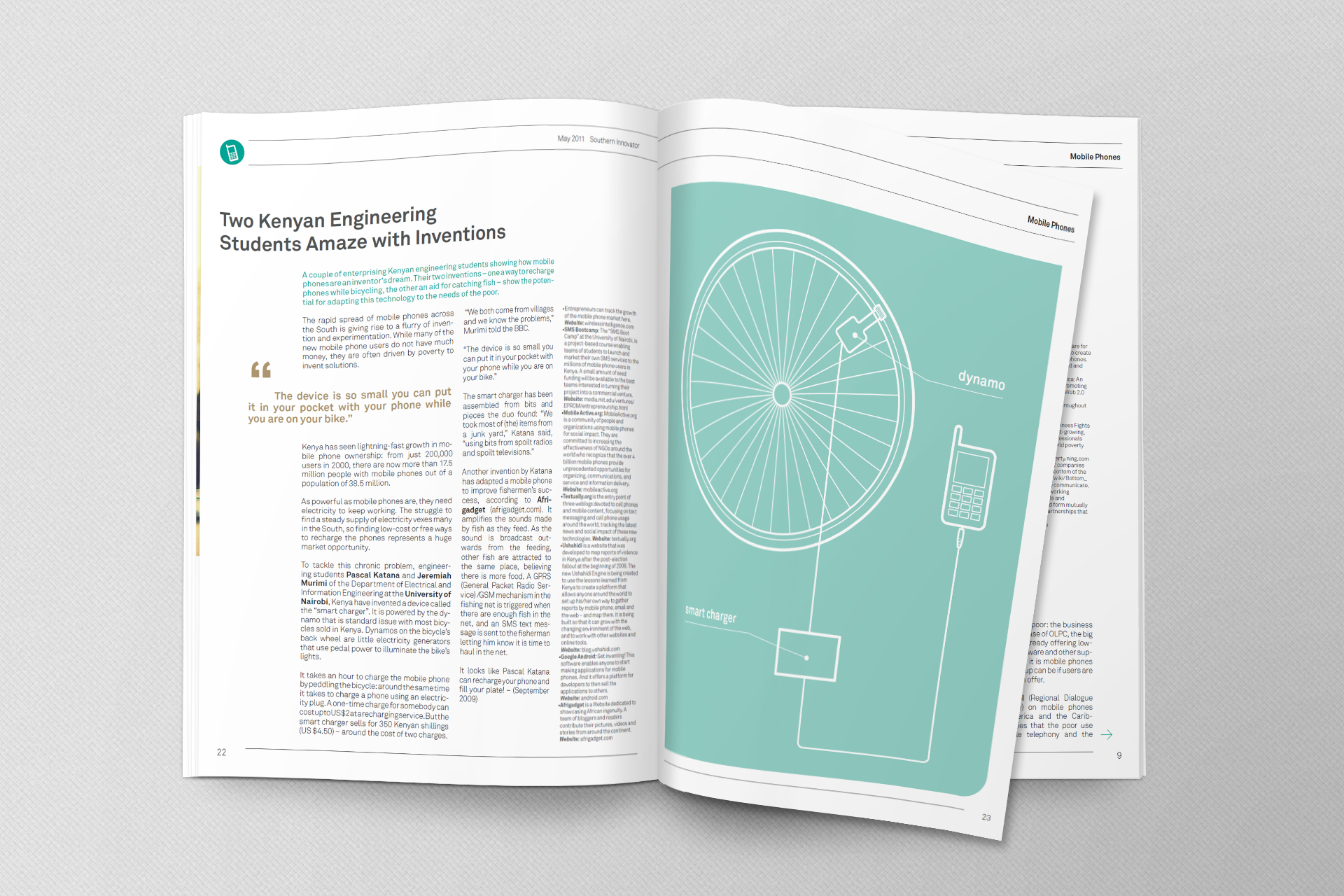
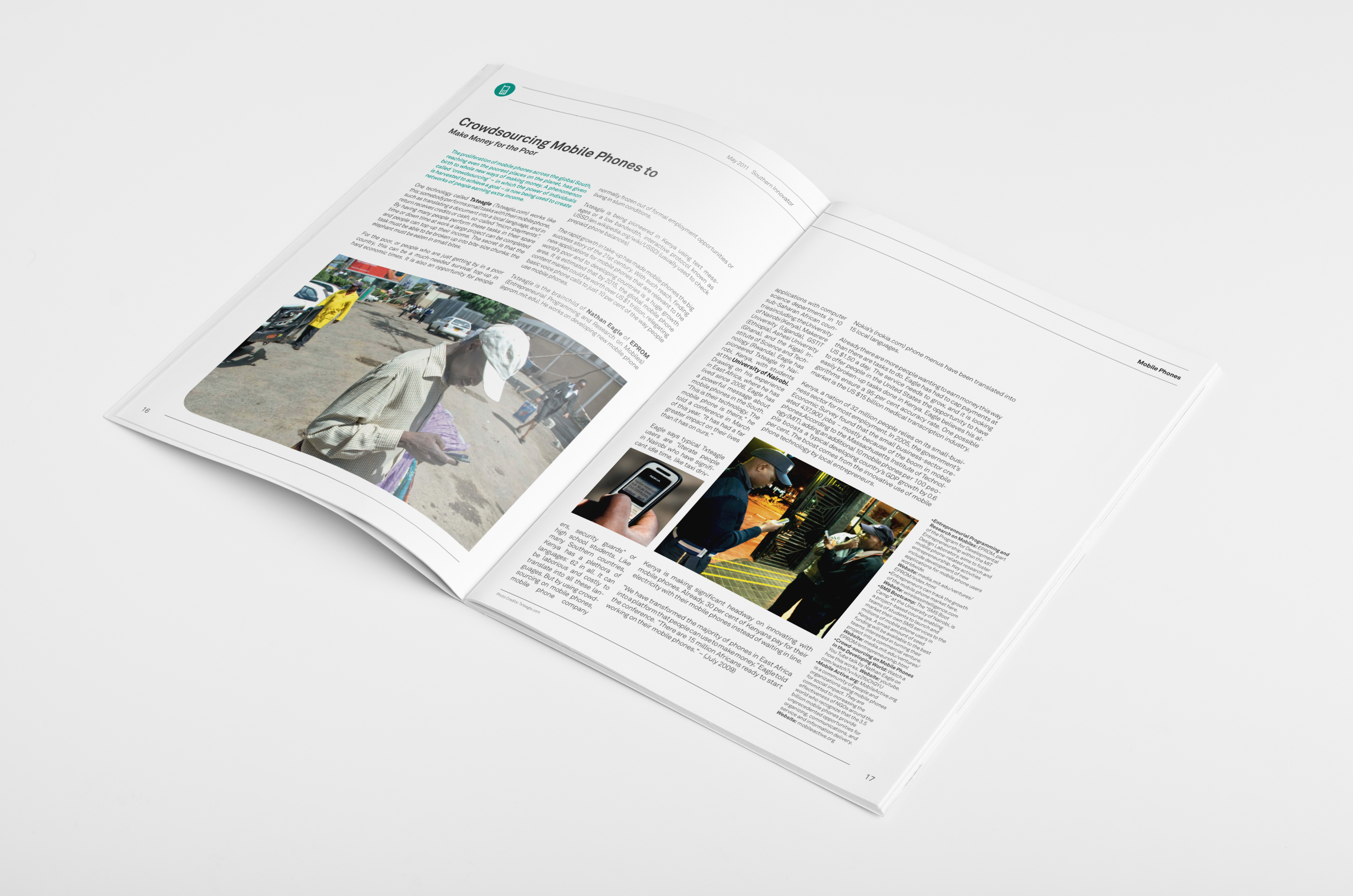
    Development Challenges, South-South Solutions was launched as an e-newsletter in 2006 by UNDP’s South-South Cooperation Unit (now the United Nations Office for South-South Cooperation) based in New York, USA. It led on profiling the rise of the global South as an economic powerhouse and was one of the first regular publications to champion the global South’s innovators, entrepreneurs, and pioneers. It tracked the key trends that are now so profoundly reshaping how development is seen and done. This includes the rapid take-up of mobile phones and information technology in the global South (as profiled in the first issue of magazine Southern Innovator), the move to becoming a majority urban world, a growing global innovator culture, and the plethora of solutions being developed in the global South to tackle its problems and improve living conditions and boost human development. The success of the e-newsletter led to the launch of the magazine Southern Innovator.

    Creative Commons License

    This work is licensed under a
    Creative Commons Attribution-Noncommercial-No Derivative Works 3.0 License.

    ORCID iD: https://orcid.org/0000-0001-5311-1052.

    © David South Consulting 2022

  • Venezuela’s Currencies Promote Cooperation Not Competition

    Venezuela’s Currencies Promote Cooperation Not Competition

    By David SouthDevelopment Challenges, South-South Solutions

    SOUTH-SOUTH CASE STUDY

    The global economic crisis has spread around the world and is bringing many problems in its wake.  As global currency markets gyrate wildly, and people find they can go from having wealth to being poor almost overnight, the question is being asked: “is there another way?”

    The global economy is slowing rapidly. Even Iceland – a country recently named as having the best quality of life in the world (Human Development Index) (HDI) – has gone broke, and many other nations around the world will face serious economic crises. People will need to protect themselves from the worst effects of the fallout from various economic bubbles bursting.

    Runaway inflation, as is occurring in Zimbabwe – reaching 231 million percent in October, 2008 according to official sources – shows faith in a country’s currency can be sorely tested. But do people and the poor in particular, need to be prisoners of the economy managed by a national currency?

    The ‘prosumer’ movement (http://en.wikipedia.org/wiki/Prosumer), where consumers take an active role in re-shaping markets and economies to their benefit, around the world is looking for ways to bypass national currencies and make food, goods and services more affordable and stable, improving the lives of the poor. One way this is done is through alternative currencies (http://en.wikipedia.org/wiki/Alternative_currency).

    Cimarrones, or the Cimarron, joins 10 other alternative currencies currently in operation across Venezuela. They are circular cardboard tokens with a picture of a runaway slave on them.

    Supported by Hugo Chavez, the country’s president, the new currencies are aimed at tackling poverty and establishing new economies. The currencies can’t be exchanged for the Venezuelan currency, the bolivar.

    It works like this: to be a prosumer, you must first bring something to sell before you can buy anything. The range of products for sale at prosumer markets is not vast, but that isn’t the point.

    “It’s magic,” Pablo Mayayo, an Argentinian advising Venezuela on prosumer schemes, told The Economist. “ When you take away money, which is the cause of almost all the great evils in the world, people relate to each other in a different way, by cooperating, not competing.”

    Argentina pioneered so-called “barter markets” in response to its economic crises, helping people avoid starvation, looting and perhaps a revolution. By the end of 2002, there were 4,500 barter markets being used by half a million people producing 600 million credits.

    “They were organized geographically around church halls, car parks and baseball courts,” recalled Peter North, a Liverpool University geographer. “They offered a wide range of products and services, supplied by professionals, trades people and farmers, as well as housewives and the unemployed. Stalls attracted ‘prosumers’ in their thousands, who paid with credit coupons issued by one or more barter markets. Everyone involved was both a prosumer and a producer, since you couldn’t purchase credits or exchange them for pesos.”

    In Rio Chico, a small town in the Venezuelan coastal region of Barlovento, the prosumer currency market has people happy with the prices.

    “I grow coconuts,” said Angenia Hernandez. “In the shops they cost 3.5 bolivares each (US $1.63) at the official exchange rate), but we we’re going to sell them at [the equivalent of] 1.5.” She calls it an end to “commercial fascism.”

    Because of global currency speculation and investment flows, national currencies are not entirely at the control of national governments. High inflation seriously hurts the poor and low-waged, and national currencies can hurt the rural poor, who become prisoners to high interest rates charged by urban lenders.

    Turning to a local, alternative currency has many advantages: it stops currency speculation, stops the flow of wealth to urban areas, preserves purchasing power, keeps trading local. Avoiding the draining away of wealth to middlemen, it addresses currency scarcity, and fosters greater awareness of how economies function and the mechanisms of trade

    Criticism of these schemes say it is just a re-run of regressive company currencies and feudal tokens that were used in the past to control people and force them to only buy products from the landowner or boss.

    In Papua New Guinea , shells are used for money and are called Tabu.  It is an ancient currency system used by the Tolai people of East New Britain Island . Stephen Demeulenaere (www.network-economies.com), who has worked on alternative currencies around the world and helped with the re-introduction of the Tabu in Papua New Guinea , sees it playing a key role in the local economy.

    “Tabu was very effective at addressing poverty,” he said, “because anything could be purchased with it, from a handful of peanuts up to a piece of land or even a car, without needing national currency.  Tabu is produced traditionally by women, so theoretically nobody would suffer from a lack of it.  The advantage over the national currency is that it has a very long history of use, and people trust it more than the national currency.

    “Tabu builds wealth by facilitating the exchange of locally-produced goods and services which may not circulate in a ‘national-currency only’ economy, and values activities that may not be considered to be economically viable if the use of national currency was the only option.  In the west we see this where ‘mother’s work’, hobbies, mutual-aid and other traditional under-valued but economically important activities are not valued monetarily.

    “By encouraging the exchange of locally-produced goods and services, wealth is built in the community from the ground up.”

    Over 75,000 people now use the shells, usually traded in great rings.

    Getting the introduction of an alternative currency right is critical. In Argentina, such currencies were criticised for being manipulated by criminal gangs and political forces.

    “The main advice I have is to study the community closely, and our website at http://www.complementarycurrency.org, provides free resources for people wishing to start their system,” Demeulenaere said.

    “The system must be transparent so that people trust it and participate in maintaining its health and stability; democratic, so that it can not be abused by those in power; appropriate, so that it achieves general social and economic goals and aspirations of the community; and to be complementary to the regular economy so that the system helps its members to improve their lives economically.”

    At the Jai Marketplace in Thailand , all of the goods in the market can be bought entirely in the local currency called “Jai’. Jai is convertible to Thai Baht or to organic, locally made cow fertilizer, and is designed to improve the local economy and the climate for micro, small and medium enterprises through the local exchange network.

    Published: January 2009

    Resources

    https://davidsouthconsulting.org/2022/10/26/african-trade-hub-in-china-brings-mutual-profits-2/

    https://davidsouthconsulting.org/2022/10/14/cash-machines-for-the-poor/

    https://davidsouthconsulting.org/2020/12/15/development-challenges-south-south-solutions-newsletter-2007-2010-2/

    https://davidsouthconsulting.org/2020/12/15/development-challenges-south-south-solutions-newsletter-2011-2014-2/

    https://davidsouthconsulting.org/2022/04/12/djibouti-re-shapes-itself-as-african-trade-hub/

    https://davidsouthconsulting.org/2022/02/10/food-inflation-ways-to-fight-it/

    https://davidsouthconsulting.org/2022/10/20/global-souths-rising-economies-gain-investor-spotlight-2/

    https://davidsouthconsulting.org/2021/07/19/global-south-trade-boosted-with-increasing-china-africa-trade-in-2013/

    https://davidsouthconsulting.org/2022/07/01/poorest-countries-being-harmed-by-euro-currency-crisis/

    https://davidsouthconsulting.org/2022/11/17/sos-shops-keep-food-affordable-for-poor-unemployed/

    https://davidsouthconsulting.org/2021/07/19/south-south-trade-helping-countries-during-economic-crisis/

    https://davidsouthconsulting.org/2021/01/23/the-sweet-smell-of-failure-the-world-bank-and-the-persistence-of-poverty/

    https://davidsouthconsulting.org/2022/10/20/trade-to-benefit-the-poor-up-in-2006-and-to-grow-in-2007/

    https://davidsouthconsulting.org/2022/10/05/women-empowered-by-fair-trade-manufacturer/

    https://davidsouthconsulting.org/2022/06/16/women-mastering-trade-rules/

    Development Challenges, South-South Solutions was launched as an e-newsletter in 2006 by UNDP’s South-South Cooperation Unit (now the United Nations Office for South-South Cooperation) based in New York, USA. It led on profiling the rise of the global South as an economic powerhouse and was one of the first regular publications to champion the global South’s innovators, entrepreneurs, and pioneers. It tracked the key trends that are now so profoundly reshaping how development is seen and done. This includes the rapid take-up of mobile phones and information technology in the global South (as profiled in the first issue of magazine Southern Innovator), the move to becoming a majority urban world, a growing global innovator culture, and the plethora of solutions being developed in the global South to tackle its problems and improve living conditions and boost human development. The success of the e-newsletter led to the launch of the magazine Southern Innovator.

    https://davidsouthconsulting.org/2021/03/05/southern-innovator-issue-2/

    Creative Commons License

    This work is licensed under a
    Creative Commons Attribution-Noncommercial-No Derivative Works 3.0 License.

    ORCID iD: https://orcid.org/0000-0001-5311-1052.

    © David South Consulting 2023

  • Saving Water to Make Money

    Saving Water to Make Money

    By David SouthDevelopment Challenges, South-South Solutions

    SOUTH-SOUTH CASE STUDY

    The world’s water supplies are running low, and according to the World Health Organisation (WHO), four out of every 10 people are already affected. But despite the gloomy reality of this problem, entrepreneurs in the South are rising to the challenge to save water.

    “The situation is getting worse due to population growth, urbanisation and increased domestic and industrial water use,” said WHO’s Director-General, Dr Margaret Chan. While the WHO has adopted the theme ‘Coping with Water Scarcity’ for this year, every year more than 1.6 million people die from lack of access to safe water and sanitation. Ninety percent of these deaths are children under the age of five.

    The health consequences of water scarcity include diarrhoeal diseases such as cholera, typhoid fever, salmonellosis, other gastrointestinal viruses, and dysentery.

    One unnecessary waste of water is car washing. The number of cars in developing countries is growing fast, with a 27 per cent increase in sales in China this year, and South America overtaking Asia as the world’s fastest-growing regional vehicle market (Global Auto Report). And all these cars will be washed, wasting this precious resource.

    The large informal car washing market in Brazil has long been known for paying low wages and avoiding taxes. On top of this they also waste water. Lots and lots of water. In Brazil, 28.5 per cent of the population (41.8 million people) do not have access to public water or wastewater services. And 60 per cent do not have adequate sanitation (Brazilian Institute of Applied Economic Research).

    Started in 1994, Drywash uses a locally available Brazilian organic carnauba wax to clean cars without using water. Drywash has also developed a line of cleaning products that cleans every part of a car without the need for water. They estimate they have saved 450 million litres of water in their first 10 years of operation. From the start, they set out to change the status quo and run a business that “thinks like a big corporation,” said its international partner, Tiago Aguiar.

    To do this, Drywash’s management team focused on operating an efficient and professional business. When Brazil’s government passed strict laws against informal selling of products, Drywash was well positioned to benefit, with companies preferring to work with a legal business. Customers have also been attracted to Drywash because they know the service is consistent and to a high standard. Drywash made US $2.7 million in 2005.

    Drywash prides itself on operating “on the books”, and paying taxes. They are also ambitious, and have expanded outside Brazil and into other services.

    And they don’t just do private cars: they also clean private jets, with Drywash Air. They have also expanded into Mexico, Portugal and Australia, on top of 50 Brazilian franchises. They also want to enter the US market.

    In China, Landwasher toilets is tackling the growing problem of providing flush toilets to the country’s 1.32 billion people. As its founder Wu Hao told the World Resources Institute (www.nextbillion.net), “Assuming all of our country uses water-flushing toilets, not even the Changjiang and the Yellow Rive will be enough.”

    Formed six years ago, it has patented a process using a special agent and sterilisation to dispose of human waste without using water, and very little electricity.

    Hao graduated from Beijing University’s Physics Department and developed management experience working in manufacturing, securities investment and corporate management.

    “On a personal level, I love the natural environment… I can’t endure the large scale waste and damage to the environment caused by the process of construction in China.”

    Landwasher has seen its sales grow to 40 million Yuan (US $5.2 million), and has six sales offices covering 27 provinces.

    Landwasher has just been awarded a contract to provide portable toilets to the 2008 Olympics in Beijing.

    Published: September 2007

    Resources

    • World Water Council: Established in 1996, the World Water Council promotes awareness and builds political commitment to trigger action on critical water issues.
    • Water Supply and Sanitation Collaborative Council: Works on sustainable sanitation, hygiene and water services to all people, with special attention to the underserved poor.
    • The Stratus Group is a Brazilian fund looking for sustainable SMEs in Brazil’s high-growth green sectors.

    Development Challenges, South-South Solutions was launched as an e-newsletter in 2006 by UNDP’s South-South Cooperation Unit (now the United Nations Office for South-South Cooperation) based in New York, USA. It led on profiling the rise of the global South as an economic powerhouse and was one of the first regular publications to champion the global South’s innovators, entrepreneurs, and pioneers. It tracked the key trends that are now so profoundly reshaping how development is seen and done. This includes the rapid take-up of mobile phones and information technology in the global South (as profiled in the first issue of magazine Southern Innovator), the move to becoming a majority urban world, a growing global innovator culture, and the plethora of solutions being developed in the global South to tackle its problems and improve living conditions and boost human development. The success of the e-newsletter led to the launch of the magazine Southern Innovator.

    Creative Commons License

    This work is licensed under a
    Creative Commons Attribution-Noncommercial-No Derivative Works 3.0 License.

    ORCID iD: https://orcid.org/0000-0001-5311-1052.

    © David South Consulting 2022

  • Traditional Healers can Heal the Mind, as well as Body

    Traditional Healers can Heal the Mind, as well as Body

    By David SouthDevelopment Challenges, South-South Solutions

    SOUTH-SOUTH CASE STUDY

    Mental healthcare is critical to physical health and overall wellbeing, yet it is seriously neglected around the world – and especially in poorer countries.

    Often seen as a luxury for the wealthy or an indulgence for the weak, mental health services are often left at the bottom of any list of development priorities. Yet Professor Martin Prince of King’s College London in the United Kingdom found that an estimated 14 percent of the global burden of disease is due to neuropsychiatric disorders, mostly depression, alcohol- and substance-use disorders, and psychoses.

    Since the contribution of mental disorders to physical illness is inadequately appreciated, the actual global burden of mental disorders is probably higher than this. Dr. Shekhar Saxena of the World Health Organization has reported that a scarcity of resources for mental health is compounded by inequities and inefficiencies in the delivery of mental healthcare.

    As a result, people who need care get none. “The treatment gap – the proportion of those who need but do not receive care – is too high for some mental disorders,” Saxena said. As many as one in three people with schizophrenia and one in two with other mental disorders do not receive any treatment. The WHO has reported that the treatment gap for serious disorders is 76 percent to 85 percent for low- and middle-income countries. And the organization says shortages of healthcare professionals have been shown to be the main limiting factor in delivering mental healthcare in most low- and middle-income countries.

    But an ingenious solution to this problem has emerged in the South American country of Ecuador. It involves turning to the traditional healers who are already well-established in communities. They are both cheaper and faster than waiting for medical psychiatrists to turn up in poor communities, and they can start right now to provide the support people need in a culturally tolerant way. Their effectiveness has been proven by Dr. Mario Incayawar, director of the Runajambi Institute for the Study of Quichua Culture and Health in Otavalo.

    “Poor countries where you find numerous traditional healers could benefit the most,” he said.

    In findings published in the prestigious British Journal of Psychiatry (The British Journal of Psychiatry (2008) 192: 390-391. doi: 10.1192/bjp.bp.107.046938), Incayawar found there are just 800 psychiatrists in Ecuador, and most live in the cities and speak Spanish. The native population on the other hand, mostly speak the local Quechua language and are served by only one psychiatrist, but thousands of traditional healers.

    In the Andean mountain city of Otavalo, most people are descendents of the ancient Inca people. Health conditions are poor and far worse than in Spanish-speaking regions. Over 3 million of Ecuador’s 12 million residents speak Quechua, many of them living in indigenous communities high up in the mountains, bypassed by development. Roughly 90 percent of indigenous communities live below the poverty level, a fact reflected in high maternal and infant mortality rates. In some remote communities, maternal mortality reaches 250 deaths per 100,000 live births, compared to the national average of 130, and one in 10 infants does not live to see his or her first birthday.

    For 5 million Indigenous people in Ecuador, for example, there is not one single mental professional paid to work within the Indigenous communities.

    Traditional healers’ practices are widespread around the world, yet their diagnostic skills have rarely been investigated. Incayawar’s study found the yachactaitas (Quichua healers) in the Andes were able to identify cases of psychiatric illness in their communities. During the study over 18 months, 10 yachactaitas participated in the identification of 50 individuals with a condition. None of the participants was found to be healthy in biomedical or psychiatric terms when reviewed by psychiatrists. The results suggest yachactaitas can be an early warning system for identifying general psychiatric cases in their communities through their powers of observation.

    “From the Quichua perspective, it is a matter of common sense,” said Incayawar. “We have a sizable number of traditional healers, why not promote their clinical skills for taking care of our communities.”

    “Healers are paid in cash or by gifts such as a bag of potatoes, a basket of eggs, or a couple of chickens. The Quichua people are not familiar with psychiatrists or mental health professionals.”

    He also sees a bright future for the role of the traditional healer: “Young people feel less threatened to pursue a career as a traditional healer. Currently, the trend points to an increase of traditional healers.”

    In the future, Incayawar would like to see a happy co-habitation between the scientifically-trained psychiatrists, and the traditional healers: “We would like to see traditional healers working in a respectful partnership with biomedically trained mental health workers. The collaboration between equals … could be something to work on for the coming decade.”

    Published: August 2008

    Resources

    • Dr Mario Incayawar has new book coming out in February 2009 called “Psychiatrists and Traditional Healers: Unwitting Partners in Global Mental Health,” Publisher: John Wiley & Sons.
      It can be pre-ordered here: Amazon.co.uk And the draft chapters read here: www.mediafire.com
    • An innovative UNFPA project has managed to give the Quecha-speaking descendents of the Incas the benefits of both traditional and modern medicines in a culturally sensitive manner.
      Website: http://www.unfpa.org

    https://davidsouthconsulting.org/2020/12/15/development-challenges-south-south-solutions-newsletter-2007-2010-2/

    https://davidsouthconsulting.org/2022/11/18/finding-fortune-in-traditional-medicine/

    https://davidsouthconsulting.org/2017/10/18/hannah-institute-for-the-history-of-medicine-1992-1994/

    https://davidsouthconsulting.org/2022/04/28/health-care-in-danger/

    https://davidsouthconsulting.org/2022/10/19/south-africa-innovates-healthcare-with-prepay-phone-vouchers/

    https://davidsouthconsulting.org/2021/03/05/southern-innovator-issue-1/

    https://davidsouthconsulting.org/2021/03/05/southern-innovator-issue-2/

    https://davidsouthconsulting.org/2020/04/17/taking-medicine-to-the-people-four-innovators-in-community-health/

    https://davidsouthconsulting.org/2022/11/19/traditional-medicine-is-now-a-proven-remedy/

    Development Challenges, South-South Solutions was launched as an e-newsletter in 2006 by UNDP’s South-South Cooperation Unit (now the United Nations Office for South-South Cooperation) based in New York, USA. It led on profiling the rise of the global South as an economic powerhouse and was one of the first regular publications to champion the global South’s innovators, entrepreneurs, and pioneers. It tracked the key trends that are now so profoundly reshaping how development is seen and done. This includes the rapid take-up of mobile phones and information technology in the global South (as profiled in the first issue of magazine Southern Innovator), the move to becoming a majority urban world, a growing global innovator culture, and the plethora of solutions being developed in the global South to tackle its problems and improve living conditions and boost human development. The success of the e-newsletter led to the launch of the magazine Southern Innovator.

    Creative Commons License

    This work is licensed under a
    Creative Commons Attribution-Noncommercial-No Derivative Works 3.0 License.

    ORCID iD: https://orcid.org/0000-0001-5311-1052.

    © David South Consulting 2023