In the Northeast Asian nation of Mongolia – landlocked between Russia and China – the traditional diet is based on the nomadic ways of its herders. Rich in meat and milk products, it is a diet that has evolved from the need to survive in a harsh climate doing hard physical labour – winter temperatures can drop below minus 50 degrees Celsius.
Social changes brought about by Mongolia’s economic journey since embracing free markets and democracy in the early 1990s have led to a growing urban population. The capital, Ulaanbaatar, has seen its population balloon for a variety of reasons – from collapsing rural economies to environmental disasters to the need to find work and opportunities – and is estimated to be over a million, out of a national population of just 2.6 million (World Bank).
Mongolia is experiencing serious food security problems due to factors including economic inflation and weather-related disasters, and is also confronting problems common to many countries in the age of globalization. According to the World Diabetes Foundation, 10 percent of the population is at risk of the disease, which it calls a lurking catastrophe.
As the paper “Lessons from a small country about the global obesity crisis” by Kelly D. Brownell and Derek Yach notes: “Globalization changes many features of modern life, including diets. As trade changes, diets can become more secure (hunger becomes less of a problem), but the cheapening of calories, the reliance on imported food, and the influence of food marketing drive up consumption and drive down nutrient density. Obesity, diabetes, and other chronic diseases are not far behind.”
In response to these problems, increasing awareness of healthy lifestyles has led to some new business ventures in Ulaanbaatar. This past summer, saw the opening of an organic vegetarian restaurant and shop: the Organic Café Shop, reports Green Traveler Guides.
Started by business partner-sisters Bayarmaa Jarantai and Enkhmaa Jarantai with nephew Lkhagvasuren, the modest four-table restaurant and shop is a mini-revolution for a country as meat-loving as Mongolia. It serves up organic vegetarian meals and sells certified organic products. The spark of inspiration came when Bayarmaa read three books on the macrobiotic diet translated into Mongolian. The macrobiotic diet (http://en.wikipedia.org/wiki/Macrobiotic_diet) avoids highly processed foods and uses grains, beans and vegetables as its staples.
The cafe’s menu includes: vegetable salads (shredded cabbage, bell peppers, carrots and seasoning), stir-fried vegetables with tofu and asparagus soup, 10-grain soup, eggplant, and Mongolian vegetarian fried vegetables. Prices range between 2,500 Mongolian tugrug and 4,500 tugrug (US $1.75 and US $3.00).
The vegetables are sourced locally from Mongolian farmers and gardeners and are chemical-free. While not officially certified as organic, they are effectively that.
The shop sells certified organic products from China. The products include rice, grains, sugars and jams. (Made-in-Mongolia organic produce is a business opportunity waiting to happen: so far there are no certified organic packaged-product producers in the country).
But despite the Organic Café Shop’s good intentions, it is not immune to the country’s food security issues: Bayarmaa admits to being puzzled about how she will be able to continue to source the fresh vegetables she needs during the harsh winter months. Ulaanbaatar is the coldest national capital in the world and fresh produce has to be imported at considerable expense.
Another enterprise promoting healthy living in Ulaanbaatar is the Ananda Café and Meditation Centre (http://www.anandacenter.org/), a vegetarian restaurant and yoga (http://en.wikipedia.org/wiki/Yoga) centre. Yoga is the traditional physical and mental discipline from ancient India used to keep physically fit. It is a form of exercise that appeals to a wide age range and can be done pretty well anywhere.
The Ananda Centre offers courses in yoga and meditation, vegetarian cooking classes and nature retreats.
Global Food Security Crisis: A joint UN website with frequent updates on the global food crisis and how to respond. Website:http://www.un-foodsecurity.org/
Ananda Yoga Centre: Part of the increasing awareness of the importance of a healthy lifestyle, this yoga and meditation centre is located in Ulaanbaatar, Mongolia. Website:http://www.yogamongolia.org/
Ger: Mongolia’s First Web Magazine (And A Pioneering Web Project For The United Nations).
In recent decades, China has been known more for its inexpensive manufactured goods than as a producer of high quality products. But this is changing as the country seeks to move up the economic chain.
China’s long-established design traditions were largely overlooked as the country made its breakneck push to become the world’s manufacturing powerhouse. But now Chinese manufacturers want to be known for high-quality designs and products rather than just for cheap-and-cheerful merchandise.
China is a critical lesson for the rest of the global South, and offers much inspiration to any country trying to develop, modernize and eradicate poverty.
The country is the main reason for the dramatic reductions in global extreme poverty rates, and it can be proud of using its average yearly economic growth rate of 10 per cent to lift 440 million Chinese out of poverty – the biggest reduction of poverty in history (The Economist). The strategy of exporting manufactured goods into Western markets at competitive prices has dominated the past 20 years.
But China faces a dilemma as other nations in the global South are moving into this niche. It needs to quickly become a high-value nation, with unique products and designs generated in the country.
Luckily, a renaissance in Chinese design in the last five years has been gradually grabbing the attention of the world’s creative community.
Innovative Chinese designers are creating home furnishings and interiors that are being snapped up by European companies.
The Italian kitchen utensil design company Alessi turned to eight Chinese architects – including Ma Yansong and Yung Ho Chang – to design a range of trays called (Un) Forbidden City. The architects’ designs were manufactured in Italy – a reversal of the pattern that has dominated for the past 20 years.
The architects drew on Chinese traditions and 21st century technologies to design the trays. One was made using a 3D scanner which captured images used to make a mould.
The drive to change and transform China’s global economic role was promoted in 2011’s Beijing International Design Week (http://www.bjdw.org/en/), with its theme of transforming “Made in China to Designed in China.”
“When you have so much of a manufacturing base in one place, it’s natural that people start thinking about how to climb the value chain,” Philip Tinari, director of Beijing’s Ullens Centre for Contemporary Art (UCCA) (http://ucca.org.cn/) – a champion of new artists and designers – told howtospendit.com.
“Chinese design has become something to rally around and, unlike art, enjoys great official support because it’s a way of improving China’s long-term economic position, as opposed to expressing thoughts about what’s been going on.”
Other Chinese designers grabbing attention include Chen Xuan, who makes tables; chair-maker Gui Yang; Li Bowen, a maker of wicker chairs; and Ge Wei, a maker of jewellery boxes.
Designer Huo Yijin makes contemporary tea trays, using heat-reactive lacquer coating to create dazzling effects.
“Users can see the wonderful effect of water and temperature reacting on the tea trays when they drink Kungfu tea in the traditional way,” Huo explained.
Jingdezhen, Jiangxi province – a city that has been making ceramics since the Ming Dynasty (1368–1644) – is now attracting craftspeople from around the world looking to tap into its expertise and skill. One attraction is Mr Yu’s Big Ware Factory. Its unparalleled ability to create giant-size pottery is a design niche with much potential.
Many foreign creatives are being drawn to China for its can-do attitude and the ability to break with conventions stifling creativity in the West. The next five years could see the world’s design centre of gravity shift eastwards again.
Published: November 2012
Resources
1) Ullens Centre for Contemporary Art (UCCA): The Ullens Center for Contemporary Art (UCCA) is a comprehensive, not-for-profit art center serving a global Beijing public. Website:http://ucca.org.cn/
2) ChinaShijitanContemporaryArtCenter: A mixed-use art venue with experimental theatre, exhibition space, art gallery and production spaces. Website:http://www.ar-chiasmus.cn/project_6.html
3) Pearl Lam Galleries: Pearl Lam Galleries lead a stable of International and Chinese artists who are multidisciplinary, refuting the hierarchy of art forms. The galleries do not follow the model of Western galleries; rather, they have evolved from the philosophy of Chinese Literati, which does not segregate between the different art disciplines. Website:http://pearllamgalleries.blogspot.co.uk/p/about.html
4) School of Design of the China Central Academy of Fine Arts (CAFA): The Central Academy of Fine Arts, located in Beijing, the capital of China, is an academy where culture, history and art are flourishing, which enjoys the best art resources of the world. Website:http://www.cafa.edu.cn/aboutcafa/lan/?c=1101
5) Beijing’s legendary 798 art district: “798” is located in the Dashanzi area, to the northeast of central Beijing. It is the site of state-owned factories including Factory 798, which originally produced electronics. Beginning in 2002, artists and cultural organizations began to divide, rent out, and re-make the factory spaces, gradually developing them into galleries, art centers, artists’ studios, design companies, restaurants, and bars. Website:http://www.798space.com/subpage_en.asp?classid=17
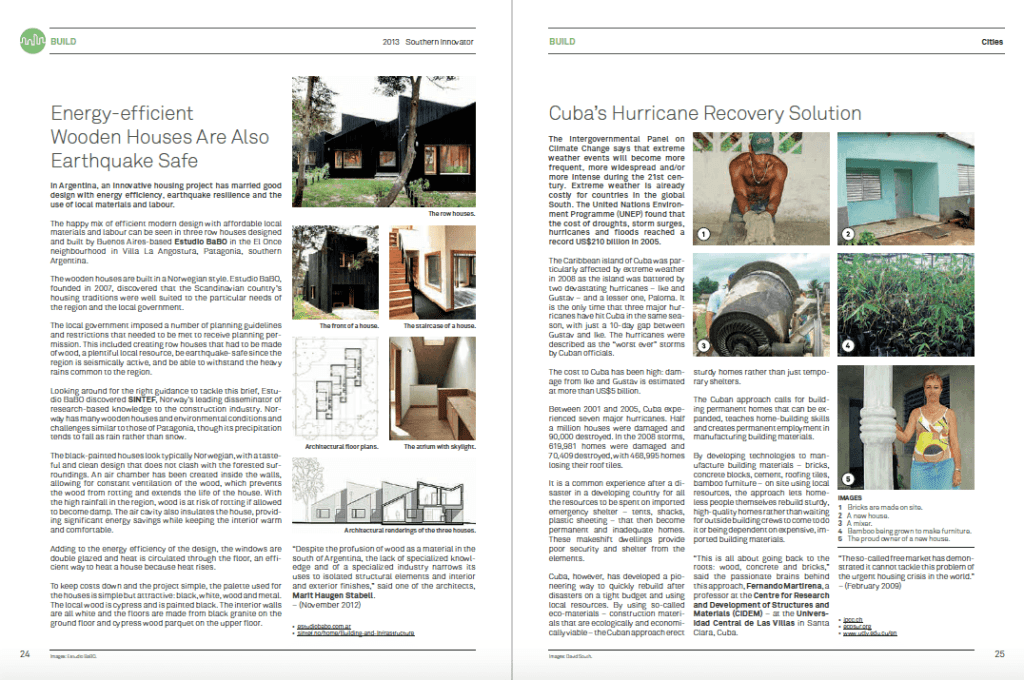
In Argentina, an innovative housing project has married good design with energy efficiency, earthquake resilience and the use of local materials and labour. As energy resources continue to be stretched around the global South, innovative building designs will be critical to the creation of sustainable housing for the future.
The happy mix of efficient modern design with affordable local materials and labour can be seen in three row houses designed and built by Buenos Aires-based Estudio BaBO (estudiobabo.com.ar) in the El Once neighbourhood in Villa La Angostura, Patagonia, southern Argentina.
The wooden houses are built in a Norwegian style. Estudio BaBO, founded in 2007, discovered that the Scandinavian nation’s housing traditions were well suited to the particular needs of the region and the local government.
The local government imposed a number of planning guidelines and restrictions that needed to be met to receive planning permission. This included creating row houses which must be made of wood – a plentiful local resource. They also had to be earthquake-safe since the region is seismically active and be able to withstand the heavy rains common to the region.
Looking around for the right guidance to tackle this brief, Estudio BaBO discovered SINTEF – Norway’s leading disseminator of research-based knowledge to the construction industry (http://www.sintef.no/home/Building-and-Infrastructure/). The Nordic nation has many wooden homes and also has similar environmental conditions and challenges to Patagonia – though its precipitation tends to fall as rain, rather than snow.
The black-painted homes look typically Norwegian, with a tasteful and clean design that does not clash with the forested surroundings. An air chamber has been created inside the homes’ walls allowing for constant ventilation of the wood, which prevents the wood from rotting and extends the life of the house. With the high rainfall of the region, wood is at risk of rotting if allowed to become damp. The air cavity also insulates the house, providing significant energy savings while keeping the interior warm and comfortable.
Adding to the energy efficiency of the design, the windows are double glazed and heat is also circulated through the floor – an efficient way to heat a home because heat rises.
To keep costs down and the project simple, the palette used for the homes is simple but attractive: black, white, wood and metal. The local wood is cypress and is painted black. The interior walls are all white and the floors are made from black granite on the ground floor and cypress wood parquet on the upper floor. The rest of the woodwork in the house is also made of cypress.
Using locally sourced materials also helps to keep costs down.
The project was initially conceived in 2009 and the houses were built in 2010-2011. While wood is plentiful in Patagonia, traditionally the use of wood in construction was rudimentary and local labour skill levels were low. This meant the design had to be simple and easy to build.
“Despite the profusion of wood as a material in the south of Argentina, the lack of specialized knowledge and of a specialized industry narrow its uses to isolated structural elements and interior and exterior finishes,” said one of the architects, Marit Haugen Stabell.
The three units of two-storey row houses each come with a living room, dining room, kitchen, toilet, two bedrooms and a laundry room. Each home also has an outdoor patio. The homes are designed to receive maximum natural light. Deploying this energy efficient design is considered unusual for Argentina and Estudio BaBO has set a new standard for sustainable housing in the country.
It looks like the CLF Houses could inspire others to look again at wood as a building material.
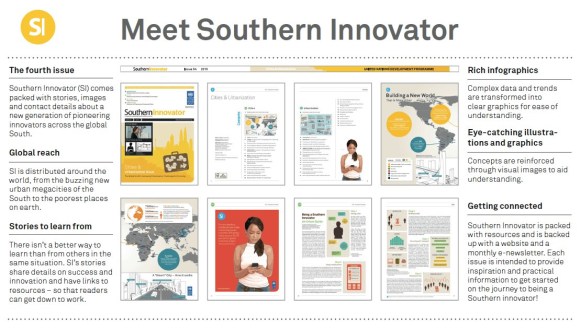
Development Challenges, South-South Solutions was launched as an e-newsletter in 2006 by UNDP’s South-South Cooperation Unit (now the United Nations Office for South-South Cooperation) based in New York, USA. It led on profiling the rise of the global South as an economic powerhouse and was one of the first regular publications to champion the global South’s innovators, entrepreneurs, and pioneers. It tracked the key trends that are now so profoundly reshaping how development is seen and done. This includes the rapid take-up of mobile phones and information technology in the global South (as profiled in the first issue of magazine Southern Innovator), the move to becoming a majority urban world, a growing global innovator culture, and the plethora of solutions being developed in the global South to tackle its problems and improve living conditions and boost human development. The success of the e-newsletter led to the launch of the magazine Southern Innovator.
A clash is occurring across the global South over the future of urban planning and the ever-growing slums of the world’s megacities. This will be a decisive clash of visions: should cities flatten slums and relocate their residents, or work with slum dwellers, acknowledge the role they play in city economies and improve their lives with better dwellings?
As the world turned into a majority urban place in the 2000s, cities grew at a phenomenal rate. The cities of Africa and Asia are growing by a million people a week, according to some estimates. Megacities and sprawling slums will be the hallmarks of this new urban world, it seems. In sub-Saharan Africa, 72 percent of the population already lives in slum conditions.
The danger of building unsafe or makeshift homes can be seen in 2010’s devastating earthquake in Haiti, where many buildings collapsed, killing thousands.
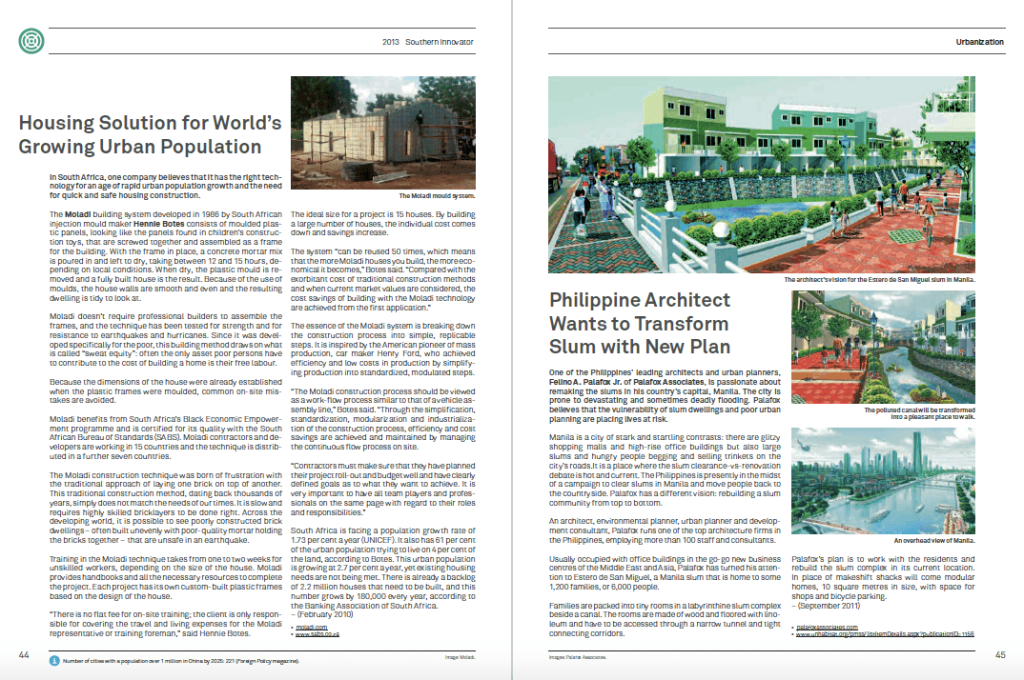
One of the Philippines’ leading architects and urban planners, Felino A. Palafox Jr. of Palafox Associates (www.palafoxassociates.com), is passionate about re-making the slums in his country’s capital, Manila. The city is prone to devastating and sometimes deadly flooding. Palafox believes the vulnerability of slum dwellings and poor urban planning are placing lives at risk.
“We can’t wait for another tragedy,” Palafox told the Philippine Daily Inquirer in 2010. “We have seen how an unprecedented volume of rainfall like what (storm) Ondoy had brought could prove too much for Metro Manila’s river and drainage system. We have also seen what a massive earthquake could do to an unprepared city like Haiti.
“While there is nothing that we could do to control the destructive power of these natural phenomena, there are steps that we could take to limit the amount of damage.”
If the rapid growth in urban populations is to be safe and sustainable, then new dwellings will need to be built that meet high standards of durability.
The UN Challenge of Slums report from 2003 (www.unhabitat.org/pmss/listItemDetails.aspx?publicationID=1156) broke with past orthodoxy that slums must be cleared, arguing that slums should be seen as positive economic forces, incubators for budding entrepreneurs that offer a gateway to better things for new migrants.
Muhammad Khadim of UN-Habitat summed up the new thinking:
“Ten years ago, we used to dream that cities would become slum-free,” he said. But “the approach has changed. People see the positives. The approach now is not to clear them but to improve them gradually (and) regularise land tenure.”
The arguments behind embracing slums come from the economic changes across developing countries since the 1970s. Growing informal economies combined with fewer social provisions and the shift to urban from rural communities have all contributed to the explosion in slums and informal housing.
Manila is a city of stark and startling contrasts: there are glitzy shopping malls and high-rise office buildings, but also large slums and hungry people begging and selling trinkets on the city’s roads.
It’s a place where the slum clearance-vs-renovation debate is hot and current. The Philippines is currently in the midst of a campaign to clear slums in Manila and move people back to the countryside.
“Many of our people are no longer interested in agriculture, so we need to give them incentives to go back,” Cecilia Alba, head of the national Housing and Urban Development Co-ordinating Council, told the New Statesman magazine. “If we had to rehouse the slum-dwellers inside Manila in medium-rise housing, it would cost a third of the national budget.”
Palafox has a different vision – rebuilding a slum community from top to bottom.
An architect, environmental planner, urban planner and development consultant, Palafox runs one of the top architecture firms in the Philippines, employing more than 100 staff and consultants.
Usually occupied with office buildings in the go-go new business centres of the Middle East and Asia, Palafox has turned his attention to Estero de San Miguel, a Manila slum that is home to some 1,200 families, or 6,000 people.
Families are packed into tiny rooms in a labyrinthine slum complex beside a canal. The rooms are made of wood and floored with linoleum and have to be accessed through a narrow tunnel and tight connecting corridors.
Palafox’s plan is to work with the residents and rebuild it in its current location. In place of makeshift shacks will come modular homes, 10 square metres in size with space for shops and bicycle parking.
The design has the homes extend above a walkway, imitating the way the original slum structures were built.
Palafox is applying innovative thinking to the problem: taking his design direction from the dwellings slum residents build: “The slum-dwellers,” he explained to the New Statesman, “are experts at live-work space design. They spontaneously do mixed-use! We just have to learn from them.”
Re-housing the residents on site means they can continue to play their role in the city’s economy, and do not have to make a long commute to jobs and opportunities.
Palafox also rebuts complaints about the cost of his plan, arguing the scale of corruption in the Philippines costs just as much.
“OK, the total cost of rehousing slum-dwellers in situ is 30 per cent of GDP (but) I calculate we lose about 30 per cent of the country’s wealth through corruption. If we didn’t have corruption, we wouldn’t need to tolerate slums.”
“We have to recognize the value of slum-dwellers to the city,” he said. “These are the ones who drive your car, clean your house and run your store. If these people were cleared from the city, the city would die. Slum-dwellers add social, political and economic value to the city.”
Even in its current form, Estero de San Miguel is a vibrant place, with an Internet café and a volunteer police force.
A BBC report found it lively and economically viable because it has educational and communication technologies that improve living conditions. The residents make their living working as cheap labour for the city.
Oliver Baldera, a carpenter, lives with his wife and four children:
“We’ve been here more than 10 years,” he told the New Statesman. “There’s no choice.
“It’s easier to get a job here and I can earn 400 pesos a day. I can send the kids to school and they eat three times a day – but it’s not enough. I need more space.”
Published: September 2011
Resources
1) More Urban, Less Poor: The first textbook to explore urban development and management and challenge the notion unplanned shanty towns without basic services are the inevitable consequence of urbanization. Website:http://www.earthscan.co.uk/?tabid=649 2) Slum Populations in the Developing World: See a breakdown of the urban/slum population in developing nations. Website:http://news.bbc.co.uk/1/hi/5078654.stm 3) Architecture for Humanity: An NGO to promote architectural and design solutions to global, social and humanitarian crises. Website:http://architectureforhumanity.org/ 5) Building and Social Housing Foundation: The Building and Social Housing Foundation (BSHF) is an independent research organisation that promotes sustainable development and innovation in housing through collaborative research and knowledge transfer. Website:http://www.bshf.org 6) NGO called Map Kibera began work on an ambitious project to digitally map Africa’s largest slum, Kibera in Nairobi, Kenya. Website:http://www.mapkibera.org 7) ArrivalCity: The Final Migration and Our Next World by Doug Saunders. Website:http://www.arrivalcity.net 8) Slum TV: Based deep inside Nairobi’s largest slum, Mathare, they have been seeking out the stories of hope where international media only see violence and gloom. Website:http://www.slum-tv.org 9) A Kenyan eco-village is helping slum dwellers to start new lives and increase their wealth. The community, Kaputei, is being built by former slum residents – some of whom used to beg to survive – and is providing new homes with electricity, running water and services like schools and parks. By building their own homes, with the help of affordable mortgage loans, the residents are able to make a big upgrade to their quality of life while acquiring real wealth. Website:http://www.jamiibora.org 8) Cities for All shows how the world’s poor are building ties across the global South. Website:http://globalurbanist.com/2010/08/24/cities-for-all-shows-how-the-worlds-poor-are-building-ties-across-the-global-south.aspx









 David South Consulting
You must be logged in to post a comment.