Tag: design

  • Ghanaian Coffins Prove Design and Craftsmanship Boost Incomes

    Ghanaian Coffins Prove Design and Craftsmanship Boost Incomes

    By David SouthDevelopment Challenges, South-South Solutions

    SOUTH-SOUTH CASE STUDY

    In many parts of the world, indigenous ingenuity and craft skills are finally getting the recognition they deserve. The quirky but very inventive gadgets and solutions featured on the Afrigadget blog (http://www.afrigadget.com) never fail to inspire and amaze. The Democratic Republic of the Congo’s (DRC) fashionable gentlemen (http://www.henryherbert.com/gentlemen-of-bacongo/) grabbed the attention of – and inspired – European fashion designers with their creativity and flair. And then there are the Africa Maker Faires, gatherings of clever and innovative thinkers and inventors who get down to work generating solutions to today’s problems.

    Beyond the grim stories of development failures and human tragedies, there is another Africa full of creativity and can-do attitude.

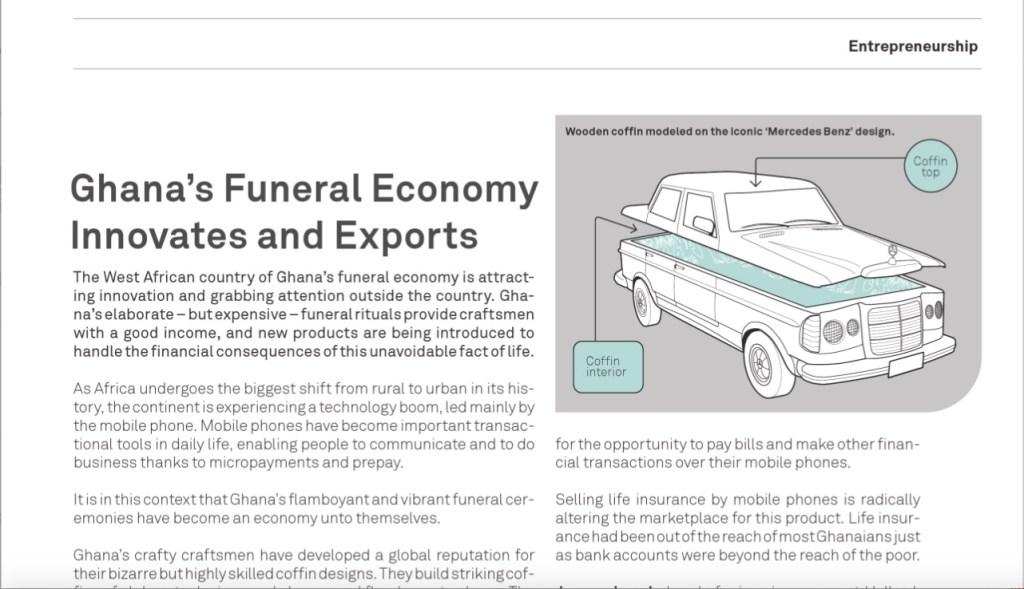
    Amongst the Ga people (http://en.wikipedia.org/wiki/Ga_people) of Teshi, Ghana there is a tradition with a twist: custom-designed coffins. A Ghanaian pioneer has been transforming the way people deal with that most sombre and respectful of rituals, the funeral. Coffin-artist Paa Joe is drawing on a modern-day tradition in Ghana dating back to the 1950s. Coffins – which are normally made from wood and follow the standard template of a narrow, body-length box – are transformed into grand and lively statements about the deceased person’s life.

    Designs have included a giant pink fish, a Ghana Airways plane, a souped-up Mercedes Benz and an African eagle.

    “The Ga people (http://www.ghanaweb.com/GhanaHomePage/tribes/ga.php), from the south-east coast of Ghana, revere their ancestors and give great importance to funeral celebrations,” Jack Bell, a London gallery owner exhibiting the coffins, told The Observer newspaper. “Their tradition of creating beautifully carved figurative coffins originated in the 1950s.”

    Paa Joe was born in the Akwapim hills north-east of Accra in 1945. He is considered the top sculpted coffin maker of his generation. He apprenticed with the pioneer of the craft, Kane Kwei (http://www.culturebase.net/artist.php?153) – the man who began this unique vocation in the 1950s. The skill and artistry involved is now recognized in museums around the world, including London’s British Museum.

    The community had a history of highly skilled woodwork and elaborate carvings were regularly created for village chiefs – giant eagles or even the surreal spectacle of a giant cocoa pod.

    The bespoke coffins are an example of how long-standing skills were applied to a new product. The idea of making custom-sculpted coffins begun by Kane Kwei evolved from being a livelihood for Kwei to an apprenticed craft passed down to younger craftsmen. When Kane Kwei’s grandmother died in 1951, without fulfilling her lifelong wish to fly on a plane, Kane made a plane-shaped coffin for her. This coffin was admired by others and Kane got the idea of setting up a workshop and making custom-designed coffins symbolizing the
    deceased’s status and achievements in life.

    “Families commission the coffins – sometimes to a brief designed by the deceased – to represent the aspirations or achievements of a deceased relative, or to characterize their personality: a car for a businessman, a cocoa pod for a farmer, a bible, or even a camera,” Bell said.

    For people with modest means, there are simpler designs of boats, canoes and books. Prices are negotiated with the coffin maker.

    Where there were none, now there are multiple workshops providing custom coffins for funerals. Traditional Ghanaian funerals are lively, colourful events, but the coffin sculptures of Teshi are a modern phenomenon and proof that innovation and good design can transform the most sombre of items into something special.

    Published: December 2010

    Resources

    • Maker Faire Africa: Flickr photo gallery: A clickable archive of the Maker Faire inventors and their inventions. Website:http://www.flickr.com/groups/makerfaireafrica/pool/
    • Afrigadget: Afrigadget: ‘Solving everyday problems with African ingenuity’: This blog never ceases to amaze and fascinate. Website: http://www.afrigadget.com/
    • E-machine Shop: eMachineShop: This remarkable service allows budding inventors to download free design software, design their invention, and then have it made in any quantity they wish and shipped to them: Amazing! Website: http://www.emachineshop.com/ 4) Maker Faire Africa 2010: Catch up on the last Maker Faire Africa. Website: (http://makerfaireafrica.com)
    • Afrigadget: ‘Solving everyday problems with African ingenuity’: This blog never ceases to amaze and fascinate. Website: http://www.afrigadget.com/
    • International Development Design Summit: The Summit is an intense, hands-on design experience that brings together people from all over the world and all walks of life to create technologies and enterprises that improve the lives of people living in poverty. Website:http://iddsummit.org/

    https://davidsouthconsulting.org/2022/10/20/bangladesh-coffin-maker-offers-an-ethical-ending/

    https://davidsouthconsulting.org/2022/10/20/ghanas-funeral-economy-innovates-and-exports/

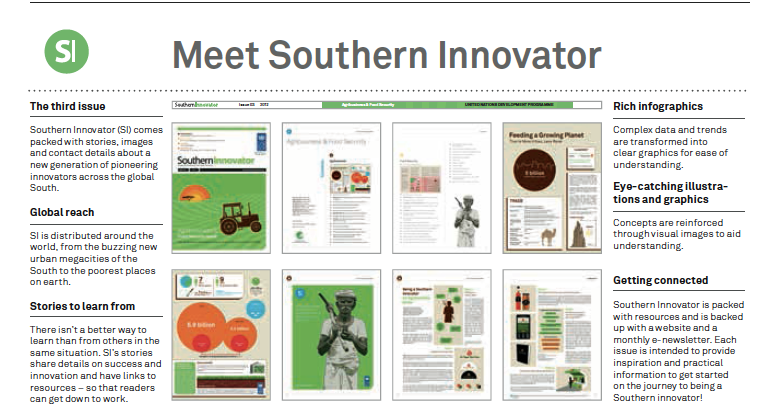
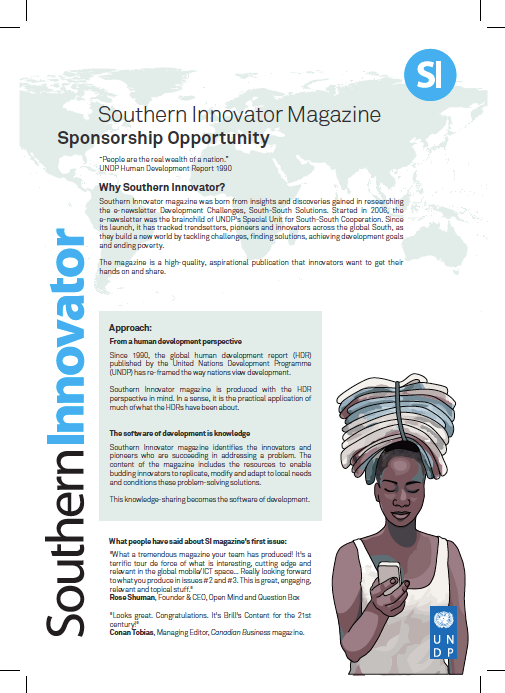
    Development Challenges, South-South Solutions was launched as an e-newsletter in 2006 by UNDP’s South-South Cooperation Unit (now the United Nations Office for South-South Cooperation) based in New York, USA. It led on profiling the rise of the global South as an economic powerhouse and was one of the first regular publications to champion the global South’s innovators, entrepreneurs, and pioneers. It tracked the key trends that are now so profoundly reshaping how development is seen and done. This includes the rapid take-up of mobile phones and information technology in the global South (as profiled in the first issue of magazine Southern Innovator), the move to becoming a majority urban world, a growing global innovator culture, and the plethora of solutions being developed in the global South to tackle its problems and improve living conditions and boost human development. The success of the e-newsletter led to the launch of the magazine Southern Innovator. 
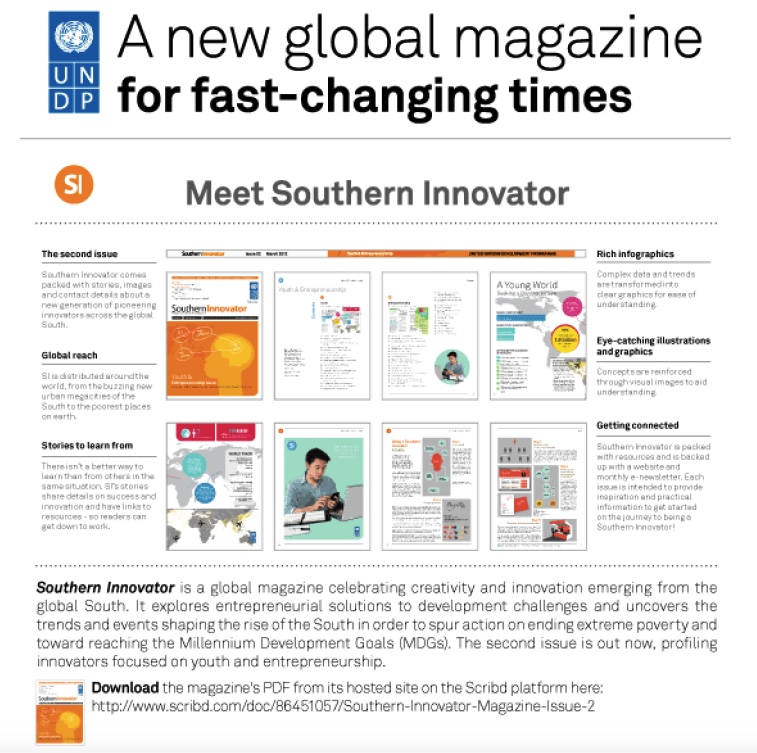
    https://davidsouthconsulting.org/2021/03/05/southern-innovator-issue-2/

    Creative Commons License

    This work is licensed under a
    Creative Commons Attribution-Noncommercial-No Derivative Works 3.0 License.

    ORCID iD: https://orcid.org/0000-0001-5311-1052.

    © David South Consulting 2023

  • Design Collaborations Revitalize Traditional Craft Techniques

    Design Collaborations Revitalize Traditional Craft Techniques

    By David SouthDevelopment Challenges, South-South Solutions

    SOUTH-SOUTH CASE STUDY

    Keeping alive traditional craft techniques and methods in the age of globalization is a tricky balance to get right. As countries seek to increase living standards and income, traditional craft-making methods are often jettisoned in favour of attracting manufacturing and other high-value activities – meaning rich and potentially lucrative skills can be lost.

    One promising new initiative is bringing craftspeople in the global South together with established and well-known designers in The Netherlands to create the market incentives to continue using traditional techniques. It is establishing a brand and a business model to sell unique and original craft products into the European marketplace. By doing this, it hopes to open up new markets in Europe – and in time, the rest of the world – for craft makers from the global South so they can continue to earn an income using their traditional skills and techniques.

    The brand is called Imperfect Design (http://www.imperfectdesign.nl/) and was founded in 2011 by Monique Thoonen, formerly the managing director of Dutch Design in Development (ddid.nl) – a matchmaker between Dutch designers, producers in developing countries and European importers. Imperfect Design takes the idea a step further: It is a brand dedicated to creating high-value, well-designed craft products for the European marketplace.

    The idea began to percolate in Thoonen’s mind in 2010. She received a good response from some of the Dutch designers she approached – who were keen to work with craft workers in developing countries – and this gave her the confidence to launch Imperfect Design.

    “We saw that many designers were very interested to work with craftsmen/small workshops in developing countries,” she explained, reflecting on her previous experience working with Dutch Design in Development. “The designers and the crafters learned a lot about the inspiring cooperation and it resulted often in good quality products/collections. However, it was hard to find good sales channels for the products. In 2010 the idea came about to set up an own brand.”

    Thoonen was seeking a business model that could be sustainable and rewarding for all the participants along the value chain (http://en.wikipedia.org/wiki/Value_chain).

    “The cooperation is inspiring for Dutch designers,” Thoonen said. “The craftsmen will learn a lot about product development during the project and will earn money from the orders. The idea is to build up long-term relations with producers in three countries in three continents – each continent one country.”

    For Thoonen, the business model approach is at the core of Imperfect Design.

    “The idea of my business model is not doing good. It must be a profitable business model, otherwise it can’t be sustainable. Making it profitable is a big challenge and also forces us to keep the commercial aspect every day in mind.”

    The criteria for selecting the designers includes a resourcefulness and creativity that can shape a high-quality craft product with the resources and tools at hand for the collaborating craft workers in the developing country. It is also crucial they understand how to shape the craft product into a high-value item that can command a high price back in Europe.

    According to Thoonen, “the products must be differentiated from the market, otherwise it can be copied easily by large producers in China. It is really important to create new things, as the prices are in general higher than from mass production, so the consumer must understand why the price is higher.”

    So far, Imperfect Design has begun working with craftspeople in Vietnam and Guatemala, and it is currently selecting a country in Africa. Craft workers can contact Imperfect Design about collaborating but the number of people it can work with is limited at this stage. Imperfect Design places emphasis in taking the time to build sustainable relationships.

    A common criticism of craft products sold in many markets is their sameness and sometimes poor and inconsistent production quality. Trying to enter an overseas market and understand what consumers want or desire is a very difficult thing for a craft worker to get right. This is where the experience and knowledge of a designer can make a big difference. Designers can help to hone the craft product, improve the production methods and position the product in the overseas marketplace.

    “The workshops have fantastic qualities and materials to work with,” says Thoonen. “When you combine that with the strength of our Dutch designers, you can create products which are commercial, of high quality, and beautiful.”

    One of the first collaborations to bear fruit is between Dutch designer Arian Brekveld (arianbrekveld.com) and craft workers in Vietnam. The collaborations have resulted in lacquer tables, trays and candlesticks, ceramic vases, iPad bags and throw cushions – all made using techniques and materials unique to Vietnam.

    Imperfect Design allows the designers to select which country they would like to work with. Brekveld’s previous experience travelling widely in Asia tipped his interest towards a country in that continent. He appreciated the friendly and welcoming contacts he had made in Vietnam, who showed a strong interest in collaborating.

    Brekveld wanted to bring a “designer’s eye” to the possibilities in Vietnam. He asked: “How could they make the crafts more beautiful and customized for the market in Europe?”

    He found Vietnam was not just an interesting place to work, but also a country undergoing significant change. As a result, he found it critical to go and see what was happening in the country and to see first-hand the working conditions in the workshops.

    This was a contrast to many of the design briefs he normally undertakes in Europe, where there often isn’t the intimacy of working directly with the craft workers in their workshops.

    The time spent in Vietnam was intense and involved visiting multiple workshops to see which would be the best partner.

    “We visited four or five lacquer companies to see what their skills were, looking for possibilities,” he said. “It is very special to see by yourself, to really to take a look by yourself, to see what companies do.”

    Brekveld was surprised to see that concepts that had been discussed and explored earlier in the day would be presented to him as completed works by the end of the day. The quick work pace and precision really impressed the designer, and the project took months to complete in comparison to the years required by some projects he works on in Europe.

    A group of women from the ethnic Catu (http://en.wikipedia.org/wiki/Co_Tu_people) community in central Vietnam weaved the fabrics for the iPad bags and cushions. It was very valuable to work with them in person because he could see what they were – and weren’t – capable of. The fabrics are made into iPad bags and cushions in the capital Hanoi by disabled craftsmen.

    Brekveld said visiting the remote workshop saved a lot of time and frustration.

    “It was a big difference compared to sitting behind a desk and sending designs. You really see all the possibilities that are there.”

    Brekveld is seeking to design products that do not fit in with a clichéd idea of what comes from a developing country.

    “If you look you can see the imperfections but they are not obvious. These designs would not necessarily sell in their own country. We try to design products showing the skills they have, using their techniques – not using patterns they would use for themselves. We look at their process and say ‘you can make that and that’. On the other hand, we don’t want to tell them to do something completely different. We look at the technique – a combination of European design language with their abilities.”

    But what about quality control? Brekveld says that is an issue he looks at right from the beginning of the design process. “I am a maker, try to make myself – try to think about it before hand.”

    He is ambitious for the collaboration to flourish.

    “We hope these relations are long-term relations,” he said. “We hope to expand the collection.”

    He will present the collections during Dutch Design Week at the end of October 2012 in Eindhoven (ddw.nl).

    For Thoonen, success will bring many benefits. “If we manage to sell the collection well in the market, then we can give more orders,” Thoonen said. “In short: it will create work, but also development in quality and design.”

    Published: September 2012

    Resources

    1) An online film showing Arian Brekveld’s trip to Vietnam and the craft collaborations. Website: http://imperfectdesign.nl/index.php?route=product/category&path=72_91

    2) Dutch Design in Development: DDiD is the agency for eco design, sustainable production and fair trade. They work with Dutch importers and designers and connect them to local producers in developing countries and emerging markets. Together products are made that are both profitable and socially and environmentally sustainableWebsite: http://www.ddid.nl/english/

    3) Dutch Design Week: Groundbreaking ideas, mind-blowing experiments and extraordinary forms of collaboration – that’s what it’s all about during DDW. With the boundless creativity of hundreds of renowned designers and young talents, each year the leading event offers a unique look into the future of design (Eindhoven, The Netherlands: 20-28 October 2012). Website: http://www.ddw.nl/

    Creative Commons License

    This work is licensed under a
    Creative Commons Attribution-Noncommercial-No Derivative Works 3.0 License.

    ORCID iD: https://orcid.org/0000-0001-5311-1052.

    © David South Consulting 2023
  • Cooking Bag Helps Poor Households Save Time, Money

    Cooking Bag Helps Poor Households Save Time, Money

    By David SouthDevelopment Challenges, South-South Solutions

    SOUTH-SOUTH CASE STUDY

    For millions of poor people around the world, life is lived on the economic margins and household and personal budgets are tight. There were 1.29 billion people in the world living on less than US $1.25 a day as of 2008 (World Bank), and 1.18 billion living on US $1.25 to US $2 per day. There was only a modest drop in the number of people living below US $2 per day – the average poverty line for developing countries – between 1981 and 2008, from 2.59 to 2.47 billion.

    Since the global economic crisis erupted in 2008, the world’s poor have seen prices fluctuate wildly as the international financial system fights the effects of the turmoil. In 2008, this led to the Food and Agriculture Organization sounding the alarm about the harmful effects of rising food inflation.

    Increasing hunger led to civil unrest and rioting that year.

    Anything poor people can do to make their slim daily budgets go a little bit further means more money left over for better quality food and other expenses, like clothing, shelter, fuel and education. One clever invention from South Africa is trying to tackle household cooking costs and shave the cost of fuel required to prepare the family meal. The Wonderbag (http://nbwonderbag.com/) is a brightly coloured, puffy cooking bag that slow cooks a meal in a pot – be it a stew, curry, rice, soups – to save energy.

    “The cost and savings per household are significant,” according to the Wonderbag’s inventor, Sarah Collins.

    It has many other advantages, too: it is a time-saver, allowing people to spend the time doing something other than just tending the cooking pot. It can also reduce cooking accidents because less time is spent around the stove or fire.

    It is an efficient cooking method that uses less water to cook meals. And it even avoids the risk of burning – and wasting – food.

    “20 per cent of all staple food in Africa is burned, due to pots being placed on open fires and unregulated stove tops. With the Wonderbag, no burning happens,” confirms Collins.

    To date, the Wonderbag has created 1,000 jobs and is looking to increase this to 7,000 jobs in the next five years.

    Wonderbag bills itself as “eco-cooking that’s changing lives.”

    Eco-cooking seeks to use every joule (http://en.wikipedia.org/wiki/Joule) of energy from the cooking fire or heat source to maximum effect. A pot is placed on the stove and brought to the temperature required for cooking the dish. Then the pot is placed in the Wonderbag. Since the bag is heavily insulated, it reflects back the existing heat in the dish and allows it to continue cooking for up to 12 hours. It can cook rice in one hour and lamb in two to three hours.

    It works in four easy steps, summed up on the Wonderbag website: “boil it, bag it, stand it, serve it”.

    The Wonderbag claims to use 30 per cent less energy than other cooking methods. According to cost breakdowns on the Wonderbag website, someone with a Wonderbag would use 2.4 litres a week of paraffin – a common fuel for cook stoves – compared to 4 litres without. This works out to a cost of US $2.40 a week with a Wonderbag and US $4.00 a week without.

    The trade-off with the savings in money and energy is time – Wonderbag is not suitable for those looking for a quick meal. According to Wonderbag, meat that cooks in 20 minutes on the stove will take five hours in the Wonderbag.

    Chicken that takes 15 minutes on the stove takes three hours in the Wonderbag. Vegetables that take five minutes on the stove will cook in an hour in the Wonderbag.

    South African entrepreneur and inventor Collins originally developed the Wonderbag for people living in the townships of Durban (http://en.wikipedia.org/wiki/Durban). She found many of the residents spent up to a third of their income on fuel for cooking. They would either use paraffin or spend many hours gathering wood or dung.

    These common fuel sources for cooking give off toxic fumes and are a health hazard if used for long periods. The Wonderbag means households spend less time inhaling fumes from a stove.

    “The Wonderbag will always be a work in progress for me as I look to adapt the bag in line with my consumers’ feedback,” confirms Collins. “For example, we are now about to launch Wonderbag 2, which has an even more efficient insulator than polystyrene and is more readily available and easier to recycle following feedback earlier in the year.”

    In South Africa, the bags sell for R170 (US $22) and there are discounts for the very poor. Collins estimates that a family of four could save US $80 a year if they used the Wonderbag two or three times a week.

    Collins has used clever marketing strategies to get the Wonderbags out to the public, and 150,000 have been sold so far. One promotion gave away a Wonderbag with every purchase of boxes of curry powder.

    Wonderbag has also partnered with local communities. Swartland Municipality (swartland.org.za) purchased 5,000 Wonderbags and distributed them to 4,700 of “the most indigent and deserving households – the poorest of the poor.”

    It is also running a promotion in the United Kingdom where, for every Wonderbag bought, one is given to a family in the developing world.

    The popularity and success of the Wonderbag prompted the multinational food company, Unilever – one of the world’s leading suppliers of fast-moving consumer goods – to purchase 5 million bags for distribution. According to the Wonderbag website, this could lead to savings of US $1.35 billion on fuel for the users.

    “The partnership has also enabled us to scale up and test the Wonderbag in different markets,” explains Collins.

    Wonderbag hope to expand to 12 or 15 developing countries in Africa in 2012.

    The company says it plans to target developing countries with high poverty, fuel supply shortages, high incidence of health problems from air pollution, and high incidence of injuries from fuel fires.

    And for Wonderbag’s success so far, Collins has this advice: “Immerse yourself in your product and the way of life of your consumers. Understand it and them inside out so you can be your best advert. Word of mouth is by far the best form of advertising and the truth out of your own mouth is a great start.”

    Published: April 2012

    Resources 

    1) Haybox: Haybox is another variation on the concept of heat retention for efficient cooking. Website: http://haybox.co.uk/

    2) How to build a clay oven. Website: http://clayoven.wordpress.com/2008/08/29/1-building-a-clay-oven-the-basics/

    3) Solar ovens and cookers are another way to cut costs when making meals.This website has many designs and plans on how to build a solar cooker. Website: http://solarcooking.org/plans/

    Follow @SouthSouth1

    Slideshare: http://www.slideshare.net/DavidSouth1/development-challengessouthsouthsolutionsnovember2010issue

    Southern Innovator Issue 1: https://books.google.co.uk/books?id=Q1O54YSE2BgC&dq=southern+innovator&source=gbs_navlinks_s

    Southern Innovator Issue 2: https://books.google.co.uk/books?id=Ty0N969dcssC&dq=southern+innovator&source=gbs_navlinks_s

    Southern Innovator Issue 3: https://books.google.co.uk/books?id=AQNt4YmhZagC&dq=southern+innovator&source=gbs_navlinks_s

    Southern Innovator Issue 4: https://books.google.co.uk/books?id=9T_n2tA7l4EC&dq=southern+innovator&source=gbs_navlinks_s

    Southern Innovator Issue 5: https://books.google.co.uk/books?id=6ILdAgAAQBAJ&dq=southern+innovator&source=gbs_navlinks_s

    Creative Commons License

    This work is licensed under a
    Creative Commons Attribution-Noncommercial-No Derivative Works 3.0 License.

    ORCID iD: https://orcid.org/0000-0001-5311-1052.

    © David South Consulting 2024