Bonn, Germany: “The training allows us to learn about western theories of journalism,” says Mr. Nyamjav, editor of the Erkh Choloo (Freedom) newspaper. A UNDP project in Mongolia has brought journalists from Ulaanbaatar, Mongolia’s capital, to run an investigative journalist training programme for their colleagues in the rural community of Moron. The programme introducing investigative journalism to students consists of a workshop and various field assignments. Here, I report on day two of the training.
9:00 a.m.
Eleven student journalists and the two trainers, Ms Oyunsetseg and Mr. Batbold from the Press Institute of Mongolia, quickly run through the day’s schedule. The journalists will spend the next two hours interviewing subjects for their stories. All the journalists say this is the first time they’ve explored in detail this sub-category of journalism. Not all the students are experienced journalists, but this is made up for by the quality of the two facilitators, both of whom keep the workshop lively.
11:30 a.m.
The debate begins over the choice of stories. One team has chosen to look at poverty alleviation projects at the Bak (local government) level. They want to write a story looking at poor accountability for loans, the practice of nepotism and the ability of recipients to start small businesses. The team investigating power black-outs wants to conduct further interviews with the poorest people affected by such interruptions.
4:00 p.m.
Back at the offices of the Erkh Choloo newspaper, editor Nyamjav discusses the week’s news with his graphic designer. The skills of the staff impress me. While they have only one computer and barren offices, the paper won an award from the Press Institute for being the best local paper in 1997. The newspaper will be cut off from local government subsidies for printing at the end of this year and is already making plans to find other sources of revenue. Nyamjav is pleased with the results of the UNDP project, saying: “It has noticeably changed our stories – I know how to criticise reporters and push them to be more investigative.”
8:30 p.m.
Outside Ulaanbaatar a petrol shortage has hit hard. At a Moron filling station drivers patiently wait for new supplies to arrive or to receive their ration. Not only is there no fuel, there is also no electricity. On a field assignment the journalists investigating the power black-outs interview Mr. Sukhbaatar the power station director who says 3,500 households owe the utility Tug 27 million (US$27,411). It is the poorest households that are unable to pay in the Ger districts. A Ger is a Mongolian felt tent. Without payment, their power is cut off.
9:00 p.m.
I am asked to conduct a one-hour discussion of my experiences as an investigative journalist in Canada and England. The debate afterwards is lively. A common question is how to deal with pressure from government and corporations to alter the content of stories. The difficulty the regional journalists have in distributing newspapers to remote communities is a common complaint. They ask how international donors could help in this matter, pointing out that in the past the government subsidised newspaper distribution to a greater extent. They would like to be linked with international journalists in some way, preferably through an association.
Id Magazine (Canada), December 12 to December 26, 1996
It is looking more and more like the Conservative government will launch a massive privatization campaign by the middle of next year. And it is becoming clear how key government assets such as Ontario Hydro, liquor stores and public broadcaster TVO will end up in private hands. The prevailing ideology of key advisors to the Harris government, including influential financial heavyweights at Canada’s top underwriters, is leaning towards a free-for-all where the highest bidder will win.
To date, the government has been coy about its plans, occassionally making vague threats that certain services need to be “looked at.” Assets that could go on the block include road maintenance, jails and the Ontario Clean Water Agency. In August, the government appointed former banker Rob Sampson as the minister for privatization. His days as vice-president of corporate finance at Chase Manhattan make him a popular candidate with the suit, tie and blouse crowd on Toronto’s Bay Street.
While Sampson is so far surrounded by only a handful of advisors, the plan is to create a privatization agency that will supervise each sell-off after getting the go-ahead from Cabinet.
Sampson’s policy advisor James Small, sums up the government’s attitude: “This is not being driven by fiscal or ideological motivation, though that may seem funny. We can do better for less, even though that may sound trite.”
The government’s taxpayer-is-always-right attitude means it believes the best option is to float the newly privatized companies on the stock market, letting the highest bidder win.
“We have sophisticated investors in Ontario,” continues Small. “[Privatization] is not driving us to expand shareholders in Ontario. Can we, as taxpayers, benefit? What will give the best results. It is not ideological. In Canada we have a consumer culture and a very mature social structure. The market will determine what people will pay for things. We didn’t get elected to sell the family silver.
“There has been 16 years of this happening. But is Margaret Thatcher the way to go? One of the advantages for Ontarians is that we can pick and choose the best approach. It’s difficult to point to one part of the world, one way we could provide better service.”
Shareholder Democracy
A concept popularized by British prime minsiter Margaret Thatcher in the 1980s, shareholder democracy actually saw the light of day in British Columbia back in 1979. Then, premier Bill Bennett embarked on an ambitious scheme to give every citizen of the province, including children, five shares in the British Columbia Resources Investment Corporation, a mining and logging company. Out of a population of 2.4 million, 2.07 million applied for the shares. While that idealistic experiment eventually failed as a series of bad deals pushed the share price down and arrogant executives pissed people off, it was a bold initiative.
Similar schemes have been used in Eastern Europe to increase private ownership in the economy.
But it is looking more and more like the government is going to try and avoid even a semblance of giving Ontarians a fair shake, by selling shares on the stock market to whoever can afford them. While the NDP and unions are opposed to privatization for some very good reasons, they are missing out on an opportunity to push the government to divide the shares up amongst all Ontarians (not necessarily a big stretch for the NDP, who brought us toll highways).
Shareholder democracy has developed two broad – and opposing – interpretations. For the left, a shareholder democracy in its truest sense is public ownership. For right-wing idealists, it means a nation of share owners playing the stock market with all the aggressiveness and greed of free-market capitalists.
Like any ideal, the reality is far more disappointing. Any small-time stock holder will tell you about arrogant CEOs and board members not listening to them. Ask any Ontarian on the street, and they will tell you about arrogant and incompetent civil servants who aren’t listening to them.
There is a more radical and fairer approach to privatization that would suit the populist rhetoric of the Conservatives. It involves selling shares along the lines of WWII war bonds. This solution would satisfy left-wing concerns the rich would run away with all the loot, while massively increasing share ownership in Ontario and raising funds to improve services and infrastructure. By selling millions of shares cheaply, and forbidding the trading of those shares, millions of Ontarians could reap the benefits of profit-making assets. This scheme would be contingent on reorganizing those agencies to become profitable, but could avoid a fire sale of taxpayer-funded agencies to wealthy corporations and investors. If critics of the government took the opportunity to guide the Conservatives, when a privatization is announced, towards mass share ownership, some good would come of it.
With all its scandals, bad publicity, grotesque executive salaries and inconsistent service that has turned privatization into a dirty word in the UK, the fact is share ownership did go up. In 1979 when Conservative prime minister Margaret Thatcher was elected, shares were owned by 2.5 million people; by 1992, 11 million people had shares or a quarter of the population. Narrowly defined, that is a success.
But the mainstream financial community loathes the idea for obvious reasons. At consultants KPMG, corporate evaluater John Kingston symbolizes the opposition to anything other than a straight sell-off at the stock exchange. “Issuance of shares to employees doesn’t put any new money into the coffers, like in the Eastern European example of gifting shares,” he says. “But selling shares to the public does provide some compensation. They must satisfy taxpayers by getting the right amount.”
“I think if government is going to privatize then it is a good time to do it,” says Deloitte and Touche’s Jim Horvath, a veteran of privatizations in Argentina, Hungary and Brazil, who supports a quick sell. “The stock market is up. There are a lot of deep pockets looking for investments.”
The mantra for an open sale will get louder as each privatization approaches. But such a sale does have its disadvantages.
Advantages of an open sale:
Can get the highest price. Use the funds to pay down debt or a one-time only increase in funds for something like health care. Argue protecting taxpayers’ interests by selling for the best price. The asset could raise funds on the stock market to improve infrastructure/services. Once in private hands, future governments will have a hard time trying to buy assets back.
Disadvantages of an open sale:
Taxpayers are also consumers; they could get screwed by any increase in rates. There is no guarantee the government will use funds for public good (maybe they will build another casino?). Any pay-off is once only, whereas the LCBO for example, makes money every year. Government could make a mistake and sell for too low a price.
Government Agenda
Two factors could significantly slow down the government’s ability to launch privatizations. The Conservatives have relished making cuts to government services despite labour unrest, but it has shown little skill at the more intellectual task of implementing a new philosophy. Major planks of their Common Sense Revolution, such as workfare, are bogged down and in chaos. Privatization will need a sophisticated sales job to counter-attack the slick television and newspaper ads unions have been running for the past year attacking privatization. Encouraging mass share ownership would show that leadership the government sorely needs.
The second liability is its own ambitious agenda. Already the Legislature has had to extend its term to try and deal with a backlog in reforms, including chopping another $3 billion, rearranging how government services are delivered and fighting the province’s doctors. But if it must privatize, then the honourable thing to do is to offer mass ownership. To do otherwise will show Ontario isn’t even capable of the heights of imagination some of Eastern Europe’s new democracies have shown.
Note: I debated this topic on CBC TV’s Face Off after this was published.
Cover headline: “The Harris Tories have an opportunity to turn Ontario into a shareholder democracy. Will they take it?”
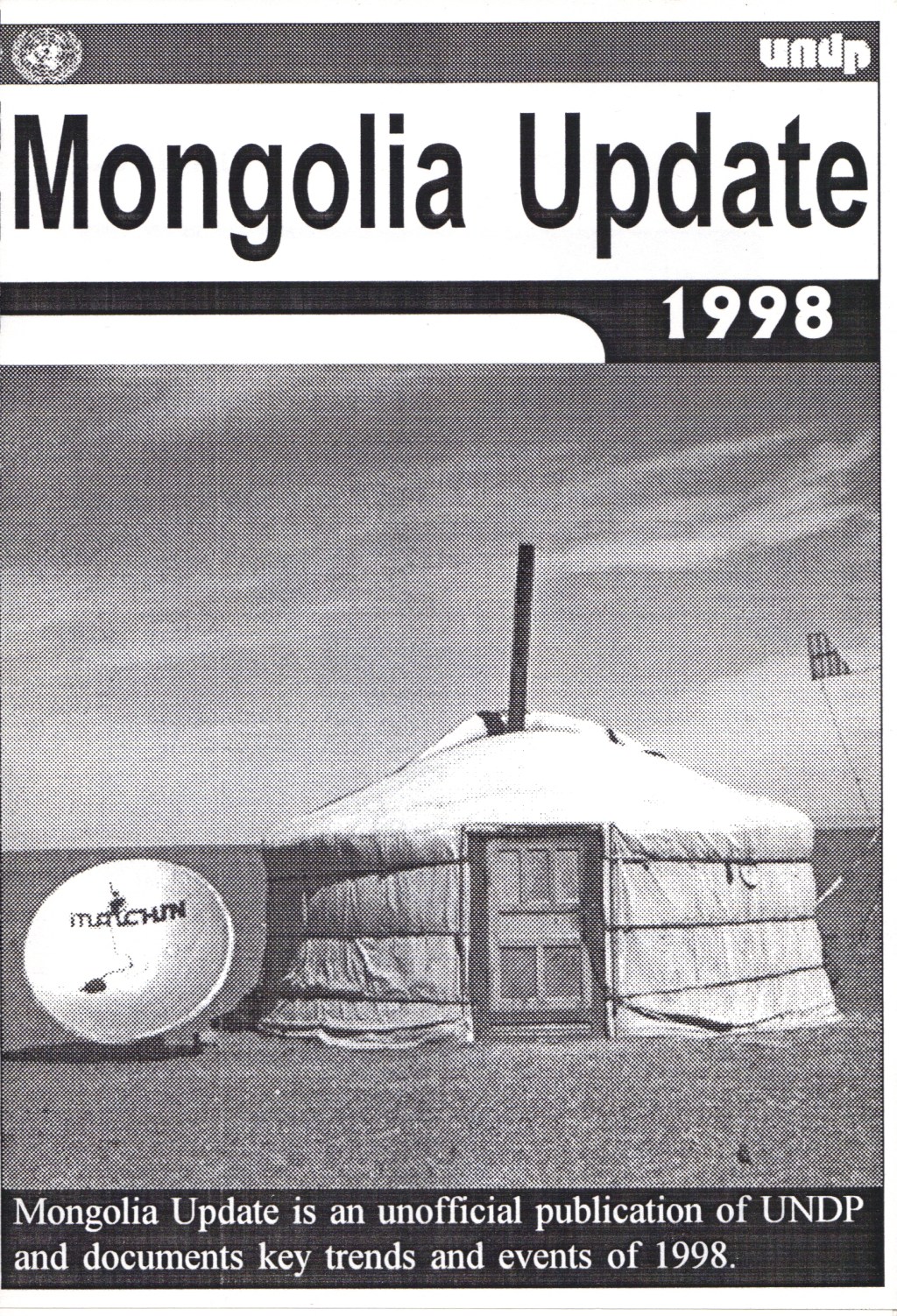
Background: Mongolia Update – Coverage of 1998 Political Changes was a one-off special edition of Mongolia Update to help explain a politically turbulent year where three governments and three prime ministers came and went. At the time, Mongolia was in the grips of a severe crisis, called one of “the biggest peacetime economic collapses ever”. By 2012, Mongolia was called the “fastest growing economy in the world”. It is proof the foundations for Mongolia’s recovery from crisis were laid in the late 1990s. The success of the peaceful transition stands in stark contrast to many other international interventions post-2001.
Mongolia Outlook 2012: World’s Fastest Growing Economy (Publisher: Eurasia Capital), 31 January 2012.
This is an unofficial publication of UNDP. Views presented in this document do not necessarily reflect those of UNDP. Mongolia Update is provided as a service to those who are interested in the rapid changes taking place in today’s Mongolia. A note about Mongolia Update: The Mongolia Update has proven to be one of the more popular documents produced by the UNDP Mongolia office. Since the autumn of 1997 UNDP has been able to offer two more frequently updated sources of information: the UNDP homepage and our monthly newsletter, the Blue Sky Bulletin (available from our office if you are not already receiving it). Please use the United Nations Homepage at http://www.un-mongolia.mn to keep abreast of the latest political, economic and social developments in Mongolia. Mongolia Update is an unofficial document of UNDP and is designed to periodically keep our partners outside of Ulaanbaatar apprised of issues in the country.
Divisions in the ruling Democratic Coalition Government in 1998 led to the fall and rise of three governments and three prime ministers. From the beginning of 1998 cracks within the Coalition intensified. A number of Democrats were dissatisfied with the system whereby the Prime Minister and the Cabinet were not parliamentarians, but “experts” appointed from outside and perceived to be aloof from Parliament. On January 15, 1998, after several weeks of wrangling Parliament ruled that under the Mongolian constitution MPs could serve as Cabinet ministers. It was to prove a fateful decision for the year-and-a-half old M. Enkhsaikhan Government.
A faction within the Coalition Government became more vociferous, with its complaints that the Democrat’s election promises would not be fulfilled without better coordination between the Government and the Parliament. Things came to a head when the General Council of the Mongolian National Democratic Party (MNDP) called for the resignation of its own Government. The move was led by the 35-year-old Speaker of the Parliament and MNDP caucus leader Ts. Elbegdorj – a natural Prime Minister in a Government of MPs. After a joint meeting of the ruling councils of the Mongolian Social Democratic Party (MSDP) and the MNDP, Prime Minister Enkhsaikhan handed in his resignation to Mongolian People’s Revolutionary Party (MPRP) President Bagabandi. The new Prime Minister, Ts. Elbegdorj, was sworn into office on April 23, vowing to chart the same economic course as his predecessor. While trying to form his Cabinet, Elbegdorj quickly ran into trouble.
The opposition MPRP was emboldened, exploiting the fissures in the Democratic Coalition. They started to launch attacks against the new Government. Elbegdorj’s attempts at forming a Cabinet were delayed as one candidate after another was rejected.
The Cabinet was not composed until May 28, when 28-year-old CH. Saikhanbileg became Education Minister – the fifth nominee put forward for the post. The new Government faced an opposition boycott of Parliament by the beginning of June, in the wake of the merging of a state bank with a private bank amidst charges of conflict of interest. On July 25 Ts. Elbegdorj and his entire Cabinet resigned after losing a no-confidence vote in Parliament. The Elbegdorj cabinet continued to work as an acting Government. The murder of prominent democrat and minister of infrastructure S. Zorig shocked the nation October 2. Poised to become a candidate for Prime Minister, Zorig was axed to death in his apartment by two assailants. The crime remains unsolved and grabbed international headlines in what had been seen as the most peaceful country making the transition from communism to democracy. In November the Constitutional Court ruled MPs holding Cabinet posts as unconstitutional. This effectively reversed the aforementioned Parliament decision of January 15, 1998. Throughout the year opinion polls showed a growing weariness and disillusionment creeping into the body politic over the political indecision.
By December a compromise Prime Minister was found, in the form of the mayor of the capital city, Ulaanbaatar. On December 9 Prime Minister Narantsatsralt took office. As 1998 turned into 1999, Narantsatralt was still trying to have his Cabinet approved by both the Parliament and the President.
External economic turmoil started to have its affect on Mongolia in 1998. Many thought the country could ride out the Asian crisis unscathed, but Prime Minister Ts. Elbegdorj admitted in June it was unavoidable. Copper prices, Mongolia’s largest foreign currency earner continued to plummet to record lows. Prices for cashmere and gold, major exports for Mongolia, also declined. The picture for the domestic economy had some bright spots in 1998, with inflation under control and an expansion in the informal service sectors. The Government’s Green Revolution campaign was able to significantly boost the production of vegetables by encouraging home gardening. The economy was still supported by foreign aid, which totaled US $205 million in commitments for the year.
Instability in Russia has also had an impact on Mongolia. For example, in May Russian coal miners blocked the Trans-Siberian train that passes through the capital Ulaanbaatar on its way to China. In August a severe benzene shortage prompted the reintroduction of rationing. At its worst all gas supplies for the country were pulled back to the capital, leaving many stranded and unable to drive cars and run gas-powered electricity generators. The delays were due to job actions by Russian workers. Russia accounts for 30 per cent of Mongolia’s imports and 13.5 per cent of its exports. On the plus side, foodstuffs from Russia became cheaper with the decline of the rouble.
Who is who in the Cabinet
Prime Minister R.Amarjargal, 38 year old Moscow educated economist. He graduated from Economic Institute of Moscow as an economist and a teacher in 1982 and earned a master’s degree at Bradford University in 1994-1995.
1982-1983, he was an instructor in Mongolian Trade Union, 1983-1990, he worked as a teacher in Military Institute, 1991-1996 has served as Director of the Economics College. He was a popular Foreign Relations Minister before resigning with the entire cabinet on July 24, 1998. A member of MNDP, he speaks fluent Russian and English.
Finance Minister Yansangiin Ochirsukh. Born in Ulaanbaatar, economist Ochirsukh graduated from the Mongolian National University and did postgraduate work at Columbia University in the United States. He worked as a lecturer and researcher at the University before moving to the Mongol Bank, where since 1997 he has been in charge of foreign exchange and reserve policy. A member of the Mongolian Social Democratic Party, he speaks Russian, English and Chinese.
Minister of External Relations Nyamosoriin Tuya, 40, was born in 1958 in Ulaanbaatar. Studied in the Institute of External Relations in Moscow, Russia in international journalism. From 1984 to1985 she studied French culture and civilisation at the Sorbon University and did a Masters degree on the ” Theory of Democracy” at Leeds University, England. Ms.Tuya speaks English and French. Married with two sons and a girl, she worked as editor of the foreign programming service of Mongolian Radio. After 1996, she was working as Head of the Department for Common Policy at the Ministry of External Relations.
Minister of Environment Sonomtserengiin Mendsaikhan, 39, was born in Ulaanbaatar, and completed degrees at the Mongolian State University and the State University of Irkutsk, Russia in mathematics. S.Mendsaikhan speaks German and Russian. Married, he has a daughter. Started his career as a math teacher at an Ulaanbaatar school, he also worked as a lecturer at the Mongolian State University and later become general secretary of the Social-Democratic Party. From 1992 to1993 he worked as a manager in the Unuudur (Today) private newspaper. From1993 to 1997 he worked as a private company director, and in 1997 he was assigned as advisor to the Parliament’s Speaker.
Minister of Defence Sh.Tuvdendorj, 32, graduated from the Army Academy of Mongolia and the Otgontenger Language School. He worked as an army officer, technician and laboratory engineer at the State Telecommunications Utilisation Committee. He started a political career in 1994, working as secretary in charge of local affairs. In 1997, he was elected as general secretary of the Mongolian National Revolutionary party.
Minister of Agriculture Choinzongiin Sodnomtseren, 46, was born in Ulaanbaatar and is married with three children.After attending Mongolian State Agricultural University, he acquired a Ph.D. in Saint Petersburg, Russia. He also has a Ph.D. degree in veterinarian sciences.
While spending many years of his career on research studies, he worked as a lecturer at the State agricultural University. Sodnomtseren became later Principal and Rector of the State Agricultural University.
Minister of Health and Social Welfare Sodoviin Sonin. Born in Ulaanbaatar in 1956, S.Sonin graduated from the Medical University of Irkutsk and Mongolia’s State Administration and Management Development Institute. A doctor and professor of medicine, he has taught surgery at the Mongolian Medical University, worked at the Central Clinical Hospital and served as a department chair at the Ministry of Health and Social Welfare. Since 1991 he has headed the Asian Development Bank-backed Health Sector Development project. Sonin, who speaks Russian and English, does not belong to any political party.
Minister of Infrastructure, Gavaagiin Bathuu, 39, born in Hujirt county of Uvurhangai province. Married with two sons and a daughter, he graduated from the Economics Institute of Harikof, Russia as an auto engineer and economist. He speaks Russian and English. He started his career as a repairman and dispatcher at the state auto-engineering company.From 1986 to 1992, he worked at the Ministry of Infrastructure as an officer and senior officer and from 1992 to 1996 he worked as Director of Shunklai Company. Since1996 he was working as a head of the Department for Road and Transportation at the Ministry of Infrastructure.
Minister of Justice, Logiin Tsog, 47, was born in Ulaanbaatar. He graduated from the State University in Irkutsk, and from the Social Science Academy in Russia. A lawyer with high education in politics, he speaks Russian and English. He worked as the prosecutor for the department at the Ministry of Justice. From 1988 to 1989, he worked as inspector at the Mongolian Revolutionary Party’s Inspection Committee. From 1990 to 1991, he was assigned as the Head of the Standing Committee of the State Baga Hural (parliament of that time) on legal issues. From 1991 to 1996 he was general director of the “Golden Button” Co. Ltd and in 1996 he was elected as general secretary
Minister of Enlightenment A.Battur was born in 1965 in Hovd aimag. Battur is a career diplomat who graduated from Russia’s Institute for International Affairs and completed a postgraduate course at France’s Institute for International Affairs. He worked as an attaché in the Foreign Ministry between 1989 and 1992, and spent 1992 to 1996 as the cultural attaché at the Mongolian Embassy in France-where he also worked with UNESCO- before returning to senior administrative positions at the Ministry in 1996.
A member of the Mongolian National Democratic Party, he speaks English, French and Russian and is married with two children.
A government of technocrats
By January 15, 1999 Mongolia had its first complete Government in six months. All nine members of the Mongolian Cabinet have been approved and appointed. Like Prime Minister Narantsatsralt, they are not Members of Parliament. Since all nine Cabinet Ministers were chosen for their experience, many expect a more stable course to be charted for the remainder of the Democratic Coalition’s term in office (until 2000). However, the new Government might experience the same sort of complaints the Enkhsaikhan Government received, when Parliament accused those ministers of being aloof. It is also unclear if the MPRP will continue to offer a vigorous opposition. For the time being its seems the political forces have exhausted themselves and there is a genuine desire for stability in 1999. The new Government is expected to follow the same reform directions of the two previous Democratic Coalition Governments and details will emerge over the coming weeks.
Paper delivered to the School of Politics and Government, Birkbeck College, University of London, London, UK, 2000
“The strongest is never strong enough to maintain his mastery at all times unless he transforms his strength into right and obedience into duty…Yielding to force is an act of necessity, not of will; at the very most, it is an act of prudence (Rousseau 1762).”
This paper analyses the following proposition: the key post-war institutions were neither an intended, nor an adequate, response to the economic and political challenges of the post-1945 world.
There is ample evidence to show that the plethora of post-war institutions were intended, and were a deliberate consequence of American policy-makers seeking to control the geo-political fallout of the most catastrophic conflict of human history, World War II.
In many respects institutions such as the United Nations, the International Monetary Fund and the World Bank were a sophisticated and modern approach to a new global order minus the old imperial powers. They were an act of significant imagination and inspiration drawn from a long tradition in asserting the rule of law over the rule of anarchy; the rights of the weak over the tyranny of the strong.
However, these institutions have repeatedly failed to meet the economic and political challenges of the past 55 years. The commitment of the United States to these bodies tailed off after World War II, and America displayed a lack of will to mature them beyond a dependence on American initiative and action.
There is substantial evidence to support the argument that the hegemony of Pax Americana over the last half century undermined the evolution of these institutions, sustaining a chaotic world order that has not delivered prolonged peace or prosperity for a large number of the world’s citizens and that these institutions were ill prepared to confront the collapse of the Soviet Union at the end of the 1980s.
This paper will explore the inadequacies of the global institutions to meet two key aspirations of the post-war world: conflict resolution and avoidance and economic prosperity based on free markets and democratic regimes.
I will argue that, while this period avoided a major conflagration on the scale of the world wars, it was not a period of peace. Regional conflicts, costly both in terms of human life and of finance, plagued every one of the years since World War II. This has been called a period of Pax Americana (Knutsen 1999). I will argue that, rather than a period of global harmony and prosperity anchored by the American hegemon, it has been a period of Pax Chaotica, a “macabre dance of death in which the rulers of the superpowers mobilize their own populations to support harsh and brutal measures directed against victims within what they take to be their respective domains, where they are ‘protecting their legitimate interests,’” as Noam Chomsky describes it (Chomsky 1995: 207). Pax Chaotica is a period in which there is an illusion of stability offered by a hegemon, but in which the hegemon’s military, economic and moral superiority is unable to secure actual peace and prosperity in the world. The hegemon is out of balance, its military and economic superiority in predominance, while its moral superiority and credibility wanes and withers on the vine.
I will analyse how adequate the global institutions were in the context of the concept of hegemony — in particular the hegemony of the United States, which has not relinquished this hegemony to the global institutions it initially set up. I will conclude that the 1990s has been a period of half measures, incremental attempts at bolstering the concept of international security by the community of nations, but that those attempts, as in the case of the Gulf War or in Kosovo, have been still under the direction of the United States.
Making up a master plan: The deliberate development of the institutions
The post-war master plan was comprehensive, and included the International Bank for Reconstruction and Development (World Bank), the International Monetary Fund, the International Trade Organisation (superseded by the General Agreement on Tariffs and Trade as the instrument of freer trade) and the United Nations. A clutch of security organisations was also established after the war, including NATO. As Knutsen aptly puts it:
WITH MEMORIES OF THE INTERWAR RECESSION AND THE NEW DEAL FRESHLY IN MIND, ALREADY, IN THE FIRST YEARS OF THE WAR THEY BEGAN TO DESIGN STABILISING POSTWAR INSTITUTIONS OF INTERNATIONAL FINANCE AND TRADE — THE IBRD, THE IMF AND THE ITO. … THEY SOUGHT TO SET UP THE MOST IMPORTANT POSTWAR INSTITUTIONS BEFORE THE CONDITIONS OF PEACE WERE EVEN RAISED. THEY RUSHED THE CONFERENCES ON THE UN, IBRD, IMF AND ITO INTO SESSION BEFORE GERMANY AND JAPAN SURRENDERED. (KNUTSEN 1999: 203)
The founding of the United Nations and the Bretton Woods institutions (the International Monetary Fund and the International Bank for Reconstruction and Development, later the World Bank) marked a turning point in world history. The United States had been attempting to exert greater control on the global order since the first 14 proposals of President Woodrow Wilson during World War I. As European powers declined at the beginning of the 20thcentury, liberal American policymakers saw an opportunity for the US to assert its hegemony over the world and re-write the rules of economic engagement along American lines. The two world wars only made the US wealthier and wealthier: in World War I, by providing armaments to both sides of the conflict; in World War II by joining with Canada as the armament and resource engine for the allied war effort.
In many ways, the new institutions represented a forward-thinking and idealistic policy compared to a global order marked by imperial rivalries. It captured contemporary ideas on economic theory, projected a universalist Lockean ideal that all men from all nations are equal, and it was injected with the idealism and energy of the world’s largest democracy and the strongest market economy.
Franklin Roosevelt, like Woodrow Wilson, saw America’s engagement in the world war as a struggle to contain European-style militarism, imperialism and exclusive trade blocs. America’s aim, in both wars, was to preserve the conditions for liberal world order — for a democratic system of politics and an economic system based on free-market principles. Wilson and Roosevelt both sought to liberalize world trade. And they both sought to use America’s leading position in world politics to bring other countries into line with America’s policy. (Knutsen 1999: 193)
These institutions ensured that the US had an influence on every facet of world affairs post World War II. It could merge its political and economic goals and ensure it had a stake in the recovery from the war. This played very well when it came to shoring up domestic support in the United States.
Under a World Bank controlled by Americans, development assistance could be focused precisely where America’s core corporations saw the greatest opportunity. And so long as the recipients of America’s foreign aid used it to buy American exports core corporations could venture into global trade confident of receptive markets. Through such means, the playing field of global commerce was sufficiently tipped in America’s direction so that by the mid-1950s even the National Association of Manufacturers could be persuaded to support tariff reduction. (Reich 1992: 64)
The institutions were philosophically strong, too. Learning from Machiavelli that human relations can be cynical, ruthless and riddled with power agendas, the United Nations offered a peaceful forum to resolve these disputes and a theoretically far more transparent alternative than what had come before. As Weber emphasised, modern states helped to promote capitalist development. With that in mind, the Bretton Woods institutions laid the groundwork for a global financial structure pegged to the US dollar and promoting an American view of free markets.
Hegemony theory and Pax Americana
I argue that these global institutions have shown themselves to be hampered and inadequate when faced with serious political and economic challenges. The root cause is a weakness that is most often cited as their strength: the United States.
Hegemonic stability has been characterised by the emergence of successive dominant liberal powers (Gilpin 1987: 66). What Strange calls “structural power” is essential to the establishment of hegemony over world affairs, since it “confers the power to decide how things shall be done, the power to shape frameworks within which states relate to each other, relate to people, or relate to corporate enterprises (Strange 1998: 25).”
The post-World War II global institutions are an excellent example of the intersection of politics and economy; institutions like the United Nations seek to wield influence in both the political sphere and the economic, most particularly through the Bretton Woods institutions. Hegemonic world order exists, Knutsen suggests, “when the major members of an international system agree on a code of norms, rules and laws which helps govern the behaviour of all. This agreement reflects the rhetorical skills of a particular great power (Knutsen 1999: 49).” This is what happened towards the end of World War II, as the United States wrote the new world order according to its own rules.
As further evidence of US supremacy, the new global rules were constructed so as to force America’s superpower rivals, the USSR and China, to join “its” institutions, not the other way around (though Taiwan stood in for the People’s Republic in the United Nations, against the protests of the USSR, until 1971).
The US became the hegemon because the Soviet Union had very little to offer, either in terms of economic assistance or of political freedoms.
Historians now understand that potential clients encouraged the United States to become a hegemon at the end of World War II: the term “empire by invitation” has come to characterize what happened. The Soviet bid for postwar influence lacked any comparable legitimacy, and so quickly came up against a condition that creates major difficulties for hegemons, which is lack of consent. (Gaddis 1992: 177)
Do as I say, not as I do: The rise and fall of the hegemon’s moral advantage
A large part of the credibility of the US hegemony was bolstered by its moral advantage vis-à-vis other nations. A heady cocktail of democratic freedoms, economic success and military might led many other nations to believe the US and its institutions had got it right where others had failed.
As Strange notes: “President Truman had followed up in his augural address to the Congress with the firm promise of American help to peoples seeking freedom and a better material life. Moral authority based on faith in American intentions powerfully reinforced its other sources of structural power (Strange 1994: 32).”
Supporters of US hegemony, like John G. Ruggie, believe the hegemon must be liberal-minded. Otherwise:
IF THE OTHER STATES BEGIN TO REGARD THE ACTIONS OF THE HEGEMON AS SELF-SERVING AND CONTRARY TO THEIR OWN POLITICAL AND ECONOMIC INTERESTS, THE HEGEMONIC SYSTEM WILL BE GREATLY WEAKENED. IT WILL ALSO DETERIORATE IF THE CITIZENRY OF THE HEGEMONIC POWER BELIEVES THAT OTHER STATES ARE CHEATING, OR IF THE COSTS OF LEADERSHIP BEGIN TO EXCEED THE PERCEIVED BENEFITS. (GILPIN 1987: 73)
The US steadily weakened its credibility and moral advantage in both the areas of conflict resolution and avoidance, and in promoting economic prosperity.
Conflict resolution and avoidance
The US was seen as willing to distort global institutions to fight its ideological — and real — battles with the Soviet Union, and its proxies around the world. The US’s credibility as a promoter of peace and security was severely hampered by the Korean War, the Vietnam War and a dubious record of support for undemocratic regimes and guerrilla movements. These conflicts were intended to “contain” the Soviet Union and the spread of communism and to support regimes that were friendly to free markets. This was played out in a cynical cat-and-mouse game with the Soviet Union, where both sides avoided direct confrontation with each other and used third countries to wage their ideological battles.
Gaddis takes an overly generous view of the Cold War high-wire act, but it is worth being reminded:
BUT THE 1950S AND 1960S DID SEE A REMARKABLE SEQUENCE OF POTENTIALLY DANGEROUS CONFRONTATIONS — DIENBIENPHU, 1954; QUEMOY-MATSA, 1955; HUNGARY-SUEZ, 1956; LEBANON, 1958; BERLIN, 1958-59; THE U2 INCIDENT, 1960; CUBA, 1961; BERLIN, 1961; LAOS, 1961-62; THE CUBAN MISSILE CRISIS, 1962 — EVERYONE OF WHICH WAS RESOLVED WITHOUT MAJOR MILITARY INVOLVEMENT BY EITHER SUPERPOWER. THE SAME COULD NOT BE SAID OF KOREA IN 1950, OR OF VIETNAM AND AFGHANISTAN LATER ON. (GADDIS 1992: 33)
Other than actually being drawn in as a combatant, as in the case of the Korean War, the UN became more of a sideline observer and critic than a robust resolver of conflicts. The UN was critically flawed from the beginning and abrogated its commitment to collective security. It also proved ineffective when confronted with crisis. As Strange points out, one of the biggest weaknesses in the founding of the UN was the Charter. In Article 2, Paragraph 7, all matters of domestic consideration were the business of a state, and in Article 51 states were allowed to form alliances for individual or collective self-defence, “thus reopening the door to a security structure based on alliances and counter-alliance rather than on collective responsibilities for the maintenance of peace between states (Strange 1994: 52).”
The UN was also hampered from developing a collective security maturity by the Security Council. The five permanent members used the veto to control resolutions, with the USSR and the US the most prolific abusers. The US had a total of 69 vetoes from 1945 to 1994; the USSR had 116.
The fall of the Soviet Union at the end of the 1980s marked the beginning of a new period of instability in large parts of the world. The spotlight is once again on the UN to become an arbiter of conflict; once again it is most active when it is pushed by the United States to act when the US feels there is an interest to be served. This has been the case in the major UN missions in the 1990s, from the Gulf War (oil reserves), to the former Yugoslavia (European security). The UN proved to be ineffective where there was no naked US interest putting pressure on the organisation to act, as in the case of Rwanda. Strange remarks that this has had a demoralising effect on those who seek a security structure upholding international law and the universal rights of man.
The fear that either the world organization would merely be the tool of one or other great power (as indeed it was the tool of the United States in the early 1950s) or that it would be ineffectual — as both the League and the UN have proved to be in the face of grave threats to international peace and order — have been enough to kill any realistic hopes of managing a transition from the present security structure to a multilateral or confederal one. (Strange 1994:52)
Economic prosperity
The second half of the 20th century has been hailed as a period of unprecedented global prosperity. Global gross national product rose from US $300 billion to US $2 trillion from 1945 to 1970 (Reich 1992: 64), though much of this was concentrated in a handful of countries. The major challenge of the 20th century has been the task of spreading prosperity around the world; to more evenly distribute the gains than can be reaped from advances in science and technology. The collapse of the colonial powers left large numbers of underdeveloped nations grappling with independence.
With the collapse of the Bretton Woods arrangements in the early 1970s, and the emergence of deregulation in financial flows in the world, the US abrogated much of its responsibility for micro-managing global development. The market was now to do all the work, and being the modern age, rapid capital flows were to make the market work efficiently.
Like the experience with conflict resolution and avoidance, the economic project has been mixed. A dependence on the market has not avoided a dependence on the economic fortunes of the global hegemon. As the US ship rises and sinks, so does the rest of the world. The Global economic system, Panic notes:
WAS RUN BY THE DOMINANT ECONOMIC POWER AFTER THE SECOND WORLD WAR: THE UNITED STATES. IN THAT SENSE, ITS FORTUNES, LIKE THOSE OF THE CLASSICAL GOLD STANDARD, WERE DIRECTLY LINKED TO THOSE OF THE RELATIVE ECONOMIC PERFORMANCE AND POLICIES OF THE COUNTRY RESPONSIBLE FOR THE LARGEST SHARE OF WORLD INDUSTRIAL PRODUCTION, TRADE, AND FINANCE AT THE TIME — PRECISELY THE OUTCOME THAT THOSE ATTENDING THE BRETTON WOODS CONFERENCE HAD BEEN ANXIOUS TO AVOID. (PANIC 1995: 46)
By 1994, total world exports were more than 14 times greater than in 1950; output was five times greater than in 1950 (Dicken 1999: 24). But the economic achievements ring hollow if the well-being of the whole planet is taken into consideration. By 1995, 60 percent of the manufacturing in the world occurred in three countries — the United States, Japan and Germany (UNIDO 1996). While manufacturing in developing countries had quadrupled to 20 percent of global output, it was concentrated in a few developing countries with strong ties to the US.
There is a direct connection between US interests and who does well economically. Western Europe was reconstructed rapidly with US money, and Germany became an industrial powerhouse again. The defeated Japan was restored as Asia’s wealthiest nation with American investment and advice. In 1945, 71 percent of world manufacturing was concentrated in four countries. Developed countries were host to 2/3 of foreign direct investment (Dicken 1999: 21). Most FDI is now concentrated in industrial, developed countries.
There is a direct link between the failures of the UN and the global economy. The weakness of the international security arrangements also have an impact on economies. Vast sums of money are re-directed towards weapons purchases and away from human needs. For many smaller economies, this is a punishing drain on national resources and the funds are often borrowed from elsewhere. As Chomsky noted in the 1980s, “The fact is that both of the superpowers — and many lesser powers as well — are ruining their economies and threatening world peace, indeed human survival, by a mindless commitment to military production for themselves and for export (Chomsky 1995: 209).”
There are concrete examples of developing countries that have achieved significant development gains, reaping the gains of peace and freer world trade. A group of 18 developing countries enjoyed growth rates in the 1990s of over five percent (DFID 2000: 66). This is attributed to more open trade policies compared to other developing countries (though many other countries have been equally open to trade, like Mongolia, but have not reaped the same benefits). China has enjoyed unprecedented growth, but it also has increasing rates of unemployment and violent unrest in its western regions. Sub-Saharan Africa’s 600 million population generates exports no greater than Malaysia’s 20 million (DFID 2000: 67).
In regard to the World Trade Organization (WTO), the majority of its 140 members are developing countries. Not a perfect organisation, its agenda is dominated by a few wealthy nations, but the alternative of a world of bilateral trade deals hangs as a spectre if it fails. As the DFID report, Eliminating World Poverty: Making Globalisation Work for the Poor, points out:
DESPITE PROGRESS OVER THE LAST 50 YEARS, DEVELOPED COUNTRIES MAINTAIN SIGNIFICANT TARIFF AND NON-TARIFF BARRIERS AGAINST THE EXPORTS OF DEVELOPING COUNTRIES…TOTAL DEVELOPING COUNTRY GAINS FROM A 50 PER CENT CUT IN TARIFFS, BY BOTH DEVELOPED AND DEVELOPING COUNTRIES, WOULD BE IN THE ORDER OF $150 BILLION — AROUND THREE TIMES AID FLOWS. (DFID 2000: 69)
Conclusion
The postwar world order and the use of global institutions to build it, was a deliberate policy of the United States. It, however, proved only a half measure and the over-dependence on the United States ensured that these institutions were hampered when confronted with economic and political crises. As I have argued, a state of Pax Chaotica was the result.
For Pax Chaotica to end, there needs to be a renewed effort by the United States to shore up global institutions and to develop a concrete plan to ensure that the global institutions become the global hegemon in every sense of the word. There have been incremental moves in this direction, including attempts to pay dues owed by the US to the UN.
There needs to be a complete shift from the realist American interests of Pax Chaotica to the interests of the community of nations. In fact, there is an opportunity for a convergence of core American values — respect for individual liberty, freedom of expression, democracy — with the goals of the global institutions.
As for international institutions, they must show themselves to not only be just, but also to be seen to be just. Institutions can no longer work in the shadows as they have in the past. Well-educated, wealthy protesters in Western countries will no doubt continue to demand transparency.










You must be logged in to post a comment.