Categories
Archive Development Challenges, South-South Solutions Newsletters

Tackling China’s Air Pollution Crisis: An Innovative Solution

By David SouthDevelopment Challenges, South-South Solutions

SOUTH-SOUTH CASE STUDY

China reached an undesired landmark in 2013. While the country’s impressive economic growth has amazed the world, it has come at a price: pollution. China recorded record levels of smog in 2013, with some cities suffering air pollution many times above what is acceptable for human health.

This is evidence of the perils of rapid industrialization using non-green technologies. China relies on coal burning, a highly polluting resource, for 70 to 80 per cent of its electricity. It also uses coal for factories and winter heating.

Burning coal causes smog, soot, acid rain, global warming, and toxic air emissions (http://www.ucsusa.org/clean_energy/coalvswind/c01.html). Environmental group Greenpeace claims 83,500 people died prematurely in 2011 from respiratory diseases in Shandong, Inner Mongolia and Shanxi – the top three coal-consuming provinces in China.

Anyone visiting Beijing or other Chinese cities will notice the high levels of smog and how this interferes with access to sunshine and curbs visibility. Worse still for human beings and the environment, this level of pollution causes severe respiratory problems, and has the potential to cause a rise in cancer rates, among other health problems.

Beijing had record pollution levels in January 2013. That haze, according to China’s Ministry of Environmental Protection, covered 1.43 million square kilometers.

Generated by industry and coal-fired power stations, particulate matter (http://www.epa.gov/pm/) or PM, is a complex mix of extremely small particles and liquid droplets. Particle pollution is made up of a number of components, including acids (such as nitrates and sulfates), organic chemicals, metals, and soil or dust particles.

In October 2013, Beijing announced a series of emergency measures to tackle the record high levels of pollution and smog (http://edition.cnn.com/2013/10/23/world/asia/china-beijing-smog-emergency-measures/index.html). The Heavy Air Pollution Contingency Plan uses a color-coded warning system if serious pollution levels occur in three consecutive days. This means kindergartens, primary and middle schools will need to stop classes. Eighty per cent of government cars must come off the roads and private cars can only enter the city on alternate days based on a ballot system. Emergency measures will come into play when the air quality index for fine particulate matter, called PM2.5 (http://www.epa.gov/pmdesignations/faq.htm#0) – very fine particles that lodge in the lungs and are very harmful to human health – exceed 300 micrograms per cubic meter for three days in a row. According to the World Health Organization (WHO), the safe limit for human beings is 20 micrograms (http://www.who.int/mediacentre/factsheets/fs313/en/).

The only serious, long-term solution is to switch to non or low-polluting green energy sources. But, meanwhile, some are coming up with stop-gap measures that also help to educate people about the necessity to do away with this major threat to human health.

Dutch designer Daan Roosegaarde (studioroosegaarde.net) thinks he has a temporary solution to the pollution problem – a “vacuum cleaner” to clean up the sky. And the city of Beijing is taking the solution seriously.

The proposed technology works like this: a system of buried coils of copper produce an ion electrostatic field that attracts smog particles. The particles are magnetized and are drawn downwards, creating a gap of clean air above the coil.

Called the Smog project, it is already under discussion with the mayor of Beijing. An animation video explains how it works: http://studioroosegaarde.net/video/the-smog-project/.

Talking to CNN, Roosegaarde likened the science behind the invention to what happens when “you have a balloon which has static (electricity) and your hair goes toward it. Same with the smog.”

In a deal with the Beijing city government, the technology will be tested in the city’s parks.

Roosegaarde has successfully tested the technology indoors and found it worked in the experiment.

He told CNN: “Beijing is quite good because the smog is quite low, it’s in a valley so there’s not so much wind. It’s a good environment to explore this kind of thing.”

“We’ll be able to purify the air and the challenge is to get on top of the smog so you can see the sun again.”

Roosegaarde thinks that successfully running the experiment in a Beijing park makes a radical statement and shows the benefits of breathing clean air and being able to see the sun on most days.

But he is not deluded that this is the final solution for pollution: “This is not the real answer for smog. The real answer has to do with clean cars, different industry and different lifestyles.”

With many people resigned to the pollution, at least for now, China’s entrepreneurs are making the face masks and air filters people wear to protect their lungs from the pollution more fashionable and appealing to look at, the South China Morning Post reported.

Xiao Lu, a saleswoman at Panfeng Household Products, explained the varying fashion tastes in masks: “Young people tend to like bright colors. Men prefer blue or black masks. Right now, UV proof masks are popular.”

Lu told the newspaper that customers make their decisions based on comfort and price.

Popular brands include Respro (http://respro.com/), Totobobo (totobobo.co.uk) and 3M9010 (http://solutions.3m.com/wps/portal/3M/en_US/3M-PPE-Safety-Solutions/Personal-Protective-Equipment/Products/Product-Catalog/?N=5022986&rt=c3).

But, why not just move out of cities and avoid breathing bad air? Things are not that simple from an economic perspective. The South China Morning Post quoted Rena from Urumqi in China’s western Xinjiang province, who came to Beijing for the better job opportunities.

“Going back to Urumqi means less job opportunities and the air is not necessarily better,” she said. “Staying in Beijing means wearing a mask most days. It’s not very comfortable.

“But I can’t cover my face forever,” she said. “I’d prefer to live in a cleaner environment.

Published: December 2013

Resources

1) eChinacities: Waiting to Exhale: Guide to Buying Face Masks in China. Website: http://www.echinacities.com/expat-corner/Waiting-to-Exhale-Guide-to-Buying-Face-Masks-in-China

2) Pollution-China.com: Living in China despite the pollution. Website: http://www.pollution-china.com/vmchk/RESPRO-masks/View-all-products.html

3) My Health Beijing: A family doctor’s evidence-based guide to wellness and public health. Website: http://www.myhealthbeijing.com/china-public-health/respro-vs-totobobo-which-mask-works-better-for-air-pollution/

4) Dutch Design in Development: DDiD is the agency for eco design, sustainable production and fair trade. We work with Dutch importers and designers and connect them to local producers in developing countries and emerging markets. Together products are made that are both profitable and socially and environmentally sustainable. Website: http://www.ddid.nl/english/

5) Coal power: A map of China’s 2,300 coal-burning plants. Website: http://world.time.com/2013/12/13/one-map-shows-you-why-pollution-in-china-is-so-awful/

https://davidsouthconsulting.org/2021/02/20/baker-cookstoves-designing-for-the-african-customer/

https://davidsouthconsulting.org/2022/02/14/cleaner-stoves-to-reduce-global-warming/

https://davidsouthconsulting.org/2023/02/03/environmental-public-awareness-handbook-case-studies-and-lessons-learned-in-mongolia/

https://davidsouthconsulting.org/2022/11/18/successful-fuel-efficient-cookers-show-the-way/

https://davidsouthconsulting.org/2020/04/25/two-stroke-engine-pollution-solution/

https://davidsouthconsulting.org/2021/01/02/a-undp-success-story-grassroots-environmental-campaign-mobilizes-thousands-in-mongolia-1998/

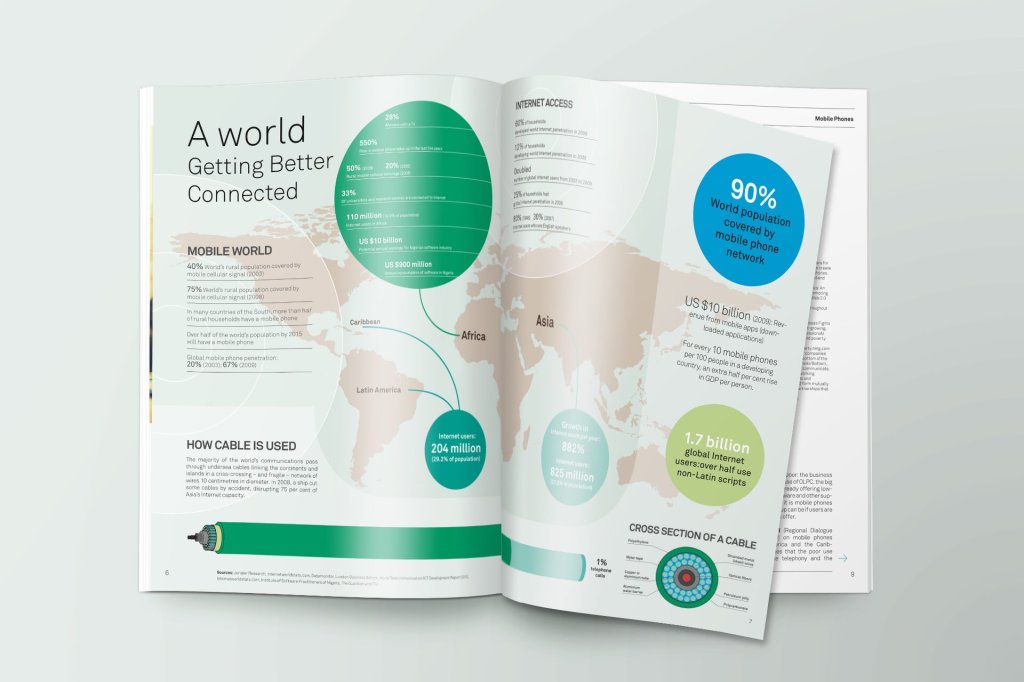
Development Challenges, South-South Solutions was launched as an e-newsletter in 2006 by UNDP’s South-South Cooperation Unit (now the United Nations Office for South-South Cooperation) based in New York, USA. It led on profiling the rise of the global South as an economic powerhouse and was one of the first regular publications to champion the global South’s innovators, entrepreneurs, and pioneers. It tracked the key trends that are now so profoundly reshaping how development is seen and done. This includes the rapid take-up of mobile phones and information technology in the global South (as profiled in the first issue of magazine Southern Innovator), the move to becoming a majority urban world, a growing global innovator culture, and the plethora of solutions being developed in the global South to tackle its problems and improve living conditions and boost human development. The success of the e-newsletter led to the launch of the magazine Southern Innovator. 

Creative Commons License

This work is licensed under a
Creative Commons Attribution-Noncommercial-No Derivative Works 3.0 License.

ORCID iD: https://orcid.org/0000-0001-5311-1052.

© David South Consulting 2023

Categories
Archive Blogroll Southasiadisasters.net United Nations Office for South-South Cooperation

Innovations In Green Economy: Top Three Agenda

By David South

southasiadiasters.net December 2013

The transition to a green economy has reached a crossroads: while multilateral global initiatives have been long-running and complex, the idea of a green economy still seems fragile and achieving it far from certain. In the face of the ravages of the global economic crisis that has raged since 2007/2008, countries are now trying to roll back their green pledges or slow the pace of transition. 

This exposes a dilemma: a perception that a green economy is in conflict with economic growth, prosperity and the advance of human development, particularly in developing countries seeking to make rapid gains in reducing poverty and building a middle class, consumer society. 

Three things need to be foremost in the minds of those who care about creating a global green economy in the 21st century: innovation in design, in market prices and in business models. I think these three factors will be the deciding elements in whether green technologies are taken up quickly and used by large numbers of people to improve their lives. 

The green option needs to always be the more appealing, cheaper option that also improves living standards. Happily, many people are doing this all around the world – you just may not have heard of them yet (unless you are reading Southern Innovator magazine that is). 

As editor of the magazine Southern Innovator since 2011, I have had the privilege to meet, interview and see first-hand green economy innovators across the global South and profile them in the magazine. What has stood out for me is this: the ones who have achieved sustainable success have put a great deal of effort into design – how the technology is made, what it looks like and how it is used, how efficiently it is made and distributed – while also thinking through the business case for their work and how to make it appealing to others. 

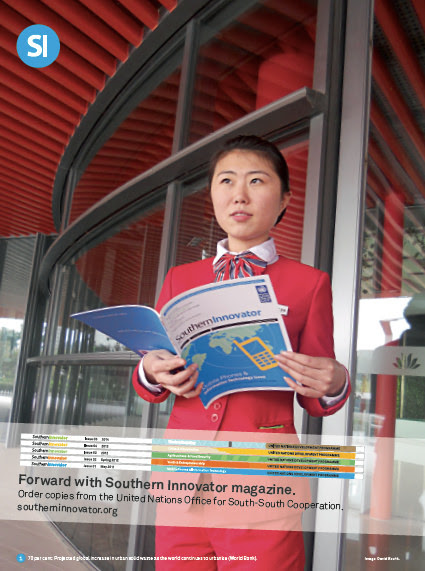
We have tried to apply this thinking to the magazine as well, by using clear and modern design with bright, eye-pleasing colours, and by choosing to use 100 per cent renewable energy (much of it from geothermal sources) for the magazine’s design and layout and to have it printed on paper from sustainable forest sources. 

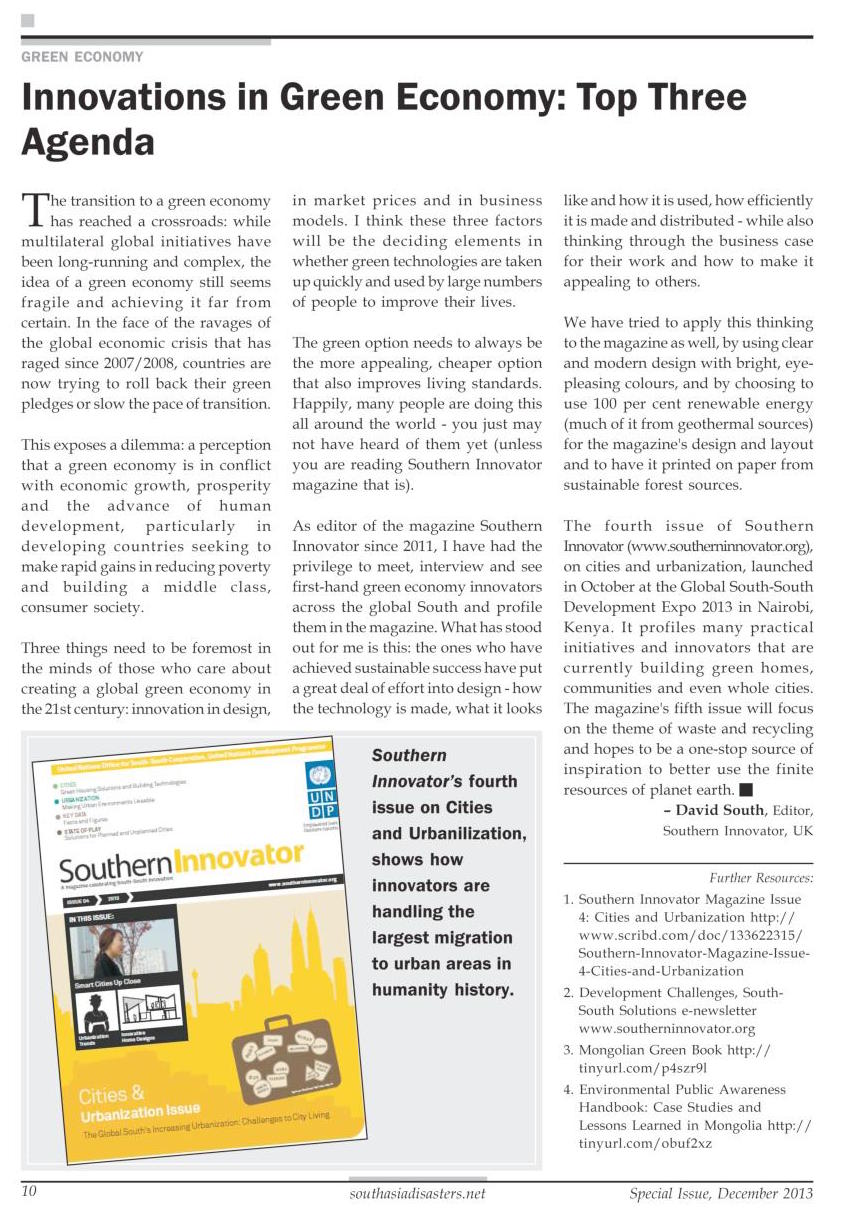
The fourth issue of Southern Innovator (www.southerninnovator.org), on cities and urbanization, launched in October at the Global South-South Development Expo 2013 in Nairobi, Kenya. It profiles many practical initiatives and innovators that are currently building green homes, communities and even whole cities. The magazine’s fifth issue will focus on the theme of waste and recycling and hopes to be a one-stop source of inspiration to better use the finite resources of planet earth.

David South, Editor, Southern Innovator
United Nations Office for South-South Cooperation (UNOSSC)

Southern Innovator Issue 1: https://books.google.co.uk/books?id=Q1O54YSE2BgC&dq=southern+innovator&source=gbs_navlinks_s

Southern Innovator Issue 2: https://books.google.co.uk/books?id=Ty0N969dcssC&dq=southern+innovator&source=gbs_navlinks_s

Southern Innovator Issue 3: https://books.google.co.uk/books?id=AQNt4YmhZagC&dq=southern+innovator&source=gbs_navlinks_s

Southern Innovator Issue 4: https://books.google.co.uk/books?id=9T_n2tA7l4EC&dq=southern+innovator&source=gbs_navlinks_s

Southern Innovator Issue 5: https://books.google.co.uk/books?id=6ILdAgAAQBAJ&dq=southern+innovator&source=gbs_navlinks_s

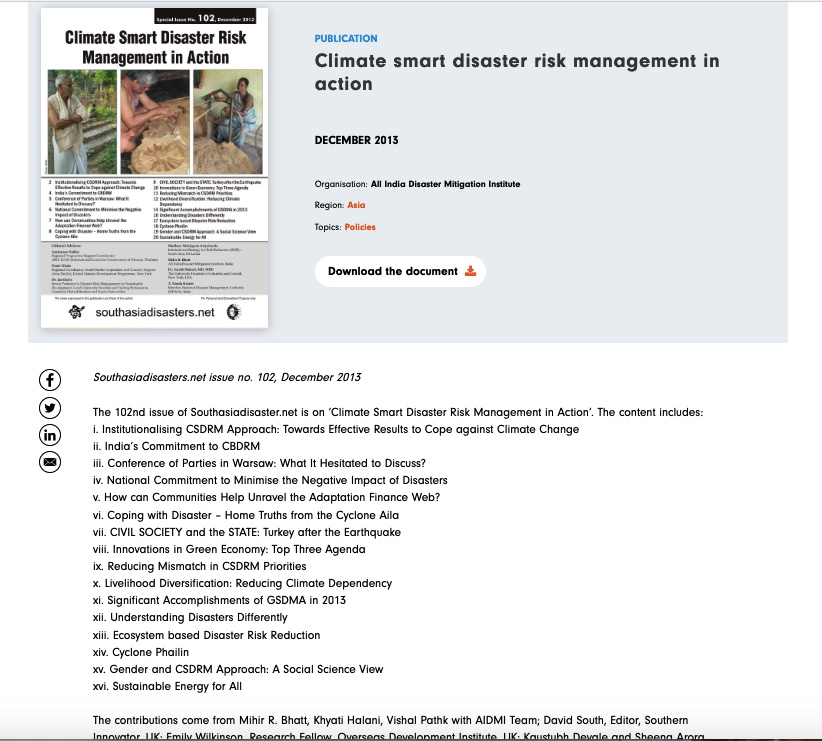
https://wrd.unwomen.org/explore/library/climate-smart-disaster-risk-management-action

https://davidsouthconsulting.org/2022/09/28/asian-factories-starting-to-go-green/

https://davidsouthconsulting.org/2022/09/27/caribbean-island-st-kitts-goes-green-for-tourism/

https://davidsouthconsulting.org/2021/01/25/creating-green-fashion-in-china/

https://davidsouthconsulting.org/2023/02/03/environmental-public-awareness-handbook-case-studies-and-lessons-learned-in-mongolia/

https://davidsouthconsulting.org/2021/02/01/ethiopia-and-djibouti-join-push-to-tap-geothermal-sources-for-green-energy/

https://davidsouthconsulting.org/2021/08/29/indian-business-model-makes-green-energy-affordable/

https://davidsouthconsulting.org/2022/11/11/innovation-cairos-green-technology-pioneers/

https://davidsouthconsulting.org/2021/10/22/lima-to-delhi-what-can-be-learned-on-urban-resilience/

https://davidsouthconsulting.org/2021/08/07/mongolian-green-book/

https://davidsouthconsulting.org/2022/04/14/prisons-with-green-solutions/

https://davidsouthconsulting.org/2021/10/22/south-south-cooperation-for-cities-in-asia/

https://davidsouthconsulting.org/2021/02/23/southern-innovator-in-southasiadisasters-net/

https://davidsouthconsulting.org/2021/03/05/southern-innovator-issue-5/

https://davidsouthconsulting.org/2021/07/15/undp-mongolia-handbooks-and-books-1997-1999/

https://davidsouthconsulting.org/2021/01/02/a-undp-success-story-grassroots-environmental-campaign-mobilizes-thousands-in-mongolia-1998/

https://davidsouthconsulting.org/2021/02/04/us-450-million-pledged-for-green-economy-investments-at-kenyan-gssd-expo/

Creative Commons License

This work is licensed under a
Creative Commons Attribution-Noncommercial-No Derivative Works 3.0 License.

ORCID iD: https://orcid.org/0000-0001-5311-1052.

© David South Consulting 2023

Categories
Archive data Development Challenges, South-South Solutions Newsletters Southern Innovator magazine

Texting For Cheaper Marketplace Food With SokoText

By David SouthDevelopment Challenges, South-South Solutions

SOUTH-SOUTH CASE STUDY

An international group of graduate-social entrepreneurs from the London School of Economics (LSE) is pioneering a way to reduce food prices in Kenya using mobile phones.

Answering a call to action to address global food insecurity by the Hult Prize (hultprize.org), the team members looked at how they could make food cheaper for urban slum dwellers.

The Hult Prize, funded by Swedish educational entrepreneur and billionaire, Bertil Hult, is a start-up accelerator for budding young social entrepreneurs emerging from the world’s universities. The winner receives US $1 million and mentorship to make their idea become real.

SokoText (sokotext.com) (soko means market in Swahili) uses SMS (short message service) messages from mobile phones to empower vegetable sellers and kiosk owners in slums when it comes to bargaining the price for wholesale fresh produce. SokoText makes it possible for them to benefit from bulk prices by pooling their orders together every day. Usually vendors lack the funds to buy in bulk and have to make numerous time-consuming trips to the centre of Nairobi to buy stock.

SokoText reduces the price of fresh produce by 20 per cent for kiosk owners by buying the produce earlier in the supply chain. SokoText then delivers the food to a wholesale outlet at the entrance to the slum.

This approach makes available a wider range of produce and reduces the price. And best of all, it will knock down prices for the poorest people and enable them to buy more food and better quality food.

The team behind SokoText come from a variety of countries – Colombia, Canada, Kenya, Britain and Germany.

Hatched at the LSE, the enterprise prototyped its service in Mathare Valley, Nairobi, Kenya for four weeks during the summer of 2013 with 27 users and began the second phase of testing in November 2013, working with a local NGO, Community Transformers (https://www.facebook.com/pages/Community-Transformers-kenya/119937408165671).

According to SokoText, slum dwellers spend on average 60 per cent of their daily budget on food.

Mobile phones can be transformative since they are now a common communications tool, even in slums.

On the SokoText website, respected blogger and commentator on technology in Africa, Erik Hersman (http://whiteafrican.com/about/), calls it “a fantastic low-tech approach that could really scale for decreasing the inefficiencies in urban slum markets.”

SokoText’s 21-year-old co-founder and chief executive, Suraj Gudka, explained the genesis of the project to news and technology in Africa website, 140Friday.com.

“From our research, the Mama Mboga (small-scale vegetable retailers) spend between 150 and 200 Kenyan shillings (US $1.70 and US $2.3) daily, about 25 per cent of her revenue, to buy her stock, and since they do not buy in bulk they [she] get their goods at a higher price.”

Getting the market traders to cooperate is very difficult, Gudka found, because competition is fierce and trust is low. SokoText sees itself as a solution to this situation. By encouraging bulk buying by way of the SMS text service, there is no need to build trust between the traders before the produce is purchased.

“To use our service, the interested retailers would be required to send us an SMS every evening detailing what they need,” said Gudka, “and then we will source the produce and they come pick it up from us the next morning. In this way they do not have to incur the additional costs of transporting their goods and it also saves them time.”

SokoText is being incubated at the Nailab (nailab.co.ke) in Nairobi, a startup accelerator that offers a three to 12 month entrepreneurship program, with a focus on growing innovative technology-driven ideas.

SokoText’s summer pilot test confirmed taking the orders can work but found getting the product to the market in time was difficult.

The next step will be to set up a presence in the Mathare slum.

“We will be selling about seven to 10 different kinds of produce, and from our calculations, according to our projections for how much the Mama Mbogas buy every day, we hope to get  40-50 customers within three months,” Gudka said.

Published: December 2013

Resources

1) SokoText: The website explains further how the service works. Website: sokotext.com

2) Hult Prize: The Hult Prize Foundation is a not-for-profit organization dedicated to launching the world’s next wave of social entrepreneurs. It encourages the world’s brightest business minds to compete in teams to solve the planet’s biggest challenges with innovative ideas for sustainable start-up enterprises. Annual Hult Prize winners can make their ideas reality with the help of US $1 million in seed funding. Website: hultprize.org

3) White African: Where Africa and Technology Collide! Website: http://whiteafrican.com/about/

4) Nailab: Nailab (Nairobi Incubation Lab) is a startup accelerator that offers an entrepreneurship program focusing on growing innovative technology driven ideas. This is done through providing business advice, technical training and support, professional mentoring and coaching, giving access to market and fostering strategic partnerships as well as linking them to investors. Website: nailab.co.ke

https://davidsouthconsulting.org/2020/04/30/crowdsourcing-mobile-phones-to-make-the-poor-money/

https://davidsouthconsulting.org/2022/06/24/dabbawallahs-use-web-and-text-to-make-lunch-on-time/

https://davidsouthconsulting.org/2022/11/01/innovative-mobile-phone-applications-storm-south/

https://davidsouthconsulting.org/2022/10/27/kenyan-mobile-phone-innovations/

https://davidsouthconsulting.org/2021/09/06/microwork-pioneer-transforms-prospects-for-poor-vulnerable/

https://davidsouthconsulting.org/2020/12/20/mobile-phones-engineering-souths-next-generation-of-entrepreneurs/

https://davidsouthconsulting.org/2020/12/12/mobile-phones-new-market-tools-for-the-poor/

https://davidsouthconsulting.org/2022/06/16/web-2-0-to-the-rescue-using-web-and-text-to-beat-shortages-in-africa/

Development Challenges, South-South Solutions was launched as an e-newsletter in 2006 by UNDP’s South-South Cooperation Unit (now the United Nations Office for South-South Cooperation) based in New York, USA. It led on profiling the rise of the global South as an economic powerhouse and was one of the first regular publications to champion the global South’s innovators, entrepreneurs, and pioneers. It tracked the key trends that are now so profoundly reshaping how development is seen and done. This includes the rapid take-up of mobile phones and information technology in the global South (as profiled in the first issue of magazine Southern Innovator), the move to becoming a majority urban world, a growing global innovator culture, and the plethora of solutions being developed in the global South to tackle its problems and improve living conditions and boost human development. The success of the e-newsletter led to the launch of the magazine Southern Innovator.  

Follow @SouthSouth1

Google Books: https://books.google.co.uk/books?id=hPNcAwAAQBAJ&dq=development+challenges+december+2013&source=gbs_navlinks_s

Slideshare: http://www.slideshare.net/DavidSouth1/development-challenges-december-2013-issue

Southern Innovator Issue 1: https://books.google.co.uk/books?id=Q1O54YSE2BgC&dq=southern+innovator&source=gbs_navlinks_s

Southern Innovator Issue 2: https://books.google.co.uk/books?id=Ty0N969dcssC&dq=southern+innovator&source=gbs_navlinks_s

Southern Innovator Issue 3: https://books.google.co.uk/books?id=AQNt4YmhZagC&dq=southern+innovator&source=gbs_navlinks_s

Southern Innovator Issue 4: https://books.google.co.uk/books?id=9T_n2tA7l4EC&dq=southern+innovator&source=gbs_navlinks_s

Southern Innovator Issue 5: https://books.google.co.uk/books?id=6ILdAgAAQBAJ&dq=southern+innovator&source=gbs_navlinks_s

SokoText co-founder Sofia Zab (left). She oversees SokoText’s marketing strategy and manages SokoText’s technology products.

Development Challenges, South-South Solutions was launched as an e-newsletter in 2006 by UNDP’s South-South Cooperation Unit (now the United Nations Office for South-South Cooperation) based in New York, USA. It led on profiling the rise of the global South as an economic powerhouse and was one of the first regular publications to champion the global South’s innovators, entrepreneurs, and pioneers. It tracked the key trends that are now so profoundly reshaping how development is seen and done. This includes the rapid take-up of mobile phones and information technology in the global South (as profiled in the first issue of magazine Southern Innovator), the move to becoming a majority urban world, a growing global innovator culture, and the plethora of solutions being developed in the global South to tackle its problems and improve living conditions and boost human development. The success of the e-newsletter led to the launch of the magazine Southern Innovator.

https://davidsouthconsulting.org/2021/03/05/southern-innovator-issue-1/

https://davidsouthconsulting.org/2021/03/05/southern-innovator-issue-5/

Creative Commons License

This work is licensed under a
Creative Commons Attribution-Noncommercial-No Derivative Works 3.0 License.

ORCID iD: https://orcid.org/0000-0001-5311-1052.

© David South Consulting 2023
Categories
Archive Blogroll Development Challenges, South-South Solutions Newsletters Southern Innovator magazine

Ethiopia and Djibouti Join Push to Tap Geothermal Sources for Green Energy

By David SouthDevelopment Challenges, South-South Solutions

SOUTH-SOUTH CASE STUDY

Ethiopia and Djibouti are the latest global South countries to make a significant commitment to developing geothermal energy – a green energy source that draws on the heat below the earth’s surface (http://en.wikipedia.org/wiki/Geothermal_energy) – to meet future development goals.

Ambitiously, Ethiopia also hopes to build Africa’s largest geothermal power plant.

It joins Kenya, which in 2012, announced projects to expand its geothermal capacity further. Currently, Kenya is Africa’s largest geothermal producer and has geothermal resources concentrated near a giant volcanic crater in the Great Rift Valley with 14 fields reaching from Lake Magadi to Lake Turkana. There are also low temperature fields in Homa Hills and Massa Mukwe (http://www.gdc.co.ke/index.php?option=com_content&view=article&id=191&Itemid=163). Around 1,400 steam holes are being drilled.

Cooperating with Reykjavik Geothermal (rg.is), a US-Icelandic private developer, Ethiopia will spend US $4 billion to build a 1,000 megawatt geothermal plant at Corbetti (http://www.volcano.si.edu/volcano.cfm?vn=221290). It is expected to be ready in eight to 10 years. The country wants to be carbon neutral by 2025.

Drilling will need to go down as deep as 3 kilometers to tap the source. This is expensive and a technological challenge, thus the need for international expertise. The country hopes to develop this source of energy and then export electricity to neighboring African countries.

Another plant, Aluto Langano 7, is being built 201 kilometers south of Addis Ababa, the capital, by a partnership between the Japanese government, Ethiopia and the World Bank.

Ethiopia has enormous potential for geothermal energy, according to a paper in the journal Geothermics: “Ethiopia holds an enormous capacity to generate geothermal energy in the volcano-tectonically active zones of the East African Rift System (http://www.sciencedirect.com/science/article/pii/S0375650513000023).”

At present, 70 per cent of people in sub-Saharan Africa, some 600 million, are without a domestic electricity supply (USAID). Electricity and other sources of energy are required if living standards are to be raised for millions of the world’s poor. The danger of this, however, is to the planet if the energy comes from polluting sources.

In March 2013 the World Bank announced a significant push to increase development of geothermal resources around the world, and in particular in energy-hungry, fast-developing countries.

“Geothermal energy could be a triple win for developing countries: clean, reliable, locally produced power,” the bank says. “And once it is up and running, it is cheap and virtually endless.”

The bank joined forces with Iceland to make a pledge to secure US $500 million in financing to get geothermal projects up and running. The announcement was made at the Iceland Geothermal Conference (http://geothermalconference.is/) in Reykjavík, the Icelandic capital.

Few countries have such easy access to geothermal energy as Iceland, with its plentiful volcanoes, geysers and hot springs bursting through the surface. But it is there, under the ground, and through the Global Geothermal Development Plan (GGDP), it is hoped this plentiful energy source will become the norm for countries around the world.

The World Bank believes at least 40 countries can get into geothermal on a significant scale with the correct investment. Many developing world regions are rich in geothermal resources, including East Africa, Southeast Asia, Central America, and the Andean region.

Just 11 gigawatts of geothermal capacity is currently being tapped in the world. Nuclear power, for example, generates 370 gigawatts a year (2012) (EIA). What has held back many countries has been the high upfront costs involved in getting projects going. A site must be found, drilled and tested to see if it is viable.

The GGDP plan is to raise US $500 million from donors and others to fund geothermal exploration and development. The GGDP will identify promising sites and then acquire funding to pay for drilling to identify commercially viable projects.

The World Bank has increased financing for geothermal development from US $73 million in 2007 to US $336 million in 2012. It comprises 10 per cent of the Bank’s renewable energy lending.

The Icelandic International Development Agency (iceida.is) signed a partnership in September 2013 with the government of Ethiopia to undergo geothermal surface exploration and to build Ethiopia’s capacity to develop this energy source. The World Bank estimates that Ethiopia has the potential to generate 5,000 megawatts (MW) of energy from geothermal sources.

The Geological Survey of Ethiopia (GSE) and the Ethiopian Electric Power Corporation (EEPCO) will undertake exploration at sites in Tendaho Alalobeda and Aluto Langano.

It fits in with a wider push by Ethiopia to develop its renewable energy resources. The country is also increasing investment in hydro-electric power.

The Ethiopia project is part of the wider World Bank-Iceland compact to develop global geothermal energy capacity. It is the second such arrangement, with the first already underway in Rwanda.

Djibouti is also moving into geothermal, with a new agreement with the World Bank to develop a site at Lake Assal. The World Bank will provide US $6 million to evaluate its commercial potential. Djibouti tried to develop its geothermal resources privately but was not successful.

Overall, geothermal power has the potential to help reduce Djibouti’s electricity production costs by 70 per cent, boost access to electricity for the population and alleviate the country’s energy dependency. The country hopes to have 100 per cent green energy by 2020.

Joining forces on helping boost geothermal in Africa is USAID’s Power Africa fund, which is providing US $7 billion in financial support and loan guarantees for energy projects.

Apart from generating electricity, what else can this powerful resource do? Countries such as Iceland now use hot geothermal water to heat homes and provide domestic hot water. Iceland also has an extensive network of swimming pools and spas in each town. The Blue Lagoon (bluelagoon.com) is a good example of how geothermal power generation can have lots of side benefits. The giant, steamy blue-colored lagoon is the consequence of an accident in 1976 at the nearby geothermal power plant; it’s now a spa and one of the country’s main tourist attractions.

The geothermal-heated pools and spas play a key role in keeping the cold north Atlantic country healthy – Iceland ranked number one on the UNDP human development index in 2007 – and provide a recreational source even in the depths of winter.

Published: December 2013

Resources

1) Iceland Review: A great way to learn about life on an island powered by geothermal energy. Website: icelandreview.com

2) Nordic Development Fund: The Nordic Development Fund (NDF) is the joint development finance institution of the five Nordic countries. The objective of NDF’s operations is to facilitate climate change investments in low-income countries. Website: ndf.fi

3) Icelandic International Development Agency (ICEIDA): The Icelandic International Development Agency (ICEIDA) is an autonomous agency under the Ministry of Foreign Affairs and is responsible for the implementation of official Icelandic bilateral development cooperation.  It follows the Icelandic government’s Act on Development Cooperation No 121/2008, which is in keeping with the UN Millennium Development Goals and other international commitments, such as the Monterrey Consensus on Financing for Development and the Paris Declaration on Aid Effectiveness. Website: iceida.is

4) Geothermal Exploration Project, NDF: The main objective of the Geothermal Exploration Project is to assist countries in East Africa to enhance geothermal knowledge and capacity in order to enable further actions on geothermal energy development in the respective countries. The project could extend to 13 countries in the East Africa Rift Valley: Burundi, Comoros, Djibouti, DR Congo, Eritrea, Ethiopia, Kenya, Malawi, Mozambique, Rwanda, Tanzania, Uganda and Zambia. Website: http://www.iceida.is/iceida-projects/nr/1488

5) Power Africa: Power Africa – an initiative to double the number of people with access to power in sub-Saharan Africa. Power Africa will achieve this goal by unlocking the substantial wind, solar, hydropower, natural gas, and geothermal resources in the region to enhance energy security, decrease poverty, and advance economic growth. Website: http://www.usaid.gov/powerafrica

6) Geological Survey of Ethiopia: The GSE has been generating , collecting  and managing geoinformation of the country for the last 4 decades. Website: http://www.gse.gov.et/index.php

7) Home geothermal: A feature from Popular Mechanics on how geothermal can work in the home. Website: http://www.popularmechanics.com/science/energy/hydropowergeothermal/4331401

Like geothermal energy? Then we think you will like our Southern Innovator Magazine. Designed and laid out in Iceland using 100% renewable energy (much of which is geothermal). 


This work is licensed under a Creative Commons Attribution 4.0 International License.

ORCID iD: https://orcid.org/0000-0001-5311-1052.

© David South Consulting 2023