UNDP Mongolia Communications Coordinator (1997-1999):David South
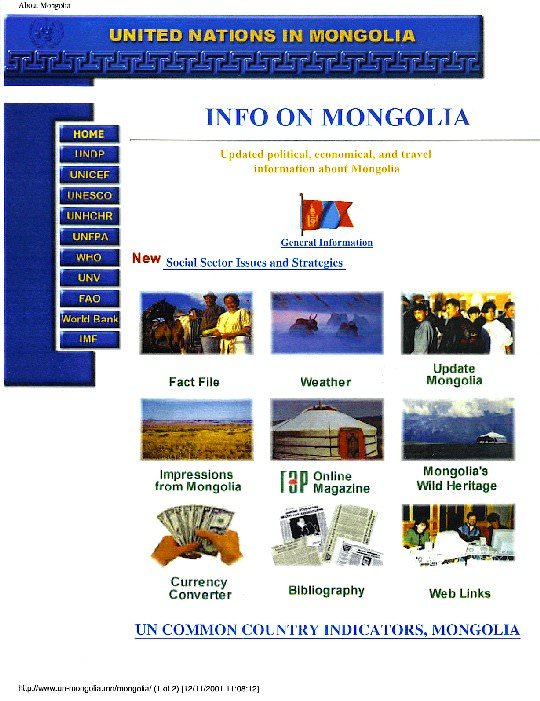
I launched this portal in 1997, in the middle of a major economic crisis in Mongolia. This award-winning (winner in 1998 of the People’s Choice WebSite 500 award and the CyberTeddy Top 500 Website award) and pioneering United Nations Mongolia development web portal was singled out by UN headquarters as an example of what a country office website should be like.
At this time, Mongolia was still recovering from the chaotic and turbulent transition from Communism to free markets and democracy begun at the start of the 1990s, called by some “one of the biggest peacetime economic collapses ever” (Mongolia’s Economic Reforms: Background, Content and Prospects, Richard Pomfret, University of Adelaide, 1994). There was a thirst for information: access to the Internet was still limited and access to mobile phones was just the preserve of the rich. As a legacy of the past, information, especially that about the outside world and the country’s true economic and social conditions, was restricted. During the years of Communism, even simple travel from one place to the next was strictly regulated.
While today we can take it for granted the world’s information arrives in seconds via the Internet on mobile and smart phones and devices, this just was not the case in the late 1990s in Mongolia.
The UN/UNDP Mongolia development web portal addressed the urgent need to communicate what was happening in the country during a major crisis, and to transparently show what the UN was doing to address the crisis. It made critical data on the country’s development easy to find, and informed the wider world about the country and its people and culture. While the Internet had only just arrived in Mongolia, from the start the UNDP Mongolia Communications Office was experimenting with this powerful new technology to reach a global audience. This included Mongolia’s first web magazine, Ger (launched in 1998).
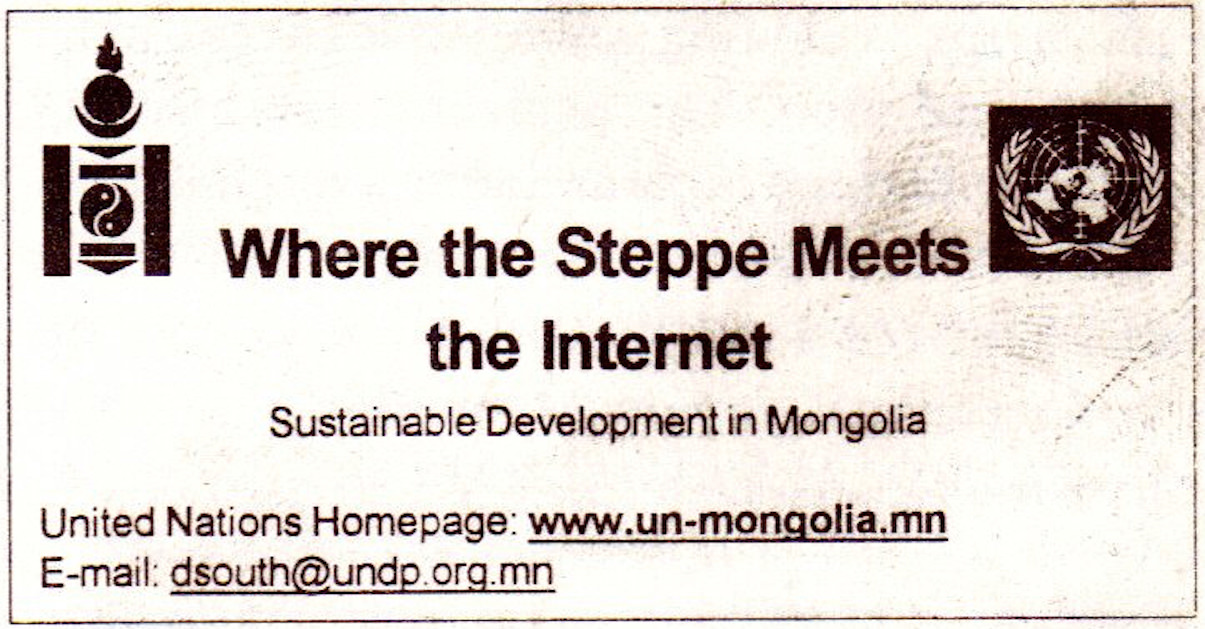
After the http://www.un-mongolia.mn website launched in 1997, a media campaign began to inform readers of its presence. This ad appeared regularly in magazines, newsletters and newspapers.
Ger Magazine was launched on September 9, 1998 (Ger is the Mongolian word for both the traditional tent dwelling and home). The theme of youth in the transition was explored by a combined team of Mongolian and foreign journalists. The Ger Magazine project had basically three goals: first, raise the quality of journalism in the country, secondly, introduce the country to a wider global audience and, thirdly, by being the country’s first online magazine, prove the Internet was an effective way to communicate.
Issue 1 of the magazine investigated what life was like for youth during the transition years (post-1989). Stories tackled the struggle to find work in the free market, the booming pop music scene and how it is leading the way in business entrepreneurship, reproductive health, the basics on Mongolian culture, and vox pop views from Mongolian youth.Issue 2 of the magazine investigated modern life in Mongolia during transition. The team of journalists were hitting their stride by this issue. Stories probed the proliferation of bars and the problem of alcoholism, corrupt banking practices and the loss of savings, how the young were the country’s leading entrepreneurs, Mongolia’s meat and milk diet, “girl power” and the strong role played by women, the burgeoning new media, the rise and rise of Buddhism, and Mongolia’s dynamic fashion designers (this article inspired foreign fashion designers to embrace the Mongolian ‘look’ in the next season’s designs).
The UN/UNDP Mongolia homepage quickly became the top resource for development news on Mongolia in the late 1990s.“A UN System site. A very nice, complete, professional site. Lots of information, easily accessible and well laid out. The information is comprehensive and up-to-date. This is a model of what a UNDP CO web site should be.”
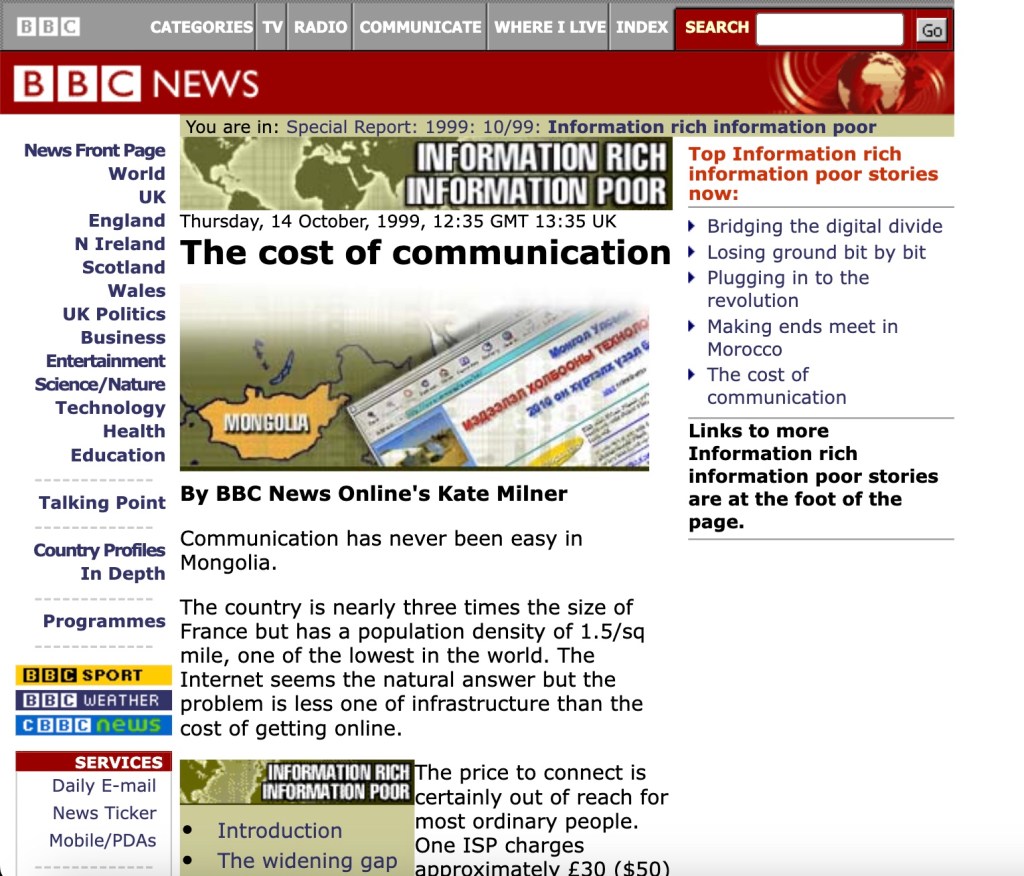
“Information Rich Information Poor: The cost of communication”, BBC News Online, Thursday, 14 October 1999.
“Internet Cafes Brew Change in Mongolia”, UB Post 16 March 1999 by Jill Lawless, cited in One Homeland or Two?: Territorialization of Identity and the Migration Decision of the Mongolian-Kazakh Diaspora by Alexander C. Diener, 2003.
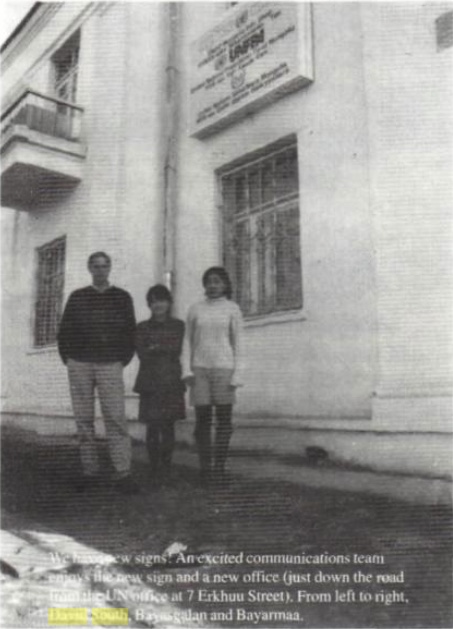
United Nations Cyber Center Ulaanbaatar, Mongolia: UNDP Mongolia established the first public internet cafe in its former headquarters as part of the UNDP Mongolia Communications Office hub in the late 1990s.
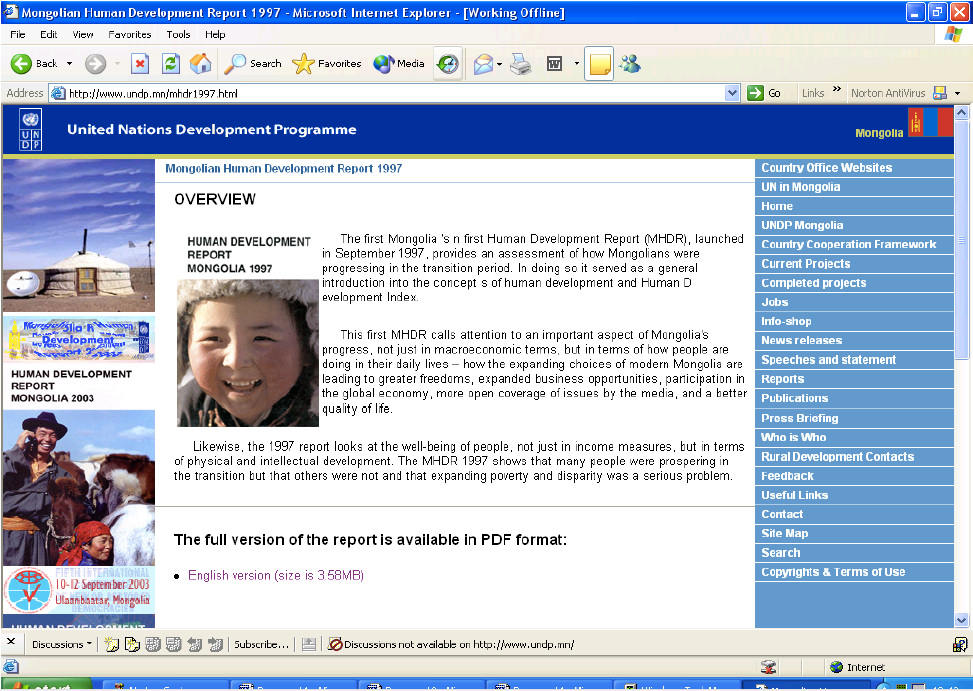
In 2000, the Kiev-based UN Ukraine team had to improve the design and capability of the mission website to handle new content and online services. There was a strong demand for information on country conditions and how to support the UN’s work (for example, on HIV/AIDS). It was a dangerous time to be involved in any online communications and the media and online communicators were routinely threatened with violence and even death.Whilst with a UK-based international development consultancy, I worked on the drafting and online launch in 2000 of the World Bank’s Task Force on Higher Education and Society report, Higher Education in Developing Countries: Peril and Promise. At the time, it was still rare to see reports made user friendly for the world’s web audience. As a survey in 2014 discovered, a shocking third of the Bank’s publications are never downloaded, 40 per cent were downloaded just 100 times, and only 13 per cent were downloaded more than 250 times in their lifetime (The Washington Post).As the Millennium Development Goals (MDGs) were being communicated, the link between the powerful new digital and mobile/information technologies and development goals became explicit in information materials. The cleaner and more modern design introduced with Mongolia’s first human development report in 1997, continued in future publications and online, as can be seen in this screen grab from 2003 and that year’s human development report. The first use of infographics was also introduced in a report on the MDGs for UNDP Mongolia in 2005. Importantly, a country that had been isolated from the non-Communist world for decades, was now routinely using the Internet to tell its stories and post development data.
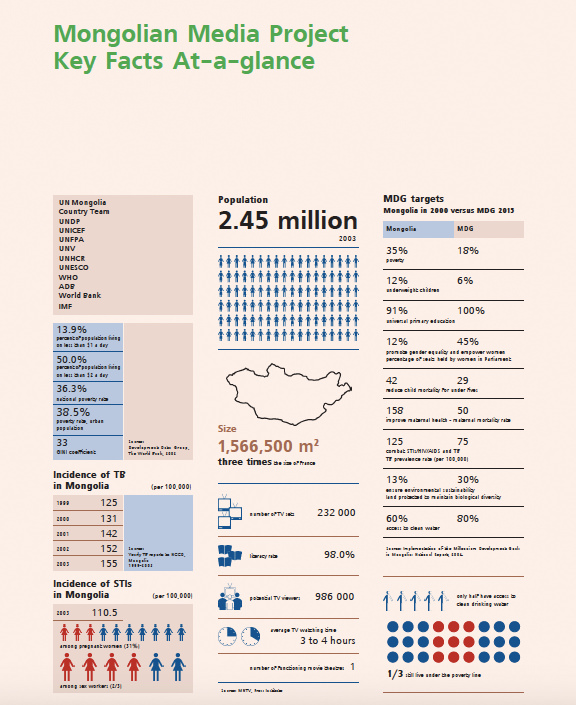
Human Development Infographics: Infographics have proven a useful visual aid for communicating human development concepts. This example was created for a UNDP Mongolia report during missions undertaken in 2005.
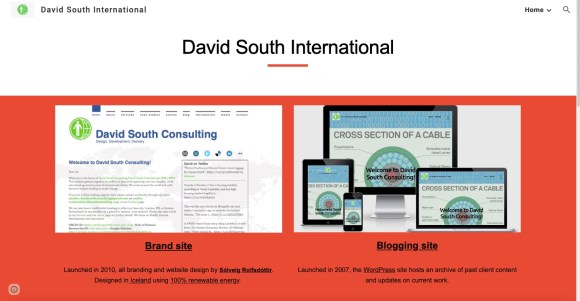
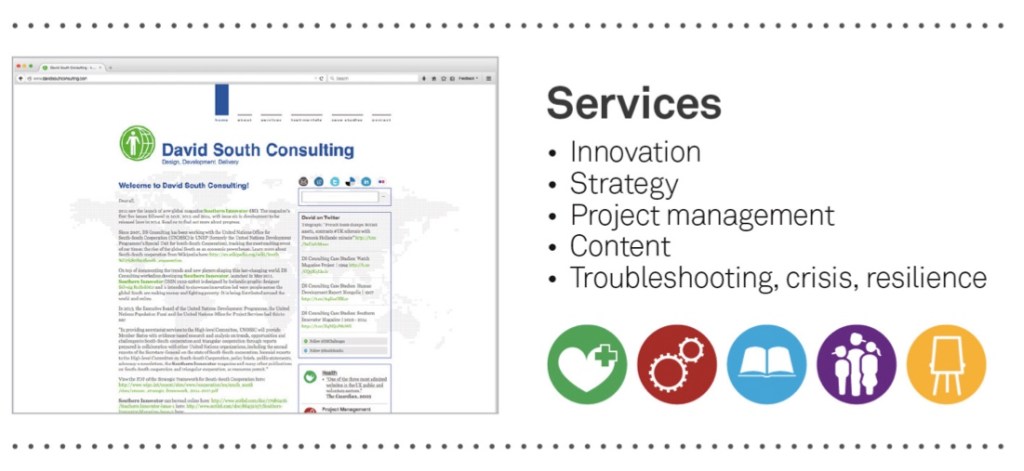
Five years prior to the MDGs deadline in 2015, the David South Consulting website went live (2010). Featuring a new branding and design, it signaled a new design phase more comfortable with developments in social media and online and mobile content sharing. Designed by Solveig Rolfsdottir, one of Iceland’s top graphic designers and illustrators, the website’s design was intentially made compatible with the new global magazine, Southern Innovator (also designed by Solveig Rolfsdottir).The online story archive for Southern Innovator was launched by the United Nations Office for South-South Cooperation (UNOSSC) in 2011. Organized by theme, the stories were cited in blogs, books and reports around the world.
The new template for the United Nations e-newsletter Development Challenges, South-South Solutions was launched in 2011 and designed by Solveig Rolfsdottir. It included a QR code for mobile and smartphone users to connect to the Southern Innovator website.
In 2016 the mobile-friendly version of the David South Consulting website was launched.
With summer break now behind us, and the autumn gradually unfolding (the pace seems slower with the economic uncertainties all around), my new public website is being assembled. Icelandic graphic designer Solveig Rolfsdottir is working on the project and I hope this is the beginning of many more collaborations.
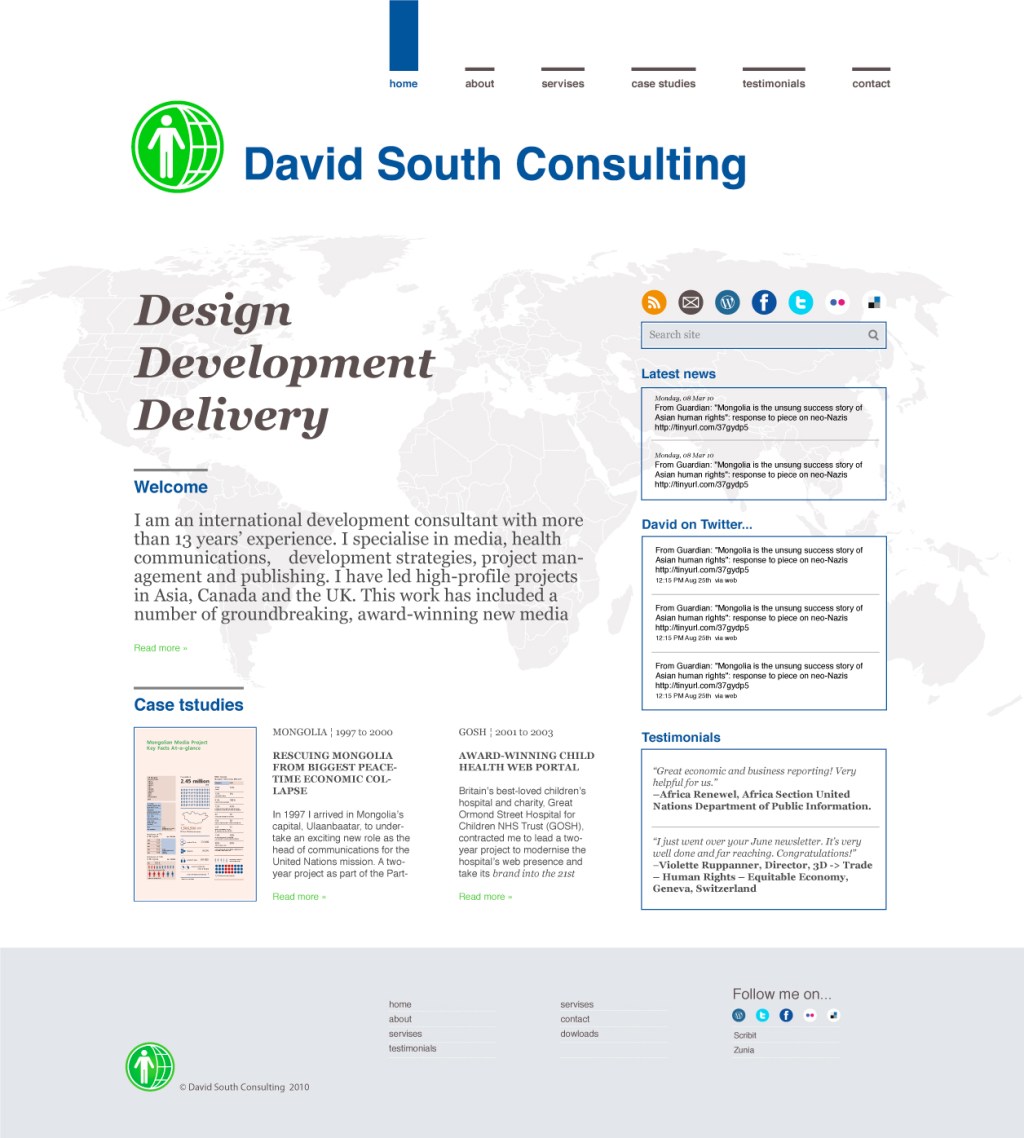
David South Consulting Prototype Website Design 2010.David South Consulting branding and Squarespace website by Graphic Designer and Illustrator Solveig Rolfsdottir.In 2010, David South Consulting was relaunched with a new logo and branding for the 21st century. It represented a new phase, as work became global and very high-profile and influential. The foundations have been laid for future growth and expansion.
A Report from the UN Conference on the Social and Political Dimensions of the Global Crisis: Implications for Developing Countries (12-13 November 2009)
Organised by the United Nations Research Institute for Social Development (UNRISD), Geneva, Switzerland. Held at the Palais des Nations.
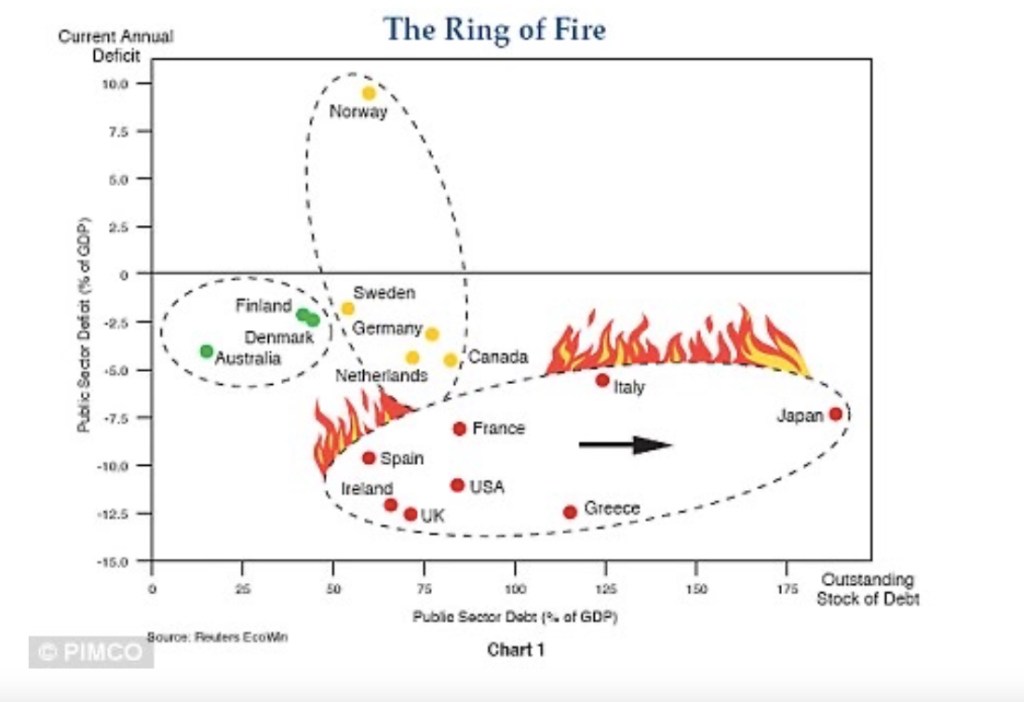
Just as this chart showed at the time of the Global Financial Crisis, the countries in “The Ring of Fire” have experienced exceptional turbulence and turmoil in the years after the crisis. For example, the UK has had austerity budgets, a no-growth economy, Brexit and the ‘shock therapy’ of the COVID-19 pandemic. The US, on the other hand, has clashed with its allies, seen a new cold war emerge with rivals China and Russia, and experienced significant domestic unrest, culminating in the storming of its seat of Government, the Capitol.
Just as now (2021) 2009 was a year in which the questions revolved around receiving a vaccine (for H1N1) and how best to affirm a person’s identity and citizenship. Photo: David SouthIceland saw its banking system collapse during the Global Financial Crisis, sparking demonstrations (October 2008-2011) and the “Pots and Pans Revolution”. Photo: David South
Session 1: Impacts, Coping Strategies and Livelihoods
The first session addressed one of the seismic shifts of our time: that we are witnessing the largest migration in human history from rural, agricultural communities to megacities. In 2007, the world became a majority urban place, with profound consequences for rural communities. Arindam Banerjee, Centre for Development Studies, pointed out that despite India’s high growth rate over this decade, agriculture experienced a low growth rate. This led to a lack of respect for farmers, who were dealing with falling prices and reduced credit. And when commodity prices do rise, farmers do not benefit under the current system.
The percentage of credit advanced in rural areas in India has been on the decline since 1991. People have now become dependent on informal credit sources with higher interest rates. Banerjee suggested some solutions to this crisis: boosting domestic demand, reducing dependence on exports, price support to growers, strengthening co-op credit services, and more employment programmes like NREGA (http://nrega.nic.in/) (National Rural Employment Guarantee Act) to support purchasing power in the rural sector. India needs to prevent a depression in the rural sector and find a solution to the fact rising prices are not going into producer’s pockets.
And how do people cope in villages when a crisis hits? May Tan-Mullins from the University of Durham compared fisher folk in Indonesia and China and their responses to economic crises in 1997 and now. In the Indonesian village during 1997’s Asian crisis, low-income families lived on US $30 to US $45 a month. In today’s Chinese village of 700 households, low-income families are living on US $300/month. The village also benefits from money made during a yearly fishing festival. Average earnings in the community are relatively good: between US $700 and US $1,000/month.
The Indonesian village during the 1997 crisis saw a big drop in the currency and it didn’t stabilise until 1999. Indonesian government stimulus through a health card scheme came along, but it wasn’t rolled out until 1999. The people were basically left to cope on their own with the crisis.
The current crisis in China in 2009 has had fewer effects on the village. The currency is under control and stable. The government has introduced stimulus packages, and the village is part of a long-term strategy to integrate it into the urban economy. In visits, Tan-Mullins had observed people had not suffered much, but they feared the real impact will come in 2010. The stimulus works out to about 2,000 Yuan (US $292) per household. However, low-income families have not benefited because they can not access formal supports like unemployment insurance.
The Indonesian fishing village survived by turning to informal credit sources. One example was to exchange ice and petrol in return for guaranteed deals for the fish at below market prices. A local mosque offered help with food parcels for 6 months in what was called a “trans-village religious network.” Women moved out of households and started working in the market, while some women made extra money cracking cashew nuts.
The Chinese fishing village has also seen social changes. There has been a cutback on perceived unnecessary education for girls. People are turning to family networks, or to gaunxi (doing favours for friends) (http://en.wikipedia.org/wiki/Guanxi). Marriage, for some fishing men, is seen as a way to use a woman to help out at home. Tan-Mullins concluded Asian communities cope better with downturns because their informal networks kick in. The Chinese are good natural savers: up to 30 to 40 percent of monthly income, which can help families weather the bad times. She called for a better understanding of these complex networks.
In Mexico, the country faces multiple challenges and social trends that were already heading in a negative direction before the crisis erupted. Lourdes Arizpe, from the National Autonomous University of Mexico, gave a sobering account of the extent of Mexico’s social breakdown. She called it “a profligate economy and an orphan society.” She detailed how migrants and drug dealers create new social and economic realities for the country. Mexico’s drug war alone has killed over 6,000 people in recent years. While some segments of the working population are finding their creative side during the downturn, others are turning to destructive behaviour. Mexico is suffering from too much legal and illegal drug use, and the medical costs of diseases of over-consumption (obesity, diabetes). The social breakdown has led to more teenage suicides and youth hooligans. Overall, Arizpe believes “all trends over the past 20 years have become worse.”
This has led to many crises being hidden from the official statistics. For example, the migration from Mexico of women for the global care market is harming Mexican children who are denied a full-time mother. This is causing a care deficit in the Global South. Teenage boys without authority figures are then recruited into drug dealing.
Arizpe’s solutions include recommending the Mexican government have a scheme for the unemployed, which would help take away the incentives to migrate for employment to other countries. She also encourages using the substantial remittance payments sent back to Mexico by migrants to invest in business and capital investment, rather than just homes.



















 David South Consulting
You must be logged in to post a comment.