Categories
Archive Development Challenges, South-South Solutions Newsletters Southern Innovator magazine

Indonesian Wooden Radio Succeeds with Good Design

By David SouthDevelopment Challenges, South-South Solutions

SOUTH-SOUTH CASE STUDY

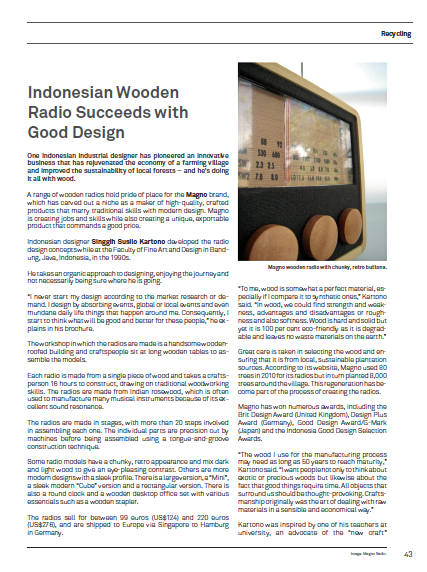
One Indonesian industrial designer has pioneered an innovative business that has rejuvenated the economy of a farming village and improved the sustainability of local forests – and he’s doing it all with wood.

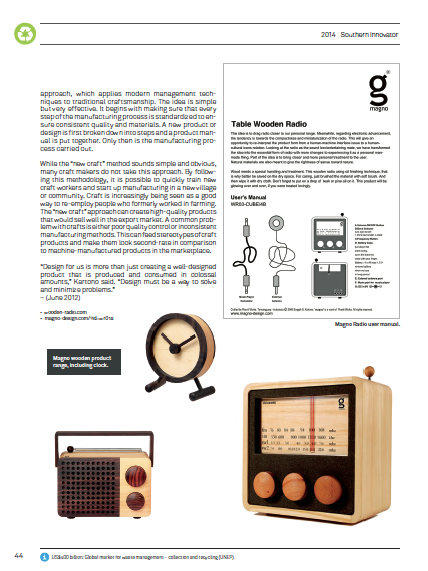
A range of wooden radios (wooden-radio.com) hold pride of place for the Magno brand (http://www.magno-design.com/?id=wr01a), which has carved out a niche as a maker of high-quality, crafted products that marry traditional skills with modern design. Magno is creating jobs and skills while also creating a unique, exportable product that commands a good price.

Indonesian designer Singgih Susilo Kartono developed the radio design concepts while at the Faculty of Fine Art and Design in Bandung, Java, Indonesia in the 1990s.

He takes an organic approach to designing, enjoying the journey and not necessarily being sure where he is going.

“I never start my design according to the market research or demand. I design by absorbing events, global or local events and even mundane daily life things that happen around me. Consequently, I start to think what will be good and better for these people,” he explains in his brochure.

The workshop in which the radios are made is a handsome wooden-roofed building and craftspeople sit at long wooden tables to assemble the models.

Each radio is made from a single piece of wood and takes a craftsperson 16 hours to construct, drawing on traditional woodworking skills. The radios are made from Indian rosewood, which is often used to manufacture many musical instruments because of its excellent sound resonance.

The radios are made in stages, with more than 20 steps involved in assembling each one. The individual parts are precision cut by machines before being assembled using a tongue and groove (http://en.wikipedia.org/wiki/Tongue_and_groove) construction technique.

Some radio models have a chunky, retro appearance and mix dark and light wood to give an eye-pleasing contrast. Others are more modern designs with a sleek profile. There is a large version, a ‘Mini’, a sleek modern Cube’ version and a rectangular version. There is also a round clock and a wooden desktop office set with various essentials like a wooden stapler.

The radios sell for between Euros 99 (US $124) and Euros 220 (US $276), and are shipped to Europe via Singapore to Hamburg in Germany.

“To me, wood is somewhat a perfect material – especially if I compare it to synthetic ones,” Kartono said. “In wood we could find strength and weakness, advantages and disadvantages or roughness and also softness. Wood is hard and solid but yet it is 100 per cent eco-friendly as it is degradable and leaves no waste materials on the earth.”

Great care is taken in selecting the wood and ensuring it is from local, sustainable plantation sources. According to its website, Magno used 80 trees in 2010 for its radios but in turn planted 8,000 trees around the village. This regeneration has become part of the process of creating the radios.

Magno has won numerous awards, including the Brit Design Award (UK), Design Plus Award (Germany), Good Design Award/G-Mark (Japan) and the Indonesia Good Design Selection Awards.

“The wood I use for the manufacturing process may need as long as 50 years to reach maturity,” Kartono said. “I want people not only to think about exotic or precious woods but likewise about the fact that good things require time. All objects that surround us should be thought-provoking. Craftsmanship originally was the art of dealing with raw materials in a sensible and economical way.”

As Kartono tells it, he faced the typical university graduate’s dilemma about his career path. Should he work as an in-house designer in a city or return to his home village of Kandangan and start a business? His choice was unusual. Once somebody with a university education leaves a small village, it is rare they return. And at first, Kartono did not.

But he was drawn back by the dire situation in the village, and decided to apply his knowledge of product design to revive its economic fortunes. He started by visiting just twice a year because that was all he could afford. This had the advantage of giving him perspective on the situation in the village.

“At first glance, these changes (happening to the village) were seen as a ‘progress,’” he said. “But when I looked more closely I concluded that it was only the ‘surface’ which experienced change. The basic structure of the village did not undergo any changes; moreover, some was actually deteriorating.”

He concluded that the village was being damaged by various government attempts to modernize agricultural practices. The debt problems this caused meant many farmers lost their farms and were forced to seek work in the city or look for another way to make money.

Craft work seemed to be the answer to this problem. It has many advantages, as Kartono sees it. It is something that can grow and fits well with village lifestyles. It is labour intensive, doesn’t need sophisticated technology and can use already existing local resources.

Kartono was inspired by one of his teachers at university, an advocate of the ‘New Craft’ approach, which applies modern management techniques to traditional craftsmanship. The idea is simple but very effective. It begins with making sure every step of the manufacturing process is standardized to ensure consistent quality and materials. A new product or design is first broken down into steps and a product manual is put together. Only then is the manufacturing process carried out.

While the New Craft method sounds simple and obvious, many craft makers do not take this approach. By following this methodology, it is possible to quickly train new craft workers and start up manufacturing in a new village or community. Craft is increasingly being seen as a good way to re-employ people who formerly worked in farming. The New Craft approach can create high-quality products that would sell well in the export market. A common problem with crafts is either poor quality control or inconsistent manufacturing methods. This can feed stereotypes of craft products and make them look second-rate in comparison to machine-manufactured products in the marketplace.

“Design for us is more than just creating a well-designed product that is produced and consumed in colossal amount,” Kartono said. “Design must be a way to solve and minimize problems.”

Published: June 2012

Resources

1) Cradle to Cradle: Remaking the Way We Make Things by William McDonough and Michael Braungart. It is a manifesto calling for the transformation of human industry through ecologically intelligent design. Website: http://www.mcdonough.com/cradle_to_cradle.htm

2) Rio+20: At the Rio+20 Conference, world leaders, along with thousands of participants from governments, the private sector, NGOs and other groups, will come together to shape how we can reduce poverty, advance social equity and ensure environmental protection on an ever more crowded planet to get to the future we want. Website: http://www.uncsd2012.org/
https://davidsouthconsulting.org/2021/03/20/accessing-global-markets-via-design-solutions/

https://davidsouthconsulting.org/2021/03/12/afro-coffee-blending-good-design-and-coffee/

https://davidsouthconsulting.org/2021/02/20/baker-cookstoves-designing-for-the-african-customer/

https://davidsouthconsulting.org/2021/12/20/better-by-design-in-china/

https://davidsouthconsulting.org/2021/08/29/brazilian-design-for-new-urban-middle-class-world/

https://davidsouthconsulting.org/2022/08/02/design-collaborations-revitalize-traditional-craft-techniques/

https://davidsouthconsulting.org/2021/01/26/designed-in-china-to-rival-made-in-china/

https://davidsouthconsulting.org/2022/10/20/ghanaian-coffins-prove-design-and-craftsmanship-boost-incomes/

https://davidsouthconsulting.org/2020/04/30/local-fashions-pay-off-for-southern-designers/

https://davidsouthconsulting.org/2021/10/04/putting-quality-and-design-at-the-centre-of-chinese-fashion/

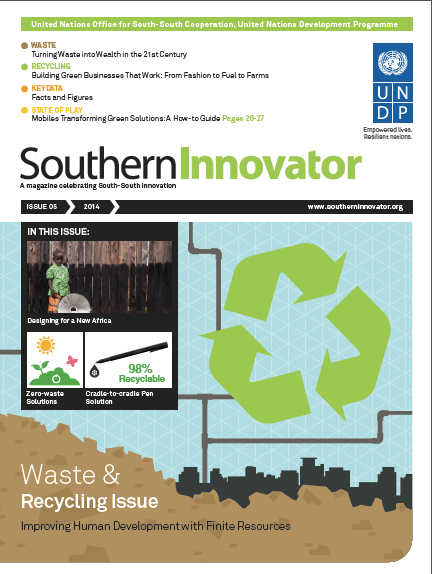
Development Challenges, South-South Solutions was launched as an e-newsletter in 2006 by UNDP’s South-South Cooperation Unit (now the United Nations Office for South-South Cooperation) based in New York, USA. It led on profiling the rise of the global South as an economic powerhouse and was one of the first regular publications to champion the global South’s innovators, entrepreneurs, and pioneers. It tracked the key trends that are now so profoundly reshaping how development is seen and done. This includes the rapid take-up of mobile phones and information technology in the global South (as profiled in the first issue of magazine Southern Innovator), the move to becoming a majority urban world, a growing global innovator culture, and the plethora of solutions being developed in the global South to tackle its problems and improve living conditions and boost human development. The success of the e-newsletter led to the launch of the magazine Southern Innovator.

https://davidsouthconsulting.org/2021/03/05/southern-innovator-issue-5/

Creative Commons License

This work is licensed under a
Creative Commons Attribution-Noncommercial-No Derivative Works 3.0 License.

ORCID iD: https://orcid.org/0000-0001-5311-1052.

© David South Consulting 2023
Categories
Archive Blogroll data Development Challenges, South-South Solutions Newsletters digital ID

Big Data Can Transform the Global South’s Growing Cities

By David SouthDevelopment Challenges, South-South Solutions

SOUTH-SOUTH CASE STUDY

The coming years will see a major new force dominating development: Big Data. The term refers to the vast quantities of digital data being generated as a result of the proliferation of mobile phones, the Internet and social media across the global South – a so-called ‘data deluge’ (UN Global Pulse). It is an historically unprecedented surge in data, much of it coming from some of the poorest places on the planet and being gathered in real time.

Big Data will have a profound impact on how the cities of the future develop, and will re-shape the way the challenges and problems of human development are handled.

Estimates by Cisco (cisco.com) foresee 10 billion mobile Internet-enabled devices around the world by 2016. With the world population topping 7.3 billion by then, that will work out to 1.4 devices per person.

Some estimates say 90 per cent of the digital data ever generated in the world has been produced in the past two years. It is also estimated that available digital data will increase by 40 per cent every year (UN Global Pulse). This digital transformation is being accompanied by another trend: the largest migration in human history from rural to semi-urban and urban areas.

This presents an unprecedented opportunity to make this rapid urbanization and social change smarter and more responsive to human needs, and to avoid the failures of the past, from over-crowding to crime, disease, pollution, unemployment and poverty. Some believe data collection can radically alter development by flagging up problems quickly, giving cities the chance to respond and correct negative trends before they get out of control. In short, to build in resilience by way of digital technology.

The latest region to see rapid industrialization and urbanization has been Asia – in particular China, a country that since the 1980s has simultaneously lifted the largest number of people in world history out of poverty and undertaken the biggest migration ever from rural to urban areas.

And now Africa is beginning to follow in Asia’s wake.

Unlike previous waves of industrialization and urbanization, Africa’s transformation is occurring in the age of the mobile phone, the Internet, personal computers and miniature electronic devices capable of more computing power than the computers used during the Apollo space programme (http://www.nasa.gov/audience/foreducators/diypodcast/rocket-evolution-index-diy.html). This changes the game significantly.

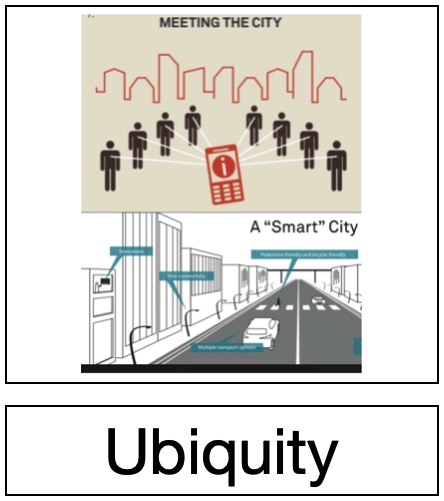
This 21st-century approach to urban growth is at its most sophisticated, and utopian, in so-called “smart cities.” These are built-from-scratch cities that use the “Internet of Things”, where everything, from lamp posts to garbage bins to roads are embedded with microchips and radio frequency transmitters (RFID chips) (http://en.wikipedia.org/wiki/Radio-frequency_identification) to communicate data in real time. By analyzing this data, cities can be responsive to human needs and mitigate problems – improving waste collection and traffic management, reducing crime and pollution. Services can be customized to residents’ needs and liberate them to spend more time on things that matter such as their own health, family, work and hobbies. Examples of these cities include Tianjin Eco-city (tianjinecocity.gov.sg) in China, Masdar (masdar.ae) in Abu Dhabi in the United Arab Emirates and Songdo International Business District (songdo.com) in the Republic of Korea.

These experimental smart cities are springing up in the East, and it will be the East – as well as Africa – that will see most of the action going forward. As the global management consulting firm McKinsey noted in its report Urban World: Mapping the Economic Power of Cities: “Over the next 15 years, the center of gravity of the urban world will move south and, even more decisively, east.”

Cities in the global South will be generating the new prosperity of the 21st century. And it is widely accepted that people living in cities have the potential to become very efficient economically while rapidly driving prosperity higher.

The McKinsey report says that “by 2025, developing-region cities of the City 600 (a list gathered by McKinsey) will be home to an estimated 235 million middle-class households earning more than (US) $20,000 a year at purchasing power parity (PPP).

“Emerging-market mega-and middleweight cities together – 423 of them are included in the City 600 – are likely to contribute more than 45 percent of global growth from 2007 to 2025 (http://www.mckinsey.com/insights/urbanization/urban_world).”

The world’s future prosperity is going to be found in the urban, the digitally connected, and the middle class.

Tracking all this digital change is the UN Global Pulse. UN Global Pulse (unglobalpulse.org) was started by Secretary-General Ban Ki-moon in 2009 with a mandate to study these changes and build expertise in applying Big Data to global development. UN Global Pulse functions as a network of innovation labs where research on Big Data for development is conceived and coordinated. It partners with experts from UN agencies, governments, academia, and the private sector to research, develop, and mainstream approaches for applying real-time digital data to 21st-century development challenges.

Unlike major technological trends of the past, this one is not restricted to the industrialized, developed world. Through the spread of mobile phone technology, billions of people are now using a device that constantly collects digital data, even in the poorest places on earth.

From an international development perspective, Big Data has five characteristics, according to UN Global Pulse: it is digitally generated, passively produced by people interacting with digital services, automatically collected, can be geographically or temporally traced and can be continuously analyzed in real time.

Sources of Big Data include chatter from social networks, web server logs, traffic flow sensors, satellite imagery, telemetry from vehicles and financial market data.

The key to using Big Data is combining datasets and then contrasting them in lots of different ways and doing it very quickly. The purpose?  Better decision-making, based on an understanding of what is really happening on the ground.

This data exceeds the capability of existing database software. It is either too much, or comes in too quickly, or can’t be handled using current software technology. Tackling this problem is creating a whole new wave of opportunities for those working in information technology.

As technology and processing power continue to improve, the cost of wrestling with this data and putting it to use is coming down.

The data can be analyzed for patterns and hidden information that before would have been too difficult to gather. This approach has been used by big companies such as WalMart (walmart.com), but it has cost them a large amount of money and time.

Pioneers in Big Data include search engine Google, email and search provider Yahoo, online shopping service Amazon and social media service Facebook. Many supermarkets use Big Data to analyze the way customers behave when they are shopping, combining it with their social and geographical data.

But new developments in hardware, cloud architecture, and open-source software mean Big Data processing is more accessible, including for small start-ups, who can just rent the capacity required on a cloud-based service (http://en.wikipedia.org/wiki/Cloud_computing).

In the past, governments and planners had a ready excuse as to why they could not keep on top of ballooning urban populations and the chaos they brought. They could just throw up their hands and say “We do not know who these people are or what to do about them!”

This excuse does not work in the age of the mobile phone. It is now relatively easy to deploy the power of the networked computing inside mobile phones to map urban slums and identify the needs of the people there. Parse that data, and you have an accurate account of what is happening in the slum – all in real-time.

Making sense of all this information is creating its own new industries as innovators, entrepreneurs and companies step forward to chart this brave new world.

Historically, significant improvements in human development have occurred only after large-scale gathering of data and information on the actual living conditions of the population. For example, prototypes of today’s infographics (http://en.wikipedia.org/wiki/Infographic) – informative visual representations of complex data – were created during the great attempts at tackling poverty and disease in Europe in the 19th century. Today’s masters of this technique include the Swedish doctor, academic and statistician Hans Rosling (gapminder.org), whose dynamic infographics are renowned for changing people’s perceptions of global problems.

UN Global Pulse notes “much of the data used to track progress toward the Millennium Development Goals (MDGs) dates back to 2008 or earlier and doesn’t take into account the more recent economic crisis.

“While this may feed a perception that there is a scarcity of information about the wellbeing of populations, the opposite is in fact true. Thanks to the digital revolution, there is an ocean of data, being continuously generated in both developed and developing nations, that did not exist even a few years ago.”

UN Global Pulse believes Big Data can be used to protect social development gains when crises strike. Rather than undoing decades of good development work and human development achievements, Big Data can help to create agile responses to crisis as it happens.

UN Global Pulse believes the same data, tools and analytics used by business can be turned to help the public sector understand “where people are losing the fight against hunger, poverty and disease, and to plan or evaluate a response.”

Published: June 2014

Resources

1) Big Data: The Next Frontier for Innovation, Competition, and Productivity, Publisher: McKinsey Global Institute. Website: mckinsey.com

2) United Nations Global Pulse: Global Pulse is an innovation initiative launched by the Executive Office of the United Nations Secretary-General, in response to the need for more timely information to track and monitor the impacts of global and local socio-economic crises. The Global Pulse initiative is exploring how new, digital data sources and real-time analytics technologies can help policymakers understand human well-being and emerging vulnerabilities in real-time, in order to better protect populations from shocks. Website: http://www.unglobalpulse.org/

3) Business Models for the Data Economy by Q. Ethan McCallum and Ken Gleason. Website: http://www.oreilly.com/data/free/business-models-for-the-data-economy.csp?intcmp=il-strata-free-product-lgen_biz_models_for_data_economy_strata_right_rail

4) Building Data Science Teams by D. J. Patil, Publisher: Radar. Website: http://www.oreilly.com/data/free/building-data-science-teams.csp

5) Big Data for Development Primer, Publisher: UN Global Pulse. Website: http://www.slideshare.net/unglobalpulse/big-data-for-development-a-primer

6) Mobile Phone Network Data for Development, Publisher: UN Global Pulse. Website: http://www.slideshare.net/unglobalpulse/mobile-data-for-development-primer-october-2013

7) Big Data, Big Impact: New Possibilities for International Development, Publisher: World Economic Forum. Website: http://www.weforum.org/reports/big-data-big-impact-new-possibilities-international-development

8) How numbers rule the world by Lorenzo Fioramonti, Publisher: Zed Books. Website: http://www.zedbooks.co.uk/node/16850

9) Southern Innovator Issue 1: Mobile Phones and Information Technology: Considered a landmark work capturing this fast-changing field, Issue 1 comes packed with stories and contacts. Website: http://books.google.co.uk/books?id=Q1O54YSE2BgC&dq=southern+innovator+issue+1&source=gbs_navlinks_s

10) Urban world: Mapping the economic power of cities published by McKinsey Global Institute. Website: http://www.mckinsey.com/insights/urbanization/urban_world

11) Hadoop: Is open source software for handling of large data sets across clusters of computers using simple programming models. Website: http://hadoop.apache.org/

12) Pivotal: Pivotal develops software applications for big data. A testimonial on the Pivotal website sums it up: “With the ability to load a day’s worth of data for a million meters in under fifty (50) seconds, we are able to keep up with the tremendous amount of data generated and start experimenting with many useful smart grid analytics.” Website: gopivotal.com

13) TotallyDot: A way to centralize all the social media people use into a single page. Website: totallydot.com

https://davidsouthconsulting.org/2022/02/09/african-health-data-revolution/

https://davidsouthconsulting.org/2020/12/04/big-data-can-transform-the-global-souths-growing-cities/

https://davidsouthconsulting.org/2020/04/27/computing-in-africa-is-set-to-get-a-big-boost/

https://davidsouthconsulting.org/2020/12/04/data-surge-across-global-south-promises-to-re-shape-the-internet/

https://davidsouthconsulting.org/2020/12/11/false-data-makes-border-screening-corruptible/

https://davidsouthconsulting.org/2022/09/27/india-2-0-can-the-country-make-the-move-to-the-next-level/

https://davidsouthconsulting.org/2021/03/04/indian-id-project-is-foundation-for-future-economic-progress/

https://davidsouthconsulting.org/2020/04/26/starting-from-scratch-the-challenge-of-transition/

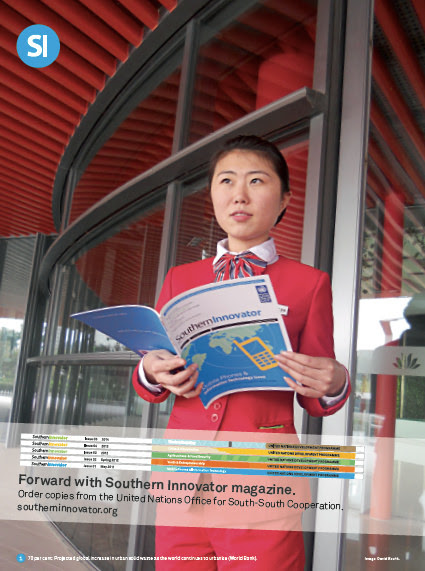
Development Challenges, South-South Solutions was launched as an e-newsletter in 2006 by UNDP’s South-South Cooperation Unit (now the United Nations Office for South-South Cooperation) based in New York, USA. It led on profiling the rise of the global South as an economic powerhouse and was one of the first regular publications to champion the global South’s innovators, entrepreneurs, and pioneers. It tracked the key trends that are now so profoundly reshaping how development is seen and done. This includes the rapid take-up of mobile phones and information technology in the global South (as profiled in the first issue of magazine Southern Innovator), the move to becoming a majority urban world, a growing global innovator culture, and the plethora of solutions being developed in the global South to tackle its problems and improve living conditions and boost human development. The success of the e-newsletter led to the launch of the magazine Southern Innovator.

https://davidsouthconsulting.org/2022/11/01/southern-innovator-magazine-2010-2014/

Creative Commons License

This work is licensed under a
Creative Commons Attribution-Noncommercial-No Derivative Works 3.0 License.

ORCID iD: https://orcid.org/0000-0001-5311-1052.

© David South Consulting 2022

Categories
Archive Blogroll Development Challenges, South-South Solutions Newsletters

Virtual Supermarket Shopping Takes off in China

By David SouthDevelopment Challenges, South-South Solutions

SOUTH-SOUTH CASE STUDY

An ingenious use of technological innovation and savvy trend-spottingis radically transforming the way people do their grocery shopping in China. Busy urban dwellers with time-poor lifestyles can now do their grocery shopping as they pass through Shanghai’s subway system and have their weekly shopping delivered to their home.

The country has experienced breakneck economic growth in the past 15 years, heading towards becoming the world’s largest economy. Much of this growth and new wealth has come from the transformation of China into the world’s manufacturing and exporting hub. But this also leaves an urban population of very busy people who need time-saving solutions to improve their quality of life.

China’s premier Wen Jiabao has now pledged to aid the world economy during the current economic crisis by boosting domestic Chinese consumption. And this new focus on consumption will open up opportunities for entrepreneurs.

“I believeChina’s economy can achieve longer-term, better-quality growth. This will be our new contribution to strong, sustainable global growth,” he told the Wall Street Journal.

And a big part of the boost in domestic consumption will come from modern retailers and supermarkets. Supermarkets were almost non-existent in China before the 1990s. The country sold food in a mix of small shops, open-air markets and through wholesale networks. It was a complex system overlaid with government bodies, marketing boards, brokers, wholesalers, distributors and government-licensed and government-run shops and vendors.

But this has radically changed as the country has moved to a modern retail system. Chinese cities now boast modern supermarkets, convenience stores, hypermarkets and warehouse clubs. There was just one modern supermarket in the country in 1990; by 2003, there were 60,000 (Chinese Chain Store and Franchise Association).

The supermarket model offers many benefits to anyone looking to sell products in the Chinese marketplace. Supermarkets are very competitive with each other and are always looking for new angles and new products to get the edge and win over new consumers. If they offer new tastes and variety, the chances are high they will attract more customers.

Supermarkets tend to offer a greater variety of food products than traditional markets. They are also cleaner, the quality control is better and more standardised, there is no need to haggle over prices and measurements and units for products are clearly labelled and controlled.

But supermarkets can also be criticized for monopolizing distribution networks, hurting small farmers by driving down prices and destroying independent retailers unable to compete with the economies of scale supermarkets can bring to bear.

In Shanghai- a city that has long been a retail pioneer in China- the Yihaodian online grocery company (http://www.yihaodian.com/product/index.do?merchant=1) is radically altering how people buy food by using “virtual supermarkets” in subway stations.

It is a convergence of several technological innovations to make something even better.

Shoppers download an app – or application – on to their mobile phones. This allows them to interact with large LED screens (http://en.wikipedia.org/wiki/LED_display) in subway stations which display images of products – from soap to noodle soup to nuts– just like in a catalogue. The shopper scrolls through the products and finds what they want to buy. Beside the images are barcodes. The shopper scans the product barcode with the phone and Yihaodian then delivers the products straight to their home within hours.

It is a very convenient service for busy workers trying to juggle the many demands of daily life.

The Yihaodian system is based on a similar technology pioneered inSouth Korea.

Yihaodian is riding a wave of growth for the company because of its innovative approach. It has seen sales rise by 28 percent each month and it hopes to make Euro 325 million (US $443 million) in 2011, four times its 2010 revenues. Proof of the value of investing in innovation.

Yihaodian is also showing how clever it is to offer a new way of doing things. It is pioneering a new business model while also recognising the reality of people’s busy lives in modern urban environments. Lily Yu, director of the company’s wireless application department, says it is about something bigger than just profits. “Changing people’s lifestyles is what we are striving for,” she told Monocle magazine.

Yu, founder of the Wireless Application Department at Yihaodian, joined the company in 2010 and leads the team to develop and introduce this technology and new way of buying products.

The only question remaining is this: how long before all retail will follow Yu’s lead?

Published: November 2011

Resources

1) Mobile Active: MobileActive.org connects people, organizations, and resources using mobile technology for social change. Website: http://mobileactive.org

2) How QR Codes Can Grow Your Business: A story on how to use these scannable codes. Website: http://www.socialmediaexaminer.com/how-qr-codes-can-grow-your-business/

3) Southern Innovator magazine: New global magazine’s first issue tackles the boom in mobile phone and information technologies across the global South. Website: www.scribd.com/doc/57980406/Southern-Innovator-Issue-1

https://davidsouthconsulting.org/2022/11/02/african-online-supermarket-set-to-boost-trade/

https://davidsouthconsulting.org/2022/10/26/african-trade-hub-in-china-brings-mutual-profits-2/

https://davidsouthconsulting.org/2021/12/20/better-by-design-in-china/

https://davidsouthconsulting.org/2022/10/20/china-consumer-market-asian-perspective-helps/

https://davidsouthconsulting.org/2020/12/10/china-sets-sights-on-dominating-global-smartphone-market/

https://davidsouthconsulting.org/2022/10/04/chinas-booming-wine-market-can-boost-south/

https://davidsouthconsulting.org/2021/01/25/creating-green-fashion-in-china/

https://davidsouthconsulting.org/2021/01/26/designed-in-china-to-rival-made-in-china/

https://davidsouthconsulting.org/2021/05/14/the-ethics-of-soup-grading-supermarket-shelves-for-profit/

https://davidsouthconsulting.org/2022/10/24/kenyan-products-a-global-success-story/

https://davidsouthconsulting.org/2020/12/12/mobile-phone-shopping-to-create-efficient-markets-across-borders/

https://davidsouthconsulting.org/2022/10/31/rainforest-gum-gets-global-market/

https://davidsouthconsulting.org/2022/11/17/sos-shops-keep-food-affordable-for-poor-unemployed/

https://davidsouthconsulting.org/2022/11/16/thai-organic-supermarkets-seek-to-improve-health/

Development Challenges, South-South Solutions was launched as an e-newsletter in 2006 by UNDP’s South-South Cooperation Unit (now the United Nations Office for South-South Cooperation) based in New York, USA. It led on profiling the rise of the global South as an economic powerhouse and was one of the first regular publications to champion the global South’s innovators, entrepreneurs, and pioneers. It tracked the key trends that are now so profoundly reshaping how development is seen and done. This includes the rapid take-up of mobile phones and information technology in the global South (as profiled in the first issue of magazine Southern Innovator), the move to becoming a majority urban world, a growing global innovator culture, and the plethora of solutions being developed in the global South to tackle its problems and improve living conditions and boost human development. The success of the e-newsletter led to the launch of the magazine Southern Innovator.

https://davidsouthconsulting.org/2021/03/05/southern-innovator-issue-2/

Creative Commons License

This work is licensed under a
Creative Commons Attribution-Noncommercial-No Derivative Works 3.0 License.

ORCID iD: https://orcid.org/0000-0001-5311-1052.

© David South Consulting 2023

Categories
Blogroll Southern Innovator magazine

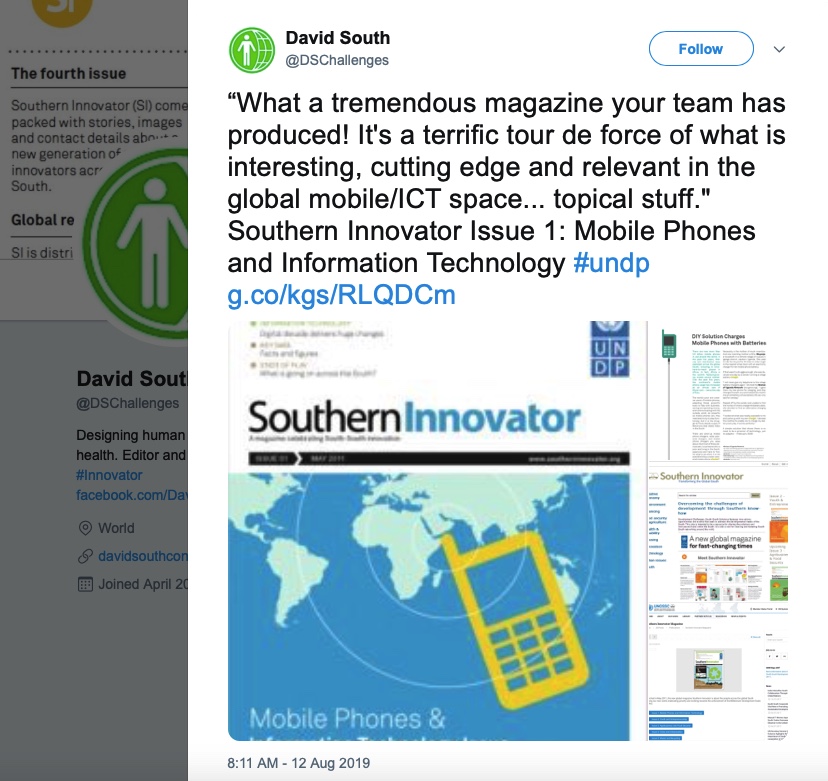
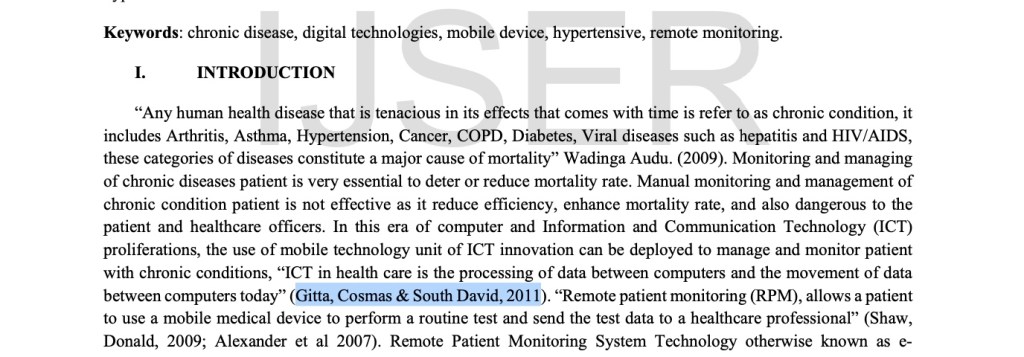
New Paper Citation For Southern Innovator Issue 1

Launched in 2011, Southern Innovator’s first issue on mobile phones and information technology proved highly influential, profiling the work of a new generation of innovators. It has been cited in books, papers and strategic plans.  

Southern Innovator Magazine Issue 1: Mobile Phones and Information Technology
Citation in Using Mobile-Enabled Devices for Engagement and Monitoring of Patient with Chronic Disease: Hypertensive Case in the International Journal of Scientific & Engineering Research Volume 10, Issue 4, April 2019 (ISSN 2229-5518).
Creative Commons License

This work is licensed under a
Creative Commons Attribution-Noncommercial-No Derivative Works 3.0 License.

ORCID iD: https://orcid.org/0000-0001-5311-1052.

© David South Consulting 2023