Tag: David South

  • New 3D Technology Makes Innovation Breakthrough and Puts Mind over Matter

    New 3D Technology Makes Innovation Breakthrough and Puts Mind over Matter

    By David SouthDevelopment Challenges, South-South Solutions

    SOUTH-SOUTH CASE STUDY

    Revolutions in technology are placing more and more power into the hands of the individual, and 3D printing and fabrication machines are opening a whole new chapter.

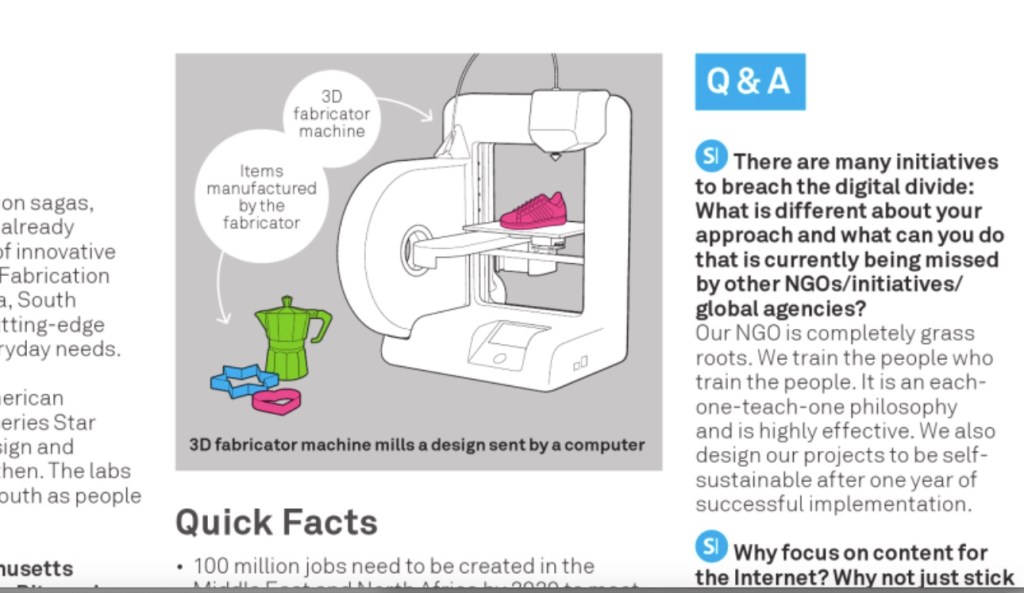
    These devices come in many forms, but they all do one thing: they can manufacture pretty well any three-dimensional object on the spot, from digital plans. These machines come in many sizes, from factory scale to smaller, home versions which are no bigger than personal computer printers, such as the well-known MakerBot Replicator 2 (makerbot.com).

    3D printers introduce sophisticated precision manufacturing to the individual much in the same way the personal computer and the Internet have empowered people to make their own software, build websites and start online businesses.

    A pioneering educational innovation in Chile is taking the technology even further, in a way that is truly mind-blowing. Thinker Thing (thinkerthing.com) promises to transform the way people interact with this new technology. “We have built a machine that will allow you to make real objects with your mind,” its website states.

    And, it wants to do more: “We want to use our invention to light a fire of inspiration throughout the remote and often disadvantaged schools of South America and we can do this with your help.”

    Thinker Thing allows the user to wear a headset and communicate through brain waves to the 3D printer. The printer then manufactures a three-dimensional model of the thoughts. These can be squiggly shapes or even, it is hoped, more sophisticated forms.

    Thinker Thing’s Chilean Chief Technology Officer is George Laskowsky. Laskowsky has a games console engineering background and was a research assistant in charge of high-energy particle experiments.

    The Chilean government is funding this experiment to help children to improve their creative skills. The idea is to use the technology to eliminate the technical side of creating objects and focus the effort on the creative thought process. Thinker Thing was selected from more than 1,400 applicants to participate in the prestigious global accelerator program, “Start Up Chile” (http://startupchile.org). Start-Up Chile is a program created by the Chilean government that seeks to attract early-stage high potential entrepreneurs to develop startups using Chile as a platform to go global, in line with the national goal of converting Chile into the innovation and entrepreneurship hub of Latin America.

    Based in Santiago, Chile, Laskowsky is seeking support for further development on IndieGoGo (http://www.indiegogo.com/projects/children-creating-real-objects-with-their-mind), an international crowdfunding platform for projects.

    The plan is to tour Thinker Thing all around Chile and use the science, art and engineering principles behind the invention to help very young children in remote rural regions to learn through understanding the project. Its creators also hope to take the exhibition – called the Monster Dreamer School Outreach Program and the Fantastical Mind Creatures of Chile Exhibition – on the road and show it in major global cities.

    The children are being asked to imagine fantastical creatures that will then be made into 3D forms with the machine. The idea is to then sell these 3D creatures to supporters of the project to help fund the initiative. As well, these creatures will go on display in an exhibition to help educate visitors about Chile’s children and their communities.

    To increase interest, exclusive photographic prints and limited edition figurines are available of the creatures the children create.

    The prototype uses what is called an EmotivEPOC, basically a wireless neuroheadset collecting signals from the user’s brain. In operation, the software allows users to make 3D models with the power of thought which are then made into a plastic model using a MakerBot Industries Replicator.

    This is experimental stuff and neurotechnology is in its early stages. It can detect simple emotions such as excitement or boredom and cognitive thoughts such as push and pull. Despite being in its early stages, the technology can evolve a 3D object over a number of steps by detecting the user’s emotional response to design changes.

    Thinker Thing has been working alongside neuroscientists to understand the workings of the brain. Amazingly, in one experiment they were able to get a person to control the leg of a cockroach using their own thoughts. Called the Salt Shaker (http://www.thinkerthing.com/about-2/salt-shaker/), it is an experimental kit for young students and hobbyists that allows them to take control of a biological limb quickly and simply.

    The 3D printing revolution is energizing for large and small-scale manufacturers alike. It means a business can now engage in precision manufacturing of products and spare parts quickly. It means it is possible to download from the Internet plans for new innovations and manufacture them within minutes. It also means communities off the mainstream supply line can make what they need and repair machinery without needing to wait weeks or months for items to be shipped from afar or spend vast sums on shipping costs.

    The Fab Labs project based at the Massachusetts Institute of Technology (MIT) has been at the forefront of pioneering and prototyping this technology, including running testing labs across the global South to prove the relevance of the technology to the world’s poorest communities.

    As of 2012, these include Fab Lab Afghanistan (http://www.fablab.af/), in Chile the FabLab Santiago (www.designlab.uai/fablab), Fab Lab Egypt (www.fablab-egypt.com), in Colombia the FabLab Medellin (http://www.fablabcolombia.com), in Ghana the Takoradi Technical Institute (http://ttifab.wikispaces.com/How+to+Use+the+TTI+Fab+Lab+Wiki), in India at various locations, Indonesia’s HONFablab (http://honfablab.org), ARO FabLab Kenya West (http://www.fablab.co.ke), and in Peru, South Africa, Suriname and many more are in the works (http://fab.cba.mit.edu/about/labs/).

    If Thinker Thing has its way, maybe people in the future will say “I think, therefore I print!”

    Published: August 2013

    Resources

    1) Stratasys: The company manufactures 3D printers and materials that create prototypes and manufactured goods directly from 3D CAD files or other 3D content. Stratasys systems are used by manufacturers to create models and prototypes to aid in the new product design process. And they are becoming widely used for production of finished goods in low-volume manufacturing. Systems range from affordable desktop 3D printers to large production systems for direct digital manufacturing. Website: http://www.stratasys.com/

    2) 3D Systems: 3D Systems is a leading provider of 3D content-to-print solutions including 3D printers, print materials and on-demand custom parts services for professionals and consumers alike. Website: http://www.3dsystems.com/

    ExOne: With decades of manufacturing experience and significant investment in research and product development, ExOne has pioneered the evolution of nontraditional manufacturing. This investment has yielded a new generation of rapid production technology in the field of additive manufacturing as well as advanced micromachining processes. Website: http://www.exone.com/

    FabCentral: This site supports a digital fabrication facility and global network of field fab labs managed by MIT’s Center for Bits and Atoms. Website: http://fab.cba.mit.edu

    Maker Shed: 3D Printing and Fabrication:  An outstanding resource for getting all you need to understand 3D printing and manufacturing, with 3D printers, supplies, Whether you want to print out physical objects or machine something from plastic, wood, or other materials, we have the tools and accessories you need. Website: http://www.makershed.com/3D_Printing_Fabrication_s/220.htm

    EMachineShop: The first and leading machine shop designed from the start for the Internet, eMachineShop’s mission is to provide easy, convenient and low-cost fabrication of custom parts via the web. Website: emachineshop.com/

    Development Challenges, South-South Solutions was launched as an e-newsletter in 2006 by UNDP’s South-South Cooperation Unit (now the United Nations Office for South-South Cooperation) based in New York, USA. It led on profiling the rise of the global South as an economic powerhouse and was one of the first regular publications to champion the global South’s innovators, entrepreneurs, and pioneers. It tracked the key trends that are now so profoundly reshaping how development is seen and done. This includes the rapid take-up of mobile phones and information technology in the global South (as profiled in the first issue of magazine Southern Innovator), the move to becoming a majority urban world, a growing global innovator culture, and the plethora of solutions being developed in the global South to tackle its problems and improve living conditions and boost human development. The success of the e-newsletter led to the launch of the magazine Southern Innovator.  

    Follow @SouthSouth1

    Google Books: https://books.google.co.uk/books?id=YfRcAwAAQBAJ&dq=development+challenges+august+2013&source=gbs_navlinks_s

    Slideshare: http://www.slideshare.net/DavidSouth1/development-challenges-august-2013-issue

    Southern Innovator Issue 1: https://books.google.co.uk/books?id=Q1O54YSE2BgC&dq=southern+innovator&source=gbs_navlinks_s

    Southern Innovator Issue 2: https://books.google.co.uk/books?id=Ty0N969dcssC&dq=southern+innovator&source=gbs_navlinks_s

    Southern Innovator Issue 3: https://books.google.co.uk/books?id=AQNt4YmhZagC&dq=southern+innovator&source=gbs_navlinks_s

    Southern Innovator Issue 4: https://books.google.co.uk/books?id=9T_n2tA7l4EC&dq=southern+innovator&source=gbs_navlinks_s

    Southern Innovator Issue 5: https://books.google.co.uk/books?id=6ILdAgAAQBAJ&dq=southern+innovator&source=gbs_navlinks_s

    Creative Commons License

    This work is licensed under a
    Creative Commons Attribution-Noncommercial-No Derivative Works 3.0 License.

    ORCID iD: https://orcid.org/0000-0001-5311-1052.

    © David South Consulting 2023
  • New Paper Citation For Southern Innovator Issue 3

    New Paper Citation For Southern Innovator Issue 3

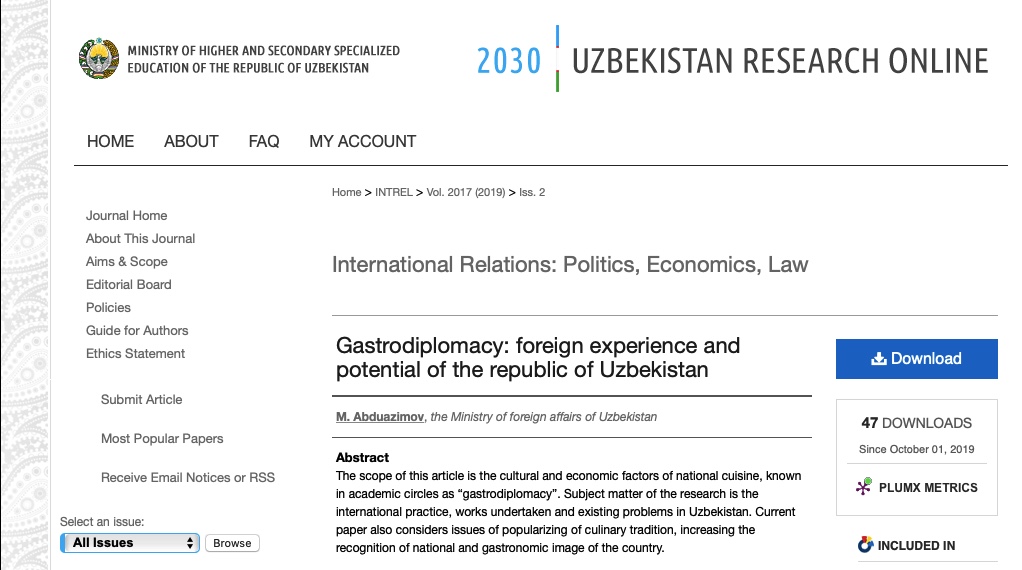
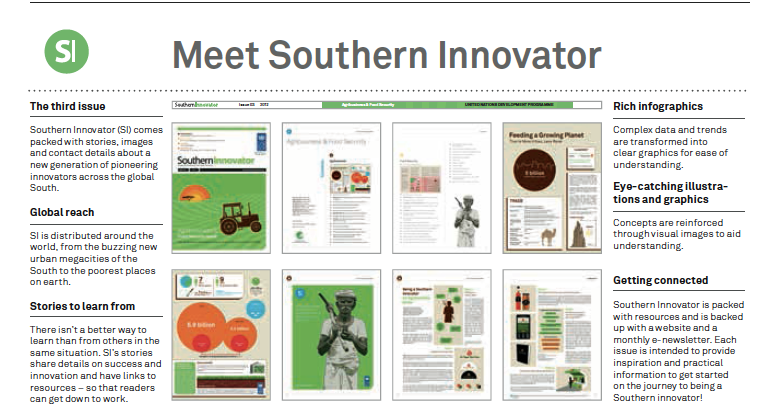
    Launched in 2011, Southern Innovator’s first issue on mobile phones and information technology proved highly influential, profiling the work of a new generation of innovators. It has been cited in books, papers and strategic plans.  The third issue focused on agribusiness and food security, including the phenomenon of ‘gastrodiplomacy’.

    Abduazimov, M. (2017) “Gastrodiplomacy: foreign experience and potential of the republic of Uzbekistan,” International Relations: Politics, Economics, Law: Vol. 2017 : Iss. 2 , Article 2. 
    Available at: https://uzjournals.edu.uz/intrel/vol2017/iss2/2.
    Gastrodiplomacy: foreign experience and potential of the republic of Uzbekistan by M. Abduazimov, International Relations: Politics, Economics, Law, 2017. 

    This work is licensed under a Creative Commons Attribution 4.0 International License.

    ORCID iD: https://orcid.org/0000-0001-5311-1052.

    © David South Consulting 2021

  • Baker Cookstoves – Designing for the African Customer

    Baker Cookstoves – Designing for the African Customer

    By David SouthDevelopment Challenges, South-South Solutions

    SOUTH-SOUTH CASE STUDY

    An innovative social enterprise is using design to create an energy-efficient cookstove for Kenya. By turning to an experienced Swedish architecture and design firm, the people behind the Baker cookstove wanted to make sure the stove’s design was as efficient as possible and relevant to the customers’ needs, while also making sure it is visually appealing and something a person would proudly want in their home.

    The Baker cookstove (bakerproduct.com) has been designed to be a high-quality and desirable product that also accomplishes the goal of saving money for the user. This unique product is being developed and made at the company’s factory in Nairobi, Kenya.

    Baker’s owner is Top Third Ventures Global (topthirdventures.com), a social-impact company registered in Kenya and founded in 2011 by American Lucas Belenky and Björn Hammar, a Swedish/Finnish entrepreneur. Their goal is to make sure that everyone in the developing world has access to an affordable, high-quality efficient cookstove.

    While cooking is a daily necessity for billions of people, it is also costly and polluting. By switching to energy-efficient cookstoves, families can reduce the cost of cooking daily meals and, if the stove is designed right, cut the amount of pollution generated. One of the great obstacles to the take-up of energy-efficient cookstoves to date has been the absence of sustainable business models to sell and distribute them.

    The Baker cookstove, designed as an aspirational product and backed up with a seven-year guarantee, hopes to change this dynamic. If things go to plan, the company hopes to significantly scale up its production based on customers wanting to have a Baker cookstove proudly on display in their home.

    The Baker cookstove is the product of a deliberate attempt to use design and a well-thought-out production life cycle to create an item that is eye-catching, effective, and manufactured consistently to a high standard.

    Designed by Claesson Koivisto Rune (http://www.ckr.se/), a Swedish architecture and design firm, the Baker cookstove is a sleek, round, modern stove and comes in eye-catching colors such as orange. It could easily fit in with other kitchen products in a high-end design shop. And that is the point: they want people to want the Baker cookstove.

    Quality is key, and engineering and design teams constantly monitor the product and make adjustments to the cookstove as they receive feedback from customers.

    The Baker cookstove is benefiting from new financing being made available through carbon credits, which its founders believe will bring big changes to the energy-efficient cookstove market over the next 10 years.

    Baker’s chief executive, Lucas Belenky, told Southern Innovator magazine – this newsletter’s sister publication – about the thinking behind the Baker cookstove.

    SI: What role does design play in the Baker cookstove social enterprise? At what stage did Top Third Ventures start to think through the production life cycle for the Baker cookstove? What did you feel was missing in the other cookstove models currently available on the market?

    The Baker cookstove is the cornerstone of the social enterprise. Top Third Ventures is at its core a product company. There are different aspects to the business model to make it work (i.e. carbon credits and big data) but everything depends on the success of the Baker product. We started thinking through the production life cycle from the day the company was founded in late 2011. The Baker is designed for usability, aspirational value, and performance, prioritized in that order. The most important thing is that the Baker is easy to use and does not require its users to change their daily routines or cooking habits. Cooking cultures vary greatly across the developing world so it is important to understand exactly who your customer is and focus on meeting their requirements. When you have a product that is easy to use it needs to be desirable as well. Beyond the service provided, the product should make the customer feel good about themselves. Finally, the Baker cooks the same food with half the fuel and much less smoke.

    The priorities seem reversed for other cookstove models on the market. Efficiency comes first, then the aesthetic design, and cultural conformity is last. Hyper-efficient cookstoves are great for health and the environment on paper but the benefits are not realized because widespread adoption isn’t achieved. Most products are imposed through a top-down approach instead of starting with the customer and designing the stove around them.

    SI: Why did you choose to have the Baker cookstove designed by Claesson Koivisto Rune, a Swedish architecture and design firm? What were some of the challenges encountered when designing the product and the production life cycle? What advice do you have for other social enterprises looking to offer an appealing product to low-income households?

    We wanted the Baker cookstove to be an aspirational product that you use as much because of the performance (less fuel and less smoke) as because it is beautiful. Claesson Koivisto Rune believed in our vision at a very early stage and I doubt we could have gotten where we are today without them. Challenges around the design mainly involve keeping the costs down. Our customers do not have a lot of disposable income so balancing affordability with performance and world-class design is tough.

    For other entrepreneurs selling to low-income households my advice is identify your customer, listen to them, and never stop listening. This is obvious to most businesses but for social enterprises sometimes the grant organizations or other dispersers of donor funding become the customer without you noticing.

    Finally, often just because the consumer is in a developing country, enterprises neglect aesthetic appeal and branding. Do not do this. Your consumer behaves for the most part like their counterpart in the developed world. They want products that look nice and make them feel good.

    SI: What role is information technology playing in the Baker cookstove’s development? How do mobile phones help with reaching customers in Africa? How does offering software products such as Top3Tracker help Baker cookstoves?

    Information technology has a huge impact in decentralized areas because it enables cheap flow of information. For Top Third Ventures it allows us to track our sales in real-time, communicate with current and future customers instantly, and gain valuable insights about how to improve the sales pitch and marketing strategy. The Baker cookstoves also depends on carbon finance, which requires a dialogue with current customers to ensure the usage of the cookstove is accurately measured. Information technology such as our Top3 Tracker significantly reduces the cost of accessing carbon finance.

    SI: It is said an innovator is somebody who disrupts existing products and ways of doing things. How is Top Third Ventures innovating and disrupting the current approach to energy-efficient cookstove distribution?

    We hope to change the way products for low-income households are designed, marketed, and sold. Top Third Ventures’ Baker cookstove embodies our conviction that these products should be customer-centric, have aspirational value, and conform to local cultures. The success of our product will show that consumers in the developing world want the same thing as their counterparts in developed countries.

    Top Third is a partner of the Global Alliance for Clean Cookstoves (cleancookstoves.org).

    Published: December 2013

    Resources

    1) Baker cookstove: The website details how the cookstove was developed. Website: bakerproduct.com

    2) Top Third Ventures: The company designs, manufactures, and sells its own unique efficient cookstoves made to fit the local cultures and traditions of their customers, supported by a strong brand and world-class customer communication. In addition, Top Third Ventures works with existing manufacturers and distributors to secure carbon financing for their activities through their programmatic CDM activity and electronic data management system. Website: topthirdventures.com

    3) Global Alliance for Clean Cookstoves: The Global Alliance for Clean Cookstoves calls for 100 million homes to adopt clean and efficient stoves and fuels by 2020. Website: cleancookstoves.org

    Like our content? Help contribute to the costs of keeping it online. 

    Scan code with your phone and help us out.

    This work is licensed under a Creative Commons Attribution 4.0 International License.

    ORCID iD: https://orcid.org/0000-0001-5311-1052.

    © David South Consulting 2021

  • African Supercomputers to Power Next Phase of Development

    African Supercomputers to Power Next Phase of Development

    By David SouthDevelopment Challenges, South-South Solutions

    SOUTH-SOUTH CASE STUDY

    Information technology developments in Africa have long lagged behind those in other parts of the world. But the transformation being brought about by the widespread adoption and use of mobile phones – each one a mini-computer – and the expansion of undersea fibre optic cable connections to Africa are creating the conditions for an exciting new phase of computing growth on the continent.

    Despite the global economic crisis, Africa is on course to see annual consumer spending reach US $1.4 trillion by 2020, nearly double the US $860 billion in 2008 (McKinsey). On top of this, by 2050, a projected 63 per cent of Africa’s population will be urban dwellers. With Africa’s middle class the fastest-growing in the world – doubling in less than 20 years – matching computing power with this consuming urban population could unleash a treasure trove of opportunity for information technology entrepreneurs.

    These developments are creating the conditions for game-changing computing in the next years. And this is encouraging the creation of a new supercomputer (http://en.wikipedia.org/wiki/Supercomputer) for Africa in Kenya that will double the total number of supercomputers in Africa. Hugely powerful compared to personal or commercial computers, supercomputers use cutting-edge technology to carry out high-speed calculations involving vast quantities of data.

    Expanded supercomputing power brings numerous advantages to both economic and human development. It will radically alter what can be accomplished in Africa – allowing mass data processing to be done, highly complex and data dense applications to be run, and very large research projects to be conducted on the continent rather than overseas.

    Increasing computing power in Africa will bring in its wake, it is hoped, a surge in economic and research opportunities.

    It will help African researchers and scientists to undertake globally competitive projects, rather than seeing this work done overseas. It will also open up a vast range of possibilities for African entrepreneurs and businesses to do complex data processing, modelling and research and will enable them to become more sophisticated operations.

    The new supercomputer, the iHub Cluster, is being built in the Kenyan capital by one of Africa’s pioneering information technology hubs – iHub Nairobi (http://ihub.co.ke/pages/home.php) – in partnership with Internet products and services company Google and microchip maker Intel Corporation.

    Africa’s first supercomputer is located in South Africa and is ranked 497 in terms of computing power on the list of 500 supercomputers in the world (http://www.top500.org/).

    It is located in the “Tsessebe cluster” in Cape Town’s Centre for High Performance Computing (http://www.chpc.ac.za/).

    “With mobile devices coming in multiple cores, it is important for developers to be exposed to higher performance computing; we are hoping to debut at a higher level than ‘Tsessebe cluster’,” Jimmy Gitonga, the project team leader for the iHub cluster, told Computer World.

    Africa suffers from poor supercomputer capacity and this has had a knock-on affect on everything to do with economic development. The iHub supercomputer hopes to help universities and colleges to gain competitive edge and be able to undertake more complex research in the fields of media, pharmaceuticals and biomedical engineering.

    “In Africa, we need to be on top of the mobile scene, its our widest used device,” Gitonga told Computer World.

    Some of the practical applications for the iHub supercomputer in East Africa and the Horn of Africa include improving weather forecasting and drought prediction, increasing the ability to give advance warning of droughts and famines in the region.

    “Most of the United Nations agencies and international agencies operating in the region have extensive field research on how to tackle natural disasters in the region. Imagine if they had affordable space where they can meet with developers and test resource-hungry applications,” Gitonga said.

    The iHub also wants to offer the services of the supercomputer to researchers and organizations who have had to go abroad to have their data processed.
    The iHub supercomputer hopes to be used by mobile phone developers, gamers, universities and research institutions.

    In the last two years, China had pushed the United States out of the number one spot for supercomputers. The Tianhe-1A located at the National Supercomputing Center in Tianjin (http://www.nscc-tj.gov.cn/en/), China, was the fastest computer in the world from October 2010 to June 2011.

    For those looking to see how they can make the most of the growing supercomputer capability in Africa, examples from other countries offer a good idea. Supercomputers can be used for weather forecasting, climate research, oil and gas exploration, physical simulations like when testing aircraft, complex modelling for medical research, processing complex social data necessary for delivering effective social programmes or running modern health care systems.

    Published: October 2012

    Resources

    1) A video on how to use a supercomputer. Website:http://www.youtube.com/watch?v=yvbSX–LOko

    2) Southern Innovator Issue 1: Mobile Phones and Information Technology. Website:http://www.scribd.com/doc/95410448/Southern-Innovator-Magazine-Issue-1-Mobile-Phones-and-Information-Technology?in_collection=3643685

    3) Read more about the iHub supercomputer. Website:http://www.ihub.co.ke/blog/2012/09/the-ihub-cluster/

    4) More on High Performance Computing from Intel Corporation. Website:http://www.intel.com/content/www/us/en/high-performance-computing/server-reliability.html

    https://davidsouthconsulting.org/2022/11/11/african-botanicals-to-be-used-to-boost-fight-against-parasites/

    https://davidsouthconsulting.org/2022/11/11/african-breakthroughs-to-make-life-better/

    https://davidsouthconsulting.org/2022/11/20/african-bus-to-tackle-african-roads/

    https://davidsouthconsulting.org/2022/11/19/african-culture-as-big-business/

    https://davidsouthconsulting.org/2022/11/17/african-ingenuity-attracting-interest/

    https://davidsouthconsulting.org/2022/11/15/african-innovators-celebrated-in-prize/

    https://davidsouthconsulting.org/2022/11/02/african-online-supermarket-set-to-boost-trade/

    Like our content? Help contribute to the costs of keeping it online.

    Scan code with your phone and help us out.
    Creative Commons License

    This work is licensed under a
    Creative Commons Attribution-Noncommercial-No Derivative Works 3.0 License.

    ORCID iD: https://orcid.org/0000-0001-5311-1052.

    © David South Consulting 2021