Tag: David South

  • Model City to Test the New Urbanism Concept in India

    Model City to Test the New Urbanism Concept in India

    By David SouthDevelopment Challenges, South-South Solutions

    SOUTH-SOUTH CASE STUDY

    India’s phenomenal economic growth rate – forecast to be 7.9 percent this year by the Asian Development Bank, after averaging 7.7 percent per year over the past decade – has been the force behind an expanding middle class population, now estimated at 50 million people (McKinsey). Forecasts see it swelling from 5 percent of the population to 40 percent by 2025.

    India now boasts many fast-growing global companies and booming enterprise zones like the technology hub of Bangalore. But the country still comes in for heavy criticism of the way it has managed the growth of its cities. Poor planning and chaotic growth have left many cities with vast slum areas, congestion, poor hygiene and sanitation services, crumbling infrastructure and poor-quality transportation services. To more and more Indians it has become clear these factors are now serious impediments to economic growth and modernisation of the country and its economy.

    With 30 percent of the population living in urban areas and cities contributing 60 percent of the country’s GDP and 90 percent of government revenues (Wall Street Journal), city-dwellers’ fate is critical to the functioning of the economy.

    According to the 2001 Indian census, slums make up 25 percent of all housing, and 26 percent of urban households lack access to sanitation facilities.

    And as the middle class grows and its members accumulate savings, their desire to be better housed will also grow. They will be on the hunt for new places to live to realise their dreams. Those who can satisfy this strong urge will be those who will also profit.

    This is where the new city concept of Lavasa (www.lavasa.com) comes in. This new community sits nestled in picturesque mountains and features promenades, sidewalk cafes, and ice cream parlours, but none of the clichéd fixtures of today’s Indian cities: rickshaws, noise and pollution, poor sanitation and over-crowding. It has apartment houses in mustard, terra cotta, ochre, olive and beige. It is also going to have a medical campus, luxury hotels, boarding schools, sports academies, a golf course, a space camp, animation and film studios, software-development companies, biotech labs and law and architectural companies. A thoroughly ‘knowledge economy’ mix that India’s aspiring classes wish to see the country embrace for its future development.

    The people behind Lavasa see it as a new model of governance and urban development for India in the 21st century.

    Lavasa is located in Western Ghats, 200 kilometres southeast of Mumbai, India’s financial and entertainment capital, and 65 kilometres west of Pune, a centre for software programming and computer animation.

    Lavasa’s colourful and detailed website boasts it as a “private hill city being developed by Lavasa Corporation Limited where people can live, work, learn and play in harmony with nature.” It’s billed as “an inclusive city, based on the principles of New Urbanism.”

    The master plan is to house more than 300,000 people divided in to five linked towns.

    The first town, Dasve, will be completed in 2011. Its houses are selling well and are almost sold out, according to its developers.

    Lavasa is the concept of Ajit Gulabchand, chairman of Hindustan Construction Company, an Indian company with extensive experience building bridges and dams.

    The development is located in the remote hills along the Varasgaon Lake, a reservoir providing water to Pune. Lavasa Hill City covers “25,000 acres with 60 Kms of lakefront” according to its website. The land had originally been designated for holiday homes, but this seemed too small an aspiration.
    Lavasa will be governed by a private corporation. It is also being planned according to the principles of New Urbanism (www.newurbanism.org) – a belief in cities built around walkability not cars, where business and residential sit side-by-side, with mixed income housing and lots of green space for parks.

    The corporation will take responsibility for providing all major utilities: running water, electricity, sewage treatment, garbage collection and fibre optic connections.

    This thoroughly modern approach has startled prospective buyers of homes, puzzled there weren’t water tanks on the roofs and septic tanks for each house: something they had come to expect with current Indian cities.

    The Lavasa Corporation has hired an American city administrator, Scot Wrighton, to run the new city.

    He told The Atlantic magazine that Lavasa offered him “a chance to build a new governance model for a country where governance at the municipal level does not work.”

    The project seeks to exploit a portion of Maharashtra state law that lets corporations assume many of the responsibilities normally provided by, or in the domain of, the state. These do not include police powers or the ability to raise taxes but take in pretty much everything else.

    Lavasa has private security guards to watch over its residents and funds itself through home sales, renting, and business deals. The prices for apartments in the development range between US $17,000 and US $36,000. While cheap by Western standards, this is still expensive to middle class Indians.

    The project has come in for criticism for being just for the wealthy and being a pipe dream in chaotic India.

    In response to criticism, Gulabchand is introducing cheaper apartments targeting young professionals and starter homes that he claims will rent for US $11 a month. This far lower monthly rent could make the development affordable for more people, including domestic servants and laborers.

    Gulabchand admitted the plan was not without risks. “We’re worried we’ll still get slums,” he said. “Do we have all the answers yet? No. It is still an experiment, okay?”

    As for charges the development doesn’t look much like the ‘real’ India, Gulabchand says: “Why should we look to the past? India is a young society.”

    But Gulabchand doesn’t think India has the time to waste pondering these aesthetic questions: the country has a desperate need for better quality living conditions.

    “We may not get a perfect Singapore-style model city,” he told The Atlantic. “But this is a model for a more vibrant, inclusive, greener place that still has soul.”

    Published: September 2011

    Resources

    1) New documentary Urbanized gives a passionate over-view of the challenges facing the rapidly urbanizing world around us. Website: http://urbanizedfilm.com/

    https://davidsouthconsulting.org/2021/03/05/southern-innovator-issue-4/

    https://davidsouthconsulting.org/2022/09/28/model-cities-across-the-south-challenge-old-ways/

    https://davidsouthconsulting.org/2020/12/04/model-indian-villages-to-keep-rural-relevant/

    Creative Commons License

    This work is licensed under a
    Creative Commons Attribution-Noncommercial-No Derivative Works 3.0 License.

    ORCID iD: https://orcid.org/0000-0001-5311-1052.

    © David South Consulting 2022
  • Global South Eco-cities Show How the Future Can Be

    Global South Eco-cities Show How the Future Can Be

    By David SouthDevelopment Challenges, South-South Solutions

    SOUTH-SOUTH CASE STUDY

    The world is currently undergoing a high-stress transition on a scale not seen since the great industrial revolution that swept Europe in the 19th and 20th centuries. Today’s urban and industrial transition involves many more people and is taking place on a greater proportion of the planet. With rapid urbanization comes a demand for middle class lifestyles, with their high-energy usage and high consumption of raw materials.

    This is stretching the planet’s resources to breaking point. And as many have pointed out, if the world’s population is to continue past today’s 7 billion to reach 9 billion and beyond, new ways of living are urgently required. Radical thinking will be necessary to match the contradictory goals of raising global living standards for the world’s poor with pressured resources and environmental conditions.

    But there are innovative projects already under development to build a new generation of 21st-century cities that use less energy while offering their inhabitants a modern, high quality of life. Two examples are in China and the Middle East.

    Both projects are seen as a way to earn income and establish viable business models to build the eco-cities of the future. Each project is seeking to develop the expertise and intellectual capacity to build functioning eco-cities elsewhere. In the case of the Masdar City project in the United Arab Emirates, international businesses are being encouraged to set up in Masdar City and to develop technologies that can be sold to other countries and cities – in short, to create a green technology hub akin to California’s hi-technology hub ‘Silicon Valley’. Masdar City is also being built in stages as investors are found to help with funding. Both projects hope to prove there is money to be made in being green and sustainable.

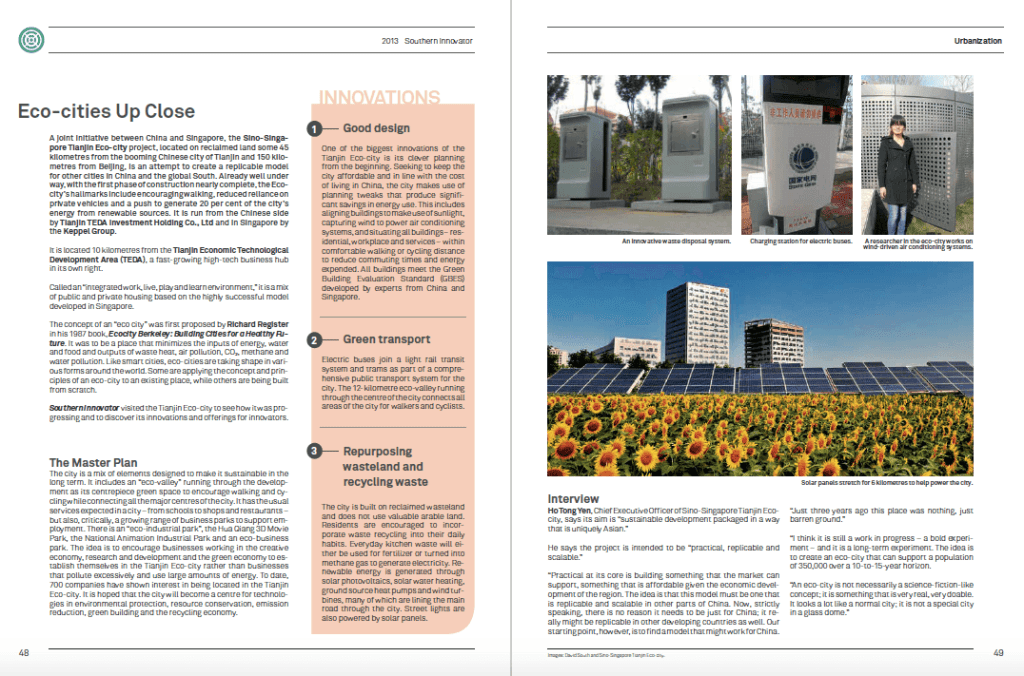
    The Tianjin Eco-city (tianjinecocity.gov.sg) project is a joint venture between China and Singapore to build a 30 square kilometre city to house 350,000 residents.

    Tianjin (http://en.wikipedia.org/wiki/Tianjin) is a large industrial city southeast of China’s capital, Beijing. It is a place that wears the effects of its industrial expansion on the outside. Air pollution is significant and the city has a grimy layer of soot on most outdoor infrastructure.

    China has received a fair bit of criticism for its polluted cities as the country has rapidly modernized in the past two decades. This sprint to be one of the world’s top economic powers has come at a cost to the environment. In this respect, China is not unusual or alone. Industrialization can be brutal and polluting, as Europe found out during its earlier industrial revolution.

    But China is recognizing this can’t go on forever and is already piloting many initiatives to forge a more sustainable future and bring development and high living standards back in line with what the environment can handle.

    Sino-Singapore Tianjin Eco-city is the second large-scale collaboration between the Chinese government and Singapore. The first was the Suzhou Industrial Park (http://www.sipac.gov.cn/english/).The Tianjin project came up in 2007 as both countries contemplated the challenges of rapid urbanization and sustainable development.

    The project’s vision, according to its website, is to be “a thriving city which is socially harmonious, environmentally-friendly and resource-efficient – a model for sustainable development.”

    The philosophy behind the project is to find a way of living that is in harmony, with the environment, society and the economy. It is also about creating something that could be replicated elsewhere and be scaled up to a larger size.

    The city is being built 40 kilometres from Tianjin centre and 150 kilometres from Beijing. It is located in the Tianjin Binhai New Area, considered one of the fastest growing places in China.

    Construction is well underway and can be followed on the project’s website (http://www.tianjinecocity.gov.sg/gal.htm). It will be completed in 2020.

    This year, the commercial street was completed and is ready for residents to move in.

    Residents will be encouraged to avoid motorized transport and to either use public transport or people-powered transport such as bicycles and walking.

    An eco-valley runs down the centre of the city and is meant to be a place for pedestrians and cyclists to enjoy.

    The basic building block of the Eco-city – its version of a city block – is called the Eco Cell. Each Eco Cell measures 400 metres by 400 metres, a comfortable walking distance. Four Eco Cells make a neighbourhood. Several Eco Neighbourhoods make an Eco District and there are four Eco Districts in the Eco-city. It is a structure with two ideas in mind: to keep development always on a walkable, human scale and also to provide a formula for scaling up the size of the Eco-city as the number of residents increases.

    It is a logical approach and seeks to address one of the most common problems with conventional cities: sprawling and unmanageable growth that quickly loses sight of human need.

    Agreement was also reached on the standards that should be achieved for a wide variety of criteria, from air and water quality to vegetation, green building standards, and how much public space there should be per person.

    An ambitious project in the United Arab Emirates is trying to become both the world’s top centre for eco cities and a living research centre for renewable energy. Masdar City (http://www.masdarcity.ae/en/)is planned to be a city for 40,000 people. It is billed as a high-density, pedestrian-friendly development where current and future renewable energy and clean technologies will be “marketed, researched, developed, tested and implemented.”

    The city hopes to become home to hundreds of businesses, a research university and technology clusters.

    This version of an eco-city is being built in three layers in the desert, 17 kilometres from the Emirati capital Abu Dhabi. The goal is to make a city with zero carbon emissions, powered entirely by renewable energy. It is an ambitious goal but there are examples in the world of cities that use significant renewable energy for their power, such as Reykjavik, Iceland in Northern Europe, which draws much of its energy from renewables and geothermal sources.

    Masdar City is designed by world-famous British architect Norman Foster (fosterandpartners.com) and will be 6.5 square kilometres in size.

    The design is highly innovative. The city will be erected on 6 metre high stilts to increase air circulation and reduce the heat coming from the desert floor. The city will be built on three levels or decks, to make a complete separation between transport and residential and public spaces.

    The lowest deck will have a transportation system based on Personal Rapid Transport Pods. These look like insect eyes and are automated, controlled by touch screens, using magnetic sensors for propulsion. On top of this transport network will be the pedestrian streets, with businesses, shops and homes. No vehicles will be allowed there, and people will only be able to use bicycles or Segway (segway.com) people movers to get around. An overhead light railway system will run through the city centre, all the way to Abu Dhabi City.

    “By layering the city, we can make the transport system super-efficient and the street level a much better experience,” Gerard Evenden, senior partner at Foster + Partners, told The Sunday Times. “There will be no car pollution, it will be safer and have more open spaces. Nobody has attempted anything like this.”

    Masdar City is being built in stages as funding comes, with the goal of completion by 2016. It hopes to achieve its aspiration to be the most technologically advanced and environmentally friendly city in the world. As for water supplies in the desert, there is a plan: dew collected in the night and morning and a solar-powered desalination plant turning salt water into drinking water.

    Electricity will come from a variety of sources. Solar panels will be on every roof and double as shade on alleyways. Non-organic waste will be recycled, while organic waste will be turned into fuel for power plants. Dirty water will be cleaned and then used to irrigate green spaces. Because of the design, the planners hope the city will just use a quarter of the energy of a conventional city.

    To keep the city smart and the project on top of developments in renewable energy, the Masdar Institute of Science and Technology (http://www.masdar.ac.ae/) will specialize in renewable energy technology.

    The cost for the city was pegged at US $22 billion in 2009.

    The chief executive of Masdar – Abu Dhabi’s renewable-energy company – is Sultan Al Jaber. He sees the city as a beacon to show the way for the rest of the Emirate to convert from a highly inefficient consumer of energy to a pioneer in green technology.

    “The problem with the renewable-energy industry is that it is too fragmented,” he told The Sunday Times. “This is where the idea for Masdar City came from. We said, ‘Let’s bring it all together within the same boundaries, like the Silicon Valley model (in California, USA).’”

    The project needs to gather much of its funding as it progresses. The United Nations’ Clean Development Mechanism (http://cdm.unfccc.int/) is helping with financing. Companies can earn carbon credits if they help fund a low-carbon scheme in the global South. The sultan is ambitious and sees this as a “blueprint for the cities of the future.” It has been able to bring on board General Electric (GE) and the Massachusetts Institute of Technology (MIT) to sponsor the university.

    It is possible to visit Masdar City and take a tour (http://www.masdarcity.ae/en/105/visit-masdar-city/) and it is also possible to view online what has been built so far (http://www.masdarcity.ae/en/32/built-environment/).

    Published: June 2012

    Resources

    1) Center for Innovation, Testing and Evaluation (CITE): Located in Texas, USA, CITE is a fully functioning city with no residents to test new technologies before they are rolled out in real cities. Website: http://www.pegasusglobalholdings.com/test-center.html

    2) Digital Cities of the Future: In Digital Cities, people will arrive just in time for their public transportation as exact information is provided to their device. The Citizen-Centric Cities (CCC) is a new paradigm, allowing governments and municipalities to introduce new policies. Website: http://eit.ictlabs.eu/action-lines/digital-cities-of-the-future/

    3) Eco-city Administrative Committee: Website: http://www.eco-city.gov.cn/

    4) Sino-Singapore Tianjin Eco-city, Investment and Development Co., Ltd. Website: tianjineco-city.com

    5) ‘The Future Build’ initiative, a new green building materials portal from Masdar City. Website: thefuturebuild.com

    6) UNHABITAT: The United Nations Human Settlements Programme is the UN agency mandated to promote socially and environmentally sustainable towns and cities with the goal of providing adequate shelter for all. Website: http://www.unhabitat.org

    Creative Commons License

    This work is licensed under a
    Creative Commons Attribution-Noncommercial-No Derivative Works 3.0 License.

    ORCID iD: https://orcid.org/0000-0001-5311-1052.

    © David South Consulting 2022

  • African Digital Laser Breakthrough Promises Future Innovation

    African Digital Laser Breakthrough Promises Future Innovation

    By David SouthDevelopment Challenges, South-South Solutions

    SOUTH-SOUTH CASE STUDY

    For decades many African countries have experienced low investment in research and development (R&D) and scientific innovation. One of the few nations to benefit from a sophisticated university network and research and development sector was South Africa. It still ranks top on the continent for funding R&D and its high number of scientific journals.

    And it seems this support has paid off in a recent innovation. The world’s first digital laser designed and built in Africa has been developed by a team of physicists at the University of KwaZulu–Natal in South Africa (http://www.ukzn.ac.za/), as reported in the MIT Technology Review (http://www.technologyreview.com/).

    This innovation joins a positive trend in Africa, where support to science, technology and R&D is rising – albeit from a very low base. In 2010 UNESCO – the United Nations Educational, Scientific and Cultural Organization – found Africa was reversing decades of neglect in research and development. African countries were increasing investment in science and technology after realizing it will accelerate their connection with the global economy and help create better-quality jobs to tackle poverty. The UNESCO Science Report found Burkina Faso, Kenya, Nigeria and South Africa had adopted laws to support biotechnology research, for example.

    Since 2005, six new science academies have been established in Mauritius, Morocco, Mozambique, Sudan, Tanzania and Zimbabwe. This compares to nine established between 1902 and 2004.

    The proportion of GDP (gross domestic product) devoted to R&D averages 0.3 per cent in Africa, according to UNESCO.

    South Africa continues to lead in R&D spending, raising its investment from 0.73 per cent of GDP in 2001 to 0.94 per cent in 2006. The country is home to 46 per cent of Africa’s scientific publications compared to 11.4 per cent in Nigeria and 6.6 per cent in Kenya (UNESCO).

    Experts say the digital laser developed in South Africa is a breakthrough that will open up ever-further innovations and business opportunities.

    So, what is a digital laser and what is the innovation? A laser is short form for Light Amplification by Stimulated Emission of Radiation. It is a device that produces a concentrated light source. Unlike conventional light sources that emit a diffused, multispectral light, lasers allow for a monochromatic light beam to be concentrated on a small area. This can be used to cut an object precisely, or beamed over long distances without losing its strength.

    Lasers can create immense light, heat and power at close range and are regularly used in surgery and medical diagnosis.

    Conventional lasers require external devices to alter and bend the laser light beam. The digital laser allows the shape of the beam to be digitally altered internally at the touch of a computer keyboard and gives greater immediate control. This means a plethora of new shapes can be formed with the laser beam, and this can have many practical applications.

    The digital laser augers in a new age of creativity with lasers and more spontaneity in how they are used. Rather than having to place a lens or mirror at the front of the casing to shape the laser beam, this innovation makes it possible to create any shape desired digitally by a computer. The research team has been able to create various complex shapes for the laser beams in experiments. One mooted use is to apply laser beams to manipulate microscopic objects – similar to the tractor beams seen in science fiction films such as “Star Trek”.

    Few of us spend much time thinking about lasers, yet they are ubiquitous in the modern world and are found in many electronic products (https://en.wikipedia.org/wiki/List_of_laser_applications). They play a critical part in the modern world’s economy. Some common applications for lasers include laser light shows at music concerts, bar code readers at the grocery store, or laser pointers used during public presentations. Dentists also use them to speed the hardening of fillings.

    Not to exploit lasers as a technology in the modern world is equivalent to bypassing the silicon micro-chip that sits inside personal computers, electronic devices and mobile phones.

    Published: May 2013

    Resources

    1) Digital laser: The research paper submitted by the team explaining the innovation. Website: http://arxiv.org/abs/1301.4760

    2) 3D Laser Hologram Kit: Now you can make your own holograms at home with the help of this innovative kit. Website: http://www.scientificsonline.com/hologram-kit.html

    3) Hands-On Science Kits and Demos. Website: http://ice.chem.wisc.edu/Catalog/SciKits.html

    4) Home kit for making a Laser Theatre. Website: http://www.scientificsonline.com/laser-theater.html

    5) Little Bits: littleBits is an open source library of electronic modules that snap together with magnets for prototyping, learning and fun. Website: http://littlebits.cc/

    6) Consolidated Plan of Action for Africa’s Science and Technology adopted by African Minsters of Science and Technology in 2005. Website: http://www.nepad.org/humancapitaldevelopment/news/1581/advancing-science-and-technology-africa

    Southern Innovator logo

    London Edit

    31 July 2013

    Like science and technology stories from the global South? Here are some more from the archive:

    China Sets Sights on Dominating Global Smartphone Market

    China Pushing Frontiers of Medical Research

    China Looking to Lead on Robot Innovation

    Follow @SouthSouth1

    Slideshare: http://www.slideshare.net/DavidSouth1/development-challengessouthsouthsolutionsnovember2010issue

    Southern Innovator Issue 1: https://books.google.co.uk/books?id=Q1O54YSE2BgC&dq=southern+innovator&source=gbs_navlinks_s

    Southern Innovator Issue 2: https://books.google.co.uk/books?id=Ty0N969dcssC&dq=southern+innovator&source=gbs_navlinks_s

    Southern Innovator Issue 3: https://books.google.co.uk/books?id=AQNt4YmhZagC&dq=southern+innovator&source=gbs_navlinks_s

    Southern Innovator Issue 4: https://books.google.co.uk/books?id=9T_n2tA7l4EC&dq=southern+innovator&source=gbs_navlinks_s

    Southern Innovator Issue 5: https://books.google.co.uk/books?id=6ILdAgAAQBAJ&dq=southern+innovator&source=gbs_navlinks_s

    Creative Commons License

    This work is licensed under a
    Creative Commons Attribution-Noncommercial-No Derivative Works 3.0 License.

    ORCID iD: https://orcid.org/0000-0001-5311-1052.

    © David South Consulting 2023

  • Innovative Stoves to Help the Poor

    Innovative Stoves to Help the Poor

    By David SouthDevelopment Challenges, South-South Solutions

    SOUTH-SOUTH CASE STUDY

    Half of the world’s population cook with a fuel-burning stove, and this figure rises to 80 per cent of households in rural areas in developing countries. Typical fuels burned include wood, coal, crop leftovers and animal dung. The indoor pollution from smoke and carbon monoxide is a top health hazard in the developing world, ranking just behind dirty water, poor sanitation and malnutrition. The World Health Organization (WHO) estimates that 1.6 million people die each year as a result of toxic indoor air.

    A landmark five-year study comparing Guatemalans cooking on open fires, to those using improved stoves, has brought more evidence forward of the damage done by indoor air pollution: “It’s been shown that children living in houses using open fires with solid fuels will have more pneumonia than children living in houses that are using cleaner fuels,” said Dr. Kirk R. Smith, an environmental health scientist at the University of California, Berkeley.

    The research, combined with studies in Asia, suggests additional health problems from indoor air pollution, including higher frequency of cataracts, partial blindness, tuberculosis, low birth weights and high blood pressure. The researchers found that cleaner stoves had larger effects than reducing salt in the diet or lowering blood pressure in women, with the results published last July in Environmental Health Perspectives.

    But Southern innovators are finding practical ways to curb pollution from indoor cooking and the burning of trash in slums.

    In Yunnan Province, China, entrepreneur Hao Zheng Yi’s Yunnan Zhenghong Environmental Protection Co. has been selling clean-burning stoves to rural farmers. One fifth of rural China has no electricity (UN), and 80 per cent rural dwellers burn wood or straw in ovens for heating and cooking. This creates heavy indoor air pollution, damaging health.

    The so-called Efficient Gasification Burning system combines traditional fuel and natural gas: a hybrid that helps low-income households to affordably use the stove and not pollute their indoor air.

    The stoves are sold for a profit in Yunnan Province, and so far 50,000 have been sold. Because the ovens are sold for a profit, Zhenghong had to consult extensively with the farmers in the design phase to make sure the ovens meet their needs.

    The result has been that Zhenghong ovens run for five to eight years using the same amount of wood and hay a conventional oven burns in one year.

    Another source of air pollution is burning trash in slums. The lack of formal trash removal services in slums has two bad consequences: one is the pollution and poison from rotting rubbish leaching into the soil and water table; the other is ad-hoc burning of the trash to get rid of it, which pollutes the air with a toxic, acrid stench. In Nairobi’s Kibera slum – the second biggest in Africa – over 60 per cent of the city’s residents live in the slum, and are bypassed by garage collection services. Garbage is piled up along the muddy roads and paths, or hangs in the trees.

    The Kenyan NGO Umande Trust, which specialises in water and sanitation projects, has developed a home-grown method to burn trash and avoid having to turn to very expensive and complicated incinerators from Europe. The sheer quantity of trash that needs to be burned in the slum means smaller solutions will not be able to handle the problem.

    Its “community cooker” re-uses garbage from the community as fuel for a boiler and oven attached to it. The heat generated by burning the rubbish provides hot water and cooking facilities – and also jobs for unemployed youths who collect the rubbish and stock the incinerator. It was developed by a Kenyan architect, and it is hoped the “community cooker” will be taken up across Africa.

    The community cooker’s inventor, Kenyan architect Jim Archer, took eight years to design and build it: “My thinking was how do we get rid of the rubbish and …how can we induce people to pick it up. Then I thought, well if we can convert it to heat on which people can cook…” he told Australia’s ABC News.

    Similar industrial scale trash incinerators can cost between US $50 million to US $280 million (World Bank) – “…when applying waste incineration, the economic risk of project failure is high…”. The community cooker on the other hand, will sell for US $10,000.

    The idea was to create an incinerator that was simple to use and repair: something that the commercially available, computer-controlled incinerators were not able to do. As the cooker gets up to speed, it will be able to burn 60 per cent of the slum’s trash.

    Local youth go house-to-house collecting trash. They get money from the slum residents for this. Rubbish is then exchanged for cooking time or hot water for washing.

    “The trash has started to help us a bit after the cooker came. There are fewer diseases like diarrhea and the environment has improved. … I think burning the rubbish will bring good health to this community,” said Patricia Ndunge, as she fried onions on the cooker.

    And it looks like the community cooker has a future: Kenya’s largest supermarket, Nakumatt, has pledged to pay for 20 more slum cookers.

    Published: March 2008

    Resources

    • Envirofit: A Shell Foundation supported project to produce 300,000 clean, wood-burning stoves for the developing world (starting with India, Brazil, Kenya and Uganda). Envirofit will offer a variety of sleek ceramic stoves from single to multipot, with and without chimneys, and with colors like apple red, baby blue and gold. The cost is to start at $10 to $20 and run to $150 to $200.
      Website: http://www.envirofit.org/

    Follow @SouthSouth1

    Slideshare: http://www.slideshare.net/DavidSouth1/development-challengessouthsouthsolutionsnovember2010issue

    Southern Innovator Issue 1: https://books.google.co.uk/books?id=Q1O54YSE2BgC&dq=southern+innovator&source=gbs_navlinks_s

    Southern Innovator Issue 2: https://books.google.co.uk/books?id=Ty0N969dcssC&dq=southern+innovator&source=gbs_navlinks_s

    Southern Innovator Issue 3: https://books.google.co.uk/books?id=AQNt4YmhZagC&dq=southern+innovator&source=gbs_navlinks_s

    Southern Innovator Issue 4: https://books.google.co.uk/books?id=9T_n2tA7l4EC&dq=southern+innovator&source=gbs_navlinks_s

    Southern Innovator Issue 5: https://books.google.co.uk/books?id=6ILdAgAAQBAJ&dq=southern+innovator&source=gbs_navlinks_s

    Creative Commons License

    This work is licensed under a
    Creative Commons Attribution-Noncommercial-No Derivative Works 3.0 License.

    ORCID iD: https://orcid.org/0000-0001-5311-1052.

    © David South Consulting 2023