Tag: David South

  • China Consumer Market: Asian Perspective Helps

    China Consumer Market: Asian Perspective Helps

    By David SouthDevelopment Challenges, South-South Solutions

    SOUTH-SOUTH CASE STUDY

    The rise of China since 1989 has been the most remarkable development story of our times. The number of people lifted out of poverty is historically unprecedented: 65 percent of Chinese people lived below the poverty line in 1981; in 2007 it was 4 percent (World Bank).

    Many commentators have focused on China’s astonishing work ethic, vast labour resources and ability to export great quantities of products. But while China has been busy meeting the needs of the world economy, domestic Chinese consumption has received less attention.

    Yet, with the Chinese firmly established as keen savers and very ambitious to improve their living standards, a vast new opportunity has emerged: the Chinese consumer market. But it will be a tricky market to tap. Chinese consumers are notorious bargain hunters and prefer to save and invest rather than consume. Poor rural families earning less than US $200 per person a year still are able to save 18 percent of their income.

    This makes a lot of sense: social supports have been stripped away as China’s economy embraced the market system. If you do not save and invest, then you will not have the resources to meet the costs of education and health care, for example. China has also seen a dramatic move to urban areas, with over 43 percent of the population now urban.

    China, despite all the hype, is still a marketplace that is difficult to easily enter for Western brands and businesses. And this makes for an opportunity for local brands to raise their game.

    In order to compete in the consumer market, businesses need to do more than compete on price: they need to also offer something more and that usually involves building a strong brand.

    The Chinese urban consumer market could grow from around US $570 billion in 2005 to around US $4.7 trillion by 2025 (PWC) (http://www.pwc.co.uk). Fast growth will be seen in discretionary spending, things other than food, clothing and utilities.

    While Chinese businesses have focused on export markets and meeting the needs of the global marketplace – a focus which has been very successful and led to remarkable wealth gains – the Chinese consumer has come lower down the list of priorities.

    Growing the domestic consumer market offers a substantial wealth-creating opportunity. Since the global economic crisis erupted in 2008, it has become apparent that the old model of exporting vast quantities of products to Western consumers alone will not be enough to keep living standards rising. Western economies are highly indebted and will take many years to recover from the mistakes and debts from the boom years and the economic crisis.

    This is an opportunity for South-South trade, which made up 20 percent of global exports by 2010. Foreign direct investment to developing economies rose by 10 percent in 2010 due to a rapid economic recovery and increasing South-South flows.

    One company successfully targeting this market is the Singapore-based Banyan Tree Hotels and Resorts brand (www.banyantree.com), which bills itself as specializing in luxury sanctuaries to rejuvenate the body, mind and soul. It is notable for deliberately not competing on price but on its brand reputation and for tailoring its offering explicitly to Asian tastes. The company claims its resorts are “naturally-luxurious, ecologically sensitive, culture-aware experiences for the discerning, responsible traveller.”

    The first Banyan Tree resort was built in Phuket, Thailand in 1987. It now employs 8,200 people from 50 nationalities in 26 resorts. Founder and executive chairman Ho Kwon Ping focused from the start on the business’s brand as critical to driving the growth of the company.

    He told INSEAD Knowledge: “The difference between us and some others is that, for many other companies having a strong brand is a reward for being successful in many things that you do but it’s sort of coincidental. It comes afterward; it’s a reward for success in other areas. For us, we’ve always said from the very beginning – having a strong brand is imperative for our survival.”

    Banyan Tree has also eschewed quick-growth models, instead trying to do as little environmental damage as possible and to include community development and environmental projects at each resort.

    Its Banyan Tree Ringha resort in China’s Yunnan province tries to bring the atmosphere of the fictional earthly paradise of Shangri-La to China. Ringha Valley sits near the Temple of the Five Wisdom Buddhas, 3,600 meters above sea level. The resort has 15 one-bedroom suites, 11 two-bedroom lodges, and six spa suites, decorated in a Tibetan style. The area is home to the Naxi people who trace their origins to nearby Tibet (http://en.wikipedia.org/wiki/Naxi_people).

    The accommodation is rustic and the resort is located in the middle of a village. Visitors can see farmers at work right from the resort. Overlooked by Tibetan mountains and settled in a lush, fertile valley the sight was picked for its tranquillity and isolation. The appeal of the area to tourists is clear: mountain peaks, deep canyons, rivers, valleys, streams and tranquil lakes. And in polluted urban China, it is an area free from pollution.

    The resort is built from transplanted Tibetan farm houses and offers hikes, mountain lakes, hot springs, gorges, forests. There are Asian touches like a welcome at the resort of Tibetan horns, songs and a tea ceremony.

    Tourism is transforming the area. Towns and villages have been renovated to showcase traditional architecture.

    The hotel and resort chain gets its name from the tradition of ancient merchants gathering under the branches of the banyan tree to conduct business in the cool shade.

    “The 21st century is really going to be the age of Asia – both India and China,” said Ho Kwon Ping. “The huge consumer markets are going to be Asian … Now there’s a real opportunity for people of Asian origin, who have an instinctive cultural feel for where their consumers are moving towards, to come out and create a brand which can be primarily rooted in their own Asian context, but have a global relevance.”

    Published: March 2011

    Resources

    1) How big will the Chinese consumer market get by 2025? A report by PriceWaterhouseCoopers. Website: http://tinyurl.com/5upqew8

    2) An interactive map of Africa’s new wealth and where to find it. Website: http://online.wsj.com/article/SB10001424052748704720804576009672053184168.html#project%3DAFRICAMAP0111%26articleTabs%3Dinteractive

    3) A video on the rising African consumer market. Website: http://annansi.com/blog/2010/12/growth-and-spending-of-african-consumer-video/

    4) Environmental Public Awareness Handbook: Case Studies and Lessons Learned in Mongolia: Tested approaches to community development and environmental protection in Asia. Website: http://www.scribd.com/doc/28633063/Environmental-Public-Awareness-Handbook-Case-Studies-and-Lessons-Learned-in-Mongolia-Part-One?in_collection=2521442
    https://davidsouthconsulting.org/2022/10/26/african-trade-hub-in-china-brings-mutual-profits-2/

    https://davidsouthconsulting.org/2022/10/26/africas-consumer-market-in-spotlight-for-2011/

    https://davidsouthconsulting.org/2020/12/10/china-sets-sights-on-dominating-global-smartphone-market/

    https://davidsouthconsulting.org/2022/11/21/chinese-trade-in-angola-helps-recovery/

    https://davidsouthconsulting.org/2021/03/20/computer-gold-farming-turning-virtual-reality-into-real-profits/

    https://davidsouthconsulting.org/2021/01/26/designed-in-china-to-rival-made-in-china/

    https://davidsouthconsulting.org/2022/11/15/indonesian-middle-class-recycle-wealth-back-into-domestic-economy/

    https://davidsouthconsulting.org/2022/10/04/popular-chinese-social-media-chase-new-markets/

    https://davidsouthconsulting.org/2022/11/17/pulque-aztec-drink-ferments-new-economy/

    https://davidsouthconsulting.org/2022/10/26/shopping-and-flying-in-africas-boom-towns/

    https://davidsouthconsulting.org/2020/04/17/virtual-supermarket-shopping-takes-off-in-china/

    Development Challenges, South-South Solutions was launched as an e-newsletter in 2006 by UNDP’s South-South Cooperation Unit (now the United Nations Office for South-South Cooperation) based in New York, USA. It led on profiling the rise of the global South as an economic powerhouse and was one of the first regular publications to champion the global South’s innovators, entrepreneurs, and pioneers. It tracked the key trends that are now so profoundly reshaping how development is seen and done. This includes the rapid take-up of mobile phones and information technology in the global South (as profiled in the first issue of magazine Southern Innovator), the move to becoming a majority urban world, a growing global innovator culture, and the plethora of solutions being developed in the global South to tackle its problems and improve living conditions and boost human development. The success of the e-newsletter led to the launch of the magazine Southern Innovator. 

    https://davidsouthconsulting.org/2021/03/05/southern-innovator-issue-1/

    https://davidsouthconsulting.org/2021/03/05/southern-innovator-issue-2/

    Creative Commons License

    This work is licensed under a
    Creative Commons Attribution-Noncommercial-No Derivative Works 3.0 License.

    ORCID iD: https://orcid.org/0000-0001-5311-1052.

    © David South Consulting 2023

  • African Countries Re-branding for New Economic Role

    African Countries Re-branding for New Economic Role

    By David SouthDevelopment Challenges, South-South Solutions

    SOUTH-SOUTH CASE STUDY

    Africa’s diverse countries have been subject to years of negative stories in the media. The effect on global audiences has left many to cast the whole continent in a bad light and to know little about the individual countries and cultures.

    This has damaged business confidence over the years. Just like products and people, nations need to have a strong and positive brand to do well in the global economy. Nation branding, the process by which countries alter people’s perceptions, has taken hold in Africa as the continent seeks to reverse the bad vibes.

    South Africa is the continent’s leader in nation-branding, and countries including Nigeria, Kenya and Ghana are newly pursuing it. South Africa’s ‘Proudly South African’ (http://www.proudlysa.co.za/) campaign is known around the world.

    The past decade has seen economic growth and rising tourism in many African countries. But the reality that many people around the world can’t tell the difference between most African countries, or have mostly negative impressions formed from news reports, means they are unaware of the positive developments and opportunities.

    Author and researcher Simon Anholt, in his book Brand New Justice, claims Africa’s biggest obstacle to growth is the image of the continent itself. He argues that in a globalized world it is the responsibility of good governments to understand, measure, and exercise control over a country’s reputation if it is to prosper. However, he has criticized nation-branding if it is just a marketing strategy without substantial changes to how things are done in a country.

    And it is clear the winners in nation re-branding will be the countries that prove on the ground that they are changing and living up to the fine words and catchy phrases.

    In Nigeria’s Lagos State (www.lagosstate.gov.ng), Governor Babtunde Fashola – known as ‘Nigeria’s Obama’ – has launched a campaign to turn around the country’s long-standing reputation for corruption. Using the slogan Good People, Great Country, the city of Lagos has set itself ambitious goals that are dependent on significant increases in investment.

    Lagos wants the city to be transformed into a place anyone can do business and be attractive to tourists.

    The city has seen its population triple in the last 50 years and is on track to be the third largest city in the world by 2015. Thinking long term, plans are in place for the city to eventually be home to 40 million people.

    Critics are blunt about their hostility to the re-branding exercise: “How do you re-brand a product when the content stinks?” asked Akinola M.A. on news website Mynaija News. “I can’t understand the meaning of this project when basic facilities like good roads, water and electricity are virtually not available.”

    Supporters say the governor’s strategy is based on action, not words. Investment is going into a Rapid Bus Transit (BRT) system, traffic management, security, street lighting, beautification, and public-private partnerships to improve services.

    “Nigeria cannot wait until it solves all her problems before it can stand to give serious thought to re-branding its battered image,” Nigeria’s information minister Dora Akunyili told Online Nigeria. “This is because our development is tied to our image. This negative perception has had destructive effects on our people and stymied our growth and national progress.”

    Showing the power of trans-African approaches, the Wisdom Keys Group, a Nigerian company founded in South Africa (http://www.wkg.co.za/network.html) and working in 16 countries with partners, was contracted to do the campaign.

    As the pioneer of brand power in Africa, South Africa’s International Marketing Council (http://www.imc.org.za/) heads a relentless campaign to engage an international audience and expatriate South Africans. It is a sharp, multi-media outfit tackling every aspect of South Africa’s domestic and international reputation. Products include e-newsletters, campaigns to lure back expert South Africans, a vast network of web content, and a highly targeted advertising and marketing campaign that lures businesses and tourists to the airport (via ads on taxis and in subways) and on to flights to South Africa.

    For Kenya (http://www.brandkenya.go.ke/), the focus is on instilling pride within the country. As Kenyan media consultant Kwendo Opanga told the Nation Branding website, “it is not branding Kenya for foreigners that is difficult. It is branding Kenyans for Kenya and Kenya for Kenyans that is a tough call.”

    “We even work with the school system to ensure that this is in the curriculum so that children are told that they need to start living dignified lives.”

    Rwanda, despite experiencing a horrific genocide in 1994, is gaining attention for turning its image around. It has taken a different approach and has targeted building powerful networks of support around the world to make deals. As Rwandan government adviser Elaine Ubalijoro told FastComany, “How do you take a country that’s been through hell and bring it to security and prosperity? This is about healing, and this is about hope. We think it can be done.”

    The Rwandan strategy is hinged on exploiting a global network of high-profile and powerful contacts that includes former British Prime Minister Tony Blair, Starbucks CEO Howard Schultz and Google chief Eric Schmidt. The results include a training programme where British civil servants work in Rwanda. Starbucks, meanwhile, has become one of the top purchasers of Rwandan coffee.

    Ghana’s newly launched Brand Ghana office was set up to coordinate the development of an engaging national image for the country. Its head, Mathias Akotia, told Nation Branding: “We are in competition with other nations for attention, wealth, tourism and for the export of products. Country branding is about the management of our national identity and values in a way that will take us forward.”

    Still in the early stages of re-branding, Ghana plans to hold a national summit to draft a plan and identify the country’s values and identity.

    Branding is not merely slogans and catch phrases. Word-of-mouth can radically change a country’s image, and its prospects. The international magazine Monocle (www.monocle.com), a publication that prides itself on spotting the next big thing, has highlighted the East African nation of Burundi (http://en.wikipedia.org/wiki/Burundi) as the place to watch. The magazine thinks that by reinventing itself as a place of tourism, coffee and oil, with some of Africa’s best inland beaches and a wealth of art-deco architecture recalling Miami’s South Beach area, Burundi can distance itself from past conflict and become a must-see destination. At present, 80 percent of its earnings come from coffee and tea exports. It is hoping to become a tourist and transport hub with a new port, linking central and east Africa.

    As the magazine says, “Bujumbura has got all the substance – and architecture – required to turn Burundi’s backwater capital into an African success story, and the country’s upcoming elections are a chance to create lasting peace after 15 years of civil war. But corruption could still derail the dream.”

    The Nation Branding website (http://www.nation-branding.info/) (“everything about nation branding and country brands”) is the place to visit for all those interested in nation branding, country brands and how countries can improve their image abroad. Upcoming nation branding events can be found here: http://www.nationbrandingevents.com/nationbranding.

    Published: November 2009

    Resources

    1) Monocle Magazine: Launched in February 2007, Monocle is a global briefing covering international affairs, business, culture and design. Developed for an international audience hungry for information across a variety of sectors, the magazine is a consistent champion of Southern countries and their economic opportunities. Website: http://www.monocle.com/

    2) A BBC radio documentary on Nigeria’s experience of nation branding. Website: http://www.bbc.co.uk/worldservice/documentaries/2009/html

    3) Brandchannel: The world’s only online exchange about branding, packed with resources, debates and contacts to help businesses intelligently build their brand. Website: www.brandchannel.com

    4) Small businesses looking to develop their brand can find plenty of free advice and resources here. Website: www.brandingstrategyinsider.com

    5) Catwalk for Africa: A fashion show taking place from December 4-6, 2009 in Tunisia. Website: http://www.catwalkforafrica.com/accueil/accueil_en.php

    https://davidsouthconsulting.org/2022/11/11/african-breakthroughs-to-make-life-better/

    https://davidsouthconsulting.org/2022/11/20/african-bus-to-tackle-african-roads/

    https://davidsouthconsulting.org/2022/11/19/african-culture-as-big-business/

    https://davidsouthconsulting.org/2022/10/20/african-hotel-boom-bringing-in-new-investment-and-creating-jobs/

    https://davidsouthconsulting.org/2022/11/17/african-ingenuity-attracting-interest/

    https://davidsouthconsulting.org/2022/11/15/african-innovators-celebrated-in-prize/

    https://davidsouthconsulting.org/2022/10/21/african-media-changing-to-reach-growing-middle-class/

    https://davidsouthconsulting.org/2022/11/02/african-online-supermarket-set-to-boost-trade/

    https://davidsouthconsulting.org/2023/01/16/african-theatre-becomes-european-success/

    https://davidsouthconsulting.org/2022/10/20/african-tourism-leads-the-world-and-brings-new-opportunities/

    https://davidsouthconsulting.org/2022/11/22/happy-nigeria-west-african-nation-has-good-attitude/

    https://davidsouthconsulting.org/2022/10/20/online-education-could-boost-african-development/

    https://davidsouthconsulting.org/2022/10/18/woman-wants-african-farming-to-be-cool/

    Development Challenges, South-South Solutions was launched as an e-newsletter in 2006 by UNDP’s South-South Cooperation Unit (now the United Nations Office for South-South Cooperation) based in New York, USA. It led on profiling the rise of the global South as an economic powerhouse and was one of the first regular publications to champion the global South’s innovators, entrepreneurs, and pioneers. It tracked the key trends that are now so profoundly reshaping how development is seen and done. This includes the rapid take-up of mobile phones and information technology in the global South (as profiled in the first issue of magazine Southern Innovator), the move to becoming a majority urban world, a growing global innovator culture, and the plethora of solutions being developed in the global South to tackle its problems and improve living conditions and boost human development. The success of the e-newsletter led to the launch of the magazine Southern Innovator. 
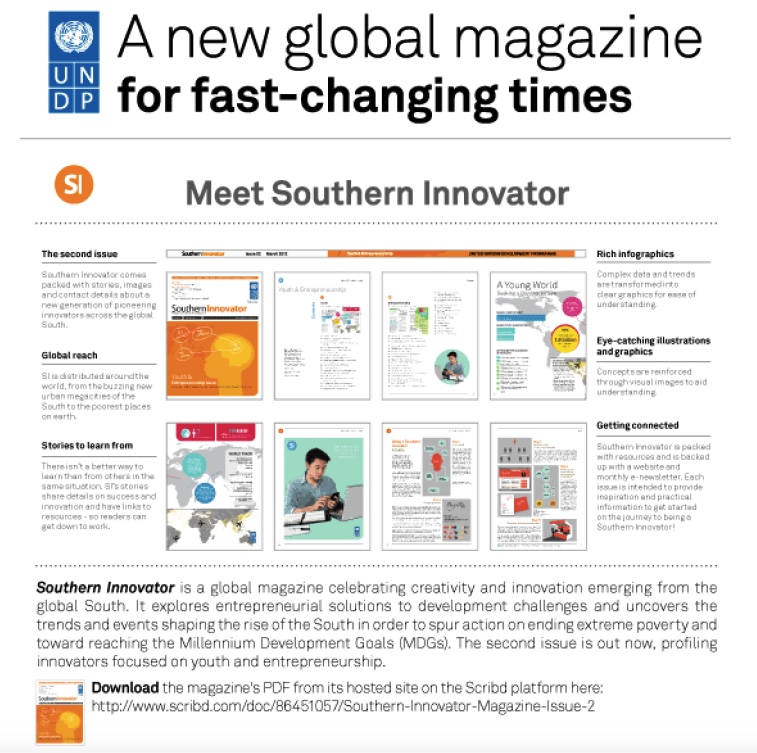
    https://davidsouthconsulting.org/2021/03/05/southern-innovator-issue-2/

    Creative Commons License

    This work is licensed under a
    Creative Commons Attribution-Noncommercial-No Derivative Works 3.0 License.

    ORCID iD: https://orcid.org/0000-0001-5311-1052.

    © David South Consulting 2022

  • Ghanaian Coffins Prove Design and Craftsmanship Boost Incomes

    Ghanaian Coffins Prove Design and Craftsmanship Boost Incomes

    By David SouthDevelopment Challenges, South-South Solutions

    SOUTH-SOUTH CASE STUDY

    In many parts of the world, indigenous ingenuity and craft skills are finally getting the recognition they deserve. The quirky but very inventive gadgets and solutions featured on the Afrigadget blog (http://www.afrigadget.com) never fail to inspire and amaze. The Democratic Republic of the Congo’s (DRC) fashionable gentlemen (http://www.henryherbert.com/gentlemen-of-bacongo/) grabbed the attention of – and inspired – European fashion designers with their creativity and flair. And then there are the Africa Maker Faires, gatherings of clever and innovative thinkers and inventors who get down to work generating solutions to today’s problems.

    Beyond the grim stories of development failures and human tragedies, there is another Africa full of creativity and can-do attitude.

    Amongst the Ga people (http://en.wikipedia.org/wiki/Ga_people) of Teshi, Ghana there is a tradition with a twist: custom-designed coffins. A Ghanaian pioneer has been transforming the way people deal with that most sombre and respectful of rituals, the funeral. Coffin-artist Paa Joe is drawing on a modern-day tradition in Ghana dating back to the 1950s. Coffins – which are normally made from wood and follow the standard template of a narrow, body-length box – are transformed into grand and lively statements about the deceased person’s life.

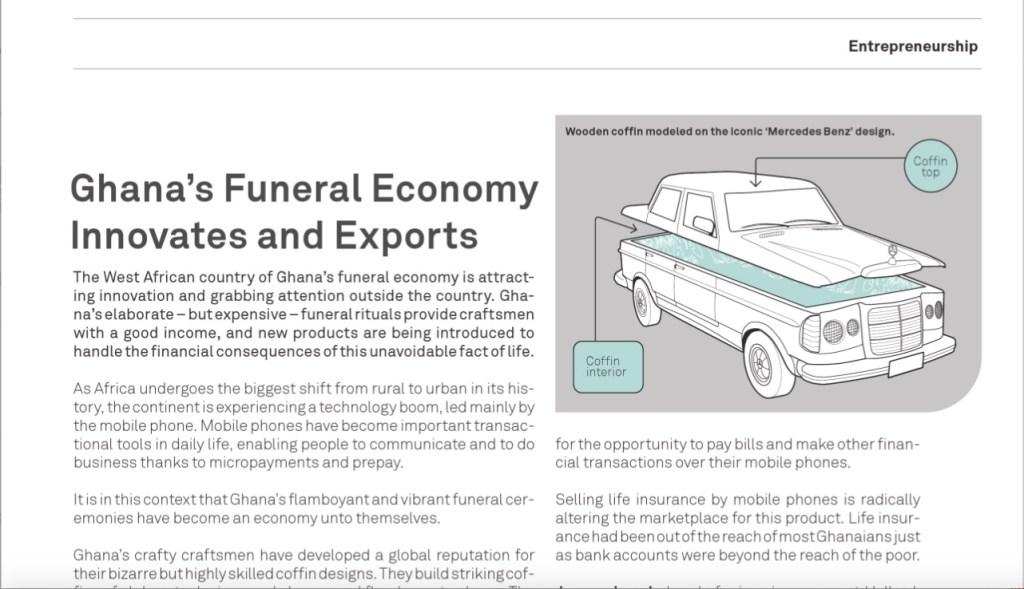
    Designs have included a giant pink fish, a Ghana Airways plane, a souped-up Mercedes Benz and an African eagle.

    “The Ga people (http://www.ghanaweb.com/GhanaHomePage/tribes/ga.php), from the south-east coast of Ghana, revere their ancestors and give great importance to funeral celebrations,” Jack Bell, a London gallery owner exhibiting the coffins, told The Observer newspaper. “Their tradition of creating beautifully carved figurative coffins originated in the 1950s.”

    Paa Joe was born in the Akwapim hills north-east of Accra in 1945. He is considered the top sculpted coffin maker of his generation. He apprenticed with the pioneer of the craft, Kane Kwei (http://www.culturebase.net/artist.php?153) – the man who began this unique vocation in the 1950s. The skill and artistry involved is now recognized in museums around the world, including London’s British Museum.

    The community had a history of highly skilled woodwork and elaborate carvings were regularly created for village chiefs – giant eagles or even the surreal spectacle of a giant cocoa pod.

    The bespoke coffins are an example of how long-standing skills were applied to a new product. The idea of making custom-sculpted coffins begun by Kane Kwei evolved from being a livelihood for Kwei to an apprenticed craft passed down to younger craftsmen. When Kane Kwei’s grandmother died in 1951, without fulfilling her lifelong wish to fly on a plane, Kane made a plane-shaped coffin for her. This coffin was admired by others and Kane got the idea of setting up a workshop and making custom-designed coffins symbolizing the
    deceased’s status and achievements in life.

    “Families commission the coffins – sometimes to a brief designed by the deceased – to represent the aspirations or achievements of a deceased relative, or to characterize their personality: a car for a businessman, a cocoa pod for a farmer, a bible, or even a camera,” Bell said.

    For people with modest means, there are simpler designs of boats, canoes and books. Prices are negotiated with the coffin maker.

    Where there were none, now there are multiple workshops providing custom coffins for funerals. Traditional Ghanaian funerals are lively, colourful events, but the coffin sculptures of Teshi are a modern phenomenon and proof that innovation and good design can transform the most sombre of items into something special.

    Published: December 2010

    Resources

    • Maker Faire Africa: Flickr photo gallery: A clickable archive of the Maker Faire inventors and their inventions. Website:http://www.flickr.com/groups/makerfaireafrica/pool/
    • Afrigadget: Afrigadget: ‘Solving everyday problems with African ingenuity’: This blog never ceases to amaze and fascinate. Website: http://www.afrigadget.com/
    • E-machine Shop: eMachineShop: This remarkable service allows budding inventors to download free design software, design their invention, and then have it made in any quantity they wish and shipped to them: Amazing! Website: http://www.emachineshop.com/ 4) Maker Faire Africa 2010: Catch up on the last Maker Faire Africa. Website: (http://makerfaireafrica.com)
    • Afrigadget: ‘Solving everyday problems with African ingenuity’: This blog never ceases to amaze and fascinate. Website: http://www.afrigadget.com/
    • International Development Design Summit: The Summit is an intense, hands-on design experience that brings together people from all over the world and all walks of life to create technologies and enterprises that improve the lives of people living in poverty. Website:http://iddsummit.org/

    https://davidsouthconsulting.org/2022/10/20/bangladesh-coffin-maker-offers-an-ethical-ending/

    https://davidsouthconsulting.org/2022/10/20/ghanas-funeral-economy-innovates-and-exports/

    Development Challenges, South-South Solutions was launched as an e-newsletter in 2006 by UNDP’s South-South Cooperation Unit (now the United Nations Office for South-South Cooperation) based in New York, USA. It led on profiling the rise of the global South as an economic powerhouse and was one of the first regular publications to champion the global South’s innovators, entrepreneurs, and pioneers. It tracked the key trends that are now so profoundly reshaping how development is seen and done. This includes the rapid take-up of mobile phones and information technology in the global South (as profiled in the first issue of magazine Southern Innovator), the move to becoming a majority urban world, a growing global innovator culture, and the plethora of solutions being developed in the global South to tackle its problems and improve living conditions and boost human development. The success of the e-newsletter led to the launch of the magazine Southern Innovator. 

    https://davidsouthconsulting.org/2021/03/05/southern-innovator-issue-2/

    Creative Commons License

    This work is licensed under a
    Creative Commons Attribution-Noncommercial-No Derivative Works 3.0 License.

    ORCID iD: https://orcid.org/0000-0001-5311-1052.

    © David South Consulting 2023

  • Ghana Wants to Tap Global Trendy Party Scene

    Ghana Wants to Tap Global Trendy Party Scene

    By David SouthDevelopment Challenges, South-South Solutions

    SOUTH-SOUTH CASE STUDY

    Tourism is big business – and one of the most resilient parts of the global economy. Despite the international economic crisis that has wreaked havoc and increased unemployment and poverty in many countries since 2007, tourism is still going strong.

    The UN’s World Tourism Organization (UNWTO) (http://www2.unwto.org/) found international tourist arrivals grew by 5 per cent during the first half of 2013 from the same period in 2012, reaching 500 million arrivals.

    “The fact that international tourism grew above expectations confirms that traveling is now part of consumer patterns for an increasing number of people in both emerging and advanced economies,” said UNWTO Secretary-General Taleb Rifai. “This underlines the need to rightly place tourism as one of the key pillars of socio-economic development, being a leading contributor to economic growth, exports and jobs.”

    One successful way to lure tourists, especially young tourists, is to nurture hubs of culture, outdoor activities, music and fashion around a holiday destination – generally one involving sun and sand. Such “party scenes” can be found in hotspots as far afield as Florida, the Spanish island of Ibiza and Koh Samui (http://www.kohsamui.com/) in Thailand. While at times annoying to local people, these groups of young tourists do bring significant wealth to smaller towns and seaside communities.

    And now there are some in Africa who want to replicate this successful business formula in beach communities.

    The Ghanaian fishing village of Kokrobrite (http://en.wikipedia.org/wiki/Kokrobite), located west of the capital, Accra, has become a nascent hub for a dance music scene and beach parties.

    “We are organizing an all-day-long beach party with DJs, food and partying, inspired by the kind of summer jams that are held in Miami,” Basil Anthony, Chief Executive of Silky Entertainment (http://www.silkyentertainment.com/), told The Guardian newspaper. Silky Entertainment is organizer of Ghana Summer Beach Rave 2013.

    “We are expecting partygoers in the thousands, and double the number we had last year. It’s going to be big.”

    Other popular events include Tidal Rave (http://www.youtube.com/watch?v=8f5Wy3g9Y7w), aimed at university students, and an upmarket champagne party at Bella Roma beach which attracts expats and wealthy Ghanaians.

    While these events have been very popular locally, ambitious entertainment entrepreneurs want to take the parties to the next level and make them truly global events, attracting tourists from around the world.

    “The next Ibiza will be in Africa. It has already started,” said Andrew Tumi, also known as Won, a singer from the group Supafly.

    “We are trying to recreate the good things about going to Ibiza, the music and the vibes. But more and more we are creating our own sound here, an Afro-house, reggae, African mashup… It’s really blending the African rhythm into a house scene.”

    Dance music is hot right now, and is being refreshed with new trends in Afro-house and Afro-pop from across the continent. This in turn is creating a demand for parties to celebrate and enjoy the music.

    The economic impact is considerable as the parties inspire other businesses to feed off the good vibrations. DJ MoBlack, who works in a nightclub in Accra, told The Guardian, “It’s not just the music, it’s a whole scene that’s on the rise – goods, fashion, jewelry – there is a style revolution happening around it. It’s a unique African vibe, but something that people everywhere can relate to.”

    The impact on the tourism sector is already quantifiable. Tourist visits to Ghana grew from 400,000 a year in 2005 to 1 million in 2011.

    Ben Ohene-Aryeh at the Ghana Tourism Authority (http://www.ghana.travel/) is optimistic bigger things are to come: “[The scene] is catching on well with the youth and now we hope that it will be done on a massive scale,” he said.

    There is, however, a downside to this strategy: drug use is on the increase. According to the West Africa Commission on Drugs (wacommissionondrugs.org), marijuana use is on the rise as well as harder drugs such as cocaine.

    It’s clear there are pitfalls to the youth-tourism strategy, but these can be managed with the right strategy – and the economic opportunities for small communities are substantial.

    Published: November 2013

    Resources

    1) Information on drug tourism from DARA Thailand: DARA is Asia’s first and leading international destination for drug and alcohol rehabilitation. Website: http://alcoholrehab.com/alcohol-rehab/drug-tourism/

    2) 3rd UNWTO International Conference on Tourism and the Media: How new media is shaping the news: With the rise of the new media, both the media landscape and the way stories are being told are changing. Millions of consumers now have the possibility to directly engage in the editorial process due to faster than ever evolving technology. More recently, mobile technology and a myriad of applications for smart phone devices are increasingly influencing communication flows. Website: http://www2.unwto.org/en/event/3rd-unwto-international-conference-tourism-and-media-how-new-media-shaping-news

    3) The UNWTO World Tourism Barometer: A regular publication of the Tourism Trends and Marketing Strategies Programme of UNWTO aimed at monitoring the short-term evolution of tourism and providing the sector with relevant and timely information. Website: http://mkt.unwto.org/en/barometer

    Tourism Investment and Business Forum for Africa: INVESTOUR is an annual tourism business and knowledge exchange platform in which representatives of African tourism and potential Spanish and Portuguese investors/partners meet to discuss about business and cooperation opportunities. Website: http://africa.unwto.org/en/event/v-tourism-investment-and-business-forum-africa-investour-edition-2014-madrid-spain

    Development Challenges, South-South Solutions was launched as an e-newsletter in 2006 by UNDP’s South-South Cooperation Unit (now the United Nations Office for South-South Cooperation) based in New York, USA. It led on profiling the rise of the global South as an economic powerhouse and was one of the first regular publications to champion the global South’s innovators, entrepreneurs, and pioneers. It tracked the key trends that are now so profoundly reshaping how development is seen and done. This includes the rapid take-up of mobile phones and information technology in the global South (as profiled in the first issue of magazine Southern Innovator), the move to becoming a majority urban world, a growing global innovator culture, and the plethora of solutions being developed in the global South to tackle its problems and improve living conditions and boost human development. The success of the e-newsletter led to the launch of the magazine Southern Innovator. 

    Creative Commons License

    This work is licensed under a
    Creative Commons Attribution-Noncommercial-No Derivative Works 3.0 License.

    ORCID iD: https://orcid.org/0000-0001-5311-1052.

    © David South Consulting 2023