Tag: David South

  • 2011 Trends for the South

    2011 Trends for the South

    By David SouthDevelopment Challenges, South-South Solutions

    SOUTH-SOUTH CASE STUDY

    The world has been through a dramatic and fascinating period since the global economic crisis erupted in 2008. While the wealthy, developed nations of the North have been pitched into one crisis after another, the countries of the global South (many of whom are well accustomed to crises) have been part of a powerful new economic phenomenon: the rapid growth of South-South trade, investment and exchange. Its effects include stronger ties between Asia and South America and between China and Africa.

    South-South trade is the great economic success story of the past decade. World Trade Organization (WTO) (www.wto.org) figures show South-South trade grew to 16.4 percent of the US $14 trillion in total world exports in 2007, from 11.5 percent in 2000. While the global economic crisis has slowed trade down, the overall trend for South-South trade and connections seems firmly established.

    South-South trade made up 20 percent of global exports by 2010, and foreign direct investment to developing economies rose by 10 percent in 2010 due to a rapid economic recovery and increasing South-South flows.

    Trade between China and Africa has surged during the decade since China joined the WTO in 2001, from around US $10 billion in 2000 to US $73.3 billion in 2007, a year-on-year increase of 32.2 percent. By 2008, it had soared by 44.1 percent to reach a record high of US $106.84 billion, according to Zhang Yongpeng of the Institute for West Asian and African Studies (IWAAS).

    The surge is remarkable and recent. For example, according to accountants KPMG, between 2001 and 2009 China invested just US $215 million in Brazil. But in 2010, China invested US $20 billion in energy and chemical companies in Argentina and Brazil. And Luis Alberto Moreno, president of the Inter-American Development Bank, told the Financial Times that “seven percent of Colombian gasoline has been replaced by domestic ethanol, produced with green Indian technology – while Indian companies, including Infosys and Tata, now have 17,000 employees in Latin America and the Caribbean.”

    This jump in investment has also had its downside: coming fast and furious as investment cash chases better investment profits in the global South, it has pushed up inflation and commodity prices and spawned property speculation bubbles. This, as can be seen across North Africa and the Middle East, can lead to political and social instability.

    A review of the big trends bubbling under the surface in 2011 shows how important South-South exchange will be in alleviating poverty and improving lives in the run-up to the 2015 Millennium Development Goals (http://www.un.org/millenniumgoals/). It also shows up the dangers inherent in this new environment – rising inflation without economic growth can crush the poor. A focus on innovation and new thinking will be necessary to get through this year and beyond.

    Some of the top trends that will have a big impact in 2011 are:

    – Inflation: In 2011 it looks like we will hear a lot about inflation. As the global economy tries to stabilize and return to growth, there will be inflation surges for a wide variety of reasons. People will need strategies and new techniques to make sure they can afford the necessities of life. This will be critical if development gains from the past decade are not to be lost.

    – Super cycle: Some are putting forward the theory we are entering a ‘super cycle’ (http://www.bloomberg.com/news/2011-01-23/super-cycle-leaves-no-economy-behind-as-davos-shifts-to-growth-from-crisis.html) created by better connectivity, global travel and mobility and the ease of moving around investment to create businesses and jobs. The super cycle theory claims that this will spark the greatest period of human development in history – raising all national economies – as more and more people benefit from rising living standards and opportunities.

    – Switch to South-South trade: With the trend of increasing South-South trade now firmly established, there is a greater awareness now of the power of sharing ideas across the South. One example of this idea-sharing is the annual Global South-South Development Expo (http://www.southsouthexpo.org/) run by UNDP’s Special Unit for South-South Cooperation Unit (http://ssc.undp.org/).

    – New technologies: The spread of new technologies around the world will continue and bring many changes. Africa is seeing increasing access to high-speed Internet as new undersea cables are laid around the continent. Mobile phones will continue to be a critical tool for many to stay in touch and boost incomes.

    – MDGs on horizon in 2015: The Millennium Development Goals (MDGs) target of 2015 is just four years away. This will face the headwinds of the global economic crisis and urgent attention will be needed to make sure gains are not lost as 2015 approaches. The role played by South-South trade will be a critical partner in aiding goal achievements.

    – Cities: A surge to the urban was pronounced by 2007 and we are now living in a majority urban world. Innovation and sharing experiences and knowledge will play a key role in ensuring this is not a disaster. A recent book, Arrival City by Canadian journalist Doug Saunders, detailed this urban surge occurring across the global South, the largest movement of people to cities and urban and semi-urban areas in human history. It follows the pattern that was seen in Europe in the 19th century, as economies change and people seek the new opportunities promised by cities, or find rural economies unsustainable.

    – The China model of development: The big talking point will be China’s economic model for eradicating poverty on a mass scale. A new book by Dambisa Moyo, How the West Was Lost: Fifty Years of Economic Folly – And the Stark Choices Ahead, investigates the mistakes made in developed, Western nations and what can be learned from the experiences in the global South.

    – Food crisis: At the beginning of February, the Food and Agricultural Organization (FAO) issued a warning about the risk of a new global food crisis after its food price index reached a record high in January 2011. The FAO also issued an alert about severe drought in China, the world’s largest wheat producer. Flooding in Brazil and Australia have also devastated crops, much of which are exported to countries across the South. There is also risk to crops from flooding in southern Africa. Wheat, corn and soybean prices are rising, and prices reached a peak just as they did in 2008 (FAO).

    Even developed countries normally used to food surpluses are at risk. In the US, corn reserves are at a 15 year low (US Department of Agriculture), and the price of corn has doubled in past six months.

    A billion people go to bed hungry every night; someone starves to death every 3.6 seconds – 75 percent are children under five, according to the World Food Programme (http://www.wfp.org/1billion).

    Published: 2011

    Resources
    1) Global Information and Early Warning System on Food and Agriculture: A data mix tracking global food prices and situation reports. Website: http://www.fao.org/worldfoodsituation/wfs-home/en/
    2) World Bank Food Crisis blog: Website: http://www.worldbank.org/foodcrisis/
    3) Trade Law Centre for Southern Africa: “Building capacity to help Africa trade better”: tralac’s mission is to build trade law capacity in southern Africa so that these countries can participate effectively in the global economy; to negotiate trade agreements that will support their development objectives, and so that they can implement the agreements to ensure that they realise the potential benefits of international trade. Website: http://www.tralac.org/cgi-bin/giga.cgi?cmd=cause_dir_cause&cause_id=1694
    4) Future Forum world videos: Compelling animated videos exploring the hard choices of an urbanizing world and the need to promote sustainable development and environmental harmony. Website: http://www.youtube.com/user/forumforthefuture96

    Development Challenges, South-South Solutions was launched as an e-newsletter in 2006 by UNDP’s South-South Cooperation Unit (now the United Nations Office for South-South Cooperation) based in New York, USA. It led on profiling the rise of the global South as an economic powerhouse and was one of the first regular publications to champion the global South’s innovators, entrepreneurs, and pioneers. It tracked the key trends that are now so profoundly reshaping how development is seen and done. This includes the rapid take-up of mobile phones and information technology in the global South (as profiled in the first issue of magazine Southern Innovator), the move to becoming a majority urban world, a growing global innovator culture, and the plethora of solutions being developed in the global South to tackle its problems and improve living conditions and boost human development. The success of the e-newsletter led to the launch of the magazine Southern Innovator. 
    Creative Commons License

    This work is licensed under a
    Creative Commons Attribution-Noncommercial-No Derivative Works 3.0 License.

    ORCID iD: https://orcid.org/0000-0001-5311-1052.

    © David South Consulting 2022

  • Pakistan Simplifies Job-matching Services

    Pakistan Simplifies Job-matching Services

    By David SouthDevelopment Challenges, South-South Solutions

    SOUTH-SOUTH CASE STUDY

    An innovative job-matching service from Pakistan is trying to bring together people who normally live separate lives. It is eliminating the middlemen who gouge both employers and employees for job-seeking fees and opening up a new world of opportunities for the poor.

    Connecting employees and employers is a problem being compounded in countries all over the world by the global economic crisis, as people retrench to their own communities and stick with known and trusted contacts. While this is a natural response to crisis, it is highly damaging to economies and social mobility.

    Pakistan (http://www.tourism.gov.pk) has had to contend with multiple challenges in the last few years. It has been hard hit during the global economic crisis. It is also experiencing stress from the ongoing conflict resulting from terrorism and the nearby war in Afghanistan. And 2010’s floods devastated large swathes of the country’s crops.

    As the World Bank noted in its Pakistan Economic Update June 2011, “Pakistan continues to face significant political challenges in achieving durable development. The domestic security situation as a result of (the) campaign against terrorism is a direct and indirect tax on the costs of economic activity and the achievement of the kinds of social stability required to promote a supportive environment for businesses.”

    The World Bank estimates that 30 percent of the population lives below the poverty line, although Pakistan’s finance ministry has recently estimated it to be 43 percent.

    “Due to the global financial crisis, many businesses in Pakistan either scaled down their operations or had to close down,” said Asim Fayaz, one of the people behind Pakistan Urban Link and Support, or PULS (http://www.puls.pk).

    “As a result, the income of the informal sector was also affected because many of them became unemployed. In turn, the supply surplus meant the job market became more competitive, further affecting their income growth.”

    Job-hunting is time-consuming for everyone involved in any country, worse still during an economic downturn. The hunt for a job or for the right employee is part and parcel of a dynamic economy. The more dynamic and fast-evolving an economy, the more employees will move around looking for the best deal and the more employers will need to seek out people with the latest skills and best attitudes to stay competitive. A fluid labour market is a good thing if a country wants to be competitive.

    PULS bills itself as a “Telecommunications Software Platform for Job Search and Networking between the Working Poor and Educated Elite of Pakistan” (http://www.puls.pk). It was a semi-finalist in the 2011 Dell Social Innovation Competition (http://www.dellsocialinnovationcompetition.com/ideaView?id=08780000000DaC6AAK).

    “Conventionally, the informal sector workforce has found employment primarily through personal connections,” explains Fayaz. “In cases where that doesn’t work, they approach employment agencies and get enlisted. These employment agencies, behaving as middle men, charge both the employer and the employee upon making a connection. PULS removes the need for the middle man. Employees sign up on this platform themselves. Employers will only be charged a very small amount if they wish to contact a listed employee. If the employee is actually hired, PULS does not find out about the transaction and does not make anything off it.”

    As an e-marketplace accessible through SMS and Web, PULS matches the working poor to the educated elite of Pakistan. It is hoped it will boost the creation of jobs in Pakistan and help in raising incomes. PULS defines working poor as skilled but undereducated domestic workers (cooks, drivers, guards, gardeners, tailors, etc.), independent laborers and self-employed craftspeople.

    Pakistan has a population of over 169 million (World Bank, 2009). Of that, PULS estimates there are 20 million people who are literate and have access to mobile phones but not the Internet.

    Then there is the elite, defined as educated employers and formal-sector professionals. They live in extended family households and employ one or more domestic workers. Of this elite group, around 10 million are regular Internet users.

    The much larger group of working poor have little access to the resources found on the Internet or in employment databases. Because of this, most turn to word-of-mouth and informal connections to the elite for new jobs and upward mobility.

    These groups have traditionally failed to meet. The educated elite, with their access to online search-engines and classifieds, only ever see other people engaged with the formal employment sector. Those in the informal sector are left out of the loop in accessing these better quality jobs with better pay.

    Fayaz says PULS enables jobseekers to “get access to more employment opportunities outside their network.”

    “They will be able to contact those potential employers directly without going through a middle man,” he said. “Most importantly, this service will be free for employees.”

    He says the platform could potentially be used for other transactions, such as buying and selling cars, electronics and other equipment.

    PULS has built a multi-use, “mobile-to-web software platform explicitly designed for semi-literate mobile phone users and fully literate Web users.”

    The first version, PULS 1.0, has an SMS (short message service) interface in the Urdu language and enables domestic employees to register, create a profile, and communicate with employers. All an employer has to do is pull up the PULS 1.0 website. The employer creates a profile as well, searches for potential employees, and sends SMS messages to employees through an anonymous gateway.

    “In addition to employer-to-employee broadcasting, PULS will also (eventually) provide the informal sector a simple means to self-promote and broadcast custom messages back to employers,” Fayaz said. “Presumably PULS will eventually offer a multi-use tool for advertising, networking, job search, and even financial transactions, all via SMS-to-Web.”

    PULS is a non-profit entity developed by a team from The Fletcher School, Tufts University in the United States (http://fletcher.tufts.edu) and aims to be financially sustainable as it grows and the service stays affordable for its users. Employees can use the system for free as long as they pay standard SMS charges, while employers must buy credits. To get things started, employers are given 1,000 credits for free. PULS is also offering premium services such as mass-communication surveys, market research, and advertising.

    Developing the technology didn’t prove difficult in Pakistan, Fayaz says.

    “We have a large of pool of skilled workers equipped to develop such platforms, very high cellular penetration and one of the lowest SMS rates in the world!”

    Fayaz advocates taking an organic approach to developing a new technology like PULS.

    “Setting up the technology is just one part of the picture,” he said. “You should identify a problem, look at how it’s currently being addressed, see how you can improve, research on how it’s being addressed in similar circumstances elsewhere (in our case, India works best), design your solution with just the main use cases addressed, and aggressively roll out.

    “You should remember that you have to make revenue at some point but don’t let it be a hurdle in the short term. Don’t jump back to the drawing board if the first few people find your service hard to use. Also, you may want it to look fancier than Facebook but remember, they also took time getting there!”

    Published: August 2011

    Resources

    1) Dell Social Innovation Competition: The competition is looking for students with the most innovative ideas to solve a social or environmental problem anywhere in the world and the first prize is US $50,000. Website: http://www.dellsocialinnovationcompetition.com/

    2) Taka Taka Solutions: TakaTaka Solutions is a social enterprise that collects and recycles waste. It aims to bring about social and environmental change through a commercially viable business approach in Kenya. Website: http://www.facebook.com/pages/TakaTaka-Solutions/101240103296048

    Development Challenges, South-South Solutions was launched as an e-newsletter in 2006 by UNDP’s South-South Cooperation Unit (now the United Nations Office for South-South Cooperation) based in New York, USA. It led on profiling the rise of the global South as an economic powerhouse and was one of the first regular publications to champion the global South’s innovators, entrepreneurs, and pioneers. It tracked the key trends that are now so profoundly reshaping how development is seen and done. This includes the rapid take-up of mobile phones and information technology in the global South (as profiled in the first issue of magazine Southern Innovator), the move to becoming a majority urban world, a growing global innovator culture, and the plethora of solutions being developed in the global South to tackle its problems and improve living conditions and boost human development. The success of the e-newsletter led to the launch of the magazine Southern Innovator. 

    Creative Commons License

    This work is licensed under a
    Creative Commons Attribution-Noncommercial-No Derivative Works 3.0 License.

    ORCID iD: https://orcid.org/0000-0001-5311-1052.

    © David South Consulting 2022

  • Brazilian Solar-powered WiFi for Poor Schools

    Brazilian Solar-powered WiFi for Poor Schools

    By David SouthDevelopment Challenges, South-South Solutions

    SOUTH-SOUTH CASE STUDY

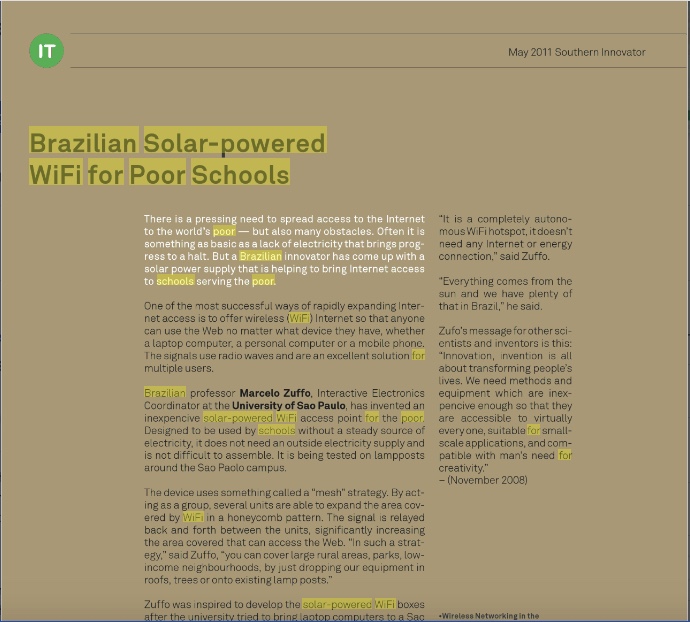
    There is a pressing need to spread access to the internet to the world’s poor — but also many obstacles. Often it is something as basic as a lack of electricity that brings progress to a halt. But a Brazilian innovator has come up with a solar power supply that is helping to bring internet access to schools serving the poor.

    Many initiatives are trying to bring inexpensive access to the internet to rural and remote regions around the world. Schools in poor areas are receiving laptop computers through schemes like the One Laptop Per Child project, but it is common that schools do not have a steady electricity supply to power the computers or the internet connection. One of the most successful ways of rapidly expanding access is to offer wireless (WiFi) internet so that anyone can use the Web, no matter what device they have, whether a laptop computer, a personal computer or a mobile phone. The signals use radio waves, and are an excellent solution for multiple users.

    Brazilian professor Marcelo Zuffo, Interactive Electronics Coordinator at the University of Sao Paulo, has invented a cheap solar-powered WiFi access point for the poor. Designed to be used by schools without a steady source of electricity, it doesn’t need outside electricity supply, and is not difficult to assemble. It is being tested on lampposts around the Sao Paolo campus.

    The device uses something called a ‘mesh’ strategy. By acting as a group, several units are able to expand the area covered by WiFi in a honeycomb pattern. The signal is relayed back and forth between the units, significantly increasing the area covered that can access the Web. “In such a strategy,” said Zuffo,”you can cover large rural areas, parks, low income neighbourhoods, by just dropping our equipment in roofs, trees or on to existing lamp posts.”

    Zuffo was inspired to develop the solar-powered WiFi boxes after the university tried to bring laptop computers to a Sao Paulo school, and found they didn’t have a steady electricity supply.

    “We came up with the idea of taking energy that is most plentiful and cheap, i.e. the sun,” he told the BBC. “We have a solar panel, a cheap motorcycle battery and a circuit that is responsible for energy management. We can have up to two days of full internet coverage and our goal is to increase that to 10 days – so that in the rainy season and the winter, you can have the internet for free.

    “The natural plan is to miniaturize the system so that we can save on costs. So by the end you can imagine these WiFi solar mesh devices being the size of a cellphone or playing card.”

    The low cost, solar-powered access point is ready as soon as it is unpacked and needs neither maintenance nor a power socket to get going.

    “It is a completely autonomous WiFi hotspot, it doesn’t need any internet or energy connection,” said Zuffo.

    “Everything comes from the sun and we have plenty of that in Brazil,” he said.

    The volunteer organization Green WiFi initiative is also developing solar powered technologies to bring ubiquitous internet access to the world’s poor.

    Zufo’s message for other scientists and inventors is this: “Innovation, invention is all about transforming people’s lives. We need methods and equipment which are cheap enough so that they are accessible to virtually every one, suitable for small scale applications, and compatible with man’s need for creativity.”

    The issue of inequality in access to the internet has stark consequences for global economic development. Already, according to the World Information Society Report 2007, “Europe has achieved the largest overall gain in digital opportunity over the last two years, followed by the Americas… Asia and Africa have witnessed smaller gains in digital opportunity. The implications for the digital divide are clear: digital opportunity is becoming more sharply divided by region, not less.”

    Published: November 2008

    Resources

    • Wireless Networking in the Developing World: A Practical Guide to Planning and Building Low-cost Telecommunications Infrastructure. Website:
    • World Information Society Report 2007: A progress report on pledges to bring digital opportunity to all. Website:
    • The Wireless Geographic Logging Engine: This is a website with maps tracking the presence of WiFi access around the globe. So far it maps over 10 million separate WiFi networks. Entrepreneurs only have to log into the website to start searching for wireless networks near them.
    • iTrike: The world’s first solar powered wireless internet rickshaw.
    • The KyaTera lab where the technology was developed. Website: http://kyatera.incubadora.fapesp.br/portal/research/laboratories/interactive-electronic-media

    Development Challenges, South-South Solutions was launched as an e-newsletter in 2006 by UNDP’s South-South Cooperation Unit (now the United Nations Office for South-South Cooperation) based in New York, USA. It led on profiling the rise of the global South as an economic powerhouse and was one of the first regular publications to champion the global South’s innovators, entrepreneurs, and pioneers. It tracked the key trends that are now so profoundly reshaping how development is seen and done. This includes the rapid take-up of mobile phones and information technology in the global South (as profiled in the first issue of magazine Southern Innovator), the move to becoming a majority urban world, a growing global innovator culture, and the plethora of solutions being developed in the global South to tackle its problems and improve living conditions and boost human development. The success of the e-newsletter led to the launch of the magazine Southern Innovator. 
    Creative Commons License

    This work is licensed under a
    Creative Commons Attribution-Noncommercial-No Derivative Works 3.0 License.

    ORCID iD: https://orcid.org/0000-0001-5311-1052.

    © David South Consulting 2023

  • Solar Power Bringing Light and Opportunity to the Poor

    Solar Power Bringing Light and Opportunity to the Poor

    By David SouthDevelopment Challenges, South-South Solutions

    SOUTH-SOUTH CASE STUDY

    Meeting the South’s energy needs will be crucial to achieving radical improvements in quality of life and human development. It is estimated that 1.7 billion people around the world lack electricity (World Bank), of whom more than 500 million live in sub-Saharan Africa.

    Africa’s greater global engagement and economic growth in the past few years has started to draw attention back to the continent’s dearth of reliable power sources and inadequate power infrastructure. With demand for electricity growing fast, it is people running small enterprises and organizations – especially in rural areas – who often get cut out.

    Being able to see at night unleashes a vast range of possibilities, but for the very poor, lighting is often the most expensive household expense, soaking up 10 to 15 percent of income.

    There’s a direct link between lighting and economic development. Each 1 per cent increase in available power will increase GDP by an estimated 2 to 3 per cent.

    A reliable power supply helps people to work longer, important for small businesses, and this increases the amount of wealth that can be created. Lit streets are safer at night, and lure people outside to do business and seek entertainment. It makes it easier for students to study into the night, and in consequence improve their grades.

    To take up this challenge, entrepreneurs are using different approaches across the South, to make solar power affordable and able to reach millions of poor people.

    Marrying new lighting technology such as compact fluorescent light bulbs (CFLs) and light emitting diodes (LEDs) with solar power generation, opens up the possibility to bring clean, portable, durable, low cost, high quality lighting to Africa’s poor. These new lighting systems also come with huge health and safety benefits, compared to gas alternatives.

    In Kenya, more than 80 percent of people lack access to the national grid and depend primarily on fossil fuels for their lighting needs, leading to respiratory diseases and environmental hazards associated with indoor air pollution.

    Kenyan solar entrepreneur Charles Rioba of Kodesha Mwangaza – Rent a Light is impressed by the interest in solar power solutions. An expert in renewable technologies with 15 years’ experience teaching in universities, he “realized that to reach the lower end of the market, one had to design an affordable solution.”

    “The biggest challenges faced are still affordability, and very little disposable income from the potential end users,” he said. “We are currently discussing with a number of micro institutions who have expressed interest on coming on board on rolling out the project.”

    Rioba’s business provides rental solar-charged Powerpacks designed to make electricity affordable for the majority of urban poor, rural households and slum dwellers. The rental system allows the consumer to rent a fully charged Powerpack from designated distributors in the neighbourhood, without having to invest in an off-grid power source, such as a solar panel. The project will set up 100 distribution agents and 10 service centers for the Powerpacks to reach approximately 8,000 households within 18 months. In addition the Powerpack will be used for mobile charging and powering radios, and hopes to create a new market concept for portable electrical energy distribution among the poor in Kenya.

    “My model targets to reach the lower end of the market,” Rioba said. “We are doing this by using existing businesses and groupings without creating new ones. We are also sourcing directly from the suppliers and we are working our project on numbers. In this way the margins are very low but aimed at achieving high usage hence return on investment.”

    Rioba has just been awarded funding by the World Bank’s Lighting Africa initiative, which aims to provide up to 250 million people in sub-Saharan Africa with access to non-fossil fuel based, low cost, safe, and reliable lighting products and associated basic energy services by the year 2030. It uses equipment that can weather long-term use in remote and difficult areas, trains people to service the equipment, and comes up with commercially viable business models to make all of this affordable to the rural poor.

    Rioba says that “for solar to be more attractive in Africa, there are a number of challenges. On the technology side, to make products which are both durable and affordable to the masses. Such new products such as LED lighting may ultimately reduce the size of the solar system and hence the cost.”

    In Laos, the rental mode is also proving effective. Only 48 percent of the country’s 5.7 million people have access to electricity, and most turn to firewood and kerosene for light and energy. Over 74 percent of people live on less than US $2 a day and could not afford to buy a solar-power system outright.

    The company Sunlabob rents solar-powered lanterns for prices beginning at 35,000 kip (US $3.80) per month, lower than the 36,000 to 60,000 kip (US $4.00 to US $6.60) per months households typically pay for kerosene fuel. After 10 hours’ use, the lanterns are recharged for a small fee from the village’s central solar-power collection facility. All fees go towards maintaining the central solar recharging station. The equipment is rented to a village-appointed Village Energy Committee, which sub-leases it to households at prices it sets. Rent covers all costs, including replacements and operational servicing costs. In the event of breakdowns, rent payments are suspended until repairs are made.

    Sunlabob has installed over 5,600 solar power systems since 2000 in over 450 villages and is also working in Cambodia and Indonesia.

    “Sunlabob really works well with local people,” says Bouathep Malaykham, head of the Lao Government Rural Electrification Program. “Because they are a private company they can make things happen quickly.”

    In Bangladesh, more than 230,000 households are now using solar power systems thanks to the government’s Infrastructure Development Company Ltd. (IDCOL), giving rise to opportunities for a whole new generation of entrepreneurs to make use of this new power supply for the poor. IDCOL is run by the Ministry of Finance, and is on course to install 1 million Solar Household Systems (SHS) using solar panels by 2012. The Bangladeshi government is hoping to bring electricity to all its citizens by 2020 – meaning this is now a prime time for entrepreneurs specializing in providing energy efficient products to the poor.

    The Executive Director of IDCOL, Ehsanl Haque, told a recent press conference: “SHS system, containing photo voltaic panels, battery, charge controller, solar lamp and switch, is a convenient mode for supply of power for small electrical loads such as lights, radio, cassette players and black and white TV.”

    It doesn’t provide electricity 24 hours a day, but Haque says even with a few hours of electricity available each day, the rural economy is being transformed. “Now they are using SHS for income-generating activities and working hours have been increased for small businessmen, weavers, tailors, hairdressers, and makers of handicraft items.”

    Among the many benefits of the electricity has been the ability to listen to radio and watch TV: an activity women reported made them feel safer at night.

    Published: September 2008

    Resources

    • Lighting Africa: this website run by the World Bank is a virtual business community and has forums, market intelligence, access to grants, network and partnership opportunities.
      Website: http://lightingafrica.org/index.cfm?Page=Home
    • D.light Design is dedicated to bringing modern lighting and power to over 1.6 billion people globally currently living without electricity. They aim to be the number one player in off-grid lighting and power solutions worldwide.
      Website: http://www.dlightdesign.com/
    • Solar Power Answers is a one-stop-shop for everything to do with solar power. It has a design manual and guides to the complex world of solar power equipment.
      Website: http://www.solar-power-answers.co.uk/index.php

    Development Challenges, South-South Solutions was launched as an e-newsletter in 2006 by UNDP’s South-South Cooperation Unit (now the United Nations Office for South-South Cooperation) based in New York, USA. It led on profiling the rise of the global South as an economic powerhouse and was one of the first regular publications to champion the global South’s innovators, entrepreneurs, and pioneers. It tracked the key trends that are now so profoundly reshaping how development is seen and done. This includes the rapid take-up of mobile phones and information technology in the global South (as profiled in the first issue of magazine Southern Innovator), the move to becoming a majority urban world, a growing global innovator culture, and the plethora of solutions being developed in the global South to tackle its problems and improve living conditions and boost human development. The success of the e-newsletter led to the launch of the magazine Southern Innovator. 
    Creative Commons License

    This work is licensed under a
    Creative Commons Attribution-Noncommercial-No Derivative Works 3.0 License.

    ORCID iD: https://orcid.org/0000-0001-5311-1052.

    © David South Consulting 2022