Tag: David South

  • Reality Television Teaches Business Skills in Sudan

    Reality Television Teaches Business Skills in Sudan

    By David SouthDevelopment Challenges, South-South Solutions

    SOUTH-SOUTH CASE STUDY

    Learning how to thrive in a market economy does not necessarily come naturally. But for young people who have grown up under a different economic system or known nothing but economic chaos, learning business skills can give them the tools to get on in life.

    With youth unemployment rates high around the world, it is clear many young people may never get the jobs they expect unless they start businesses themselves.

    In 2013, 73.4 million young people were out of work, an increase of 3.5 million from 2007. A report by the International Labour Organization (ilo.org) found persistent unemployment around the world in the wake of the global economic crisis, a proliferation of temporary jobs and growing youth discouragement in advanced economies; and poor quality, informal, subsistence jobs in developing countries. School-to-work transition surveys of developing countries showed that youth are far more likely to land low-quality jobs in the informal economy than jobs paying decent wages and offering benefits.

    High youth unemployment often has nothing to do with poor educational achievement (many unemployed youth have high school educations or university degrees), but is often caused by other factors, including lack of access to capital, rigid labour markets, skills mismatched to demand in the economy (for example construction and building trades), or a gap between personal aspirations and the true state of the country’s economic development.

    But rather than despair, it is possible to show youth how to turn things around and use business skills to re-shape economies in their favor. Youth tend to bring to the economy energy and drive combined with new ideas and experiences calibrated to the demands of the 21st century. By harnessing this, youth can find a unique space in the marketplace. In turn, young people can lead in reviving damaged economies and making their countries wealthier and healthier. Many youth have grown up around the emerging digital economy and the use of mobile phones. Being comfortable with the 21st century digital economy will unleash many economic opportunities that favor youth.

    The British Council says that “creative entrepreneurship is considered the most efficient model for youth in the developing world who are facing huge difficulties in finding employment”. The entrepreneurship or creative investment industry is one of the fastest-growing sectors in the world.

    Understanding what works for youth business entrepreneurship has become a specialty in its own right. Using the media to teach skills and inspire youth to action is one proven approach.

    One recent example is a successful television programme from the Republic of the Sudan. Called Mashrouy (mashrouy.com), it is modeled on reality TV programmes such as The Apprentice, which features serial U.S. entrepreneur Donald Trump (http://www.bbc.co.uk/programmes/b00q3fkq) and the BBC’s Dragon’s Den (http://www.bbc.co.uk/programmes/b006vq92), where contestants pitch their ideas to a panel of judges to see if they can get funding for their business idea.

    In Mashrouy, 12 contestants battled it out to see who had the best business idea. They undertook various challenges and the original 12 were whittled down to three contestants. Live on air in December 2013, viewers voted for their favorite contestant and the winner (https://www.facebook.com/Mashrouy) received a prize of 200,000 SDG (US $35,211), while the second prize winner received 150,000 SDG (US $26,408) and the third prize winner received 100,000 SDG (US $17,605). All three were then taken to London in the United Kingdom to meet other creative entrepreneurs and receive valuable business advice.

    The Sudanese show (http://sudan.britishcouncil.org/our-work/mashrouy) is supported by the British Embassy and the British Council, and is working with the Sudanese Young Businessmen Association and major Sudanese companies to spread the idea of entrepreneurship among the youth of Sudan.

    Sudan suffered a brutal civil war on and off throughout the 2000s, leading to the partition of the original country into the Republic of the Sudan and the new nation of South Sudan in 2011.

    Faced with Sudan’s serious youth unemployment – as high as 34 per cent – and a fragile economy, the TV show’s producers wanted to encourage youth to start businesses.

    The contest was aimed at youth between 18 and 40 and appeared on the Blue Nile (http://bnile.tv/blue.html) channel.

    “At a time of national economic hardship, it has kindled the imagination of Sudanese youth,” wrote journalist Isma’il Kushkush (https://twitter.com/ikushkush) in The New York Times.

    For the show, a panel of experts picked 12 projects out of 2,500 applications. Each of the 12 finalists was given a chance to do a “pitch,” giving a quick summary of their business idea and trying to get the panel excited about the idea and its potential. The idea that generated the most excitement won.
    The 12 pitches included an idea for an ostrich farm and a plan to export spicy peanut butter. The winner, 32-year-old Samah al-Gadi, wants to use a locally available weed-like river plant to make bags and furniture. She said she got up the courage to be on the show from a supportive mother.

    “Amid ululations, screams and clapping, a jubilant Ms. Gadi raised both hands above her scarf-covered head, flashing victory signs,” The New York Times said. “Her mother, sitting at a dinner table, was brought to tears.”

    The women-owned social enterprise Making Cents International (makingcents.com), based in Washington, D.C., USA, has been gathering resources on youth entrepreneurship since 1999. It has put together a custom “curricula to develop the mindset, skillset, and toolset that enable entrepreneurs and enterprises to participate in profitable markets; financial institutions to serve new populations; and individuals to obtain meaningful work”.  This is available in 25 languages. It also hosts the Global Youth Economic Opportunities Conference in Washington, DC, held this year from 6 to 8 October 2014 (http://youtheconomicopportunities.org/conference).

    Published: April 2014

    Resources

    1) Khartoum Teaching Centre: The British Council is a world leader in English language training and teaching. It offers general English courses for adult learners of all levels, totaling 60 hours of tuition over 10 weeks. Website: http://sudan.britishcouncil.org/learn-english/courses

    2) Start-up Chile innovation fund: Start-Up Chile is a program created by the Chilean Government, executed by Corfo via InnovaChile, that seeks to attract early stage, high-potential entrepreneurs to bootstrap their startups in Chile, using it as a platform to go global. Website: startupchile.org

    3) Global Youth Economic Opportunities Conference 2014: From 6 to 8 October Youth entrepreneurship conference in Washington, D.C., USA. Website: youtheconomicopportunities.org/conference

    4) Making Cents International: The Youth Economic Opportunities learning platform is the first community of practice and knowledge exchange portal developed by and for the youth economic opportunities sector. Website: youtheconomicopportunities.org

    5) Mongolian Rock Pop book: A book published by UNDP in the Mongolian language on how the country’s rock and pop musicians led on business innovation using creative marketing and publicity during the country’s turbulent transition during the 1990s. Website: http://tinyurl.com/p25scqq

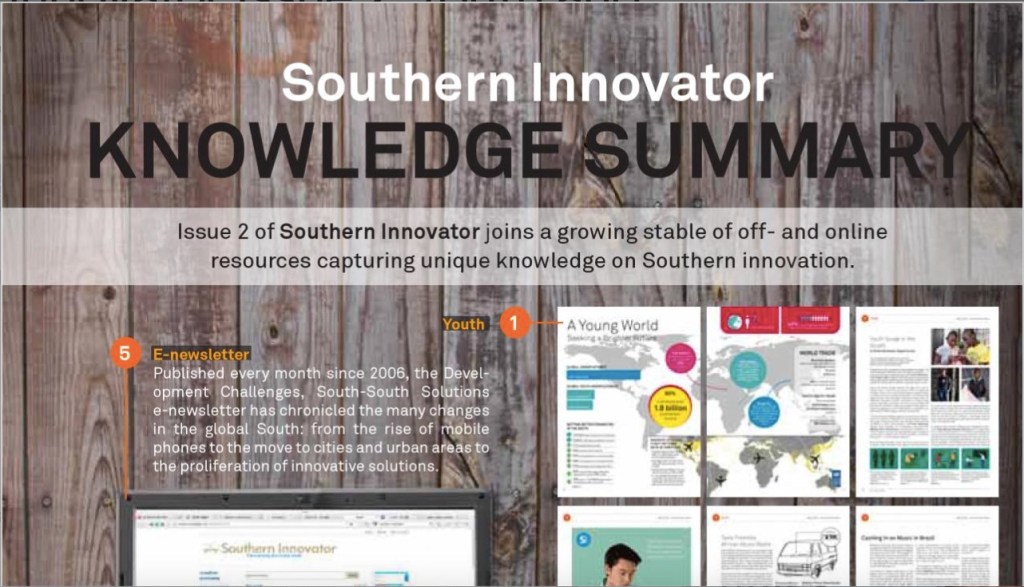
    Development Challenges, South-South Solutions was launched as an e-newsletter in 2006 by UNDP’s South-South Cooperation Unit (now the United Nations Office for South-South Cooperation) based in New York, USA. It led on profiling the rise of the global South as an economic powerhouse and was one of the first regular publications to champion the global South’s innovators, entrepreneurs, and pioneers. It tracked the key trends that are now so profoundly reshaping how development is seen and done. This includes the rapid take-up of mobile phones and information technology in the global South (as profiled in the first issue of magazine Southern Innovator), the move to becoming a majority urban world, a growing global innovator culture, and the plethora of solutions being developed in the global South to tackle its problems and improve living conditions and boost human development. The success of the e-newsletter led to the launch of the magazine Southern Innovator. 

    https://davidsouthconsulting.org/2021/03/05/southern-innovator-issue-2/

    Creative Commons License

    This work is licensed under a
    Creative Commons Attribution-Noncommercial-No Derivative Works 3.0 License.

    ORCID iD: https://orcid.org/0000-0001-5311-1052.

    © David South Consulting 2023

  • Arab World Domain Name Opportunity Huge Economic Help

    Arab World Domain Name Opportunity Huge Economic Help

    By David SouthDevelopment Challenges, South-South Solutions

    SOUTH-SOUTH CASE STUDY

    With the so-called Arab Spring still unfolding across much of the Arabic-speaking world, it is easy to miss a rising new economic opportunity: The introduction of an Arabic domain name system for the Internet.

    The explosion in mobile phones in the Arab world has dramatically increased the number of people who can now access the Internet. One Arabic financial website put the number of people who can now access the Internet in one way or another in the Arab world as 75 million (www.nuqudy.com). As highlighted in the 2003 Arab Human Development Report (AHDR), Arabic-speaking countries have been at a knowledge disadvantage for some time: more than 270 million citizens have access to fewer books than other languages, slower growth economies, and greater illiteracy than the faster-growing emerging economies. At the time, the AHDR found there were just 18 computers per 1,000 people compared to a global average of 78. And just 1.6 percent of Arabs had Internet access, one of the lowest ratios in the world (AHDR 2003).

    Since the dawn of the Internet, Latin script has been used exclusively for top-level web domain names, the addresses that end .com, .org and so on. That has been a big obstacle for users of non-Latin script languages like Arabic. It is estimated just 10 percent of people in the Arab world speak English. Many of the resources on the Internet and its utility have been lost to these people. But by using Arabic domain names, there will be a consistency and no more guesswork.

    A typical problem in Latin transliterations of Arabic is the conundrum as to either using El or Al as the prefix to a word. This problem is eliminated when Arabic is used.

    The Arab world is also very mixed, including the resource-rich, cash-rich Gulf States – Kuwait, Qatar, United Arab Emirates, Saudi Arabia, Oman and Bahrain – and states with high rates of poverty such as Egypt, Djibouti and Yemen.

    The protests and uprisings this year in Tunisia, Egypt and elsewhere – with their Facebook pages and Twitter streams – have shown that a growing group of highly Internet-savvy young people is emerging in the Arab world. But for many without the education or the resources, access to knowledge still remains weak. But armed with Internet-capable mobile phones and Arabic language domain names, rapid change is now possible.

    The number of books published in Arabic is notoriously relatively low, and print runs are small. Arabic language books make up just 1.1 percent of world production.

    The AHDR reports have called this knowledge deficit a direct obstacle to human development in Arab countries.

    But things are changing and the rise of Arabic domain names offers the potential for an explosion in Arabic language Internet content.

    In May 2010 ICANN, the world’s Internet domain authority, decided to allow top-level domains in non-Latin script. For Arabic speakers, it started this program in Egypt, Saudi Arabia and the United Arab Emirates.

    As a sign of the importance of Arabic participation in future growth of the Internet, this year’s World Summit for the Information Society (WSIS) held in Geneva, Switzerland in May 2011 was sponsored by the United Arab Emirates (UAE).

    A catchy domain name has many advantages. For Arabic speakers, this means they can type in Arabic domain names for websites and even do it right to left, as they do in print.

    In 2009, the first Arabic domain name was grabbed by Egypt. As the Internet naming authority, the Internet Corporation for Assigned Names and Numbers (ICANN) (www.icann.org), started to allow the registering of non-Latin script names. The domain was for the Arabic word for Egypt or “.masr”.

    As an early adopter, Egypt sees it as an important part of bringing more Arabic speakers online. George Victor, from the Egyptian National Telecom Regulatory Authority, told the BBC: “We believe that this is a great step that will open new horizons for many e-services in Egypt, and it will have its direct impact, enlarging the number of online users.”

    Victor believes using Arabic builds trust.

    “Having a domain name in your own language is a point of having a local identity,” he said.

    “When talking about Arabic domain names, we are talking about having users which are not online now. People with languages disabilities – people who are having language as a barrier to connect online.”

    From now on Internet address names will be able to end with almost any word in any language, offering organizations around the world the opportunity to market their brand, products, community or cause in new and innovative ways.

    The advantages of registering an Arabic domain name are numerous. They include clear improvements to business and trade: an ability to protect a trademark, better communication with Arabic customers, better Arabic-language advertising opportunities, better memorability for Arabic domain names because they will be in the Arabic language, and greater access to Arabic customers.

    But there are also significant improvements to how the Internet functions in the Arabic world. Search results on Arabic search engines will be more precise with Arabic domain names; catchy, memorable domain names will be a spur to the advertising and marketing industries; and a more Arab-friendly Internet will draw in more Arabic-speaking Internet users, helping them to enjoy the fruits of this great technological advance just as speakers of other languages have.

    In March 2011, the Gulf state of Qatar enthusiastically started to offer Arabic domain names.

    “The launch of Qatar’s Arabic top-level domain names is a major milestone as we work to build a more digitally inclusive society,” said Dr. Hessa Al Jaber, Secretary General of the Supreme Council of Information and Communication Technology, which will manage Qatar’s Internet domain names through the Qatar Domains Registry.

    “As more organizations and individuals begin adopting Arabic domain names, the Internet will literally be opened up to broad new audiences. The Arab world represents a region with enormous potential for growth both in terms of usage and the creation of new digital content, especially Arabic content.”

    ICANN’s President and Chief Executive, Rod Beckstrom, sees this as a new phase for the Internet: “ICANN has opened the Internet’s naming system to unleash the global human imagination. Today’s decision respects the rights of groups to create new Top Level Domains in any language or script. We hope this allows the domain system to better serve all of mankind.”

    Published: July 2011

    Resources

    1) Watch the ICANN educational video “Get Ready for the Next Big Thing”, explaining how domain names work and what the changes mean. Website: http://www.icann.org

    https://davidsouthconsulting.org/2022/10/26/africa-to-get-own-internet-domain/

    https://davidsouthconsulting.org/2022/11/11/berber-hip-hop-helps-re-ignite-culture-and-economy/

    https://davidsouthconsulting.org/2020/12/04/data-surge-across-global-south-promises-to-re-shape-the-internet/

    https://davidsouthconsulting.org/2022/02/11/egyptian-youth-turns-plastic-waste-into-fuel/

    https://davidsouthconsulting.org/2022/11/11/innovation-cairos-green-technology-pioneers/

    https://davidsouthconsulting.org/2022/10/29/new-apps-make-driving-and-travelling-in-egypt-easier-safer/

    https://davidsouthconsulting.org/2022/10/21/preserving-beekeeping-livelihoods-in-morocco/

    https://davidsouthconsulting.org/2022/10/21/social-networking-websites-a-way-out-of-poverty/

    Development Challenges, South-South Solutions was launched as an e-newsletter in 2006 by UNDP’s South-South Cooperation Unit (now the United Nations Office for South-South Cooperation) based in New York, USA. It led on profiling the rise of the global South as an economic powerhouse and was one of the first regular publications to champion the global South’s innovators, entrepreneurs, and pioneers. It tracked the key trends that are now so profoundly reshaping how development is seen and done. This includes the rapid take-up of mobile phones and information technology in the global South (as profiled in the first issue of magazine Southern Innovator), the move to becoming a majority urban world, a growing global innovator culture, and the plethora of solutions being developed in the global South to tackle its problems and improve living conditions and boost human development. The success of the e-newsletter led to the launch of the magazine Southern Innovator. 

    Creative Commons License

    This work is licensed under a
    Creative Commons Attribution-Noncommercial-No Derivative Works 3.0 License.

    ORCID iD: https://orcid.org/0000-0001-5311-1052.

    © David South Consulting 2023

  • Bamboo Becomes Transport Option for the South

    Bamboo Becomes Transport Option for the South

    By David SouthDevelopment Challenges, South-South Solutions

    SOUTH-SOUTH CASE STUDY

    The sturdy bamboo plant (http://en.wikipedia.org/wiki/Bamboo) is enjoying a revival around the world as a building material. A strong, fast-growing and highly renewable woody plant, it is becoming increasingly popular as people seek out less environmentally wasteful alternatives to steel and other materials.

    But who would have thought bamboo taxis would turn up on the scene?

    A fleet of bamboo taxis is now plying the streets in Tabontabon, a municipality in The Philippines that is home to 10,000 people, most of them rice farmers.

    Bamboo can sometimes grow more than 1 metre a day. While in Asia, it has long been a traditional construction material, people are now turning to it to make transportation vehicles. In The Philippines, there are 62 species of bamboo, up to 15 of which are suitable for industrial applications.

    So-called habal-habal motorcycles, the most popular form of transportation in the town, are also the source of many accidents and are uncomfortable on sunny days or when it rains. A covered taxi service is both a safer and a more comfortable alternative.

    The town’s mayor, Rustico Balderian, took the initiative to build a fleet of bamboo taxis. He set four criteria the new taxis had to meet: they should be low-cost, fuel efficient, safe and environmentally friendly. The bamboo has a higher tensile strength (http://en.wikipedia.org/wiki/Tensile_strength) than steel, which also requires vast quantities of energy to produce.

    The taxis are 90 percent made of bamboo and are built by unemployed youth. They are divided into Eco 1 (a model that seats 20 people and runs for eight hours on one gallon of coco-biodiesel from coconuts) (http://cocobiodiesel.blogspot.com/), and Eco 2, which seats eight people, has a stereo and sound system, and also runs for eight hours on a gallon of coco-biodiesel.

    Both are made by the Tabontabon Organic Transport Industry [TOTI] (http://totieco.multiply.com/).

    Making vehicles out of bamboo is a serious endeavour that also has been under development in Japan. In 2008, Kyoto University’s Venture Business Laboratory (VBL) unveiled a unique single-seat electric vehicle equipped with a body made from bamboo. The vehicle was developed under the Kyoto Electric Car Development Project, which is one of the laboratory’s major initiatives. Nicknamed Bamgoo, this eco-car’s body is made of braided rods of bamboo, one of the local specialty products of the area.

    Other bamboo modes of transport in the South include bamboo bicycles in Ghana. A partnership between an American bike designer and a Ghanaian government initiative is taking advantage of this local resource to manufacture bicycles for the local market – and as a source of export income.

    Not only are the Ghanaian builders harvesting bamboo to make bikes for the domestic market, they are also offering a sophisticated online shopping service for the overseas market. People from around the world can now buy Ghanaian bikes using a website (http://www.bamboosero.com). Customers can choose frame builders by their specialty – cargo bike, mountain bike or road bike – and then order it online. The completed bikes are quality checked and then distributed by Calfee Design in California, USA. This approach keeps the middlemen out of the transaction, and means more money gets back to the bike builder.

    Meanwhile in Cambodia, the legendary bamboo railway is a people’s solution to the poor service offered by the established railway system. In the northwest of the country near the second city of Battambang, an entire railway system has been built using bamboo.

    The bamboo trains, called ‘noris’ or ‘lorries’ by the locals, are driven by a electric generator engine. Passengers sit on a bamboo platform placed on two sets of wheels. The bamboo train reaches speeds of over 40 km/h.

    “We’re very careful,” 18-year-old Sok Kimhor, a 10-year veteran of the bamboo trains, told the BBC. “We look out for children and animals running across the lines, and we have to slow down when other trains come along.”

    There is just one track, so when two trains meet, one has to be taken off the track to pass.

    The regular rail service runs only once a week to the capital, Phnom Penh. This makes the bamboo train the only alternative for many people to get around. While the main railway station is deserted, the bamboo service is a hive of activity.

    “They’re very safe – a motorbike taxi is too fast, and if I use one of those I sometimes get dizzy and fall off,” said Sao Nao as she sat on the rails with a small group of people. “On a bamboo train I can sit down and go to sleep. You can’t do that on a motorbike.”

    Design for Development (http://designfordevelopment.org/) is also turning to bamboo for a transport solution. The Canadian NGO is working in Kenya on making five emergency medical transportation devices (EMTD), or ambulances, to move local people to health clinics or hospitals. Bamboo is locally available and they hope to set up a workshop and make the ambulances using local labour.

    Published: August 2009

    Resources

    1) A slideshow of the bamboo taxis. Website:http://totieco.multiply.com/photos/album/2/ECO2

    2) UNEP, the UN’s Environment Programme, has produced a report on bamboo biodiversity and how it can be preserved. Website: http://www.unep-wcmc.org

    3) The Asian Development Bank is using its Markets for Poor programme to link bamboo products to marketplaces, helping poor communities. Website:http://www.markets4poor.org/

    4) A blog describing the use of coco-biodiesel in the Philippines. Website: http://cocobiodiesel.blogspot.com/

    Development Challenges, South-South Solutions was launched as an e-newsletter in 2006 by UNDP’s South-South Cooperation Unit (now the United Nations Office for South-South Cooperation) based in New York, USA. It led on profiling the rise of the global South as an economic powerhouse and was one of the first regular publications to champion the global South’s innovators, entrepreneurs, and pioneers. It tracked the key trends that are now so profoundly reshaping how development is seen and done. This includes the rapid take-up of mobile phones and information technology in the global South (as profiled in the first issue of magazine Southern Innovator), the move to becoming a majority urban world, a growing global innovator culture, and the plethora of solutions being developed in the global South to tackle its problems and improve living conditions and boost human development. The success of the e-newsletter led to the launch of the magazine Southern Innovator. 

    Creative Commons License

    This work is licensed under a
    Creative Commons Attribution-Noncommercial-No Derivative Works 3.0 License.

    ORCID iD: https://orcid.org/0000-0001-5311-1052.

    © David South Consulting 2023

  • Colombian Architect Proving Strength and Beauty of Bamboo

    Colombian Architect Proving Strength and Beauty of Bamboo

    By David SouthDevelopment Challenges, South-South Solutions

    SOUTH-SOUTH CASE STUDY

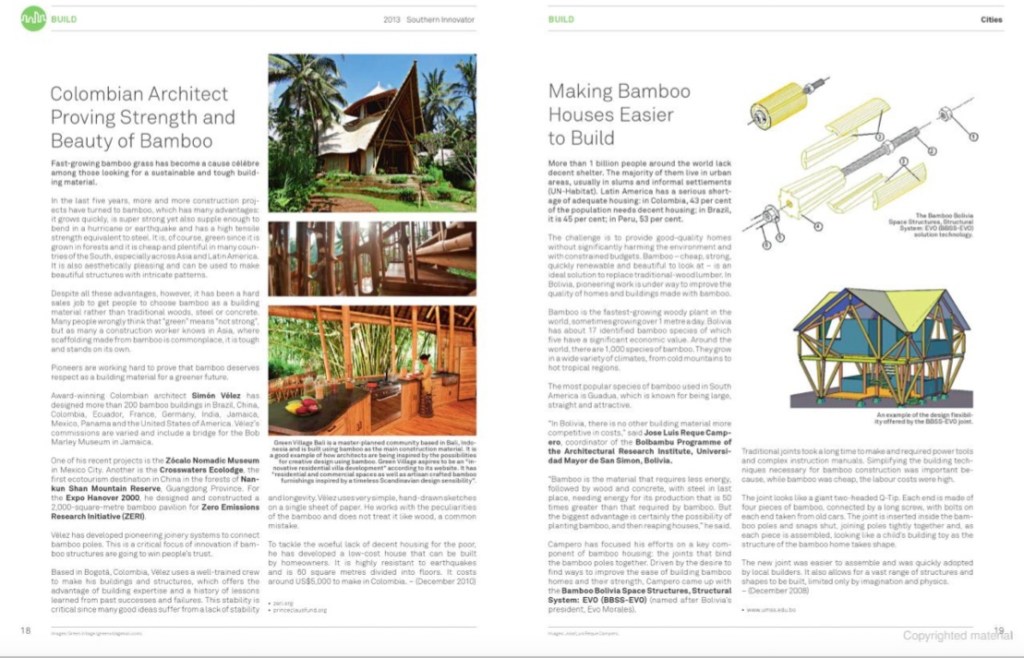
    Fast-growing bamboo grass (http://en.wikipedia.org/wiki/Bamboo) has become a cause celebre amongst those looking for a sustainable and tough building material.

    In the last five years, more and more construction projects have turned to bamboo. It has many advantages: it grows quickly, is super-strong yet also supple enough to bend in a hurricane or earthquake and has a high tensile strength (http://en.wikipedia.org/wiki/Ultimate_tensile_strength) equivalent to steel. It is, of course, green since it is grown in forests, and is cheap and plentiful in many countries of the South, especially across Asia and Latin America.

    It is also aesthetically pleasing and makes beautiful structures with intricate patterns.

    But despite all these advantages, it has been a hard sales job to get people to choose bamboo as a building material rather than traditional woods, steel or concrete. Many people wrongly think green means not strong. But as many a construction worker knows in Asia, where scaffolding made from bamboo is commonplace, it is tough and stands on its own.

    Pioneers are working hard to prove bamboo deserves respect as a building material for a greener future.

    Award-winning Colombian architect Simón Vélez has designed more than 200 bamboo buildings in Germany, France, the United States, Brazil, Mexico, China, Jamaica, Colombia, Panama, Ecuador, and India.

    Vélez’s commissions are varied, and include a bridge for the Bob Marley Museum in Jamaica.

    One of his recent projects is the Zócalo Nomadic Museum (http://en.wikipedia.org/wiki/Nomadic_Museum) in Mexico City. Another is the Crosswaters Ecolodge (http://www.asla.org/2010awards/370.html), the first ecotourism destination in China in the forests of Nankun Shan Mountain Reserve, Guangdong Province. For the Expo Hanover 2000, he designed and constructed a 2000-square-meter bamboo pavilion for ZERI (Zero Emissions
    Research Initiative) (http://www.zeri.org/).

    Vélez has developed pioneering joinery systems to connect bamboo poles together. This is a critical focus of innovation if bamboo structures are going to win people’s trust.

    Based in Bogotá, Colombia, Vélez uses a well-trained crew to make his buildings and structures. This has the advantage of building expertise and a history of lessons learned from past successes and failures. That stability is a critical insight: many good ideas suffer from a lack of stability and longevity. He uses very simple, hand-drawn sketches on a single sheet of paper. He works with the peculiarities of the bamboo and does not treat it like wood: a common mistake.

    To tackle the woeful lack of decent housing for the poor, he has developed a low-cost house that can be built by home-owners. It is highly resistant to earthquakes and is 60 square metres divided on two floors. It costs
    around US $5,000 to make in Colombia.

    Winner of the Prince Claus Fund (http://www.princeclausfund.org/en/index.html), Vélez’s work promotes sustainable development, introducing new ideas on ecological issues and questions. The Fund calls him an architect “whose aesthetic and technical innovations have considerably expanded the possibilities of bamboo as a building material, providing a challenge to prevailing architectural trends.”

    With more than 1 billion people around the world lacking decent shelter, many see plentiful bamboo as a key part of the solution. Most people with poor quality housing live in urban areas, usually in slums and informal settlements (UN-HABITAT). Latin America has a serious shortage of adequate housing: in Colombia, 43 percent of the population needs decent housing; in Brazil, 45 percent; Peru, 53 percent.

    The challenge is to provide good quality homes without significantly harming the environment – and with constrained budgets. Bamboo – cheap, strong, quickly renewable and beautiful – is an ideal solution to replace traditional wood lumber.

    Bamboo is the fastest growing woody plant in the world, sometimes growing over 1 metre a day. Around the world, there are 1,000 species of bamboo. They grow in a wide variety of climates, from cold mountains to hot tropical regions.

    Once called the “poor man’s timber” – a temporary building material to replace once there is more money – bamboo is now getting the respect it deserves. Bamboo for housing has a long history in Latin America, stretching back 4,500 years to ancient civilizations. In Asia, it has long been a traditional construction material. But most of the existing bamboo dwellings in Latin America are 50 to 100 years old.

    The most popular species of bamboo used in South America is Guadua, which is known for being large, straight and attractive.

    Thoughtful and methodical pioneers like Vélez are proving bamboo has a viable future as a building material that will tackle the housing needs of the world’s poor and the fast-growing cities of the South.

    Published: December 2010

    Resources

    Development Challenges, South-South Solutions was launched as an e-newsletter in 2006 by UNDP’s South-South Cooperation Unit (now the United Nations Office for South-South Cooperation) based in New York, USA. It led on profiling the rise of the global South as an economic powerhouse and was one of the first regular publications to champion the global South’s innovators, entrepreneurs, and pioneers. It tracked the key trends that are now so profoundly reshaping how development is seen and done. This includes the rapid take-up of mobile phones and information technology in the global South (as profiled in the first issue of magazine Southern Innovator), the move to becoming a majority urban world, a growing global innovator culture, and the plethora of solutions being developed in the global South to tackle its problems and improve living conditions and boost human development. The success of the e-newsletter led to the launch of the magazine Southern Innovator. 

    Creative Commons License

    This work is licensed under a
    Creative Commons Attribution-Noncommercial-No Derivative Works 3.0 License.

    ORCID iD: https://orcid.org/0000-0001-5311-1052.

    © David South Consulting 2023