Categories
Archive Watch Magazine

CASE STUDY 2: Watch Magazine | 1994 And 1996

Expertise: Editing, start-ups, youth media, content development, art direction, design and layout, investigative journalism.

Location: Toronto, Ontario, Canada 1994 and 1996

Editor-in-Chief: David South

Abstract

In 1994 I was hired by start-up Youth Culture to be Editor-in-Chief of Toronto’s Watch Magazine, a bi-weekly distributed to the city’s high schools and to all youth hang-outs. In 1996 I was hired again to help with preparing the magazine for its national launch. 

About

In 1994, the Internet had not arrived in any great form (though Watch Magazine was on top of its emergence as Internet cafes popped up in the city) and the digital economy was still minimal. There was no such thing as ‘start-up culture’ for youth. There was an urgent need to create opportunity for youth, to create new markets, and to change the business culture of the city of Toronto, which had been hit hard by an economic crash and austerity. 

Watch Magazine had had a brief false start prior to my arrival in 1994. The previous format had not worked and the magazine needed a vision and somebody with the experience and dedication to see it through. It was also entering a competitive marketplace for readers, with already existing free magazines capturing most of the advertising spend for youth-oriented marketing in Toronto (though failing to offer a genuine youth content experience as could be found in Europe – the UK especially – at that time). As an example, Toronto lacked sharp and credible coverage of youth popular culture in the early 1990s. Drawing on my extensive experience as a journalist (including at Toronto’s established alternative weekly, Now Magazine) and editor, I assembled a team of youth editors and writers to work on making the content and magazine’s design appealing to the youth demographic in Toronto. The magazine needed to turn a profit in short order and become credible to advertisers, its main source of income (in Canada, 64 per cent of magazine revenues come from advertisers)*. The design and content needed to appeal to a youth audience but work with a tight (but increasing) budget. It was doing this in a tough economy with high unemployment, austerity, business failures, and a generally negative business environment.

By having an actual youth editorial team, Watch Magazine quickly developed an authentically young 1990s voice. The magazine also benefited from its youth team’s ability to spot trends bubbling under the surface ready to explode into mainstream society. As an example, they had this to say on the Internet in a piece on Toronto’s coffee shops, “Some mean places for bean”: “The powers-that-be think we should cocoon in our houses and rent videos, play with the Internet and order in food …” 

Youth unemployment was high in the early to mid 1990s in Canada. It reached 19.3 per cent for those 15 to 19 years old in 1993. “It should be noted, however, that youth unemployment relative to that of adults has worsened since the 1990-91 recession (Youth Unemployment in Canada by Kevin B. Kerr, 2000).”

The Canadian economy overall severely contracted and unemployment was at 11.4 per cent by 1993 (Statistics Canada), and as Statistics Canada said, “Because employment recovered at a snail’s pace after the recession of the early 1990s, the decline in the unemployment rate was delayed until 1994”.

As the Bank of Canada also said: “In early 1994, Canada’s economic situation was not that favourable—our economy was facing some rather serious problems. … the recession here was more severe than in the United States.

“Working their way out of these difficulties was disruptive and painful for Canadian businesses. Defaults, restructurings, and downsizings became the order of the day. With all this, unemployment took a long time to recover from the 1990–91 recession …” *

And the media in general could not avoid the crisis. According to the book The Missing News: Filters and Blind Spots in Canada’s Press (Robert A. Hackett and Richard S. Garneau, Canadian Centre for Policy Alternatives, University of Toronto Press 2000), Canada’s media was also in a crisis throughout the 1990s, as declining resources, staff layoffs and media closures reduced the breadth and depth of news coverage.

In less than a year, Watch Magazine had gone from being an unknown quantity, to being a fast-growing and profitable youth publication, significantly increasing its advertising revenue: a key metric for a magazine reliant on this as its main source of income. It had expanded in size and audited distribution and was able to make a move to new digs (the Watch Magazine “crib” – a studio and work space) at innovative “arts-and-culture hub” start-up space 401 Richmond Street in Toronto – at the centre of Toronto’s emerging media and design neighborhood in its former fashion district.  All the contributors were high-school-age youth drawn from talent across the city; many had already shown their ability by starting their own publications and media. They gained first-hand experience in investigative journalism skills, business skills in a start-up, and magazine and media production skills. 

“… thanks to David [South] for all his hard work on Watch magazine! I learned a lot from him and it was a great experience.” William White

In 1996, I was hired again to help with preparing the content format for Watch’s expansion to a national magazine – further proof of its success as a publication and a business. 

* (Bank of Canada: Canada’s Economic Future: What Have We Learned from the 1990s?)

* The Missing News: Filters and Blind Spots in Canada’s Press (Robert A. Hackett and Richard S. Garneau, Canadian Centre for Policy Alternatives, University of Toronto Press 2000)

Brief descriptions of sample issues are below: 

Youth Gangs Cover

In 1994, with Canada’s economy still in the doldrums, Watch Magazine exploded into Toronto’s high schools. Staffed by talented youth, it shook up the staid publishing scene and proved young people did have something to say. This first issue still remains relevant, with its exploration of youth gangs and violence in the school system.  

Therapy Cover

After its successful launch, Watch Magazine was grabbing readers and getting the attention of advertisers and television. It was time to improve the design and introduce the latest in graphic design software. The results paid off: the magazine looked sharper and quickly ran from its cheeky launch, when we had basically avoided all traditional approaches to a launch (like actually having a designer).

For anoraks out there, this photo shoot with Irish band Therapy took place outside the former Wellesley Hospital emergency department in Toronto. And, yes, that is a genuine restraining ‘straitjacket’ used by psychiatric hospitals to restrain mental health patients. 

Digable Planets Cover

By this issue, Watch had hit its stride: we were the first to seriously review the ballooning zine culture, get immersed in the rave and late-night party scene, and dig deep into “chopsocky world”: Hong Kong and Asian film fans. But “Hip-Hop Comb-munism”? What were we thinking?

It was also the biggest issue to date. 

Beck Cover

Highly talented Beck gave Watch his eloquent thoughts on the media’s infatuation with Generation X and how it always desperately needs to sell young people more stuff. Watch took on Ontario’s film censors over the GG Allin documentary, Hated: GG Allin and the Murder Junkies, and let students across the city blow off steam on life in the 1990s. 

Bass is Base Cover

By October 1994 the magazine’s investigative powers were in full flow. Two investigations – a sex scandal at an alternative school, and whether the Battle of the Bands contests, a fixture at most high schools, are really worth it – joined a profile of the band Bass is Base and more coverage on the growing rave scene in Toronto. 

Oasis Cover

In 1994, Oasis were still an indie band with a lot of bottle and big mouths. Riding a tsunami of hype from the UK, they washed up in North America to face their biggest challenge: could they become as big as The Beatles or The Rolling Stones? Lead singer Liam Gallagher does not disappoint, as he gives me an expletive-laden exposition on everything under the sun.

This was the first published print interview with the band in Canada.

Sloan Cover

Canada’s answer to the ‘Madchester’ scene of the early 1990s, Sloan, played the pop game with gusto. In the photo shoot for the feature, it was pants down and prayer hands to an unseen religious icon.

Timeline 

1994: Hired to re-launch and expand Watch Magazine in Toronto.

1996: Hired to re-develop editorial content for Watch Magazine’s national launch.  

Testimonials 

“As one of those high school kids and the guy who wrote (most of) this article, I’d like to say thanks to David [South] for all his hard work on Watch magazine! I learned a lot from him and it was a great experience.” William White

Impact

Micro 

  •  Toronto’s first youth culture media start-up. Introduced ‘youth culture’ concept to Canada
  •  oversaw two format re-launches of the magazine as it expanded and grew
  •  assembled talented youth editorial team
  •  grew magazine and its profile as the main media source for reaching Toronto’s youth
  •  writers trained and appeared on TV as youth commentators
  •  first profile in Canada of British band Oasis, among many other story firsts
  •  became first stop for anyone wishing to target the youth market, or seeking intelligence on the youth market 

Macro

  • created youth culture market in Toronto
  • first magazine to be based at new start-up hub in Toronto – pioneering concept at the time 

A sample of published stories is below:  

Freaky – The 70s Meant Something

Oasis Has Arrogance, A Pile of Attitude and the Best Album of 1994

Citations 

Other Resources 

GOSH Child Health Portal 2001 to 2003 Resources

Note: Complete issues of the magazine’s first year await professional digital scanning. This could be of interest to a library, scholar or university interested in archiving this authentic artefact of 1990s youth culture. Please send an email if you would like to get in touch or share a thought: mailto: davidsouthconsulting@gmail.com.  

Media

Youth culture magazine Watch goes national, Wendy Cuthbert, September 1, 1997, Strategy, Canada

“Free teen publication Watch Magazine is going national this month – promising to more than double its high school penetration. 

The self-described youth culture magazine, which last year at this time went province-wide – delivering copies to 350 high schools across Ontario – plans to send out 125,000 copies to 800 participating high schools across Canada. 

Going national only four years after its inception (the magazine started as a Toronto-only vehicle in 1993) could make national advertisers interested in reaching the elusive teen market very happy.”

“The self-described youth culture magazine, which last year at this time went province-wide – delivering copies to 350 high schools across Ontario – plans to send out 125,000 copies to 800 participating high schools across Canada.”

Ryerson Review of Journalism, Page 34, 2003, Toronto, Canada

By Mindy Bell, Published June 23, 2003.

Selling Students Short

“Owned by marketing company Youth Culture Group, these gender – specific magazines attempt to construct a teen image that is built on spending.”

“Youth Culture originally produced a younger, unisex magazine called Watch, which eventually became Bang.”

By Dimetre Alexiou, Published April 4, 1995. Some context on poor youth representation in Canadian media in the early to mid 1990s.
Watch Magazine Editor-in-Chief David South
Watch Magazine Editor-in-Chief David South photographed at Toronto’s Beaches neighbourhood in 1994. Watch Magazine was Toronto’s first youth culture media start-up and led the way on Toronto’s revival after the economic crisis of the early 1990s. Photo: Margaret South.

Note: Complete issues of the magazine’s first year await professional digital scanning. This could be of interest to a library, scholar or university interested in archiving this authentic artifact of 1990s youth culture. Please send an email if you would like to get in touch or share a thoughtmailto: davidsouthconsulting@gmail.com. You can also fund this goal through our PayPal account here:

https://davidsouthconsulting.org/2021/07/20/case-study-3-id-magazine-1996-1997-2/

https://davidsouthconsulting.org/2021/05/25/ger-mongolias-first-web-magazine-and-a-pioneering-web-project-for-the-united-nations-12-january-2016/

https://davidsouthconsulting.org/2021/03/12/southern-innovator-magazine/

We accept payments and donations. We use any funds received to keep content online, or to create new content. Thank you! https://www.paypal.me/davidsouthconsulting
Creative Commons License

This work is licensed under a
Creative Commons Attribution-Noncommercial-No Derivative Works 3.0 License.

ORCID iD: https://orcid.org/0000-0001-5311-1052.

© David South Consulting 2025

Categories
Archive Blogroll Southern Innovator magazine United Nations Development Programme United Nations Office for South-South Cooperation

Southern Innovator Issue 5

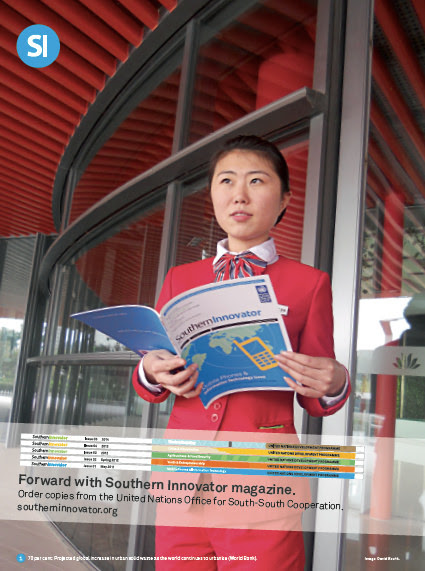
Launched in May 2011, the new global magazine Southern Innovator (ISSN 2222-9280) is about the people across the global South shaping our new world, eradicating poverty and working towards the achievement of the Millennium Development Goals (MDGs). 

Team | Southern Innovator Phase 1 Development (2010 – 2015)

They are the innovators.

Follow the magazine on Twitter @SouthSouth1. 

Southern Innovator Issue 1

Southern Innovator Issue 2

Southern Innovator Issue 3

Southern Innovator Issue 4

Southern Innovator Issue 5

If you would like hard copies of the magazine for distribution, then please contact the United Nations Office for South-South Cooperation (UNOSSC)(https://www.unsouthsouth.org/2014/12/25/southern-innovator-magazine/).

Citations

Recasting ‘truisms’ of low carbon technology cooperation through innovation systems: insights from the developing world by Alexandra Mallet, Innovation and Development, Volume 5, 2015 – Issue 2: Low-Carbon Innovation and Development

https://davidsouthconsulting.org/2021/07/30/disrupted-whatever-happened-to-southern-innovator-issue-6/

https://davidsouthconsulting.org/2021/07/30/issue-6-will-launch-in-autumn-2014-get-on-board-28-july-2014/

https://davidsouthconsulting.org/2021/12/20/press-release-1-southern-innovator/

https://davidsouthconsulting.org/2021/12/20/press-release-2-southern-innovator/

https://davidsouthconsulting.org/2021/12/20/press-release-3-southern-innovator/

https://davidsouthconsulting.org/2021/03/05/southern-innovator-issue-1/

https://davidsouthconsulting.org/2021/03/05/southern-innovator-issue-2/

https://davidsouthconsulting.org/2021/03/05/southern-innovator-issue-3/

https://davidsouthconsulting.org/2021/03/05/southern-innovator-issue-4/

https://davidsouthconsulting.org/southern-innovator-scale-up-fundraiser/

ORCID iD: https://orcid.org/0000-0001-5311-1052.

© David South Consulting 2023

Categories
Archive Blogroll Development Challenges, South-South Solutions Newsletters Southern Innovator magazine

Rebuilding After Chinese Earthquake: Beautiful Bamboo Homes

By David SouthDevelopment Challenges, South-South Solutions

SOUTH-SOUTH CASE STUDY

It has been a year since the May 12, 2008 Sichuan earthquake in China that killed more than 70,000 people.

China’s strongest earthquake for more than half a century, with a magnitude of 8.0 (en.wikipedia.org), it devastated large parts of the province of Sichuan. More than 10 million people were made homeless, most of them poor and elderly villagers (cities were not badly damaged).

Getting Sichuan back to normal is critical for not only the province’s people, but for all of China. Sichuan is China’s rice bowl, growing more food than any other province. But despite the abundance of food, Sichuan remains poor and has seen its working age population move away for work. If it is to have a viable future then its communities need to get back to normal as fast as possible – and its farming economy back to full production.

The unprecedented media coverage of the disaster meant people across China saw the scenes of devastation and have since contributed large donations to help with the reconstruction. The Chinese government has pledged to spend US $151 billion on reconstruction projects.

Finding ways to re-house people after large disasters has become an urgent issue over the last five years. From the Asian tsunami to Hurricane Katrina in the United States and multiple hurricane disasters in the Caribbean, restoring communities is critical for the health of the people and the economies they rely on. Experience has shown that temporary shelters have many drawbacks, being usually of poor quality for long-term habitation and a source of health problems.

The temporary shelters erected for the Sichuan homeless are unsuitable for long-term housing: the 12 square metre grey boxes – two sheets of aluminium sandwiching a polystyrene core for insulation – have no heating. The occupants roast inside in the summer and freeze in the winter. They are also located away from the main source of income: the farms.

The dilemma is how to build new, long-term houses that will not cost too much. Inflation has increased the costs of conventional building materials: bricks, cement and steel.

But the use of traditional building materials and home designs offers an alternative. By drawing on the abundant bamboo and wood in Sichuan and by building to traditional designs, cheaper but sturdy and beautiful homes can be built.

An average home now costs around 80,000 yuan (US $11,688). The Chinese government estimates the price is now 820 yuan per square meter for a new home: bamboo homes cost between 300 and 400 yuan per square meter. Government compensation is between 16,000 yuan (US $2,337) and 23,000 yuan (US $3,360) per family. The bamboo houses range in size from 75 to 200 square metres, and in cost from 22,500 yuan to 80,000 yuan for a very large home.

In Daping village, Pengzhou Town, original homes destroyed by the earthquake sit at the edge of a forested hill. Their frames are more or less intact, but the walls and roofs have collapsed. The new houses replacing them are large, two stories high and have solid grey clay tile roofs. The beauty of the designs stands out and sits in stark contrast to the temporary shelters and concrete buildings.

“There are 43 houses and two public buildings being rebuilt in this project,” says team member Hu Rong Rong of the Green Building Research Centre of Xi’an University of Architecture and Technology. “The design and the main building material are based on the ecological and sustainable habitat idea. The place (Sichuan) is rich in bamboo and wood. These natural materials are cheap and friendly to the environment. In some buildings we use light steel which can be also recycled.”

The new homes are built to earthquake resistance standards. Led by Professor LiuJiaping, a team of 15 people from the research centre and two from a design institute developed the home designs and supervised the training of local people. They were joined by 10 people from an NGO called Global Village of Beijing, who managed the project to completion.

“All the designs were discussed with the local people,” continues Hu. “We trained a local construction team, which means the local people would build their own houses by themselves. Both our research center and the local people were involved in developing the home design.

“To get the trust from the local people is a challenge in the project. We resolved it by showing our respect to the local people. Before we started our design we discussed with the local people many times to know what kind of house they like. We built the first house to make them believe us.”

Hu believes it is possible to replicate the homes across Sichuan.

“The design is suitable for other villages in Sichuan which have a similar climate and culture with this village. To rebuild sustainable houses after a disaster we should know well about the local life, environment and culture – try to find the useful technique which was used in their traditional houses and upgrade the traditional house to meet the need of their modern life.”

Others have not been as lucky as these villagers. In the village of Yuan Bao, Chen Jingzhong, 66, has had to build a makeshift shack: “They wanted to get us to build our own houses but they didn’t give us enough money,” Chen told the Telegraph Magazine. “All we could afford was this shack, which we built ourselves, with our own hands and without any help from anyone.”

Published: May 2009

Resources

Architecture for Humanity: By tapping a network of more than 40,000 professionals willing to lend time and expertise to help those who would not otherwise be able to afford their services, they bring design, construction and development services where they are most critically needed. Website: www.architectureforhumanity.org

Chinese Red Cross: The Red Cross Society of China is accepting donations for disaster reconstruction and is coordinating rebuilding efforts in Sichuan Website: http://www.redcross.org.cn/ywzd/

Gerd Niemoeller has developed flat pack, cardboard homes that can be deployed quickly after a disaster and can become permanent homes.Website: http://tinyurl.com/6t6jtf and the company
Website: http://www.wall.de/en/home

Global Greenhouse Warming is a website that tracks extreme weather events around the world: drought, flooding, severe storms, severe winter, tropical cyclone, wildfires, and extreme heat waves.Website: www.global-greenhouse-warming.com

The Building and Social Housing Foundation: An independent research organization promoting sustainable development and innovation in housing through collaborative research and knowledge transfer. Website: www.bshf.org

https://davidsouthconsulting.org/2021/09/01/disaster-recovery-ten-years-after-the-gujarat-india-experience/

https://davidsouthconsulting.org/2021/11/12/energy-efficient-wooden-houses-are-also-earthquake-safe/

https://davidsouthconsulting.org/2021/09/01/haiti-earthquake-prompts-tech-aid/

https://davidsouthconsulting.org/2021/02/12/rammed-earth-houses-china-shows-how-to-improve-and-respect-traditional-homes/

https://davidsouthconsulting.org/2022/09/26/3d-home-printing-landmark-10-houses-in-a-day/

Development Challenges, South-South Solutions was launched as an e-newsletter in 2006 by UNDP’s South-South Cooperation Unit (now the United Nations Office for South-South Cooperation) based in New York, USA. It led on profiling the rise of the global South as an economic powerhouse and was one of the first regular publications to champion the global South’s innovators, entrepreneurs, and pioneers. It tracked the key trends that are now so profoundly reshaping how development is seen and done. This includes the rapid take-up of mobile phones and information technology in the global South (as profiled in the first issue of magazine Southern Innovator), the move to becoming a majority urban world, a growing global innovator culture, and the plethora of solutions being developed in the global South to tackle its problems and improve living conditions and boost human development. The success of the e-newsletter led to the launch of the magazine Southern Innovator.

https://davidsouthconsulting.org/2021/03/05/southern-innovator-issue-4/

Creative Commons License

This work is licensed under a
Creative Commons Attribution-Noncommercial-No Derivative Works 3.0 License.

ORCID iD: https://orcid.org/0000-0001-5311-1052.

© David South Consulting 2023

Categories
Archive Blogroll Development Challenges, South-South Solutions Newsletters Southern Innovator magazine

Cuba’s Hurricane Recovery Solution

By David SouthDevelopment Challenges, South-South Solutions

(Havana, Cuba), November 2008

SOUTH-SOUTH CASE STUDY

The frequency of extreme weather in the past decade has been attributed to global warming (http://tinyurl.com/5peel). Many scientists believe the future will bring even more turbulent weather events and disasters. The devastation and hardship brought by natural disasters can eradicate development gains, and destroy livelihoods and health. It is critical countries help people to get back to their normal lives as fast as possible.

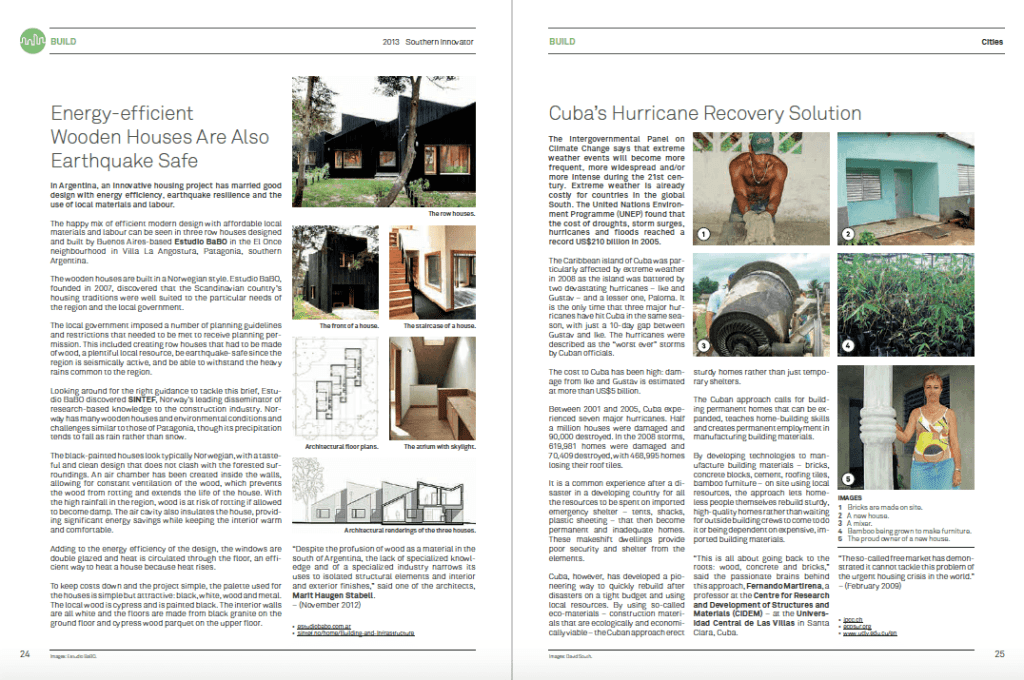
The Intergovernmental Panel on Climate Change (http://www.ipcc.ch) says extreme weather events will become more frequent, more widespread and/or more intense during the 21st century. Extreme weather is already costly for countries in the global South. The United Nations Environment Program (UNEP) found that the cost of droughts, storm surges, hurricanes and floods reached a record US$210 billion in 2005.

The Caribbean island of Cuba (http://en.wikipedia.org/wiki/Cuba) was particularly affected in 2008 by extreme weather, as the island was battered by two devastating hurricanes – Ike and Gustav – and a lesser one, Paloma.  It was the only time that three major hurricanes have hit Cuba in the same season, with just a 10 day gap between Gustav and Ike. The hurricanes were described as the “worst ever” storms by Cuban officials

The cost to Cuba has been high: Damages from Ike and Gustav are estimated at more than US$5 billion (http://tinyurl.com/ba7xny).

Between 2001 and 2005, Cuba experienced seven major hurricanes. Half a million houses were damaged, and 90,000 destroyed. In the 2008 storms, 619,981 homes were damaged and 70,409 destroyed, with 468,995 homes losing their roof tiles.

But Cuba has developed a pioneering way to quickly rebuild after disasters on a tight budget and using local resources. By using so-called ecomaterials – construction materials that are ecologically and economically viable – the Cuban approach erects sturdy homes, rather than just temporary shelters.

It is a common experience after a disaster in a developing country for all the resources to be spent on imported emergency shelter – tents, shacks, plastic sheeting – that then become permanent and inadequate homes. These makeshift dwellings provide poor security and shelter from the elements. For Cuba, the enormous scale of the repair and reconstruction job is especially difficult because of the fuel shortages and building supply restrictions brought on by the United States’ embargo on the country (http://tinyurl.com/4alwrb). In turn, Cubans are adaptable and creative with their solutions.

The Cuban approach builds permanent homes that can be expanded, teaches homebuilding skills and creates permanent employment in manufacturing building materials.

By developing technologies to manufacture building materials – bricks, concrete blocks, cement, roofing tiles, bamboo furniture – on site using local resources, the approach lets homeless people themselves rebuild sturdy, high-quality homes, rather than waiting for outside building crews to come and do it, or being dependent on expensive, imported building materials. By doing this, jobs are created and wealth and gets the community back on its feet after the disaster.

“This is all about going back to the roots: wood, concrete and bricks,” said the passionate brains behind this approach, Fernando Martirena, a professor at CIDEM  — the Centre for Research and Development of Structures and Materials — at the Universidad Central de Las Villas, in Santa Clara , Cuba (www.ecosur.org).

“The so-called free market has demonstrated it can not tackle this problem of the urgent housing crisis in the world.”

At the heart of the Cuban approach are easy-to-use machines that produce the building materials. They range from hand-cranked presses that make mud and clay bricks, to vibrating presses for concrete brick making.

Training the homeless population to do the building themselves allows reconstruction work to begin straight away, rather than waiting for professional building crews to arrive on the scene. It is also psychologically more empowering for the people to be active participants in the rebuilding of their lives. The pride the people have in their new homes is visible.

And quality has been critical for the programme so it can become sustainable and long-lasting:

“The driving force for this project is need,” Martirena said. “If we want to obtain sustainability, we must go beyond need. After disaster, need is the driving force. But after two years, when most things have been completed, it must be a business. Good, beautiful, cheap. Normally, this technology is cheaper than industrial technology.”

To stay prepared for future natural disasters that destroy or damage homes, the Cubans have established strategic reserves of micro-concrete roofing tiles. The lightweight but strong tiles can be used to quickly erect a small module home, and then the home can be expanded and built on as resources and time allow.

Martirena, a former UNHABITAT award-winner, believes this approach to building materials brings prosperity back to rural areas and helps stem the flood of people to cities and urban sprawl seen across the global South.

“You have to go back to the origin of the problem: people are looking for money and better jobs. It is not because they like the cities; they hate the cities!”

“Bamboo harvesting (for furniture making) can bring people three times more income than they would make in the cities. They are really making money.”

For Cuba, this has been a journey from a highly centralised and fuel-dependent approach to house building, to a decentralised, low-fuel approach. From 1959, the year of the revolution, until 1988, Cuba built housing using a centralised factory method to make building materials. Prefabricated houses were erected across the country. The materials were delivered by road and rail, all fuelled by cheap oil from the former Soviet Union.

After the collapse of the Soviet Union in the early 1990s, oil became scarce and the transport network the building industry depended on fell apart. This time was called the “special period.”

Apart from natural disasters, Cuba’s housing stock has suffered under the US embargo. The country’s housing began to decay as repairs were not happening and new houses were not being built. When people did want to do the repairs themselves, the lack of building supplies made it difficult for them to do so. Cuba realized it had to do things differently: the solutions had to be local, energy-efficient, and easy to use.

CIDEM oversees workshops, training and building teams across the country. It tests new materials and designs in its labs before they are deployed as building solutions. The ecomaterials are chosen for low energy use and the ability to recycle waste. Being inexpensive, they offer a sustainable solution for the poor.

In the community of Jatibonico, single mothers make up 40 percent of those who have benefited from the building projects. One woman proudly showed off the home she had built in the Spanish style, complete with Greco-roman columns on the porch. It has a clean, modern bathroom with shower and toilet.

Martirena is currently working on a book of case studies about CIDEM’s projects helping Cubans cope with reduced oil dependency.

CIDEM collaborates with universities around the world and has 19 workshops employing over 200 people in Cuba, and 15 in other countries in Latin America and Africa. It works with the Ecosur initiative and all the machines and advice on how to use them is available from the Ecosur website (www.ecosur.org).

Published: November 2008

Resources

  • “How Cuba Survived Peak Oil” is an award-winning film on how Cuba transitioned from a highly mechanized, industrial agricultural system to one using organic methods of farming and local, urban gardens. It is an unusual look into the Cuban culture during this economic crisis, which they call “The Special Period.” Website:http://www.powerofcommunity.org/cm/index.php
  • Global Greenhouse Warming is a website that tracks extreme weather events around the world: drought, flooding, severe storms, severe winter, tropical cyclone, wildfires, and extreme heat waves.Website:http://www.global-greenhouse-warming.com/extreme-weather.html
  • Cuba Hurricanes: Real-time reports of current hurricane threats to Cuba provided by an office in Old Havana. Also information on hurricanes of historical significance to Cuba. Website: http://www.cubahurricanes.org/
  • Gerd Niemoeller has developed flat pack, cardboard homes that can be deployed quickly after a disaster and can become permanent homes. Website: http://tinyurl.com/6t6jtf and the company website: http://www.wall.de/en/home
  • CIDEM and Ecosur specialise in building low-cost community housing using eco-materials. They have projects around the world and are based in Cuba. Website: http://www.ecosur.org

https://davidsouthconsulting.org/2021/10/03/a-new-house-kit-for-slum-dwellers-that-is-safe-and-easy-to-build/

https://davidsouthconsulting.org/2022/05/23/debt-free-homes-for-the-poor/

https://davidsouthconsulting.org/2021/11/11/decent-and-affordable-housing-for-the-poor/

https://davidsouthconsulting.org/2022/11/16/housing-innovation-in-souths-urban-areas/

https://davidsouthconsulting.org/2021/11/11/housing-solution-for-worlds-growing-urban-population/

https://davidsouthconsulting.org/2021/02/12/rammed-earth-houses-china-shows-how-to-improve-and-respect-traditional-homes/

https://davidsouthconsulting.org/2021/02/12/rebuilding-after-chinese-earthquake-beautiful-bamboo-homes/

https://davidsouthconsulting.org/2022/05/23/solar-bottle-bulbs-light-up-dark-homes/

https://davidsouthconsulting.org/2022/09/26/3d-home-printing-landmark-10-houses-in-a-day/

https://davidsouthconsulting.org/2022/11/17/tiny-homes-to-meet-global-housing-crisis/

https://davidsouthconsulting.org/2021/03/05/southern-innovator-issue-4/

Sponsored by BSHF. BSHF is now called World Habitat and it aims to seek out and share the best solutions to housing problems from around the world.

Creative Commons License

This work is licensed under a
Creative Commons Attribution-Noncommercial-No Derivative Works 3.0 License.

ORCID iD: https://orcid.org/0000-0001-5311-1052.

© David South Consulting 2023