Tag: David South Consulting

  • New Cuban Film Seeks to Revive Sector

    New Cuban Film Seeks to Revive Sector

    By David SouthDevelopment Challenges, South-South Solutions

    SOUTH-SOUTH CASE STUDY

    Since Cuba’s 1959 revolution, the country’s film sector has largely survived on the largesse of the state. The switch to Communism as the guiding economic model of the country after the revolution led, at first, to generous support to filmmakers. The government ranked cinema ahead of television seeing both cinema and television as the two most important forms of artistic expression in the country. But as state funding has dwindled in recent years, adventurous independent filmmakers have tried to keep the Cuban film tradition going using other sources.

    Prior to the revolution, Cuban cinema had been dominated by American and Mexican companies that used Cuba as an exotic backdrop for their productions and dominated the distribution of film in the country.

    In the 17 years after the 1959 revolution, generous funding for filmmaking in Cuba produced 74 full-length films and 600 documentary shorts (Julianne Burton: Revolutionary Cuban Cinema). Soon Cuba had established a reputation for making its own, interesting, high-quality films. These range from “Memories of Underdevelopment” (http://en.wikipedia.org/wiki/Memories_of_Underdevelopment) released in 1968, with its innovative narrative technique, to Academy Award-nominated “Strawberry and Chocolate” in 1993 and 2006’s “Tomorrow” (http://www.cubaabsolutely.com/articles/art/article_art.php?landa=23).

    But funding for Cuban film has been dropping since the ending of generous state supports with the collapse of the Soviet Union in 1991. Cuba had received extensive subsidies from the Soviet Union and enjoyed preferential trading privileges.

    But a new Cuban film is grabbing fistfuls of international accolades and shows it is possible to make films with a combination of foreign investment and state support.

    The zombie horror-comedy “Juan of the Dead” (juanofthedeadmovie.com/lang/en/) has raised more than a few eyebrows but it is also showing a more commercial instinct among Cuban filmmakers and points the way to greater diversity in Cuba’s film sector.

    The film’s poster declares: “50 years after the Cuban revolution a new one is about to start.” The film’s website is a colourful feast of images from the film and uses slick graphic design. It has previews, background resources and online clips for viewers to sample.

    Calling itself a “zombie comedy”, the film was written and directed by Alejandro Brugués and produced by Gervasio Iglesias, Inti Herrera and Claudia Calviño.

    The plot revolves around Juan, a 40-year-old man who has spent most of his life doing nothing. He and his lazy pal Lazaro witness people starting to attack each other. Mistaking this for another stage in Cuba’s revolution, the pair at first believe the government media when it says the incidents are provoked by dissidents paid by the U.S. government. But it begins to dawn on the two men they are surrounded by zombies. Taking a Cuban approach to the problem, Juan decides to get rid of the zombies while making some money at it.

    “Cubans have basically three ways of dealing with problems: they try to make a business out of it, they get used to it and keep going with their lives; or they throw themselves to the sea to run away from the island,” Brugués says on the movie’s website. “‘Juan’ gave me the opportunity to make things really difficult for Cubans, filling the country with zombies, which is in a way what we have become after all these years, but also gave me a leading character that could take a different option, that could stand and say ‘I’m not going to allow this, this is my country, I love it and will stay to defend it’ … after trying to make a business out of it and keep going with his life, of course.”

    The film has received enthusiastic praise from international film festivals and audiences, and its producers are hoping it will give a boost to Cuban cinema.

    Released in 2011 as a joint Spanish/Cuban co-production, “Juan of the Dead” was filmed on location in Cuba’s capital, Havana. The country’s first feature length horror film in half a century, its title is a play on George Romero’s 1978 zombie classic “Dawn of the Dead”, which also inspired the successful 2004 British comedy “Shaun of the Dead”.

    It cost US $2.7 million, and the funds were raised from Spanish investors and the Cuban Institute on Cinematographic Industry and Arts (ICAIC) (http://www.cubarte.cult.cu/paginas/servicios/directorio/directorio.php?id_institucion=77&selected=&offset=36&windowstart=1&letra=&canal).

    Brugués was born in Buenos Aires, Argentina in 1976 and graduated from the International Film and Television School of San Antonio de los Baños, Cuba.

    He built up his expertise in the Cuban film industry as a scriptwriter for several Cuban films and is one of the partners at the Cuban indie film production company Producciones La 5ta Avenida (http://eses.facebook.com/pages/Producciones-de-la-5ta-Avenida/110339122340016).

    His first feature film was “Personal Belongings”, which received worldwide distribution.

    “I have been a follower of the zombie movies since I was a little kid (zombie movies have followers, not fans),” Brugués said. “The idea of ‘Juan’ simply came from watching the reality around me. That reality is Cuba, so one day inevitably, I was asking myself if we were so different from film zombies. Besides that, Cuba is a country that has been preparing itself for a confrontation with the United States during the last 50 years. So, what if instead of that, have to confront zombies?”

    Brugués sees a coming together of independent filmmakers and state-funded filmmakers in the future: “At the moment there are two trends, films produced by Cuba’s state production company and films made outside of that,” he told the BBC.

    “There needs to be a balance but I think the two will eventually merge. When this happens I think this will produce the best Cuban cinema.”

    Published: March 2012

    Resources 

    1) UNCTAD Global Database on the Creative Economy. Website: http://unctadstat.unctad.org/ReportFolders/reportFolders.aspx?sCS_referer=&

    sCS_ChosenLang=en

    2) Creative Economy Report 2010: Creative Economy: A Feasible Development Option. Website: www.unctad.org/Templates/WebFlyer.asp?intItemID=5763&lang=1

    Creative Commons License

    This work is licensed under a
    Creative Commons Attribution-Noncommercial-No Derivative Works 3.0 License.

    ORCID iD: https://orcid.org/0000-0001-5311-1052.

    © David South Consulting 2023

  • Cuban Entrepreneurs Embracing Changes to Economy

    Cuban Entrepreneurs Embracing Changes to Economy

    By David SouthDevelopment Challenges, South-South Solutions

    SOUTH-SOUTH CASE STUDY

    The Caribbean island of Cuba has gone its own way economically and socially since its revolution in 1959. The country has seen significant gains in its human development in the decades since, and can boast impressive education levels and good public health care.

    Cuba enjoys a good ranking on the Human Development Index (HDI) – 59 out of 187 countries – and it has been rising since 1980. For Latin America and the Caribbean, Cuba is above the regional average (http://hdrstats.undp.org/en/countries/profiles/CUB.html).

    But the country has also had a turbulent economy with periods of severe economic contraction. This has increased poverty levels and hunger, in particular during the Special Period beginning in 1990 (http://www.historyofcuba.com/history/havana/lperez2.htm) when the significant subsidies enjoyed by the country from the Soviet Union were pulled and the country saw a steep drop in its ability to import fuel and other goods. Cuba is still trying to repair the economic damage.

    In the book Cuba: Between Reform and Revolution, Louis A. Perez, Jr. explains: “The old socialist bloc Council of Mutual Economic Assistance (CMEA) had accounted for almost 85 percent of Cuban trade, transactions conducted almost entirely in nonconvertible currency. Commercial relations with the former Soviet Union declined by more than 90 percent, from $8.7 billion in 1989 to $4.5 billion in 1991 and $750 million in 1993. Trade with eastern European countries ended almost completely.

    “Soviet oil imports decreased by almost 90 percent, from 13 million tons in 1989 to 1.8 million tons in 1992. Shipments of capital grade consumer goods, grains, and foodstuff declined and imports of raw materials and spare parts essential for Cuban industry ceased altogether.”

    Conducting private business in Cuba was discouraged after the revolution as the state became the dominant arbiter of all economic transactions. Since the fall of the Soviet Union, Cuba has experimented at various times with moving to a mixed economy, only to pull back and return to the old ways. But now things are changing significantly after economic reforms that have accelerated since Cuban President Raul Castro took over from his brother Fidel in 2008.The reforms began in 2008 with the liberalizing of access to mobile phones, and accelerated between 2010 and 2013, when the number of people working in small businesses tripled.

    Cuentapropistas – the Cuban term for entrepreneurs, named after “cuenta propria,” the ability to do business for oneself – have flocked to be officially registered as small businesses, with the number shooting up from 143,000 in 2010, to 429,000 by June 2013 (Report on Business).

    Gustavo Kouri told the Report on Business magazine, “Although I enjoyed the work I was doing before – at an information centre in specialized health sciences – it wasn’t possible to earn enough to support my family.

    “And then the state opened more opportunities to develop private businesses, for cuenta propia.”

    He now owns the Rio Mar restaurant (https://www.facebook.com/restauranteriomar).

    Artists and athletes have also been attracted to the opportunities that have opened up.

    One is former volleyball Olympic gold medalist Mireya Luis (http://en.wikipedia.org/wiki/Mireya_Luis), who now owns Las Tres Medallas (http://www.alamesacuba.com/en/la-habana/restaurant/las-tres-medallas/), a pizza-and-pasta restaurant.

    For Luis, becoming an entrepreneur means the chance to “realize a dream.”

    “Being able to open a place – a restaurant, a bar, a cafeteria, whatever – is a good opportunity for self-development, for people to demonstrate a capacity for business, and for them to grow personally,” she said. “It’s something incredible.”

    Gilberto Valladares owns a hair salon in Old Havana, Arte Corte Studio, and has been able to employ others.

    “Initially, it was a dream of dignifying and recovering a certain degree of respect for the trade of hairdresser and barber,” he told the Report on Business. “As my business grew, so did the dream.” He now employs a half dozen people from the neighborhood.

    Cuba is attempting to reform and modernize its economy while holding on to the things people hold dear and see as the good achievements of the revolution: free healthcare, education and other public services.

    Gregory Biniowsky is a Canadian-trained lawyer and political scientist who has spent more than 15 years living and working in Cuba and works for Havanada Consulting, a firm that focuses on sustainable development projects and social enterprise initiatives. “The irony is those that will save the Revolution are the emerging small- and medium-sized private businesses,” he said. “And those that could destroy it are those elements in the bureaucracy that resist those changes.”

    The entrepreneurial spirt gripping the island is infectious. At one time, much of the only reading material available in bookshops were works with a communist or socialist theme.
    But Cubans now have an alternative: an English-language bookshop called Cuba Libro (https://www.facebook.com/cubalibroHAV). It is filing an urgent gap in the marketplace for English-language books and foreign works in general.

    Set up by an American writer and journalist Conner Gorry (connergorry.com), who has been living in Havana, Cuba since 2002, the bookshop has become a hub for free thinking and new ideas.

    “I know how hard it is to get English-language sources here,” she told The Associated Press. “So I started cooking this idea.”

    Libro is the Spanish word for book and the play on words is meant to evoke a Cuba Libre, a rum-and-cola drink named for the country’s liberation from colonial Spain. The store bills itself as a “cafe, bookstore, oasis,” and  its logo features a woman reclining with a cup of coffee and a good book for reading.

    The idea came about when a friend of Gorry could not find a place to unload 35 books she had. In time, Gorry amassed a collection of 300 English-language books, and this embryonic library became the book shop. The store also carries magazines, including U.S. titles The New Yorker and Rolling Stone.

    So far, the store faces little competition. Government book shops feature the occasional Cuban novel translated into English or the English-language versions of state-run newspapers such as Granma (http://www.granma.cu/ingles/).

    Cubans are enjoying the slow thaw and what it could bring. “It is increasing in Cuba, the possibility to have different alternatives,” said Carlos Menendez, a 77-year-old retired economist Menendez.

    Cuba Libro has two licenses to operate – one for selling food and one for selling used books – and is run as a type of cooperative, a group-owned private enterprise with five Cubans.

    Doing business in Cuba is not without challenges. The bookshop needs to steer a steady path and avoid selling anything that would be considered “counterrevolutionary.” Gorry also needs to avoid problems with the U.S. government, which bans Americans from any financial transactions with the Cuban government.

    “I’ve had to tread extremely carefully, everything above-board and legal, because I’m an American, I’m a North American, I am beholden to U.S. laws,” she said. “And so I’m not in agreement with those laws, but I abide by them.”

    The bookshop has the benefit of a well-educated pool of potential customers; the annual Havana book festival is a popular draw in the country (http://feriadellibro.cubaliteraria.cu/).
    There is a strong thirst for self-improvement in Cuba, and to gain knowledge is to get a better paying job. To widen access to the shop, there will be a lending library for those who can’t afford to buy the books on offer, and there will also be English classes.

    And how will the bookshop get restocked in a country that still exercises a lot of control over information?

    “Getting donations is going to be another interesting piece of it, because importing books here is very difficult,” Gorry said.

    Published: October 2013

    Resources

    1) Cuba Research Center: The Cuba Research Center is a nonprofit organization based in Alexandria, Virginia.  Founded in 2013, its purpose is to provide information about Cuba and U.S.-Cuba relations, to participate in public debate about those subjects, and to build bridges between Americans and Cubans interested in those topics. Website: http://www.us-crc.org/

    2) Havanada Consulting: Havanada Consulting is a consulting firm which focuses on sustainable development projects and social enterprise initiatives in Cuba. Website: havanada.com

    3) Havana Cuba Business: If you are engaged in or would like to learn more about Cuba-related business or travel activities, Havana Cuba Business offer a customized consulting service that will address your questions and concerns. Website: cuentapropistas.com

    4) A business-friendly Cuba gets a hand from Canada (Report on Business). Website: http://www.theglobeandmail.com/report-on-business/rob-magazine/a-business-friendly-cuba-gets-a-hand-from-canada/article14006239/?page=all

    https://davidsouthconsulting.org/2021/02/04/cubas-hurricane-recovery-solution/

    https://davidsouthconsulting.org/2021/02/04/new-cuban-film-seeks-to-revive-sector/

    https://davidsouthconsulting.org/2022/11/11/urban-farming-to-tackle-global-food-crisis/

    https://davidsouthconsulting.org/2021/03/05/southern-innovator-issue-3/


    This work is licensed under a Creative Commons Attribution 4.0 International License.

    ORCID iD: https://orcid.org/0000-0001-5311-1052.

    © David South Consulting 2023

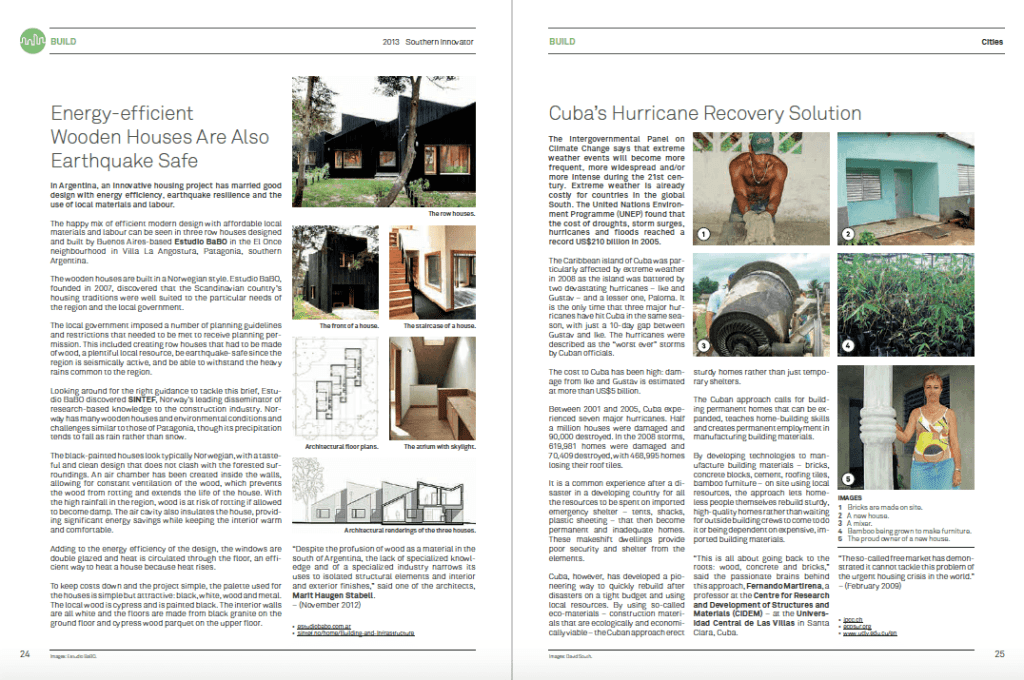
  • Cuba’s Hurricane Recovery Solution

    Cuba’s Hurricane Recovery Solution

    By David SouthDevelopment Challenges, South-South Solutions

    (Havana, Cuba), November 2008

    SOUTH-SOUTH CASE STUDY

    The frequency of extreme weather in the past decade has been attributed to global warming (http://tinyurl.com/5peel). Many scientists believe the future will bring even more turbulent weather events and disasters. The devastation and hardship brought by natural disasters can eradicate development gains, and destroy livelihoods and health. It is critical countries help people to get back to their normal lives as fast as possible.

    The Intergovernmental Panel on Climate Change (http://www.ipcc.ch) says extreme weather events will become more frequent, more widespread and/or more intense during the 21st century. Extreme weather is already costly for countries in the global South. The United Nations Environment Program (UNEP) found that the cost of droughts, storm surges, hurricanes and floods reached a record US$210 billion in 2005.

    The Caribbean island of Cuba (http://en.wikipedia.org/wiki/Cuba) was particularly affected in 2008 by extreme weather, as the island was battered by two devastating hurricanes – Ike and Gustav – and a lesser one, Paloma.  It was the only time that three major hurricanes have hit Cuba in the same season, with just a 10 day gap between Gustav and Ike. The hurricanes were described as the “worst ever” storms by Cuban officials

    The cost to Cuba has been high: Damages from Ike and Gustav are estimated at more than US$5 billion (http://tinyurl.com/ba7xny).

    Between 2001 and 2005, Cuba experienced seven major hurricanes. Half a million houses were damaged, and 90,000 destroyed. In the 2008 storms, 619,981 homes were damaged and 70,409 destroyed, with 468,995 homes losing their roof tiles.

    But Cuba has developed a pioneering way to quickly rebuild after disasters on a tight budget and using local resources. By using so-called ecomaterials – construction materials that are ecologically and economically viable – the Cuban approach erects sturdy homes, rather than just temporary shelters.

    It is a common experience after a disaster in a developing country for all the resources to be spent on imported emergency shelter – tents, shacks, plastic sheeting – that then become permanent and inadequate homes. These makeshift dwellings provide poor security and shelter from the elements. For Cuba, the enormous scale of the repair and reconstruction job is especially difficult because of the fuel shortages and building supply restrictions brought on by the United States’ embargo on the country (http://tinyurl.com/4alwrb). In turn, Cubans are adaptable and creative with their solutions.

    The Cuban approach builds permanent homes that can be expanded, teaches homebuilding skills and creates permanent employment in manufacturing building materials.

    By developing technologies to manufacture building materials – bricks, concrete blocks, cement, roofing tiles, bamboo furniture – on site using local resources, the approach lets homeless people themselves rebuild sturdy, high-quality homes, rather than waiting for outside building crews to come and do it, or being dependent on expensive, imported building materials. By doing this, jobs are created and wealth and gets the community back on its feet after the disaster.

    “This is all about going back to the roots: wood, concrete and bricks,” said the passionate brains behind this approach, Fernando Martirena, a professor at CIDEM  — the Centre for Research and Development of Structures and Materials — at the Universidad Central de Las Villas, in Santa Clara , Cuba (www.ecosur.org).

    “The so-called free market has demonstrated it can not tackle this problem of the urgent housing crisis in the world.”

    At the heart of the Cuban approach are easy-to-use machines that produce the building materials. They range from hand-cranked presses that make mud and clay bricks, to vibrating presses for concrete brick making.

    Training the homeless population to do the building themselves allows reconstruction work to begin straight away, rather than waiting for professional building crews to arrive on the scene. It is also psychologically more empowering for the people to be active participants in the rebuilding of their lives. The pride the people have in their new homes is visible.

    And quality has been critical for the programme so it can become sustainable and long-lasting:

    “The driving force for this project is need,” Martirena said. “If we want to obtain sustainability, we must go beyond need. After disaster, need is the driving force. But after two years, when most things have been completed, it must be a business. Good, beautiful, cheap. Normally, this technology is cheaper than industrial technology.”

    To stay prepared for future natural disasters that destroy or damage homes, the Cubans have established strategic reserves of micro-concrete roofing tiles. The lightweight but strong tiles can be used to quickly erect a small module home, and then the home can be expanded and built on as resources and time allow.

    Martirena, a former UNHABITAT award-winner, believes this approach to building materials brings prosperity back to rural areas and helps stem the flood of people to cities and urban sprawl seen across the global South.

    “You have to go back to the origin of the problem: people are looking for money and better jobs. It is not because they like the cities; they hate the cities!”

    “Bamboo harvesting (for furniture making) can bring people three times more income than they would make in the cities. They are really making money.”

    For Cuba, this has been a journey from a highly centralised and fuel-dependent approach to house building, to a decentralised, low-fuel approach. From 1959, the year of the revolution, until 1988, Cuba built housing using a centralised factory method to make building materials. Prefabricated houses were erected across the country. The materials were delivered by road and rail, all fuelled by cheap oil from the former Soviet Union.

    After the collapse of the Soviet Union in the early 1990s, oil became scarce and the transport network the building industry depended on fell apart. This time was called the “special period.”

    Apart from natural disasters, Cuba’s housing stock has suffered under the US embargo. The country’s housing began to decay as repairs were not happening and new houses were not being built. When people did want to do the repairs themselves, the lack of building supplies made it difficult for them to do so. Cuba realized it had to do things differently: the solutions had to be local, energy-efficient, and easy to use.

    CIDEM oversees workshops, training and building teams across the country. It tests new materials and designs in its labs before they are deployed as building solutions. The ecomaterials are chosen for low energy use and the ability to recycle waste. Being inexpensive, they offer a sustainable solution for the poor.

    In the community of Jatibonico, single mothers make up 40 percent of those who have benefited from the building projects. One woman proudly showed off the home she had built in the Spanish style, complete with Greco-roman columns on the porch. It has a clean, modern bathroom with shower and toilet.

    Martirena is currently working on a book of case studies about CIDEM’s projects helping Cubans cope with reduced oil dependency.

    CIDEM collaborates with universities around the world and has 19 workshops employing over 200 people in Cuba, and 15 in other countries in Latin America and Africa. It works with the Ecosur initiative and all the machines and advice on how to use them is available from the Ecosur website (www.ecosur.org).

    Published: November 2008

    Resources

    • “How Cuba Survived Peak Oil” is an award-winning film on how Cuba transitioned from a highly mechanized, industrial agricultural system to one using organic methods of farming and local, urban gardens. It is an unusual look into the Cuban culture during this economic crisis, which they call “The Special Period.” Website:http://www.powerofcommunity.org/cm/index.php
    • Global Greenhouse Warming is a website that tracks extreme weather events around the world: drought, flooding, severe storms, severe winter, tropical cyclone, wildfires, and extreme heat waves.Website:http://www.global-greenhouse-warming.com/extreme-weather.html
    • Cuba Hurricanes: Real-time reports of current hurricane threats to Cuba provided by an office in Old Havana. Also information on hurricanes of historical significance to Cuba. Website: http://www.cubahurricanes.org/
    • Gerd Niemoeller has developed flat pack, cardboard homes that can be deployed quickly after a disaster and can become permanent homes. Website: http://tinyurl.com/6t6jtf and the company website: http://www.wall.de/en/home
    • CIDEM and Ecosur specialise in building low-cost community housing using eco-materials. They have projects around the world and are based in Cuba. Website: http://www.ecosur.org

    https://davidsouthconsulting.org/2021/10/03/a-new-house-kit-for-slum-dwellers-that-is-safe-and-easy-to-build/

    https://davidsouthconsulting.org/2022/05/23/debt-free-homes-for-the-poor/

    https://davidsouthconsulting.org/2021/11/11/decent-and-affordable-housing-for-the-poor/

    https://davidsouthconsulting.org/2022/11/16/housing-innovation-in-souths-urban-areas/

    https://davidsouthconsulting.org/2021/11/11/housing-solution-for-worlds-growing-urban-population/

    https://davidsouthconsulting.org/2021/02/12/rammed-earth-houses-china-shows-how-to-improve-and-respect-traditional-homes/

    https://davidsouthconsulting.org/2021/02/12/rebuilding-after-chinese-earthquake-beautiful-bamboo-homes/

    https://davidsouthconsulting.org/2022/05/23/solar-bottle-bulbs-light-up-dark-homes/

    https://davidsouthconsulting.org/2022/09/26/3d-home-printing-landmark-10-houses-in-a-day/

    https://davidsouthconsulting.org/2022/11/17/tiny-homes-to-meet-global-housing-crisis/

    https://davidsouthconsulting.org/2021/03/05/southern-innovator-issue-4/

    Sponsored by BSHF. BSHF is now called World Habitat and it aims to seek out and share the best solutions to housing problems from around the world.

    Creative Commons License

    This work is licensed under a
    Creative Commons Attribution-Noncommercial-No Derivative Works 3.0 License.

    ORCID iD: https://orcid.org/0000-0001-5311-1052.

    © David South Consulting 2023

  • Swing Shift: Sexual liberation is back in style

    Swing Shift: Sexual liberation is back in style

    By David South

    Id Magazine (Canada), October 3-16, 1996

    Deep in the bedrooms (and living rooms) of the home-owning classes, the sexual liberation movement marches on: swingers’ parties are back. Those libidinous libertines many thought were lost in a 70s disco haze, according to a Toronto swinger, are back in greater numbers than in those polyester days. 

    In contrast to the many people (mostly men) looking for the anonymous and on-demand buzz of escort agencies, porn videos and sex toys, it seems to me swinging is the most idealistic camp in the army of sexual liberation. There isn’t any sneaking around behind your spouse’s back – in fact, you bring them along for the good times. 

    Swingers were usually the subject of the porn movies I watched at the base cinema during my army days. They weren’t real people, but some sort of myth from more electric times. 

    Ron Michaels, 41, is an unabashed proselytizer for swinging. A strip-club DJ and erotic and commerical photographer, he’s also co-owner, along with his wife, of swingers’ club Eros. A confident and articulate spokesperson, he has been swinging since he was 17. 

    “We believe honesty is the cornerstone of our lifestyle – that makes it work,” he says. “The people engaging in back-alley sex are being dishonest. It’s the same with having an affair – wanting your cake but not being able to share it with the rest of us. 

    “Swinging is a moral alternative to having affairs.” 

    The divorce rate among swingers, Michaels maintains, is only five per cent, compared to 51 per cent for the general population. The one wrinkle in this impressive “fact” is Michaels’ other admission that many swingers are on their second “married relationship”.

    Interviewing Michaels, I feel like I’m talking to a Rotary Club member or a boy scout leader, not a swinger. The talk is about clubs, memberships ($69 a year per couple), trips. It’s a hobby, sport and lifestyle to many swingers, claims Michaels. 

    “We have regular weekly functions throughout the year. Some of them are organized by the members. We organize trips and holidays. Weekends in the Caribbean. Like any other social club.”

    That can’t be wife/husband swapping he’s talking about, can it?

    Michaels’ Toronto Beaches home leaves no doubt as to its occupant’s lifestyle choices: “If you don’t swing, don’t ring,” says a brass plaque nailed to the door. 

    Michaels is very proud of swinging’s growth in the 90s. His group has grown from 300 member-couples 14 years ago to 1,800 today. Michaels ambitiously estimates that between 100,000 and 200,000 Southern Ontarians are into swinging, between 20 and 25 million across North America. 

    So, how does swinging in the 90s work?

    Michaels says most clubs operate more as matchmaking parties than full-out orgies. Couples get to know each other and make the arrangements to meet away from the club’s party. Michaels is quick to disassociate his club from drop-in style swingers parties. 

    “Canadians are much more conservative than Americans. In New York they are more hardcore, less selective of their partners. When they get there they are more like, ‘let’s find the first available body and get to it,’ whereas people at social clubs want to get to know you. We are talking about four-way compatability here.”

    According to Michaels, the big victory for Canadian swingers took place in 1992. “Our Mississauga club was raided back in ’92 and we took it through the courts for a year. We were acquitted and set a legal precedent, making swingers’ clubs legal.”

    To many men, the whole swinging thing seems like the best of both worlds: you keep your wife and get to taste the fruits of other trees at the same time. But Michaels says this male teenage fantasy doesn’t pan out in reality. 

    “That wears off pretty quickly. Let’s face it, men have a much lower capacity for sex than women do. Men need a longer recovery period and don’t have as many orgasms in a night. Women can just go and go. Guys can’t compete with that. After a while the fantasy wears thin, and it’s the guy that wants to drop out of the lifestyle.” 

    And what about that other most-asked-question: what’s it like to see your spouse having the time of their life with your neighbour?

    “They don’t get into those kinds of comparisons. How can I describe this? It’s not a competitive thing where you try to outperform each other. Most swingers appreciate each other as being unique and different, rather than this is bigger, this is harder, this is faster, this is better. Each new experience is taken at face value, ‘Hey, it’s a good time’. You move on to the next one or you go back to your regular partner.”

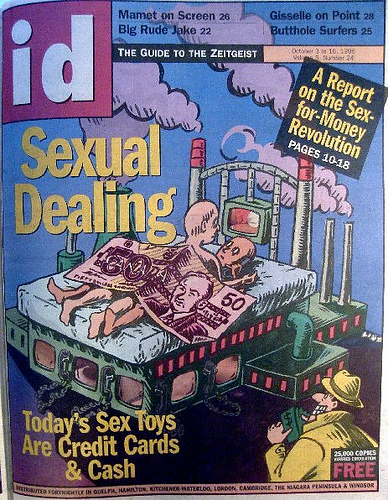
    Read more on the 1990s sex economy here: From Special Report: Sexual Dealing: Today’s Sex Toys Are Credit Cards & Cash: A Report On The Sex-For-Money Revolution

    Special Report: Sexual Dealing: Today’s Sex Toys Are Credit Cards & Cash: A Report On The Sex-For-Money Revolution.

    Read more on the 1990s sex economy here: From Special Report: NMM (New Media Markets) Spotlight On The Emergence Of Satellite Porn Channels In The UK

    Update: It is over 20 years since this Special Report was published. It forecast the significant role the Internet was to play in the growth of sex content and the sex industry and vice versa. Here is an interesting overview of the situation in 2020. The Internet is for Porn – It always was, it always will be.

    “One of the biggest and most interesting things happening in the consumer web right now is running almost completely under the radar. It has virtually zero Silicon Valley involvement. There are no boastful VCs getting rich. It is utterly absent from tech’s plethora of twitters, fora and media (at least, as they say, “on main”). Indeed, the true extent of its incredible success has gone almost completely unnoticed, even by its many, many, many customers.

    I’m talking, of course, about OnlyFans.”

    ORCID iD: https://orcid.org/0000-0001-5311-1052.

    © David South Consulting 2021