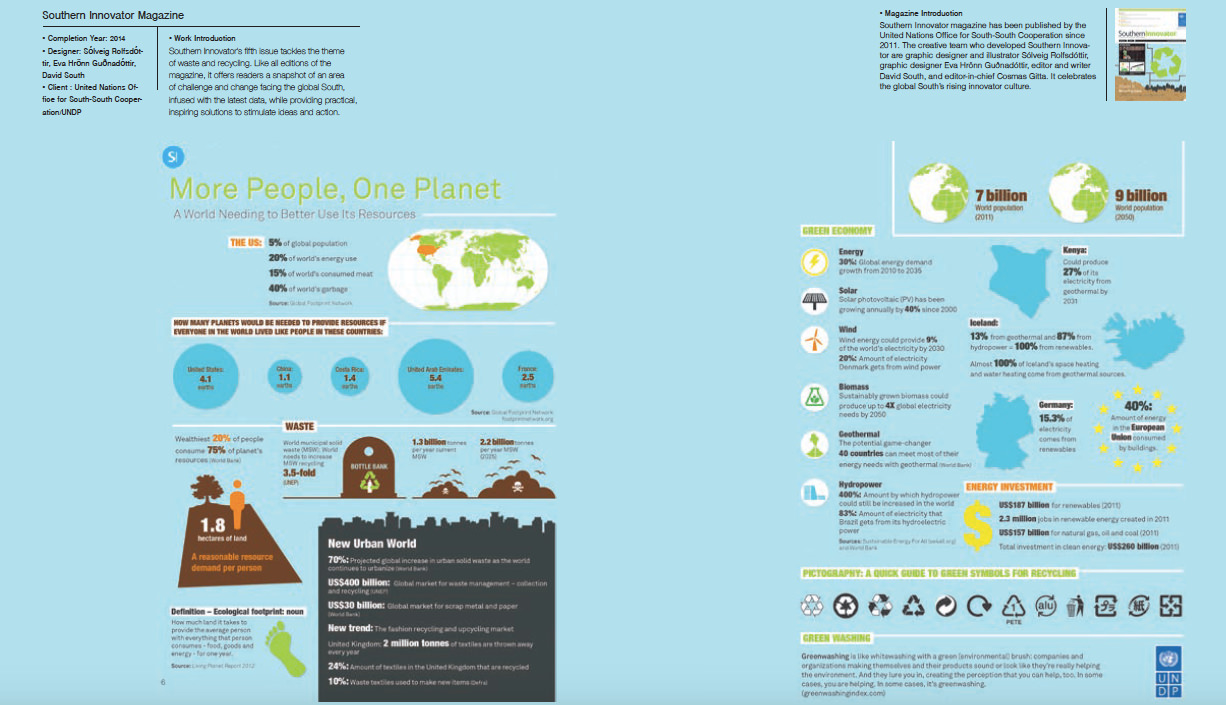
“Close, but no cigar” some might say, but we were genuinely flattered to be shortlisted in 2014 for inclusion in the book Visual Storytelling: Infographic Design in News published by Images Publishing in Shanghai, China. It is a lovely book to look at and the quality of infographics chosen for the book is high so it must have been a tough call. It was further proof Southern Innovator was getting known around the world and gaining respect for its content and design. The excellent work done by our graphic designer and illustrator Solveig Rolfsdottir speaks for itself.
Graphic Designer and Illustrator: Sólveig Rolfsdóttir.
The proof flats for inclusion in Visual Storytelling: Infographic Design in News.Visual Storytelling: Infographic Design in News published by Images Publishing.
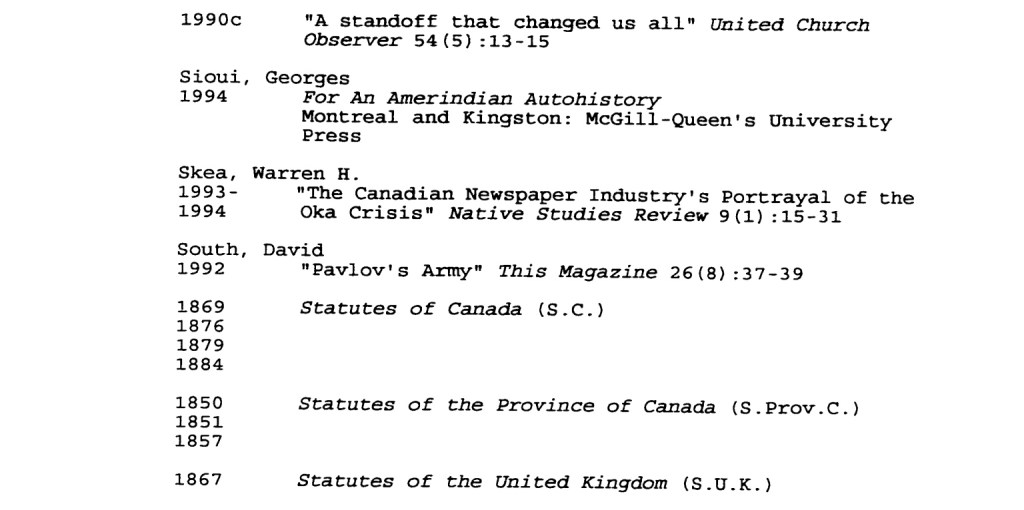
In August 1992 I wrote a feature for Canada’s This Magazine. The country was in the depths of a severe recession and an austerity crisis but this also came with two emergencies requiring the Canadian Armed Forces: the first Gulf War from 1990 to 1991, and at home, the 1990 Oka Crisis. A few years prior (1988) changes were made to the War Measures Act (Canada invoked the War Measures Act in 1970 during the October FLQ Crisis, bringing troops to Canadian streets and mass arrests), replacing it with something called the Emergency Measures Act (EMA) (now Emergencies Act), which was given Royal Assent in 1988. I interviewed various legal experts on this new legislation and its implications and applications in future civil emergencies.
“The EMA WILL be used to suppress civil liberties in various parts of the country,” says Rosenthal. “A thing to keep in mind is that although the War Measures Act was passed during the First World War, it wasn’t used in a terrible way until 1970. The emergencies legislation is on the books. The Public Order Emergency could be used to suppress any kind of legitimate dissent.”
Many critics fear there is potential for manipulation of the EMA in the heat of the moment in the hands of an unscrupulous government.
“Words are very malleable,” says Rosenthal. “It was absurd for Trudeau to claim that there was an apprehended insurrection in Quebec in 1970. As he said the words he knew it was a lie.”
Launched in 1999 towards the end of my two-year assignment in Mongolia, this book is a unique resource for a developing country: a one-stop compilation of journalism chronicling the ups and downs of life in a country where the political and economic system has been turned on its head. You can download an edited selection of the book from Google Books here: In their own words: Selected writings by journalists on Mongolia, 1997-1999.
“Herding instinct” by Jill Lawless, The Guardian, 9 June 1999.“A Mongolian Shopping Spree Fizzles” by Thomas Crampton, The New York Times, June 25, 1998.“The Milk of Kindness Flows in a Peculiar Land A Steppe From Nowhere” by Leslie Chang, The Asian Wall Street Journal, 15 August 1998.
Top journalists covering Asia in the late 1990s contributed to the book.
In 1996 I was hired as Features Editor for Id Magazine, a bi-weekly alternative magazine in Guelph, Ontario, Canada.
About
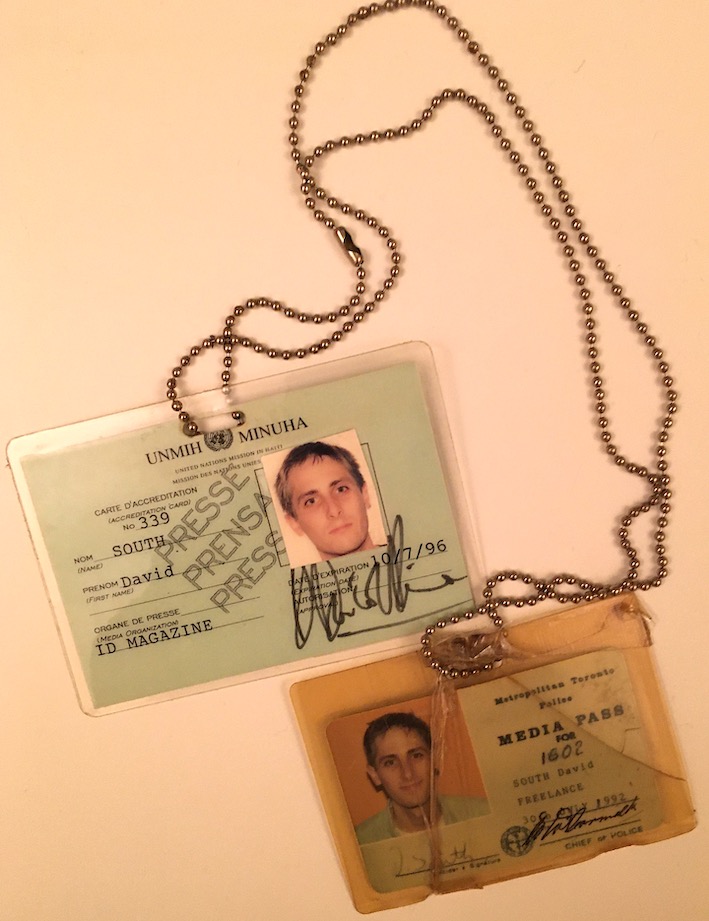
In 1996 Id Magazine, an Ontario, Canada alternative biweekly, was expanding and needed to improve the quality of its journalism, while also making the difficult shift to being a more consistently professional offering. I was hired as Features Editor and set about swiftly assembling a team of investigative journalists. My strategy involved targeting stories overlooked by Canadian newspapers and TV news. In the 1990s, it was often the case the best journalism and the best investigative journalism in Canada could be found in the country’s alternative media. This led to a number of firsts, including an extensive investigation into Canada’s flourishing sex industry, the government’s addiction to casinos to boost revenues, unearthing a plot by neo-nazis to infiltrate Ontario high schools with hate rock, university students’ catastrophic debt culture, reporting from the streets of Port-au-Prince, Haiti on Canada’s UN mission, and probing the government’s public services privatisation plans (including being invited to debate this topic on CBC TV’s programme, Face Off). With a keen eye for new media trends, the magazine covered the fast-rising Internet economy, early experiments with digital currencies and smart cards (Mondex) (Canadian Town Tries Out Cash Cards) being carried out in Guelph, Ontario, and concerns about data privacy.
There clearly was a gap in the news marketplace Id could better fill with solid investigative journalism and features writing aimed at a younger demographic.
How large a market gap can be confirmed by various analyses on the state of the Canadian media at the time and since. According to the book The Missing News: Filters and Blind Spots in Canada’s Press (Robert A. Hackett and Richard S. Garneau, Canadian Centre for Policy Alternatives, University of Toronto Press 2000), Canada’s media was in a mess in the 1990s resulting from declining resources, staff layoffs and media closures reducing the breadth and depth of news coverage.
My challenge: Could I bring together a talented, young team and improve the quality and consistency of journalism for a start-up magazine seeking to grow? The proof came in the form of improved audited pick-up of the magazine by readers, the magazine’s confident push to expand on the Internet, and the fact many from that original team have gone on to not only have successful careers in the media and film, but also to be influential in their own right – proof the original belief in their talent was correct.
Pressure on journalists to toe the line and not upset advertisers was also increasing in the context of ongoing high unemployment, a stagnant economy in a recession, and government austerity. Canadian media as whole also has a “great dependence on advertising, which accounts for more than 70% of daily newspaper revenues, about 64% of magazine revenues,” which means there is enormous pressure to only publish stories that do not upset advertisers. And monopolies exert great control over news content in Canada: “In the United States, ten companies control 43.7% of total daily newspaper circulation. By contrast, in Canada since 1996, one single company controls a comparable share of the media pie.”
Quoting Jeffrey Simpson in the book, newspapers are “shrinking in size, personnel, ambition and, as a consequence, in their curiosity,” …. “I believe the result has been a diminution in quality.” (p64)
Fast forward to “Today, we have a crisis in the journalism industry unprecedented in scope. A media implosion. Newspapers being reduced to digital editions, large numbers losing their jobs, circulation falling, ad revenues plunging, near monopoly ownership of big-city dailies, the old business model in a state of collapse.” (Canada’s media: A crisis that cries out for a public inquiry by Lawrence Martin, The Globe and Mail, Feb. 02, 2016).
Brief descriptions of sample issues are below:
Can Harris be Stopped? Cover
My first Id Magazine cover. It was thrown together in a few days after being hired. While a work of resourcefulness under pressure, it did capture the spirit of the times as multiple demonstrations and strikes tried to bring down the much-hated Conservative government in Ontario.
“Can the UN Help Remake a Country?” Cover
This cover photo by Phillip Smith was taken in the market area of Port-au-Prince, Haiti. I had never seen such squalor and desperation in my life. It got worse as we visited the city’s morgue, packed to the rafters with the dead and mutilated bodies of children and adults. It was a tough assignment and one that was captured with professionalism by Phillip’s camera.
Christmas Issue Cover
Back in 1996, the Thatcher thirst for privatisation came to Ontario with a vengeance. In this issue, we asked if it showed a lack of imagination to just sell publicly paid for assets to wealthy investors. We offered other ownership models and I debated this topic on CBC TV’s Face Off.
“Pulling the Plug on Hate Rock” Cover
This excellent cover by Gareth Lind was, as far as I know, the first use of pop art on a biweekly magazine cover in Ontario at that time (I certainly hadn’t seen anyone else do it). It sold the excellent investigation into skinhead rock bands infiltrating Ontario high schools very well. It was timed for release during the North-by-Northeast music festival in Toronto, and had zero returns (as in all issues were picked up).
Sarah Polley Cover
A regular contributor to Id, Canadian actor and director Sarah Polley challenged the stale Canadian left with her spiky views. In this issue we tackled the decline in the quality of TV programmes and asked if it was a moral vacuum being hoovered up by consumerism.
Student Issue Cover
This cover is by great Canadian political cartoonist and illustrator Jack Lefcourt. Always funny, Jack captures well the corporate take-over of the country’s universities and the introduction of the catastrophic debt culture that leaves so many students in a financial pickle. It was also Id’s first student issue.
“The Great Education Swindle: Are Reforms Destroying Your Future?”
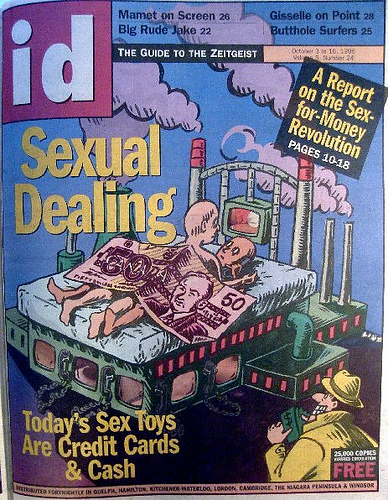
“Today’s Sex Toys are Credit Cards and Cash” Cover
As Ontario’s economy experienced year-after-year of high unemployment and stagnant salaries, its sex economy flourished. In another first, the Id team tackled all aspects of the growth of the sex economy and changing attitudes to sexual behaviour. Beating the big papers to this story, they wrote with honesty and verve and made a refreshing break from the limp journalism of most Canadian newspapers.
Timeline
1996: Hired as Features Editor and assembled editorial and creative team.
1997: Id Magazine begins to simultaneously publish its content online, a pioneering move at the time.
Impact
Micro
reducing returns and boosting audited pick-ups of the free magazine – a key metric for a publication reliant on local advertising
assembled talented investigative team and graphic design and photo team
introduced pop art front covers
increased news coverage, especially impact of austerity in Canada
increased foreign coverage, including on Canada’s United Nations mission in Haiti
introduced high-profile contributors, including actor and director Sarah Polley
debated stories on other media, including CBC TV’s Face Off
Macro
most of the team have gone on to very successful careers in the media
magazine still receives good comments on Facebook many years after its closure
one of the first Canadian magazines to embrace the Internet and publish simultaneously online


















 David South Consulting
You must be logged in to post a comment.