The Internet has revolutionized retail sales in many developed countries – and nowhere more so than for booksellers. The ability to offer an almost unlimited supply of books through a website is revolutionizing the way people shop and giving life to books long out of print or by unknown authors.
Kenya has recently gained a reputation for doing things differently in Africa and making great strides when it comes to using information technologies. And the next development in this story is the launch of a Kenyan online book shop modelled on the successful U.S. online bookseller Amazon (amazon.com).
A book boom is well underway across the global South. Literary festivals continue to expand, from Colombia in South America to India to Nigeria in West Africa, and so do sales of books, newspapers and magazines. While the publishing industries in developed countries despair at the impact of digital media on their profits, in the global South, rising prosperity and literacy are fuelling greater interest in reading and a growing print publishing industry. For example, India is experiencing 15-per-cent-a-year growth for its publishing industry, which is valued at nearly US $2 billion (Frankfurt Book Fair).
Kenya’s Text Book Centre (TCB) (textbookcentre.com), considered one of the country’s most reputable booksellers, has launched its own online book selling portal and its “eBook web store”. It is targeting readers across East Africa and sells books in 14 categories. Being Kenyan, it is taking an innovative approach that recognizes the large numbers of people who are doing all their transactions over mobile phones. The book portal allows customers to make purchases with their mobile phones using mobile money. This system uses the Kopo Kopo (kopokopo.com) software platform, which allows small and medium sized businesses to accept mobile phone payments.
Kopo Kopo was first developed in Sierra Leone in 2011, before being further prototyped in Kenya. Kopo Kopo wanted to develop an effective mobile platform to help small and medium sized businesses to better interact with their customers. The Kopo Kopo service was officially launched in February 2012 and is partnered with Safaricom, using its M-PESA Buy Goods service. It is being currently used by hundreds of businesses, from “salons to restaurants to office supply stores”, according to Kopo Kopo’s website.
As an added benefit, the Kenyan online book platform is joined by a new marketplace for thousands of African ebooks. This part of the service is called eKitabu (ekitabu.com).
EKitabu will be a big boost to the continent’s authors and also open up new opportunities for budding authors who previously would have struggled to get published and distribute their work. If the ebook web store follows the dynamic of online booksellers in more developed markets, then this ability to gain exposure for author’s work and find an audience could also attract bigger publishers and spark interest in international book deals for formerly obscure writers.
The Text Book Centre was founded in 1964 by two Indian business partners in Kenya, Mr. SV Shah and Mr. MJ Rughani, and is now considered the leading bookstore in Kenya, specializing in leisure and educational books, according to its website.
Headquartered in Nairobi’s central business district, it focuses on providing books for the educational sector and strives to be “East Africa’s leading leisure and educational bookstore and office support resource centre”. It also supplies to customers in Uganda, Sudan, Somalia, Malawi, Zanzibar and Tanzania.
Published: March 2013
Resources
1) Tara Books: Based in Chennai, India, the book publisher is a co-operative and has published 200,000 hand-made books since its founding in 1994. Website: http://www.tarabooks.com/
4) African Publishers Network (APNET): APNET’s vision is the transformation of African peoples through books. APNET’s mission is to strengthen African publishing through networking, training, trade promotion, Intellectual Property (IP) and advocacy, in partnership with other stakeholders, to fully meet Africa’s need for quality, relevant books. Website: http://www.african-publishers.net/
Finding ways to generate low-cost or free light has captured the imagination of innovators across the global South. The desire for light is strong: Light gives an immediate boost to income-making opportunities and quality of life when the sun goes down or in dark homes with few windows.
More than 1.7 billion people around the world have no domestic electricity supply, of whom more than 500 million live in sub-Saharan Africa (World Bank). Without a source of electricity, it is difficult to use conventional technology to switch the lights on.
While it is possible to run lights using batteries or diesel generators, these are expensive options that are not possible for many poor people. The more of a slim income that is spent on light, heat or cooking fuel, the less there is left for better-quality food, clothing, transport or education and skills development.
Low-cost light is great, but free light is even better – and one Brazilian solution is offering this.
Brazilian innovator and mechanic Alfredo Moser has taken the common plastic water bottle and created a low-cost lighting solution for dark spaces. Often makeshift homes lack decent lighting or a good design that lets the light in during the day. This means it may be a bright, sunny day outside, but inside the home or workplace, it is very dark and reading or working is difficult.
Moser came upon the idea during regular blackouts in his home city of Uberaba (http://www.uberaba.mg.gov.br/portal/principal) in southern Brazil during 2002. During the blackouts, only factories were able to get electricity, leaving the rest of the population in the dark.
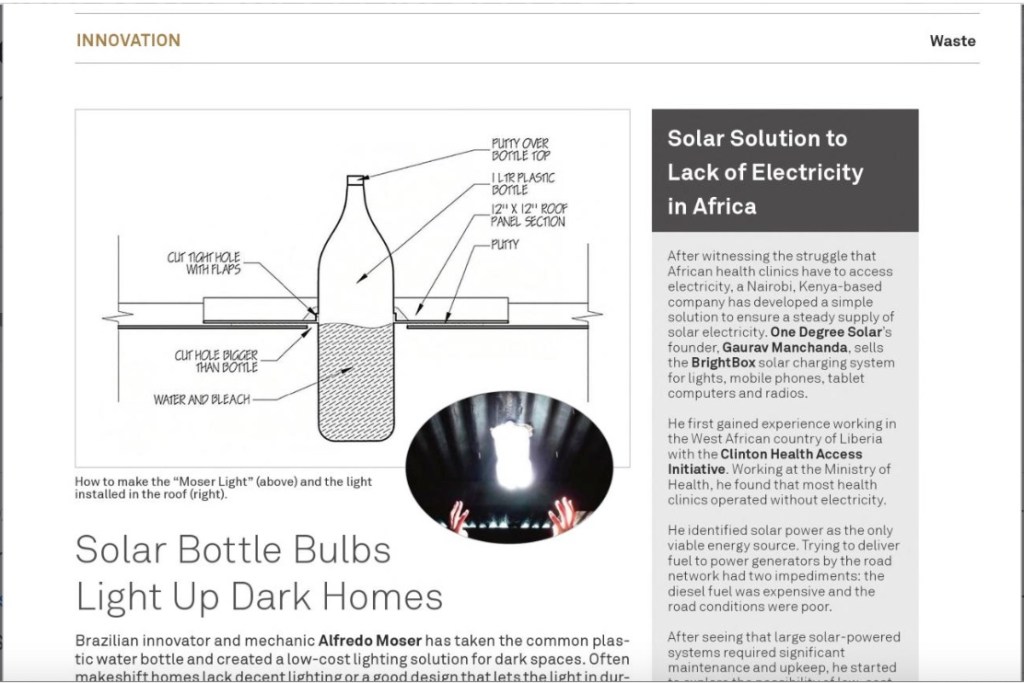
The “Moser Light” involves taking plastic bottles, which are usually just thrown away or recycled, and filling them with water and bleach to draw on a basic physical phenomenon: the refraction of sunlight when it passes through a water-based medium.
It is a simple idea: Holes are drilled in the ceiling of a room and the bottles placed in the holes. The liquid-filled bottle amplifies the existing sunlight (or even moonlight) and projects it into the dark room. This turns the plastic bottle into a very bright lightbulb that does not require any electricity.
Moser uses a solution of two capfuls of bleach added to the water to prevent anything growing in the water such as algae because of the exposure to sunlight.
“The cleaner the bottle, the better,” he said.
Polyester resin is used to seal the hole around the plastic bottle and make it watertight from rain.
Moser claims his bottle innovation can produce between 40 and 60 watts of light.
Moser uses recycled plastic bottles, so the carbon footprint is minimal compared to the manufacture of one incandescent bulb, which takes 0.45 kilograms of CO2 (UN). Running a 50 Watt incandescent light bulb for 14 hours a day for a year, around the same light as produced by the bottle bulb, produces a carbon footprint of nearly 200 kilograms of CO2.
“There was one man who installed the lights and within a month he had saved enough to pay for the essential things for his child, who was about to be born. Can you imagine?” Moser told the BBC.
The plan is to try and get as many as a million homes fitted with the lighting system by the end of 2013.
In many poor areas, it is common to live in makeshift or rudimentary dwellings. These are often built to crude designs and, in order to keep costs down and boost security, will have few or no windows. These dwellings will consequently be very dark inside, even on the brightest days. This leaves people having to turn to a source of artificial light if they want to do something indoors like read or work. And this costs money. Be it electricity from a mains, or battery-powered lamps or gas-powered lanterns, the cost will eat into a person’s tight income. This is where Moser’s simple solution saves the day and saves pennies: it is free light once the bottle lamp system is installed.
Placing the bottle lights in the ceiling transforms the ceiling into something akin to the night sky, with many points of light shining down into the room like stars. It also means the occupant of the room does not just have to strain to see with the use of a single light but now has many lights illuminating the room from all angles.
“It’s a divine light,” Moser told the BBC World Service. “God gave the sun to everyone, and light is for everyone. Whoever wants it saves money. You can’t get an electric shock from it, and it doesn’t cost a penny.”
It has not been a road to riches for Moser. He has made some money installing the system in a local supermarket and nearby homes, and he has inspired a charity to install the lighting system and to train people to do the installation and make an income from it.
The MyShelter Foundation in the Philippines was inspired by Moser’s invention and has installed the system in some 140,000 homes there, the BBC reported.
“We want him to know that there are a great number of people who admire what he is doing,” MyShelter Executive Director Illac Angelo Diaz said of Moser.
Using bottle bulbs instead of electricity or generators means families can save US $6 per month, according to Diaz (CNN). The Philippines is reported to have the most expensive electricity in Asia and slum homes usually do not have electricity.
It is estimated 15 other countries also have homes using the Moser system. The MyShelter Foundation believes 1 million homes worldwide have used the Moser system as of 2013.
Liter of Light (http://aliteroflight.org), run by the MyShelter Foundation, offers instructions on how to install the lighting system on its website.
Published: September 2013
Resources
1) D-Lab: MIT: Development through Dialogue, Design and Dissemination: D-Lab is building a global network of innovators to design and disseminate technologies that meaningfully improve the lives of people living in poverty. The program’s mission is pursued through interdisciplinary courses, technology development, and community initiatives, all of which emphasize experiential learning, real-world projects, community-led development, and scalability. Website: http://d-lab.mit.edu/
2) d.light Solar: d.light is a for-profit social enterprise whose purpose is to create new freedoms for customers without access to reliable power so they can enjoy a brighter future. d.light design manufacture and distribute solar light and power products throughout the developing world. Website: http://www.dlightdesign.com/
3) Liter of Light: It brings the eco-friendly bottle light to communities living without electricity. Website: http://aliteroflight.org
4) Solar Sister: Solar Sister eradicates energy poverty by empowering women with economic opportunity. They combine the breakthrough potential of solar technology with a deliberately woman-centered direct sales network to bring light, hope and opportunity to even the most remote communities in rural Africa. Website: http://www.solarsister.org/
As the population around the world’s cities grows, and slums grow larger and more prevalent, the urgent need for affordable and decent housing becomes more pressing. The world’s megacities – like Buenos Aires, Argentina, where more than 13 million live in the metropolitan region – have to find a way to provide housing that is both cheap and does the minimum possible amount of harm to the environment.
About one-third of the world’s urban dwellers live in slums, and the United Nations estimates that the number of people living in such conditions will double by 2030 as a result of rapid urbanization in developing countries. Latin America is already the most urbanized region in the developing world.
“Throughout Latin America you have economies that are growing and doing well, but the way the economies are growing is actually generating more shanty towns,” said Erik Vittrup, senior adviser on Latin America and the Caribbean for the U.N. Human Settlements Program. “It’s a growth that is just generating wealth for those who (already) have it.”
How well people dwell is integral to their mental and physical health. Most squatters and slum dwellers live in makeshift homes made from whatever they can get their hands on. These dwellings are usually unsafe and vulnerable to fire, floods, and earthquakes.
But across the South, initiatives are proving it is possible to build good quality homes for the poor while avoiding burdening them with debt. Pioneering ways are being developed for the poor to build their own high-quality houses using recycled materials and environmentally friendly products.
In Colombia , Alejandro Salazar, a chemical engineer, professor at the Universidad del Valle (http://www.univalle.edu.co/english/) and innovator running several companies pioneering new building technologies using recycled waste, is building high-quality, inexpensive houses for the poor. By combining free building materials recovered from waste, a government grant and the voluntary labour of the homeowners, Salazar’s company is able to build homes for the poor that don’t leave them with ongoing bank debt from mortgages.
Based in Cali, Colombia (http://gosouthamerica.about.com/od/cali/p/Cali.htm), his companies Ecoingenieria (product and material research and development), Ecomat SA (production of eco-materials using industrial waste and construction rubble), Constructora Paez, (social housing construction using eco-products) and Wassh SA (environmental management and transformation of dangerous solid waste into non-dangerous materials), are focused on pioneering new technologies for housing.
“Our company uses two basic technologies,” said Salazar. “The production of eco-materials from solid waste and demolition waste, and the implementation of an agile building system, which does not require skilled labour and is hand-transportable. All the pieces are produced in a prefabrication plant that uses the eco-materials.”
Salazar has found a way to provide homes quicker than existing NGOs – Popular Housing Organizations (OPV), as they are called – established to address homelessness in Colombia. The homeless poor are caught in a Catch-22: they need to have a formal job to receive homebuilding assistance from the government, and they usually can not save up enough money for a down payment on the home.
Salazar’s solution is to take the maximum grant given by the central government, which is US $4,730, and combine it with the recycled building materials and homeowners’ own labour. He says this allows a house to be built for roughly half the price of a similarly sized one that uses conventional materials: the eco-materials house costs around US $ 6,590, compared to US $12,000 using conventional materials. Land is often either donated by the municipality or the family already owns it. And in Salazar’s experience, the whole family chips in with the building: husbands, sons, brothers, fathers, wives.
The training takes just three days on eco-materials and a day in construction techniques for house building.
“To date, we have built with this method 306 houses,” said Salazar. “For the coming year, we expect to deliver around 500 houses or more. To build a house, after acquiring the land, we need three people working eight hours a day to build it in four weeks – all under the supervision of a workforce teacher and the supervision of an engineer or architect.
“The houses are designed by architects with the participation of the community or families. They do some workshops and the design conforms to their vision and expectation. In Colombia, there is an earthquake resistance code which is binding in law and provides detailed specifications of the materials, foundations, structure and roof.”
The pre-fabricated building materials are made from recovered waste from a wide variety of sources: ceramic red brick, coarse ash and fly ash, slag from steel, copper slag, porcelain insulators used for electrical power lines, nickel slag, sludge from sugar and alcohol plants and water treatment plants.
“The raw materials we use are industrial solid waste and demolition waste. It costs the industry a lot to throw away this waste,” Salazar said.
He said the biggest obstacle to the new homes is psychological: many people initially “tend to reject at first-hand the technology.”
“When visiting the factory and then visiting the homes – or model homes – they then compare it with a traditional house, and realize that the best eco-homes when finished meet the standards of Colombian earthquake resistance and are also cheaper,” he said.
Compared to using conventional building materials, the eco-materials reduce the cost of a new home. And the company still makes a profit from it!
In Paraguay, Elsa Zaldivaris using recycled plastic, cotton netting, corn husks, and loofah sponges (http://en.wikipedia.org/wiki/Luffa) to make cheap, lightweight construction panels for housing. This has a double benefit: it makes for cheap housing and it is good for the environment.
“That’s very important in Paraguay,” said Zaldivar, “because we’ve already reduced our original forest to less than 10 percent of the national territory.”
Zaldivar got her experience working with people in the impoverished area of Caaguazú, where in the past she helped with the building of toilets and making stoves. She found that involving local people in this work made a huge difference: “They told me: ‘Now we feel like we’re people with dignity.’”
She encourages local women to grow loofah – a plant that once flourished but was being ignored. While the fruit is edible she was more interested in the crusty sponge that is left over when the plant is dried. The women started a cooperative selling loofah sponges, mats and slippers. But there was a lot of waste in the process, with a third not suitable for export. She then came up with the idea to use the loofahs for wall and roof panels for cheap housing.
Along with industrial engineer Pedro Padros, she developed a way to combine loofah with plastic waste. Padros invented a machine to melt the recycled plastic and mix the molten plastic with loofah, vegetable fibres and chopped corn husks. It has produced a building panel that is lighter and easier to move around than lumber or brick. With a grant from the Inter-American Development Bank, design improvements have been made and the cost-per-panel brought down from US $6 per square meter. It is now competitive with the cost of wood panels. The great thing about the panels is that they can be recycled again when they wear out, completing the cycle.
“To have a decent home liberates people,” said Zaldivar.
Published: January 2009
Resources
Cradle to Cradle: Remaking the Way We Make Things: This radical concept is about how products, can be used, recycled, and used again without losing any material quality—in cradle to cradle cycles. Website:http://www.mcdonough.com/cradle_to_cradle.htm
Builders Without Borders: Is an international network of ecological builders who advocate the use of straw, earth and other local, affordable materials in construction. Website:http://builderswithoutborders.org/
World Hands Project: An NGO specialising in simple building techniques for the poor. Website:www.worldhandsproject.org
CIDEM and Ecosur specialise in building low-cost community housing using eco-materials. They have projects around the world and are based in Cuba. Website:http://www.ecosur.org
I was head of communications for the United Nations mission in Mongolia from 1997 to 1999. The mission had to primarily tackle three major crises: the country’s turbulent transition from Communism to free markets and democracy, the social and economic crash this caused, and the Asian Financial Crisis (Pomfret 2000) (Quah 2003)*.
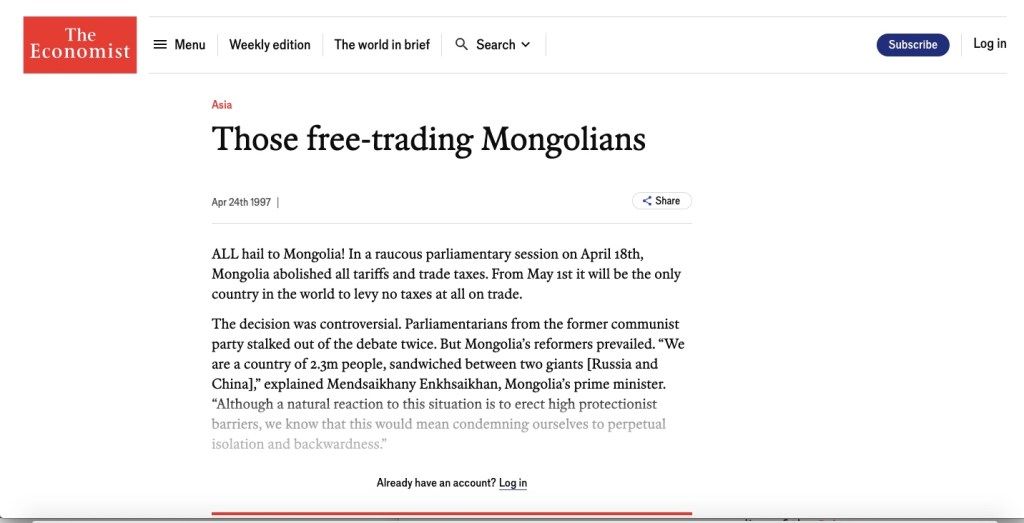
The Economist: “Those free-trading Mongolians” was published Apr 24th 1997. I arrived in May of 1997 to find a country on the cusp of great and turbulent change.
Richard Pomfret said in 1994 “In 1991 Mongolia suffered one of the biggest peacetime economic collapses ever (Mongolia’s Economic Reforms: Background, Content and Prospects, Richard Pomfret, University of Adelaide, 1994).”
From Curbing Corruption in Asia: A Comparative Study of Six Countries by Jon S. T. Quah: “The combined effect of these three shocks was devastating as ‘Mongolia suffered the most serious peacetime economic collapse any nation has faced during this century’. Indeed, Mongolia’s economic collapse ‘was possibly the greatest of all the (peaceful) formerly’” Communist countries.
Writing in 2018, author John West found, in a chapter titled Mongolia’s Corruption Curse (Transparency International and the World Bank had found corruption worsened in Mongolia after 2001), “In many ways, Mongolia has everything going for it. After being a satellite state of the former Soviet Union for much of the twentieth century, Mongolia regained its independence with the end of the Cold War. A relatively peaceful political revolution in the early 1990s ushered in a multi-party democracy and open society which have remained in place. … And it is blessed with vast reserves of copper, gold, coal, molybdenum, fluorspar, uranium, tin and tungsten deposits. True, Mongolia experienced great upheavals as the breakup of the Soviet Union saw its trade decline by 80%. But Mongolia was also perfectly placed to benefit from the commodity super cycle driven by China, which is now the destination for the vast majority of its exports.
“However, despite much hype about the Mongolian “wolf economy”, this country of so much promise is being dragged down by massive corruption. …
In this role, I pioneered innovative use of the Internet and digital resources to communicate the UN’s work and Mongolia’s unfolding crises. The UN called this work a “role model” for the wider UN and country offices. A survey of United Nations country office websites in 2000 ranked the UN Mongolia website I launched in 1997 and oversaw for two years (1997-1999), third best in the world, saying: “A UN System site. A very nice, complete, professional site. Lots of information, easily accessible and well laid out. The information is comprehensive and up-to-date. This is a model of what a UNDP CO web site should be.” (https://www.scribd.com/document/35249986/United-Nations-2000-Survey-of-Country-Office-Websites)
As part of a strategic plan to raise awareness of Mongolia’s development challenges and to spur action on meeting them, a Communications Office was established for the UN mission in 1997. Acting as a strategic hub, the Communications Office and its dynamic and talented team, were able to leverage the existing budget to spur action on many fronts, including:
Media
Working with journalists and media both within Mongolia and outside – including organising frequent cross-country media tours – the Communications Office was able to significantly raise awareness of Mongolia and its development challenges. This was reflected in a substantial increase in media coverage of the country and in the numerous books and other publications that emerged post-1997. The book In Their Own Words: Selected Writings by Journalists on Mongolia, 1997-1999 (ISBN 99929-5-043-9) archived the stories by theme.
Top journalists covering Asia in the late 1990s contributed to the book. The BBC’s Charu Shahane joined other journalists on a UNDP Mongolia media tour in 1998.
Ger Magazine
Ger Magazine (the Mongolian word for home and traditional tent dwelling) was published as the country’s first e-magazine in 1998. There were four issues in total from 1998 to 2000. The launch issue was on the theme of youth in the transition. Mongolia was transitioning from Communism to free markets and democracy and this had been both an exhilarating time and a wrenching time for young people. The magazine drew on talented journalists from Mongolia and the handful of international journalists based there to create a mix of content, from stories about life adapting to free markets to stories on various aspects of Mongolian culture and life.
The second issue of the magazine proved particularly effective, with its modern life theme and cover story on a thriving Mongolian fashion scene.
Archived issues of the magazine can be found at the Wayback Machine here: https://archive.org/. Just type in the UN Mongolia website address for the years 1997 to 1999: http://www.un-mongolia.mn.
Blue Sky Bulletin
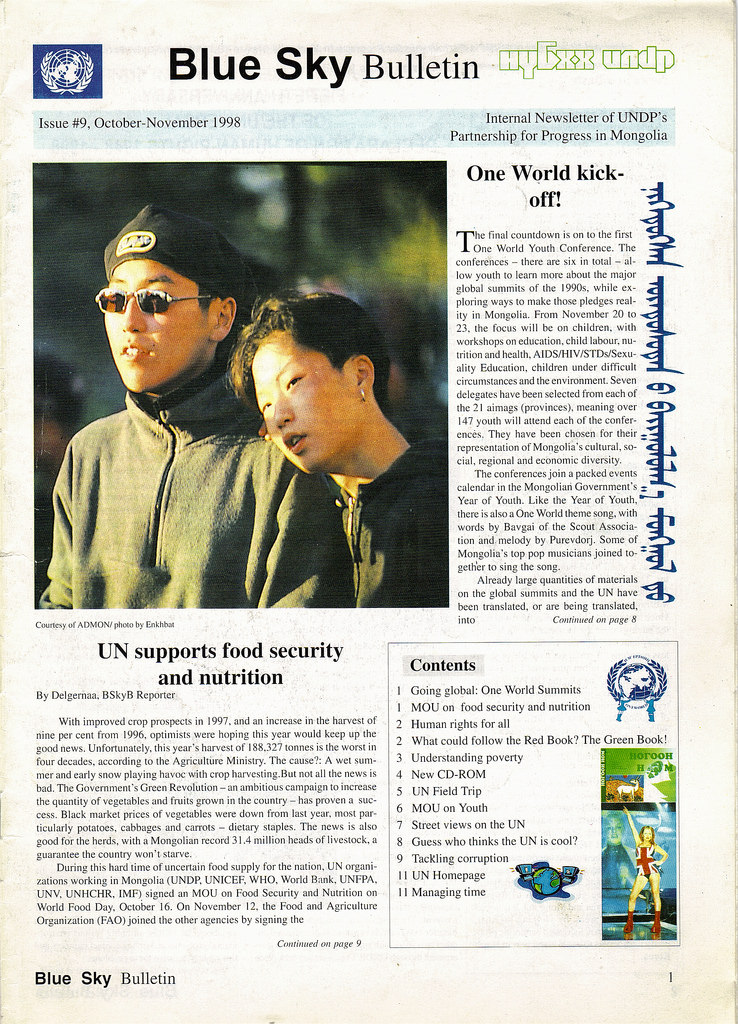
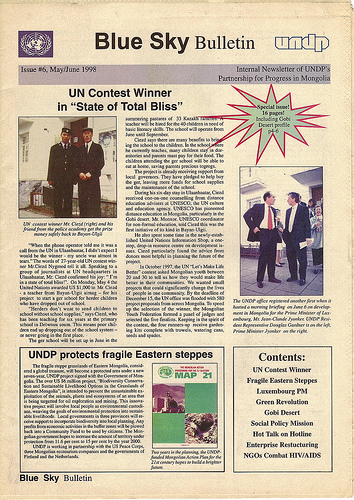
The Blue Sky Bulletin newsletter was launched in 1997 initially as a simple, photocopied handout. It quickly founds its purpose and its audience, becoming a key way to communicate what was happening in the country and a crucial resource for the global development community, scholars, the media and anyone trying to figure out what was happening in a crazy and chaotic time. Blue Sky Bulletin was distributed via email and by post and proved to be a popular and oft-cited resource on the country. The quality of its production also paralleled Mongolia’s growing capacity to publish to international standards, as desktop publishing software became available and printers switched to modern print technologies. Blue Sky Bulletin evolved from a rough, newsprint black and white publication to becoming a glossy, full-colour, bilingual newsletter distributed around Mongolia and the world.
The Mongolian Human Development Report 1997 (MHDR), the country’s first, placed the story of the Mongolian people during the transition years (post-1989) at its heart, using photographs, stories and case studies to detail the bigger narrative at play.
This groundbreaking Mongolian Human Development Report went beyond just chronicling Mongolia’s state of development in statistics and graphs. Designed, laid out and published in Mongolia, the report broke with the practices of many other international organisations, who would publish outside of Mongolia – denying local companies much-needed work and the opportunity to develop their skills. The report’s costs helped to kick-start a publishing boom in the country and significantly raised standards in design and layout in the country. The foundations laid down by the project producing the report ushered in a new age in publishing for Mongolia.
The report’s launch was innovative, not only being distributed for free across the country, but also part of a multimedia campaign including television programming, public posters, town hall meetings and a ‘roadshow’ featuring the report’s researchers and writers.
The initial print run of 10,000 copies was doubled as demand for the report increased. To the surprise of many, once hearing about the free report, herders would travel to the capital, Ulaanbaatar, to pick up their copy. The report proved people cared passionately about the development of their country and that development concepts are not to be the secret domain of ‘development practitioners’. The report also became an English language learning tool as readers compared the Mongolian and English-language versions.
Assembled by a team of health experts after the Fourth International Congress on AIDS in Asia and the Pacific, the Mongolian AIDS Bulletin was published in 1997 in the middle of an HIV/AIDS crisis. It provided timely information and health resources in the Mongolian language and was distributed across the country.
“Mongolia’s first AIDS Bulletin marked the beginning of the UNDP Response to HIV/AIDS/STDs Project back in the autumn of 1997. Over 5,000 copies of the magazine were distributed across the country, offering accurate information on the HIV/AIDS situation. The project has been pivotal in the formulation of a national information, education and communication (IEC) strategy, bringing together NGOs, donors, UN agencies and the government.”
Source: YouandAids: The HIV/AIDS Portal for Asia Pacific
Green Book
In the Mongolian language, the Mongolian Green Book details effective ways to live in harmony with the environment while achieving development goals. Based on three years’ work in Mongolia – a Northeast Asian nation coping with desertification, mining, and climate change – the book presents tested strategies.
EPAP Handbook
The Environmental Public Awareness Handbook was published in 1999 and features the case studies and lessons learned by UNDP’s Mongolian Environmental Public Awareness Programme (EPAP). The handbook draws on the close to 100 small environmental projects the Programme oversaw during a two-year period. These projects stretched across Mongolia, and operated in a time of great upheaval and social, economic and environmental distress. The handbook is intended for training purposes and the practice of public participation in environmental protection.
In its 2007 Needs Assessment, the Government of Mongolia found the EPAP projects “had a wide impact on limiting many environmental problems. Successful projects such as the Dutch/UNDP funded Environmental Awareness Project (EPAP), which was actually a multitude of small pilot projects (most costing less than $5,000 each) which taught local populations easily and efficiently different ways of living and working that are low-impact on the environment.”
Mongolia Updates 1997, 1998, 1999
Mongolia Update 1998 detailed how the country was coping with its hyperinflation and the Asian economic crisis.
1998 proved a tumultuous year for Mongolia. The country’s existing economic crisis caused by the transition from Communism to free markets was made worse by the wider Asian Crisis. The government was destabilised, leading to an often-confusing revolving door of political figures. In order to help readers better understand the political changes in the country, a special edition of Mongolia Update was published that year.
UNDP Mongolia: The Guide
The Guide, first published in 1997, provided a rolling update on UNDP’s programmes and projects in Mongolia during a turbulent time (1997-1999). The mission simultaneously had to deal with the 1997 Asian Crisis (http://en.wikipedia.org/wiki/1997_Asian_financial_crisis) and the worst peacetime economic collapse in post-WWII history.
Each edition came with short project and context summaries, key staff contacts, and facts and figures on how the country was changing. For the first time, any member of the public could grasp what the UN was up to in the country and be able to contact the project staff. An unusual level of transparency at the time for a UN mission.
Memoranda of Understanding
Three Memoranda of Understanding were negotiated with the Mongolian Government to help focus efforts and aid the attainment of internationally-agreed resolutions. This was affirmed by a series of youth conferences, One World, held in 1998 and 1999.
Strategy and Leadership in a Crisis
The scale and gravity of the crisis that struck Mongolia in the early 1990s was only slowly shaken off by the late 1990s. The economic and social crisis brought on by the collapse of Communism and the ending of subsidies and supports from the Soviet Union, led to a sharp rise in job losses, poverty, hunger, and family and community breakdowns.
The challenge was to find inspiring ways out of the crisis, while building confidence and hope. The sort of challenges confronted by the UNDP Mongolia Communications Office included:
1) A food crisis: agricultural production was down sharply, and the traditional nomadic herding economy, while at peak herd, was failing to get the meat to markets and to a high enough standard to restore export levels to where they once were. As a result, a cross-border trading frenzy became the solution to falling domestic food production and availability.
2) HIV/AIDS/STDs crisis
3) A major banking crisis
4) Both the Asian Financial Crisis and the Russia Crisis.
5) An ongoing political crisis and an inability to form stable governments.
“Mongolia is not an easy country to live in and David [South] showed a keen ability to adapt in difficult circumstances. He was sensitive to the local habits and cultures and was highly respected by his Mongolian colleagues. … David’s journalism background served him well in his position as Director of the Communications Unit. … A major accomplishment … was the establishment of the UNDP web site. He had the artistic flare, solid writing talent and organizational skills that made this a success. … we greatly appreciated the talents and contributions of David South to the work of UNDP in Mongolia.” Douglas Gardner, UN Resident Coordinator and UNDP Resident Representative Mongolia
The response by the Communications Office has been cited in numerous articles, stories, publications and books. It has also contributed to the development of the human development concept and understanding of human resilience in a crisis and innovation in a crisis. Book citations include:
In 2001, the UN won the Nobel Peace Prize for “their work for a better organized and more peaceful world” and its communications innovations, with work such as that in Mongolia being cited as a contributing factor to the awarding of the Prize.
In 2000, the Millennium Development Goals (MDGs) were launched in a 15-year bid to use a focused approach to development centred around eight goals to accelerate improvements to human development. From 2000 to 2005, work was undertaken in various UN missions (Mongolia, South Africa, Turkmenistan, Ukraine) to communicate the goals and to reshape communications activities around the goals.
*Curbing Corruption in Asia: A Comparative Study of Six Countries by Jon S. T. Quah, Eastern Universities Press, 2003














You must be logged in to post a comment.