Tag: David South Consulting

  • Iranian Savings Funds to Tackle Loan Drought

    Iranian Savings Funds to Tackle Loan Drought

    By David SouthDevelopment Challenges, South-South Solutions

    SOUTH-SOUTH CASE STUDY

    For entrepreneurs around the world, acquiring finance to start or expand a small business has become harder and harder as the global financial crisis has bitten hard. Across the globe, people with good ideas or successful businesses that need funds to expand are finding the door closed by traditional banks.

    As banks and governments have focused on reducing debt and building up cash reserves, it is small businesses and small-scale entrepreneurs – often without business or family connections – who suffer the most. Opportunities are being missed to create new jobs and enterprises and lift poor communities out of poverty.

    In that climate, the search is on for alternative ways to build up wealth. In Iran, a new phenomenon has arisen to address the lack of bank loans for small businesses brought about by the economic crisis. Iran is suffering under international sanctions as well as outstanding bank loans exceeding US $45 billion, according to the Financial Times.

    The domestic banking crisis this has provoked has resulted in a tightening of credit for loans.

    But in response, middle class Iranians are forming their own savings clubs to help each other with loans.

    The savings clubs work like this: each member buys a share in the club costing around US $2 per day (around US $620 over 10 months). Each share makes the saver eligible for one loan during the year. For example in a club of 30 Tehran taxi drivers, every month four members of the club receive US $600 each in loans. The fund lasts 10 months and each member is guaranteed one loan per share.

    “It is a savings fund and doesn’t have the uncertainty of the banking system, which might or might not give you a loan,” club member Ahmad told the Financial Times newspaper. As one of the drivers, he has four shares and is eligible for four loans.

    “My mother is also saving money in a fund of housewives among our female relatives.”

    The fund is managed by the head of the taxi agency and a driver who is a retired teacher. Both are trusted. “The retired teacher receives the money every day and puts a check mark by the names of those who pay. He is trusted by the head of the taxi agency, while other drivers respect him as an educated, honest man.”

    Savings clubs are also good for the local economy, helping people to be able to buy goods on loans they would never be able to purchase otherwise. Another driver used the fund to “buy the things we cannot afford under normal conditions, like a washing machine, for instance, for which we have zero chance to get bank loans.”

    Overdue loans by Iran’s banks grew by 66 percent from last year according to Asghar Abolhassani, the deputy economy minister.

    The Financial Times reported that an estimated 25 percent of bank loans are outstanding, making Iran’s banking system technically bankrupt. International sanctions are also blocking the country’s banks from accessing global financial markets for support.

    “Stagnation has gripped many parts of the economy,” said Hamid Tehranfar, the central bank’s director-general for banking supervision.

    Turning to savings clubs can be an excellent alternative saving and loans model, but it requires very specific trust guarantees in place to ensure the holder of the funds doesn’t just take the money. For those who can’t find somebody local they trust, there are a number of online social lending and fundraising alternatives for raising funds and borrowing money. These include Kiva (www.kiva.org), which connects poor people looking for loans with people around the world willing to lend.

    As the crisis continues and banks and governments hoard wealth for their own needs to pay down debt, alternative sources of loans will become ever more important for the poor.

    Published: April 2010

    Resources

    1) Zopa: “Where people meet to lend and borrow money.” Website: www.zopa.com

    2) Kiva: Kiva’s mission is to connect people, through lending, for the sake of alleviating poverty. Website: www.kiva.org

    3) Betterplace: Started in 2007, Betterplace is an online marketplace for projects to raise funds. It is free, and it passes on 100 percent of the money raised on the platform to the projects. Website: www.betterplace.org

    4) Kickstarter: Kickstarter is a funding platform for artists, designers, filmmakers, musicians, journalists, inventors, and explorers. Website: http://www.kickstarter.com/

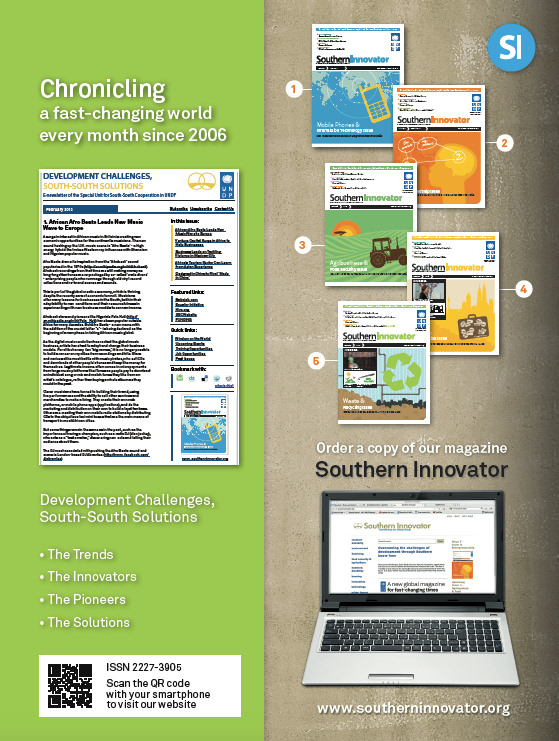
    Development Challenges, South-South Solutions was launched as an e-newsletter in 2006 by UNDP’s South-South Cooperation Unit (now the United Nations Office for South-South Cooperation) based in New York, USA. It led on profiling the rise of the global South as an economic powerhouse and was one of the first regular publications to champion the global South’s innovators, entrepreneurs, and pioneers. It tracked the key trends that are now so profoundly reshaping how development is seen and done. This includes the rapid take-up of mobile phones and information technology in the global South (as profiled in the first issue of magazine Southern Innovator), the move to becoming a majority urban world, a growing global innovator culture, and the plethora of solutions being developed in the global South to tackle its problems and improve living conditions and boost human development. The success of the e-newsletter led to the launch of the magazine Southern Innovator. 

    Creative Commons License

    This work is licensed under a
    Creative Commons Attribution-Noncommercial-No Derivative Works 3.0 License.

    ORCID iD: https://orcid.org/0000-0001-5311-1052.

    © David South Consulting 2023

  • Floating Bank Floats New Dreams for Brazilian Middle Class

    Floating Bank Floats New Dreams for Brazilian Middle Class

    By David SouthDevelopment Challenges, South-South Solutions

    SOUTH-SOUTH CASE STUDY

    Brazil’s booming economy has seen a dramatic increase in the size of its middle class. More and more people have been lifted out of poverty as a growing, stable economy overcomes years of political and economic instability. In 2010, Brazil’s economy grew by a record 7.5 percent, surpassing a previous peak in 1986 (Brazilian Institute of Geography and Statistics) (IBGE) (www.ibge.gov.br/english). The country’s gross domestic product (GDP) reached 3.67 trillion reais (US $2.21 trillion) in 2010, making it Latin America’s largest economy.

    This strong growth is being fuelled by growing domestic demand in Brazil.

    One key component in building personal wealth is the ability to save and bank. It is common across the global South for the poor and lower middle classes to be ignored by traditional banking services.

    Freezing large numbers of people out of banking services is a double problem. Individuals are being denied a safe way to store and grow wealth and borrow to improve their economic situation, and the wider economy suffers because many millions are left out of the mainstream economy and can neither consume high-value products nor use services beyond those that meet the basic needs of daily survival.

    This leaves many economies experiencing what can be described as a whirlpool effect: wealth spiralling around small clusters of people – for example those with privileged access to natural resources – but failing to spread across the whole of society. This has the effect of discounting the contribution made by the majority of a nation’s people. That majority is a market that needs tending to, not ignoring, as pioneers like the late C.K. Prahalad (http://en.wikipedia.org/wiki/C._K._Prahalad) have shown.

    In Brazil, one major bank has woken up to this fact and is pioneering services for millions of the nation’s “unbanked” (http://en.wikipedia.org/wiki/Unbanked). Even wealthy countries like the United States have large numbers of unbanked people, often those living paycheck to paycheck and with little or no savings. In the US in 2009, 7.7 percent of the population fell into this category (Federal Deposit Insurance Corporation) (FDIC).

    Banco Bradesco SA (www.bradesco.com.br) has pioneered reaching the poor and marginalised by opening branches in long-neglected places like the impoverished and crime-ridden shanty town favelas (http://en.wikipedia.org/wiki/Favela) that surround major cities like Rio de Janeiro and Sao Paulo. It is creating a path other businesses can follow.

    “Every bank will care about these people eventually,” Odair Rebelato, the executive heading Bradesco’s retail banking outreach programme, told The Wall Street Journal.

    According to FEBRABAN (http://www.febraban.org.br), the Brazilian Banking Federation, the number of bank accounts in the country has tripled in the past decade. It has surged from 42 million in 1997, to 126 million by the end of 2008. That still leaves around 50 million Brazilians who do not have bank accounts.

    It’s not just poverty that cuts many Brazilians off from banking services – there is also the problem of isolation.

    Brazil is home to the largest portion of the vast Amazon rainforest (http://en.wikipedia.org/wiki/Amazon_Rainforest), whose population is spread out in isolated villages reachable only by boat. The capital of Amazonas state, Manaus, is the economic hub of the region but transport links only connect it to major cities and not the region’s many isolated villages.

    A solution to both problems comes in the form of Bradesco bank’s Voyager III, a three-deck riverboat converted into a floating bank. Launched in November 2010, the white-and-blue 38 metre riverboat ventures up the Solimões River on a journey to 50 isolated communities in 11 municipalities.

    “It was something never seen before in the world – a floating branch,” Nézio Vieira, a Bradesco bank manager in São Paulo, told Monocle magazine. “We are now present in 100 per cent of Brazil’s municipalities.”

    Luzia Moraes is a former housewife and now the manager of the Voyager III’s floating bank. The bank offers savings and checking accounts, personal loans and direct deposits. Most of the customers are public servants, pensioners and the poor.

    It is a simple operation: a red banner is hung in a cramped former storeroom on the boat. Sitting behind a desk, Moraes has just three tools to offer the full banking services: a laptop computer, a printer and an automated teller machine.

    Enterprising and adventures, Moraes even uses canoes and rafts to reach out from the riverboat to even remoter villages.

    “Before, there were cases where people would take 10 to 12 hours by boat to get to a bank. It wasn’t worth it,” Vieira said. “To be able to serve these river-dwellers you need to go to them. Today the Voyager goes there.”

    The Voyager III has signed up more than 1,000 new account holders by touring the river. It heads off every two weeks from Manaus, reaching as far as a remote town on the border with Colombia and Peru, Tabatinga.

    The boat’s computers communicate with a satellite, allowing 24-hour access to the bank’s servers so people can access accounts and apply for loans.

    A regional lifeblood, the Voyager III also carries 500 tons of beans, chicken, bleach and other goods to sell on the 1,609 kilometre river journey. The boat can carry around 200 passengers for the trip.

    “People don’t know what to think,” Moraes told The Wall Street Journal, “but it’s not hard to explain that a bank can make things easier.”

    Published: May 2011

    Resources

    1) Kenya’s Equity Bank: By offering Kenya’s poor people savings accounts and microloans, Equity Bank has captured 50 percent of the Kenyan bank market. Website: http://www.equitybank.co.ke

    2) Safaricom M-PESA: Mobile phone banking in Kenya is proving highly successful. Customers can deposit, transfer and withdraw money using their mobile phones. Website: http://www.safaricom.co.ke/index.php?id=123

    https://davidsouthconsulting.org/2022/10/21/african-media-changing-to-reach-growing-middle-class/

    https://davidsouthconsulting.org/2021/08/29/brazilian-design-for-new-urban-middle-class-world/

    https://davidsouthconsulting.org/2022/10/20/global-souths-middle-class-is-increasing-prosperity/

    https://davidsouthconsulting.org/2022/11/15/indonesian-middle-class-recycle-wealth-back-into-domestic-economy/

    Development Challenges, South-South Solutions was launched as an e-newsletter in 2006 by UNDP’s South-South Cooperation Unit (now the United Nations Office for South-South Cooperation) based in New York, USA. It led on profiling the rise of the global South as an economic powerhouse and was one of the first regular publications to champion the global South’s innovators, entrepreneurs, and pioneers. It tracked the key trends that are now so profoundly reshaping how development is seen and done. This includes the rapid take-up of mobile phones and information technology in the global South (as profiled in the first issue of magazine Southern Innovator), the move to becoming a majority urban world, a growing global innovator culture, and the plethora of solutions being developed in the global South to tackle its problems and improve living conditions and boost human development. The success of the e-newsletter led to the launch of the magazine Southern Innovator. 

    https://davidsouthconsulting.org/2021/03/05/southern-innovator-issue-2/

    Creative Commons License

    This work is licensed under a
    Creative Commons Attribution-Noncommercial-No Derivative Works 3.0 License.

    ORCID iD: https://orcid.org/0000-0001-5311-1052.

    © David South Consulting 2023

  • Business Leads on Tackling Violence in Mexican City

    Business Leads on Tackling Violence in Mexican City

    By David SouthDevelopment Challenges, South-South Solutions

    SOUTH-SOUTH CASE STUDY

    The damaging affects of crime and violence can ruin a city. They act as a drag on efforts to increase wealth and improve living conditions, and a city that gets a bad reputation, especially in the age of the Internet, will lose investment opportunities.

    The North American nation of Mexico has been struggling against drug and gang-related violence that has left an estimated 47,000 people dead over the past five years. It is a casualty rate worthy of a war.

    In Monterrey, the capital of Nuevo Leon state (http://en.wikipedia.org/wiki/Nuevo_Le%C3%B3n), an innovative initiative has brought together local businesses to tackle the root causes of violence and crime. The initiative – called Red SumaRSE, which means ‘joining a network’ – was born from anger and disgust at the situation in the city. And it was ignited by a prominent member of the business community expressing this frustration on the social media outlet Twitter (twitter.com).

    The chief executive of the Cemex cement company had had enough one day. Lorenzo Zambrano tweeted a blunt message to other companies in the city: “He who leaves Monterrey is a coward.” It was to be a rallying cry for the campaign to take back the city from the violent gangs.

    Monterrey is embroiled in violent drug-related gang crime. Just one incident shows how bad the situation had become. In August 2011 members of the Zetas drug gang torched a casino over a dispute over non-payment of extortion money, killing 52 people.

    Law enforcement measures can often only go so far to curb violence in a community. Little impact can be made without addressing the underlying economic causes of much of the violence – poor employment opportunities, drug turf wars between rival gangs, economic instability and more.

    “Violence is an expression of social inequality,” Zambrano told The New York Times.

    Tragedies like the casino fire provoked the city’s business community to take action. Private companies in the city have stepped up to design and fund a recruitment campaign for the police force and are paying part of the cost for government-backed community redevelopment plans.

    Corporate philanthropy in Mexico has a history of being very limited. Apart from distribution of gifts at holiday time,there was little else. But this is changing, with Red SumaRSE showing the way.

    “In the last five or 10 years there has been progress both in terms of the quantity of the money and the quality,” Michael Layton, director of the Philanthropy and Civil Society Project at the Autonomous Technological Institute of Mexico, told The New York Times. “But I don’t think Mexico has caught up to Brazil and other countries where the business sector has taken corporate philanthropy to heart.”

    The Red SumaRSE alliance of Monterrey’s companies is directing support to non-governmental organizations working on community development. Examples include telephone company Axtel and the tortilla maker Gruma (gruma.com/vEsp) taking charge of 20 other companies to invest in schools, building up infrastructure and reversing drop-out rates.

    The Oxxo company (oxxo.com/index.php), Mexico and Latin America’s largest chain store, has started to work at improving conditions in the neighbourhood immediately behind its headquarters. The company is working on building parks, increasing job opportunities and finding ways to prevent teenagers from joining gangs in the first place.

    Cemex has also opened a new community centre in a violent neighbourhood where shootings were a regular occurrence. It was based on some Latin American knowledge sharing: inspired by the case of the Colombian city of Medellin, where libraries were strategically located in violent slum areas.

    And there is more good work in the pipeline. The business community has drawn up a list of 70 neighbourhoods in the city needing re-development.

    Red SumaRSE has not been without its critics. They have attacked the focus on security, education and victims while ignoring corruption, which many believe is the source of many of the city’s problems.

    Published: February 2012

    Resources

    1) Medellin: Walking between slums and dreamworlds of neoliberalism: More on the complexities of the situation in this Colombian city.Website: http://www.a0n.com/medellin/dreamworlds.htm

    Development Challenges, South-South Solutions was launched as an e-newsletter in 2006 by UNDP’s South-South Cooperation Unit (now the United Nations Office for South-South Cooperation) based in New York, USA. It led on profiling the rise of the global South as an economic powerhouse and was one of the first regular publications to champion the global South’s innovators, entrepreneurs, and pioneers. It tracked the key trends that are now so profoundly reshaping how development is seen and done. This includes the rapid take-up of mobile phones and information technology in the global South (as profiled in the first issue of magazine Southern Innovator), the move to becoming a majority urban world, a growing global innovator culture, and the plethora of solutions being developed in the global South to tackle its problems and improve living conditions and boost human development. The success of the e-newsletter led to the launch of the magazine Southern Innovator. 

    Creative Commons License

    This work is licensed under a
    Creative Commons Attribution-Noncommercial-No Derivative Works 3.0 License.

    ORCID iD: https://orcid.org/0000-0001-5311-1052.

    © David South Consulting 2023
  • Latin American Food Renaissance Excites Diners

    Latin American Food Renaissance Excites Diners

    By David SouthDevelopment Challenges, South-South Solutions

    SOUTH-SOUTH CASE STUDY

    Food is essential for a good life and plays a critical part in overall human health and development. The better the quality of food available to the population, the better each individual’s overall health will be, and this will have a direct impact on mental and physical performance (http://www.sciencedirect.com/science/article/pii/S2213453012000055).

    An innovative restaurant can be the beginning of a taste and flavors renaissance as new foods are discovered and the recipes and foods are cross-marketed. It is an effective strategy that has worked around the world. The restaurant’s brand, in turn, becomes a valuable commodity that can be used to promote a range of products. For example, Brazil’s D.O.M. Restaurante has successfully used its strong reputation to help promote a range of food products drawn from the Amazon rainforest. There is money to be made in this and it can be a major boost to the incomes of food producers, especially small-scale farmers.

    As is being found across South America, a rediscovered love of local cuisines and indigenous culinary culture can also lead to profits and a growing global awareness of the continent’s varied foods and recipes.

    Innovators are playing with traditional cooking and locally available foods to come up with a modern Latin American cuisine that is getting people very excited.

    The latest country to benefit from this is Peru. The first Michelin star awarded to a Peruvian restaurant in Europe went to a restaurant in London, UK. The Michelin (http://travel.michelin.co.uk/michelin-guides-105-c.asp) star is awarded to a restaurant based on the quality of its food and its overall atmosphere and service.

    The London restaurant Lima (limalondon.com) is part of the global rise in awareness of Latin American food. It was launched by Venezuelan brothers Gabriel and Jose Luis Gonzalez in partnership with Peruvian chef Virgilio Martinez. Their signature dishes include sea bream ceviche (a lime-preserved raw fish dish) and suckling pig done in the “Andes” style.

    Martinez is also a chef consultant for the Central Restaurante (http://centralrestaurante.com.pe/es/) in Lima, Peru. It was named one of The World’s 50 Best Restaurants by S. Pellegrino (theworlds50best.com).

    Gabriel Gonzalez moved to London from Paris two years ago, and is surprised at how quickly he and his colleagues have made an impact.

    “It was definitely not expected. … It’s just incredible, it definitely sets a precedent for Peruvian food and gives it a stamp of credibility and a lot of promise, it’s just amazing,” he told the London Evening Standard.

    As another mark of the rising profile of Latin American food, the first edition of Latin America’s 50 Best Restaurants was held in Lima in September 2013 (theworlds50best.com/latinamerica/en/). In its press release, it said: “The evolution and robustness of gastronomy in Latin America has demanded recognition.”

    It comes after the first expansion of the awards to Asia with Asia’s 50 Best Restaurants, held in Singapore in February 2013.

    The ceremony in Peru is being seen as another vote of confidence in Peru’s innovative restaurant scene. Other acknowledgements of the country’s culinary success include winning in 2012 the World’s Best Culinary Destination by the World Travel Awards. The Organization of American States (OAS) also declared Peru’s cuisine part of America’s World Heritage (oas.org).

    The number of South American restaurants on the The World’s 50 Best Restaurants list increased to six in 2013, two more than in 2012. This year’s winners include the innovative Brazilian restaurant D.O.M  in Sao Paulo, and Astrid y Gaston (http://astridygaston.com/en/) in Lima.

    D.O.M. Restaurante’s (http://domrestaurante.com.br/pt-br/home.html) chef Alex Atala is a passionate champion of Brazil’s traditional ingredients and dishes. He trawls the Amazon rainforest for new taste sensations and then deploys them in his inventive dishes in the restaurant. D.O.M. was named the best restaurant in South America for four years in a row by The World’s 50 Best Restaurants.

    At Astrid y Gaston in Lima, an innovative take on menus shows how the restaurant stands out from the rest. The restaurant uses storytelling techniques to build up interest in its various menus. One example is the Winter 2013 Tasting Menu with its title El Viaje, meaning trip or journey. “It is a story told through a long sequence of courses divided into five acts, a mise en scène where we attempt to take the life experiences of a restaurant beyond its traditional gastronomic limits,” the restaurant says on its website.

    “During each of the five acts, the dishes, the music, the clothing, the decoration, the tableware and the book that accompanies this experience, will narrate the turning points that define this life journey”

    Astrid y Gaston is a partnership between a German and a Peruvian who set out to challenge the dominance of French haute cuisine and started the restaurant in 1994.

    “Twenty years later, much has happened with Peru and Peruvian cuisine. Unlike those times when inspiration was sought in foreign ingredients and recipes, when cooks locked themselves up in their kitchens and lived with suspicion of their peers, ignoring the farmers’ work and the social and ecological challenges of the environment, today’s cooking is fortunately getting a breath of fresh and beautiful air.”

    Another cuisine pioneer is Pujol (pujol.com.mx) in Mexico City, Mexico. It serves Mexican cuisine focused on local ingredients blending ancient and modern culinary techniques. The food is original and exciting: for starters, there is baby corn and chicatana ant, aguachile with chia seeds and avocado, suckling lamb taco, and for desert, fermented plantain, macadamia nuts, plantain vinegar and chamomile flower petals.

    The potential is enormous for marrying these restaurant innovators with the many small-scale farmers and food producers to boost awareness of their products and increase incomes across South and Central America.

    Published: November 2013

    Resources

    1) Latin American food pyramid: A guide to eating a healthy diet using common foods from Latin America. Website: http://www.foodpyramid.com/food-pyramids/latin-american-pyramid/

    2) Visit Peru: Peru Tourism Bureau: Includes extensive information on Peruvian food and cuisine. Website: http://visitperu.com/

    3) How functional foods play critical roles in human health by Guangchang Pang, Junbo Xie, Qingsen Chen and Zhihe Hu. Website: http://www.sciencedirect.com/science/article/pii/S2213453012000055

    Southern Innovator Issue 3: Agribusiness and Food Security: Website: http://books.google.com.au/books?id=-Y6Gnqx9PIcC&source=gbs_similarbooks_r&cad=2

    Development Challenges, South-South Solutions was launched as an e-newsletter in 2006 by UNDP’s South-South Cooperation Unit (now the United Nations Office for South-South Cooperation) based in New York, USA. It led on profiling the rise of the global South as an economic powerhouse and was one of the first regular publications to champion the global South’s innovators, entrepreneurs, and pioneers. It tracked the key trends that are now so profoundly reshaping how development is seen and done. This includes the rapid take-up of mobile phones and information technology in the global South (as profiled in the first issue of magazine Southern Innovator), the move to becoming a majority urban world, a growing global innovator culture, and the plethora of solutions being developed in the global South to tackle its problems and improve living conditions and boost human development. The success of the e-newsletter led to the launch of the magazine Southern Innovator. 

    Creative Commons License

    This work is licensed under a
    Creative Commons Attribution-Noncommercial-No Derivative Works 3.0 License.

    ORCID iD: https://orcid.org/0000-0001-5311-1052.

    © David South Consulting 2023