Tag: David South Consulting

  • China Looking to Lead on Robot Innovation

    China Looking to Lead on Robot Innovation

    By David SouthDevelopment Challenges, South-South Solutions

    SOUTH-SOUTH CASE STUDY

    Since the 1950s, science fiction has been telling the world we will soon be living with robots. While robots have emerged, they have been mostly kept to heavy industry, where machines can perform dangerous, hot and unpleasant repetitive tasks to a high standard.

    But China is pioneering the move to mainstream robots in more public spheres. And the country is promising big changes in the coming decade.

    Robots, strange as it may seem, can play a key role in development and fighting poverty.

    If used intelligently, the rise of robots and robotics – itself a consequence of huge technological advances in information technology, the Internet, nanotechnology,artificial intelligence, and mobile communications – can free workers from boring, difficult and dangerous jobs. This can ramp up the provision of public goods like cleaning services in urban areas, or remove the need to do back-breaking farming work.

    Robotics also offers a new field of high-tech employment for countries in the global South who are producing far more educated engineering and science students than they can currently employ. These students can help build the new robot economy.

    China is considered to be in the early stages of competing with robot pioneers such as Japan, Switzerland, Germany, Sweden and the United States. And China still has a low penetration of industrial robots per population. In 2011 estimates placed the number of industrial robots in China at 52,290 (International Federation of Robotics) (ifr.org).

    In the years ahead, China confronts a double demographic problem. It has the world’s largest elderly population, who will need care, and it also has a shrinking number of young people available to work as a result of the country’s one-child policy (http://en.wikipedia.org/wiki/One-child_policy).

    Robots can help solve these problems.

    China started its robotics research in the 1970s and ramped it up from 1985. It has already made significant progress manufacturing domestic robots for cleaning. The Xiamen Lilin Electronics Co., Ltd. (http://cnlilin.en.made-inchina.

    com/) makes vacuum cleaners that are small round robots smart enough to return to their recharging stations when low on power. Another firm, Jetta Company (http://www.jetta.com.hk/home.htm), has built and sells the iRobot Roomba vacuum cleaning and floor-washing robots (http://www.irobot.com/uk/store.aspx?camp=ppc:google:products_roomba:G_790612075_1846279957_iRobot%20roomba:roomba_brand&gclid=CMiezMiG8a4CFc4LtAodYE3MKw).

    For the heavy duty stuff, there is Ningbo’s Dukemen Robot, sold with the slogan “man, technology, robot”. The company manufactures arm-like robots for heavy lifting and lifting in dangerous or uncomfortable environments (dukerobot.com/ks/robot-manufacturers/).

    A company called Quick specializes in making soldering equipment for manufacturing electronic components and sells robots that can do this with high accuracy and speed (quick-global.com/9-new-soldering-robot-1.html).

    Other robotic advances in China include a robot dolphin that swims through the water measuring its quality.

    There are also robots in development to do housework and help people who need assistance in the home like the elderly and the disabled. These robots can monitor a person’s physical condition and provide psychological counselling and search for, and deliver, requested items. One example is called UNISROBO, and is based on the Japanese robot PaPeRo robot (http://www.nec.co.jp/products/robot/en/index.html).

    Still other robots can perform surgical procedures or even play sport, like Zhejiang University’s ping pong-playing robot (http://www.youtube.com/watch?v=4BtHYHi7trA).

    Even more ambitiously, China is developing robots to send to the moon.

    The push to introduce robots into the workplace and wider society is receiving considerable attention in China.

    The Taiwan-based technology company Foxconn – well-known for assembling products for the American company Apple, maker of the iPad and iPhone -has pledged to deploy a million robots in its Chinese factories in the coming years to improve efficiency.

    Some are forecasting that if China starts building robots on the scale it has pledged, then the world’s population of manufacturing robots will grow tenfold in 10 years.

    China is also broaching one of the trickiest aspects of robotics – getting robots to interact with humans.

    The tricky bit in robotics is getting interaction with human beings right and to avoid the experience being intimidating or frightening. One sector that is already ahead in experimenting with this aspect of robots is the restaurant business. One robot being used in restaurants sits on a tricycle trolley laden with drinks. It cycles from table to table in endless rotation allowing customers to choose drinks when they like.

    The first robot restaurant started a trial run in 2010 in Jinan (http://en.wikipedia.org/wiki/Jinan), the capital of Shandong Province. The hot pot restaurant uses six robots to help with the service. The restaurant has also given itself the perfect name for this new approach: Continental Robot Experience Pavilion. Adorned with robot posters, the restaurant is 500 square metres in size and can seat 100 diners.

    Diners at the Continental Robot Experience Pavilion are greeted by two ‘female’ “beauty robot receptionists” dressed in uniforms. Inside, the six robot waiters serve the customers. There are two to deliver drinks and two to serve the small tables and two to serve the big tables.

    The robot comes to the table and takes the customers’ orders for food dishes and drinks. The robots, designed with sensors to stop them moving when they sense something or someone in front of them, are able to handle 21 tables and deal with the 100 customers at a single sitting.

    The robots have proven so effective, the restaurant’s staff can stay focused on administration and providing assistance. The cooking is still done by human beings.

    This trial run is designed to test the concept and the novelty of having robots attracting customers, the restaurant’s manager told the People’s Daily Online.

    The plan is to increase the number of robots to 40 and also to have robots do cleaning and other tasks.

    “They have a better service attitude than humans,” said Li Xiaomei, 35, who was visiting the restaurant for the first time. “Humans can be temperamental or impatient, but they don’t (the robots) feel tired, they just keep working and moving round and round the restaurant all night,” Li said to China Daily.

    Published: March 2012

    Resources

    1) The Robot Report: It boasts compiling more than 1,400 robotics-related links and is about “Tracking the business of robotics”. Website: therobotreport.com

    2) The Robot Shop: Bills itself as “The world’s leading source for professional robot technology” and sells online all the parts, kits, toys, tools and equipment to get any enthusiast or small and medium enterprise working with robotics quickly. Website: robotshop.com

    3) Robot App Store: Sells ‘apps’ or software applications to expand the capabilities of robots. It also operates as a store for application developers to sell their robot apps to others. Also has information and resources on how to get started making robot apps and making money from making robot apps. Website: robotappstore.com

    4) Roboearth: Funded by the European Union, RoboEarth is an online, open source network where robots can communicate with each other and share information and “learn from each other about their behaviour and their environment. Bringing a new meaning to the phrase “experience is the best teacher”, the goal of RoboEarth is to allow robotic systems to benefit from the experience of other robots, paving the way for rapid advances in machine cognition and behaviour, and ultimately, for more subtle and sophisticated human-machine interaction. Website: roboearth.org

    5) Robotland: A blog writing about the “visions, ideas, innovations, awards, trends and reports from leading robotics research and development places in the world”. Website: http://robotland.blogspot.co.uk/

    6) China Hi-Tech Fair: Running from 16-21 November 2012, the Fair is a great way to see the latest developments in robotics in China. Website: chtf.com/english/

    7) Singularity Hub: A cornucopia of robotic resources and news on “science, technology and the future of mankind”. Website: http://singularityhub.com/

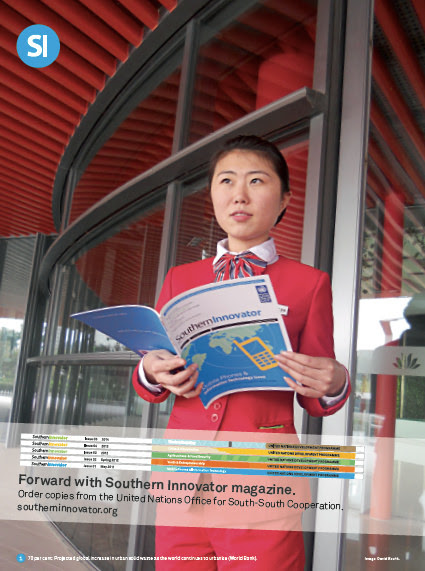
    Development Challenges, South-South Solutions was launched as an e-newsletter in 2006 by UNDP’s South-South Cooperation Unit (now the United Nations Office for South-South Cooperation) based in New York, USA. It led on profiling the rise of the global South as an economic powerhouse and was one of the first regular publications to champion the global South’s innovators, entrepreneurs, and pioneers. It tracked the key trends that are now so profoundly reshaping how development is seen and done. This includes the rapid take-up of mobile phones and information technology in the global South (as profiled in the first issue of magazine Southern Innovator), the move to becoming a majority urban world, a growing global innovator culture, and the plethora of solutions being developed in the global South to tackle its problems and improve living conditions and boost human development. The success of the e-newsletter led to the launch of the magazine Southern Innovator.  

    Follow @SouthSouth1

    Slideshare: http://www.slideshare.net/DavidSouth1/development-challengessouthsouthsolutionsnovember2010issue

    Southern Innovator Issue 1: https://books.google.co.uk/books?id=Q1O54YSE2BgC&dq=southern+innovator&source=gbs_navlinks_s

    Southern Innovator Issue 2: https://books.google.co.uk/books?id=Ty0N969dcssC&dq=southern+innovator&source=gbs_navlinks_s

    Southern Innovator Issue 3: https://books.google.co.uk/books?id=AQNt4YmhZagC&dq=southern+innovator&source=gbs_navlinks_s

    Southern Innovator Issue 4: https://books.google.co.uk/books?id=9T_n2tA7l4EC&dq=southern+innovator&source=gbs_navlinks_s

    Southern Innovator Issue 5: https://books.google.co.uk/books?id=6ILdAgAAQBAJ&dq=southern+innovator&source=gbs_navlinks_s

    Citations

    Cited in Studies in Intelligence, Autonomous Systems in the Intelligence Community: Many Possibilities and Challenges, Vol. 59, No.1 (Extracts, March 2015).

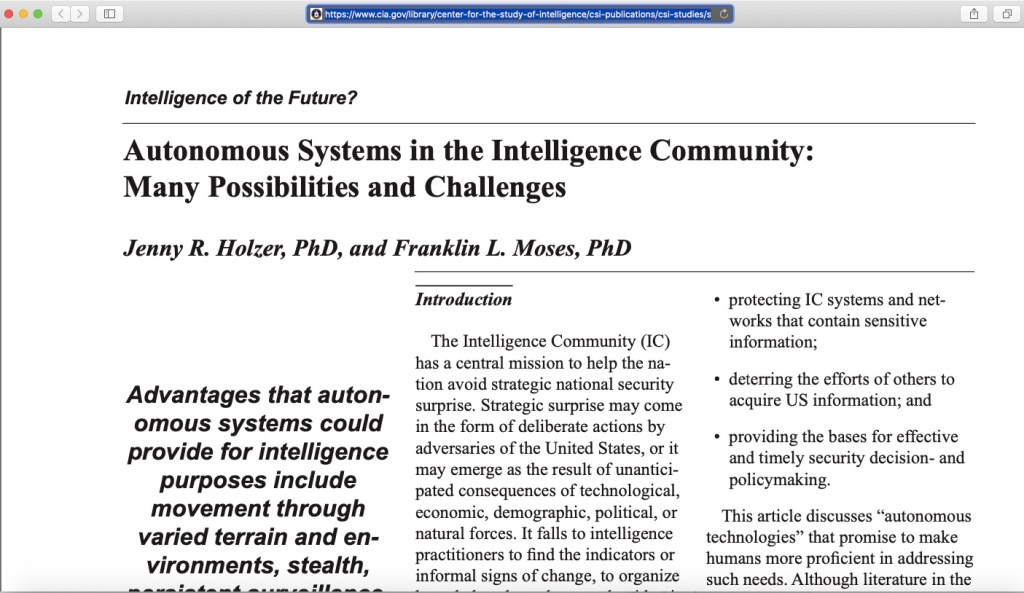
    Studies in Intelligence, Vol. 59, No.1 (Unclassified articles from March 2015).
    Autonomous Systems in the Intelligence Community: Many Possibilities and Challenges by Jenny R. Holzer, PhD, and Franklin L. Moses, PhD in Studies in Intelligence Vol 59, No. 1 (Extracts, March 2015).
    Autonomous Systems in the Intelligence Community: Many Possibilities and Challenges by Jenny R. Holzer, PhD, and Franklin L. Moses, PhD in Studies in Intelligence Vol 59, No. 1 (Extracts, March 2015).
    Link: https://www.cia.gov/resources/csi/studies-in-intelligence/volume-59-no-1/autonomous-systems-in-the-intelligence-community-many-possibilities-and-challenges/.

    More China stories:

    Better by Design in China

    https://davidsouthconsulting.org/2021/12/20/better-by-design-in-china/

    https://davidsouthconsulting.org/2022/10/20/china-consumer-market-asian-perspective-helps/

    China Pushing Frontiers of Medical Research

    https://davidsouthconsulting.org/2020/04/25/china-pushing-frontiers-of-medical-research/

    China Sets Sights on Dominating Global Smartphone Market

    https://davidsouthconsulting.org/2020/12/10/china-sets-sights-on-dominating-global-smartphone-market/

    https://davidsouthconsulting.org/2022/10/04/chinas-booming-wine-market-can-boost-south/

    China’s Outsourced Airliner Development Model

    https://davidsouthconsulting.org/2020/04/29/chinas-outsourced-airliner-development-model/

    https://davidsouthconsulting.org/2021/03/20/computer-gold-farming-turning-virtual-reality-into-real-profits/

    Creating Green Fashion in China

    https://davidsouthconsulting.org/2021/01/25/creating-green-fashion-in-china/

    https://davidsouthconsulting.org/2020/12/11/cyber-cities-an-oasis-of-prosperity-in-the-south/

    Designed in China to Rival ‘Made in China’

    https://davidsouthconsulting.org/2021/01/26/designed-in-china-to-rival-made-in-china/

    https://davidsouthconsulting.org/2022/10/04/popular-chinese-social-media-chase-new-markets/

    https://davidsouthconsulting.org/2021/10/04/putting-quality-and-design-at-the-centre-of-chinese-fashion/

    Rammed-Earth Houses: China Shows how to Improve and Respect Traditional Homes

    https://davidsouthconsulting.org/2021/02/12/rammed-earth-houses-china-shows-how-to-improve-and-respect-traditional-homes/

    Virtual Supermarket Shopping Takes off in China

    https://davidsouthconsulting.org/2020/04/17/virtual-supermarket-shopping-takes-off-in-china/

    Creative Commons License

    This work is licensed under a
    Creative Commons Attribution-Noncommercial-No Derivative Works 3.0 License.

    ORCID iD: https://orcid.org/0000-0001-5311-1052.

    © David South Consulting 2023

  • Artists Fear Indifference From Megacity

    Artists Fear Indifference From Megacity

    The Annex Gleaner (Toronto, Canada), February 1997

    The Harris government’s proposed megacity is stirring up fear, rumour and speculation in many quarters, and no group is more worried than Toronto’s artists.

    The merger of Toronto into a new megacity will place arts funding in jeopardy. Toronto’s generous contributions to the arts far exceed those of any other municipality in the region, meaning the city’s artists could be devastated if Toronto receives only a sixth of a new mega arts budget.

    Currently, Annex-based artists and arts groups can turn to two levels of municipal funding: the City of Toronto and Metro Toronto.

    Even at the Metro level, Toronto artists receive the bulk of arts funding, and a healthy share of that money goes to individuals and groups based in the Annex.

    Alas, the Annex’s vibrant milieu of resident artists, festivals and respected institutions is small comfort to many arts supporters who fear the indifference of politicians from the satellite cities and the cost-cutting measures of the Tories.

    They worry because the budget of the Toronto Arts Council, which will be eliminated under amalgamation, far exceeds the contributions to the arts made by the surrounding cities. In 1996, Toronto’s arts budget was $4.7 million, compared to $325,905 for the five other Metro municipalities combined.

    Many fear Toronto’s superior cultural activities will simply be overlooked by philistine councillors from Metro’s satellite cities.

    Tarragon Theatre general manager Mallory Gilbert, a former resident of Detroit who witnessed first-hand that city’s decline, worries Toronto could go the same way.

    “Once you get a population that doesn’t work or entertain downtown, they will just want an expressway through the city.”

    As Gilbert sees it, those voters who never patronize the arts in downtown Toronto are going to pressure politicians not to fund them. Gilbert also worries that suburban councillors will demand quotas to ensure arts funding is redirected away from downtown Toronto.

    Anne Bermonte, associate director for the Toronto Arts Council, also fears downtown artists will be lost in the megacity abyss.

    “The political make-up will resemble Metro rather than Toronto – the councillors who realize the arts accrue benefits will be out-voted.”

    Not surprisingly, officials at Metro don’t think downtown will be neglected. John Elvidge, cultural affairs officer at Metro Parks and Culture, doesn’t believe suburban politicians will pull money out of the core of the city. He says this never happened in the past and sees no reason why it would in the future.

    “The 28 councillors from the geographic area understand the core of arts is in the downtown. Look at our almost 40-year-funding history: 90 per cent is based in Toronto organizations. If you are a councillor in Etobicoke, you know people go downtown. (North York councillor) Howard Moscoe is the biggest supporter of the arts.”

    Statistics show the Annex has a strong competitive advantage over other areas when it comes to receiving arts grants. Bermonte estimates the Annex area currently receives close to $400,000 in grants in the course of a year, from both Metro and Toronto. While half of the Metro culture budget goes to the “big four” (the Toronto Symphony, the Art Gallery of Ontario, the National Ballet and the Canadian Opera Company), the Annex receives 10 per cent of the remaining $3 million, estimates Elvidge. Out of the combined Metro and Toronto budgets of $10.7 million, the Annex receives just under five per cent. All for a population of 36,000.

    “There are a lot of artists who live in the Annex area,” says Bermonte. “And the Annex enjoys the economic impact of the presence of those activities. If the Fringe disappeared, there wouldn’t be the animation in the area.”

    Unfortunately for artists, the past five years have seen shrinking arts budgets at all levels of government.

    While TAC has held on to its current funding level since 1994, Bermonte is worried this could change. TAC’s highest funding level was in 1991, when the board received $5.5 million. Metro has seen its budget drop from $7.5 million in 1993 to today’s $6 million. Both budgets are up for review, with Metro’s expected to drop by a further five per cent.

    If the megacity goes through, Bermonte hopes the new municipality will commit to arts funding levels appropriate for a modern, cultured city. She points out that London, England spends $30 million, while Berlin, Germany spends $930 million on culture.

    As Gilbert says, if the arts aren’t funded, the Annex will become less interesting to the many notables living here, such as writers Margaret Atwood, Rick Salutin, Judith Thompson, Stuart Ross and MT Kelly.

    Deputations will take place at City Hall on Feb. 17 to defend the Toronto Arts Council’s 1997 budget.

    Creative Commons License

    This work is licensed under a
    Creative Commons Attribution-Noncommercial-No Derivative Works 3.0 License.

    ORCID iD: https://orcid.org/0000-0001-5311-1052.

    © David South Consulting 2021

  • Will The Megacity Mean Mega-Privatization?

    Will The Megacity Mean Mega-Privatization?

    Annex Gleaner (Toronto, Canada), March 1997

    As the provincial government tries to shoehorn six municipalities into one megacity, opponents of the plan worry that one of the results of amalgamation will be widespread privatization of public services.

    References to contracting out and tendering municipal services in order to achieve savings run through the provincial government’s much-maligned report supporting a megacity, produced by consultants KPMG.

    Many observers feel the new city will have no choice, while others argue privatization won’t be nearly as extensive as some fear. Still others think it is far from a foregone conclusion that a future amalgamated council will push privatization.

    “Who knows if the council will have an interest in privatization?” says a senior bureaucrat at the City of Toronto, who did not want to go on record. “People are running around saying they will privatize everything, but who knows what the political make-up will be of the new council? They are assuming there will always be savings to be had from privatization – that doesn’t automatically follow. The financial pressures on the megacity can’t be avoided by privatization.”

    Among the six current Metro municipalities, it is Etobicoke that has most fully embraced contracting out. The City of Etobicoke’s experiments with contracting out – 60 per cent of public works contracts are performed by private-sector companies – calls into question the estimates of substantial savings being bandied about by the provincial government.

    According to the senior bureaucrat in charge of running that city, acting city manager and commissioner of public works Tom Denes, contracting out isn’t the tax-saving nirvana some believe.

    “I think we are finding in contracting out,” says Denes, “that the higher the skills of the workforce, the less sense it makes to contract out. For example, it would be very expensive to contract out water treatment.”

    Denes says the city’s pride and joy is its privatized garbage collection handled by Waste Management Inc. and BFI. The WMI contract is worth $6 million a year, down from the $7.5 million a year it was costing to publicly run garbage collection. The price is fixed for five years, when it must be negotiated again. While the city made $1.9 million selling its old trucks, councillors set up a $4 million fund so Etobicoke could go back to collecting garbage itself if private companies tried to gouge the city.

    Denes, who has been meeting with counterparts at other cities and the provincial government, believes the new Toronto will be divided up into several districts which private garbage collectors will have to compete for.

    “Based on what I know, if you were to divide the city up into waste contracts, it would be at least four areas,” claims Denes. “No company can handle the whole city. You just can’t find a company that could handle a megacity. It would become a monopoly.”

    Denes thinks the likely suspects for contracting out would be any manual labour work and the TTC. He thinks a megacity would be mistaken to contract out skilled work like surveying, arguing that skilled workers would use their desirability to their advantage and charge high consulting fees.

    “The US cities have all gone through these exercises. They are in fact contracting services back in,” says Denes.

    While the Tories have been slipperier than a scoop of ice cream about their specific privatization plans, one thing is clear: An essential element of the Tory economic vision is a greater role for the private sector in delivering public services. The $100,000 KPMG report plays to this, making it clear contracting out is a key means to saving money in the new megacity. The report claims between $28 million and $43 million per year could be saved from contracting out computer operations and some management; between $38.5 million and $68 million by contracting out fraud investigations; between $29.6 million and $54.5 million by contracting out road and electrical maintenance, snow removal and data collection; between $21 million and $39.4 million by contracting out garbage pick-up and processing.

    The report also offers this proviso: “There is no such thing as automatic, cost-free savings from organizational change. The implementation process must be tightly managed to produce the savings suggested here.”

    Ron Moreau is the administrator for Local 43 of the Metro Toronto Civic Employees Union, which represents over 3,000 public works workers and ambulance drivers at Metro.

    “How will the megacity and municipalities cope with pressure from the public to hold the line on taxes? Where will councils find the difference between spending and revenues?” asks Moreau. “The level of service will suffer. When you contract out, public policy is held hostage by private enterpise.”

    Moreau threatens that labour will play hardball with the new city. Most of the contracts for Moreau’s members run out on Dec. 31 of this year.

    “Assuming the government doesn’t tamper with the labour legislation on our books, the unions can be organized into two large locals, one clerical/technical, the other outside workers. They would have effective bargaining clout.”

    One major player looking for government contracts in a megacity will be Laidlaw Inc. While the company recently sold its garbage collection operations to an American firm, USA Waste, it still has interests in operating school buses and ambulances. Laidlaw is a heavy contributor to the Ontario Progressive Conservative Party, according to records kept by the Commission on Election Financing. Laidlaw has also made an influential new friend: in January, it hired former Metro chief administrative officer Bob Richards as its vice-president.

    Ward 13 city councillor John Adams is definitely in the privatization-if-necessary-but-not-necessarily-privatization camp. “I don’t see everything being contracted out, but more stuff being put out for competitive bids.”

    Adams thinks contracting out could be a good tactic to help modernize garbage collection, for example. He points to the City of Toronto’s deal with WMI to collect garbage at apartment buildings. In that deal, costs were reduced by $2.5 million over a five-year contract, and the crews on trucks were reduced from two to one. Instead of an extra crew member, closed-circuit television cameras were installed on trucks to speed up pick-up. Adams points out the crews are still unionized, but instead of CUPE it is the Teamsters.

    “The way we pick up garbage from households is back-breakingly stupid. I think we need to rethink how we do it, to use machines more than people’s backs.”

    But Adams doesn’t believe a megacity is a money-saver. “There will be a leveling up of wages. How long will two firefighters work side-by-side for different salaries? You can bet the union will negotiate an increase at the first opportunity.”

    Adams thinks a megacity will be more prone to the slick lobbying efforts of companies like Laidlaw because councillors will be dependent on political parties to get elected. “The provincial government will contract out municipal government to Laidlaw,” he says sarcastically.

    More on megacities:

    African Megacity Makeovers Tackle Rising Populations

    Artists Fear Indifference From Megacity

    Cities For All Shows How The World’s Poor Are Building Ties Across The Global South

    Global South’s Rising Megacities Challenge Idea of Urban Living

    Safety At Stake

    Southern Innovator Issue 4

    David South Consulting business card
    In 2010, David South Consulting was relaunched with a new logo and branding for the 21st century. It represented a new phase, as work became global and very high-profile and influential. The foundations have been laid for future growth and expansion.
    Creative Commons License

    This work is licensed under a
    Creative Commons Attribution-Noncommercial-No Derivative Works 3.0 License.

    ORCID iD: https://orcid.org/0000-0001-5311-1052.

    © David South Consulting 2021

  • Take Two Big Doses Of Humanity And Call Me In The Morning

    Take Two Big Doses Of Humanity And Call Me In The Morning

    By David South

    The Toronto Star (Toronto, Canada), January 1, 1993

    “Anybody going into medicine should read a whole bunch of good novels.” Dr. Alvin Newman isn’t kidding. The head of curriculum renewal at the largest English-speaking medical school in the world, the University of Toronto, feels strongly that doctors have been ill-prepared for their profession’s challenges.

    How doctors become doctors is being hotly debated as Ontario’s five medical schools institute a potpourri of curriculum reforms. After a century of taking a back seat to scientific achievement, bedside manners and the art of medicine are in vogue again.

    “Around the world, medical education is undergoing significant changes,” says Newman. “Medical schools must strike a balance between the incredible explosion of scientific knowledge and re-establish the role of the physician as wise counsel and empathic healer.”

    It’s a role that many feel doctors have ignored. An American Medical Association poll, conducted between 1985 and 1988, found that fewer than 50 per cent of respondents said they thought doctors listened well and half believed doctors no longer care as much about patients as they used to.

    In response to these criticisms, current reforms are shifting medical education away from reliance on the turn-of-the-century science-based approach, says Professor Jackie Duffin, a medical historian at Queen’s University who helped organize the new curriculum introduced there in 1991.

    “In the old days doctors could probably make a diagnosis and tell people what was happening to them, but not do very much for them,” says Newman.

    “Yet society had more trust and fondness for physicians than they do now. Much of the condemnation of the medical profession is because we have become the custodians of high-tech medicine.”

    While the Ontario government embarks on the most sweeping reforms to health care since the 1966 introduction of comprehensive health insurance in Ontario and the founding of national medicare in 1968, many doctors feel their profession cannot afford to maintain the status quo.

    The concensus at Ontario’s five medical schools – U of T, Queen’s, University of Western Ontario, University of Ottawa and McMaster University – has gelled around a belief that doctors need to be as comfortable dealing with people as they are with scientific medicine. To this end, revamped curricula supplement basic science and clinical medicine with emphasis on early exposure to patients, communication skills, psychological issues, medical ethics, medical literacy and health promotion.

    These schools hope to produce new doctors to fit into a rapidly-changing health care system – one that many believe will rely far less on large hospitals.

    Instead, many procedures will take place in the home or in the day clinics. Expanding community health care care centres will try to tackle extensive social and health problems. This preventive approach ot medical education was pioneered by Hamilton’s McMaster medical school.

    Since its founding in 1967, McMaster has experimented with teaching methods that steer away from mass lectures to concentrate on the individual student. The evolution of McMaster’s curriculum has placed greater emphasis on communication skills, psychosocial aspects of medicine, community issues, and disease prevention and health promotion.

    How do McMaster students rate against other medical students?

    Last year they scored above the national average on licencing exams. A higher proportion of McMaster students enter research and academic medicine than their counterparts from other schools. One study comparing them to U of T suggested they were more motivated to be life-long learners.

    Dr. Rosana Pellizzari practices the kind of medicine everyone is talking about these days. Working out of renovated church, Pellizzari’s practice at the Davenport/Perth Community Health Centre in west end Toronto serves a working class neighbourhood that has been home to generations of recent immigrants.

    A member of the Medical Reform Group – which has long advocated significant reforms to health care – and trained at McMaster, Pellizzari can be seen to represent the doctor of the future: Sensitive, salaried and working in community health.

    “McMaster’s curriculum attracts people with innovative ideas,” says Pellizzari, who was active in community health education before going to medical school. “It is a very supportive environment.

    “I think the important question is: Who do we choose to be medical students? They should open up medical schools to those who know what it’s like to be a parent, a mother or disabled. Doctors should represent the population they serve. We are still getting mostly white, inexperienced young males as physicians. They aren’t going to practice the way that is necessary.”

    In Ontario, many doctors see the 1986 doctors’ strike as a watershed for public opinion.

    As a result of the negative fallout from the strike and perceived gap between physicians andhe public they serve, a five-year project entitled Educating Future Physicians for Ontario became a major advocate for reform.

    Started in 1988, EFPO has examined fundamental issues in designing and implementing new medical school curricula. These issues include defining societal health care needs and expectations, faculty development and student evaluation. While each medical school has adapted reforms to its particular situation, EFPO hopes to prod further reforms.

    “This is a unique venture in Canada, and could have implications far beyond Ontario if successful,” says Dr. William Seidelman, a key player in EFPO. “It captures the unique sense of the Canadian scene, and will build on the implied contact in the Canadian health system.”

    Pellizzari sees the attitude of medical schools and teaching hospitals towards medical students as a significant factor in creating insensitive doctors. She recalls the high rate of suicide among medical students and the abusive work environment that forces doctors-in-training to work shifts unthinkable for other workers.

    “The way we train doctors is inhumane,” she says. “We don’t expect other workers to put in 30-hour shifts. It creates in new physicians the attitude that they paid their dues and now society owes them.”

    Many critics feel that changing training methods isn’t enough; the whole ethos and selection process must be changed. If doctors are to better serve the population, they must better reflect it.

    “We are getting very close to gender equality and a laudable distribution of ethnic and racial backgrounds,” says Newman. “But students still come from a fairly narrow social spectrum,  very middle class kids. Their exposure to the extremes of society, to poverty, to homelessness and related illnesses have been very limited.”

    Pellizzari found how out-of-date the medical profession was in her first year. One teacher wanted her to work till 10 at night. When told that she needed 24 hours notice for a babysitter, the teacher shot back that motherhood and medicine don’t mix.

    “I was a mother before I was a physician. When I get a call at night from a mother, I understand this. With 30 per cent of visits to doctors having no biological basis – like depression due to unemployment – you can’t do anything unless you have experienced life.

    “If we don’t address this, you can design the best training in the world, but things won’t change.”

    But Newman also feels many factors outside of medical school discourage a more diverse student body.

    “To go through medical school in the United States requires large indebtedness. That’s not true in Canada. You can calculate what a year of medical school costs in terms of a finite number of CDs, a leather jacket and ghetto blaster. So something is dissuading people from pursuing this career, and it isn’t money.”

    While there is a concensus among academics that medical schools haven’t prepared doctors well enough, there is little support for a dramatic change in selection criteria. “I can’t muster a lot of support from colleagues for serious changes,” says Newman.

    Dr. Jock Murray, the former dean of Dalhousie medical school in Halifax, recently told an EFPO meeting he doesn’t see any significant changes ahead.

    “Physicians have a reputation for being conservative and self-serving,” says Murray. “If reform is going to be successful we have to be clear that it is about what is good for the people.”

    Pellizzari believes life experience and empathy with social circumstances just can’t be taught.

    “I grew up in this neighbourhood. I understand their powerlessness, the conditions. Doctors have to see themselves as a member of a team of health professionals, not as the top of the social and medical totem pole.”

    U of T’s experience is a classic example of the hurdles ahead. Newman admits it has come as a shock to students loaded with society’s ingrained expectations.

    “They spend half a day a week in the community seeing things like drug rehab clinics and community health centres. But being out in the community doesn’t make the students feel comfortable. Their image of what they are going to do involves big buildings, chrome and steel, scurrying personnel and banks of computers.”

    This work is licensed under a Creative Commons Attribution 4.0 International License.

    “… in recent years it has become a pursuit for a growing number of researchers. … Behind much of this growth has been the Hannah Institute for the History of Medicine …” 

    Read more about Canadian innovation in healthcare delivery here: Taking Medicine To The People: Four Innovators In Community Health

    Read more on my work promoting Canadian medical history scholarship here: Hannah Institute For The History Of Medicine | 1992 – 1994

    Read more on my work leading on innovation and modernisation in the UK’s NHS here: CASE STUDY 5: GOSH/ICH Child Health Portal | 2001 – 2003

    ORCID iD: https://orcid.org/0000-0001-5311-1052.

    © David South Consulting 2021