Tag: David M South

  • Book Boom Rides Growing Economies and Cities

    Book Boom Rides Growing Economies and Cities

    By David SouthDevelopment Challenges, South-South Solutions

    SOUTH-SOUTH CASE STUDY

    Along with growing economies, the global South is seeing growing numbers of readers and a newly flourishing publishing industry. The creative economy – of which book publishing is part – is experiencing a jolt from a combination of expanding economies and urbanizing cities. Just as the first settled cities of ancient Mesopotamia (today’s Iraq) spawned literature and learning, so the rapidly urbanizing South is changing dynamics and creating the space and demand for books.

    The creative economy is seen as the “interface between creativity, culture, economics and technology in a contemporary world dominated by images, sounds, texts and symbols” (UNCTAD). It has been shown to be an effective way for emerging economies to leapfrog into high-growth areas in the 21st century world economy.

    Telling stories about local conditions and people’s rapidly changing lives is proving a commercial success formula. Fast-growing India is forecast to become the largest market for English language books within a decade. India’s economic boom, which saw 6.7 percent growth in 2009, and its expanding middle class are driving demand for books. India saw the number of literate people pass 66 percent by 2007.

    “It is a forward-looking generation,” said Manish Singh, country manager for publisher Harlequin Mills and Boon, to The Guardian newspaper.

    Estimates of India’s book reading market put the number of readers at just 5 million out of a population of over 1 billion people. But according to Anantha Padmanabhan, the director of sales in India for publisher Penguin, “that is set to increase dramatically.”

    A survey by Tehelka (http://www.tehelka.com) found Indians are favouring stories about local conditions and set in the places where they live.

    India’s most popular current writer is Chetan Bhagat, a former investment banker. He has sold more than 3 million books in the last five years. His latest, Two States, sold a million copies in four months.

    Bhagat writes about the country’s aspiring middle class. His publisher, Rupa (http://www.rupapublications.com/Client/home.aspx), believes he appeals to a “pan-Indian, pan-age group.”

    Bhagat puts his success down to the way the stories are written. “This is not like the mature English literature market,” he said. “It needs an English that is highly accessible, simple, and with stories that are still interesting and relevant.”

    Book prices in India have stayed affordable for the middle classes. A book can cost from US $1.85 to US $2.65 for a paperback – still a high cost for the poor, however, who live on a dollar a day.

    In Egypt, around 30 percent of the population is illiterate and book reading has been historically very low: it has been claimed an average literate Egyptian reads a quarter of a page of a novel per year. From this low base, a best seller only needs to sell a few thousand copies.

    However, in Egypt small-scale independent publishers are starting to make an impact. Mohamed Hashem – founder of the Dar Merit publishing house (http://www.zoominfo.com/Search/ReferencesView.aspx?PersonID=1007104230) – has built from scratch in 12 years one of the country’s most critically acclaimed publishers: all from a tiny apartment in a rundown Cairo building.

    “We can’t compete with the big firms in terms of profits,” he told The Guardian, “but the new wave of authors will always be sitting here. Yes, we have poverty and limited resources. But we also have the future.”

    Launched to counter what Hashem felt was an unimaginative book market, his stable of authors have shaken up the Arabic fiction world. The global success of Alaa al-Aswany’s The Yacoubian Building (http://en.wikipedia.org/wiki/The_Yacoubian_Building) is proof Hashem’s gamble on edgy talent was correct: rejected by two government-run publishing houses, the book went on to be a hit in English and Arabic and has been made into a film.

    Hashem is being credited with unleashing a wave of new talented authors that has pushed literature out from being the preserve of a select group.

    One of its successful authors, Hamdi Abu Golayyel – winner of the country’s top literary prize, the Naquib Mahfouz medal – believes “Merit has changed the way pioneering literature emerges in Egypt.”

    “Before, you had the innovative writers – there are normally no more than five or six in a generation – meeting together in mutual isolation, because popular opinion rejected them.”

    Merit “had the drive and ambition to support and distribute new and younger authors properly. Today innovative writing is wanted by the people.”

    Hashem’s secret in attracting talented writers has been more than just business savvy: he also gives them “the freedom to write in my own way,” according to writer Ahmed Alaidy.

    The writers also have a credibility advantage: they are writing about their circumstances rather than just imagining what it would be like. Writer Hani Abdel Mourid comes from Cairo’s traditional garbage-collecting neighbourhood; another author, Mohamed Salah Al Azab, has written a book named after the folding seats on Egypt’s lively minibuses.

    Demographic changes and Cairo’s relentless expansion are being cited as the catalyst for the new writing.

    “The fact that the city has grown the way it has,” says Samia Mehrez, a literature professor in Cairo, “the fact that what we used to call the periphery is now the centre, that is very important.”

    “The year we started, we published five titles and the number of people interested could be counted in the dozens,” he told The Guardian. “Now we have 600 titles under our belt, and thousands are interested. It’s my duty to try and expand that circle. We’re chipping away at a wall, and slowly we’re making progress.”

    Published: May 2010

    Resources

    1) Creative Economy Report 2008. An economic and statistical assessment of creative industries world-wide as well as an overview of how developing countries can benefit from trade in creative products and services produced by UNCTAD and the Special Unit for South-South Cooperation in UNDP. Website: http://www.unctad.org/en/docs/ditc20082cer_en.pdf

    2) Global Creative Economy Convergence Summit 2009: The summit is about the successful and emerging creative technologies and initiatives that are driving economic growth locally, nationally and internationally. Website: http://www.gcecs2009.com/

    3) A directory of Indian publishers. Website: http://www.publishersglobal.com/directory/publishers-by-country.asp?publishers-of=India

    4) Full Circle Publishing: A successful Indian publishing company. Website: http://www.atfullcircle.com/

    5) Jaipur Literature Festival: Described as the ‘greatest literary show on Earth’, the Jaipur Literature Festival is a sumptuous feast of ideas.The past decade has seen it transform into a global literary phenomenon having hosted nearly 2000 speakers and welcoming over a million book lovers from across India and the globe. Website: https://jaipurliteraturefestival.org/

    https://davidsouthconsulting.org/2021/09/23/david-south-consulting-books-1997-2014/

    https://davidsouthconsulting.org/2022/06/15/e-books/

    https://davidsouthconsulting.org/2022/11/23/publications/

    https://davidsouthconsulting.org/2022/10/26/south-gets-reading-bug-with-more-festivals/

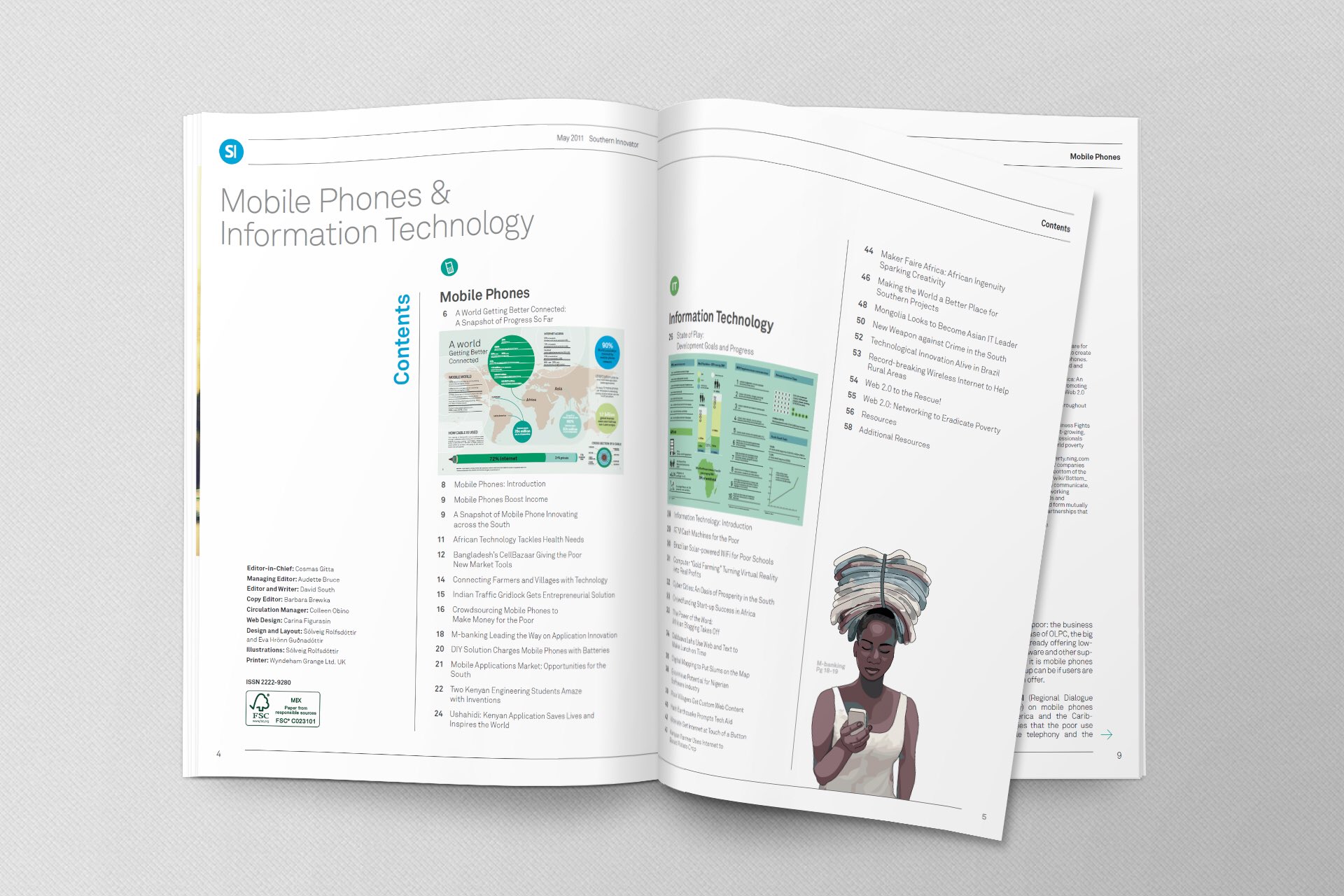
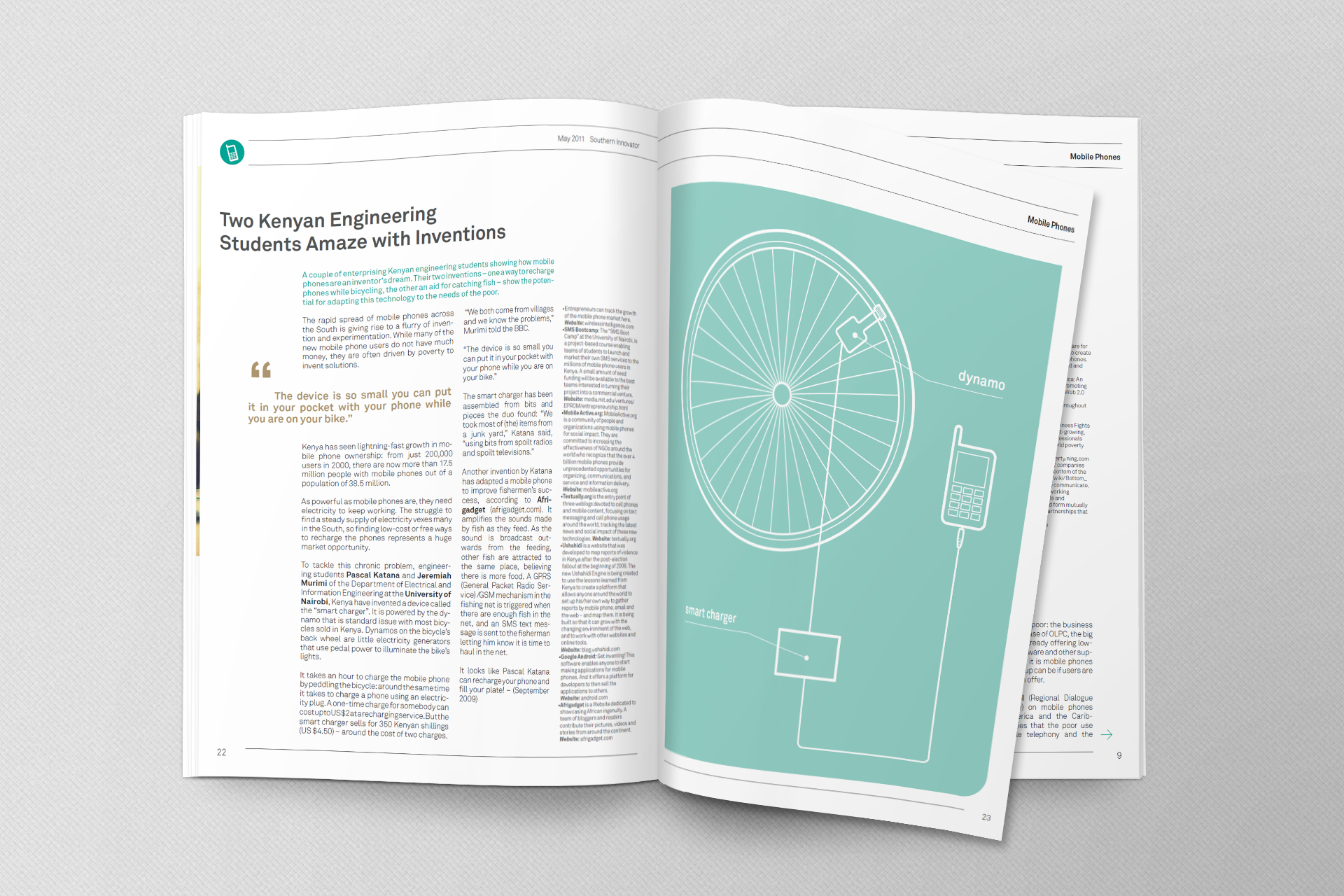
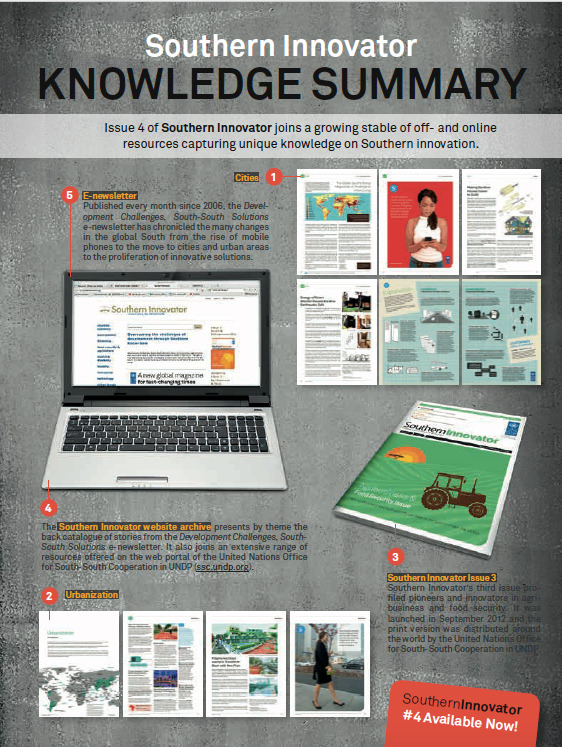
    Development Challenges, South-South Solutions was launched as an e-newsletter in 2006 by UNDP’s South-South Cooperation Unit (now the United Nations Office for South-South Cooperation) based in New York, USA. It led on profiling the rise of the global South as an economic powerhouse and was one of the first regular publications to champion the global South’s innovators, entrepreneurs, and pioneers. It tracked the key trends that are now so profoundly reshaping how development is seen and done. This includes the rapid take-up of mobile phones and information technology in the global South (as profiled in the first issue of magazine Southern Innovator), the move to becoming a majority urban world, a growing global innovator culture, and the plethora of solutions being developed in the global South to tackle its problems and improve living conditions and boost human development. The success of the e-newsletter led to the launch of the magazine Southern Innovator. 

    Creative Commons License

    This work is licensed under a
    Creative Commons Attribution-Noncommercial-No Derivative Works 3.0 License.

    ORCID iD: https://orcid.org/0000-0001-5311-1052.

    © David South Consulting 2022

  • New Journal Celebrates Vibrancy of Modern Africa

    New Journal Celebrates Vibrancy of Modern Africa

    By David SouthDevelopment Challenges, South-South Solutions

    SOUTH-SOUTH CASE STUDY

    Africa has seen huge changes to its communications and media in the past five years. The rise and rise of mobile phones, the expansion of the Internet and the explosion in African blogging and social media, on top of flourishing print and broadcast media, all bring an increasing range of options for telling African stories and increasing dialogue.

    With all this new media creating new communications channels – and all the turmoil and change affecting millions as economies and countries change – people need the ability to make sense of it all. One magazine is trying to play that role.

    An entrepreneur and multimedia innovator has created a unique publication that is capturing the spirit, ideas and stories of modern Africa. It is a high-quality product, has gathered together talented writers and photographers and is gaining a growing global audience. Chimurenga Magazine (http://www.chimurenga.co.za/) based in Cape Town, South Africa, calls itself a “pan African publication of writing, art and politics.” Named for the Zimbabwean Shona word for “revolutionary struggle,” it is published three times a year. Editor Ntone Edjabe is from Cameroon and came to Cape Town in the 1990s after the end of South Africa’s racist Apartheid regime.

    With more than 100 contributors, the magazine offers insight into contemporary Africa, what occupies people’s thoughts and how their lives are actually lived.

    It is involved in a wide range of other activities, including co-curating a Global South Dialogue Series. And its readership is truly diverse.

    “We have readers who are long-term prisoners at Pretoria Central Prison, who have subscriptions that they get to us in coins, and readers who are successful businessmen,” Edjabe said to The Financial Times Magazine.

    Chimurenga is out to challenge perceptions of Africa. Practicing the art of long-form journalism more associated with established high-end publications like The New Yorker (newyorker.com), the magazine sets out to challenge perceptions about Africa.

    “Discourse on Africa is geared towards simplicity,” Edjabe told CNN. “Everything must be simple – ‘he’s a poor black man, he’s a victim’ – like there has to be a simple story, in a way this is what signifies Africa and global consciousness.

    “The moment you bring a degree of complexity to it, it kind of throws people off, they just don’t know where to look anymore. It’s like, ‘what’s going on?’ So Chimurenga in a way does not try to maintain the superficiality of this narrative – we engage with life, we try to present life as complex as it really is.”

    Stories in the journal include Billy Kahora writing on the decay of a neighbourhood in Nairobi, Kenya, Michael Abrahams writing about his time in the Cape Town mental hospital after a suicide attempt, and Sean O’Toole following a Zimbabwean immigrant on his journey into South Africa.

    The magazine’s website carries back issues of the journal, along with a shop selling magazines, books and t-shirts and the “Chimurenga Library,” an archive of pan-African, independent periodicals. There’s also live online streaming of music – “from ancient techno to future roots” – through the Pan African Space Station radio station, there is a biennial publication of urban life it calls “Africa-style,” and the writings of 14 African writers who visited 14 African cities to check-up on life in urban areas.

    As an example of the creativity of Chimurenga’s talent, a special issue of the magazine tried to better understand the impact of violence in South Africa in May 2008 that led to the deaths of 62 people. It did this by creating a fictitious newspaper called The Chimurenga Chronic (http://www.chimurenga.co.za/chimurenga-magazine/current-issue) set during the violence.

    The writers are a mix of Anglophones and Francophones, all based in Africa. Common subjects focus on the world of lower-middle class Africa. Examples of past issues show the variety of its content: Conversations With Poets Who Refuse To Speak, Futbol, Politricks & Ostentatious Cripples, Conversations in Luanda and Other Graphic Stories, *We’re all Nigerian!

    Well-travelled editor Edjabe has studied and lived in Lagos, Nigeria and Johannesburg, South Africa. He has worked as a disc jockey, music writer and basketball coach. He launched Chimurenga in 2002. He told The Financial Times Magazine “I printed 1,000 copies, which I carried around in my bag. I sold it mainly to friends.”

    It was supposed to be a one-off publication but became a journal, initially written mostly by his friends.

    “I found out later that this is how most journals actually begin,” he said. “At the time I thought it was unique.”

    He aspired to get Africans writing about the Africa they saw and lived in. The challenge was changing the dynamic he found of writers only considering something worth writing about if it had been featured in non-African media.

    Edjabe had already made his mark with an innovative initiative to show the diversity of what Africa has to offer. Three years after arriving in South Africa he started the Pan African Market (PAM) in Cape Town. An African cultural centre, it began as a craft market with various traders able to run their individual businesses and leasing stall space from the market. PAM became very successful because it brought together Africans from across the continent and offered a vibrant mix of artists, small businesses and food. It now has 33 stores and stalls from 14 countries of Africa. Shoppers can find arts and crafts, hair dressing, tailoring, holistic healing and catering.

    Hard copies of Chimurenga are distributed around Africa and sent to Europe, the United States and India.

    “There’s a feeling about writing something, sharing something that is beautiful and truthful from one’s perspective,” Edjabe told CNN.

    Published: June 2012

    Resources

    1) How to Start a Magazine: Simple online advice on starting and running a magazine. Website: http://www.ehow.com/how_16579_start-magazine.html

    2) Venture Capital for Africa: VC4Africa is the largest online community of investors, angels and entrepreneurs working to build businesses on the continent. Website: http://vc4africa.biz/landing/?redir_to=%2F

    https://davidsouthconsulting.org/2022/10/21/african-media-changing-to-reach-growing-middle-class/

    https://davidsouthconsulting.org/2021/01/05/development-challenges-south-south-solutions-newsletter/

    https://davidsouthconsulting.org/2021/07/14/freedom-of-expression-introducing-investigative-journalism-to-local-media-in-mongolia-1999-25-january-2016/

    https://davidsouthconsulting.org/2021/05/25/ger-mongolias-first-web-magazine-and-a-pioneering-web-project-for-the-united-nations-12-january-2016/

    https://davidsouthconsulting.org/2022/11/01/indian-newspapers-thrive-with-economy/

    https://davidsouthconsulting.org/2022/10/04/popular-chinese-social-media-chase-new-markets/

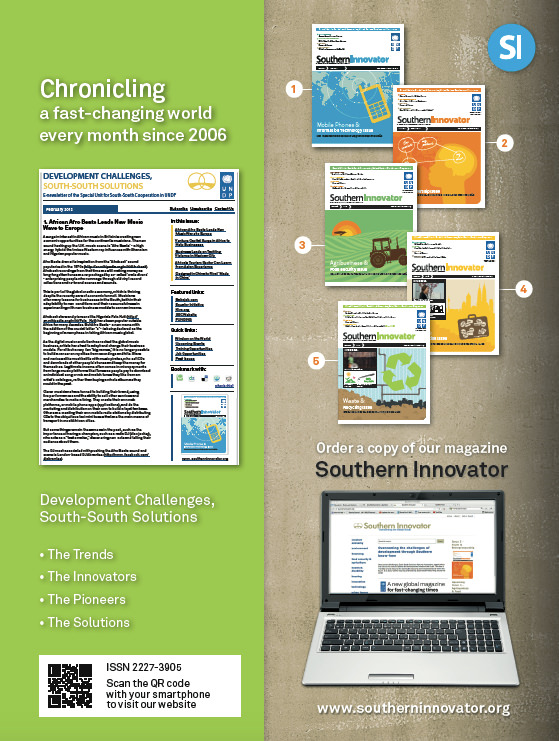
    https://davidsouthconsulting.org/2022/11/01/southern-innovator-magazine-2010-2014/

    Development Challenges, South-South Solutions was launched as an e-newsletter in 2006 by UNDP’s South-South Cooperation Unit (now the United Nations Office for South-South Cooperation) based in New York, USA. It led on profiling the rise of the global South as an economic powerhouse and was one of the first regular publications to champion the global South’s innovators, entrepreneurs, and pioneers. It tracked the key trends that are now so profoundly reshaping how development is seen and done. This includes the rapid take-up of mobile phones and information technology in the global South (as profiled in the first issue of magazine Southern Innovator), the move to becoming a majority urban world, a growing global innovator culture, and the plethora of solutions being developed in the global South to tackle its problems and improve living conditions and boost human development. The success of the e-newsletter led to the launch of the magazine Southern Innovator. 

    https://davidsouthconsulting.org/2021/03/05/southern-innovator-issue-1/

    Creative Commons License

    This work is licensed under a
    Creative Commons Attribution-Noncommercial-No Derivative Works 3.0 License.

    ORCID iD: https://orcid.org/0000-0001-5311-1052.

    © David South Consulting 2022

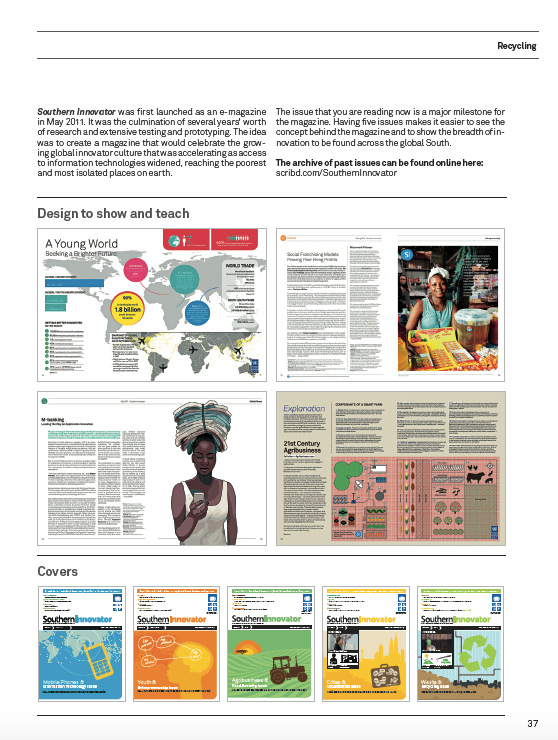
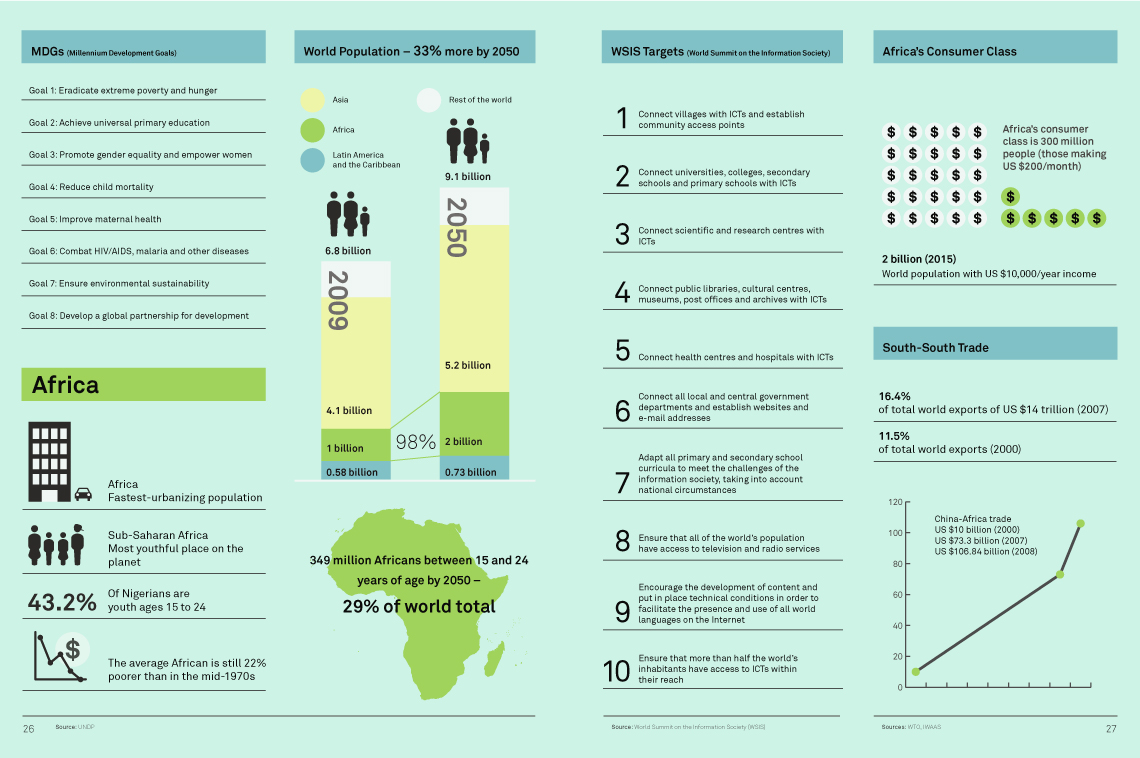
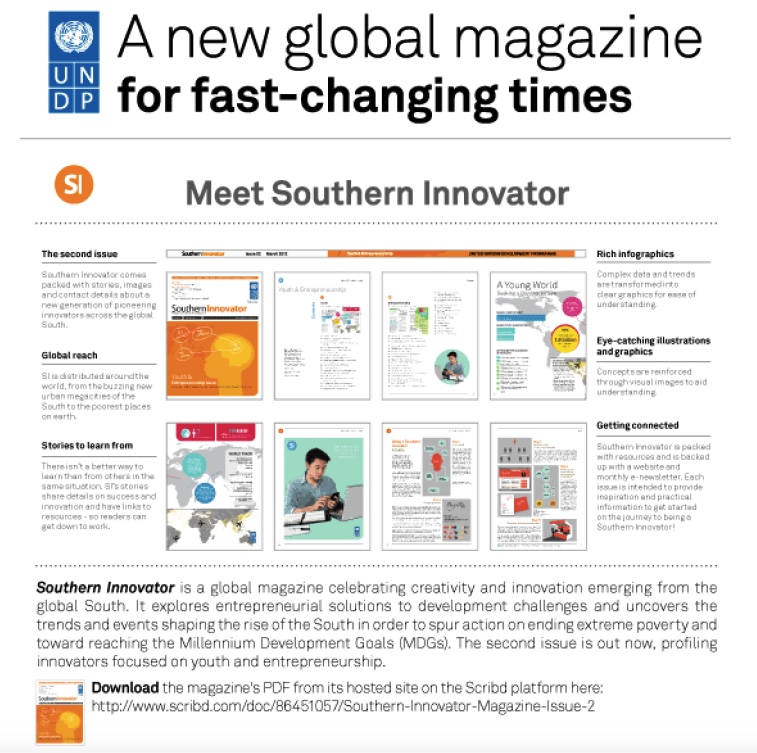
  • Southern Innovator Magazine | 2010 – 2014 

    Southern Innovator Magazine | 2010 – 2014 

    By David South

    “I think you [David South] and the designer [Solveig Rolfsdottir] do great work and I enjoy Southern Innovator very much!” 

    Ines Tofalo, Programme Specialist, United Nations Office for South-South Cooperation
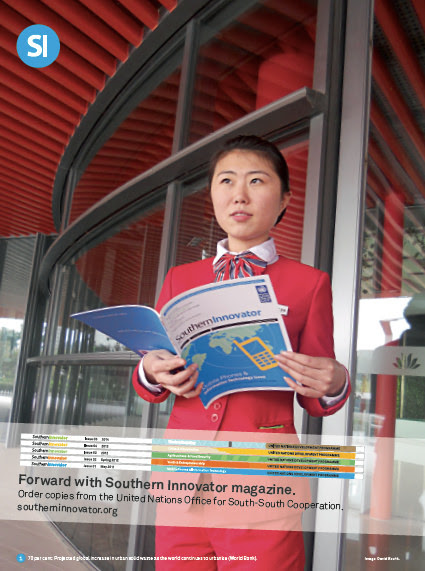
    Southern Innovator in Tianjin, China.
    Issue 5 of Southern Innovator at the Global South-South Development Expo (GSSD Expo) 2014 held in Washington, D.C.
    Volunteers in Nairobi, Kenya pose with Southern Innovator Issue 4 at the Global South-South Development Expo (GSSD Expo) in 2013.
    Southern Innovator Editor and Writer David South in Australia.
    Southern Innovator Graphic Designer and Illustrator Sólveig Rolfsdóttir in Iceland.

    Some comments that have come in so far about SI’s first issue:

    “What a tremendous magazine your team has produced! It’s a terrific tour de force of what is interesting, cutting edge and relevant in the global mobile/ICT space… Really looking forward to what you produce in issues #2 and #3. This is great, engaging, relevant and topical stuff.”, to “Looks great. Congratulations. It’s Brill’s Content for the 21st century!”

    What they are saying about SI on Twitter: From @CapacityPlus Nice job RT @ActevisCGroup: RT @UNDP: Great looking informative @SouthSouth1 mag on South-South Innovation; @UNDP Great looking informative @SouthSouth1 mag on South-South Innovation; @JeannineLemaireGraphically beautiful & informative @UNDP Southern Innovator mag on South-South Innov. 

    And on Pinterest:

    Peggy Lee • 1 year ago 

    “Beautiful, inspiring magazine from UNDP on South-South innovation. Heart is pumping adrenaline and admiration just reading it”

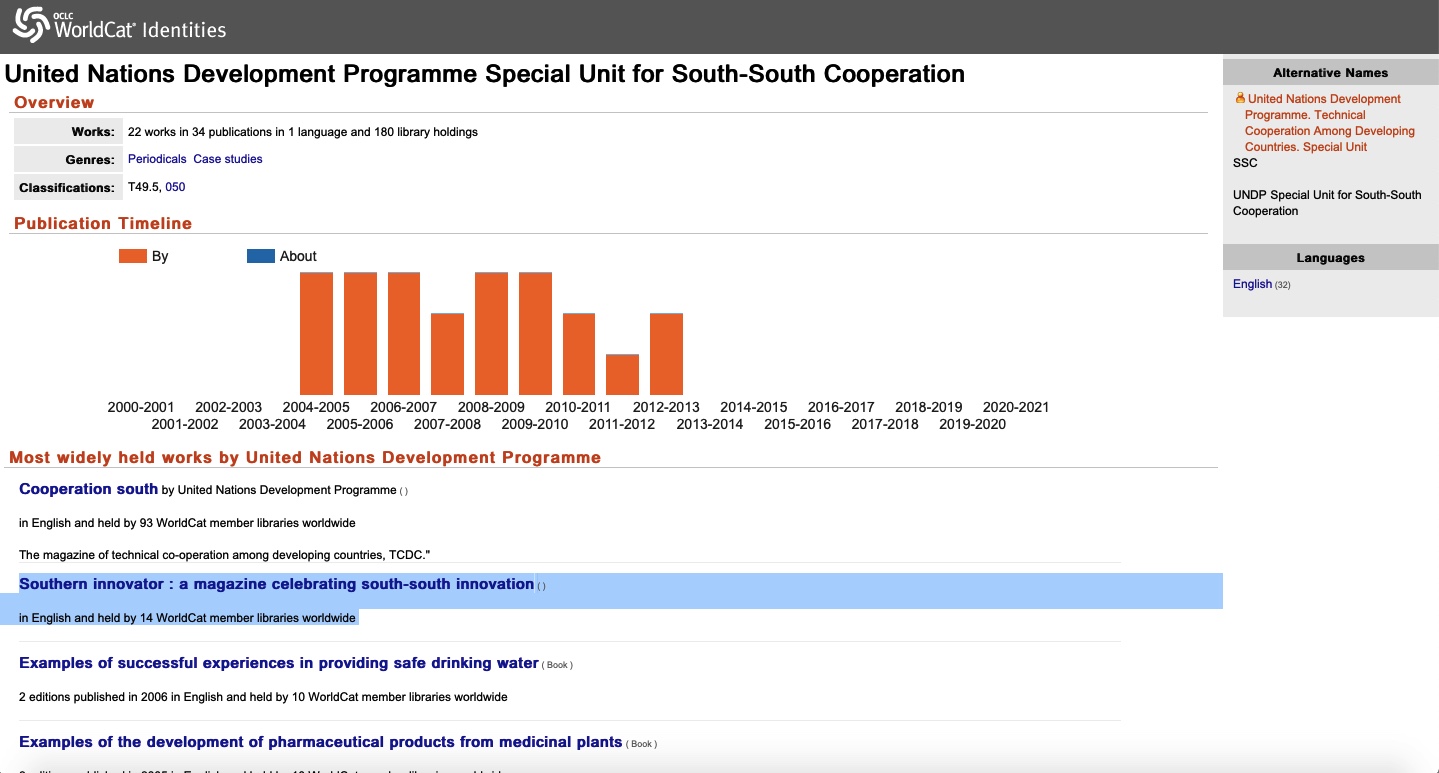
    Southern Innovator Magazine can be found in libraries around the world.

    Development Challenges, South-South Solutions was launched as an e-newsletter in 2006 by UNDP’s South-South Cooperation Unit (now the United Nations Office for South-South Cooperation) based in New York, USA. It led on profiling the rise of the global South as an economic powerhouse and was one of the first regular publications to champion the global South’s innovators, entrepreneurs, and pioneers. It tracked the key trends that are now so profoundly reshaping how development is seen and done. This includes the rapid take-up of mobile phones and information technology in the global South (as profiled in the first issue of magazine Southern Innovator), the move to becoming a majority urban world, a growing global innovator culture, and the plethora of solutions being developed in the global South to tackle its problems and improve living conditions and boost human development. The success of the e-newsletter led to the launch of the magazine Southern Innovator. 

    https://davidsouthconsulting.org/southern-innovator-scale-up-fundraiser/

    Creative Commons License

    This work is licensed under a
    Creative Commons Attribution-Noncommercial-No Derivative Works 3.0 License.

    ORCID iD: https://orcid.org/0000-0001-5311-1052.

    © David South Consulting 2022

  • Energy-Efficient Wooden Houses are also Earthquake Safe

    Energy-Efficient Wooden Houses are also Earthquake Safe

    By David SouthDevelopment Challenges, South-South Solutions

    SOUTH-SOUTH CASE STUDY

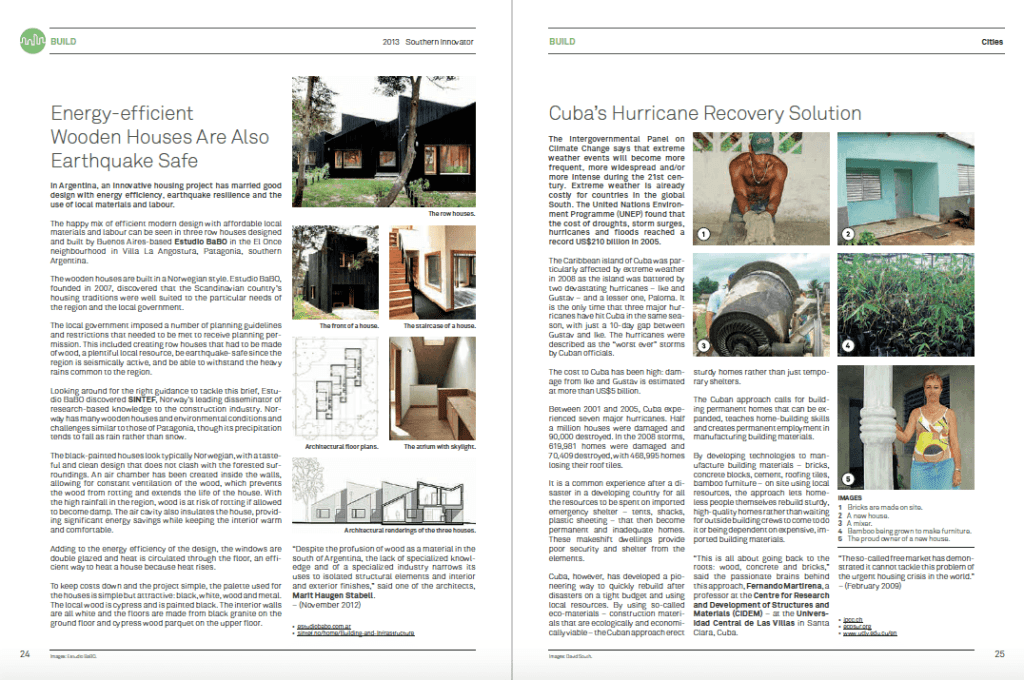
    In Argentina, an innovative housing project has married good design with energy efficiency, earthquake resilience and the use of local materials and labour. As energy resources continue to be stretched around the global South, innovative building designs will be critical to the creation of sustainable housing for the future.

    The happy mix of efficient modern design with affordable local materials and labour can be seen in three row houses designed and built by Buenos Aires-based Estudio BaBO (estudiobabo.com.ar) in the El Once neighbourhood in Villa La Angostura, Patagonia, southern Argentina.

    The wooden houses are built in a Norwegian style. Estudio BaBO, founded in 2007, discovered that the Scandinavian nation’s housing traditions were well suited to the particular needs of the region and the local government.

    The local government imposed a number of planning guidelines and restrictions that needed to be met to receive planning permission. This included creating row houses which must be made of wood – a plentiful local resource. They also had to be earthquake-safe since the region is seismically active and be able to withstand the heavy rains common to the region.

    Looking around for the right guidance to tackle this brief, Estudio BaBO discovered SINTEF – Norway’s leading disseminator of research-based knowledge to the construction industry (http://www.sintef.no/home/Building-and-Infrastructure/). The Nordic nation has many wooden homes and also has similar environmental conditions and challenges to Patagonia – though its precipitation tends to fall as rain, rather than snow.

    The black-painted homes look typically Norwegian, with a tasteful and clean design that does not clash with the forested surroundings. An air chamber has been created inside the homes’ walls allowing for constant ventilation of the wood, which prevents the wood from rotting and extends the life of the house. With the high rainfall of the region, wood is at risk of rotting if allowed to become damp. The air cavity also insulates the house, providing significant energy savings while keeping the interior warm and comfortable.

    Adding to the energy efficiency of the design, the windows are double glazed and heat is also circulated through the floor – an efficient way to heat a home because heat rises.

    To keep costs down and the project simple, the palette used for the homes is simple but attractive: black, white, wood and metal. The local wood is cypress and is painted black. The interior walls are all white and the floors are made from black granite on the ground floor and cypress wood parquet on the upper floor. The rest of the woodwork in the house is also made of cypress.

    Using locally sourced materials also helps to keep costs down.

    The project was initially conceived in 2009 and the houses were built in 2010-2011. While wood is plentiful in Patagonia, traditionally the use of wood in construction was rudimentary and local labour skill levels were low. This meant the design had to be simple and easy to build.

    “Despite the profusion of wood as a material in the south of Argentina, the lack of specialized knowledge and of a specialized industry narrow its uses to isolated structural elements and interior and exterior finishes,” said one of the architects, Marit Haugen Stabell.

    The three units of two-storey row houses each come with a living room, dining room, kitchen, toilet, two bedrooms and a laundry room. Each home also has an outdoor patio. The homes are designed to receive maximum natural light. Deploying this energy efficient design is considered unusual for Argentina and Estudio BaBO has set a new standard for sustainable housing in the country.

    It looks like the CLF Houses could inspire others to look again at wood as a building material.

    Published: November 2012

    Resources

    1) A story on how researchers are perfecting wooden home designs to withstand heavy earthquakes. Website:http://inhabitat.com/wooden-house-can-withstand-severe-earthquakes/

    2) A website packed with photographs of wooden and other houses for inspiration and lesson learning. Website:http://www.trendir.com/house-design/wood_homes/

    3) A step by step slideshow on how a Norwegian wooden house was re-built. Website:http://www.dwell.com/articles/norwegian-wood.html

    4) Inspirational wooden home decorating ideas from across Scandinavia. Website:http://myscandinavianhome.blogspot.cz/

    https://davidsouthconsulting.org/2022/10/19/chinese-building-solution-for-rapidly-urbanizing-global-south/

    https://davidsouthconsulting.org/2021/09/01/disaster-recovery-ten-years-after-the-gujarat-india-experience/

    https://davidsouthconsulting.org/2021/09/01/haiti-earthquake-prompts-tech-aid/

    https://davidsouthconsulting.org/2017/10/27/information-accelerates-crisis-recovery-and-development-1997/

    https://davidsouthconsulting.org/2021/02/12/rebuilding-after-chinese-earthquake-beautiful-bamboo-homes/

    https://davidsouthconsulting.org/2021/02/23/southern-innovator-in-southasiadisasters-net/

    https://davidsouthconsulting.org/2022/09/26/3d-home-printing-landmark-10-houses-in-a-day/

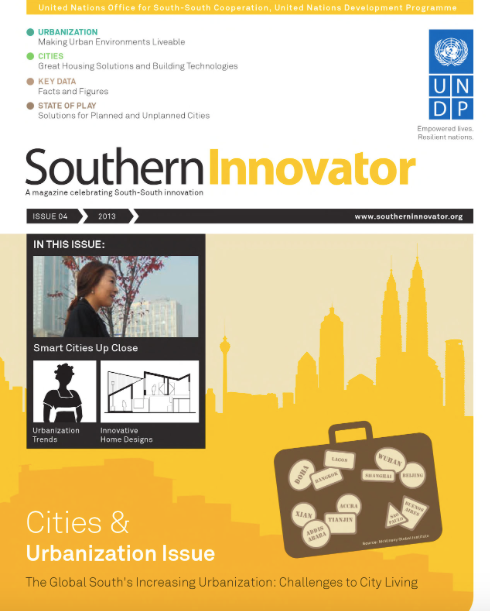
    https://davidsouthconsulting.org/2021/03/05/southern-innovator-issue-4/

    Development Challenges, South-South Solutions was launched as an e-newsletter in 2006 by UNDP’s South-South Cooperation Unit (now the United Nations Office for South-South Cooperation) based in New York, USA. It led on profiling the rise of the global South as an economic powerhouse and was one of the first regular publications to champion the global South’s innovators, entrepreneurs, and pioneers. It tracked the key trends that are now so profoundly reshaping how development is seen and done. This includes the rapid take-up of mobile phones and information technology in the global South (as profiled in the first issue of magazine Southern Innovator), the move to becoming a majority urban world, a growing global innovator culture, and the plethora of solutions being developed in the global South to tackle its problems and improve living conditions and boost human development. The success of the e-newsletter led to the launch of the magazine Southern Innovator.

    Creative Commons License

    This work is licensed under a
    Creative Commons Attribution-Noncommercial-No Derivative Works 3.0 License.

    ORCID iD: https://orcid.org/0000-0001-5311-1052.

    © David South Consulting 2023