Tag: data

  • UNDP In Mongolia: The Guide | 1997 – 1999

    UNDP In Mongolia: The Guide | 1997 – 1999

    Editor: David South

    Researcher and Writer: Jill Lawless

    Publisher: UNDP Mongolia Communications Office

    Published: Between 1997 and 1999

    Background: This is the original text from the brochure UNDP in Mongolia: The Guide first published in 1997. It, for the first time, provided a rolling update on what the United Nations was doing in Mongolia, offering key contacts and data to help advance human development in the country. It introduced transparency to the UN’s work in the country and made it easier to hold programme and project staff to account.

    Mongolia – Population

    With an area of more than 1.5 million square kilometres and a population of 2.38 million as of October 1997, Mongolia has a population density of only 1.5 people per square kilometre, one of the lowest in the world. The country has a relatively low growth rate of 1.6 per cent (1995), down from 2.5 per cent in 1989. At this rate, Mongolia’s population will reach 2.5 million by the year 2000.

    Despite the popular image of Mongolians as nomadic herders, it is an increasingly urbanized country – 51.9 per cent of the population is urban, 48.1 per cent rural. More than one quarter of Mongolians live in the capital city, Ulaanbaatar. The other major urban centres are Darhan (pop. 90,000) and Erdenet (pop. 65,000 ).

    The country is divided into 21 aimags (provinces), plus the autonomous capital region. The aimags are:

    In the centre: Tuv, Uvurhangai, Arhangai

    In the north: Bulgan, Selenge, Hovsgul, Zavhan, Darhan-Uul, Orhon

    In the east: Hentii, Dornod, Suhbaatar

    In the west: Hovd, Uvs, Bayan-Olgii, Gov-Altai

    In the south: Dundgov, Dornogov, Omnogov, Bayanhongor, Gobisumber

    The People:

    About 86 per cent of the country’s population are Kalkh Mongols. Another 7 per cent are Turkic in origin, mostly Kazakhs living in the western aimags of Bayan-Olgii and Hovd. The rest belong to a wide variety of ethnic groups, including the Buryat, Dariganga, Bayad, Zakchin and Uriankhai. Mongolia’s smallest ethnic group is the Tsaatan, about 200 of whom live as reindeer herders in the far north of the country. 

    During the communist period, Mongolia was home to tens of thousands of Russians. Few remain. 

    More than 4 million Mongols live outside Mongolia, in Russia and the Chinese province of Inner Mongolia.

    Human Development:

    – Mongolia’s per capita GDP is U.S. $359 (1995). But this fails to take into account the cashless subsistence and barter economy widespread in rural areas.

    – Poverty, though widespread, is difficult to tabulate. 1996 government figures put the poverty rate at 19.2 per cent – 19.8 per cent for rural areas, 18.7 for urban areas. But State Statistical Office figures for October 1997 indicate 36.8 per cent of urban residents and 27.5 per cent of rural Mongolians live below the poverty line. 

    – Omnogov, Gobisumber, Hovsgol, Ovorhangai and Bayanhongor are the aimags with the highest poverty rates.

    – The average monthly household income in September 1997 was 58,516.7 tugrugs (U.S. $73). Average expenditure was 58,124.8 tugrugs. In 1995, 48 per cent of household expenditure went on food. In poor households, the figure was 64 per cent.

    Social Data:

    Life expectancy: 63.8 years (1995)

    Infant mortality rate: 40 per 1000 

    Under five mortality rate: 56.4 per 1000 

    Maternal mortality rate: 185.2 per 100,000 (1995)

    One-year-old immunization rate: tuberculosis 94.4 per cent, measles 85.2 per cent (1995)

    Access to safe drinking water: rural 89.9 per cent, urban 46.1 per cent (1995)

    Access to sanitation: 74 per cent (1995)

    Adult literacy rate:

     men 97.5 per cent,

     women 96.3 per cent 

    Primary school net enrollment: 93.4 per cent

    Secondary school net enrollment: 56.9 per cent 

    Physicians: 26 per 10,000

    Hospital beds: 9.9 per 1000

    Daily calorie intake: 2278.2

    Data 1996 unless otherwise indicated. Sources: State Statistical Office, Human Development Report Mongolia 1997

    Mongolia – Economy

    An Economy in Transition:

    After 70 years of centrally planned economy, Mongolia is embracing free-market principles with a vengeance. Economic liberalization began under the Mongolian People’s Revolutionary Party government in the early 1990s. The Democratic Coalition government, elected in June 1996, has vowed sweeping economic changes, including  privatization of state assets, liberalization of trade and promotion of foreign investment.

    The foreign investment law now encourages foreign investment in the form of share purchases, joint ventures and wholly foreign-owned concerns. Mining companies are given significant tax holidays. In May, 1997 parliament abolished customs duties expect on alcohol, tobacco and oil products.

    All of this has been a shock to Mongolia and Mongolians. The country’s GDP shrank by a third in the early 1990s, though it has slowly recovered since. Inflation topped 300 per cent in 1993, but was brought down to below 50 per cent by 1997. The tugrug fell from 40 to U.S. $1 in 1991 to 800 to the dollar in 1997. Unemployment officially stands at 6.5 per cent – unofficial estimates are much higher.

    The government’s ambitious privatization scheme has stalled; manufacturing and exports are down; imports are up. Adding to the problems is the fact that world prices for Mongolia’s major export items – copper and cashmere – have fallen.

    The state retains at least 50 per cent ownership of the nation’s flagship enterprises, including the national airline, MIAT, the Gobi cashmere company and the power stations.

    Mongolia has a resource-based economy, exporting mostly raw materials and importing mostly processed goods. The top exports are mineral products, textiles, base minerals, hides, skins and furs and animals and animal products. The major imports include petroleum products, industrial equipment and consumer goods.

    Mongolia’s major trading partners are its two neighbours, China and Russia, though Korea and Japan are becoming more important – and the number-one export destination is Switzerland. 

    Sidebar: The rural economy

    Half of Mongolia’s population is rural, and herding remains the backbone of the Mongolian economy. Agriculture accounts for 30 per cent of the nation’s GDP. The number of herding households grew during the economic turmoil of the early 1990s, and now stands at more than 170,000; there are 30 million head of livestock in Mongolia. Herders produce meat, skins and furs; more and more herders are investing in cashmere goats, a substantial money-earner. 

    Cultivation of crops, on the other hand, is limited. Before 1990, Mongolia was self-sufficient in cereals and even exported to the Soviet Union. But the sector suffered badly in the early 1990s. The 1997 harvest was 239,000 tonnes, 56 per cent of 1991-95 levels and only 40 per cent of pre-1990 harvests. Mongolia must now import 40 per cent of its cereal needs, a factor that contributes to a vulnerable food-security situation. Cultivation of vegetables is up, but remains minor – only 31,000 tonnes in 1997.

    Sidebar: Rich in resources

    Mongolia is resource-rich. This vast territory contains 15 per cent of the world’s supply of fluorspar and significant deposits of copper, molybdenum, iron, phosphates, tin, nickel, zinc, tungsten and gold, as well as at least 100 billion tonnes of coal.

    Copper is the nation’s number one export. 

    Minerals account for more than a third of Mongolia’s GDP and earn half of its hard currency. Gold production is increasing.

    Mongolia also contains significant reserves of oil, which could transform the economy. But infrastructure and transportation limitations mean that commercial extraction is limited. The completion of a pipeline to China could change all this.

    Economic Data:

    Exchange rate: $1 = Tg 808 (Nov 1997)

    GDP: Tg 185.5 billion (1996)

    GDP per capita: Tg 228,605 (1996)

    Inflation: 325 per cent (1992), 53 per cent (1996)

    State budget expenditure: Tg 203.6 billion (Jan-Oct 1997)

    State budget revenue: Tg 176 billion (Jan-Oct 1997)

    Foreign aid (1991-97): U.S. 478 million

    Official external debt: Tg 522 billion (Oct 97)

    Industrial output: Tg 270.6 billion (Jan-Oct 97)

    Exports: $334.2 million (Jan-Oct 97)

    Imports: $343.3 million (Jan-Oct 97)

    Workforce: employed: 791,800, unemployed 65,700 (Oct 97)

    Source: State Statistical Office 

    Mongolia – Politics

    Seven decades of communist rule in Mongolia began to crumble in 1990, when the collapse of the old Eastern Bloc brought the first pro-democracy demonstrations. The ruling Mongolian People’s Revolutionary Party, which had already initiated a Mongolian version of glasnost, permitted the nation’s first multiparty elections in July, 1990. 

    Superior organization helped the MPRP win both the 1990 and 1992 elections (taking 71 of 76 parliamentary seats in the latter), but reform picked up speed. In 1992, the country adopted a new Constitution that enshrined human rights, private ownership and a state structure based on separation of power between legislative and judicial branches.

    In the June 1996 election, major opposition groups united to form the Democratic Coalition, made up of the National Democratic Party, the Social Democratic Party, the Believers’ Party and the Green Party. Somewhat to its own surprise, the Coalition won a healthy 50 of 76 seats in the State Ikh Hural, or parliament. The composition of the Hural is now: National Democrats 35, Social Democrats 15, MPRP 25, Mongolian Traditional United Party 1.

    In addition to their economic reforms, the Democrats have carried out radical restructuring of government, slashing the number of Ministries from 14 to 9.

    The government has a healthy majority, but tensions sometimes emerge between the coalition partners. Mongolia’s transition to democracy has been remarkably peaceful, and the young democracy is robust – there are now more than 20 political parties in the country. 

    But economic hardship has caused resentments. In the 1997 Presidential election, voters elected N. Bagabandi, the candidate of the MPRP. In the fall of 1997, the government had to face demonstrations from students and pensioners and an opposition campaign that led to a confidence vote in parliament — a vote the government easily survived. 

    Political structure:

    Mongolia has a parliamentary system of government, with a 76-seat legislature called the State Ikh Hural. The President, directly elected for a four-year term, is second in authority to the legislature, but he appoints judges and has the power of veto (which can be overturned by a 2/3 vote in parliament).

    Chronology:

    1911 collapse of Manchu Qing Dynasty; Mongolia declares its independence

    1919 China invades Mongolia

    1921 with Soviet help, Mongolia gains final independence from China

    1924 Mongolian People’s Republic declared

    1990 pro-democracy protests; Constitution amended; first multiparty elections

    1992 second multiparty elections; new Constitution adopted

    1996 Democratic Coalition elected as Mongolia’s first non-communist government, headed by Prime Minister Enkhsaikhan

    1997 N. Bagabandi from the MPRP elected President

    Voter turnout: 

    1996 elections: 92.2 per cent

    1996 local Hural: 64.0 per cent

    1997 presidential: 85.1 per cent

    Mongolia – Society and Culture

    Mongolia has a unique and durable traditional culture, centred around the herding lifestyle. Herders remain semi-nomadic, moving their animals with the seasons as they have for centuries

    Many urban Mongolians retain strong links to the land, both literal and sentimental, and the country’s performing and visual arts often celebrate the landscape and the animals — especially horses — that are central to Mongolian life. Mongolia has several distinctive musical instruments and styles, including the morin khuur (horsehead fiddle), the long song (urtyn duu) and the throat-singing style known as khoomi.

    After seven decades of communism, Mongolians are once again celebrating their traditional culture, and embracing the image and legacy of the most famous Mongolian of all time – Chinggis Khan, who in the 13th century initiated the Mongol Empire, the greatest land empire the world has ever known. He gives his name to everything from a brand of vodka to a luxury hotel, and centres for academic Chinggis research have been set up.

    In sports, Mongolians favour the “three manly sports” — wrestling, archery and horse racing — that form the core of the annual festival known as Naadam. Mongolian wrestlers have won a number of medals at international competitions and are even entering the field of Japanese Sumo.

    The 1990s have seen a flowering of freedom of expression. Mongolia has an extraordinary 525 newspapers and a wide range of magazines, while the first private radio and television stations have been established. 

    Religion:

    Mongolians have been Buddhists since the 16th century, when the Mongolian king, Altan Khan, was converted by Tibetan lamas. In the pre-revolutionary period, Mongolia was ruled by a series of Living Buddhas, or Jebtzun Damba. The eighth, and last, Jebtzun Damba was removed after the communist takeover.

    Traditionally, monasteries were centres both of learning and of power. It’s estimated Mongolia had 100,000 monks, or lamas, in 1921 — one third of the male population. In the 1930s, this power became the focus of a ruthless series of purges that reached a climax in 1937. Most of the country’s monasteries were destroyed, and as many as 17,000 monks were killed.

    Today, Mongolia is once again embracing its Buddhist heritage. Monasteries are being restored, and are once again crowded with worshippers. The Dalai Lama is an enormously popular figure and has visited the country several times.

    For many Mongolians, Buddhism is flavoured with traces of Shamanism, an even more ancient spirituality.

    Mongolia also has a significant Muslim community — about 6 per cent of the population. These are mostly ethnic Kazakhs living in the far west of the country. The opening-up of the country has led to an influx of Christian missionaries, and this remains a source of some tension and debate.

    A Young Country:

    Mongolia is a remarkably young country — more than 60 per cent of the population is below the age of 30, and 40 per cent of Mongolians are younger than 16. This young generation, with its embrace of Western styles and ideas, is changing the complexion of the country. Western pop music and North American sports like basketball have a huge following among Mongolia’s youth. So, too, do homegrown artists like the pop groups Nikiton and Spike and the singer Saraa. 

    Social Data:

    Television sets: 6.2 per 100 (1995)

    Newspapers: 2 per 100 (1995)

    Number of telephones: 82,800

    Marriage: 10.9 per 1000 over 18

    Divorce: 0.7 per 1000 over 18

    Number of pensioners: 287,200

    Crimes reported: 20,454 (Jan-Oct 97)

    As percentage of same period in 1996: 114.4 per cent

    Data 1996 unless indicated. Sources: State Statistical Office, Human Development Report Mongolia 1997

    More from Jill Lawless:

    Read a story by Jill in The Guardian (9 June 1999): Letter from Mongolia | Herding instinct 

    Read a World Health Organization (WHO) report on substance abuse and alcohol consumption (WHO Global Status Report on Alcohol 2004) citing Jill here: https://www.who.int/substance_abuse/publications/en/mongolia.pdf?ua=1 

    Further Reading:

    Modern Mongolia: From Khans to Commissars to Capitalists

    The Mongolian Economy: A Manual of Applied Economics for a Country in Transition

    The transition to a market economy: Mongolia 1990-1998

    Wild East: Travels in the New Mongolia

    This work is licensed under a Creative Commons Attribution 4.0 International License.

    ORCID iD: https://orcid.org/0000-0001-5311-1052.

    © David South Consulting 2018  

  • 2014: Development Challenges, South-South Solutions

    2014: Development Challenges, South-South Solutions

    By David SouthDevelopment Challenges, South-South Solutions

    SOUTH-SOUTH CASE STUDY 

    ISSN 2227-3905

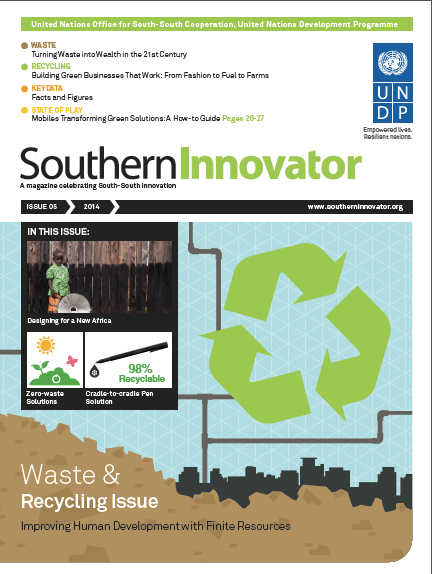
    The fifth issue of Southern Innovator has launched online and in print. Order copies now for distribution. Email: southerninnovator@yahoo.co.uk.

    Issue six will be on science, technology and innovation. This issue will be different from previous issues and will be including supplements and inserts to boost the impact of the magazine. Southern Innovator is seeking sponsors to fund this and also to help us expand the print run (currently 5,000 copies for global distribution).

    July

    3D Home Printing Landmark: 10 Houses in a Day Development Challenges: The global South is experiencing urban growth on a scale unprecedented in human history, far outstripping the great urbanization wave that swept across Europe and North America during the 19th and 20th centuries.

    Old Boats Become New Furniture in Senegal Development Challenges: Every country has its fair share of waste and the remnants of past economic activity. Old cars nobody wants, discarded tins of food, old plastic bags, spare copper wire, cast-off clothing – all can have a new life in the right hands.

    Innovative Solutions Celebrated in Ashden Awards Development Challenges: The world’s population is heading towards 9.6 billion by 2050 (UN). Combined with a growing middle class and rising living standards across the global South, that means ever-greater demand on the world’s finite resources. This raises a crucial question: Where will the energy to power rising living standards come from, and how much damage will be done to the planet’s environment by pollution created generating it (https://www.un.org/en/development/desa/news/population/un-report-world-population-projected-to-reach-9-6-billion-by-2050.html)?

    Innovative Ways to Collect Water from Air Development Challenges: World water resources are being depleted quickly as populations grow, urbanize and demand better living standards. Many scientists believe we are reaching peak water – the point at which fresh water is consumed faster than it is replenished.

    June

    Caribbean Island St. Kitts Goes Green for Tourism Development Challenges: Going green may sound like the right thing to do but it can also be associated with being a costly burden and boring. But, as one island nation is proving, being green is a great selling point for attracting tourists and investors – especially in a world where many places are grappling with pollution and resource depletion.

    Big Data Can Transform the Global South’s Growing Cities Development Challenges: The coming years will see a major new force dominating development: Big Data. The term refers to the vast quantities of digital data being generated as a result of the proliferation of mobile phones, the Internet and social media across the global South – a so-called ‘data deluge’ (UN Global Pulse). It is an historically unprecedented surge in data, much of it coming from some of the poorest places on the planet and being gathered in real time.

    Indian Business Model Makes Green Energy Affordable Development Challenges: The technology already exists to provide renewable energy and electricity to all the world’s poor. The trick is finding a way to pay for it and to make it sustainable. Many innovators are experimenting with business models to reach the so-called Bottom of the Pyramid (BOP) cohort, and the 1.2 billion poorest people in the world who do not have access to electricity (World Bank) (http://tinyurl.com/n9p3f5x). A further 2.8 billion have to rely on wood or other biomass materials to cook and heat their homes.

    South-South Trade Helping Countries During Economic Crisis Development Challenges: Weathering the global economic crisis is testing the stability of countries across the global South. But many countries are finding South-South trade and catering to their domestic middle classes can lift incomes and maintain growth rates despite the global turmoil.

    May

    3D Printing Gives Boy a New Arm in Sudan Development Challenges: 3D printing is rapidly going mainstream and is now starting to make a big impact in health care. One innovative solution is using the technology to manufacture artificial arms for amputees harmed by war in Africa.

    African Hotel Boom Bringing in New Investment and Creating Jobs Development Challenges: Africa is experiencing a boom not seen for decades. The IMF forecasts economic growth in sub-Saharan Africa of 6 per cent in 2014, compared to global growth of 3.6 per cent.

    China’s Outsourced Airliner Development Model Development Challenges: Many emerging-market countries in the global South have built up substantial foreign currency reserves. Much of this has been a response to past foreign currency crises, particularly the Asian Crisis in the late 1990s (http://en.wikipedia.org/wiki/1997_Asian_financial_crisis).

    Brazilian Design for New Urban, Middle-Class World Development Challenges: Countries across the global South are experiencing rapid urbanization as people move to cities for better economic opportunities — and this massive social change is creating new business opportunities. Those who recognize how fundamentally people’s lifestyles are changing will be those who will benefit from this big shift in populations.

    April

    Cheap Paper Microscope to Boost Fight Against Diseases Development Challenges: To tackle diseases in the developing world, the most important first step is diagnosis. Without effective diagnosis, it is difficult to go to the next steps of either treatment or cure. While much attention is given to the high costs involved in treating and curing ailments, screening for diagnosis is also expensive, especially if it involves lots of people. Anything that can reduce the cost of diagnosis will free up resources to expand the number of people who can be checked, and help eradicate contagious diseases.

    Asian Factories Starting to go Green Development Challenges: Media headlines have recently highlighted the growing air pollution crisis in Asia’s expanding cities. This is caused by a mix of factors – the growing number of vehicles, coal-powered factories, people burning dirty fuels to heat their homes, and poor enforcement of standards – and has severe consequences for human health. If it’s not tackled, more and more countries will see large rises in respiratory problems, cancers and early deaths from pollution-caused illnesses (http://www.nrdc.org/air/).

    Reality Television Teaches Business Skills in Sudan Development Challenges: Learning how to thrive in a market economy does not necessarily come naturally. But for young people who have grown up under a different economic system or known nothing but economic chaos, learning business skills can give them the tools to get on in life.

    Popular Chinese Social Media Chase New Markets Development Challenges: China has a vast and growing market for the Internet and mobile devices. Over the past decade that market has been largely confined to China –  most businesses have had enough domestic demand and opportunities inside the country to keep them busy.

    The BRCK: Kenyan-Developed Solution to Boost Internet Access Development Challenges: Using the Internet in Africa has its challenges, as anyone who has worked there knows. Issues can include weak Wi-Fi signals, slow Internet service providers, electricity outages and power surges that can damage or destroy sensitive electronic devices.

    March

    Women Empowered by Fair Trade Manufacturer Development Challenges: There is sometimes a great deal of negativity surrounding the issue of manufacturing in Africa. Some claim the risks of doing business are too high or that the workers are not motivated enough. But one garment manufacturer is out to prove the skeptics wrong. It pays decent wages and gives its mostly female workforce a stake in the business in a bid to drive motivation and make it worthwhile to work hard.

    Global South Trade Boosted with Increasing China-Africa Trade in 2013 Development Challenges: It was announced in January 2014 that China has surpassed the United States to become the world’s number one trading nation, as measured by the total value of exports and imports. This new economic behemoth also continued to grow its trade relationships with Africa.

    India 2.0: Can the Country Make the Move to the Next Level? Development Challenges: With the global economic crisis threatening to cause turmoil in the emerging markets of the global South, it is becoming clear that what worked for the past two decades may not work for the next two.

    “Pocket-Friendly” Solution to Help Farmers Go Organic Development Challenges: Interest in organic food and farming is high, and organics have become a growing global industry. The worldwide market for organic food grew by more than 25 per cent between 2008 and 2011, to US $63 billion, according to pro-organic group the Soil Association. That is an impressive accomplishment given the backdrop of the global economic crisis, and evidence that people value quality food, even in tough times.

    Cheap Farming Kit Hopes to Help More Become Farmers Development Challenges: Food security is key to economic growth and human development. A secure and affordable food supply means people can meet their nutrition needs and direct their resources to improving other aspects of their lives, such as housing, clothing, health services or education.

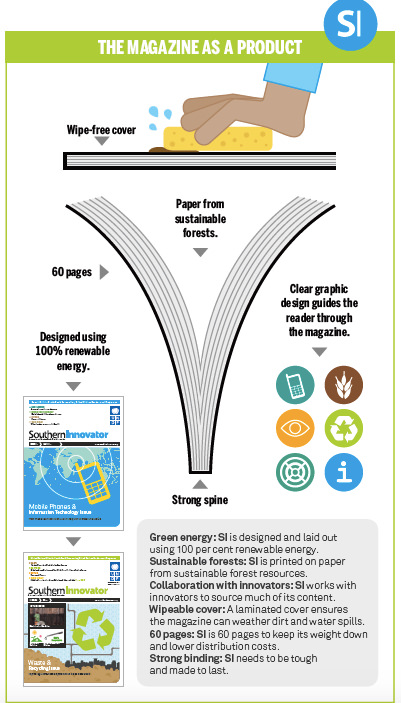
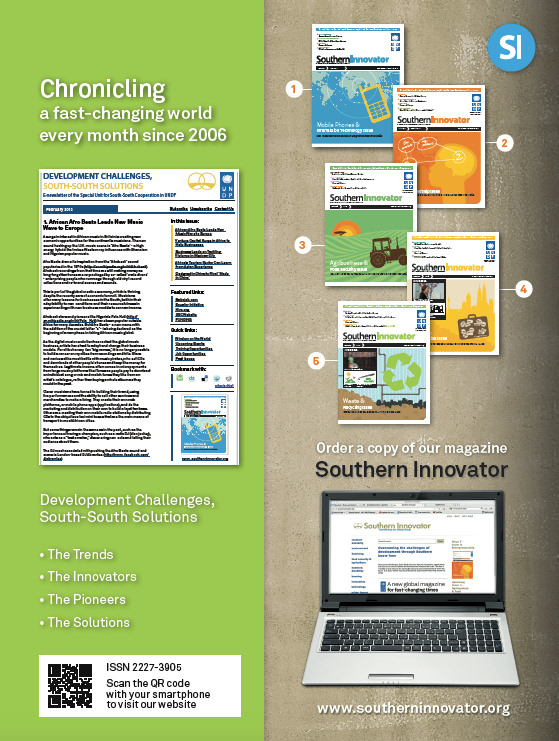
    While Southern Innovator’s digital presence has been key to its success and global reach, the hard copy of the magazine was designed with special features. The magazine needed to be robust and able to stand a fair bit of abuse and hard wear. It needed to be easy to read in low light conditions. And it needed to look sharp and eye-catching to reach as wide an audience as possible.

    Back Issues

    Development Challenges, South-South Solutions Newsletter | 2011-2014

    Development Challenges, South-South Solutions Newsletter | 2007-2010

    2013

    2012

    2011

    2010

    2009

    2008

    2007

    ISSN Portal.
    South-South cooperation for development, SSC/17/3, High-level Committee on South-South Cooperation, 12 April 2012.

    Development Challenges, South-South Solutions was launched as an e-newsletter in 2006 by UNDP’s South-South Cooperation Unit (now the United Nations Office for South-South Cooperation) based in New York, USA. It led on profiling the rise of the global South as an economic powerhouse and was one of the first regular publications to champion the global South’s innovators, entrepreneurs, and pioneers. It tracked the key trends that are now so profoundly reshaping how development is seen and done. This includes the rapid take-up of mobile phones and information technology in the global South (as profiled in the first issue of magazine Southern Innovator), the move to becoming a majority urban world, a growing global innovator culture, and the plethora of solutions being developed in the global South to tackle its problems and improve living conditions and boost human development. The success of the e-newsletter led to the launch of the magazine Southern Innovator.

    Creative Commons License

    This work is licensed under a
    Creative Commons Attribution-Noncommercial-No Derivative Works 3.0 License.

    ORCID iD: https://orcid.org/0000-0001-5311-1052.

    © David South Consulting 2022

  • Research Reviews | 2001 – 2002

    Research Reviews | 2001 – 2002

    2001

    Research Review 2001: A Year of Excellence and Innovation 

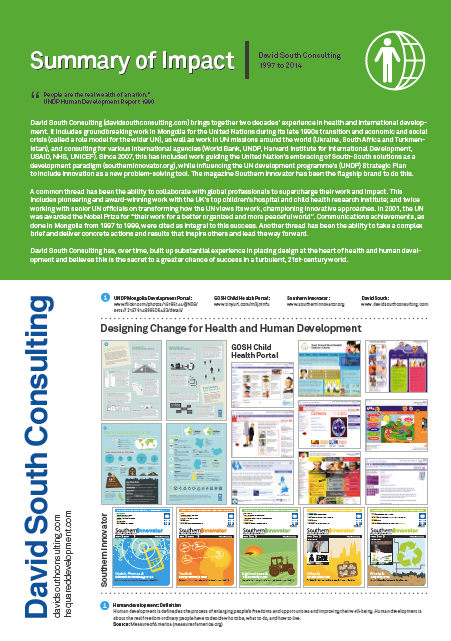
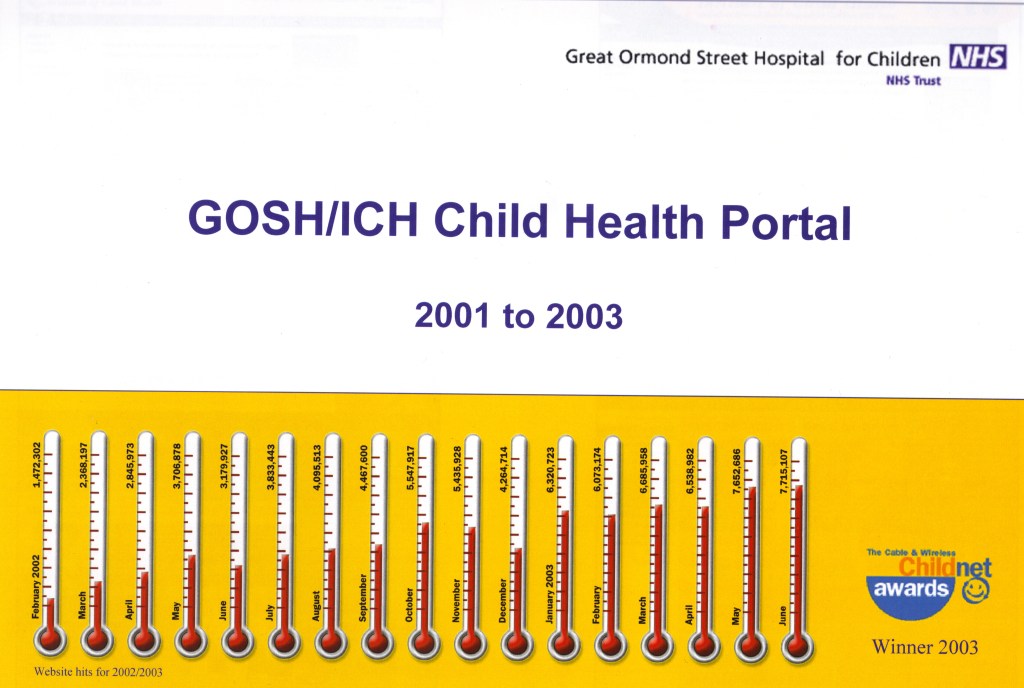
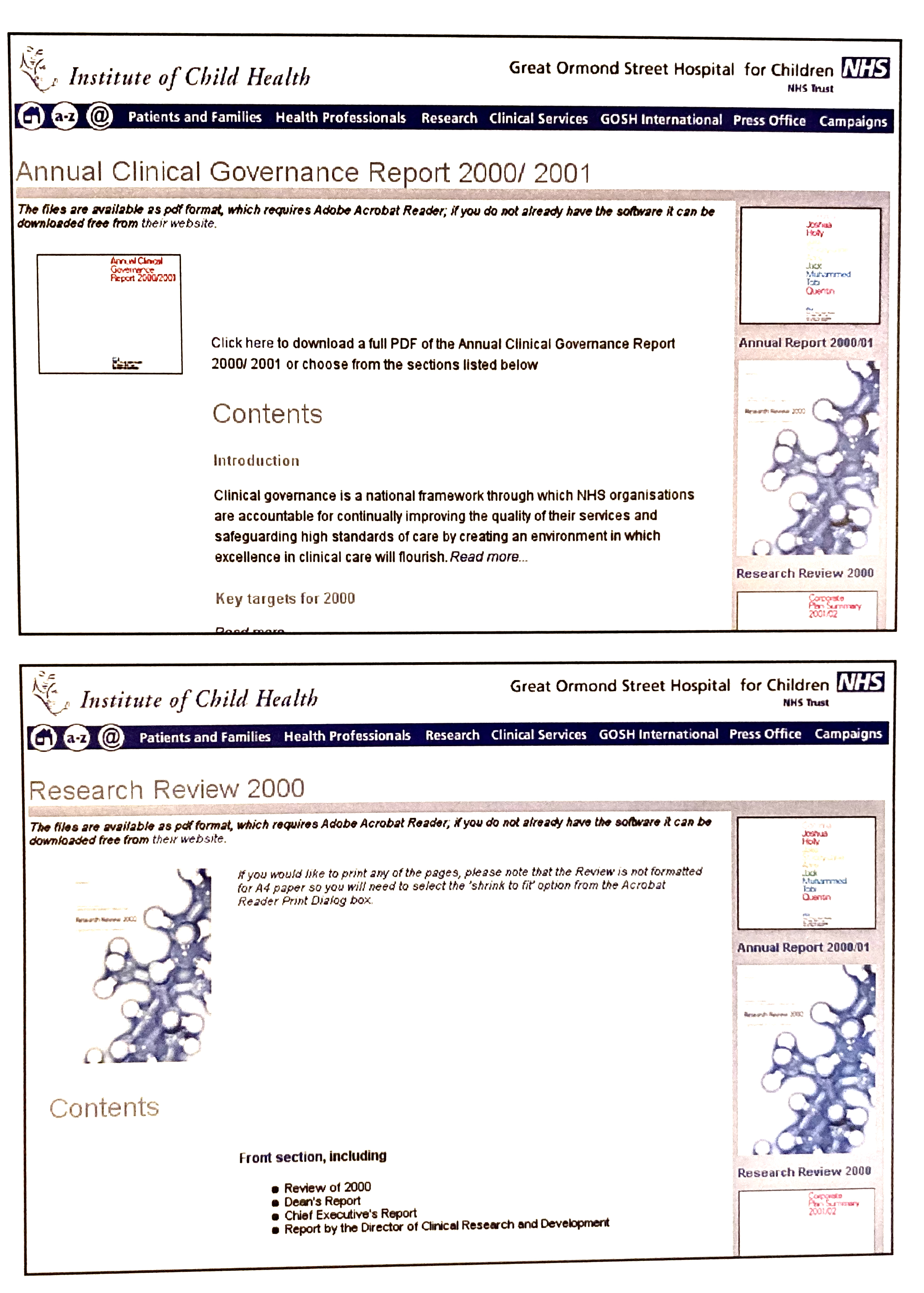
    Britain’s best-loved children’s hospital and charity, Great Ormond Street Hospital for Children NHS Trust (GOSH), contracted me to lead a two-year project to modernise the hospital’s web presence and take its brand into the 21st century.

    2002

    Research Review 2002: Building on Success 

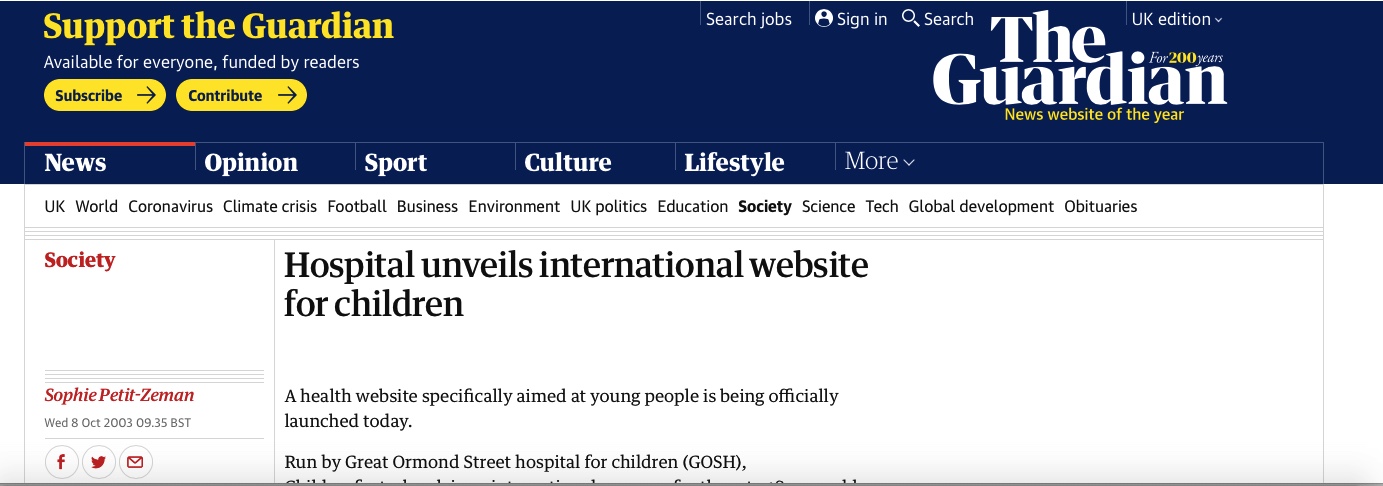
    In 2003, the UK’s Guardian newspaper called the Children First website one of the “three most admired websites in the UK public and voluntary sectors,” and a UK government assessment called the overall GOSH child health web portal a role model for the NHS.
    Content produced for the GOSH Child Health Portal (now MyGOSH) in 2003 on the ketogenic diet and how it can help with the treatment of epilepsy.
    “A highly attractive website written by and with children at Britain’s biggest specialist hospital for children. The site is carefully segmented for different age groups and provides a powerful platform on which children can reach out from the confines of their hospital wards, share their experiences and learn about a range of medical issues as well as have access to fun interactive resources.”

    This work is licensed under a Creative Commons Attribution 4.0 International License.

    ORCID iD: https://orcid.org/0000-0001-5311-1052.

    © David South Consulting 2024

  • South-South Trade Helping Countries During Economic Crisis

    South-South Trade Helping Countries During Economic Crisis

    By David SouthDevelopment Challenges, South-South Solutions

    SOUTH-SOUTH CASE STUDY

    Weathering the global economic crisis is testing the stability of countries across the global South. But many countries are finding South-South trade and catering to their domestic middle classes can lift incomes and maintain growth rates despite the global turmoil.

    A decade of boom in global markets as they became more integrated has brought rising incomes and created growing economies in the so-called emerging markets of the global South. Finance and investment from developed countries flowed into the global South and helped bolster growing economies, boosting incomes and bringing millions of people into the middle classes. But since the start of the global economic crisis in 2008, more and more countries in the global South have experienced turmoil, chaos and crisis.

    The export-driven model that had served many Asian countries well – creating products for developed Western markets – is being tested by high unemployment in developed economies and declining purchasing power for the Western middle classes. Two trends that have grown in the past 10 years may offer a solution to this economic crisis. One is to build on the growth in South-South trade, and the other is to tap the growing middle classes of the global South by expanding the products and services available to them and further improving their quality of life.

    It is well established that one of the key elements to securing sustainable prosperity is a thriving middle class. Middle classes in many countries in the global South are still classified as vulnerable – at risk of returning to poverty if the economy experiences a short-term crisis. Their resilience to an economic downturn needs to be strengthened, and this can be done by improving the quality of products and services available to them.

    Building this market can also strengthen domestic job growth and help reduce a country’s dependence on imports.

    One country facing up to this challenge is Indonesia. The New York Times recently reported that ports in Indonesia and other resource-exporting countries are quiet, as China’s demand for resources slows.

    But while export markets are experiencing a slowdown, investment is going into Indonesia’s agricultural food-processing industry. Agricultural multinational Cargill (cargill.com) is building a cocoa-bean processing plant in the country, and the PT. Suprama (suprama.co.id/en/) instant-noodle factory is running at full capacity to meet the needs of the country’s growing middle class.

    Many countries have experienced significant inflows of investment money as a result of stimulus measures led by the United States Federal Reserve (http://www.federalreserve.gov/faqs/about_12594.htm) to counter the economic contraction caused by the global economic crisis. This money, however, is uncertain and can just as easily disappear as it leaves to chase the next opportunity. Wise countries take measures to avoid being dependent on this fickle and fast investment funding.

    Unlike in the Asian Crisis of 1997-1998 (http://en.wikipedia.org/wiki/1997_Asian_financial_crisis), many emerging-market countries now have large foreign currency reserves and robust stock markets. They have also built up their middle classes and increased consumption. Trade links with other countries in the global South have grown enormously since the late 1990s. For example, the trade between China and Africa, as announced by Chinese President Xi Jinping (http://en.wikipedia.org/wiki/Xi_Jinping) in early 2014, has surpassed US $200 billion for the first time, turning China into Africa’s largest trading partner

    The relationship between trade and poverty reduction, the case of China.

    Despite a raging global crisis, in many emerging economies domestic spending is holding up and, in some cases, has never been stronger.

    China now plays a key role in maintaining global economic demand. According to the global bank HSBC, Chinese growth adds “twice as many dollars to annual global demand as growth in the United States economy and far more than the economies of the European Union.”

    An article in The New York Times (http://www.nytimes.com/2014/02/13/business/emerging-markets-in-asia-in-a-delicate-limbo.html?_r=0) suggested that global South countries can benefit from these trends by becoming an alternative to China’s “own increasingly high-cost producers of coal, aluminum, and other minerals” – as well as of clothing, shoes and electronics.

    China is also in the process of altering its economy, from being the low-wage workshop of the world to an increasingly high-tech, high-value economy with growing science, technology and innovation sectors buoyed by heavy investment in research and development, for example China’s Xi’an Hi-tech Industries Development Zone (xdz.com). As China changes, other countries can step in and replace the industries that no longer find China an affordable place to manufacture their goods.

    As an example, the Indonesian vice minister of trade, Bayu Krisnamurthi, announced that the Foxconn Technology Group of Taiwan (foxconn.com), which makes components and assembles devices for the popular Apple (apple.com) computer brand, is looking to set up a large factory in Indonesia.

    “The other brands will come in their footsteps,” Krisnamurthi told The New York Times.

    Other countries are bucking the crisis trend and using greater freedom to boost economic growth.

    Cuba has been able to bounce back with free-market reforms. The Caribbean island has had its ups and downs economically since its revolution in the late 1950s. After the revolution, the country had several decades of impressive human development gains and built up enviable education and health care systems. But with the collapse of the Soviet Union in the early 1990s, the country lost its trade relationships and subsidies and was pitched into a major economic crisis.

    During the Cold War, the USSR hoovered up almost all of Cuba’s exports of sugar, nickel and citrus fruit, and sold Cuba two-thirds of its food and 98 per cent of its fuel.

    What was termed the “special period” after the collapse of the Soviet Union saw petrol become scarce. Many had to turn to cycling and walking to get around. Factories closed and food production declined.

    One estimate by Hal Klepak of the Royal Military College of Canada, reported in The Observer newspaper, found the economy collapsed by 50 per cent in the five years to 1993.

    Since then, Cuba has endured significant austerity and has struggled to regain its trade relationships and restore economic growth. Tourism has played a key role in keeping the country going.

    And since 2008, various economic reforms have started to shift the economy away from over-dependence on the state and towards a more mixed market model.

    Its capital, Havana, is a UNESCO world heritage site and is a popular tourist destination with one of the best-preserved former Spanish colonial architecture in the Caribbean.

    When President Raul Castro took over from his brother Fidel, he began to slowly experiment with reforms to test how much market freedom could boost the economy and increase incomes. This has included allowing paladares, or privately-run restaurants, which are now flourishing and benefiting from the steady flow of tourists to the island.

    The state now allows people to set up as independent traders in 200 occupations. Some have established entertainment businesses such as paint balling, others are running bars, or bookshops. It is now possible to easily change money in Havana and to find accommodation in private homes. Cash machines are spreading throughout the capital and more and more businesses will accept credit cards.

    Registered businesspeople rose from 157,000 in October 2011 to more than 442,000 in 2013.

    By being flexible, it is possible to discover new ways to grow economies and increase incomes, even in hard times. And increasing South-South trade is the way to go.

    Published: June 2014

    Resources

    1) The China Africa Project: The China Africa Project is a multimedia resource dedicated to exploring every aspect of China’s growing engagement with Africa. Website: chinaafricaproject.com

    2) China’s trade and investment in Africa: Resources to contribute to more informed investment and trade policies and decision making in sectors and locations where China is emerging as a major player. Website: http://www.cifor.org/china-africa/home.html

    Made-in-China.com: With the continuous and explosive growth of Chinese exports, trade and the number of internet users, Focus Technology launched its online trade platform, Made-in-China.com. Made-in-China.com provides the most complete, accurate and up-to-date information on Chinese products and Chinese suppliers available anywhere on the web. Nowadays, Made-in-China.com is a world-leading B2B portal, specializing in bridging the gap between global buyers and quality Chinese suppliers. Website: made-in-china.com

    4) Southern Innovator Issue 2: Youth and Entrepreneurship: Called “Graphically beautiful & informative”, Issue 2 features entrepreneurial solutions for escaping poverty relevant to youth. Website: http://books.google.co.uk/books?id=Ty0N969dcssC&dq=southern+innovator+issue+2&source=gbs_navlinks_s

    Development Challenges, South-South Solutions was launched as an e-newsletter in 2006 by UNDP’s South-South Cooperation Unit (now the United Nations Office for South-South Cooperation) based in New York, USA. It led on profiling the rise of the global South as an economic powerhouse and was one of the first regular publications to champion the global South’s innovators, entrepreneurs, and pioneers. It tracked the key trends that are now so profoundly reshaping how development is seen and done. This includes the rapid take-up of mobile phones and information technology in the global South (as profiled in the first issue of magazine Southern Innovator), the move to becoming a majority urban world, a growing global innovator culture, and the plethora of solutions being developed in the global South to tackle its problems and improve living conditions and boost human development. The success of the e-newsletter led to the launch of the magazine Southern Innovator.  

    Follow @SouthSouth1

    Google Books: https://books.google.co.uk/books?id=m5GYBgAAQBAJ&dq=development+challenges+may+2012&source=gbs_navlinks_s

    Slideshare: http://www.slideshare.net/DavidSouth1/development-challengessouthsouthsolutionsmay2012issue

    Southern Innovator Issue 1: https://books.google.co.uk/books?id=Q1O54YSE2BgC&dq=southern+innovator&source=gbs_navlinks_s

    Southern Innovator Issue 2: https://books.google.co.uk/books?id=Ty0N969dcssC&dq=southern+innovator&source=gbs_navlinks_s

    Southern Innovator Issue 3: https://books.google.co.uk/books?id=AQNt4YmhZagC&dq=southern+innovator&source=gbs_navlinks_s

    Southern Innovator Issue 4: https://books.google.co.uk/books?id=9T_n2tA7l4EC&dq=southern+innovator&source=gbs_navlinks_s

    Southern Innovator Issue 5: https://books.google.co.uk/books?id=6ILdAgAAQBAJ&dq=southern+innovator&source=gbs_navlinks_s

    China has been a member of the WTO (World Trade Organization) since 11 December 2001.
    Creative Commons License

    This work is licensed under a
    Creative Commons Attribution-Noncommercial-No Derivative Works 3.0 License.

    ORCID iD: https://orcid.org/0000-0001-5311-1052.

    © David South Consulting 2023