Tag: data

  • Help is at Hand for India’s Beleaguered Bus-riders

    Help is at Hand for India’s Beleaguered Bus-riders

    By David South, Development Challenges, South-South Solutions

    SOUTH-SOUTH CASE STUDY

    The website is a simple affair: a distinctive logo sits above a lean-looking booking system that allows users to enter their journey start and end destination, date and then click for available buses and prices. Its simplicity is deceptive: redBus is a smart technological solution to a very complicated problem in India: booking and buying a bus ticket. The service it offers – relief from a chaotic, frustrating and time-consuming task – is transforming the experience of travel in India.

    Based in India’s technology hub of Bangalore (http://en.wikipedia.org/wiki/Bangalore), redBus (redbus.in) is a web start-up begun by young whizzes from technology companies who decided to take a risk and venture out and do something new.

    Back in 2005, redBus’ three founders, all graduates of one of India’s top engineering schools, were working in Bangalore for well-known information technology companies such as IBM, Texas Instruments and Honeywell.

    As they tell the story on their website, it was the difficulty of getting a bus home during the Hindu religious festival of Diwali that prompted the inspiration. The trip was a last-minute decision, and buying bus tickets proved far from easy. On top of failing to get a ticket from various travel agents, journeying around Bangalore meant encountering the city’s traffic gridlock.

    This experience led to the idea of developing a service to book bus tickets over the Internet.

    RedBus quickly evolved into an innovative service offering multiple options to customers. They can call a phone number and speak to a customer service representative or use a mobile phone to book a ticket. RedBus claims to have sold more than 8,000,000 tickets to date.

    Tickets are also delivered to customers in major cities in advance of their travel. Even more conveniently, redBus developed a service called mTicket. It sends the ticket by SMS (mobile phone text message) straight away when a customer makes a booking. The mTicket appears on the display screen of the mobile phone and the customer just has to show their mTicket to the driver to board the bus.

    RedBus uses partnerships to expand their distribution network, and this means redBus tickets can be purchased at more than 75,000 outlets. The company now works with more than 350 bus operators, allowing customers to book tickets on more than 4,500 routes across India.

    The service set out to achieve two goals: create a one-stop shop for ticket purchases, and to make it possible for customers to get tickets when they needed them and not be told they have been sold out.

    Indians were already having success with booking airline tickets online. But nobody else had thought of doing central, online sales for bus tickets before.

    Research was behind redBus’ success. The founders interviewed bus operators, consumers and venture capitalists before setting up the business.

    They then set about writing the code for the Internet service and put together a business plan and presented it to The Indus Entrepreneurs (TiE) (tie.org) – a network of mentors who help young entrepreneurs. With the support in place, they were able to leave their well-paying, secure jobs to start redBus.

    Among the many challenges they faced was changing the mindset of bus operators used to dealing only with travel agents working out of sales offices.

    It also took time for the concept to take off. But as word-of-mouth got around, more people started to use the website. The young team grew from just three to 50 within nine months.

    Their business success, as they describe it, is the result of listening to, and soliciting feedback from their customers. They say it has helped them identify what is going wrong and fix it, and describe their business culture as “learn, implement, grow.” They also have a culture of sharing ideas and mistakes to encourage learning. It seems it is this buzzy, youthful and always-learning business culture that is behind redBus’ success.

    Resources

    1) IDiscoverIndia: A website detailing how to explore India’s vast bus network.Website: http://www.idiscoverindia.com/Travel_Info/india_travel_bus.html

    2) TiE: Fostering Entrepreneurship Globally: The Indus Entrepreneurs (TiE),was founded in 1992 in Silicon Valley by a group of successful entrepreneurs, corporate executives, and senior professionals with roots in the Indus region. TiE’s mission is to foster entrepreneurship globally through mentoring, networking, and education. Dedicated to the virtuous cycle of wealth creation and giving back to the community, TiE’s focus is on generating and nurturing our next generation of entrepreneurs. Website: tie.org

    Creative Commons License

    This work is licensed under a
    Creative Commons Attribution-Noncommercial-No Derivative Works 3.0 License.

    ORCID iD: https://orcid.org/0000-0001-5311-1052.

    © David South Consulting 2021

  • Human Development Report Mongolia | 1997

    Human Development Report Mongolia | 1997

    This groundbreaking Mongolian Human Development Report – the country’s first – went beyond just chronicling Mongolia’s state of development in statistics and graphs. It placed the story of the Mongolian people during the transition years (post-1989) at its heart, using photographs, stories and case studies to detail the bigger narrative at play.

    Designed, laid out and published in Mongolia, the report broke with the practices of many other international organisations, who would publish outside of Mongolia – denying local companies much-needed work. The report’s costs helped to kick-start a publishing boom in the country and significantly raised standards in design and layout. The foundations laid down by the project producing the report ushered in a new age in publishing for Mongolia.

    The report’s launch was innovative, not only being distributed for free across the country, but also part of a multimedia campaign including television programming, public posters, town hall meetings and a ‘roadshow’ featuring the report’s researchers and writers.

    The initial print run of 10,000 copies was doubled as demand for the report increased. To the surprise of many, once hearing about the free report, herders would travel to the capital, Ulaanbaatar, to pick up their copy. The report proved people cared passionately about the development of their country and that development concepts are not to be the secret domain of ‘development practitioners’.

    You can read the report’s pdf here: books.google.co.uk/books?id=dx7Q-yJot_cC&printsec=fro…

    The MHDR 1997 was so popular it had two print runs. It has been cited in many books, journals and publications. It was the first exhaustive account of the country’s turbulent transition years and mapped the extent of poverty in the country.
    The Human Development Report Mongolia 1997 is available in many library collections around the world. In this case, the Oulu University Library Finland.
    The award-winning UN/UNDP Mongolia Development Portal was launched in 1997. It quickly became the go-to source on Mongolia’s development challenges.
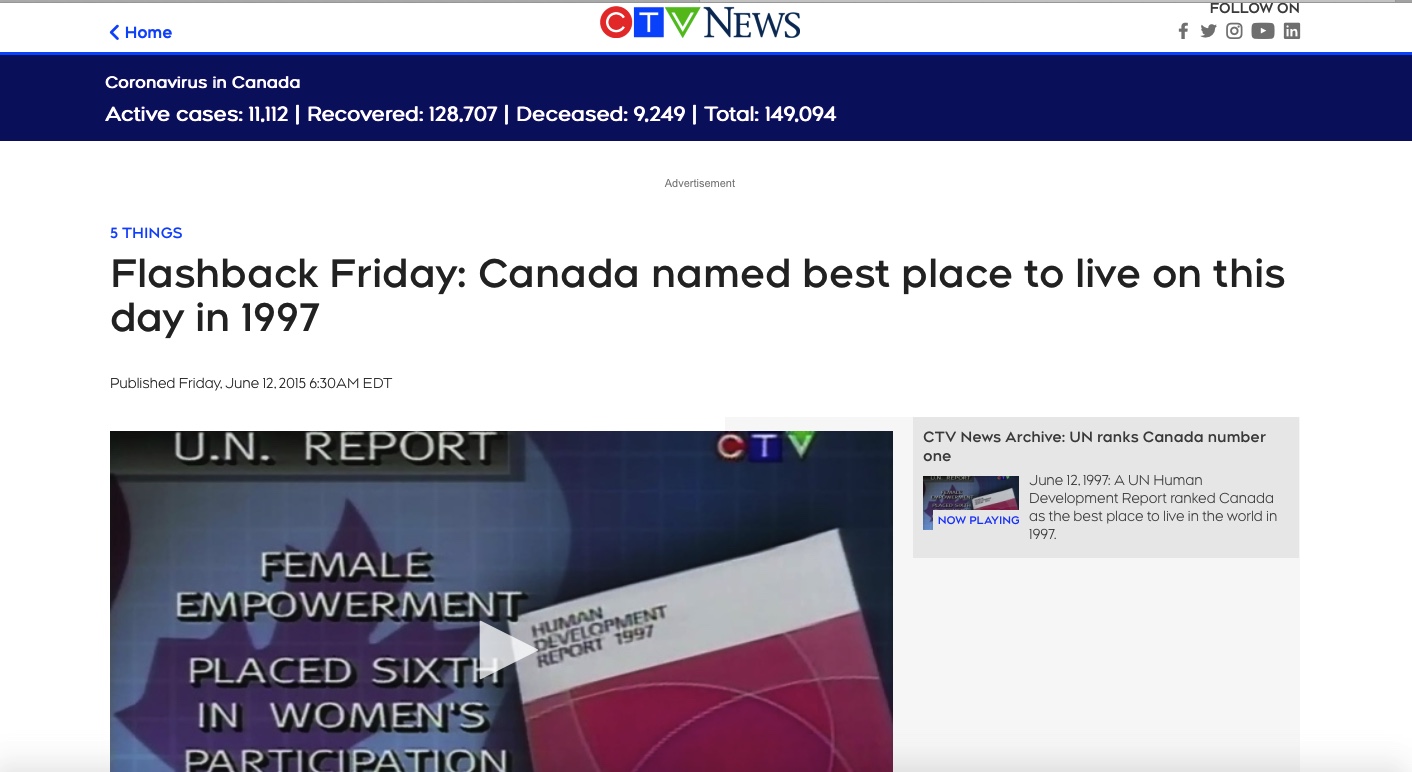
    CTV News: “Canada named best place to live on this day in 1997”. I considered it an enormous privilege to be given the opportunity to work with fellow Canadians on sharing our experiences with Mongolia during the 1990s crisis.

    “On this day in 1997, Canada was on top of the world. Or at least, on top of the United Nations’ annual ranking of the best places to live in the world.

    “CTV News archival footage captured a proud moment for Canada on June 12, 1997, as then-National News anchor Lloyd Robertson hailed the UN ranking as a “report card to be proud of.”

    “It’s not quite straight As but Canada is still at the head of the class,” Robertson said. “In fact, it’s No. 1 in the world.”

    Related Links

    “Canada beat out France, Norway, the United States and Iceland for top spot on the UN human development list, which ranks countries based on a variety of factors linked to quality of life.

    “It was the fourth straight year Canada topped the list.

    “Canada earned top marks in the life expectancy, health, education and income categories, which helped propel the country’s overall Human Development Index score to No. 1 in the world.”

    This work is licensed under a Creative Commons Attribution 4.0 International License.

    ORCID iD: https://orcid.org/0000-0001-5311-1052.

    © David South Consulting 2023

  • African Health Data Revolution

    African Health Data Revolution

    By David SouthDevelopment Challenges, South-South Solutions

    SOUTH-SOUTH CASE STUDY

    A pioneering tool for gathering health data now being used in Kenya could herald a revolution in the way diseases are tracked and defeated around the world. It uses mobile phones to better connect patients with medical and health personnel, and allows data to be gathered in real-time and used to track health and improve the delivery of services, especially to remote and under-serviced areas.

    In the past couple of years, Kenya has become a hotbed of mobile phone and information technology innovation. The now-famous Ushahidi crisis-mapping platform (www.ushahidi.com) is just one example. Social enterprise Data Dyne (www.datadyne.org) – with offices in Washington DC and Nairobi, Kenya – is offering its EpiSurveyor application (www.episurveyor.org) free to all to aid health data collection. It bills itself as “the first cloud-computing application for international development and global health … Think of it as like Gmail, but for data collection!”

    EpiSurveyor claims to have more than 2,600 users around the world and is currently being upgraded to a second version.

    “With the touch of a button I can see what’s going on across the country in real time,” Kenyan civil servant Yusuf Ibrahim told Britain’s Daily Telegraph newspaper. “It is amazing.”

    Ibrahim works in Nairobi as the Kenyan Ministry of Health liaison to Data Dyne.

    He uses maps and charts on mobile phones to track deadly disease outbreaks and vulnerable pregnancies.

    The EpiSurveyor application works simply: A user logs into the website and builds and creates the sort of form they want. They then download it to a phone and start collecting data straight away.

    Ibrahim gathers this data from mobile phones used by health care workers across the country.

    “It used to take days, weeks or even a couple of months to find out about an outbreak of polio on the other side of the country,” he said. “Now we know almost instantly. The speed with which we can now collect information has catapulted healthcare and prevention to another level. It has completely changed healthcare and saved countless lives.”

    He proudly points out Kenya’s mobile phone data collection system is “probably better than what they’ve got in the West.”

    “Although we are a third world country, I’m pretty sure we’ve done this before

    Western countries. While they are still collecting information in hard copy on clipboards, we are getting it instantly.”

    Packed with data processing power, mobile phones are capable of an immense range of tasks and applications. Some see phones as key to a revolution in how healthcare is provided: the mobile phone becomes one-part clinic, another part mobile hospital dispensing advice and transmitting vital information back to healthcare professionals and scientists in hospitals and labs.

    Despite dramatic improvements to the quality of hospitals in Africa and the number of qualified doctors, the continent’s healthcare services are still a patchwork, with rural and slum dwellers poorly served and the stresses of treating patients with contagious diseases like HIV/AIDS and malaria pushing resources to the limit.

    The United Nations has a number of initiatives partnering with mobile phone manufacturers, networks and software developers as part of a global campaign to reduce HIV/AIDS, malaria and deaths in childbirth.

    EpiSurveyor is being used by more than 15 countries’ ministries of health and is the adopted standard for the World Health Organization (www.who.int) (WHO) for electronic health data collection.

    It began as a partnership with the United Nations Foundation, The Vodafone Group Foundation, WHO and the ministries of health of Kenya and Zambia in 2006 to pilot test the software for EpiSurveyor.

    At the United Nations Foundation (www.unfoundation.org), chief executive Kathy Calvin equates the impact of mobile phones on global healthcare to the discovery of the antibiotic penicillin.

    “Instead of building clinics and roads to remote towns and villages so that people can access healthcare, we are bringing healthcare directly to the people via mobile phones. You get a lot more healthcare for your money,” Calvin told the Telegraph.

    Published: November 2010

    https://davidsouthconsulting.org/2022/10/06/african-technology-tackles-health-needs/

    https://davidsouthconsulting.org/2020/12/04/big-data-can-transform-the-global-souths-growing-cities/

    https://davidsouthconsulting.org/2021/01/18/cheap-paper-microscope-to-boost-fight-against-diseases/

    https://davidsouthconsulting.org/2020/12/04/data-surge-across-global-south-promises-to-re-shape-the-internet/

    https://davidsouthconsulting.org/2022/10/18/indians-fighting-inflation-with-technology/

    https://davidsouthconsulting.org/2022/10/12/lagos-traffic-crunch-gets-a-new-solution/

    https://davidsouthconsulting.org/2022/10/31/mapping-beirut-brings-city-to-light/

    https://davidsouthconsulting.org/2022/10/17/mapping-to-protect-kenyas-environment-the-emazingira-solution/

    https://davidsouthconsulting.org/2022/03/08/mobile-phone-microscopes-to-revolutionize-health-diagnostics/

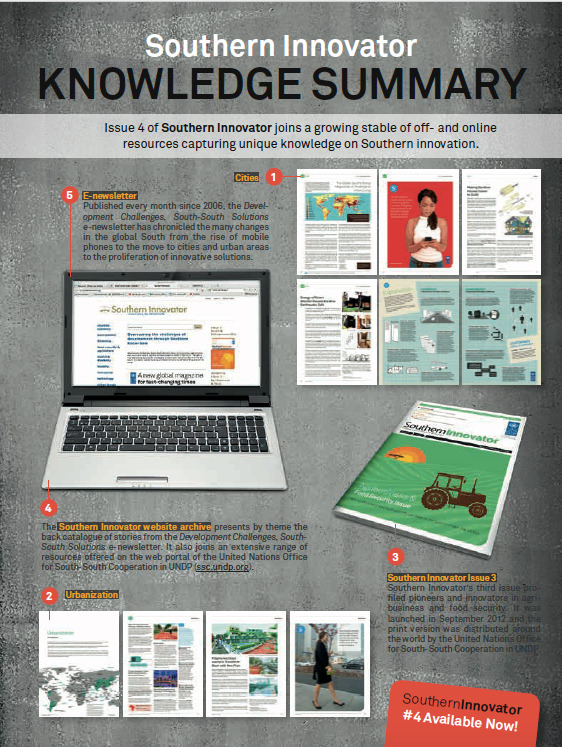
    Development Challenges, South-South Solutions was launched as an e-newsletter in 2006 by UNDP’s South-South Cooperation Unit (now the United Nations Office for South-South Cooperation) based in New York, USA. It led on profiling the rise of the global South as an economic powerhouse and was one of the first regular publications to champion the global South’s innovators, entrepreneurs, and pioneers. It tracked the key trends that are now so profoundly reshaping how development is seen and done. This includes the rapid take-up of mobile phones and information technology in the global South (as profiled in the first issue of magazine Southern Innovator), the move to becoming a majority urban world, a growing global innovator culture, and the plethora of solutions being developed in the global South to tackle its problems and improve living conditions and boost human development. The success of the e-newsletter led to the launch of the magazine Southern Innovator.  

    https://davidsouthconsulting.org/2021/03/05/southern-innovator-issue-1/

    Follow @SouthSouth1

    Slideshare: http://www.slideshare.net/DavidSouth1/development-challengessouthsouthsolutionsnovember2010issue

    Southern Innovator Issue 1: https://books.google.co.uk/books?id=Q1O54YSE2BgC&dq=southern+innovator&source=gbs_navlinks_s

    Southern Innovator Issue 2: https://books.google.co.uk/books?id=Ty0N969dcssC&dq=southern+innovator&source=gbs_navlinks_s

    Southern Innovator Issue 3: https://books.google.co.uk/books?id=AQNt4YmhZagC&dq=southern+innovator&source=gbs_navlinks_s

    Southern Innovator Issue 4: https://books.google.co.uk/books?id=9T_n2tA7l4EC&dq=southern+innovator&source=gbs_navlinks_s

    Southern Innovator Issue 5: https://books.google.co.uk/books?id=6ILdAgAAQBAJ&dq=southern+innovator&source=gbs_navlinks_s

    Creative Commons License
    This work is licensed under a
    Creative Commons Attribution-Noncommercial-No Derivative Works 3.0 License.

    ORCID iD: https://orcid.org/0000-0001-5311-1052.

    © David South Consulting 2022

  • Press Release 1 | Southern Innovator

    Press Release 1 | Southern Innovator

    Press Release for General Distribution

    New Magazine Targets Innovators in Global South

    United Nations, New York, 20 September 2011

    • Global magazine Southern Innovator profiles innovation culture ending poverty
    • 60-page color magazine gives snapshot of fast-changing world

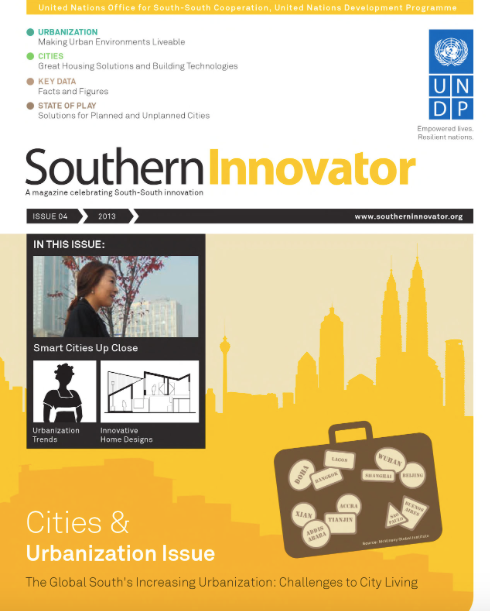
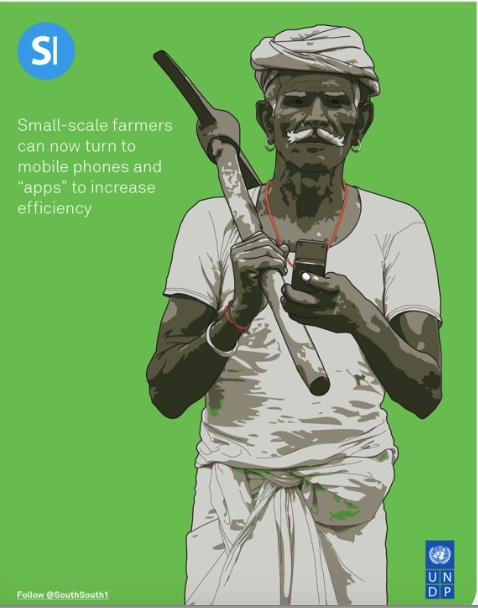
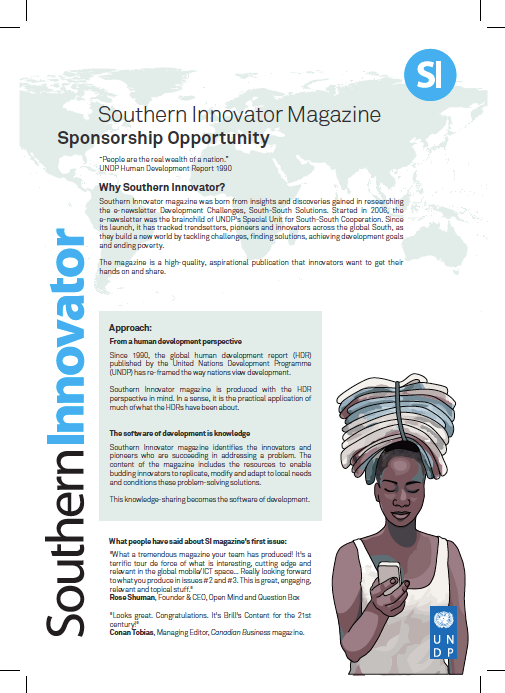
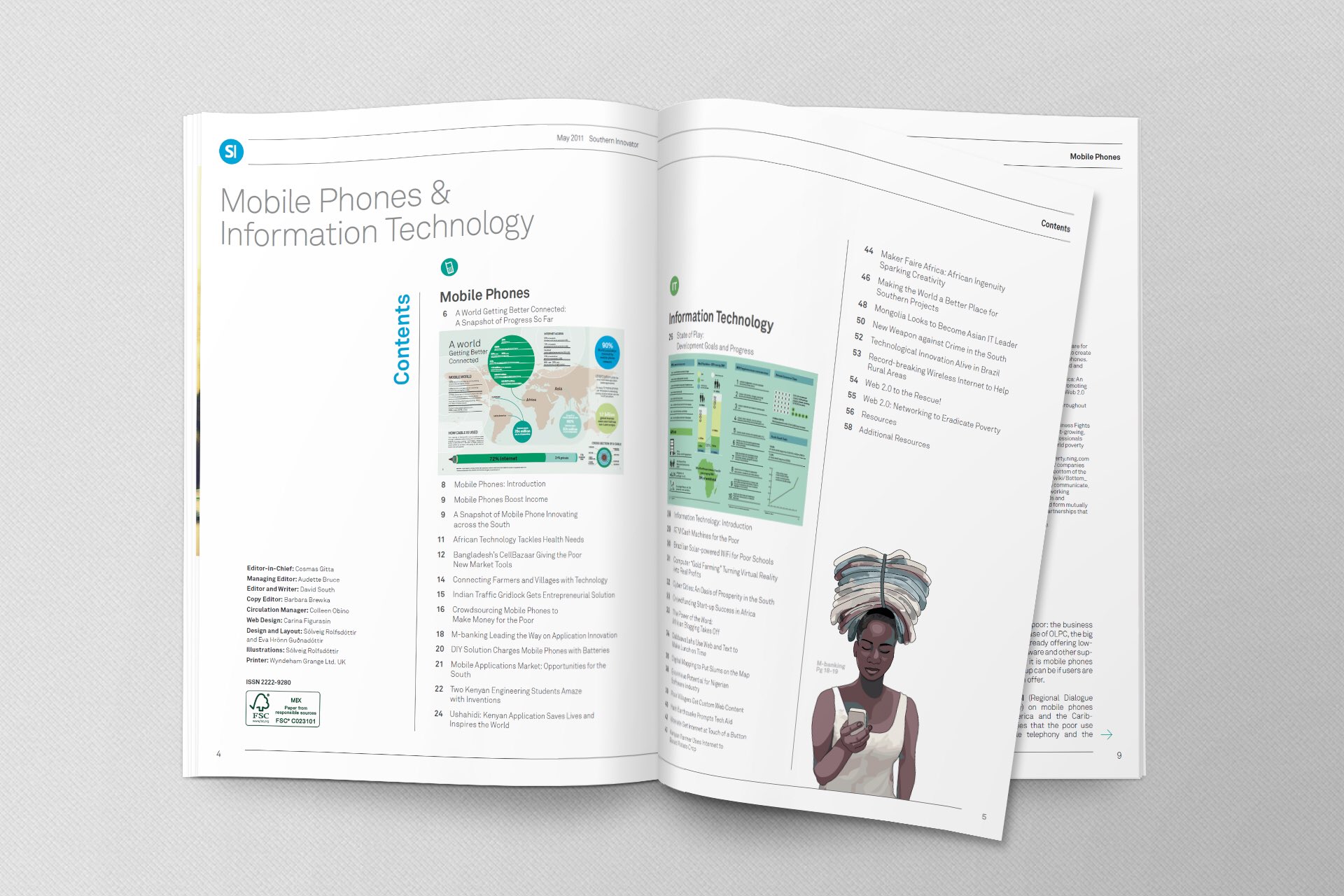
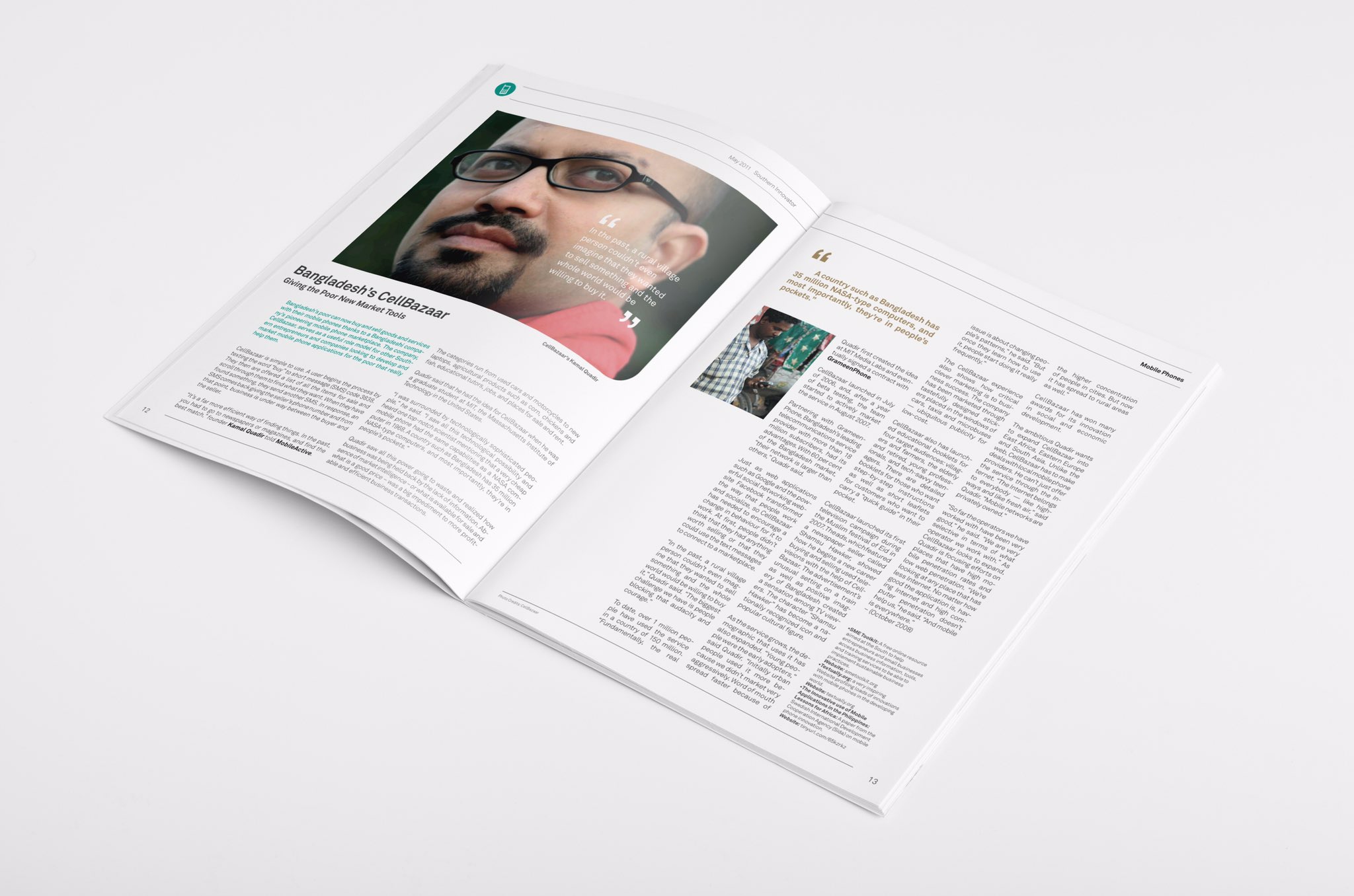
    Southern Innovator (SI) is a new magazine for a fast-changing world. It profiles and celebrates the innovators across the global South finding new ways to tackle poverty, create wealth and improve human development and achieve the millennium development goals (MDGs). In its first issue, Southern Innovator features the people who are re-shaping new technologies – from mobile phone ‘apps’ to Internet technologies – to overcome poverty and to improve the quality of life in some of the poorest places on earth.

    SI is based on intensive research and is produced by UNDP’s Special Unit for South-South Cooperation (www.southerninnovator.org). The Unit is the leading organisation in the world tasked with the goal of sharing knowledge across the global South. It organises events including the yearly South-South Expo (www.southsouthexpo.org), a roaming celebration and gathering of Southern innovators previously held in New York and Geneva, Switzerland. This year’s Expo will be held in Rome, Italy (5 to 9 December 2011).

    SI is being distributed around the world through the United Nations network and partners and reaches some of the poorest and remotest places as well as the vibrant but stressed growing global megacities. It is hoped the magazine will inspire budding innovators with its mix of stories, essential information, facts and figures, images and graphics. The magazine will evolve based on reader responses and this first issue is very much the beginning of a journey. As became clear while researching this first issue, many things can change in a short space of time. Few could have imagined the rapid take-up of mobile phones in Africa and how these phones have become integral to development goals across the continent.

    SI magazine is a quarterly publication and the next issues will launch in September and December of this year.

    A summary for publication is here:

    “Southern Innovator (ISSN 2222-9280) is a quarterly magazine published by the United Nations Development Programme’s Special Unit for South-South Cooperation. Launched in May 2011, SI is a new magazine celebrating creativity and innovation emerging from the global South. It explores entrepreneurial solutions to development challenges and uncovers the trends and events shaping the rise of the South in order to spur action on ending extreme poverty and toward reaching the Millennium Development Goals (MDGs).”

    We hope you enjoy the magazine and find its content interesting and illuminating: a snapshot of a fast-changing world awash, as we found out, with innovators, creators and do-ers making their world a better place.

    For more information on Southern Innovator contact Cosmas Gitta at cosmas.gitta@undp.org or editor David South at southerninnovator@yahoo.co.uk.

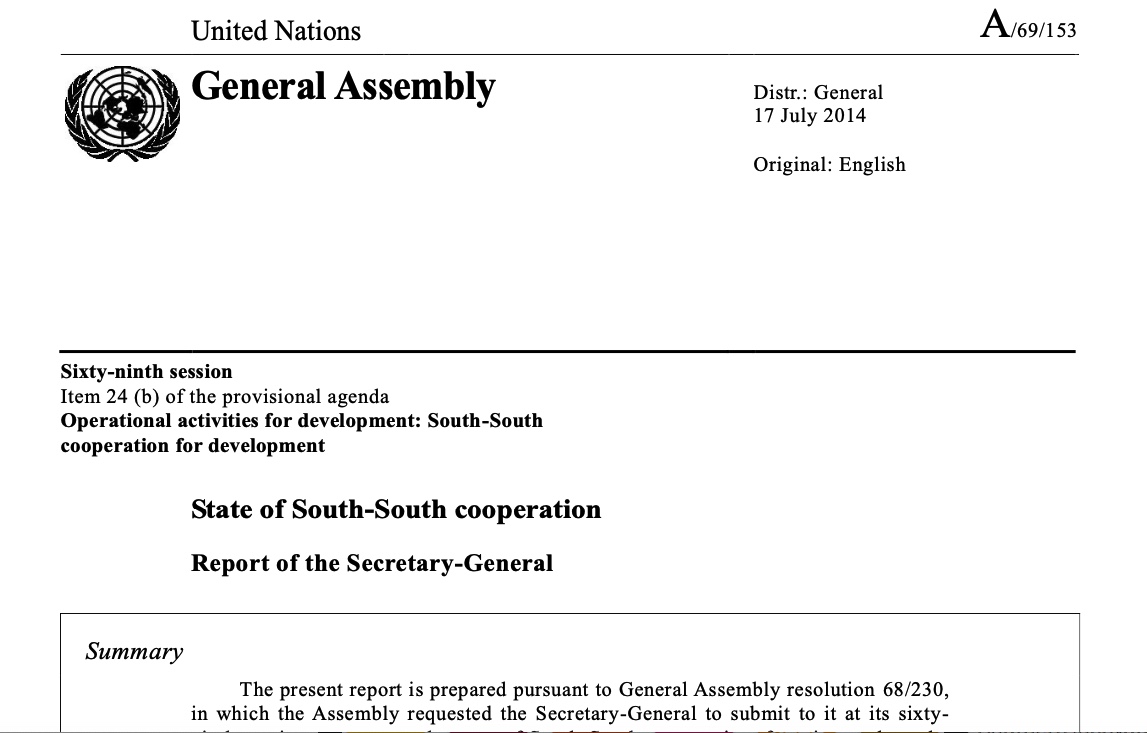
    United Nations General Assembly: Sixty-ninth session, Item 24 (b) of the provisional agenda, Operational activities for development: South-South cooperation for development, 17 July 2014.
    The research informing Southern Innovator Magazine played a part in the formulation of the UN’s post-2015 development agenda, including the Sustainable Development Goals (SDGs).

    https://davidsouthconsulting.org/southern-innovator-scale-up-fundraiser/

    ORCID iD: https://orcid.org/0000-0001-5311-1052.

    © David South Consulting 2022