New technology that can spew out a person’s life history in less than six seconds is now available to Canada’s customs and immigration officials.
And while Canada customs and immigration officers say this toy is a boon – replacing the need to memorize names of so-called undesirables – civil rights workers and refugee activists point out that the gizmo could have serious consequences, with little recourse.
The technology is called PALS, or primary automated look out system, and is already in operation at airports in Toronto, Montreal, Calgary, Winnipeg, Ottawa and Vancouver.
PALS’ operation is based on the use of computer-readable passports. Canada is one of several countries that have started including computer strips on passports and identity cards. Officers use PALS by either keying in a special number printed on the passport or identity card or using a scanning machine to read the strip.
The system went into effect at Toronto’s Pearson airport on January 20, after a three-year pilot project in Vancouver, adding Canada to the 11 countries that have machine readers for passports. Under the old system, customs officers combined judgement, questioning and the most-wanted list to decide if a passenger required further interrogation and search.
During a demonstration of the system, customs officials at Pearson airport boast about the system’s role in apprehending a drug smuggler in PALS’ first week of operation.
Sinister sign
But to civil libertarians with experience of such systems in other countries, PALS hasa sinister implication. Many say that PALS spews out what is fed into it. And depending on the country involved, what is fed into it may not necessarily be true.
While customs emphasizes PALS’ role in apprehending popular targets like drug smugglers, terrorists and child kidnappers, its reach also includes people who have smuggled in too many cigarettes or bottles of alcohol, convicted criminals who have finished serving their time, immigrants, refugees and a range of petty offenders.
All of these face a second interrogation and detention based on what their governments have decided to incorporate into the computer strip. And it is this that worries civil libertarians and refugee workers.
Consider the case of a legally sponsored Portuguese immigrant who arrived at Pearson just after PALS had been introduced. He was detained based on information stored in PALS. His immigration lawyer Ali Mohideen recalls how the man was held because of a cheque that he bounced in his native Portugal about eight years ago.
Ed Lam, director of research for the Canadian Ethnocultural Council, feels customs and immigration already have “too many powers.” He regularly receives complaints from visible minorities and immigrants who feel they are singled out for harassment at the airport.
“This is big brother. Legal protection is not enough,” he argues. “It leads to costly court battles with the government. I would like to see an ombudsperson or complaints bureau set up. As for refugees turned back at the border, we will never hear from them.”
False data
Other critics, especially those in the US, where a PALS-type system has been in operation for more than a decade, worry that the system will simply accept information given by tyrannical governments.
“It is hard to trace false information to a foreign government,” says Jeanne Woods, legislative counsel to the American Civil Liberties Union, which monitors abuse under the United States system.
“People have been accused of being communists or terrorists who have denied it. The El Salvadoran government is one example of a regime which has called prominent human rights activists and lawyers terrorists.”
She would like the Canadian Parliament to pass a law similar to one passed last November in the US requiring the state department to report to Congress when somebody is denied access because they have been called a terrorist, so that the origin of the information can be tracked.
“People have been accused of being communists or terrorists who have denied it. The El Salvadoran government is one example of a regime which has called prominent human rights activists and lawyers terrorists.”
The Canadian database draws its information from several sources, according to customs spokesperson Suzanne Bray. The sources include immigration records and the Police Information Retrieval System, which is a database shared between customs and the RCMP.
Bray refuses to divulge any other sources, citing security, but both RCMP and customs operate their own intelligence services, sharing information with their counterparts all over the world, especially the US. Information is also drawn from the Canadian Security Intelligence Service (CSIS) and its sister organizations such as the CIA. However, CSIS spokesperson Ray Boisvert says they have adequate safeguards against false information provided by countries known to be human rights abusers.
“CSIS does look at bias in intelligence reports,” he says.
The US equivalent of PALS has been criticized after several cases of abuse were detected. Gara LaMarche, executive director of the Fund for Free Expression, a project of US-based Human Rights Watch, has documented abuse on political and ideological grounds.
“The US public has a right to hear dissenting views under the first amendment of the Constitution,” he says. “I don’t think improving the technology of border control violates civil liberties, but keeping a massive database of information which includes people’s political associations is bad.”
Similar concerns are expressed by John Tackaberry of Amnesty International in Ottawa, which is only now beginning its own analysis of PALS. “We have concerns over data input, who controls information and basic civil liberties.”
Even as Canadian civil rights activists take stock of PALS, Canada customs is planning to use it to check cross-border shopping by expanding the system to all land entry points.
As for those visitors who feel wronged by PALS, they may have a problem seeking redress from such organizations as the Canadian Human Rights Commission. A spokesperson says the CHRC can only help those who have been admitted to Canada. And visitors turned back at the border are not considered admitted.
Sherry Gerstl, a customs superintendent responsible for the implementation of PALS at Pearson, says that people can also appeal to the Privacy Act to see information that is kept on them. But two fact sheets explaining how this can be done are located in a corner, pretty much out of public view.
Bray acknowledges that “honest” passengers could face the prospect of a search with PALS, but given its positive attributes, she says, passengers involved in such delays should simply “grin and bear it.”
Facial recognition AI software triangulates facial features to produce a recognition match.“Computers Track Travellers” by David South. Now Magazine published investigative journalism from David South, Naomi Klein and others in the early 1990s.
The deluge of data gathered by the digital revolution underway in the global South continues to offer a significant economic opportunity. How this data is harvested will forge the successful Internet business models of the future.
As the Internet spreads its way further across the global South, many are forecasting this new surge in web users and the data they generate will radically reshape the way people engage with and use the Internet. Unlike previous generations of web users, most of these new users will be accessing the Internet primarily with mobile phones and other devices, rather than computers. Many will not be native English speakers.
Argentinian philosopher and digital publisher Octavio Kulesz says “the digital experiences undertaken in the South suggest that new technologies represent a great opportunity for developing countries … but on the condition that local entrepreneurs seek out original models adapted to the concrete needs of their communities.”
In a report for the International Alliance of Independent Publishers, Kulesz said we “must ask ourselves how useful it would be to reproduce the prototypes from the North in the South.”
According to the Cisco Visual Networking Index Forecast (2010-2015), by 2015, there will be 3 billion Internet users in the world: 40 percent of the global population. Internet Protocol (IP) traffic is growing fastest in Latin America, where it is forecast to grow by 50 percent from 2010 to 2015. Next are the Middle East and Africa.
There are already as many networked devices – tablets, mobile phones, connected appliances and smart machines – on the planet as people. By 2015 – the year of the Millennium Development Goals (http://www.un.org/millenniumgoals) – they’ll outnumber people by two to one.
The potential of the Internet revolution is especially compelling in Africa, a continent neglected for so long in the global communications revolution. The 10,000 kilometre-long East African Submarine Cable System (EASSy), connecting sub-Saharan Africa with Europe and Asia, has joined other cables from the continent. Gradually, the infrastructure is coming in to place to connect Africa properly to the world.
The first batch of Internet users came from the United States, home of the Internet which grew out of the US military’s Arpanet system (http://en.wikipedia.org/wiki/ARPANET). This first wave of the Internet’s history was very much an American phenomenon. The priorities and content of the web were driven by the cultural and economic concerns of its American users. And the big brands of today’s web reflect this: Google, Facebook, eBay, Twitter, Yahoo, WordPress, to name a few.
As the web expanded across wealthy, developed nations in Europe, users mostly mimicked the priorities of the American approach, using the web to express themselves, be entertained, share files, access government services and sell and market products and services.
But the spread of the Internet across the global South is already showing itself to have a different character and set of priorities. One change is in the way people are accessing the web: through mobile phones and other devices, rather than through laptops and personal computers.
In the future, the trend is towards a global mobile world, in which the communications medium will favour video and audio over text, according to Fast Company magazine (http://www.fastcompany.com). Information is being shared across boundaries on a vast scale for the first time. People around the world are gaining access to data and information never available before, and all of it is nearly instantaneous.
Kulesz said countries of the South face a profound and difficult decision: follow the lead taken by the technology pioneers of the South, or try and replicate what was done in the North?
“Sooner or later, these countries will have to ask themselves what kind of digital publishing highways they must build,” his report said, “and they will be faced with two very different options: a) financing the installation of platforms designed in the North; b) investing according to the concrete needs, expectations and potentialities of local authors, readers and entrepreneurs. Whatever the decision of each country may be, the long-term impact will be immense.”
The costs of trying to replicate the technological infrastructure of the North makes little sense, when it is technologically possible to bypass this costly infrastructure with even newer work-arounds.
“Of course, it would be extraordinary to obtain 80 percent Internet penetration in Africa or make huge investments in infrastructure throughout the developing regions,” continues Kulesz, “but that may never happen. And in the event that it does occur some day, by then the industrialized countries will no doubt have made another technological leap, meaning that the disparity in infrastructure would still persist. So the most effective option is to start working right now, with what is available.”
New global magazine Southern Innovator (http://www.scribd.com/doc/57980406/Southern-Innovator-Issue-1), published by UNDP’s Special Unit for South-South Cooperation, captures how this process is happening, as the people of the global South re-shape the Internet to be their own and to meet their needs.
2) Cisco Visual Networking Index Forecast (2010-2015): The annual Cisco VNI Forecast was developed to estimate global Internet Protocol traffic growth and trends. Widely used by service providers, regulators, and industry influencers alike, the Cisco VNI Forecast is based on in-depth analysis and modelling of traffic, usage and device data from independent analyst forecasts. Website:http://newsroom.cisco.com/press-release-content?type=webcontent&articleId=324003
3) Digital Publishing in Developing Countries: A report by the International Alliance of Independent Publishers. Website:http://alliance-lab.org/etude/archives/date/2010/01?lang=en
Development Challenges, South-South Solutions was launched as an e-newsletter in 2006 by UNDP’s South-South Cooperation Unit (now the United Nations Office for South-South Cooperation) based in New York, USA. It led on profiling the rise of the global South as an economic powerhouse and was one of the first regular publications to champion the global South’s innovators, entrepreneurs, and pioneers. It tracked the key trends that are now so profoundly reshaping how development is seen and done. This includes the rapid take-up of mobile phones and information technology in the global South (as profiled in the first issue of magazine Southern Innovator), the move to becoming a majority urban world, a growing global innovator culture, and the plethora of solutions being developed in the global South to tackle its problems and improve living conditions and boost human development. The success of the e-newsletter led to the launch of the magazine Southern Innovator.
The coming years will see a major new force dominating development: Big Data. The term refers to the vast quantities of digital data being generated as a result of the proliferation of mobile phones, the Internet and social media across the global South – a so-called ‘data deluge’ (UN Global Pulse). It is an historically unprecedented surge in data, much of it coming from some of the poorest places on the planet and being gathered in real time.
Big Data will have a profound impact on how the cities of the future develop, and will re-shape the way the challenges and problems of human development are handled.
Estimates by Cisco (cisco.com) foresee 10 billion mobile Internet-enabled devices around the world by 2016. With the world population topping 7.3 billion by then, that will work out to 1.4 devices per person.
Some estimates say 90 per cent of the digital data ever generated in the world has been produced in the past two years. It is also estimated that available digital data will increase by 40 per cent every year (UN Global Pulse). This digital transformation is being accompanied by another trend: the largest migration in human history from rural to semi-urban and urban areas.
This presents an unprecedented opportunity to make this rapid urbanization and social change smarter and more responsive to human needs, and to avoid the failures of the past, from over-crowding to crime, disease, pollution, unemployment and poverty. Some believe data collection can radically alter development by flagging up problems quickly, giving cities the chance to respond and correct negative trends before they get out of control. In short, to build in resilience by way of digital technology.
The latest region to see rapid industrialization and urbanization has been Asia – in particular China, a country that since the 1980s has simultaneously lifted the largest number of people in world history out of poverty and undertaken the biggest migration ever from rural to urban areas.
And now Africa is beginning to follow in Asia’s wake.
Unlike previous waves of industrialization and urbanization, Africa’s transformation is occurring in the age of the mobile phone, the Internet, personal computers and miniature electronic devices capable of more computing power than the computers used during the Apollo space programme (http://www.nasa.gov/audience/foreducators/diypodcast/rocket-evolution-index-diy.html). This changes the game significantly.
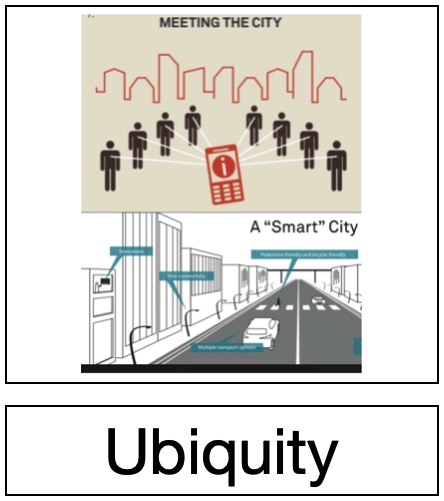
This 21st-century approach to urban growth is at its most sophisticated, and utopian, in so-called “smart cities.” These are built-from-scratch cities that use the “Internet of Things”, where everything, from lamp posts to garbage bins to roads are embedded with microchips and radio frequency transmitters (RFID chips) (http://en.wikipedia.org/wiki/Radio-frequency_identification) to communicate data in real time. By analyzing this data, cities can be responsive to human needs and mitigate problems – improving waste collection and traffic management, reducing crime and pollution. Services can be customized to residents’ needs and liberate them to spend more time on things that matter such as their own health, family, work and hobbies. Examples of these cities include Tianjin Eco-city (tianjinecocity.gov.sg) in China, Masdar (masdar.ae) in Abu Dhabi in the United Arab Emirates and Songdo International Business District (songdo.com) in the Republic of Korea.
These experimental smart cities are springing up in the East, and it will be the East – as well as Africa – that will see most of the action going forward. As the global management consulting firm McKinsey noted in its report Urban World: Mapping the Economic Power of Cities: “Over the next 15 years, the center of gravity of the urban world will move south and, even more decisively, east.”
Cities in the global South will be generating the new prosperity of the 21st century. And it is widely accepted that people living in cities have the potential to become very efficient economically while rapidly driving prosperity higher.
The McKinsey report says that “by 2025, developing-region cities of the City 600 (a list gathered by McKinsey) will be home to an estimated 235 million middle-class households earning more than (US) $20,000 a year at purchasing power parity (PPP).
“Emerging-market mega-and middleweight cities together – 423 of them are included in the City 600 – are likely to contribute more than 45 percent of global growth from 2007 to 2025 (http://www.mckinsey.com/insights/urbanization/urban_world).”
The world’s future prosperity is going to be found in the urban, the digitally connected, and the middle class.
Tracking all this digital change is the UN Global Pulse. UN Global Pulse (unglobalpulse.org) was started by Secretary-General Ban Ki-moon in 2009 with a mandate to study these changes and build expertise in applying Big Data to global development. UN Global Pulse functions as a network of innovation labs where research on Big Data for development is conceived and coordinated. It partners with experts from UN agencies, governments, academia, and the private sector to research, develop, and mainstream approaches for applying real-time digital data to 21st-century development challenges.
Unlike major technological trends of the past, this one is not restricted to the industrialized, developed world. Through the spread of mobile phone technology, billions of people are now using a device that constantly collects digital data, even in the poorest places on earth.
From an international development perspective, Big Data has five characteristics, according to UN Global Pulse: it is digitally generated, passively produced by people interacting with digital services, automatically collected, can be geographically or temporally traced and can be continuously analyzed in real time.
Sources of Big Data include chatter from social networks, web server logs, traffic flow sensors, satellite imagery, telemetry from vehicles and financial market data.
The key to using Big Data is combining datasets and then contrasting them in lots of different ways and doing it very quickly. The purpose? Better decision-making, based on an understanding of what is really happening on the ground.
This data exceeds the capability of existing database software. It is either too much, or comes in too quickly, or can’t be handled using current software technology. Tackling this problem is creating a whole new wave of opportunities for those working in information technology.
As technology and processing power continue to improve, the cost of wrestling with this data and putting it to use is coming down.
The data can be analyzed for patterns and hidden information that before would have been too difficult to gather. This approach has been used by big companies such as WalMart (walmart.com), but it has cost them a large amount of money and time.
Pioneers in Big Data include search engine Google, email and search provider Yahoo, online shopping service Amazon and social media service Facebook. Many supermarkets use Big Data to analyze the way customers behave when they are shopping, combining it with their social and geographical data.
But new developments in hardware, cloud architecture, and open-source software mean Big Data processing is more accessible, including for small start-ups, who can just rent the capacity required on a cloud-based service (http://en.wikipedia.org/wiki/Cloud_computing).
In the past, governments and planners had a ready excuse as to why they could not keep on top of ballooning urban populations and the chaos they brought. They could just throw up their hands and say “We do not know who these people are or what to do about them!”
This excuse does not work in the age of the mobile phone. It is now relatively easy to deploy the power of the networked computing inside mobile phones to map urban slums and identify the needs of the people there. Parse that data, and you have an accurate account of what is happening in the slum – all in real-time.
Making sense of all this information is creating its own new industries as innovators, entrepreneurs and companies step forward to chart this brave new world.
Historically, significant improvements in human development have occurred only after large-scale gathering of data and information on the actual living conditions of the population. For example, prototypes of today’s infographics (http://en.wikipedia.org/wiki/Infographic) – informative visual representations of complex data – were created during the great attempts at tackling poverty and disease in Europe in the 19th century. Today’s masters of this technique include the Swedish doctor, academic and statistician Hans Rosling (gapminder.org), whose dynamic infographics are renowned for changing people’s perceptions of global problems.
UN Global Pulse notes “much of the data used to track progress toward the Millennium Development Goals (MDGs) dates back to 2008 or earlier and doesn’t take into account the more recent economic crisis.
“While this may feed a perception that there is a scarcity of information about the wellbeing of populations, the opposite is in fact true. Thanks to the digital revolution, there is an ocean of data, being continuously generated in both developed and developing nations, that did not exist even a few years ago.”
UN Global Pulse believes Big Data can be used to protect social development gains when crises strike. Rather than undoing decades of good development work and human development achievements, Big Data can help to create agile responses to crisis as it happens.
UN Global Pulse believes the same data, tools and analytics used by business can be turned to help the public sector understand “where people are losing the fight against hunger, poverty and disease, and to plan or evaluate a response.”
Published: June 2014
Resources
1) Big Data: The Next Frontier for Innovation, Competition, and Productivity, Publisher: McKinsey Global Institute. Website: mckinsey.com
2) United Nations Global Pulse: Global Pulse is an innovation initiative launched by the Executive Office of the United Nations Secretary-General, in response to the need for more timely information to track and monitor the impacts of global and local socio-economic crises. The Global Pulse initiative is exploring how new, digital data sources and real-time analytics technologies can help policymakers understand human well-being and emerging vulnerabilities in real-time, in order to better protect populations from shocks. Website: http://www.unglobalpulse.org/
11) Hadoop: Is open source software for handling of large data sets across clusters of computers using simple programming models. Website: http://hadoop.apache.org/
12) Pivotal: Pivotal develops software applications for big data. A testimonial on the Pivotal website sums it up: “With the ability to load a day’s worth of data for a million meters in under fifty (50) seconds, we are able to keep up with the tremendous amount of data generated and start experimenting with many useful smart grid analytics.” Website: gopivotal.com
13) TotallyDot: A way to centralize all the social media people use into a single page. Website: totallydot.com
Development Challenges, South-South Solutions was launched as an e-newsletter in 2006 by UNDP’s South-South Cooperation Unit (now the United Nations Office for South-South Cooperation) based in New York, USA. It led on profiling the rise of the global South as an economic powerhouse and was one of the first regular publications to champion the global South’s innovators, entrepreneurs, and pioneers. It tracked the key trends that are now so profoundly reshaping how development is seen and done. This includes the rapid take-up of mobile phones and information technology in the global South (as profiled in the first issue of magazine Southern Innovator), the move to becoming a majority urban world, a growing global innovator culture, and the plethora of solutions being developed in the global South to tackle its problems and improve living conditions and boost human development. The success of the e-newsletter led to the launch of the magazine Southern Innovator.
Red stripe is a symbol of solidarity with millions and millions of AIDS-infected, to take care after them and to join in a battle against of this disease.
Message from the Editor
“Information and education are the most powerful instruments to protect our planet from AIDS”. This quotation is found in the introduction of one of the international organisation against AIDS.
The Mongolian delegation participated in the 4th Conference on the AIDS issue in Manila on 24-29 October brought this idea back home. Mongolians admit a lack of adequate information. Therefore we have decided to publish this magazine to support efforts AIDS . Also it would be the bridge in the battle against AIDS between Mongolian Government and Mongolian people.
We would like to acknowledge the UNDP Resident Representative Mr. Douglas Gardner, Support Officer to Resident Co-ordinator, UNDP Mr. Jerry van Mourik and Mr. Nicholas Bates for the financial support and Mr. David South, Information Specialist UNDP for the initiative to produce this magazine and for their valuable professional assistance.
We also acknowledge Mr. Sh. Enkhbat, Secretary of the National AIDS Committee, Mr. H. Davaajav, Head of the department against AIDS/STD of the Infection Dicease Research Centre, Ms. Narantuya, correspondent of the newspaper “Mongol Messenger” for their encouragement and support.
Since this is our first issue, we recognise there will be mistakes. Your comments and valuable criticism are very welcome. We hope that with your assistance our magazine would have its own feature stories in the near future and we look forward receiving letters and photos from you.
We wish you good health and success in your work.
D. Altanchimeg
AIDS update news
According to the latest report from UNAIDS Programme a number of AIDS virus infected people has reached to more than 30 millions. Comparing with the number of infected people in 1996 – 22,6 millions it increases by 19 %.
It is said in a report that “this is much large number”.
CNN news reports that 1 out of 100 sexually active population of age from 16 to 49 is infected by AIDS virus. Only 1 out of 10 AIDS virus infected is aware of this fact.
National newsbulletin
Prime Minister called for parents to talk about AIDS hazard with children at least one time
On a World day of battling against AIDS the Prime Minister of Mongolia called for parents to talk about AIDS danger with children at least one time in order to prevent from the epidemic of this century – AIDS.
Prior to the World day of battling against AIDS a first session of the National Committee to battle against AIDS took place in Ulaanbaatar. Prime minister of Mongolia underlined in his speech on this session the importance given by Mongolia to the need to battle against this disease through a setting of National Committee headed by the Prime Minster in a full awareness of the hazard of the disease encountered by the world community:
“ International experts have identified that in nations facing socio-economic transitions there is a base for AIDS dissemination. On the other hand, although a great experience has bee accumulated by Mongolia in battling of sexually-transmitted diseases (STD,) in circumstances of this time it becomes vital to change the ways and methods of battling”.
The first session of the National Committee has advised to youth and health organizations to consider the establishing of mutual trust and understanding with the people of risk group (vulnerable group) who are vulnerable to this disease one of areas of battling activities, .as well as stressed the need for cooperation and participation of citizenry, institutions of all levels of the society.
Also the Prime Minister pointed out that since of its dissemination the “disease put on a stake the existence or collapse of a specific nation”, that’s why AIDS battling it is not a matter of health sector employees.
Prime Minster highly appreciated UN cooperation in provided support and participation to the Government of Mongolia in battling of AIDS and STD.
Government of Mongolia is to cooperate with UN in battling against AIDS
In June of 1997 the Government of Mongolia and UN organizations concluded a Memorandum of understanding to undertake joint activities in battling against AIDS, STD and Human Immuno Deficiency Virus (HIV).
At late of November the Project team was established to undertake this joint Programme. The team comprises of H. Enhjargal, National Coordinator, Nicholas Bates, Health Consultant and B. Oyun, Project staff member.
According to Enhjargal, the main objective of the Team is to coordinate health, education, media and NGOs in implementing of the Programme, to increase public participation in battling of AIDS, to change a wrong approach considering this matter a matter of few doctors and to move it to public-oriented.
AIDS battling National Committee established
By a Resolution of the Government of October 29, 1997 National Committee to battle against AIDS was set up headed by Prime Minister M. Enhsaihan; L. Zorig, Minister of Health and Social Welfare is a deputy Chair; Also Ministers of Finance, Justice, Education, Chief of Radio and TV as well as other key relevant officials.
Sub regional session took place in Ulaanbaatar
On November 11-13 1997, a consultative session of North Eastern Asian nations such as People’s Republic of China and Mongolia was taken place in Ulaanbaatar to discuss issues of AIDS. The session arranged jointly by UNDP Office Mongolia and Ministry of Health and Social Welfare discussed a project to prevent from battle against AIDS in North Eastern Asian nations. Within the frame of this UN-funded worth 400.000 US D for a duration of 3 year the activities to speed up research work against AIDS; to exchange the staff; to provide with publicity materials and to enroll into training media representatives in this area will be undertaken.
Mongolia first ever time participated in Regional Conference
Mongolian delegation first ever time participated in 4th Conference of Asia and Pacific Region nations on AIDS issue taken place in Manila, capital city of Philippines on October 25-29.
Although only one person is officially registered as AIDS virus infected in Mongolia, with regard to the following real reasons: less than 3% of total population was involved in AIDS analysis; number of STD infected people – as a basis for AIDS infection – in increasing every year; number of prostitutes and street children – as representatives of risk group (vulnerable group) is also increasing as well as a fact that in Russia and China – two actions where many Mongolians travel for business and private purposes – a number of infected people is growing the professionals are doubtful that only one person in Mongolia is infected by this virus. Therefore, it is understood that at such a crucial stage of encountered internal and external factors the participation of Mongolian delegation comprised from representatives of legislative body, ministry and NGO in Manila Conference is a sign that Mongolia is to undertake thorough battle activities against AIDS.
As soon as one is infected and the disease is spread out it requires a large amount of funds, therefore, in circumstances of Mongolia it is vital to conduct preventive training programs based on a concrete analysis and in accordance with Mongolian mentality; to undertake publicity activities about use of condom as one of most reliable way to prevent from AIDS – presented participants of the Conference.
On a press conference held as a follow-up activity of Manila Conference, Ms. B. Delgermaa, MP said:”This issue is new for Mongolian society. The Conference gave us an opportunity to learn from experience of ways of battling against AIDS and preventive measures taken by nations of Asia Pacific Region”.
Events on AIDS
THE AIDS/STD TEST
By the order of the Ministry of Health and Social Welfare, AIDS/STD tests were carried out among people aged 15-40 from May to October, 1997. The test have not released as of 20 November, as aimags statistics have not arrived.
According to the results of the tests carried out in Ulaanbaatar, the 84% of all people targeted to be tested have been covered in the campaign. The Minister of Health and Social Welfare, Zorig reported that 63518 people have been tested in Ulaanbaatar and 1300 have STD. Bayanzurkh, Chingeltei district the city Ulaanbaatar have the highest number of people with STD. “ It is because a lot of young people live in those districts and the infrastructure is not well developed comparing with other districts.” Said Minister Zorig. The printed decree by the Ulaanbaatar city governor Narantsatsaralt gave the permission to doctors to use force if a person is not willing to be tested.
However the Ministry of Health and Social Welfare is denying the use of force for testing. Before 19980, the Ministry of Health and the local authorities co-operated with medical organisations used to conduct medical examinations and tests, including STD tests and covered 80% of the population.
40 MILLION CHILDREN ARE ORPHANS
Reuters news agency reports that according to the USAID estimation about 40 million children are orphaned since their parents have died of AIDS. Those children are under high risk to starve to death or to become sick or to become involved in child labour. It means the social welfare system has to be responsible for the care of those orphan children.
AIDS AND INFANT MORTALITY
The infant mortality rate is increasing in many countries because of AIDS. If the number of people infected by HIV does decrease the infant mortality rate, will triple over the next 15 years in countries such as Thailand and Zimbabwe.
DEMOGRAPHIC EFFECTS OF AIDS
The average life expectancy of the population of countries can be an important index of development. But in countries seriously affected by AIDS/HIV this index is changing dramatically. For instance, the life expectancy has decreased to 37 years in Uganda placing this country in last place. Scientists calculated that life expectancy will decreased to 25 years in some Asian and African countries by the year 2010. For example, the life expectancy of Zimbabwe is projected to decrease from 70 to 40 by 2010.
The sudden death of the princess Diana was a great loss for people infected by HIV/AIDS. How could we forget her humanistic attitude towards the people with HIV /AIDS. She shook their hands and held children suffering from AIDS and participated actively in the battle against AIDS.
In his condolence Dr. Roi Chan has said that Diana was an outstanding fighter against AIDS and against discrimination of those with HIV and AIDS. She was an active organiser of charity activities.
SOON WOMEN WOULD USE CONDOMS
Until recently condoms were only for men. According to numerous surveys carried out in many countries, it showed that woman are powerless in having safe sexual relations with men. The research work experimenting with condoms for women is in the final stage and the results are promising. Currently 10 countries are ordered the product and more than 30 countries are expressed their interest to purchase the product.
The price of the new condom would not be more than 1 $ promised the NUAIDS program.
Countries from Asia and Pacific region
AUSTRALIA
Australia has been one of the countries most affected by AIDS in the region. Since 1987 as a result of the Government action giving priority to people’s participation against AIDS, AIDS infection is now under control. The number of newly infected people is reducing.
CAMBODIA
AIDS infection is spreading rapidly in Cambodia and its future is not very rosy According to the official statistics data 600 people are AIDS virus infected . However it is estimated that this number is at least 100 thousand. The study carried out in 1997 shows that 40% of prostitutes, 6% of police and army people, 3% of pregnant women of are infected by AIDS virus.
CHINA
Xinhua news agency informed that the number of people registered as HIV infected and suffering from AIDS reached to 8277 in September, most were people are intervenous drug users. The joint UNAIDS program estimated that this year 400 thousand more people may have been infected by AIDS virus.
INDIA
AIDS is spreading dramatically in India. There are currently 5000 people living with AIDS according to official studies. Specialists think 2.5 million people are suspected or being infected by AIDS.
JAPAN
1,521 people are suffering from AIDS virus and 3,665 people are infected, by AIDS in Japan. Most of those unfortunate people got infected from imported donor blood and blood products.
SOUTH KOREA
AIDS is spread in Korea extremely slowly. The situation is changing. In June, 1997 679 people were HIV infected and 83 people are suffering from AIDS.
PHILIPPINES
There are 922 people infected with HIV and 312 people are experiencing AIDS symptoms. Most of those people are young people aged 20-49. However about 175000 more people are likely infected by AIDS.
What is UNAIDS ?
In December 1994 UNAIDS program was established as the United NAtion AIDS joint program UNICEF, UNDP, UNESCO, UNFPA, WHO and the World Bank. The main goal of this program to attract attention to the integration all efforts against AIDS. In order to fulfil its objective, a global policy against AIDS should be developed including support in planning, research studies and development amongst all nations.
Dr. Peter Piot, executive director of UNAIDS program, gave a speech at the Manila Conference. In his speech he underlined that, “ Asia has the highest density of population in the world. Therefore, countries from this region facing the danger of AIDS should wake up from their passiveness and accelerate the battle against AIDS.” He has identified the action plan of the UNAIDS program for this region in the following four steps:
1. The countries and their leaders should realise the necessity of an effective battle against AIDS2. In order to make an effective effort against AIDS, the proven experiences and methods from different countries should be shared.3. To activate community initiatives in the battle against AIDS4. To involve all countries and nations spontaneously in the campaign against AIDS.
“ The battle against AIDS is progressing. Only our enemy is to do nothing” emphasised Mr. Peter in the Manila conference.
Children of the AIDS Era
Every year, on December 1 the world community has a tradition to undertake measures to be solidary in a battle against AIDS, to do publicity work about the harm and hazard of the disease, to offer moral and humanitarian aid to infected and ill people and their relatives. A slogan of battle of each year is different. 1997 year’s battle against AIDS has a slogan:”Children of AIDS Era”.
According to the latest data, 90% of AIDS-infected children under the 15 age are in developing countries. Only in 1996 more 400000 children under age of 15 were infected by AIDS virus.
Children are not only infected but they also experience the consequences of this disease. In many nations of the world children lose their parents and other members of the family given to this fatal disease. By the mid of the last year 9million children under the age 15 became orphans due to this disease. This figure can make one’s heart feel ill, but it is just a small part of the social grievance. In other words, there is a number ill mother or a father or sometimes both ill are waiting in anguish for a fatal end; at the same time so much pain and suffer the children carry. These children are very different from those who lose their parents because of other reasons. These children suffer seeing how their mother or father is getting worse and worse day by day with no way of treatment. In addition to it the cool attitude from other children make them suffer more.
Since AIDS transfers through STD, so that it is very often that children lose both parents. Leon, Ugandan woman says:”I have 11 orphan children. My older sister died of AIDS and left me 6 orphan children. The other 5 are my daughter’s children who also died of AIDS.
The below examples demonstrate the presence of poverty and violation of human rights toward children who lose parents due to AIDS. Since it is heard that one of family members is infected it is common that guests avoid visiting that family; classmates become cool. According to a survey conducted in Thailand for AIDS-infected children it it taboo to play together with other children at a play-yard. Also it was revealed fro from this survey that parents might be fired, the host lady stops visiting , thus the income of the family falls down encountering poverty. There is a number of such examples reported from different corners of the world. Fortunately, there is also a number of individuals and institutions who would like to help. UNICEF, Children Protection Foundation, some religious missions and other voluntary organizations. It is vital to help those families while AIDS-infected parents are alive. Because the children suffer from a very beginning day of parents’infection.
The World Conference held in 1996 “Against violent involvement of children in prostitution and pornography” reported that every year more than 1 million children become prostitutes. Besides, there is a number of hidden violations both moral and physical against them from their relatives or strange people. Today more than 100 million children are called “street children” living on an edge of knife. The thorough preventive program based on the specific needs and demands of street and drug-addicted children is really needed.
Let’s save children who live in Era of AIDS.
PERSONAL VIEW – SHALL WE WAIT FOR THE “SILENT” EPIDEMIC?
You might say we are a little bit exaggerating things. You might also ask “Is AIDS
really threatening Mongolia?” In some countries there is a belief that the Asian people have an immunity against AIDS and it’s not a secret that some Mongolians are also subject to this naive and false understanding. It would be really wonderful if God could have blessed us with such a rare destiny but…
Dramatically, today about 5.2 mln or 25 per cent of all 22.6 mln HIV positive live in the Asia-Pacific region. According to the officil data in Thailand where AIDS was regarded as an alien’s disease, the number of HIV-positive reached 700-800 thousand, in China 8200. So, what’s the situation in Mongolia? The Mongolians proudly say that there is only 1case of AIDS was officially registered in Mongolia. Some sceptically say that there should be more than 1 case… And I am among those who think that AIDS is enevitably threatening Mongolia and is always scared to think of a day when this silent epidemic might completely demolish the country’s 2 mln population.
The term “silent” epidemic was given to the disease because unlike other infectious diseases AIDS has no distinct symptoms and it takes many years before the disease gets exposed and the last ”resort” is always death. So, it is obvious that the HIV positive victims can infect others being completely unaware of their sickness.
Mongolia has all favourable conditions for AIDs to progress like the recent development of tourism, international trade, increase of drunkness, prositution, spread of sexual perversions, street kids, rape, etc. In addition, the increase of STDs gives solid grounds for AIDs development. We, the Mongolians, have very strange attitude towards destroying ourselves with our own hands. It is common to be hospitalized and have intravenous injections and even curse the doctors who didn’t prescribe intravenous injections. There are cases of getting hepatitis B through poor sterilized syringes because of the desire to be hospitalized while being almost healthy. How many patients, nurses do we have who are really scared of getting AIDs through injections? Do we have many doctors who really care of their job’s safety? They only think of curing the diseases and don’t think of getting infected. The HIV positives mostly suffer from pneumonia, TB and lung tumours. The number of TB cases in Mongolia has sharply increased during the last years. Does the medical personnel think about it? The questions like this arouse and scare me among other problems.
Hasn’t the time for us Mongolians come to make considerable efforts and bold steps to stay less exposed to this “silent” epidemic. To lay the AIDS burden on the shoulders of the Ministry of Health would certyainly result in unforgivable mistakes. The AIDS virus doesn’t distinguish between the rich and poor, women and men as well as doesn’t accept any bribes and corruption.
Any of us can become the next victim, so the whole society is not guaranted against it. Since there is no vaccination, no medicine against the virus everybody needs to foster their knowledge , learn more and choose safe means. In that case we can prevent ourselves against the deadly virus.
We need the sound voices of mass media representatives and prominant figures to join our battle against AIDs. Shall we, the Mongolians wait for the “silent” epidemic?
D. Altanchimeg
New generation – AIDS
Sexual Education as the most reliable means against AIDS
The first AIDS case was registered in 1981 the victim being an American homosexual and about 6.4 mln people died of AIDS since the first AIDS virus was found in 1983.
Until now no effective medicine was found and everyone infected with AIDS virus is doomed to die. According to the WHO data every day 8500 people get AIDS virus of whom 7500 are adults and 1000 are children.
However, the most reliable prevention is to remember that AIDS is not that dangerous if the person takes proper care of himself. It has become a worldwide trend to teach the younger generation about AIDS transmissons ways and give them sexual education. This would allow us not only protect our 20th century future but also make a feasible contribution to the coming future. At present, 50 per cent of the world and 70 per cent of Mongolia’s population are people under 25. In Mongolia the cases of STDs and prostitution in volve more younger people as compared to previous years and this contributes to the AIDS development and indicates the importance of promoting sexual education among young people especially at secondary schools.
Historically the Mongols never talk about sex to children although the time has gone when they used to learn about sex from their communal living in one dwelling together with their parents, grandparents and also watching the livestock habits.
The nationwide survey “Young generation knowledge, attitude and experiences towards reproductive health” conducted by Mongolian Ministry of Health and WHO covering 5000 young people in between the age of 13-20 showed that 53.6 per cent of them expressed the readiness to learn about family planning, STDs and AIDS from secondary schools, 23.9 from TV and mass media and 13.1 per cent from books and magazines.
At present, the information on sexual education given at secondary schools during biology classes didn’t prove to be fully informative and complete. According to Dr.Lhagwasuren, Head of the National Medical University, a special project should be elaborated focusing on how the sexual education should be taught and when and at what age and in what context.
Recently, the lecturer of the National Medical University B. Ayush and Gynecologist Bayarmaa founded the “Young generation – future” centre.The centre aims at giving basic education about reproductive health to 10-24 year olds, unexpected pregnancy, prevention of STDs and AIDS, as well as rendering qualified medical assistance. The consultancy hot-line “Trusty phone” is to start operating soon and will help to solve urgent problems of the youth. This is the beginning of active actions.
On the other hand, it is time for parents to give up the old fashioned understanding of “secret subject” and join efforts in teaching basic knowledge about sex. It should be also noted that in reality the parents tend to think that teaching sexual education is the duty of school teachers, so the parents also need a special training considering this subject. In other words, the parents- chidlren-school triangle is very important to ensure the success of developing sexual education to children.
It is certain that we won’t solve today’s problems by only introducting sexual education at secondary schools. There are many street kids missing the schools and and this number is increasing, the kids have no supervision and enter the sexual life without any knowledge.
The survey held by the Ministry of Health and UN Human Fund showed the increasing number of street teenagers (girsl) who get involved in sexual relations at the very early age. According to the results out of 92 street teenagers (girls) 71 or 77 per cent already started sexual life and 50.4 per cent of them were raped. The average age is 14. The experts emphasized that these figures are higher as compared to other kids who have homes. Recently, some Asian countries with the same problem of street kids have been successfully passing the sexual education through the so called “leaders” of the groups.
The doctors involved in the survey also noted that when the sreet kids (Ulaanbaatar) get STDs they inject each other with penicillinum instead of going to hospitals.
Another thing that should be considered is that the sexual education should be taught in line with the kids’ interests and habits. For example, some methods like enrolling famous pop singers, rock bands , basketball stars or using the most popular FM channells in STDs and AIDS pevention campaigns could have more effect on city kids while in countryside the prominent young wrestlers with national titles could participate in these campaigns and make them more fruitful.
D. Narantuya
MAY I BE THE FIRST AND LAST AIDS VICTIM IN MONGOLIA
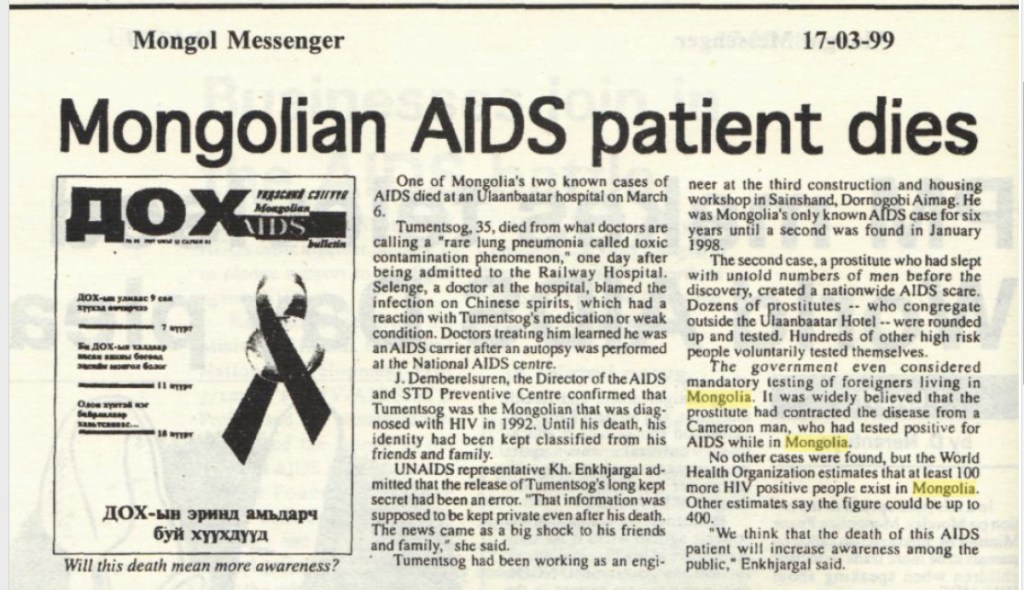
The only Mongolian with HIV positive for the first time spoke to mass media addressing the teenagers and youth. This decision was motivated by his desire to warn the Mongolian youth of the danger of AIDS widely spreading all over the world and Asian countries and toprotest against some false information related to him and published in some papers. In its October issue one of the papers published an “interview” with him which read that the Mongolian HIV positive had sexual relations with 6 partners and was going to get married soon. However, it was found out that the journalist who rote it never met the HIV positive. Dr. Davaajav, head of the National STD and AIDS Centre, acted as a liason between the press and HIV positive and stressed that his patient had never had sexual relations with anybody since he knew he was HIV positive. He also emphasized that his patient expressed his will to be the first and the last AIDS victim in Mongolia.
The interview was given to Ardyn Erkh paper, the most popular national daily distributed both in urban and rural areas. According to Dr. Davaajav the HIV positive’s health state is satisfactory and the AIDS symptoms have not shown up. “Of course he needs a moral and human support as he feels really down” says Dr. Davaajav. Right now, the HIV positive has no job and has no place of his own.
THREE REASONS WHY THE YOUTH IS EXPOSED TO AIDS
Dr. John Chittick who has been working on AIDS projects for the last 10 years and conducted “AIDS, Teenagers and the Youth” survey, founded a Teen AIDS-PeerCorps charity fund. Dr. Chittick thinks that the campaigns on AIDS prevention among the teenagers are really insufficient and the governments neglect this problem. According to him, there are 3 reasons why the youth has wrong understanding about AIDS regarding it as an adults’ disease. The reasons are as the following:
They don’t realize AIDS as a real threat The youth and teenagers have no opportunity to see HIV positives among themselves because AIDS virus appears after 10 years the person gets infected.
They don’t receive enough information on AIDS.The adults, especially in Asian countries don’t talk much about AIDS and sex. They always say “Don’t” but rarely explain why it is prohibited. And the youth actually disregards these don’ts.
They don’t talk about AIDS among themselves. Acording to Dr. John Chittick’s studies the young people in Asian countries don’t talk much about sex and AIDS. The situation is a little bit better in European countries. If you are interested in Dr. John Chittick’s activities on staging AIDS preventive campaigns please refer to his e-mail or write a letter.
Note: The national magazine on AIDS is available on Internet at information centres sponsored by UNDP. These centeres function in Ulaanbaatar, Tuv and Uvurhangai aimags.
Means of prevention
To stay with one sexual partner is one of the most reliable and handy means.
Avoid using alcohol and drugs which lead to loosing self control.
Make sure you have a condomn just in case. Don’t get ashamed to use it and remember it is very important for the couples to learn how to use it properly.
Make it a habit to use only sterilized syringes.
Use only analyzed blood or blood substances in treatment.
It is not very difficult, isn’t it? Once you discuss these means within your family or with your friends, don’t forget that you protect not only yourself, but also help to protect others from AIDs virus.
Questions and answers about HIV-AIDS
Q:If I know (suspect) that somebody is HIV positive how should I react to it?
A: First thing is to remember that you won’t get infected through sharing dishes, toilet, shaking hands, kissing, etc. Make sure you keep the person’s secret and avoid gossip ping about it. Try to be human because AIDS is like TB or dysentery and nobody is guaranteed against it.
Q:How can a person know that he is not infected?
A: It is difficult to say if the person is infected or not just looking at him, so the couples should get AIDS tests after 5 months they had sexual relations. This will allow you to be more self confident.
Q:Can I get infection through kissing?
A: Normally, the AIDS virus was not found in saliva. So, there is less danger but in cases of bleeding or damaged cavity there is a possibility for the AIDS virus to penetrate.
Q: Is there any place in Mongolia to get consultancy on AIDS and STDs?
A: The consultancy service was founded in 1992 and is located in the western wing of the Infectious Diseases Hospital AIDs/STDs Centre, 1st floor, Room 104.
MAGAZINES
AIDS action
Quarterly magazine, comes out in English, France, Portugeuse and Spanish. Free distribution to developing countries.
Address:
HAIN No.9 Cabanatuan Road, Philam Homes 1104, Quezon City Philippinnes
Report on UNICEF Guidelines and report on AIDS actions.
Dec 7-11, 1997
The World 10th Congress against AIDS, Africa.
Dec 21, 1997
Activities of elaborating guidelines for management of Chinese NGOs programmes against AIDS If you need more information please refer to the Hong Kong AIDS Centre e-mail: http://www.aids.org.hk/
Jan 12-15, 1998
The 2nd European Conference on AIDS surveys, results and methods.
“Despite rising rates of HIV infection in Asia, there is no evidence to suggest that HIV is currently a problem in Mongolia6. However, our study suggests that there is a significant problem with STDs, including antimicrobial resistant N. gonorrhoeae in this region. STDs are known to be an important factor in HIV transmission and outbreaks of STDs have been associated with significant increases in HIV in specific geographic regions15.”
AIDS: The Fourth International Congress on AIDS and Asia in the Pacific convened 3,000 scientists, people working in the communities, and people living with HIV/AIDS to discuss the state of AIDS in Asia and the Pacific and how the problem is being addressed now and into the future. The following topics addressed at the Congress are explored: the extent of the HIV epidemic, HIV risk behaviors, women and HIV, clinical manifestations of HIV infection, antiretroviral therapy, and perinatal HIV transmission. HIV is spread differently among these countries and a nation’s wealth largely determines its ability to execute prevention programs and patient access to therapy. Most patients in Asia pay for their own medications. It is hoped that more prosperous and technologically advanced nations will demonstrate stronger leadership and commitment in the fight against AIDS in the region.













 About red stripe…


 David South Consulting
You must be logged in to post a comment.