Categories
Archive Development Challenges, South-South Solutions Newsletters Southern Innovator magazine

Computer ‘Gold Farming’ Turning Virtual Reality Into Real Profits

ByDavid South,Development Challenges, South-South Solutions

SOUTH-SOUTH CASE STUDY

The rapid spread of the internet around the global South is bringing with it new forms of work. One of these trends is so-called “gold farming”: making money in the virtual world of computer gaming by trading in virtual money, prizes and goods for busy gamers who don’t have time to do it themselves. This work now employs 400,000 people – mostly men and mostly in China, but also elsewhere in the South, according to new report.

Working out of internet centres where they can get access to high-speed or broadband internet connections, “gold farmers” use the global trade in virtual goods for online computer games in the same way stockbrokers trade shares on the world’s stock exchanges. The trade operates similarly to the stock market, with prices fluctuating based on demand and changing by the minute.

And as the report discovered, this trade is acting as a gateway into the world of information technology employment, where computer-literate young men are able to earn an income they could not have done otherwise.

It is a trade that can provide gold farmers with US $145 a month in income. They are often given free food and accommodation to do it, and many have few other economic choices.

“You can probably think of two models,” said the report’s author, Professor Richard Heeks of Manchester University’s Development Informatics Group. “They could play as an individual at a local cybercafe doing their own in-game farming and then selling to one of the trading sites (that buy from farmers at one price, then sell on to player-buyers at a higher price). Or they could be organized into a small/medium enterprise by an owner, all working together in a room full of computers.”

There is a dark side to gold farming too: there have been reports of youths forced to gold farm by gangs who make them work 12 hour days. Crime gangs sometimes become involved and scams proliferate.

Heeks says the downside is the result of governmental ignorance. “The main problem is a lack of understanding about ICT and ICT enterprise generally in some governments in developing countries and in particular a relative lack of understanding about the spread and implications of computer games.”

Supporters see gold farming as a flourishing Southern economy that is worth hundreds of millions of dollars, and exposes participants both to information technology skills and the wide horizons of the virtual computing world. Its defenders say it shows that those who dismiss the expansion of IT infrastructure as a waste of time are missing the emerging economic opportunities it is creating.

Heeks said we still know too little about this fast-evolving sector, but that “gold farming does seem to be providing income/livelihood for young men who would otherwise be unemployed. There are claims that it has helped mop up youths who had otherwise been involved in crime, but we don’t yet know how generalized such claims are.”

The number of players engaged in online gaming has grown by 80 percent per year, and Heeks sees the rise in gold farming as linked to a bigger trend: “in both North and South, we will spend increasing amounts of work and leisure time in cyberspace. Couple that with the growing penetration of ICTs into developing countries, including into poor communities, and there will be growing opportunities for this kind of ‘virtual outsourcing.’”

Currently, more than 300 million people worldwide have access to the internet through fast broadband connections (mostly in developed countries, although this is changing quickly), and more than 1.1 billion of the world’s estimated 6.6 billion people are online.

China is working hard to capture the economic power of the internet. The country’s economic boom has helped create an affluent urban middle class clamouring for the social aspects of internet access like chat rooms, while the government has been driving the roll-out of internet access in rural areas.

The country’s largest Cyber Park is under construction inWujin New and High-tech Development Zone of Changzhou. It will be a technology incubator, a research and development centre, and a place for small and medium-sized enterprises to innovate.

China’s most ambitious digital media industry development is the Beijing Cyber Recreation District (CRD), a collection of digital media academies and company incubators spread over 100 square kilometres, creating the world’s largest virtual world development. It is already home to more than 200 game and multimedia content producers in western Beijing.

And even in Africa, where broadband penetration rates are very poor, countries are now looking to the mobile phone companies to provide their populations with access to the internet, as they struggle to find a place at the digital table.

Mauritius, an island in the Indian Ocean strategically close to Africa and better known for tourism and luxury hotels, wants to become the world’s “cyber island”, and Africa’s e-gateway. Armed with the first 3G network in Africa (the third generation of mobile phone technology – offering high-speed internet access and video telephony), Mauritius is moving fast to make good on this advantage. And it is even moving to the next level of mobile-phone speed, High-speed Download Packet Access (HSDPA) – allowing even greater quantities of information to be exchanged.

Mauritius joins a select few countries, including Japan and South Korea, at the forefront of access to 3G. Wireless – or wi-fi – computer access is available in three-quarters of the island.

Published: September 2008

https://davidsouthconsulting.org/2022/11/21/asia/

https://davidsouthconsulting.org/2022/10/20/china-consumer-market-asian-perspective-helps/

https://davidsouthconsulting.org/2020/12/10/china-sets-sights-on-dominating-global-smartphone-market/

https://davidsouthconsulting.org/2020/12/11/cyber-cities-an-oasis-of-prosperity-in-the-south/

https://davidsouthconsulting.org/2021/01/26/designed-in-china-to-rival-made-in-china/

https://davidsouthconsulting.org/2022/10/04/popular-chinese-social-media-chase-new-markets/

https://davidsouthconsulting.org/2020/04/17/virtual-supermarket-shopping-takes-off-in-china/

Development Challenges, South-South Solutionswas launched as an e-newsletter in 2006 by UNDP’s South-South Cooperation Unit (now the United Nations Office for South-South Cooperation) based in New York, USA. It led on profiling the rise of the global South as an economic powerhouse and was one of the first regular publications to champion the global South’s innovators, entrepreneurs, and pioneers. It tracked the key trends that are now so profoundly reshaping how development is seen and done. This includes the rapid take-up of mobile phones and information technology in the global South (as profiled in the first issue of magazine Southern Innovator), the move to becoming a majority urban world, a growing global innovator culture, and the plethora of solutions being developed in the global South to tackle its problems and improve living conditions and boost human development. The success of the e-newsletter led to the launch of the magazine Southern Innovator.

Follow@SouthSouth1

Archive.org:https://archive.org/details/Httpwww.slideshare.netDavidSouth1development-challengessouthsouthsolutionsseptember2008issue

Slideshare:http://www.slideshare.net/DavidSouth1/development-challengessouthsouthsolutionsseptember2008issue

Southern Innovator Issue 1:https://books.google.co.uk/books?id=Q1O54YSE2BgC&dq=southern+innovator&source=gbs_navlinks_s

Southern InnovatorIssue 2: https://books.google.co.uk/books?id=Ty0N969dcssC&dq=southern+innovator&source=gbs_navlinks_s

Southern Innovator Issue 3:https://books.google.co.uk/books?id=AQNt4YmhZagC&dq=southern+innovator&source=gbs_navlinks_s

Southern Innovator Issue 4:https://books.google.co.uk/books?id=9T_n2tA7l4EC&dq=southern+innovator&source=gbs_navlinks_s

Southern Innovator Issue 5:https://books.google.co.uk/books?id=6ILdAgAAQBAJ&dq=southern+innovator&source=gbs_navlinks_s
Creative Commons License
This work is licensed under a
Creative Commons Attribution-Noncommercial-No Derivative Works 3.0 License.

ORCID iD:https://orcid.org/0000-0001-5311-1052.

© David South Consulting 2025

Categories
Archive Blogroll data Development Challenges, South-South Solutions Newsletters digital ID

Cyber Cities: An Oasis of Prosperity in the South

By David SouthDevelopment Challenges, South-South Solutions

SOUTH-SOUTH CASE STUDY

The future is arriving in the South even faster than many think: so-called “cyber cities” are being created to become this century’s new Silicon Valleys. Well-known ‘cyber cities’ like India’s Hyderabad and Bangalore have been joined by many other cities across the global South. But two places are set to make big waves with their ambition and drive in 2008: Mauritius and China.

Mauritius, an island in the Indian Ocean strategically close to Africa, better known for tourism and luxury hotels, wants to become the world’s “cyber island”. Armed with the first 3G network in Africa (the third generation of mobile phone technology – offering high-speed internet access and video telephony), Mauritius is moving fast to make good on this advantage. And it is even moving to the next level of mobile-phone speed, something called High-speed Download Packet Access (HSDPA) – allowing even greater quantities of information to be exchanged.

Mauritius joins a select few countries, including Japan and South Korea, at the forefront of access to 3G. Wireless – or wi-fi – computer access is available in three-quarters of the island.

Outside the capital of Port Louis, former sugar cane plantations are being turned into a “cyber city”. The centrepiece of the development is the 12-story Cyber Tower, home to young technology start-ups. The country is also investing heavily in education from primary school to university, to make sure the country’s 1.2 million people are cyber-ready.

Computer novices in remote villages are being visited by a Cyber Caravan with a classroom teaching housewives, children, the unemployed and the disabled basic computing and world processing.

Mauritius built its wealth on tourism, sugar plantations and textile manufacturing. But it is worried that trading arrangements that helped the sugar and textile industries to flourish, will be taken away. So it is focusing on the future: it sees itself as the world centre for disaster recovery computing services for the world’s companies in event of a disaster in their own country that destroys computer networks.

In China, its largest Cyber Park is under construction in Wujin New and High-tech Development Zone of Changzhou. It will be a technology incubator, a research and development centre, and a place for small and medium-sized enterprises to innovate.

What is truly making people stop and think is another far-reaching project: the Beijing Cyber Recreation District (CRD) – China’s most ambitious digital media industry development: a virtual worlds’ initiative with digital media academies and company incubators. It is spread over 100 square kilometres, creating the world’s largest virtual world development. It is already home to more than 200 game and multimedia content producers in western Beijing.

The CRD says its goal is “to create a virtual economy providing infrastructure and platforms through which any business – not just those based in China – can come in and sell their real-world products and services. While a concerted effort will be placed on bringing Chinese businesses and consumers in, the effort is worldwide and open to businesses and consumers from any country.”

The idea is to create a vast virtual economy for commerce where manufacturers can directly connect with billions of customers – bypassing middlemen.

It claims it will be “the world’s one-stop shop for customers and producers.” It will host billions of avatars – or virtual people – surpassing the capability of the very popular Second Life virtual world game’s 40,000.

Published: January 2008

Resources

  • The Atlas of Ideas is an 18-month study of science and innovation in China, India and Republic of Korea Korea, with a special focus on new opportunities for collaboration with Europe. It is a comprehensive account of the rising tide of Asian innovation. Special reports on China, India and Korea, introducing innovation policy and trends in these countries can be downloaded for free.
  • The Cyber Cities Reader: the first book to bring together a
    vast range of debates and examples of ICT-based city changes.
  • Entrepreneurship Development Institute of India
  • Innovation China: A website linking all stories on the fast-breaking world of Chinese innovation.

https://davidsouthconsulting.org/2022/02/09/african-health-data-revolution/

https://davidsouthconsulting.org/2020/12/04/big-data-can-transform-the-global-souths-growing-cities/

https://davidsouthconsulting.org/2020/04/25/china-looking-to-lead-on-robot-innovation/

https://davidsouthconsulting.org/2020/12/10/china-sets-sights-on-dominating-global-smartphone-market/

https://davidsouthconsulting.org/2021/03/20/computer-gold-farming-turning-virtual-reality-into-real-profits/

https://davidsouthconsulting.org/2020/12/04/data-surge-across-global-south-promises-to-re-shape-the-internet/

https://davidsouthconsulting.org/2021/01/26/designed-in-china-to-rival-made-in-china/

https://davidsouthconsulting.org/2017/11/08/eco-cities-up-close-2013/

https://davidsouthconsulting.org/2020/12/11/false-data-makes-border-screening-corruptible/

https://davidsouthconsulting.org/2022/09/28/model-cities-across-the-south-challenge-old-ways/

https://davidsouthconsulting.org/2022/10/04/popular-chinese-social-media-chase-new-markets/

https://davidsouthconsulting.org/2017/11/08/smart-cities-up-close-2013/

https://davidsouthconsulting.org/2021/02/18/what-is-the-un-doing-with-your-data/

Check out award-winning cyber and digital work here: http://www.davidsouthconsulting.com/blog/2020/2/26/awards-1998-2003-february-2020.html

More stories on cyber innovation from e-newsletter Development Challenges, South-South Solutions and magazine Southern Innovator

China Sets Sights on Dominating Global Smartphone Market

China Looking to Lead on Robot Innovation

Crowdsourcing Mobile Phones To Make The Poor Money

Mobile Phones: Engineering South’s Next Generation of Entrepreneurs

Development Challenges, South-South Solutions was launched as an e-newsletter in 2006 by UNDP’s South-South Cooperation Unit (now the United Nations Office for South-South Cooperation) based in New York, USA. It led on profiling the rise of the global South as an economic powerhouse and was one of the first regular publications to champion the global South’s innovators, entrepreneurs, and pioneers. It tracked the key trends that are now so profoundly reshaping how development is seen and done. This includes the rapid take-up of mobile phones and information technology in the global South (as profiled in the first issue of magazine Southern Innovator), the move to becoming a majority urban world, a growing global innovator culture, and the plethora of solutions being developed in the global South to tackle its problems and improve living conditions and boost human development. The success of the e-newsletter led to the launch of the magazine Southern Innovator.  

Follow @SouthSouth1

Google Books: https://books.google.co.uk/books?id=dKaXBgAAQBAJ&dq=Development+Challenges+January+2008&source=gbs_navlinks_s

Slideshare: http://www.slideshare.net/DavidSouth1/development-challengessouthsouthsolutionsjanuary2008issue

Southern Innovator Issue 1: https://books.google.co.uk/books?id=Q1O54YSE2BgC&dq=southern+innovator&source=gbs_navlinks_s

Southern Innovator Issue 2: https://books.google.co.uk/books?id=Ty0N969dcssC&dq=southern+innovator&source=gbs_navlinks_s

Southern Innovator Issue 3: https://books.google.co.uk/books?id=AQNt4YmhZagC&dq=southern+innovator&source=gbs_navlinks_s

Southern Innovator Issue 4: https://books.google.co.uk/books?id=9T_n2tA7l4EC&dq=southern+innovator&source=gbs_navlinks_s

Southern Innovator Issue 5: https://books.google.co.uk/books?id=6ILdAgAAQBAJ&dq=southern+innovator&source=gbs_navlinks_s

https://davidsouthconsulting.org/2021/03/05/southern-innovator-issue-1/

https://davidsouthconsulting.org/2021/03/05/southern-innovator-issue-4/

Creative Commons License
This work is licensed under a
Creative Commons Attribution-Noncommercial-No Derivative Works 3.0 License.

ORCID iD: https://orcid.org/0000-0001-5311-1052.

© David South Consulting 2023

Categories
Archive Blogroll data Development Challenges, South-South Solutions Newsletters digital ID

Data Surge across Global South Promises to Re-shape the Internet

By David SouthDevelopment Challenges, South-South Solutions

SOUTH-SOUTH CASE STUDY

The deluge of data gathered by the digital revolution underway in the global South continues to offer a significant economic opportunity. How this data is harvested will forge the successful Internet business models of the future.

As the Internet spreads its way further across the global South, many are forecasting this new surge in web users and the data they generate will radically reshape the way people engage with and use the Internet. Unlike previous generations of web users, most of these new users will be accessing the Internet primarily with mobile phones and other devices, rather than computers. Many will not be native English speakers.

Argentinian philosopher and digital publisher Octavio Kulesz says “the digital experiences undertaken in the South suggest that new technologies represent a great opportunity for developing countries … but on the condition that local entrepreneurs seek out original models adapted to the concrete needs of their communities.”

In a report for the International Alliance of Independent Publishers, Kulesz said we “must ask ourselves how useful it would be to reproduce the prototypes from the North in the South.”

According to the Cisco Visual Networking Index Forecast (2010-2015), by 2015, there will be 3 billion Internet users in the world: 40 percent of the global population. Internet Protocol (IP) traffic is growing fastest in Latin America, where it is forecast to grow by 50 percent from 2010 to 2015. Next are the Middle East and Africa.

There are already as many networked devices – tablets, mobile phones, connected appliances and smart machines – on the planet as people. By 2015 – the year of the Millennium Development Goals (http://www.un.org/millenniumgoals) – they’ll outnumber people by two to one.

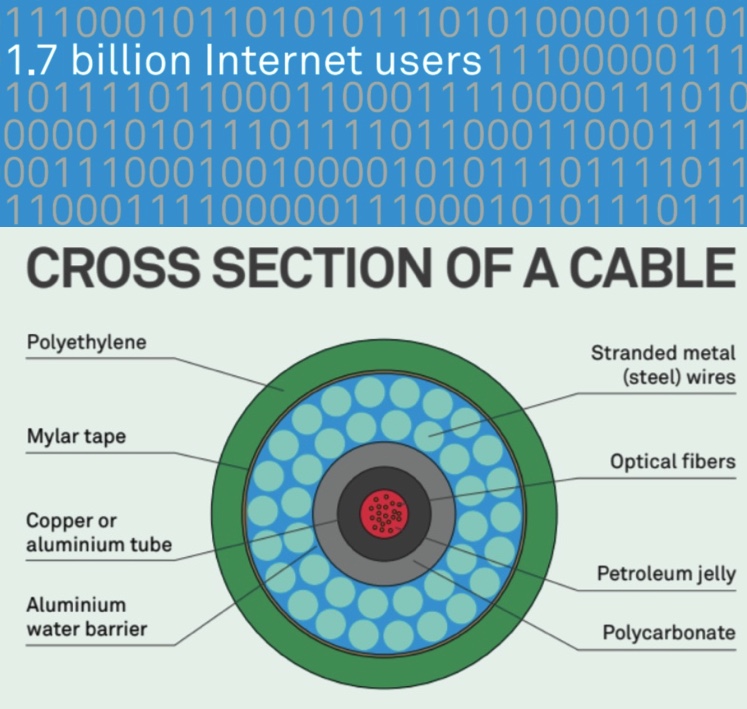
The potential of the Internet revolution is especially compelling in Africa, a continent neglected for so long in the global communications revolution. The 10,000 kilometre-long East African Submarine Cable System (EASSy), connecting sub-Saharan Africa with Europe and Asia, has joined other cables from the continent. Gradually, the infrastructure is coming in to place to connect Africa properly to the world.

The first batch of Internet users came from the United States, home of the Internet which grew out of the US military’s Arpanet system (http://en.wikipedia.org/wiki/ARPANET). This first wave of the Internet’s history was very much an American phenomenon. The priorities and content of the web were driven by the cultural and economic concerns of its American users. And the big brands of today’s web reflect this: Google, Facebook, eBay, Twitter, Yahoo, WordPress, to name a few.

As the web expanded across wealthy, developed nations in Europe, users mostly mimicked the priorities of the American approach, using the web to express themselves, be entertained, share files, access government services and sell and market products and services.

But the spread of the Internet across the global South is already showing itself to have a different character and set of priorities. One change is in the way people are accessing the web: through mobile phones and other devices, rather than through laptops and personal computers.

In the future, the trend is towards a global mobile world, in which the communications medium will favour video and audio over text, according to Fast Company magazine (http://www.fastcompany.com). Information is being shared across boundaries on a vast scale for the first time. People around the world are gaining access to data and information never available before, and all of it is nearly instantaneous.

Kulesz said countries of the South face a profound and difficult decision: follow the lead taken by the technology pioneers of the South, or try and replicate what was done in the North?

“Sooner or later, these countries will have to ask themselves what kind of digital publishing highways they must build,” his report said, “and they will be faced with two very different options: a) financing the installation of platforms designed in the North; b) investing according to the concrete needs, expectations and potentialities of local authors, readers and entrepreneurs. Whatever the decision of each country may be, the long-term impact will be immense.”

The costs of trying to replicate the technological infrastructure of the North makes little sense, when it is technologically possible to bypass this costly infrastructure with even newer work-arounds.

“Of course, it would be extraordinary to obtain 80 percent Internet penetration in Africa or make huge investments in infrastructure throughout the developing regions,” continues Kulesz, “but that may never happen. And in the event that it does occur some day, by then the industrialized countries will no doubt have made another technological leap, meaning that the disparity in infrastructure would still persist. So the most effective option is to start working right now, with what is available.”

New global magazine Southern Innovator (http://www.scribd.com/doc/57980406/Southern-Innovator-Issue-1), published by UNDP’s Special Unit for South-South Cooperation, captures how this process is happening, as the people of the global South re-shape the Internet to be their own and to meet their needs.

Published: August 2011

Resources

1) Southern Innovator: New global magazine first issue gives a snapshot of the big changes across the global South in mobile phones and information technology. Website:http://www.scribd.com/doc/57980406/Southern-Innovator-Issue-1

2) Cisco Visual Networking Index Forecast (2010-2015): The annual Cisco VNI Forecast was developed to estimate global Internet Protocol traffic growth and trends. Widely used by service providers, regulators, and industry influencers alike, the Cisco VNI Forecast is based on in-depth analysis and modelling of traffic, usage and device data from independent analyst forecasts. Website:http://newsroom.cisco.com/press-release-content?type=webcontent&articleId=324003

3) Digital Publishing in Developing Countries: A report by the International Alliance of Independent Publishers. Website: http://alliance-lab.org/etude/archives/date/2010/01?lang=en

https://davidsouthconsulting.org/2022/02/09/african-health-data-revolution/

https://davidsouthconsulting.org/2020/12/04/big-data-can-transform-the-global-souths-growing-cities/

https://davidsouthconsulting.org/2020/12/11/false-data-makes-border-screening-corruptible/

https://davidsouthconsulting.org/2022/09/27/india-2-0-can-the-country-make-the-move-to-the-next-level/

https://davidsouthconsulting.org/2022/10/31/mapping-beirut-brings-city-to-light/

Development Challenges, South-South Solutions was launched as an e-newsletter in 2006 by UNDP’s South-South Cooperation Unit (now the United Nations Office for South-South Cooperation) based in New York, USA. It led on profiling the rise of the global South as an economic powerhouse and was one of the first regular publications to champion the global South’s innovators, entrepreneurs, and pioneers. It tracked the key trends that are now so profoundly reshaping how development is seen and done. This includes the rapid take-up of mobile phones and information technology in the global South (as profiled in the first issue of magazine Southern Innovator), the move to becoming a majority urban world, a growing global innovator culture, and the plethora of solutions being developed in the global South to tackle its problems and improve living conditions and boost human development. The success of the e-newsletter led to the launch of the magazine Southern Innovator.

https://davidsouthconsulting.org/2021/03/05/southern-innovator-issue-1/

Creative Commons License

This work is licensed under a
Creative Commons Attribution-Noncommercial-No Derivative Works 3.0 License.

ORCID iD: https://orcid.org/0000-0001-5311-1052.

© David South Consulting 2023