Categories
Archive Blogroll Development Challenges, South-South Solutions Newsletters Southern Innovator magazine

The Power of the Word: African Blogging and Books

By David SouthDevelopment Challenges, South-South Solutions

SOUTH-SOUTH CASE STUDY

“Culture is not a luxury … Culture is the spiritual backbone of society”: with these words Jan Kees van de Werk, the Dutch poet and long-standing advocate of African literature, summed up the importance of culture to Africa’s development. Two trends could significantly alter the prospects for African writers in 2007: the new wave of African bloggers and websites that are now emerging, and the increasing awareness of African literature. More traditional writing is now being joined in 2007 by a surge in African blogging. As internet access has increased, and awareness of free blogging websites like WordPress has also shot up, Africans are jumping online to express themselves (see also Development Challenges, March issue).

African literature is gaining an ever-greater audience through high-profile prize-winning. From veteran Nigerian writer and UNFPA Goodwill Ambassador Chinua Achebe winning this year’s Man Booker International Prize, to best-selling French language authors like Ivorian Ahmadou Kourouma (Allah is not Obliged) and Albert Memmi, winner of the French Academy’s Grand Prix de la Francophonie. They are joined by many others gaining international acclaim, including Uganda’s Monica Arac de Nyeko – winner of the prestigious Caine Prize for African Writing – Nigeria’s Chris Abani (Graceland), Cameroon’s Calixthe Beyala (Lost Honor), Congolese writer Daiel Biyaoula (Alley Without Exit) and Mauritius’s Carl de Souza. The Salon International du Livre et de la Presse de Geneva has established the Ahmadou Kourouma Prize, and the new Book Show for African Literature, Press and Culture is scheduled for 2008.

Increasingly, the creative industries are gaining respect as a key part of a vibrant economy. The power of a successful author or musician to generate awareness and excitement about a country and its products, has gained the respect of many governments. And they are also learning to respect the wealth that can be generated. For example, in Britain the creative industries earn almost as much as the powerful financial sector (Work Foundation). The World Bank’s private sector arm, the International Finance Corporation, has singled out Africa’s creative sector for its future investment.

Blogger Titilayo Soremi in Abuja, Nigeria, is typical of the new wave. A business development officer for an NGO, her blog is a vivid snapshot of life in her country. Obed Sarpongin Accra, Ghana is a budding poet and does not shy away from thorny issues. In his current blog, he tackles domestic politics and writes about the on-again, off-again electricity supply. The secretive Kenyan banker known by the name Bankelele is a lover of new ideas judging by his blog. The content is a mix of financial tip-offs and upcoming business investment opportunities in the region, all stirred up with some rather frank thoughts on politics. He has also gone the extra mile and acquired sponsors for his blog (that banking experience is not going to waste).

The Internet age has also given birth to a new phenomenon: the so-called ”long tail” This is best explained by Kelvin Smith in his paper ‘African Publishers and Writers in British and International Markets’: “What now emerges is that more than half the revenue of Amazon is in the ‘bottom’ two million books on the list.

“So, the ‘Long Tail’ principle goes, we are now looking at a technology that can service the needs not of dozens of markets of millions, but millions of markets of dozens. This has great significance for the small publisher, whether that publisher is in a large publishing nation or in a country where publishing is a smaller scale activity.”

It looks as if getting creative is not only fun, it can be the next goldmine for Africa’s entrepreneurs.

Published: August 2007

Resources

Creative Commons License

This work is licensed under a
Creative Commons Attribution-Noncommercial-No Derivative Works 3.0 License.

Update: There is no better proof of concept than impact.

One of the many African blogs and websites to share content from UN e-newsletter Development Challenges, South-South Solutions (2006-2014) and Southern Innovator Magazine (2011-2014).

“Great economic and business reporting! Very helpful for us.” Africa Renewal, Africa Section United Nations Department of Public Information

The story Nollywood: Booming Nigerian Film Industry, from UNDP e-newsletter Development Challenges, South-South Solutions, cited in Innovation Africa: Emerging Hubs of Excellence edited by Olugbenga Adesida, Geci Karuri-Sebina, Joao Resende-Santos (Emerald Group Publishing, 2016).

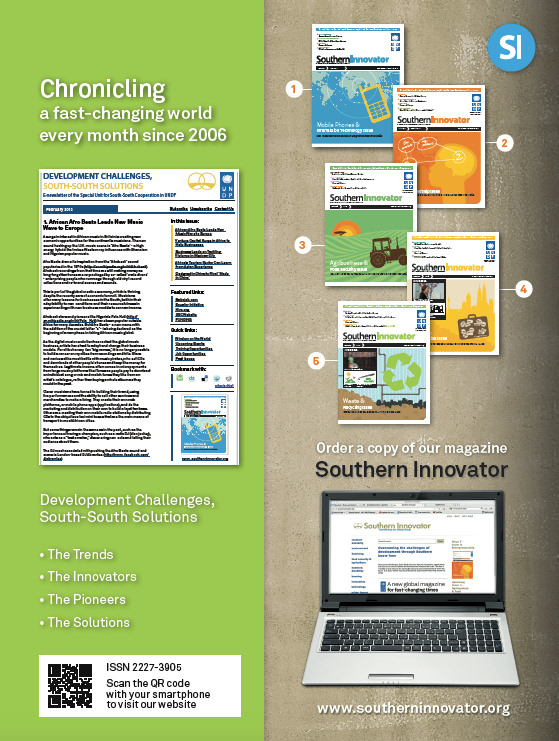
Southern Innovator was published from 2011 to 2015 by the United Nations.

Team | Southern Innovator Phase 1 Development (2010 – 2015)

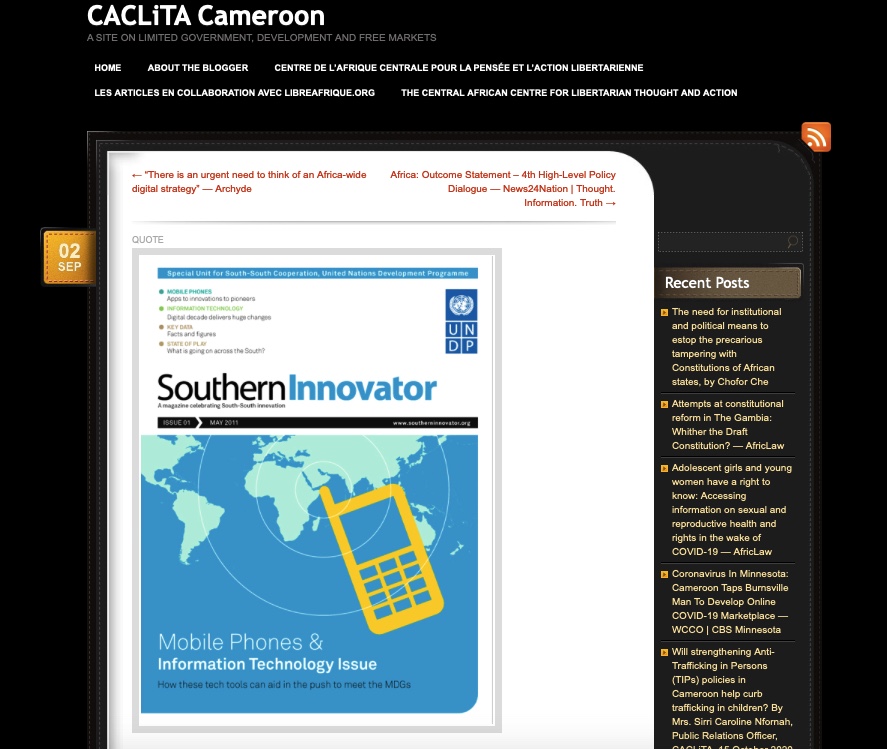
Development Challenges, South-South Solutions was launched as an e-newsletter in 2006 by UNDP’s South-South Cooperation Unit (now the United Nations Office for South-South Cooperation) based in New York, USA. It led on profiling the rise of the global South as an economic powerhouse and was one of the first regular publications to champion the global South’s innovators, entrepreneurs, and pioneers. It tracked the key trends that are now so profoundly reshaping how development is seen and done. This includes the rapid take-up of mobile phones and information technology in the global South (as profiled in the first issue of magazine Southern Innovator), the move to becoming a majority urban world, a growing global innovator culture, and the plethora of solutions being developed in the global South to tackle its problems and improve living conditions and boost human development. The success of the e-newsletter led to the launch of the magazine Southern Innovator.  

Follow @SouthSouth1

Google Books: https://books.google.co.uk/books?id=uXWUyfb4MacC&dq=development+challenges+september+2009&source=gbs_navlinks_s

Slideshare: http://www.slideshare.net/DavidSouth1/development-challengessouthsouthsolutionsseptember2009issue

Southern Innovator Issue 1: https://books.google.co.uk/books?id=Q1O54YSE2BgC&dq=southern+innovator&source=gbs_navlinks_s

Southern Innovator Issue 2: https://books.google.co.uk/books?id=Ty0N969dcssC&dq=southern+innovator&source=gbs_navlinks_s

Southern Innovator Issue 3: https://books.google.co.uk/books?id=AQNt4YmhZagC&dq=southern+innovator&source=gbs_navlinks_s

Southern Innovator Issue 4: https://books.google.co.uk/books?id=9T_n2tA7l4EC&dq=southern+innovator&source=gbs_navlinks_s

Southern Innovator Issue 5: https://books.google.co.uk/books?id=6ILdAgAAQBAJ&dq=southern+innovator&source=gbs_navlinks_s

ORCID iD: https://orcid.org/0000-0001-5311-1052.

© David South Consulting 2023

Categories
Archive id magazine

Redneck Renaissance: A Coterie Of Journalists Turn Cracker Culture Into A Leisure Lifestyle

By David South

Id Magazine (Canada), August 22 to September 4, 1996 

What happens when rednecks pick up a lesson or two from the world of identity politics? Mostly ridiculed by smug urbanites, or just plain ignored by the general population at large as cultural fads come and go, angry rednecks are standing tall in these conservative times. 

Part Mark Twain-like satire, reverence and condescension, a cottage industry promoting the southern American redneck lifestyle is starting to resemble past struggles for cultural pride. 

Just think of the gay rights movement in the 70s and 80s, which turned the derogatory word queer into a touchstone of homosexual pride. 

In the 90s, dismissing rednecks as a bunch of dumb crackers can not only ensure free dental work in many an American bar, it can also be seen as an affront to white American values. But while some want to stereotype this culture as the heart and soul of white working-class American ideals, it is hard not to be disturbed by this phenomenon. Can God, beer, the American Constitution and guns weave together a stable lifestyle? 

Author, radio personality and Redneck Olympics MC Bo Whaley was interviewed in a phone booth across from the bomb site at Atlanta’s Centennial Olympic park. During the interview Bo was kicked out of the phone booth by Atlanta police for talking too long. He picked up the interview from a truckstop near Dublin, Georgia. 

id: What is a redneck? 

Bo: A redneck to me is a lifestyle, that’s what it is. I relate rednecks to people who work hard, men of the soil. They look for the common things in life. They enjoy the outdoors, enjoy hunting and fishing. They aren’t too interested in status or setting the world on fire. They like to do their own thing. Real close to being what we call a good ole boy. They enjoy life – they work hard and they party hard. 

There is nothing put on by them. They are down to earth. I really enjoy them, they are on the level. If you ask them a question they will tell you the truth. They aren’t trying to impress anybody, just trying to be themselves. 

Go to the local bar and they are listening to the juke-box, smoking cigarettes and drinking beer. We can make fun of ourselves down here, we enjoy it. We laugh at ourselves. Poke a lot of fun. I’m having fun with people who live on farms, live in small towns. Like to hunt, like to fish. They drink beer. I have lived in the south for 24 years. I try to look at people and write what I see. I also wrote The Field Guide to Southern Women

id: I heard the Redneck Olympics didn’t go down so well with the city council. 

The chamber of commerce was concerned about the image. We attract a lot of industry to the town, they were afraid what was going out was a negative image of the lifestyle that is going on in Dublin. 

We didn’t know it was going to catch on like it did. At the opening ceremony we were expecting maybe 250 maybe 350 people – and we had 4,000! The national and international media has got into it. 

id: Are rednecks all right-wing? 

On the right of the political spectrum, yeah. Happy with Newt Gingrich. I don’t think we take politics as seriously as up north. (Former U.S. president) Jimmy Carter is not very popular with the rural people here in Georgia. Well, I think when he went to Washington his values changed. I can name many, many people including me, who don’t like him. Right now I’m five minutes from the Carter Centre in Atlanta. I’ve never been to it. Not really interested in what Carter is doing. 

He is trying to solve all the problems of the world. He looks at himself as more of a missionary than an ex-president. He goes to Haiti, he goes to South Africa, Bosnia. He calls these peace conferences and by-passes the established government in the United States to try to do his own thing. It’s a self-serving thing. 

id: What do you think about the militia movement? 

I do not agree with them. Right now I’m standing across from Olympic park where they had the bomb go off. People that I talked to have no sympathy for the militia, they say let the established investigators handle it and they don’t have any use for (the militia) at all. 

id: Do you think the militias are a symbol of the frustration a lot of rednecks are feeling? 

I agree. But they do a lot more talking than they do acting. 

id: Why do they distrust the federal government and imagine black helicopters are helping the U.N. to set up a totalitarian state? 

I think what they feel is that they know more about handling a situation than the government does and they want to do it on their own. I don’t agree with that. The government’s not perfect here nor in Canada. As long as it is the government I’m going to support it. I was not a Clinton fan but once he was elected he became my president. I have to support him until he gets out. But I don’t support everything he does. 

id: Is the redneck style locked in the 70s? 

The redneck symbol is more popular than it has ever been. A lot of people in offices in stuffed shirts and ties who would love to get out and live this way but they can’t do it on account of losing their jobs. They like to get in a jeep or ride on a motorcycle and say “whee” and to the heck with it. Everybody in the world needs some quiet time, time to yourself to do what you want to do. 

id: Do you think rednecks are in danger of extinction in the age of the Internet? 

They are on the increase. They don’t know about high-tech stuff. They haven’t even got into electric typewriter yet – they are still on manual typewriter. 

id: Do they have any heroes or heroines? 

They are beer people, and if they have any drug they smoke marijuana. 

id: I mean heroes. 

Many are country music fans, like Garth Brooks and Hank Williams Jr. They are big on country music. Female rednecks admire shows like Designing Women

Oh lord, they love T-shirts. The T-shirts say “Opry land,” “Dollywood,” “Get your heart in America or get your ass out.” They don’t like plain T-shirts. 

id: Can you give an estimate of the number of rednecks in the U.S.? 

I travel more in the South Eastern states. In my hometown, in my home county, there are 37,000 people. Most of the people there, I’d say 75 per cent are working people, they either farm or work in factories. Out of those people, I’d say 20 to 25 per cent fall in the category of what I call redneck – they work hard all day and they play hard all night. Nationwide, I have no idea. I can tell you towns that have a lot of rednecks. Chattanooga, Tennessee – lot of rednecks. Columbus, Georgia, it’s a military town. In Montgomery, Alabama they work real hard at being rednecks. 

id: Is there a problem with blurring rednecks with more negative elements like the Ku Klux Klan? 

No, I really don’t see that. Most of the people I know can’t stand the Klan. They give country people a bad name. 

id: Some guy at the Redneck Olympics had a Klan T-shirt on. 

I’m not surprised by that. The main thing you are going to see them wearing if they have anything to do with a symbol of patriotism is a Confederate flag saying “God bless America” and “God bless the South.” 

id: What about the rebel flag? 

They do not want to give it up. There is some legislator in Atlanta who is trying to ban it, and this has to do with trying to appease a faction for their votes. But you get out into rural Georgia, rural Alabama, they want to keep that flag. To be truthful it has a lot to do with the civil rights movement.

id: That it means it’s an affront to the civil rights movement? 

Yeah. 

id: Are there yuppie rednecks? 

I know a neuro-surgeon living in Birmingham, Alabama, I met him through his wife while I was signing books. She came up and said “I’ve got to have one of those Redneck Handbooks,” and I said “Why?” She said, “Because my husband is a neuro-surgeon and he’s from Arkansas and all day long on in his office he’s got his blue buttoned-down shirt, his navy blue suit and his spit shine shoes and driving his Mercedes. When he gets home in the afternoon he puts on his blue jeans, and denim shirt gets the pick-up truck, the dog gets in back and he starts riding in the woods.” He’s a Dr. Jekyll and Mr. Hyde type. I see a lot of that. They kind of let their hair down. It’s a release for them. 

id: Do you see the redneck lifestyle as a different kind of leisure lifestyle, a more working-class leisure lifestyle? 

I think so, David. They put on ragged jeans, say to the world “I am a redneck.” 

What they like to do is go fishing. They will go to the coast and go deep sea fishing. Especially they like to go to stock car races. Big stock car fans. The faster that car goes the better they like it, and the more wrecks they have the better they like it. 

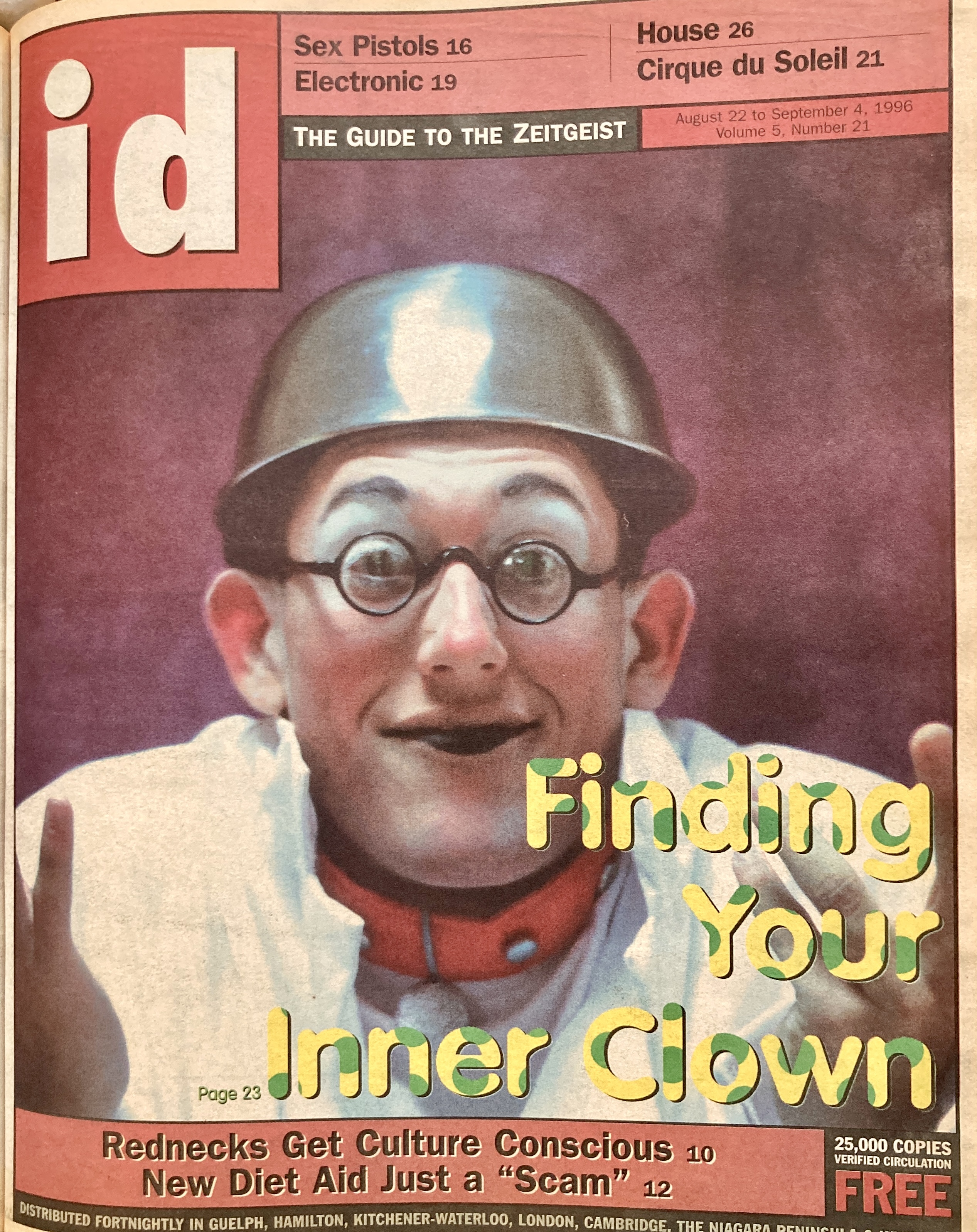
“Finding Your Inner Clown”: Id Magazine (Canada), August 22 to September 4, 1996 . Id Magazine was published in Guelph, Canada in the 1990s.
Creative Commons License

This work is licensed under a
Creative Commons Attribution-Noncommercial-No Derivative Works 3.0 License.

ORCID iD: https://orcid.org/0000-0001-5311-1052.

© David South Consulting 2024