The power of the creative economy to transform lives, livelihoods – and perceptions – should never be underestimated. Creativity can transform the image of places and situations often seen in a negative light. A film from Angola is shining a light on the country’s music scene and showing the vitality of the nation in the wake of a long-running civil war.
Angola’s vicious civil war ran from 1975 to 2002 (http://en.wikipedia.org/wiki/Angolan_Civil_War) and the country is still recovering from the economic and social damage wreaked by the conflict.
The film Death Metal Angola (deathmetalangola.com) was a hit of the recent Dubai International Film Festival (dubaifilmfest.com/en/), an annual film showcase running every December in the United Arab Emirates (UAE) in the Middle East.
Death Metal Angola illustrates the power of film storytelling to draw attention to a country and spark interest in its culture and challenges.
The film focuses on the hidden world of heavy metal music (of which death metal is a sub-genre) (http://en.wikipedia.org/wiki/Heavy_metal_music) in Angola – but it was not supposed to be about heavy metal music at all.
The story starts with American director Jeremy Xido (http://jeremyxido.com/). Originally asked to do a film on immigration, Xido happened upon a railway line in Angola being built by Chinese workers. The railway line was being built in the town of Huambo (http://en.wikipedia.org/wiki/Huambo) in central Angola.
“There’s only one cafe in Huambo where you can get a decent cup of coffee,” he told the UAE’s The National news website. “Everyone interested in coffee is there: expats, military guys, Lebanese businessmen, people from all over the place.”
Hanging out in the café, he met a young man, Wilker Flores, who said he was a musician.
“He said he played death metal, and I just thought: ‘I have to hear this.’”
Flores’ partner, Sonia Ferreira, runs an orphanage and Wilker invited Xido to come hear him play.
“It was in this really poor neighbourhood with no electricity, and there’s Wilker with an amplifier and guitar and stolen electricity from this wire. We lit him with the headlights from an SUV (sport utility vehicle) and he proceeded to play this impromptu death metal concert in the middle of an orphanage with kids running around. It was the most amazing thing I’ve ever seen.
“ Xido then discovered that Ferreira and Flores were organizing the country’s first heavy metal music concert. While they were planning the concert, Xido was inspired to switch to making the film Death Metal Angola.
The documentary took about six weeks to film. Filming took place around Huambu, Benguela and Angola’s booming capital, Luanda. It is a mix of interviews with musicians, including some from the death metal and thrash metal scenes.
The origins of this music scene in Angola reaches back to the country’s former colonial ruler, Portugal, a country where heavy metal rock music has a strong fan base.
Xido found the love for metal music was a by-product of the civil war years. “During the war, a lot of the young guys – if they had the opportunity – would go to Portugal to study to get away from armed service, and they were often exposed to contemporary rock.”
There are local links, too. “Wilker says that rock is actually African in its roots, and says that a lot of the rhythms you’ll find in the countryside are the rhythms you’ll find in death metal.”
“I think a lot of it has to do with looking back at the war and the sort of unfilled promises of post-war,” said Xido, who adds that the lyrics have very political messages and those involved are highly intellectual.
“A lot of these guys are working in banks or doing IT. There’s a young guy who is considered to have the best metal growl. He wanted to come to Dubai, but is studying electronics and has exams.”
Filmmaking is a vibrant part of the global creative economy. According to a 2011 UIS (UNESCO Institute for Statistics) survey, two countries in the global South lead the world in filmmaking. India remains the world’s leading film producer, and Nigeria, with its prolific home video market, continues to hold second place ahead of the United States.
According to the Creative Economy Report 2010, the creative economy is “A new development paradigm” linking the economy and culture, embracing economic, cultural, technological and social aspects of development at both the macro and micro levels.
“Central to the new paradigm is the fact that creativity, knowledge and access to information are increasingly recognized as powerful engines driving economic growth and promoting development in a globalizing world,” the report says.
And as for Xido, making the film has opened his ears to heavy metal music, which he says was not what he listened to growing up.
“Because of these guys I started listening to Pantera and Sepultura and I really got into it. Metal on headphones in New York is fantastic. I love the way they like it in Angola, where it’s a huge expression of joy.”
But what about the other film, the one about immigration and the railway? “It’s still in production,” Xido said.
“Culture is not a luxury … Culture is the spiritual backbone of society”: with these words Jan Kees van de Werk, the Dutch poet and long-standing advocate of African literature, summed up the importance of culture to Africa’s development. Two trends could significantly alter the prospects for African writers in 2007: the new wave of African bloggers and websites that are now emerging, and the increasing awareness of African literature. More traditional writing is now being joined in 2007 by a surge in African blogging. As internet access has increased, and awareness of free blogging websites like WordPress has also shot up, Africans are jumping online to express themselves (see also Development Challenges, March issue).
African literature is gaining an ever-greater audience through high-profile prize-winning. From veteran Nigerian writer and UNFPA Goodwill Ambassador Chinua Achebe winning this year’s Man Booker International Prize, to best-selling French language authors like Ivorian Ahmadou Kourouma (Allah is not Obliged) and Albert Memmi, winner of the French Academy’s Grand Prix de la Francophonie. They are joined by many others gaining international acclaim, including Uganda’s Monica Arac de Nyeko – winner of the prestigious Caine Prize for African Writing – Nigeria’s Chris Abani (Graceland), Cameroon’s Calixthe Beyala (Lost Honor), Congolese writer Daiel Biyaoula (Alley Without Exit) and Mauritius’s Carl de Souza. The Salon International du Livre et de la Presse de Geneva has established the Ahmadou Kourouma Prize, and the new Book Show for African Literature, Press and Culture is scheduled for 2008.
Increasingly, the creative industries are gaining respect as a key part of a vibrant economy. The power of a successful author or musician to generate awareness and excitement about a country and its products, has gained the respect of many governments. And they are also learning to respect the wealth that can be generated. For example, in Britain the creative industries earn almost as much as the powerful financial sector (Work Foundation). The World Bank’s private sector arm, the International Finance Corporation, has singled out Africa’s creative sector for its future investment.
Blogger Titilayo Soremi in Abuja, Nigeria, is typical of the new wave. A business development officer for an NGO, her blog is a vivid snapshot of life in her country. Obed Sarpongin Accra, Ghana is a budding poet and does not shy away from thorny issues. In his current blog, he tackles domestic politics and writes about the on-again, off-again electricity supply. The secretive Kenyan banker known by the name Bankelele is a lover of new ideas judging by his blog. The content is a mix of financial tip-offs and upcoming business investment opportunities in the region, all stirred up with some rather frank thoughts on politics. He has also gone the extra mile and acquired sponsors for his blog (that banking experience is not going to waste).
The Internet age has also given birth to a new phenomenon: the so-called ”long tail” This is best explained by Kelvin Smith in his paper ‘African Publishers and Writers in British and International Markets’: “What now emerges is that more than half the revenue of Amazon is in the ‘bottom’ two million books on the list.
“So, the ‘Long Tail’ principle goes, we are now looking at a technology that can service the needs not of dozens of markets of millions, but millions of markets of dozens. This has great significance for the small publisher, whether that publisher is in a large publishing nation or in a country where publishing is a smaller scale activity.”
It looks as if getting creative is not only fun, it can be the next goldmine for Africa’s entrepreneurs.
Published: August 2007
Resources
Kwani is a lively Kenyan journal of new and young writers. They also organize regular readings and events in Nairobi.
Update: There is no better proof of concept than impact.
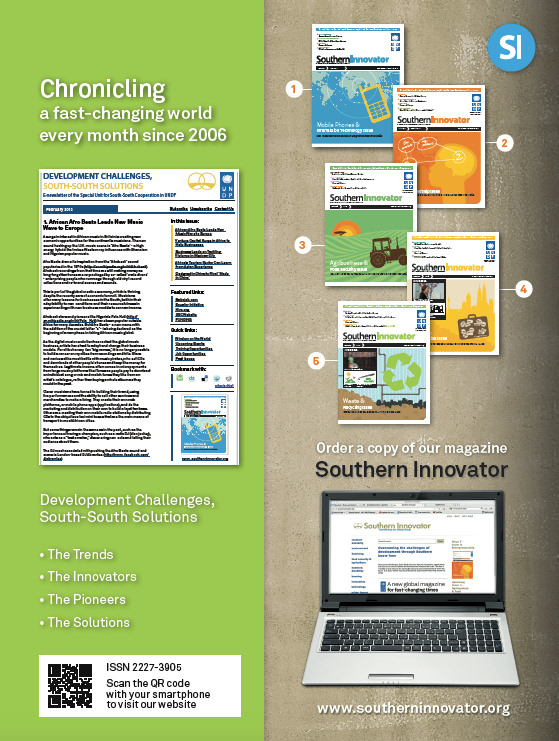
One of the many African blogs and websites to share content from UN e-newsletter Development Challenges, South-South Solutions (2006-2014) and Southern Innovator Magazine (2011-2014).
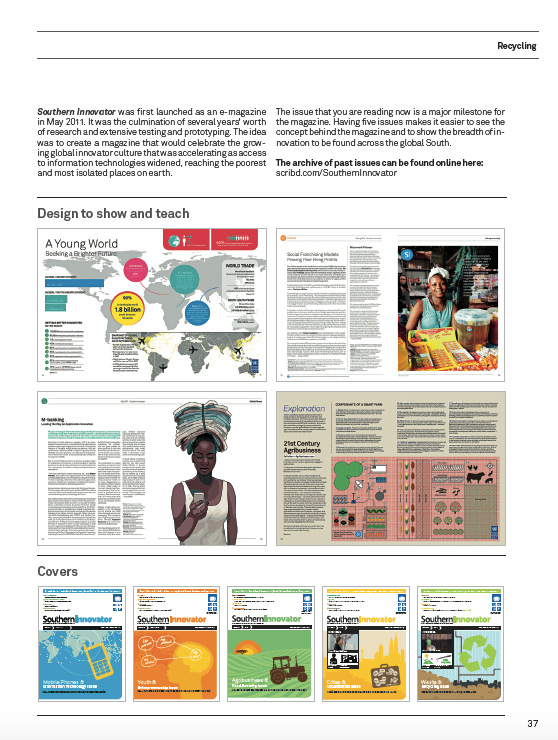
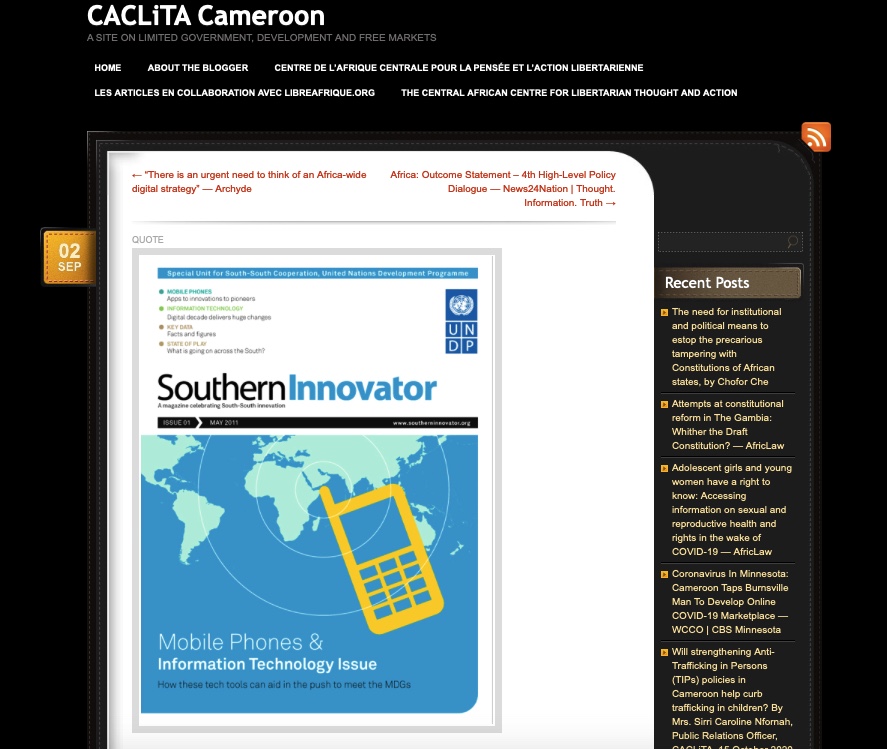
Development Challenges, South-South Solutions was launched as an e-newsletter in 2006 by UNDP’s South-South Cooperation Unit (now the United Nations Office for South-South Cooperation) based in New York, USA. It led on profiling the rise of the global South as an economic powerhouse and was one of the first regular publications to champion the global South’s innovators, entrepreneurs, and pioneers. It tracked the key trends that are now so profoundly reshaping how development is seen and done. This includes the rapid take-up of mobile phones and information technology in the global South (as profiled in the first issue of magazine Southern Innovator), the move to becoming a majority urban world, a growing global innovator culture, and the plethora of solutions being developed in the global South to tackle its problems and improve living conditions and boost human development. The success of the e-newsletter led to the launch of the magazine Southern Innovator.
The aspect of satellite and cable programming most feared by the British government when it pushed the development of new media in the mid-80s looks set to become firmly entrenched as a part of the emerging television era.
Next Wednesday, the USA’s most famous soft-pornography channel will arrive in the UK, almost certainly heralding a satellite porn war for the eyes of the British public.
The Home Office, which used to look after televsion, was worried that porn would be one shock too many for the British and would create havoc with British television laws. But the mores of the marketplace have changed the climate, although the Broadcasting Act and the Independent Television Commission (ITC) still create limits that are stricter than in most other countries.
Hard-core pornography – such as that shown on several continental channels which can be picked up in the UK – remains out of bounds, as evidenced by the Department of National Heritage’s recent proscription of the hard-core TV Erotica.
But the drawing of the line between hard-porn and soft-porn changes over time: the programming now permitted by the ITC is a lot stronger than many might have thought likely a few years ago. The porn channels have learned how to push the boundaries of acceptability and, with competition increasing, are likely to push their luck even further.
Politicians, journalists and old-fashioned new-media programmers – for instance, the United Artists people who were dismayed at the decision of parent company TeleCommunications Inc to bring Playboy over to the UK – may believe that porn channels serve only to cheapen the quality of life.
But the supply side of the marketplace detects that there is a widespread demand for porn and (ironically) religion and so programmers will follow the demand by supplying suitable programming.
The soi-dissant “adult” channels estimate their potential audience at between 7 per cent and 30 per cent of cable and satellite homes – between 400,000 and 1.7 million homes at present penetration levels.
Their main target market is the consumer of “top shelf” magazines which range from the glossy, even glamorous Playboy to the more downmarket magazines of the “reader’s wives” variety. According to the Campaign Against Pornography, the top six pornographic magazine titles sell about 2.5 million copies a month. Altogether, there are about 200 pornographic titles on sale in the UK.
Deric Botham, programmer at the recently-launched Television X – The Fantasy Channel and a porn-industry veteran, estimates that the total UK sex industry – from videos and magazines to sex aids, but excluding prostitution – generates revenues of £4 billion a year, a figure which is difficult to substantiate but is equivalent to 10 times the investment in the UK film industry in 1994.
According to Botham, “our research shows that people want this thing and the majority of people want it to some degree.”
The porn channels are finding it relatively easy to find satellite capacity, largely because they are forced by the rules to operate at a time of day (i.e. night) when most channels have quit their transponders and are only too happy to find someone to sub-lease them to.
According to Botham, “our research shows that people want this thing and the majority of people want it to some degree.”
The first of the new porn channels will be the Playboy Channel, which likes to think of itself as being a cut above the others. The others, it claims, are for “sad, lonely men”. Playboy, on the other hand, is for “happy, heterosexual couples”.
The channel, probably the softest of the genre, will be launched on November 1 by Flextech, BSkyB and the US Playboy Channel.
It will be followed by the not-so-soft Penthouse which is being launched in the UK by a joint venture of Penthouse magazine owners General Media and Graff Pay-Per-View, which already owns the UK Adult Channel.
Two other channels have received licences from the ITC – David (Sunday Sport newspaper) Sullivan’s Babylon Blue and the Adam and Eve Channel. With the Adult Channel and Television X already broadcasting, there could be six porn channels on offer to UK viewers.
But two other channels are beamed into the UK for those willing to pay the cost of extra reception equipment: the continental pirates, Rendezvous and Eurotica. There is also the now-banned TV Erotica.
Cable and satellite was bound to be an attractive medium for the porn channels, given the possibility of encrypting the signal and imposing a subscription fee and, as a consequence, benefiting from the lighter regulation that has seemed likely. Sex-channel executives say that the ITC has become increasingly flexible in what it will allow.
Three other factors have fuelled would-be channels to turn to cable and satellite:
The replacement of the independent high-street video store by big video superstores has robbed the porn industry of a key outlet.
New-media distribution should bring in consumers who are embarassed to hire a porn video from a shop. Yet buying a subscription to a porn channel may be a more embarassing act within the family environment.
The Adult Channel is regarded as demonstrating that there is an audience for porn in the UK: it is thought to have about 224,000 subscribers.
Cable and satellite has far more potential for the porn industry than the traditional-format channel. The prize, which will make everything worthwhile, is pay-per-view (ppv). Bill Furrelle, Playboy Channel’s sales director, said that he had been asked by several UK cable operators about providing a ppv service next year. The operators want Playboy, the Adult Channel and Adam and Eve to contribute to the Home Cinema ppv service which they hope to put together.
Susan Sontag, the renowned American essayist, described pornography as a “crutch for the pyschologically deformed and brutalisation of the morally innocent.” The Campaign Against Pornography in the UK believes that pornography exploits women and children “in a degrading and humiliating way, often with the message that we enjoy this and want to be abused.”
The campaign encourages its supporters to take direct action against any distributor of pornographic material as part of its wider campaign to put the industry out of business.
The porn channels dismiss arguments that they degrade women and encourage male violence against women. Playboy managing director Rita Lewis argues that “women are happy to consume erotic imagery like pin-ups. Women are not hung-up by this anymore, they are not threatened by the fantasy women we show in our programming. We hope Playboy will lead to couples’ making love together.”
Andrew Wren, financial director of the Adult Channel, also dismisses the link between pornographic programming and sexual violence. “I don’t think there is anything in programmes that would encourage men to go and rape. Women are interested in sex as men are.”
Television X’s (Deric) Botham says that porn programmes are “a bit of titilation” in the fine, upstanding tradition of the British Carry On films. None the less, he admits that “I wouldn’t want my daughter to get involved in pornography.”
He says that the women involved in the programmes, some of them housewives, are willing participants and enjoy the opportunity. “I don’t produce anything that is against the law. We speak to the individuals concerned. If you have a reluctant model, it doesn’t work – I just won’t buy the video.”
The Campaign Against Pornography sees it all rather differently. Ann Mayne, a member of the campaign’s management committee, was particularly critical of two programmes on Television X – Shag Nasty and Mutley and Fly on the Wall.
She said that Shag Nasty and Mutley, in which a presenter approaches women in the street or in supermarkets and offers them £25 to look at their knickers, or £50 to be filmed having sex with him, gave the message that women were simply objects and that it was acceptable to harass them.
“It is complete prostitution of female sexuality,” she said. “Botham wants full-on, across-the-board prostitution of women. In his view, every woman must have a price.”
Mayne said that Fly on the Wall, in which real-life couples are shown having sex, was an open invitation for men to coerce their partners into being filmed, possibly to the point of abuse.
UK laws on satellite porn among toughest in Europe
UK regulations on what can be shown on sex channels are tougher than in most countries of the European Union. Channels such as the hard-core Swedish TV Erotica and the recently-launched French Rendezvous are licensed in their respective countries and transmit explicit scenes of sexual intercourse, straight and gay, featuring close-up shots of copulating genitals.
Graff Pay-Per-View, the experienced US sex channel operator, consciously decided to exclude the UK as a market for its hard-core Eurotica channel which is licensed in Denmark and, like the other hard-core channels, transmits via a Eutelsat satellite. But pirate smart cards for the channel, as for the other channels, are available in the UK in specialist satellite shops.
Graff’s seeming respect for the UK regulations may not be unconnected with the fact that it owns the Adult Channel and would be wary of upsetting the ITC. Broadcasting unacceptable material into the UK could provoke the ITC into seeing Graff as a body unfit to hold a licence, thereby threatening the Adult Channel.
The ITC’s guidelines on sexually explicit material state that representations of sexual intercourse can be shown only after 9pm and that “the portrayal of sexual behaviour, and of nudity, needs to be defensible in context and presented with tact and discretion.”
There has been some relaxation of the rule. The ITC will, on an experimental basis, allow the watershed to be broken by a ppv or video-on-demand service. It is not, however, prepared to give this freedom to a porn channel, at least not in the early days, because it does not want to be seen to be licensing pornography. The relaxation will affect only general services.
The ITC will also monitor any ppv service to ensure that there are no cases of children accessing the programming before deciding if the programme code should be revised.
The transmission pf 18-rated films on terrestrial or new-media channels is not permitted before 10pm. Films with a 15-rating are not allowed before 9pm on terrestrial channels such as BSkyB’s Sky Movies or the Movie Channel. These are minimum requirements. Some 15-rated films, for instance those which show scenes of sexual intercourse or drug-taking, would not be deemed suitable for transmission even on an encrypted channel at 8pm.
In practice, the ITC does not permit depictions of erect penises, anal intercourse, close-ups of genitalia or ejaculation.
Where channels have overstepped the mark and gone abroad to get licences from less strict authorities – the late Red Hot Dutch and TV Erotica – the ITC has recommended that the channels be proscribed, action which has subsequently been taken by the Department of National Heritage. The ITC is now monitoring the Rendezvous channel, which shows a mix of gay and heterosexual hard-core pornography with graphic scenes of sexual intercourse.
The DNH issues proscription orders under Sections 177 and 178 of the Broadcasting Act. The orders make it a criminal offence to supply equipment to receive the channels or to market and advertise them.
The European Union directive on transfrontier broadcasting lays down that one country cannot prevent the reception of channels licensed by other European Union countries. However, it allows individual governments to take action against any broadcast which could damage the physical, mental or moral development of minors.
The Playboy Channel, due to launch in the UK on November 1, is trying to position itself as being a cut above the existing sex channels with which it will compete for subscribers.
The channel, which is running an advertising campaign costing more than £1.5 million, believes that its big budgets and slick production values will attract viewers who have hitherto been uninterested in so-called “adult” entertainment. It hopes to win an audience among women as well as men.
Managing director Rita Lewis dismisses the other sex channels as being aimed at people who are “a bit sad and on their own”. The channels promote “deviant” behaviour.
Playboy hopes to attract happy, heterosexual couples who will treat the channel as an aid to foreplay: “We hope Playboy will lead to couples’ making love,” said Lewis, who believes that women, as well as men “are happy to consume erotic imagery like pin-ups.”
In the USA, according to Lewis, 70 per cent of the audience for the channel comprises couples.
“We hope Playboy will lead to couples’ making love,” said Lewis, who believes that women, as well as men “are happy to consume erotic imagery like pin-ups.”
She said that the UK Playboy will run programmes that have more in common with programmes like Channel Four’s The Good Sex Guide. “These days, a whole bunch of people are sampling erotic programming like The Good Sex Guide. It is very sexy programming with mass-market appeal.”
Playboy’s movies would have a high standard of production, she said, very different from what she claims to be the cheap programming made for the other channels, often home videos and often shot with hand-held cameras.
Playboy’s programming will comprise sex films, interviews with “centrefold” models, documentaries on the sex industry and general-entertainment programming such as quiz shows.
The rival channels claim that Playboy will not be a big threat to them. The Adult Channel’s Wren says that all the new channels “hype the market, which helps us.” In any case, adult entertainment consumers have already been weaned on a harder mix of programming and do not want something that offers little more than what Channel Four shows.
The UK Playboy Channel, which is owned by UK programmer Flextech (51 per cent), British Sky Broadcasting (30 per cent) and Playboy Enterprises (19 per cent), will transmit from between midnight and 4am on the Bravo transponder on Astra 1c.
Special Report: Sexual Dealing: Today’s Sex Toys Are Credit Cards & Cash: A Report On The Sex-For-Money Revolution.
Update: It is over 20 years since this Special Report was published. The Internet now plays a significant role in the growth of sex content and the sex industry and vice versa. Here is an interesting overview of the situation in 2020. The Internet is for Porn – It always was, it always will be.
“One of the biggest and most interesting things happening in the consumer web right now is running almost completely under the radar. It has virtually zero Silicon Valley involvement. There are no boastful VCs getting rich. It is utterly absent from tech’s plethora of twitters, fora and media (at least, as they say, “on main”). Indeed, the true extent of its incredible success has gone almost completely unnoticed, even by its many, many, many customers.









 David South Consulting
You must be logged in to post a comment.