Categories
Archive Development Challenges, South-South Solutions Newsletters

Southern Art Hubs Grab Attention for Creative Economy

By David SouthDevelopment Challenges, South-South Solutions

SOUTH-SOUTH CASE STUDY

Regeneration – of poor neighbourhoods, districts, even whole countries after a conflict – is both a challenge and a key to transforming lives. One approach that has a track record is turning to artists and creative people to re-imagine a neighbourhood or country’s culture, and restore pride and vitality to places beaten down by life’s hardships.

The tool to do this is the creative economy. The “interface between creativity, culture, economics and technology in a contemporary world dominated by images, sounds, texts and symbols” (UNCTAD) is seen as away for emerging economies to leapfrog into high-growth areas in the world economy.

Two approaches offer inspiring examples: a Brazilian art gallery owner is single-handedly remaking the Brazilian market for contemporary art. And in Cambodia, a new wave of young artists are creating a stir in the global art scene.

Galeria Leme (http://www.galerialeme.com/home.php?lang=ing) is located in a graffiti-strewn, down-at-heel neighbourhood in Sao Paulo, Brazil.

Brazil has seen impressive economic growth in the past decade. The country is Latin America’s biggest economy and had reached growth of 5.1 percent in 2008 before being hit by the global recession.

The gallery pursues several goals at once: its mission is to draw attention to socially and politically engaging contemporary Brazilian art, but it also aims to increase awareness of the art market in Brazil and help in the revitalization of the gallery’s neighbourhood.

The gallery is a concrete box designed by Paulo Mendes da Rocha (http://en.wikipedia.org/wiki/Paulo_Mendes_da_Rocha), an award-winning Brazilian architect. Founded in 2004 by former banker Eduardo Leme, the gallery has fashioned itself into being the leading authority on contemporary art in Brazil. Leme used to work in the financial sector before moving into running a gallery, and has applied his understanding of markets and how to create demand.

This in turn has grabbed international attention, and had the global art world beating a path to this neighbourhood. In short, it creates a buzz that soon feeds on itself and draws in more people to the scene.

It’s a formula that has worked well in many other places, where a successful gallery fosters a scene and draws in audiences, buyers and new businesses. Soon, a creative economy comes alive and that means serious money. Both New York and London have shown how this can work. In New York City, the creative economy employs over 278,000 people (2002).

Sao Paulo is the commercial hub of Brazil’s contemporary art market. But previously, buyers had to search all over the city to find the works they wanted to buy.

“I think it is a really good moment for Brazilian art,” Leme said.”Brazilian art is fantastic. Due to our miscellaneous (sic) of culture and people and all these kind of things. Brazil is almost a continent. You have art made of wood, made of metal, made of plastic films, all the materials. More and more, I am seeing Brazilians moving onto the international markets, the prices are moving up. The number of fellows from museums that are coming down here to see what’s going on, it’s fantastic.

“To run this business you not just to have good stuff: you need to understand to whom you should sell also,” Leme told the magazine Monocle. “I mean also not just Sao Paulo is a rich and big city that you have a lot of collectors. There is a lot of social stuff you have to understand to be in this specific business.

“My challenge is to increase the Brazilian market. I have this kind of ambition. More partners, more people talking about art, if more people talking about art I am going to receive more feedback and I am going to grow the terms. Not just as a business but also as a man I will have more things on my mind, more information. And the financial market, the more money you make the richest you are. Here, it is not just that: my point of view is that the more challenge is the thing, the more goals I make I am going to be richer in this business.”

Another scene has taken off in formerly war-ravaged Cambodia in Southeast Asia. The country was notorious for the horrors of the Killing Fields in the 1970s (http://en.wikipedia.org/wiki/The_Killing_Fields), where the extremist Khmer Rouge government executed people and Cambodian artists suffered greatly. As a result, the art community was devastated for many years.

Thirty years on, a new generation of artists has emerged from the recent years of peace. This new wave is getting attention across Asia for its innovation.

Artist Pich Sopheap is one of the pioneers. By founding the Cambodian contemporary art association saklapel.org with Linda Saphan, he has focused the Cambodian art scene through group exhibitions and promotion. Another tool he uses to build the scene up has been the Visual Art Open(VAO), an annual event since 2005 featuring work by Cambodian artists.

This has had the effect of building a strong community of artists within the country who can support each other. It also makes it easier for outside art buyers to discover who is working in the country’s art scene.

Sopheap works in a variety of media including oil painting, photography and sculpture. He manipulates bamboo and rattan to shape his sculptures.

“I think for me sculpture with this material is just because it is cheap. It’s easy to use, it is very relevant. The subject matter is in the work already. For me it is discovering new forms that resonant with the atmosphere, with the conditions of this country,” Sopheap told the BBC.

Sopheap’s family fled from the Khmer Rouge in the 1970s. He spent his early life in the United States, where he trained in art. When he returned to Cambodia a few years ago, he found the art scene very small and weak.

“Cambodia is a young country when it comes to modern art. It takes a while for new blood to come back and actually make something that concerns the present time,” believes Sopheap. “And we are very young, in our early 30s. Before that there was almost none that was known. We are making our own way – it is all up to us. We show in different cafes, we show in bars, we show in gift shops. And when we do those kind of exhibitions it is kind of exciting, it is not really a gallery, a cold place, people go by and it exposes to a lot of foreigners.”

A Cambodian-trained artist, Leang Seckon (http://saklapel.org/vao/artists/leang_seckon/), takes these approaches further, using sewing, painting, metalwork and collage in ways that reference Cambodian traditions, from apsara ballet (http://en.wikipedia.org/wiki/Apsara_Dance) to fortune-telling, while subtly commenting on modern culture, society and politics. Seckon now has shows in Britain, Japan and Norway, and has become one of the country’s most successful artistic exports.

“To begin with I was not a professional artist and I didn’t realize I could jump from low to high level so fast. Things have changed so quickly for me. If I do one style of art it makes me feel so bored. But if I mix it up with other techniques like sewing and collage, it makes it more interesting for me. I don’t know if you can call that real Cambodian art but I didn’t copy or learn it from anyone: I created it myself.”

“This is a very important point for me: I can show all my work to the international community. In the countries I go to, I tell them the same thing. Cambodia has new, young artists – we haven’t disappeared: the young ones have been growing up.”

His approach is to stay away from cliched Cambodian art.

“I just think we work really hard,” says Sopheap on the group’s success to date. “I just think we work really hard and get together and organize exhibitions ourselves for the most part. It is just artists working hard and they are hungry and they are fearless and when that energy is happening, people from the outside start to actually pronounce our name correctly and afterward they come to town and just by accident they find this little scene, and they are very interested in it because it is raw.”

Published: December 2009

Resources

  • Global Creative Economy Convergence Summit 2009: The summit is about the successful and emerging creative technologies and initiatives that are driving economic growth locally, nationally and internationally. Website: http://www.gcecs2009.com/
  • Creative Economy Report 2008. An economic and statistical assessment of creative industries world-wide as well as an overview of how developing countries can benefit from trade in creative products and services produced by UNCTAD and the Special Unit for South-South Cooperation in UNDP. Website: http://www.unctad.org/en/docs/ditc20082cer_en.pdf
  • An article about artists in the Caribbean and how they are using online networks to connect and earn income. Website: http://globalvoicesonline.org/2009/07/23/trinidad-and-tobago-online-art-networks/

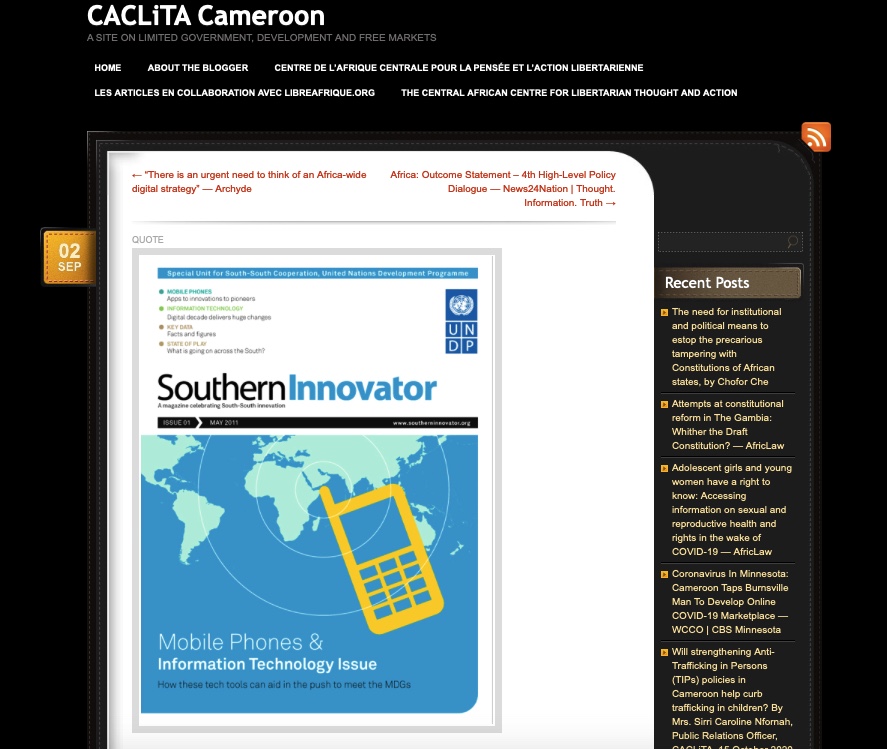
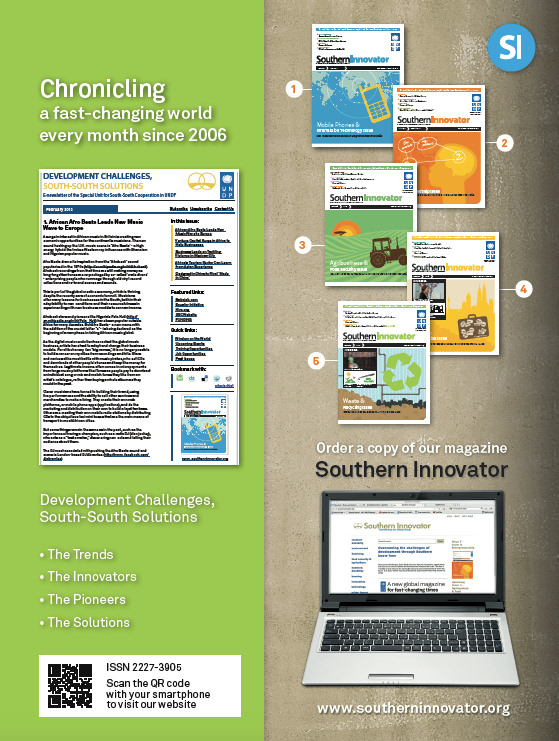
Development Challenges, South-South Solutions was launched as an e-newsletter in 2006 by UNDP’s South-South Cooperation Unit (now the United Nations Office for South-South Cooperation) based in New York, USA. It led on profiling the rise of the global South as an economic powerhouse and was one of the first regular publications to champion the global South’s innovators, entrepreneurs, and pioneers. It tracked the key trends that are now so profoundly reshaping how development is seen and done. This includes the rapid take-up of mobile phones and information technology in the global South (as profiled in the first issue of magazine Southern Innovator), the move to becoming a majority urban world, a growing global innovator culture, and the plethora of solutions being developed in the global South to tackle its problems and improve living conditions and boost human development. The success of the e-newsletter led to the launch of the magazine Southern Innovator.
Creative Commons License

This work is licensed under a
Creative Commons Attribution-Noncommercial-No Derivative Works 3.0 License.

ORCID iD: https://orcid.org/0000-0001-5311-1052.

© David South Consulting 2022
Categories
Archive Development Challenges, South-South Solutions Newsletters

Reality Television Teaches Business Skills in Sudan

By David SouthDevelopment Challenges, South-South Solutions

SOUTH-SOUTH CASE STUDY

Learning how to thrive in a market economy does not necessarily come naturally. But for young people who have grown up under a different economic system or known nothing but economic chaos, learning business skills can give them the tools to get on in life.

With youth unemployment rates high around the world, it is clear many young people may never get the jobs they expect unless they start businesses themselves.

In 2013, 73.4 million young people were out of work, an increase of 3.5 million from 2007. A report by the International Labour Organization (ilo.org) found persistent unemployment around the world in the wake of the global economic crisis, a proliferation of temporary jobs and growing youth discouragement in advanced economies; and poor quality, informal, subsistence jobs in developing countries. School-to-work transition surveys of developing countries showed that youth are far more likely to land low-quality jobs in the informal economy than jobs paying decent wages and offering benefits.

High youth unemployment often has nothing to do with poor educational achievement (many unemployed youth have high school educations or university degrees), but is often caused by other factors, including lack of access to capital, rigid labour markets, skills mismatched to demand in the economy (for example construction and building trades), or a gap between personal aspirations and the true state of the country’s economic development.

But rather than despair, it is possible to show youth how to turn things around and use business skills to re-shape economies in their favor. Youth tend to bring to the economy energy and drive combined with new ideas and experiences calibrated to the demands of the 21st century. By harnessing this, youth can find a unique space in the marketplace. In turn, young people can lead in reviving damaged economies and making their countries wealthier and healthier. Many youth have grown up around the emerging digital economy and the use of mobile phones. Being comfortable with the 21st century digital economy will unleash many economic opportunities that favor youth.

The British Council says that “creative entrepreneurship is considered the most efficient model for youth in the developing world who are facing huge difficulties in finding employment”. The entrepreneurship or creative investment industry is one of the fastest-growing sectors in the world.

Understanding what works for youth business entrepreneurship has become a specialty in its own right. Using the media to teach skills and inspire youth to action is one proven approach.

One recent example is a successful television programme from the Republic of the Sudan. Called Mashrouy (mashrouy.com), it is modeled on reality TV programmes such as The Apprentice, which features serial U.S. entrepreneur Donald Trump (http://www.bbc.co.uk/programmes/b00q3fkq) and the BBC’s Dragon’s Den (http://www.bbc.co.uk/programmes/b006vq92), where contestants pitch their ideas to a panel of judges to see if they can get funding for their business idea.

In Mashrouy, 12 contestants battled it out to see who had the best business idea. They undertook various challenges and the original 12 were whittled down to three contestants. Live on air in December 2013, viewers voted for their favorite contestant and the winner (https://www.facebook.com/Mashrouy) received a prize of 200,000 SDG (US $35,211), while the second prize winner received 150,000 SDG (US $26,408) and the third prize winner received 100,000 SDG (US $17,605). All three were then taken to London in the United Kingdom to meet other creative entrepreneurs and receive valuable business advice.

The Sudanese show (http://sudan.britishcouncil.org/our-work/mashrouy) is supported by the British Embassy and the British Council, and is working with the Sudanese Young Businessmen Association and major Sudanese companies to spread the idea of entrepreneurship among the youth of Sudan.

Sudan suffered a brutal civil war on and off throughout the 2000s, leading to the partition of the original country into the Republic of the Sudan and the new nation of South Sudan in 2011.

Faced with Sudan’s serious youth unemployment – as high as 34 per cent – and a fragile economy, the TV show’s producers wanted to encourage youth to start businesses.

The contest was aimed at youth between 18 and 40 and appeared on the Blue Nile (http://bnile.tv/blue.html) channel.

“At a time of national economic hardship, it has kindled the imagination of Sudanese youth,” wrote journalist Isma’il Kushkush (https://twitter.com/ikushkush) in The New York Times.

For the show, a panel of experts picked 12 projects out of 2,500 applications. Each of the 12 finalists was given a chance to do a “pitch,” giving a quick summary of their business idea and trying to get the panel excited about the idea and its potential. The idea that generated the most excitement won.
The 12 pitches included an idea for an ostrich farm and a plan to export spicy peanut butter. The winner, 32-year-old Samah al-Gadi, wants to use a locally available weed-like river plant to make bags and furniture. She said she got up the courage to be on the show from a supportive mother.

“Amid ululations, screams and clapping, a jubilant Ms. Gadi raised both hands above her scarf-covered head, flashing victory signs,” The New York Times said. “Her mother, sitting at a dinner table, was brought to tears.”

The women-owned social enterprise Making Cents International (makingcents.com), based in Washington, D.C., USA, has been gathering resources on youth entrepreneurship since 1999. It has put together a custom “curricula to develop the mindset, skillset, and toolset that enable entrepreneurs and enterprises to participate in profitable markets; financial institutions to serve new populations; and individuals to obtain meaningful work”.  This is available in 25 languages. It also hosts the Global Youth Economic Opportunities Conference in Washington, DC, held this year from 6 to 8 October 2014 (http://youtheconomicopportunities.org/conference).

Published: April 2014

Resources

1) Khartoum Teaching Centre: The British Council is a world leader in English language training and teaching. It offers general English courses for adult learners of all levels, totaling 60 hours of tuition over 10 weeks. Website: http://sudan.britishcouncil.org/learn-english/courses

2) Start-up Chile innovation fund: Start-Up Chile is a program created by the Chilean Government, executed by Corfo via InnovaChile, that seeks to attract early stage, high-potential entrepreneurs to bootstrap their startups in Chile, using it as a platform to go global. Website: startupchile.org

3) Global Youth Economic Opportunities Conference 2014: From 6 to 8 October Youth entrepreneurship conference in Washington, D.C., USA. Website: youtheconomicopportunities.org/conference

4) Making Cents International: The Youth Economic Opportunities learning platform is the first community of practice and knowledge exchange portal developed by and for the youth economic opportunities sector. Website: youtheconomicopportunities.org

5) Mongolian Rock Pop book: A book published by UNDP in the Mongolian language on how the country’s rock and pop musicians led on business innovation using creative marketing and publicity during the country’s turbulent transition during the 1990s. Website: http://tinyurl.com/p25scqq

Development Challenges, South-South Solutions was launched as an e-newsletter in 2006 by UNDP’s South-South Cooperation Unit (now the United Nations Office for South-South Cooperation) based in New York, USA. It led on profiling the rise of the global South as an economic powerhouse and was one of the first regular publications to champion the global South’s innovators, entrepreneurs, and pioneers. It tracked the key trends that are now so profoundly reshaping how development is seen and done. This includes the rapid take-up of mobile phones and information technology in the global South (as profiled in the first issue of magazine Southern Innovator), the move to becoming a majority urban world, a growing global innovator culture, and the plethora of solutions being developed in the global South to tackle its problems and improve living conditions and boost human development. The success of the e-newsletter led to the launch of the magazine Southern Innovator. 

https://davidsouthconsulting.org/2021/03/05/southern-innovator-issue-2/

Creative Commons License

This work is licensed under a
Creative Commons Attribution-Noncommercial-No Derivative Works 3.0 License.

ORCID iD: https://orcid.org/0000-0001-5311-1052.

© David South Consulting 2023

Categories
Archive Blogroll Development Challenges, South-South Solutions Newsletters Southern Innovator magazine

The Power of the Word: African Blogging and Books

By David SouthDevelopment Challenges, South-South Solutions

SOUTH-SOUTH CASE STUDY

“Culture is not a luxury … Culture is the spiritual backbone of society”: with these words Jan Kees van de Werk, the Dutch poet and long-standing advocate of African literature, summed up the importance of culture to Africa’s development. Two trends could significantly alter the prospects for African writers in 2007: the new wave of African bloggers and websites that are now emerging, and the increasing awareness of African literature. More traditional writing is now being joined in 2007 by a surge in African blogging. As internet access has increased, and awareness of free blogging websites like WordPress has also shot up, Africans are jumping online to express themselves (see also Development Challenges, March issue).

African literature is gaining an ever-greater audience through high-profile prize-winning. From veteran Nigerian writer and UNFPA Goodwill Ambassador Chinua Achebe winning this year’s Man Booker International Prize, to best-selling French language authors like Ivorian Ahmadou Kourouma (Allah is not Obliged) and Albert Memmi, winner of the French Academy’s Grand Prix de la Francophonie. They are joined by many others gaining international acclaim, including Uganda’s Monica Arac de Nyeko – winner of the prestigious Caine Prize for African Writing – Nigeria’s Chris Abani (Graceland), Cameroon’s Calixthe Beyala (Lost Honor), Congolese writer Daiel Biyaoula (Alley Without Exit) and Mauritius’s Carl de Souza. The Salon International du Livre et de la Presse de Geneva has established the Ahmadou Kourouma Prize, and the new Book Show for African Literature, Press and Culture is scheduled for 2008.

Increasingly, the creative industries are gaining respect as a key part of a vibrant economy. The power of a successful author or musician to generate awareness and excitement about a country and its products, has gained the respect of many governments. And they are also learning to respect the wealth that can be generated. For example, in Britain the creative industries earn almost as much as the powerful financial sector (Work Foundation). The World Bank’s private sector arm, the International Finance Corporation, has singled out Africa’s creative sector for its future investment.

Blogger Titilayo Soremi in Abuja, Nigeria, is typical of the new wave. A business development officer for an NGO, her blog is a vivid snapshot of life in her country. Obed Sarpongin Accra, Ghana is a budding poet and does not shy away from thorny issues. In his current blog, he tackles domestic politics and writes about the on-again, off-again electricity supply. The secretive Kenyan banker known by the name Bankelele is a lover of new ideas judging by his blog. The content is a mix of financial tip-offs and upcoming business investment opportunities in the region, all stirred up with some rather frank thoughts on politics. He has also gone the extra mile and acquired sponsors for his blog (that banking experience is not going to waste).

The Internet age has also given birth to a new phenomenon: the so-called ”long tail” This is best explained by Kelvin Smith in his paper ‘African Publishers and Writers in British and International Markets’: “What now emerges is that more than half the revenue of Amazon is in the ‘bottom’ two million books on the list.

“So, the ‘Long Tail’ principle goes, we are now looking at a technology that can service the needs not of dozens of markets of millions, but millions of markets of dozens. This has great significance for the small publisher, whether that publisher is in a large publishing nation or in a country where publishing is a smaller scale activity.”

It looks as if getting creative is not only fun, it can be the next goldmine for Africa’s entrepreneurs.

Published: August 2007

Resources

Creative Commons License

This work is licensed under a
Creative Commons Attribution-Noncommercial-No Derivative Works 3.0 License.

Update: There is no better proof of concept than impact.

One of the many African blogs and websites to share content from UN e-newsletter Development Challenges, South-South Solutions (2006-2014) and Southern Innovator Magazine (2011-2014).

“Great economic and business reporting! Very helpful for us.” Africa Renewal, Africa Section United Nations Department of Public Information

The story Nollywood: Booming Nigerian Film Industry, from UNDP e-newsletter Development Challenges, South-South Solutions, cited in Innovation Africa: Emerging Hubs of Excellence edited by Olugbenga Adesida, Geci Karuri-Sebina, Joao Resende-Santos (Emerald Group Publishing, 2016).

Southern Innovator was published from 2011 to 2015 by the United Nations.

Team | Southern Innovator Phase 1 Development (2010 – 2015)

Development Challenges, South-South Solutions was launched as an e-newsletter in 2006 by UNDP’s South-South Cooperation Unit (now the United Nations Office for South-South Cooperation) based in New York, USA. It led on profiling the rise of the global South as an economic powerhouse and was one of the first regular publications to champion the global South’s innovators, entrepreneurs, and pioneers. It tracked the key trends that are now so profoundly reshaping how development is seen and done. This includes the rapid take-up of mobile phones and information technology in the global South (as profiled in the first issue of magazine Southern Innovator), the move to becoming a majority urban world, a growing global innovator culture, and the plethora of solutions being developed in the global South to tackle its problems and improve living conditions and boost human development. The success of the e-newsletter led to the launch of the magazine Southern Innovator.  

Follow @SouthSouth1

Google Books: https://books.google.co.uk/books?id=uXWUyfb4MacC&dq=development+challenges+september+2009&source=gbs_navlinks_s

Slideshare: http://www.slideshare.net/DavidSouth1/development-challengessouthsouthsolutionsseptember2009issue

Southern Innovator Issue 1: https://books.google.co.uk/books?id=Q1O54YSE2BgC&dq=southern+innovator&source=gbs_navlinks_s

Southern Innovator Issue 2: https://books.google.co.uk/books?id=Ty0N969dcssC&dq=southern+innovator&source=gbs_navlinks_s

Southern Innovator Issue 3: https://books.google.co.uk/books?id=AQNt4YmhZagC&dq=southern+innovator&source=gbs_navlinks_s

Southern Innovator Issue 4: https://books.google.co.uk/books?id=9T_n2tA7l4EC&dq=southern+innovator&source=gbs_navlinks_s

Southern Innovator Issue 5: https://books.google.co.uk/books?id=6ILdAgAAQBAJ&dq=southern+innovator&source=gbs_navlinks_s

ORCID iD: https://orcid.org/0000-0001-5311-1052.

© David South Consulting 2023