Categories
Archive

Angolan Film Grabs Attention at Film Festival

By David SouthDevelopment Challenges, South-South Solutions

SOUTH-SOUTH CASE STUDY

The power of the creative economy to transform lives, livelihoods – and perceptions – should never be underestimated. Creativity can transform the image of places and situations often seen in a negative light. A film from Angola is shining a light on the country’s music scene and showing the vitality of the nation in the wake of a long-running civil war.

Angola’s vicious civil war ran from 1975 to 2002 (http://en.wikipedia.org/wiki/Angolan_Civil_War) and the country is still recovering from the economic and social damage wreaked by the conflict.

The film Death Metal Angola (deathmetalangola.com) was a hit of the recent Dubai International Film Festival (dubaifilmfest.com/en/), an annual film showcase running every December in the United Arab Emirates (UAE) in the Middle East.

Death Metal Angola illustrates the power of film storytelling to draw attention to a country and spark interest in its culture and challenges.

The film focuses on the hidden world of heavy metal music (of which death metal is a sub-genre) (http://en.wikipedia.org/wiki/Heavy_metal_music) in Angola – but it was not supposed to be about heavy metal music at all.

The story starts with American director Jeremy Xido (http://jeremyxido.com/). Originally asked to do a film on immigration, Xido happened upon a railway line in Angola being built by Chinese workers. The railway line was being built in the town of Huambo (http://en.wikipedia.org/wiki/Huambo) in central Angola.

“There’s only one cafe in Huambo where you can get a decent cup of coffee,” he told the UAE’s The National news website. “Everyone interested in coffee is there: expats, military guys, Lebanese businessmen, people from all over the place.”

Hanging out in the café, he met a young man, Wilker Flores, who said he was a musician.

“He said he played death metal, and I just thought: ‘I have to hear this.’”

Flores’ partner, Sonia Ferreira, runs an orphanage and Wilker invited Xido to come hear him play.

“It was in this really poor neighbourhood with no electricity, and there’s Wilker with an amplifier and guitar and stolen electricity from this wire. We lit him with the headlights from an SUV (sport utility vehicle) and he proceeded to play this impromptu death metal concert in the middle of an orphanage with kids running around. It was the most amazing thing I’ve ever seen.

“

Xido then discovered that Ferreira and Flores were organizing the country’s first heavy metal music concert. While they were planning the concert, Xido was inspired to switch to making the film Death Metal Angola.

The documentary took about six weeks to film. Filming took place around Huambu, Benguela and Angola’s booming capital, Luanda. It is a mix of interviews with musicians, including some from the death metal and thrash metal scenes.

The origins of this music scene in Angola reaches back to the country’s former colonial ruler, Portugal, a country where heavy metal rock music has a strong fan base.

Xido found the love for metal music was a by-product of the civil war years. “During the war, a lot of the young guys – if they had the opportunity – would go to Portugal to study to get away from armed service, and they were often exposed to contemporary rock.”

There are local links, too. “Wilker says that rock is actually African in its roots, and says that a lot of the rhythms you’ll find in the countryside are the rhythms you’ll find in death metal.”

“I think a lot of it has to do with looking back at the war and the sort of unfilled promises of post-war,” said Xido, who adds that the lyrics have very political messages and those involved are highly intellectual.

“A lot of these guys are working in banks or doing IT. There’s a young guy who is considered to have the best metal growl. He wanted to come to Dubai, but is studying electronics and has exams.”

Filmmaking is a vibrant part of the global creative economy. According to a 2011 UIS (UNESCO Institute for Statistics) survey, two countries in the global South lead the world in filmmaking. India remains the world’s leading film producer, and Nigeria, with its prolific home video market, continues to hold second place ahead of the United States.

According to the Creative Economy Report 2010, the creative economy is “A new development paradigm” linking the economy and culture, embracing economic, cultural, technological and social aspects of development at both the macro and micro levels.

“Central to the new paradigm is the fact that creativity, knowledge and access to information are increasingly recognized as powerful engines driving economic growth and promoting development in a globalizing world,” the report says.

And as for Xido, making the film has opened his ears to heavy metal music, which he says was not what he listened to growing up.

“Because of these guys I started listening to Pantera and Sepultura and I really got into it. Metal on headphones in New York is fantastic. I love the way they like it in Angola, where it’s a huge expression of joy.”

But what about the other film, the one about immigration and the railway? “It’s still in production,” Xido said.

Published: February 2013

Resources

1) UNESCO Institute for Statistics: A treasure trove of data and analysis on the impact of culture. Website: http://www.uis.unesco.org/Culture/Pages/movie-statistics.aspx

2) How to Make a Movie: Tips on movie-making in 23 steps with pictures. Website: http://www.wikihow.com/Make-a-Movie

3) How to Make a Video: The 3-step process of making a video. Website: http://www.mediacollege.com/video/tutorial/

4) Coming soon … how to make the perfect movie trailer: If you want to get your movie noticed, you need an eye-catching trailer. Just follow these simple rules. Website: http://www.guardian.co.uk/film/2012/jun/16/how-to-make-a-movie-trailer

Southern Innovator logo

London Edit

31 July 2013

Creative Commons License

This work is licensed under a
Creative Commons Attribution-Noncommercial-No Derivative Works 3.0 License.

ORCID iD: https://orcid.org/0000-0001-5311-1052.

© David South Consulting 2022
Categories
Archive Blogroll Development Challenges, South-South Solutions Newsletters

Riverwood: Kenyan Super-fast, Super-cheap Filmmaking

By David SouthDevelopment Challenges, South-South Solutions

SOUTH-SOUTH CASE STUDY

The African film-making success story of Nigeria’s Nollywood has been joined by another fast-rising star: Kenya’s Riverwood. Both are beneficiaries of the digital revolution in filmmaking over the last decade, and both are using low-cost digital filmmaking and editing to tell local stories — in the process making money and creating thousands of jobs.

The power of creative industries to create jobs and wealth has been a focus of UNESCO, through its Global Alliance for Cultural Diversity. UNESCO has been in the forefront in helping African countries re-shape their policies to take cultural industries into consideration. The promotion of cultural industries also has been incorporated into the New Partnership for Africa’s Development (NEPAD).

What is particularly attractive about this phenomenon for the poor in the South is its rough-and-ready approach to filmmaking: combining low-cost digital cameras and film editing software on personal computers, with small budgets and fast turn-around times. Films are made on location using local people. These factors make getting into filmmaking accessible and within reach of more people.

Riverwood is named after River Road, a bustling creative and business hub in Nairobi. Riverwood operates at a furious pace, with 20 to 30 films made every week. It adds up to 1,000 films a year selling 500,000 copies at 200 Kenyan shillings (US $2.60) a piece: 1 billion shillings (US $13 million) in the past two years.

The whole industry is totally self-sufficient, and is following the well-trodden path laid down by Hollywood and India’s Bollywood.

One of Kenya’s woman directors is leading the renaissance in filmmaking. “Movies are very important because I think they are the most important art in Kenya – in Africa,” said Wanjiru Kinyanjui in the film, “Riverwood, the Blooming of a Film Industry,” by the World Intellectual Property Organization (www.wipo.org). “Basically, because Africans have an oral tradition, and a visual one, there is a huge market for local films.”

Riverwood films share a common characteristic of on-the-spot sets and a resourceful and cheap approach.

“They are shot in two, three days and edited in a week,” she continued. “They are selling because people can identify with them. The films being in Riverwood are basically the lives of people, reflecting the Kenyan way of life and entertaining Kenyans. “

And it is a new form of employment for many people:  “When I am making a movie, I need people: you employ very many people. And you also employ yourself. It is a real way of getting rid of poverty. Because all this talent, which is untapped, could be working.”

And as Riverwood rising star director John E. Maina puts it: “Hollywood is the model for any society that wants to develop.”

While still in its infancy compared to Nigeria’s Nollywood, Riverwood is already pioneering ways to protect the creative rights of filmmakers and build a financially-sustainable industry. Inspired by Hollywood’s ownership of creative material, Kenyan filmmakers have come up with some ingenious solutions. Each production company has a rubber stamp and signs on the sleeve of the DVD (digital video disc) – even if it is 1,000 copies.

If a director finds a pirated copy, and even if pirates have forged the rubber stamp, the signature will look like a forgery.

“It is based on a business model,” said director John E. Maina. ”It is commercial. So it is self-sustaining. This is how Bollywood is growing, this is how Nollywood is growing, this is how Hollywood developed.”

As pioneers in copyright protection, Riverwood directors strongly believe they are an important part of the country’s development.

“When you pirate a product, and the resources are not channelled back to the person who created that product, he is losing out on creating a new product for you tomorrow,” said Maina. “So you are the loser: tomorrow you will not have another product.

“Riverwood, Nollywood, Hollywood, are the model for any society that wants to develop. No society will develop without an audiovisual industry. And I think the way to protect an audiovisual industry is through strong copyright laws,” he said.

“If you go to most of the cafes and the pubs in Kenya, people only turn to TV at 7 o’clock, watch the news, after the news is over, they tell the management to put for them the local DVDs from Riverwood. Because they see themselves, they identify with those images. They don’t identify with the foreign American films, the soaps from South America.<

“The audiovisual industry is a mirror. If you don’t have a mirror to see yourself, you don’t know who you are. If you don’t have that mirror to see yourself, you are lost.”

Published: November 2008

Resources

  • The global charity Camfed (dedicated to eradicating poverty in Africa through the education of girls and empowerment of women) has projects to teach women filmmaking skills. Website: http://uk.camfed.org
  • Festival Panafricain du Cinéma et de la Television de Ouagadoogou 2009: Africa’s biggest film festival. Website: http://www.fespaco.bf/
  • Naijarules: Billing itself as the “largest online community of lovers and critics of Nollywood”, an excellent way to connect with all the players in the business.Website: http://www.naijarules.com/vb/index.php
  • A film by the World Intellectual Property Organization about the Riverwood phenomenon and an introduction to its up-and-coming directors. Website: http://uk.youtube.com/watch?v=OwSu5kcUErE

Citations

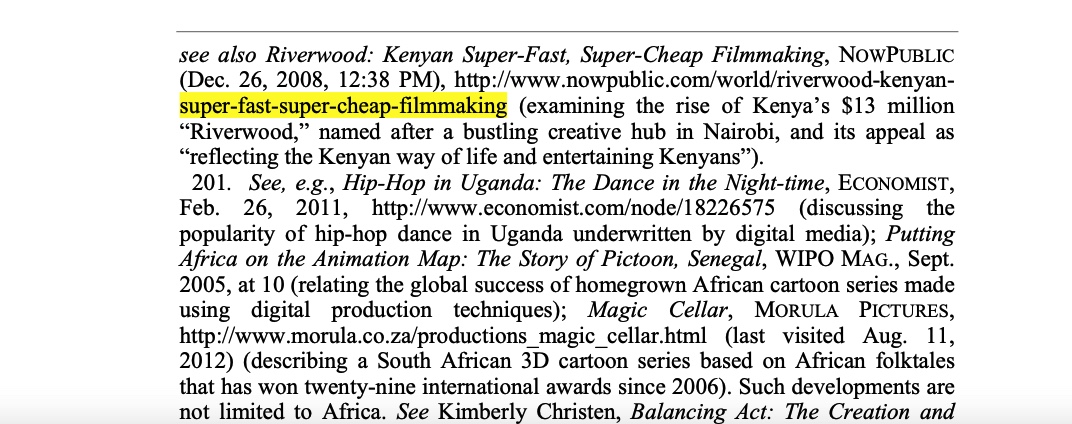
Cited in The Liverpool Companion to World Science Fiction Film by Sonja Fritzsche (2014).

Accentuating the positive: Building capacity for creative industries into the development agenda for global intellectual property law by Sean A. Pager, Michigan State University College of Law, American University International Law Review, 2012

Cinema as cultural discourse: A study of cultural symbols in selected contemporary Gikuyu comedies by Stanley Mbugua Njoroge, School of Creative and Performing Arts, Film and Media Studies, Kenyatta University, 2019

Other Film Stories

https://davidsouthconsulting.org/2022/03/30/angolan-film-grabs-attention-at-film-festival/

https://davidsouthconsulting.org/2022/04/01/bolivian-film-schools-film-scene-paying-off/

https://davidsouthconsulting.org/2022/10/21/local-animation-a-way-out-of-poverty/

https://davidsouthconsulting.org/2021/02/04/new-cuban-film-seeks-to-revive-sector/

https://davidsouthconsulting.org/2020/11/30/nollywood-booming-nigerian-film-industry/

Creative Commons License

This work is licensed under a
Creative Commons Attribution-Noncommercial-No Derivative Works 3.0 License.

ORCID iD: https://orcid.org/0000-0001-5311-1052.

© David South Consulting 2023

Categories
Archive Blogroll Development Challenges, South-South Solutions Newsletters Southern Innovator magazine

The Power of the Word: African Blogging and Books

By David SouthDevelopment Challenges, South-South Solutions

SOUTH-SOUTH CASE STUDY

“Culture is not a luxury … Culture is the spiritual backbone of society”: with these words Jan Kees van de Werk, the Dutch poet and long-standing advocate of African literature, summed up the importance of culture to Africa’s development. Two trends could significantly alter the prospects for African writers in 2007: the new wave of African bloggers and websites that are now emerging, and the increasing awareness of African literature. More traditional writing is now being joined in 2007 by a surge in African blogging. As internet access has increased, and awareness of free blogging websites like WordPress has also shot up, Africans are jumping online to express themselves (see also Development Challenges, March issue).

African literature is gaining an ever-greater audience through high-profile prize-winning. From veteran Nigerian writer and UNFPA Goodwill Ambassador Chinua Achebe winning this year’s Man Booker International Prize, to best-selling French language authors like Ivorian Ahmadou Kourouma (Allah is not Obliged) and Albert Memmi, winner of the French Academy’s Grand Prix de la Francophonie. They are joined by many others gaining international acclaim, including Uganda’s Monica Arac de Nyeko – winner of the prestigious Caine Prize for African Writing – Nigeria’s Chris Abani (Graceland), Cameroon’s Calixthe Beyala (Lost Honor), Congolese writer Daiel Biyaoula (Alley Without Exit) and Mauritius’s Carl de Souza. The Salon International du Livre et de la Presse de Geneva has established the Ahmadou Kourouma Prize, and the new Book Show for African Literature, Press and Culture is scheduled for 2008.

Increasingly, the creative industries are gaining respect as a key part of a vibrant economy. The power of a successful author or musician to generate awareness and excitement about a country and its products, has gained the respect of many governments. And they are also learning to respect the wealth that can be generated. For example, in Britain the creative industries earn almost as much as the powerful financial sector (Work Foundation). The World Bank’s private sector arm, the International Finance Corporation, has singled out Africa’s creative sector for its future investment.

Blogger Titilayo Soremi in Abuja, Nigeria, is typical of the new wave. A business development officer for an NGO, her blog is a vivid snapshot of life in her country. Obed Sarpongin Accra, Ghana is a budding poet and does not shy away from thorny issues. In his current blog, he tackles domestic politics and writes about the on-again, off-again electricity supply. The secretive Kenyan banker known by the name Bankelele is a lover of new ideas judging by his blog. The content is a mix of financial tip-offs and upcoming business investment opportunities in the region, all stirred up with some rather frank thoughts on politics. He has also gone the extra mile and acquired sponsors for his blog (that banking experience is not going to waste).

The Internet age has also given birth to a new phenomenon: the so-called ”long tail” This is best explained by Kelvin Smith in his paper ‘African Publishers and Writers in British and International Markets’: “What now emerges is that more than half the revenue of Amazon is in the ‘bottom’ two million books on the list.

“So, the ‘Long Tail’ principle goes, we are now looking at a technology that can service the needs not of dozens of markets of millions, but millions of markets of dozens. This has great significance for the small publisher, whether that publisher is in a large publishing nation or in a country where publishing is a smaller scale activity.”

It looks as if getting creative is not only fun, it can be the next goldmine for Africa’s entrepreneurs.

Published: August 2007

Resources

Creative Commons License

This work is licensed under a
Creative Commons Attribution-Noncommercial-No Derivative Works 3.0 License.

Update: There is no better proof of concept than impact.

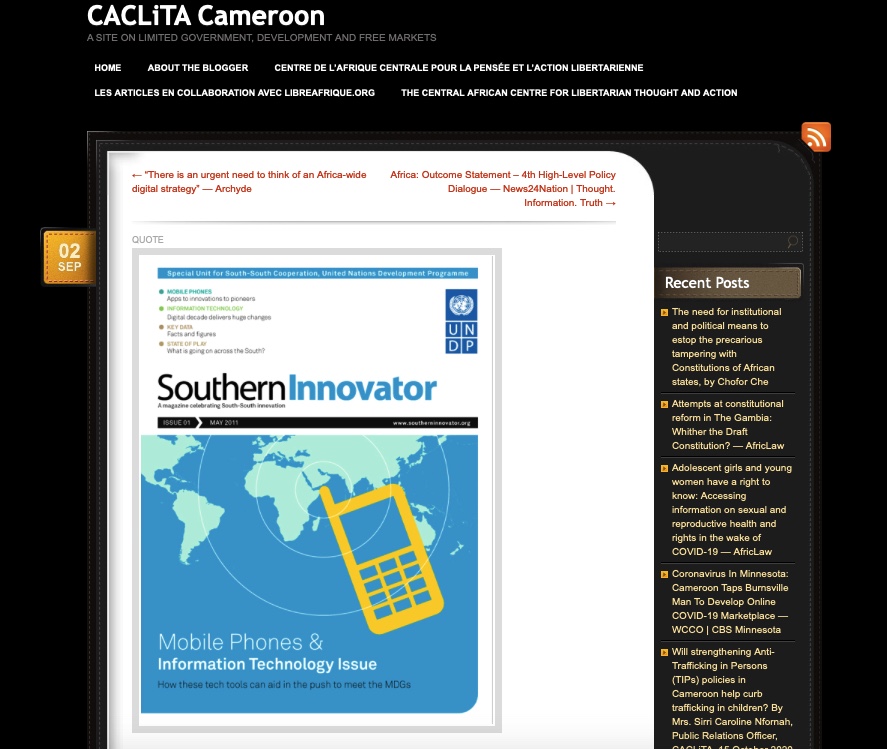
One of the many African blogs and websites to share content from UN e-newsletter Development Challenges, South-South Solutions (2006-2014) and Southern Innovator Magazine (2011-2014).

“Great economic and business reporting! Very helpful for us.” Africa Renewal, Africa Section United Nations Department of Public Information

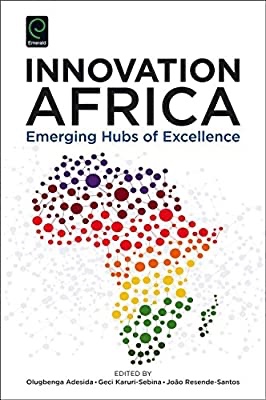
The story Nollywood: Booming Nigerian Film Industry, from UNDP e-newsletter Development Challenges, South-South Solutions, cited in Innovation Africa: Emerging Hubs of Excellence edited by Olugbenga Adesida, Geci Karuri-Sebina, Joao Resende-Santos (Emerald Group Publishing, 2016).

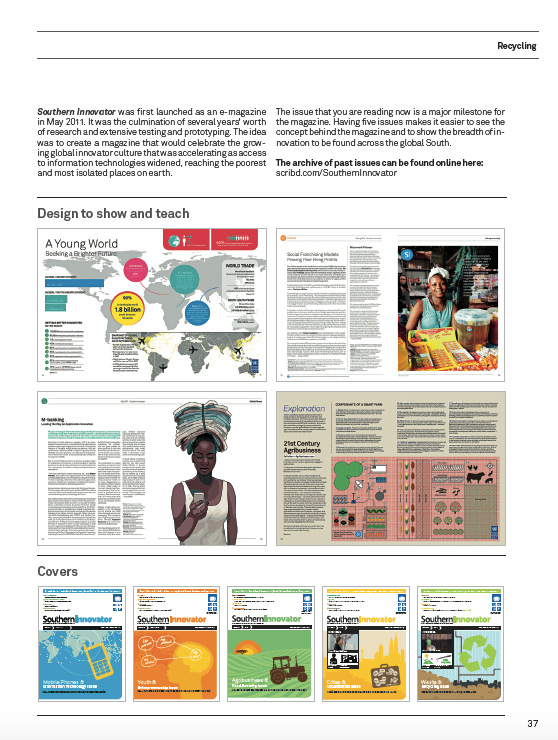
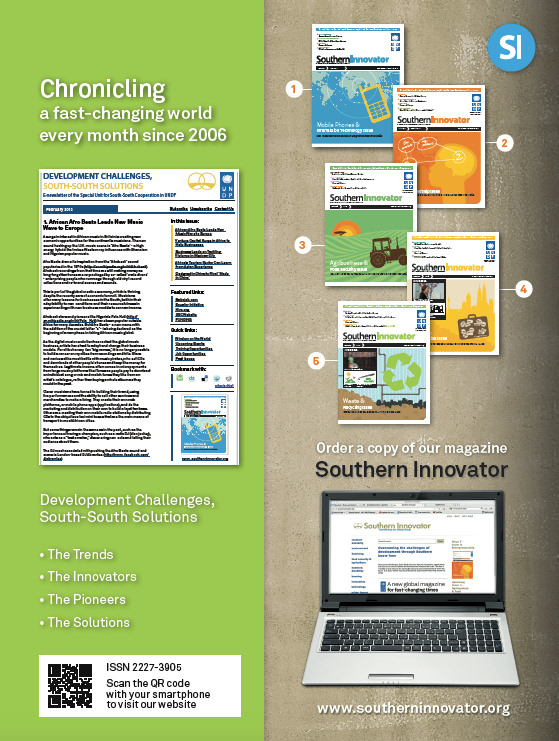
Southern Innovator was published from 2011 to 2015 by the United Nations.

Team | Southern Innovator Phase 1 Development (2010 – 2015)

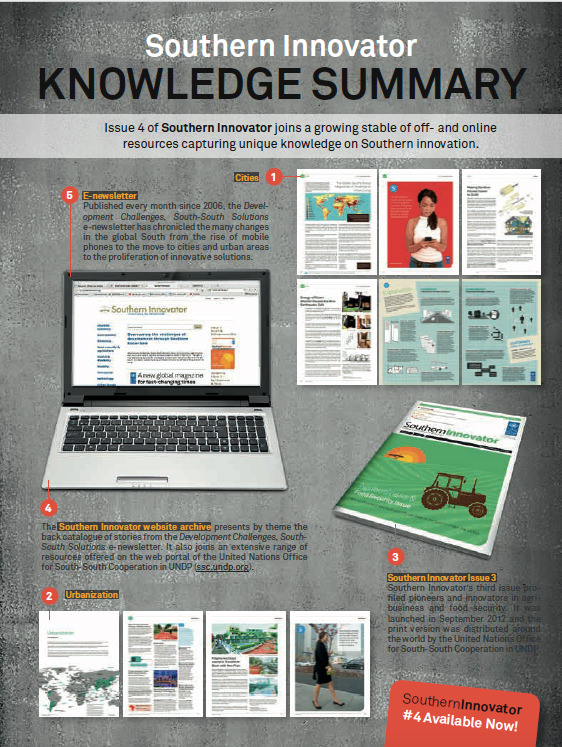
Development Challenges, South-South Solutions was launched as an e-newsletter in 2006 by UNDP’s South-South Cooperation Unit (now the United Nations Office for South-South Cooperation) based in New York, USA. It led on profiling the rise of the global South as an economic powerhouse and was one of the first regular publications to champion the global South’s innovators, entrepreneurs, and pioneers. It tracked the key trends that are now so profoundly reshaping how development is seen and done. This includes the rapid take-up of mobile phones and information technology in the global South (as profiled in the first issue of magazine Southern Innovator), the move to becoming a majority urban world, a growing global innovator culture, and the plethora of solutions being developed in the global South to tackle its problems and improve living conditions and boost human development. The success of the e-newsletter led to the launch of the magazine Southern Innovator.  

Follow @SouthSouth1

Google Books: https://books.google.co.uk/books?id=uXWUyfb4MacC&dq=development+challenges+september+2009&source=gbs_navlinks_s

Slideshare: http://www.slideshare.net/DavidSouth1/development-challengessouthsouthsolutionsseptember2009issue

Southern Innovator Issue 1: https://books.google.co.uk/books?id=Q1O54YSE2BgC&dq=southern+innovator&source=gbs_navlinks_s

Southern Innovator Issue 2: https://books.google.co.uk/books?id=Ty0N969dcssC&dq=southern+innovator&source=gbs_navlinks_s

Southern Innovator Issue 3: https://books.google.co.uk/books?id=AQNt4YmhZagC&dq=southern+innovator&source=gbs_navlinks_s

Southern Innovator Issue 4: https://books.google.co.uk/books?id=9T_n2tA7l4EC&dq=southern+innovator&source=gbs_navlinks_s

Southern Innovator Issue 5: https://books.google.co.uk/books?id=6ILdAgAAQBAJ&dq=southern+innovator&source=gbs_navlinks_s

ORCID iD: https://orcid.org/0000-0001-5311-1052.

© David South Consulting 2023

Categories
Archive Blogroll Development Challenges, South-South Solutions Newsletters

Nollywood: Booming Nigerian Film Industry

By David SouthDevelopment Challenges, South-South Solutions

SOUTH-SOUTH CASE STUDY

The digital revolution in filmmaking over the last decade has given birth to an African success story: Nollywood – Nigeria’s answer to Hollywood, uses low-cost digital filmmaking and editing to tell local stories — in the process making money and creating thousands of jobs.

This do-it-yourself (DIY), straight-to-DVD and video market has in just 13 years ballooned into a US $250 million-a-year industry employing thousands of people. In terms of the number of films produced each year, Nollywood is now in third place behind India’s Bollywood and America’s Hollywood. Despite rampant pirating of DVDs and poor copyright controls, directors, producers, actors, stars, vendors and technicians are all making a living in this fast-growing industry.

The power of creative industries to create jobs and wealth has been a focus of UNESCO, through its Global Alliance for Cultural Diversity. UNESCO has been in the forefront in helping African countries re-shape their policies to take cultural industries into consideration. The promotion of cultural industries also has been incorporated into the New Partnership for Africa’s Development (NEPAD).

What is particularly attractive about Nollywood to the poor in the South is its rough-and-ready approach to filmmaking: combining low-cost digital cameras and film editing software on personal computers, with small budgets and fast turn-around times. Films are made on location using local people. These factors make getting into filmmaking accessible and within reach of more people.

Nollywood grew out of frustration, necessity and crisis: in the late 1980s and early 1990s, Nigerian cities became crime hotbeds. People were terrified to go out on the streets, and this led to the closing down of many movie theatres. Desperate for entertainment at home – and unsatisfied with foreign imports from India and the West – Nigerians turned to telling their own stories to stave off the boredom of staying in.

The film credited with sparking off the industry is 1992’s Living in Bondage – a huge financial hit credited with raising the level of professionalism and production values in Nigerian cinema.

Now, between 500 and 1,000 feature-length movies are made each year, selling well across the continent of Africa. Average productions take 10 days and cost around US $15,000 (www.thisisnollywood.com). Nollywood stars are famous throughout Africa – and Nigeria culturally dominates West Africa just as the US does the world. It is estimated there are 300 producers and that 30 titles go to shops and market stalls every week. On average, a film sells 50,000 copies: a hit will sell several hundred thousand. With each DVD costing around US $2, it is affordable to most Nigerians and very profitable for the producers.

“These are stories about Africa, not someone else’s,” well-known actor Joke Silva told the Christian Science Monitor.

Focused on Africa, the films’ themes revolve around AIDS, corruption, women’s rights, the occult, crooked cops and prostitution. They do so well because they speak directly to the lives of slum-dwellers and rural villagers.

“We are telling our own stories in our way, our Nigerian way, African way,” said director Bond Emeruwa. “I cannot tell the white man’s story. I don’t know what his story is all about. He tells his story in his movies. I want him to see my stories too.”

The big brands – Sony, Panasonic, JVC and Canon – all produce cameras capable of high-definition digital filmmaking and these have become the staple tools of this filmmaking revolution.

More and more, the films are capitalising on the large African diaspora around the world, on top of Africa’s large internal market. And this is offering a step-up into the global marketplace for Nigerian directors and producers.

The Nollywood phenomemon has been documented in the documentary This is Nollywood, directed by Franco Sacchi, a teacher from the Center of Digital Imaging Arts at Boston University.

The prospects for the industry are only looking up: the Nigeria in the Movies project has been launched to help grow the industry, establish standards, improve distribution and broaden its international appeal and awareness. It also offers filmmaking grants for neophyte filmmakers.

Of course, filmmaking can be a tricky business: authorities in largely Muslim northern Nigeria have imposed 32 restrictions on the local film industry — nicknamed “Kannywood” after the city of Kano. A six-month ban lost the industry US $29 million and put thousands out of work: a sign of the economic importance of this DIY filmmaking business. The message is clear: filmmakers need to be sensitive to the cultural norms of the communities in which they work.

Kannywood, started in 1992, has 268 production companies and 40 editing studios, employing over 14,000 people.

Adim Williams is one Nigerian director who is getting an international audience. He spends about US $40,000 on films that take two weeks to shoot. He has already secured an American release of a comedy, Joshua. Another director, Tunde Kelani, is regularly featured at international film festivals, where Nollywood screenings are more common.

And some, like young director Jeta Amata, believe Nollywood’s cheap, fast-production, DIY approach has a lot to teach Hollywood, with its expensive filmmaking and ponderous production cycles.

Published: March 2008

Resources

  • This is Nollywood: A documentary about Nigeria’s booming movie industry.
    Website: http://www.thisisnollywood.com
    There is also an inspiring trailer to the film here.
    Website: http://www.thisisnollywood.com
  • The global charity Camfed (dedicated to eradicating poverty in Africa through the education of girls and empowerment of women) has projects to teach women filmmaking skills.
    Website: http://uk.camfed.org
  • Festival Panafricain du Cinema et de la Television de Ouagadoogou 2009: Africa’s biggest film festival.
    Website: http://www.fespaco.bf/
  • Naijarules: Billing itself as the “largest online community of lovers and critics of Nollywood”, an excellent way to connect with all the players in the business.
    Website: http://www.naijarules.com/vb/index.php
  • Nollywood Foundation: Based in the US, aims to bring Nigerian films and culture to an international audience and to promote new films and new media.
    Website:http://www.nollywoodfoundation.org/home.php

https://davidsouthconsulting.org/2022/03/30/angolan-film-grabs-attention-at-film-festival/

https://davidsouthconsulting.org/2022/04/01/bolivian-film-schools-film-scene-paying-off/

https://davidsouthconsulting.org/2022/04/01/new-african-film-proving-power-of-creative-economy/

https://davidsouthconsulting.org/2021/02/04/new-cuban-film-seeks-to-revive-sector/

https://davidsouthconsulting.org/2022/03/30/riverwood-kenyan-super-fast-super-cheap-filmmaking/

Development Challenges, South-South Solutions was launched as an e-newsletter in 2006 by UNDP’s South-South Cooperation Unit (now the United Nations Office for South-South Cooperation) based in New York, USA. It led on profiling the rise of the global South as an economic powerhouse and was one of the first regular publications to champion the global South’s innovators, entrepreneurs, and pioneers. It tracked the key trends that are now so profoundly reshaping how development is seen and done. This includes the rapid take-up of mobile phones and information technology in the global South (as profiled in the first issue of magazine Southern Innovator), the move to becoming a majority urban world, a growing global innovator culture, and the plethora of solutions being developed in the global South to tackle its problems and improve living conditions and boost human development. The success of the e-newsletter led to the launch of the magazine Southern Innovator.  

Follow @SouthSouth1

Google Books: https://books.google.co.uk/books?id=DqmXBgAAQBAJ&dq=development+challenges+march+2008&source=gbs_navlinks_s

Slideshare: http://www.slideshare.net/DavidSouth1/development-challengessouthsouthsolutionsmarch2008issue-44443163

Southern Innovator Issue 1: https://books.google.co.uk/books?id=Q1O54YSE2BgC&dq=southern+innovator&source=gbs_navlinks_s

Southern Innovator Issue 2:https://books.google.co.uk/books?id=Ty0N969dcssC&dq=southern+innovator&source=gbs_navlinks_s

Southern Innovator Issue 3:https://books.google.co.uk/books?id=AQNt4YmhZagC&dq=southern+innovator&source=gbs_navlinks_s

Southern Innovator Issue 4: https://books.google.co.uk/books?id=9T_n2tA7l4EC&dq=southern+innovator&source=gbs_navlinks_s

Southern Innovator Issue 5:https://books.google.co.uk/books?id=6ILdAgAAQBAJ&dq=southern+innovator&source=gbs_navlinks_s

One of the many stories we covered on Africa’s fast-growing cities from 2007. It was witnessing first-hand Africa’s innovators and their adaptive use of mobile and information technologies that inspired us to give birth to Southern Innovator’s first issue.

Citations

Cited in Innovation Africa: Emerging Hubs of Excellence edited by Olugbenga Adesida, Geci Karuri-Sebina, Joao Resende-Santos (Emerald Group Publishing, 2016).

https://davidsouthconsulting.org/2021/03/05/southern-innovator-issue-2/

Creative Commons License

This work is licensed under a
Creative Commons Attribution-Noncommercial-No Derivative Works 3.0 License.

ORCID iD: https://orcid.org/0000-0001-5311-1052.

© David South Consulting 2023