Categories
Archive Development Challenges, South-South Solutions Newsletters

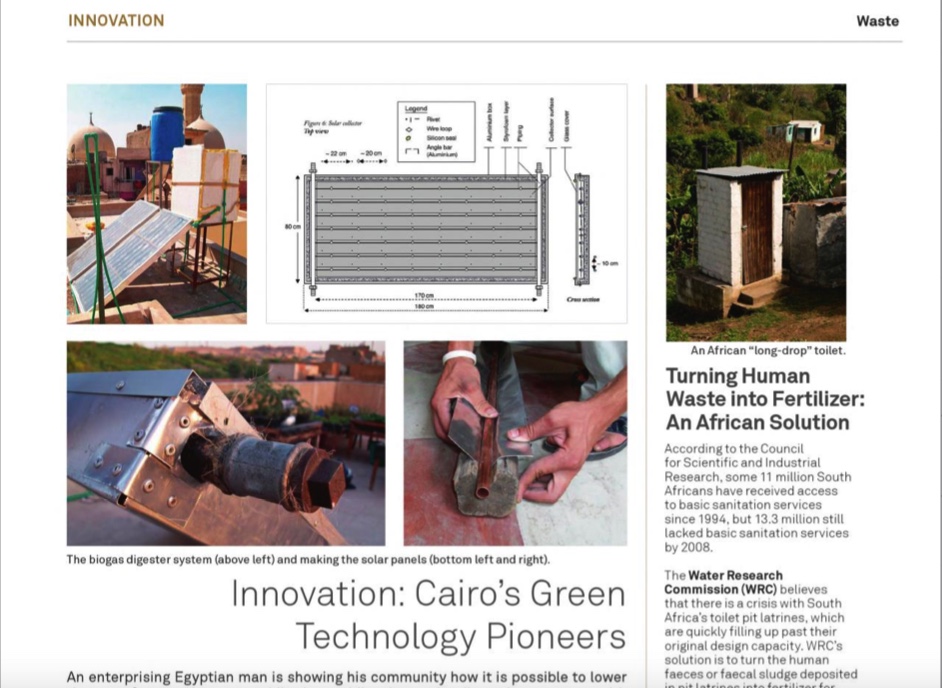
Innovation: Cairo’s Green Technology Pioneers

By David SouthDevelopment Challenges, South-South Solutions

SOUTH-SOUTH CASE STUDY

One thing is ubiquitous to every country, community and society: garbage. It’s a social and environmental problem, but far from being mere waste, rubbish has its uses. This by-product of the goods and foods consumed can also be a source of fuel. As such it has many advantages, including providing free fuel to cash-strapped households, independence from unreliable municipal services and a way to dispose of waste.

An enterprising Egyptian man is showing his community how it is possible to lower the cost of gas and hot water while also avoiding the service disruptions common with municipal utilities. In the process, he is pioneering a local green innovation model that can be replicated elsewhere.

Biogas (http://en.wikipedia.org/wiki/Biogas) generators — which can transform organic household waste into fuel — have been very successful in India and China. It is estimated there are 20 million small-scale urban biogas digesters in China and 2 million in India.

Hanna Fathy’s roof in the Manshiyet Nasser neighbourhood, home to the Coptic Christian Zabaleen community of Cairo – the city’s traditional garbage collectors and recyclers – is now a utility system, providing biogas and hot water.

The area is made of narrow streets and makeshift houses. Residents live cheek-by-jowl in a neighbourhood that is home to tens of thousands of people.

The community was badly hit when the 300,000 pigs the Christian residents have kept for the past 30 years to eat Cairo’s vegetative waste — an effective garbage-disposal system — were slaughtered under government orders to prevent the spread of swine flu (H1N1) (http://en.wikipedia.org/wiki/Swine_influenza).

One woman told U.S. National Public Radio about the hard life in the neighbourhood: “I’m working all the time. My hands get dirty, there’s no water. The price of food is too high. The gas has gone up to seven pounds (US $1.28) a bottle, so it’s expensive to heat.

“Everything is so expensive, and I have to live like this?” she said.

Fathy plops kitchen scraps, stale tea and tap water into a jug which he pours into a homemade biogas maker on the roof of his house. The stew of waste mixes with water and a small quantity of animal manure used to start the process, and overnight makes biogas, which is then used for cooking. The digester is able to provide an hour’s worth of cooking gas a day in winter months, and two hours in the summer, from around two kilograms of waste. The remaining waste by product becomes liquid organic fertilizer for the garden.

Fathy has been developing the biogas digester with the NGO Solar Cities (http://solarcities.blogspot.com), which provides designs, technical advice and support to Cairo citizens keen to embrace green technologies.

What is interesting is not only the technology but how that technology is being developed. The approach is to innovate and adapt the technology to local resources and skills. This increases the chances of take-up and buy-in.

The designs for the digesters and heaters have evolved through experimentation, brainstorming and availability of local materials.

Each biogas system costs about US $150 for materials, a cost that is being picked up right now by donations. Solar Cities believes there are only eight biogas digesters in Egypt so far, most built in 2009.

Solar Cities’ founder, Thomas Culhane, points out many urban dwellers do not believe they can generate biogas and associate it with rural systems that use animal manure. But the abundance of urban kitchen waste is in fact an excellent source material for biogas.

Culhane believes the biogas digesters are an excellent solution to two problems: the vast quantities of garbage piling up in Cairo, which has had its traditional disposal system disrupted by the slaughter of the pigs, and the city’s emissions of greenhouse gases that contribute to climate change.

Fathy has one goal: to be completely self-sufficient. He has been also prototyping a solar heater on his roof as well as the biogas digester. The solar water heater makes use of items that can be easily found: it recycles black garbage bags, has an aluminium frame and a glass cover. The whole thing rests on a Styrofoam block and uses copper tubes. The water is stored in a bright blue barrel.

Biogas, solar power and other forms of green energy face many obstacles if it is to expand further in Egypt. The average cost of each unit will need to come down to match the income of the users and compete with the government-subsidized energy sector.

Fathy has also found neighbours are skeptical and can’t believe biogas can be made this way.

Another man, Hussain Soliman, had both a solar water heater and biogas digester on the roof of his apartment building before the crumbling building collapsed.

The complete solar water heating system designed by Solar Cities can be assembled for under US $500. It uses two 200-litre recycled industrial shampoo barrels for the holding tank and back-up water supply. The solar panels need to be kept clean from dust every week, but other than that, Culhane insists the heaters require little maintenance.

Now in temporary government housing, Soliman is still enthusiastic about the technology and is re-building a solar heater and biogas digester for his new home.

“I’m planning to collect the organic waste from restaurants in the neighborhood to increase my gas output,” he told IPS News. “I’ll give the restaurants plastic bags and they can separate out the organics, and I’ll collect the bags at the end of each day.”

Published: January 2010

Resources

1) Practical Action has technical drawings and guidelines for making a small biogas digester. Website: http://practicalaction.org/practicalanswers/product_info.php?products_id=42

2)  The Anaerobic Digestion Community: Here is an excellent technical explanation of how a digester works, including a short film. Website: http://www.anaerobic-digestion.com/

3) China boasts a fast-growing biogas economy using farm waste. Here is a full summary of their experience. Website: http://www.i-sis.org.uk/BiogasChina.php.

https://davidsouthconsulting.org/2022/09/28/asian-factories-starting-to-go-green/

https://davidsouthconsulting.org/2022/09/27/caribbean-island-st-kitts-goes-green-for-tourism/

https://davidsouthconsulting.org/2021/01/25/creating-green-fashion-in-china/

https://davidsouthconsulting.org/2023/02/03/environmental-public-awareness-handbook-case-studies-and-lessons-learned-in-mongolia/

https://davidsouthconsulting.org/2021/02/01/ethiopia-and-djibouti-join-push-to-tap-geothermal-sources-for-green-energy/

https://davidsouthconsulting.org/2021/08/29/indian-business-model-makes-green-energy-affordable/

https://davidsouthconsulting.org/2021/10/22/innovations-in-green-economy-top-three-agenda/

https://davidsouthconsulting.org/2021/08/07/mongolian-green-book/

https://davidsouthconsulting.org/2022/04/14/prisons-with-green-solutions/

https://davidsouthconsulting.org/2021/02/04/us-450-million-pledged-for-green-economy-investments-at-kenyan-gssd-expo/

Development Challenges, South-South Solutions was launched as an e-newsletter in 2006 by UNDP’s South-South Cooperation Unit (now the United Nations Office for South-South Cooperation) based in New York, USA. It led on profiling the rise of the global South as an economic powerhouse and was one of the first regular publications to champion the global South’s innovators, entrepreneurs, and pioneers. It tracked the key trends that are now so profoundly reshaping how development is seen and done. This includes the rapid take-up of mobile phones and information technology in the global South (as profiled in the first issue of magazine Southern Innovator), the move to becoming a majority urban world, a growing global innovator culture, and the plethora of solutions being developed in the global South to tackle its problems and improve living conditions and boost human development. The success of the e-newsletter led to the launch of the magazine Southern Innovator. 

https://davidsouthconsulting.org/2022/11/01/southern-innovator-magazine-2010-2014/

Creative Commons License

This work is licensed under a
Creative Commons Attribution-Noncommercial-No Derivative Works 3.0 License.

ORCID iD: https://orcid.org/0000-0001-5311-1052.

© David South Consulting 2023

Categories
Archive Development Challenges, South-South Solutions Newsletters Southern Innovator magazine

Bamboo Becomes Transport Option for the South

By David SouthDevelopment Challenges, South-South Solutions

SOUTH-SOUTH CASE STUDY

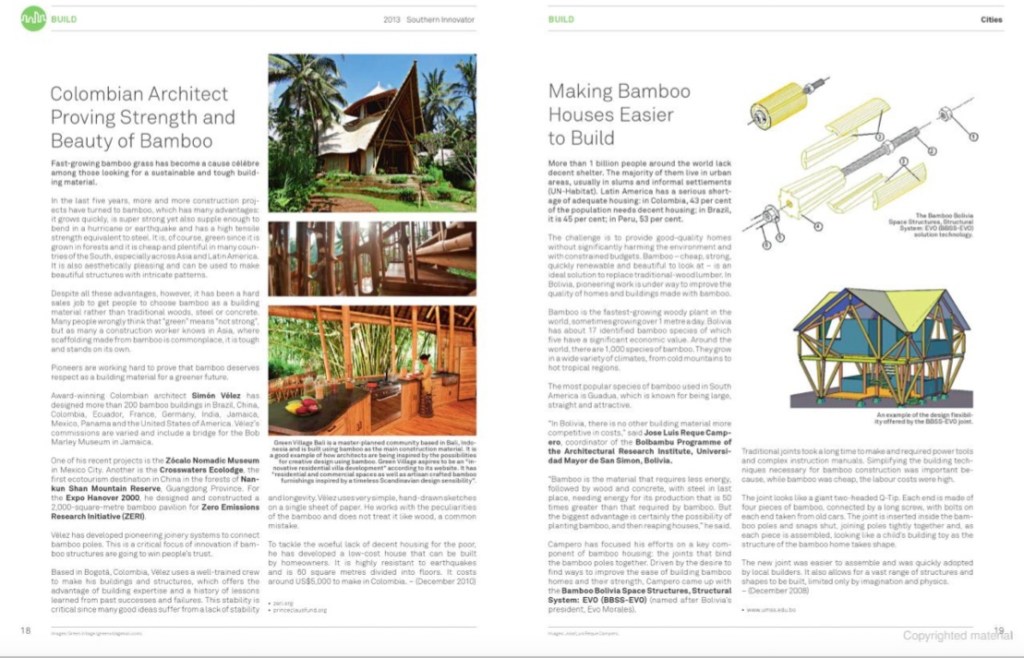
The sturdy bamboo plant (http://en.wikipedia.org/wiki/Bamboo) is enjoying a revival around the world as a building material. A strong, fast-growing and highly renewable woody plant, it is becoming increasingly popular as people seek out less environmentally wasteful alternatives to steel and other materials.

But who would have thought bamboo taxis would turn up on the scene?

A fleet of bamboo taxis is now plying the streets in Tabontabon, a municipality in The Philippines that is home to 10,000 people, most of them rice farmers.

Bamboo can sometimes grow more than 1 metre a day. While in Asia, it has long been a traditional construction material, people are now turning to it to make transportation vehicles. In The Philippines, there are 62 species of bamboo, up to 15 of which are suitable for industrial applications.

So-called habal-habal motorcycles, the most popular form of transportation in the town, are also the source of many accidents and are uncomfortable on sunny days or when it rains. A covered taxi service is both a safer and a more comfortable alternative.

The town’s mayor, Rustico Balderian, took the initiative to build a fleet of bamboo taxis. He set four criteria the new taxis had to meet: they should be low-cost, fuel efficient, safe and environmentally friendly. The bamboo has a higher tensile strength (http://en.wikipedia.org/wiki/Tensile_strength) than steel, which also requires vast quantities of energy to produce.

The taxis are 90 percent made of bamboo and are built by unemployed youth. They are divided into Eco 1 (a model that seats 20 people and runs for eight hours on one gallon of coco-biodiesel from coconuts) (http://cocobiodiesel.blogspot.com/), and Eco 2, which seats eight people, has a stereo and sound system, and also runs for eight hours on a gallon of coco-biodiesel.

Both are made by the Tabontabon Organic Transport Industry [TOTI] (http://totieco.multiply.com/).

Making vehicles out of bamboo is a serious endeavour that also has been under development in Japan. In 2008, Kyoto University’s Venture Business Laboratory (VBL) unveiled a unique single-seat electric vehicle equipped with a body made from bamboo. The vehicle was developed under the Kyoto Electric Car Development Project, which is one of the laboratory’s major initiatives. Nicknamed Bamgoo, this eco-car’s body is made of braided rods of bamboo, one of the local specialty products of the area.

Other bamboo modes of transport in the South include bamboo bicycles in Ghana. A partnership between an American bike designer and a Ghanaian government initiative is taking advantage of this local resource to manufacture bicycles for the local market – and as a source of export income.

Not only are the Ghanaian builders harvesting bamboo to make bikes for the domestic market, they are also offering a sophisticated online shopping service for the overseas market. People from around the world can now buy Ghanaian bikes using a website (http://www.bamboosero.com). Customers can choose frame builders by their specialty – cargo bike, mountain bike or road bike – and then order it online. The completed bikes are quality checked and then distributed by Calfee Design in California, USA. This approach keeps the middlemen out of the transaction, and means more money gets back to the bike builder.

Meanwhile in Cambodia, the legendary bamboo railway is a people’s solution to the poor service offered by the established railway system. In the northwest of the country near the second city of Battambang, an entire railway system has been built using bamboo.

The bamboo trains, called ‘noris’ or ‘lorries’ by the locals, are driven by a electric generator engine. Passengers sit on a bamboo platform placed on two sets of wheels. The bamboo train reaches speeds of over 40 km/h.

“We’re very careful,” 18-year-old Sok Kimhor, a 10-year veteran of the bamboo trains, told the BBC. “We look out for children and animals running across the lines, and we have to slow down when other trains come along.”

There is just one track, so when two trains meet, one has to be taken off the track to pass.

The regular rail service runs only once a week to the capital, Phnom Penh. This makes the bamboo train the only alternative for many people to get around. While the main railway station is deserted, the bamboo service is a hive of activity.

“They’re very safe – a motorbike taxi is too fast, and if I use one of those I sometimes get dizzy and fall off,” said Sao Nao as she sat on the rails with a small group of people. “On a bamboo train I can sit down and go to sleep. You can’t do that on a motorbike.”

Design for Development (http://designfordevelopment.org/) is also turning to bamboo for a transport solution. The Canadian NGO is working in Kenya on making five emergency medical transportation devices (EMTD), or ambulances, to move local people to health clinics or hospitals. Bamboo is locally available and they hope to set up a workshop and make the ambulances using local labour.

Published: August 2009

Resources

1) A slideshow of the bamboo taxis. Website:http://totieco.multiply.com/photos/album/2/ECO2

2) UNEP, the UN’s Environment Programme, has produced a report on bamboo biodiversity and how it can be preserved. Website: http://www.unep-wcmc.org

3) The Asian Development Bank is using its Markets for Poor programme to link bamboo products to marketplaces, helping poor communities. Website:http://www.markets4poor.org/

4) A blog describing the use of coco-biodiesel in the Philippines. Website: http://cocobiodiesel.blogspot.com/

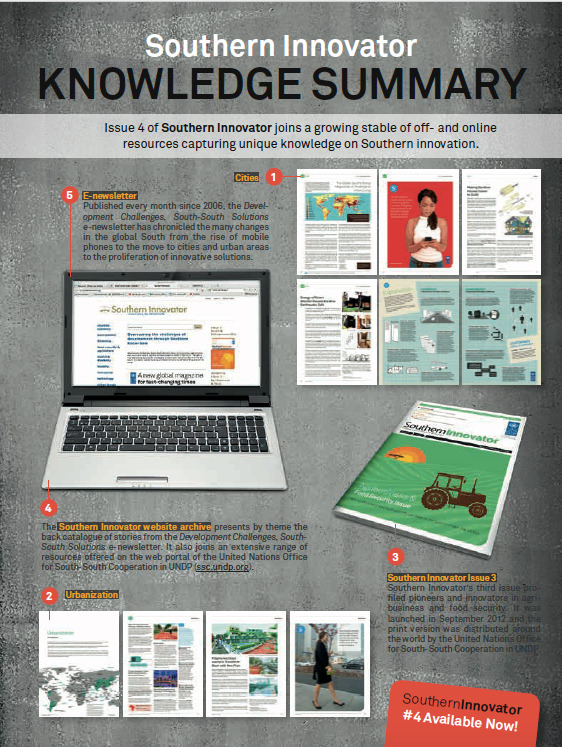
Development Challenges, South-South Solutions was launched as an e-newsletter in 2006 by UNDP’s South-South Cooperation Unit (now the United Nations Office for South-South Cooperation) based in New York, USA. It led on profiling the rise of the global South as an economic powerhouse and was one of the first regular publications to champion the global South’s innovators, entrepreneurs, and pioneers. It tracked the key trends that are now so profoundly reshaping how development is seen and done. This includes the rapid take-up of mobile phones and information technology in the global South (as profiled in the first issue of magazine Southern Innovator), the move to becoming a majority urban world, a growing global innovator culture, and the plethora of solutions being developed in the global South to tackle its problems and improve living conditions and boost human development. The success of the e-newsletter led to the launch of the magazine Southern Innovator. 

Creative Commons License

This work is licensed under a
Creative Commons Attribution-Noncommercial-No Derivative Works 3.0 License.

ORCID iD: https://orcid.org/0000-0001-5311-1052.

© David South Consulting 2023

Categories
Archive Development Challenges, South-South Solutions Newsletters

Old Boats Become New Furniture In Senegal

By David SouthDevelopment Challenges, South-South Solutions

SOUTH-SOUTH CASE STUDY

Every country has its fair share of waste and the remnants of past economic activity. Old cars nobody wants, discarded tins of food, old plastic bags, spare copper wire, cast-off clothing – all can have a new life in the right hands.

An intriguing twist on recycling is happening in the West African nation of Senegal. The country has a strong fishing tradition, and plenty of boats are used to haul in the catch every day. These boats are elaborately decorated and dazzle the eye when lined up on the beach awaiting the next journey to sea. But what to do with the boats when they have completed their service?

One ingenious social enterprise is turning the weatherbeaten but colorful boats into highly prized pieces of furniture that sell in the boutiques of Europe. The enterprise Artlantique (slogan “Made in Africa”) (http://artlantique.com) gathered together local craft folk, both masters and young apprentices, to tackle the challenge of re-shaping old fishing boats into furniture.

Artlantique’s founder, Spanish designer Ramon Llonch, then sends the furniture back to his shop in Barcelona, Spain where it is in turn distributed to shops around the world. Llonch ploughs Artlantique’s profits back in to expanding the business and hopes to hire more skilled craft folk in Senegal.

The idea is to create a “contemporary, modern design, which is above all 100 per cent African, as much in the material as in the making.”

Each unique piece of furniture is a riot of color, with planks of wood harvested from the boats creating an original and eye-pleasing pattern. The furniture has the weathered look expected of wood battered by years of exposure to salty sea water, and is streaked and branded with colorful patterns from its previous life as a fishing boat. The furniture items include cabinets, tables, benches, work tables, chairs, picture frames, coffee tables and even a fusball game table for lovers of soccer (football).

The catalogue that accompanies the website shows the families of the fisher folk, their boats, the workshop where the furniture is made, and the finished product. As the catalogue says, the boats “are stylish and elegant, their sides covered by many layers of paint, faded, and affected by rust from the salt and sea air, giving the wood a rich texture of different tones. Attracted by their beauty, and their history, we wondered whether after all the sea faring they had undergone, the wood would still be in good enough condition to begin a new life, to be ‘reincarnated’ into furniture.”

Negotiations are made with the fisher folk to acquire boats when they look like they have reached the end of their work life. The purchased boat is taken to a beach-side workshop and the craft folk discuss what to do with it. Young apprentices work alongside skilled craft folk, gaining the skills to make a high-quality wooden product capable of being exported.

The craft folk draw on their years of experience to add value to the final product. “Their contribution is essential as they suggest which type of furniture would be the most suitable to make,” Artlantique’s website explains. “They discuss their past and that of their forefathers: their cultural heritage, how to take full advantage of the wood, according to the size of the boat, and its color combinations.”

The furniture made from the boat wood has a high value because each piece is unique and can not be replicated. The raw “Samba” wood comes from an African tropical tree (http://en.wikipedia.org/wiki/Triplochiton_scleroxylon) and remains untreated by chemicals. It is seasoned naturally by the sea from its years of service as a fishing boat.

“This wood … has certain limitations, not only because it has a shape but also because it’s very damaged by the salt, the sea, the sun and the lime. But these artisans are very talented,” Llonch told CNN.

“Their creativity is not academic, they are like this by nature because [for them] recycling and reusing is not a fashion, it’s not a trend.”

Artlantique-branded furniture is now on sale in boutiques in Barcelona, Spain, Paris, France and Rome, Italy.

In Brazil, artist Sérgio Dido (http://www.artinsurf.com/art-dido.php), who lives in the dynamic beach resort town of Buzios (http://www.lonelyplanet.com/brazil/the-southeast/buzios), also salvages wood from fishing boats to create art with a surfing theme. The work is featured in the Art in Surf shop (http://www.artinsurf.com/index.php).

Published: July 2014

https://davidsouthconsulting.org/2022/11/21/africa/

https://davidsouthconsulting.org/2022/11/19/african-culture-as-big-business/

https://davidsouthconsulting.org/2022/08/02/design-collaborations-revitalize-traditional-craft-techniques/

https://davidsouthconsulting.org/2022/10/09/fashion-closes-gap-between-catwalk-and-crafts/

https://davidsouthconsulting.org/2022/11/17/fashion-recycling-how-southern-designers-are-re-using-and-making-money/

https://davidsouthconsulting.org/2022/11/16/favela-fashion-brings-women-work/

https://davidsouthconsulting.org/2022/10/20/ghanaian-coffins-prove-design-and-craftsmanship-boost-incomes/

https://davidsouthconsulting.org/2022/10/20/online-education-could-boost-african-development/

https://davidsouthconsulting.org/2022/11/22/popular-characters-re-invent-traditional-carving/

https://davidsouthconsulting.org/2021/03/05/southern-innovator-issue-2/

https://davidsouthconsulting.org/2021/03/05/southern-innovator-issue-5/

Development Challenges, South-South Solutions was launched as an e-newsletter in 2006 by UNDP’s South-South Cooperation Unit (now the United Nations Office for South-South Cooperation) based in New York, USA. It led on profiling the rise of the global South as an economic powerhouse and was one of the first regular publications to champion the global South’s innovators, entrepreneurs, and pioneers. It tracked the key trends that are now so profoundly reshaping how development is seen and done. This includes the rapid take-up of mobile phones and information technology in the global South (as profiled in the first issue of magazine Southern Innovator), the move to becoming a majority urban world, a growing global innovator culture, and the plethora of solutions being developed in the global South to tackle its problems and improve living conditions and boost human development. The success of the e-newsletter led to the launch of the magazine Southern Innovator.  

Follow @SouthSouth1

Google Books: https://books.google.co.uk/books?id=qBU9BQAAQBAJ&dq=development+challenges+july+2014&source=gbs_navlinks_s

Slideshare: http://www.slideshare.net/DavidSouth1/development-challenges-july-2014-published

Southern Innovator Issue 1: https://books.google.co.uk/books?id=Q1O54YSE2BgC&dq=southern+innovator&source=gbs_navlinks_s

Southern Innovator Issue 2: https://books.google.co.uk/books?id=Ty0N969dcssC&dq=southern+innovator&source=gbs_navlinks_s

Southern Innovator Issue 3: https://books.google.co.uk/books?id=AQNt4YmhZagC&dq=southern+innovator&source=gbs_navlinks_s

Southern Innovator Issue 4: https://books.google.co.uk/books?id=9T_n2tA7l4EC&dq=southern+innovator&source=gbs_navlinks_s

Southern Innovator Issue 5: https://books.google.co.uk/books?id=6ILdAgAAQBAJ&dq=southern+innovator&source=gbs_navlinks_s

Creative Commons License
This work is licensed under a
Creative Commons Attribution-Noncommercial-No Derivative Works 3.0 License.

ORCID iD: https://orcid.org/0000-0001-5311-1052.

© David South Consulting 2023

Categories
Archive Development Challenges, South-South Solutions Newsletters Southern Innovator magazine

Indonesian Wooden Radio Succeeds with Good Design

By David SouthDevelopment Challenges, South-South Solutions

SOUTH-SOUTH CASE STUDY

One Indonesian industrial designer has pioneered an innovative business that has rejuvenated the economy of a farming village and improved the sustainability of local forests – and he’s doing it all with wood.

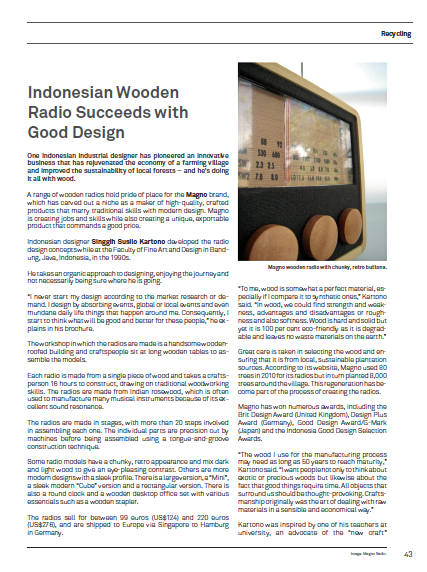
A range of wooden radios (wooden-radio.com) hold pride of place for the Magno brand (http://www.magno-design.com/?id=wr01a), which has carved out a niche as a maker of high-quality, crafted products that marry traditional skills with modern design. Magno is creating jobs and skills while also creating a unique, exportable product that commands a good price.

Indonesian designer Singgih Susilo Kartono developed the radio design concepts while at the Faculty of Fine Art and Design in Bandung, Java, Indonesia in the 1990s.

He takes an organic approach to designing, enjoying the journey and not necessarily being sure where he is going.

“I never start my design according to the market research or demand. I design by absorbing events, global or local events and even mundane daily life things that happen around me. Consequently, I start to think what will be good and better for these people,” he explains in his brochure.

The workshop in which the radios are made is a handsome wooden-roofed building and craftspeople sit at long wooden tables to assemble the models.

Each radio is made from a single piece of wood and takes a craftsperson 16 hours to construct, drawing on traditional woodworking skills. The radios are made from Indian rosewood, which is often used to manufacture many musical instruments because of its excellent sound resonance.

The radios are made in stages, with more than 20 steps involved in assembling each one. The individual parts are precision cut by machines before being assembled using a tongue and groove (http://en.wikipedia.org/wiki/Tongue_and_groove) construction technique.

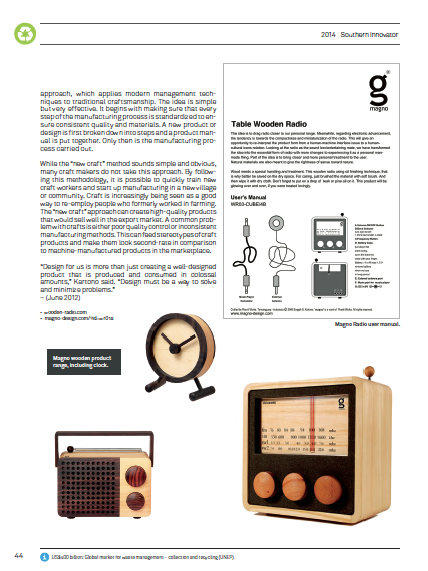
Some radio models have a chunky, retro appearance and mix dark and light wood to give an eye-pleasing contrast. Others are more modern designs with a sleek profile. There is a large version, a ‘Mini’, a sleek modern Cube’ version and a rectangular version. There is also a round clock and a wooden desktop office set with various essentials like a wooden stapler.

The radios sell for between Euros 99 (US $124) and Euros 220 (US $276), and are shipped to Europe via Singapore to Hamburg in Germany.

“To me, wood is somewhat a perfect material – especially if I compare it to synthetic ones,” Kartono said. “In wood we could find strength and weakness, advantages and disadvantages or roughness and also softness. Wood is hard and solid but yet it is 100 per cent eco-friendly as it is degradable and leaves no waste materials on the earth.”

Great care is taken in selecting the wood and ensuring it is from local, sustainable plantation sources. According to its website, Magno used 80 trees in 2010 for its radios but in turn planted 8,000 trees around the village. This regeneration has become part of the process of creating the radios.

Magno has won numerous awards, including the Brit Design Award (UK), Design Plus Award (Germany), Good Design Award/G-Mark (Japan) and the Indonesia Good Design Selection Awards.

“The wood I use for the manufacturing process may need as long as 50 years to reach maturity,” Kartono said. “I want people not only to think about exotic or precious woods but likewise about the fact that good things require time. All objects that surround us should be thought-provoking. Craftsmanship originally was the art of dealing with raw materials in a sensible and economical way.”

As Kartono tells it, he faced the typical university graduate’s dilemma about his career path. Should he work as an in-house designer in a city or return to his home village of Kandangan and start a business? His choice was unusual. Once somebody with a university education leaves a small village, it is rare they return. And at first, Kartono did not.

But he was drawn back by the dire situation in the village, and decided to apply his knowledge of product design to revive its economic fortunes. He started by visiting just twice a year because that was all he could afford. This had the advantage of giving him perspective on the situation in the village.

“At first glance, these changes (happening to the village) were seen as a ‘progress,’” he said. “But when I looked more closely I concluded that it was only the ‘surface’ which experienced change. The basic structure of the village did not undergo any changes; moreover, some was actually deteriorating.”

He concluded that the village was being damaged by various government attempts to modernize agricultural practices. The debt problems this caused meant many farmers lost their farms and were forced to seek work in the city or look for another way to make money.

Craft work seemed to be the answer to this problem. It has many advantages, as Kartono sees it. It is something that can grow and fits well with village lifestyles. It is labour intensive, doesn’t need sophisticated technology and can use already existing local resources.

Kartono was inspired by one of his teachers at university, an advocate of the ‘New Craft’ approach, which applies modern management techniques to traditional craftsmanship. The idea is simple but very effective. It begins with making sure every step of the manufacturing process is standardized to ensure consistent quality and materials. A new product or design is first broken down into steps and a product manual is put together. Only then is the manufacturing process carried out.

While the New Craft method sounds simple and obvious, many craft makers do not take this approach. By following this methodology, it is possible to quickly train new craft workers and start up manufacturing in a new village or community. Craft is increasingly being seen as a good way to re-employ people who formerly worked in farming. The New Craft approach can create high-quality products that would sell well in the export market. A common problem with crafts is either poor quality control or inconsistent manufacturing methods. This can feed stereotypes of craft products and make them look second-rate in comparison to machine-manufactured products in the marketplace.

“Design for us is more than just creating a well-designed product that is produced and consumed in colossal amount,” Kartono said. “Design must be a way to solve and minimize problems.”

Published: June 2012

Resources

1) Cradle to Cradle: Remaking the Way We Make Things by William McDonough and Michael Braungart. It is a manifesto calling for the transformation of human industry through ecologically intelligent design. Website: http://www.mcdonough.com/cradle_to_cradle.htm

2) Rio+20: At the Rio+20 Conference, world leaders, along with thousands of participants from governments, the private sector, NGOs and other groups, will come together to shape how we can reduce poverty, advance social equity and ensure environmental protection on an ever more crowded planet to get to the future we want. Website: http://www.uncsd2012.org/

https://davidsouthconsulting.org/2021/03/20/accessing-global-markets-via-design-solutions/

https://davidsouthconsulting.org/2021/03/12/afro-coffee-blending-good-design-and-coffee/

https://davidsouthconsulting.org/2021/02/20/baker-cookstoves-designing-for-the-african-customer/

https://davidsouthconsulting.org/2021/12/20/better-by-design-in-china/

https://davidsouthconsulting.org/2021/08/29/brazilian-design-for-new-urban-middle-class-world/

https://davidsouthconsulting.org/2022/08/02/design-collaborations-revitalize-traditional-craft-techniques/

https://davidsouthconsulting.org/2021/01/26/designed-in-china-to-rival-made-in-china/

https://davidsouthconsulting.org/2022/10/20/ghanaian-coffins-prove-design-and-craftsmanship-boost-incomes/

https://davidsouthconsulting.org/2020/04/30/local-fashions-pay-off-for-southern-designers/

https://davidsouthconsulting.org/2021/10/04/putting-quality-and-design-at-the-centre-of-chinese-fashion/

Development Challenges, South-South Solutions was launched as an e-newsletter in 2006 by UNDP’s South-South Cooperation Unit (now the United Nations Office for South-South Cooperation) based in New York, USA. It led on profiling the rise of the global South as an economic powerhouse and was one of the first regular publications to champion the global South’s innovators, entrepreneurs, and pioneers. It tracked the key trends that are now so profoundly reshaping how development is seen and done. This includes the rapid take-up of mobile phones and information technology in the global South (as profiled in the first issue of magazine Southern Innovator), the move to becoming a majority urban world, a growing global innovator culture, and the plethora of solutions being developed in the global South to tackle its problems and improve living conditions and boost human development. The success of the e-newsletter led to the launch of the magazine Southern Innovator.

https://davidsouthconsulting.org/2021/03/05/southern-innovator-issue-5/

Creative Commons License

This work is licensed under a
Creative Commons Attribution-Noncommercial-No Derivative Works 3.0 License.

ORCID iD: https://orcid.org/0000-0001-5311-1052.

© David South Consulting 2023