

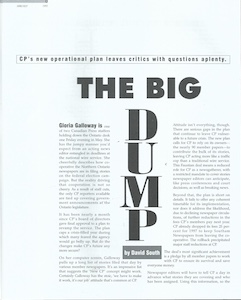
By David South
Scan Magazine (Toronto, Canada), June/July, 1997
Gloria Galloway is one of two Canadian Press staffers holding down the Ontario desk one Friday evening in May. She has the jumpy manner you’d expect from an acting news editor entangled in deadlines at the national wire service. She cheerfully describes how cooperative the Northern Ontario newspapers are in filing stories on the federal election campaign. But the reality driving that cooperation is not so cheery. As a result of staff cuts, the only CP reporters available are tied up covering government announcements at the Ontario legislature.
It has been nearly a month since CP’s board of directors gave final approval to a plan to revamp the service. The plan caps a crisis-filled year during which many feared the agency would go belly up. But do the changes make CP’s future any more secure?
On her computer screen, Galloway pulls up a long list of stories filed that day by various member newspapers. It’s an impressive list that suggests the ‘New CP’ concept might work. Certainly Galloway has the stoic, ‘we have to make it work, it’s our job’ attitude that’s common at CP.
Attitude isn’t everything, though. There are serious gaps in the plan that continue to leave CP vulnerable to a future crisis. The new plan calls for CP to rely on its owners – the nearly 90 member papers – to contribute the bulk of its stories, leaving CP acting more like a traffic cop than a traditional wire service. This Faustian deal means a reduced role for CP as a newsgatherer, with a restricted mandate to cover stories newspaper editors can anticipate, like press conferences and court decisions, as well as breaking news.
Beyond that, the plan is short on details. It fails to offer any coherant timetable for its implementation, nor does it address the likelihood, due to declining newspaper circulations, of further reductions in the fees CP’s members pay next year. CP already dropped its fees 25 percent for 1997 to keep Southam Newspapers from leaving the cooperative. The rollback precipitated major staff reductions at CP.
The deal’s most significant achievement is a pledge by all member papers to work with CP to ensure its survival and save everyone money.
Newspaper editors will have to tell CP a day in advance what stories they are covering and who has been assigned. Using this information, so the theory goes, it will be possible to avoid assigning several reporters from competing papers to cover a story when one will do. A reporter will not only be working for his or her own paper that day, but for every CP paper, and will be expected to file updates throughout the day to a CP editor, who in turn will write the story that is then ‘wired’ to all the members. That way, it is hoped, no superfluous stories will be going out on the wire. Member papers will still file analytical and feature stories to CP but, as is the case now, they are under no obligation to give away their prized family jewels – exclusive stories – to other CP papers.
In practical terms, the new approach has been creeping into CP’s way of doing things by stealth rather than command. CP has been increasing its reliance on member papers to pick up the slack when CP reporters aren’t available. The most recent example was the federal election campaign: only one CP reporter was assigned full-time to cover the whole campaign. The rest of the coverage was handled by a combination of CP bureau staff and member paper reporters.
While many smaller papers are dependent on CP for their provincial, national and international stories, the bigger papers, who are the main sources of these stories, can afford to be blase’. Their willingness to co-operate will decide the success or failure of the member-exchange component of CP.
Southam’s vice-president of editorial, Gordon Fisher, maintains his papers will support the plan because it will save his company approximately $2.5 million a year. “We pay a significant amount of money towards this cooperative,” he maintains. “A member exchange is one of the more efficient ways we can find to deliver news without incurring a huge amount of expense.”
“What is CP needs a story earlier than a reporter normally files?” asks managing editor Jane Perves of Halifax’s Chronicle-Herald and Mail-Star. “Theoretically, they should be spending all their time doing the story for our paper.”
Jane Purves is an enthusiastic supporter of CP. Nonetheless she wonders if CP editors will be caught in a contest of wills with editors at member papers. She would like to see a reporter’s CP obligations involve simply calling in a quote or raw data. She would have a problem if a reporter working on a major story for her paper was distracted by CP’s needs.
The Globe and Mail is conidering hiring a full-time co-ordinator to handle the heavy volume of stories that paper generates for CP. Newspaper managers elsewhere are split on the question of whether the plan will increase workloads. The extent that it does so will be a crucial test of their commitment.
Not only will editors need to regularly ‘loan’ reporters to CP, they will have to change how they do things on a daily basis if the plan is to work. Editors will have to file an assignment list one day in advance to CP, a task that could get easily overlooked when papers get hit with multiple big stories.
“It’s pretty minor stuff,” says Perry Beverley, the co-publisher of Brockville’s Recorder and Times. Although the Recorder and Times is an afternoon paper where copy is edited in the morning, Beverley has no plans to switch an editor to an evening shift to fit CP’s deadlines.
Deadlines are a particularly thorny question in a country that spans six time zones. Newspapers on the East coast can file stories at the end of the day and still meet CP deadlines that are pegged at Toronto time. The problem is with newspapers west of Ontario; they will have to file stories well before the end of the day. In the case of B.C., filing will have to be done in the morning so that stories picked up by CP will be ready in time for East coast papers.
The copy will have to go out to CP unedited.
At the Edmonton Sun, editor-in-chief Paul Stanway isn’t sanguine about sending out unedited copy. Stanway had editorial deadlines pushed back to 6 p.m. 18 months ago as part of a re-organization at the paper, but they still mean copy would be sent straight from reporters to CP, where copy needs to be in between 4 p.m. and 9 p.m. Toronto time. Stanway is concerned the CP staff will not have the time to fact-check stories to weed out mistakes, which would reflect poorly on his paper.
The anticipated deadline crunch has been nicknamed “the big dump” in CP circles: a tidal wave of material hitting the wire service’s desks all at once, leaving editors scrambling to do re-writes before newspapers are put to bed.
CP general manager Jim Poling, who vacates he job in June, believes this problem will be solved by the restructuring, not exacerbated by it. “The volume of copy has already dropped significantly,” he says. “We are hoping for a wider spectrum of deadlines. Hopefully you are going to get your copy spread out over a longer period, instead of over the course of a couple of hours. You might not need a massive shift of people to a certain time.”
Poling claims the resolution is in better planning which will result in fewer unwanted stories. Fewer stories, so Poling maintains, means more time for editors to re-write.
At CP’s Winnipeg bureau, Canadian Media Guild vice-president Scott Edmonds is sceptical. He isn’t convinced the slimmed down CP will have the staff to handle what he sees as an increasing workload.
“It sounds like the meatgrinder approach to journalism,”says Edmonds. “There is no way these desks are going to be able to cope with any degree of thoughtfulness with this copy. The pressure is going to be too great.”
Edmonds also sees a bigger problem in staff moral. “The majority of people working for Canadian Press don’t want their career to end up as a re-writer… It will require a lot more attention on the desk for this material, so we will be taking resources away from reporting. In other words, taking somebody away from doing the story to redoing the story.”
CP’s raison d’etre is its ability to turn out stories written in a homogenous national voice that can be tailored for a specific paper’s readers. Another important asset is the agency’s ability to quickly add knowledge and background to stories, drawing on the experience of its reporters and editors. According to Martin O’Hanlon at CP’s Ontario Desk, cut-backs have compromised this ability. Three business reporters have been poached by the Financial Post, including Ian Jack and Sandy Rubin. Over 40 talented reporters and editors took buyouts in the fall of 1996.
This means CP isn’t as well equipped as it once was to turn raw copy from reporters into high-quality journalism that can draw the respect and admiration of its subjects.
“Our reporters are not trained to write for a national audience,” emphasizes Jane Purves in Halifax.
Scott Edmonds doesn’t believe member contributors are a substitute for CP staff. “I’m very concerned about attempting to replace quality staf-written material that caters to a national audience and is written to uniform standards, with material picked up from newspapers that in some cases may be very good, but in some cases may not be of the same quality.”
There is a great deal of confusion over when the plan is supposed to kick in. One camp, which includes Jim Poling, sees it more as a gradual, evolutionary change that will take several years to fine tune. There are others who want to see trial runs. Still others believe there will be a date set for a total national switch-over.
Perry Beverley favours test sites and single switch-over date.
“Once that D-Day time is chosen for the switch-over into the restructured CP,” she says, “there will be an appointed person in the newsroom responsible for sending the schedule to CP.”
Purves favours a gradual switch. “A shot-gun approach might backfire. I’d rather have a gradual approach providing we had a starting date and an aim.”
“We don’t have to have a roll-out day,” says Poling. “But if all the managers and staff rise up and say ‘shit, we need test sites,’ then I will listen. Anybody who is waiting for a date will be disappointed. All of this started a long time ago and is a continuing process that will take a couple of years to get everything in place.”
Seven regional news committees will co-ordinate and oversee this new approach, each one staffed by representatives from member papers and CP. According to the plan, these regional news committees will act as enforcers for the new regime. They will work out the logistics of member exchange and use fines to penalize papers that miss deadlines or obstruct exchange.
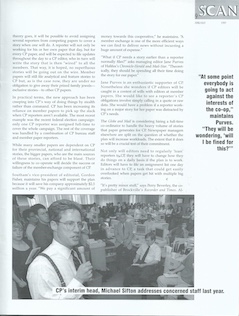
How such an approach would work in practice is still up in the air. “At some point everybody is going to act against the interests of the co-op,” maintains Purves. “They will be wondering, ‘will I be fined for this?’”
Nobody contacted by SCAN could tell us what these fines would be, how violations would be investigated or what constituted offences. Purves wondered what deterrence value the fines would have if a paper thought it had acted in its best interests. If paper X decided to hold back a juicy scoop that was supposed to be that day’s CP story, a fine of $2,000 might be worth incurring if it sells more newspapers. It was generally agreed none of these committees would meet until after the federal election at the earliest.
For now, Poling is generally optimistic (though he won’t around past June and a replacement has yet to be found). He is talking about raising salaries for the first time in five years, about hiring new staff, about stabilizing life at CP.
The lower fees have lured back one newspaper group, British Columbia’s Sterling. A trial use of CP stories started at the beginning of May. It remains to be seen whether New Brunswick’s Telegraph Journal/Times Globe papers will return, after pulling out of CP in 1993 and hiring more of its own reporters with the money saved. Publisher Jamie Milne remains coy as to his interest in returning to CP, but Poling thinks a deal will be worked out by the fall.
And what about the mood of the man charged with overseeing CP’s transition? Jim Poling, as some CP staffers like to mention, is losing that cautious reserve managers usually have for talking to the media. He isn’t happy with the state of the print media in Canada.
“There has been a lot of cutting in this industry,” says an audibly frustrated Poling. “The fact of the matter is this: cutting isn’t the only answer to having an efficient operation. There has to be some money available to allow journalists to walk around a bit. People who walk around and poke at things and stare at things write good stories.”
With phones ringing all around us, Galloway begins to think out loud about possible wrinkles in the new CP plan: how newspaper reporters at trials will have to keep leaving the courtroom to file updates for CP, how stories written for local papers will translate for national readers, how hard it can be for local, non-CP reporters to cover elections when they don’t know what questions have been asked elsewhere on the campaign trail.
But Galloway has to get back to work. She has to push the Toronto Star to file a story early so the Hamilton Spectator can pick it up.


https://davidsouthconsulting.org/2022/10/21/african-media-changing-to-reach-growing-middle-class/
https://davidsouthconsulting.org/2021/06/14/case-study-1-investigative-journalism-1991-1997-2/
https://davidsouthconsulting.org/2022/11/01/indian-newspapers-thrive-with-economy/
https://davidsouthconsulting.org/2022/05/27/media/
https://davidsouthconsulting.org/2022/11/01/new-journal-celebrates-vibrancy-of-modern-africa/
https://davidsouthconsulting.org/2021/12/08/new-media-markets-and-screen-finance/
https://davidsouthconsulting.org/2022/10/04/popular-chinese-social-media-chase-new-markets/
https://davidsouthconsulting.org/2022/11/23/publications/
https://davidsouthconsulting.org/2020/12/11/top-reporters-offer-military-media-handling-tips/


This work is licensed under a
Creative Commons Attribution-Noncommercial-No Derivative Works 3.0 License.
ORCID iD: https://orcid.org/0000-0001-5311-1052.
© David South Consulting 2023





You must be logged in to post a comment.