Tag: COP27

  • Bamboo Becomes Transport Option for the South

    Bamboo Becomes Transport Option for the South

    By David SouthDevelopment Challenges, South-South Solutions

    SOUTH-SOUTH CASE STUDY

    The sturdy bamboo plant (http://en.wikipedia.org/wiki/Bamboo) is enjoying a revival around the world as a building material. A strong, fast-growing and highly renewable woody plant, it is becoming increasingly popular as people seek out less environmentally wasteful alternatives to steel and other materials.

    But who would have thought bamboo taxis would turn up on the scene?

    A fleet of bamboo taxis is now plying the streets in Tabontabon, a municipality in The Philippines that is home to 10,000 people, most of them rice farmers.

    Bamboo can sometimes grow more than 1 metre a day. While in Asia, it has long been a traditional construction material, people are now turning to it to make transportation vehicles. In The Philippines, there are 62 species of bamboo, up to 15 of which are suitable for industrial applications.

    So-called habal-habal motorcycles, the most popular form of transportation in the town, are also the source of many accidents and are uncomfortable on sunny days or when it rains. A covered taxi service is both a safer and a more comfortable alternative.

    The town’s mayor, Rustico Balderian, took the initiative to build a fleet of bamboo taxis. He set four criteria the new taxis had to meet: they should be low-cost, fuel efficient, safe and environmentally friendly. The bamboo has a higher tensile strength (http://en.wikipedia.org/wiki/Tensile_strength) than steel, which also requires vast quantities of energy to produce.

    The taxis are 90 percent made of bamboo and are built by unemployed youth. They are divided into Eco 1 (a model that seats 20 people and runs for eight hours on one gallon of coco-biodiesel from coconuts) (http://cocobiodiesel.blogspot.com/), and Eco 2, which seats eight people, has a stereo and sound system, and also runs for eight hours on a gallon of coco-biodiesel.

    Both are made by the Tabontabon Organic Transport Industry [TOTI] (http://totieco.multiply.com/).

    Making vehicles out of bamboo is a serious endeavour that also has been under development in Japan. In 2008, Kyoto University’s Venture Business Laboratory (VBL) unveiled a unique single-seat electric vehicle equipped with a body made from bamboo. The vehicle was developed under the Kyoto Electric Car Development Project, which is one of the laboratory’s major initiatives. Nicknamed Bamgoo, this eco-car’s body is made of braided rods of bamboo, one of the local specialty products of the area.

    Other bamboo modes of transport in the South include bamboo bicycles in Ghana. A partnership between an American bike designer and a Ghanaian government initiative is taking advantage of this local resource to manufacture bicycles for the local market – and as a source of export income.

    Not only are the Ghanaian builders harvesting bamboo to make bikes for the domestic market, they are also offering a sophisticated online shopping service for the overseas market. People from around the world can now buy Ghanaian bikes using a website (http://www.bamboosero.com). Customers can choose frame builders by their specialty – cargo bike, mountain bike or road bike – and then order it online. The completed bikes are quality checked and then distributed by Calfee Design in California, USA. This approach keeps the middlemen out of the transaction, and means more money gets back to the bike builder.

    Meanwhile in Cambodia, the legendary bamboo railway is a people’s solution to the poor service offered by the established railway system. In the northwest of the country near the second city of Battambang, an entire railway system has been built using bamboo.

    The bamboo trains, called ‘noris’ or ‘lorries’ by the locals, are driven by a electric generator engine. Passengers sit on a bamboo platform placed on two sets of wheels. The bamboo train reaches speeds of over 40 km/h.

    “We’re very careful,” 18-year-old Sok Kimhor, a 10-year veteran of the bamboo trains, told the BBC. “We look out for children and animals running across the lines, and we have to slow down when other trains come along.”

    There is just one track, so when two trains meet, one has to be taken off the track to pass.

    The regular rail service runs only once a week to the capital, Phnom Penh. This makes the bamboo train the only alternative for many people to get around. While the main railway station is deserted, the bamboo service is a hive of activity.

    “They’re very safe – a motorbike taxi is too fast, and if I use one of those I sometimes get dizzy and fall off,” said Sao Nao as she sat on the rails with a small group of people. “On a bamboo train I can sit down and go to sleep. You can’t do that on a motorbike.”

    Design for Development (http://designfordevelopment.org/) is also turning to bamboo for a transport solution. The Canadian NGO is working in Kenya on making five emergency medical transportation devices (EMTD), or ambulances, to move local people to health clinics or hospitals. Bamboo is locally available and they hope to set up a workshop and make the ambulances using local labour.

    Published: August 2009

    Resources

    1) A slideshow of the bamboo taxis. Website:http://totieco.multiply.com/photos/album/2/ECO2

    2) UNEP, the UN’s Environment Programme, has produced a report on bamboo biodiversity and how it can be preserved. Website: http://www.unep-wcmc.org

    3) The Asian Development Bank is using its Markets for Poor programme to link bamboo products to marketplaces, helping poor communities. Website:http://www.markets4poor.org/

    4) A blog describing the use of coco-biodiesel in the Philippines. Website: http://cocobiodiesel.blogspot.com/

    Development Challenges, South-South Solutions was launched as an e-newsletter in 2006 by UNDP’s South-South Cooperation Unit (now the United Nations Office for South-South Cooperation) based in New York, USA. It led on profiling the rise of the global South as an economic powerhouse and was one of the first regular publications to champion the global South’s innovators, entrepreneurs, and pioneers. It tracked the key trends that are now so profoundly reshaping how development is seen and done. This includes the rapid take-up of mobile phones and information technology in the global South (as profiled in the first issue of magazine Southern Innovator), the move to becoming a majority urban world, a growing global innovator culture, and the plethora of solutions being developed in the global South to tackle its problems and improve living conditions and boost human development. The success of the e-newsletter led to the launch of the magazine Southern Innovator. 

    Creative Commons License

    This work is licensed under a
    Creative Commons Attribution-Noncommercial-No Derivative Works 3.0 License.

    ORCID iD: https://orcid.org/0000-0001-5311-1052.

    © David South Consulting 2023

  • Colombian Architect Proving Strength and Beauty of Bamboo

    Colombian Architect Proving Strength and Beauty of Bamboo

    By David SouthDevelopment Challenges, South-South Solutions

    SOUTH-SOUTH CASE STUDY

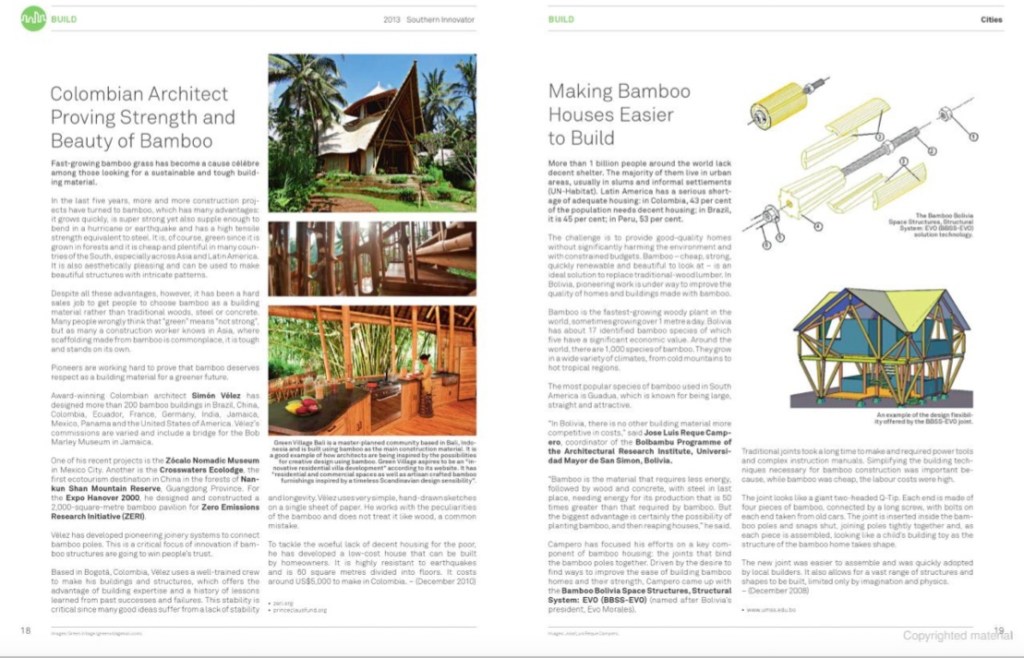
    Fast-growing bamboo grass (http://en.wikipedia.org/wiki/Bamboo) has become a cause celebre amongst those looking for a sustainable and tough building material.

    In the last five years, more and more construction projects have turned to bamboo. It has many advantages: it grows quickly, is super-strong yet also supple enough to bend in a hurricane or earthquake and has a high tensile strength (http://en.wikipedia.org/wiki/Ultimate_tensile_strength) equivalent to steel. It is, of course, green since it is grown in forests, and is cheap and plentiful in many countries of the South, especially across Asia and Latin America.

    It is also aesthetically pleasing and makes beautiful structures with intricate patterns.

    But despite all these advantages, it has been a hard sales job to get people to choose bamboo as a building material rather than traditional woods, steel or concrete. Many people wrongly think green means not strong. But as many a construction worker knows in Asia, where scaffolding made from bamboo is commonplace, it is tough and stands on its own.

    Pioneers are working hard to prove bamboo deserves respect as a building material for a greener future.

    Award-winning Colombian architect Simón Vélez has designed more than 200 bamboo buildings in Germany, France, the United States, Brazil, Mexico, China, Jamaica, Colombia, Panama, Ecuador, and India.

    Vélez’s commissions are varied, and include a bridge for the Bob Marley Museum in Jamaica.

    One of his recent projects is the Zócalo Nomadic Museum (http://en.wikipedia.org/wiki/Nomadic_Museum) in Mexico City. Another is the Crosswaters Ecolodge (http://www.asla.org/2010awards/370.html), the first ecotourism destination in China in the forests of Nankun Shan Mountain Reserve, Guangdong Province. For the Expo Hanover 2000, he designed and constructed a 2000-square-meter bamboo pavilion for ZERI (Zero Emissions
    Research Initiative) (http://www.zeri.org/).

    Vélez has developed pioneering joinery systems to connect bamboo poles together. This is a critical focus of innovation if bamboo structures are going to win people’s trust.

    Based in Bogotá, Colombia, Vélez uses a well-trained crew to make his buildings and structures. This has the advantage of building expertise and a history of lessons learned from past successes and failures. That stability is a critical insight: many good ideas suffer from a lack of stability and longevity. He uses very simple, hand-drawn sketches on a single sheet of paper. He works with the peculiarities of the bamboo and does not treat it like wood: a common mistake.

    To tackle the woeful lack of decent housing for the poor, he has developed a low-cost house that can be built by home-owners. It is highly resistant to earthquakes and is 60 square metres divided on two floors. It costs
    around US $5,000 to make in Colombia.

    Winner of the Prince Claus Fund (http://www.princeclausfund.org/en/index.html), Vélez’s work promotes sustainable development, introducing new ideas on ecological issues and questions. The Fund calls him an architect “whose aesthetic and technical innovations have considerably expanded the possibilities of bamboo as a building material, providing a challenge to prevailing architectural trends.”

    With more than 1 billion people around the world lacking decent shelter, many see plentiful bamboo as a key part of the solution. Most people with poor quality housing live in urban areas, usually in slums and informal settlements (UN-HABITAT). Latin America has a serious shortage of adequate housing: in Colombia, 43 percent of the population needs decent housing; in Brazil, 45 percent; Peru, 53 percent.

    The challenge is to provide good quality homes without significantly harming the environment – and with constrained budgets. Bamboo – cheap, strong, quickly renewable and beautiful – is an ideal solution to replace traditional wood lumber.

    Bamboo is the fastest growing woody plant in the world, sometimes growing over 1 metre a day. Around the world, there are 1,000 species of bamboo. They grow in a wide variety of climates, from cold mountains to hot tropical regions.

    Once called the “poor man’s timber” – a temporary building material to replace once there is more money – bamboo is now getting the respect it deserves. Bamboo for housing has a long history in Latin America, stretching back 4,500 years to ancient civilizations. In Asia, it has long been a traditional construction material. But most of the existing bamboo dwellings in Latin America are 50 to 100 years old.

    The most popular species of bamboo used in South America is Guadua, which is known for being large, straight and attractive.

    Thoughtful and methodical pioneers like Vélez are proving bamboo has a viable future as a building material that will tackle the housing needs of the world’s poor and the fast-growing cities of the South.

    Published: December 2010

    Resources

    Development Challenges, South-South Solutions was launched as an e-newsletter in 2006 by UNDP’s South-South Cooperation Unit (now the United Nations Office for South-South Cooperation) based in New York, USA. It led on profiling the rise of the global South as an economic powerhouse and was one of the first regular publications to champion the global South’s innovators, entrepreneurs, and pioneers. It tracked the key trends that are now so profoundly reshaping how development is seen and done. This includes the rapid take-up of mobile phones and information technology in the global South (as profiled in the first issue of magazine Southern Innovator), the move to becoming a majority urban world, a growing global innovator culture, and the plethora of solutions being developed in the global South to tackle its problems and improve living conditions and boost human development. The success of the e-newsletter led to the launch of the magazine Southern Innovator. 

    Creative Commons License

    This work is licensed under a
    Creative Commons Attribution-Noncommercial-No Derivative Works 3.0 License.

    ORCID iD: https://orcid.org/0000-0001-5311-1052.

    © David South Consulting 2023

  • Indian Solar Power Pack Powers Villages

    Indian Solar Power Pack Powers Villages

    By David SouthDevelopment Challenges, South-South Solutions

    SOUTH-SOUTH CASE STUDY

    Developments in India are showing the way forward for low-cost solar power for the poor. The Duron Solar Home Power System (http://www.duronenergy.com/product_info/) is now enabling the rural poor to generate and store solar electricity. It is powerful enough to charge gadgets and appliances and run LED lights. It allows people to do their household chores into the dark hours and to study or earn extra income.

    As the company says, it “allows ample light for cooking, for children to study at night, and for shop owners to stay open later to earn more money.”

    The system removes the need for polluting and dangerous kerosene lamps, which are used by an estimated one million families for lighting in India.

    Kerosene lamps are a major contributor to indoor air pollution, which itself claims the lives of 1.5 million people each year. Kerosene lamps have also caused countless deaths by suffocation, burns and fatal fires.

    The United Nations Environment Program says kerosene fumes are responsible for around 64 percent of deaths for children under the age of five in developing countries.

    More than 1.7 billion people around the world have no domestic electricity supply, of whom more than 500 million live in sub-Saharan Africa (World Bank). Some 400 million people in India do not have access to electricity, according to the World Bank, and 600,000 villages lack an electrical supply. Prime Minister Manmohan Singh has pledged “power for all” by 2012. Without electricity, many development goals remain dreams that will never be achieved.

    Being able to see at night unleashes a vast range of possibilities, but for the very poor lighting is often the most expensive household expense, soaking up 10 to 15 percent of income.

    According to Greenpeace (http://www.greenpeace.org/international/), India could generate 10 percent of its electricity from solar power by 2030.

    The Duron package comes with a five watt solar panel, a cell phone charger connection, three LED (http://en.wikipedia.org/wiki/LED_lamp) lights, and an AC grid charger. After a day of charging, the Duron can power three hours of bright lighting or 10 hours of dim lighting.

    The Duron system sells for about 5,999 rupees, or around US $130, and the typical user to date has been small businesses and schools.

    Duron is selling several thousand units a month and the company is currently scaling up its sales efforts.

    Duron’s approach is to provide a market solution to the huge problem of providing electricity to India’s rural poor.

    The company was launched in 2008 with the goal of providing electricity to those without around the world. It was developed out of the Idea Lab (http://www.idealab.com/), a Pasadena, Californian incubator of technology companies.

    Extensive field research was conducted across India to determine what was the best solution and what were the needs of rural dwellers. Duron moved its headquarters to Bangalore, India in 2009 to be closer to its customers and expand sales. The company operates in the Indian states of Uttar Pradesh and Karnataka.

    By August 2009, more than 2,100 people had light because of the Duron system. The company calculates this translated into 172,500 hours of light.

    One customer, Anil Singh, lives with his family in the unelectrified village of Narainpur. His family used kerosene lamps and was paying US $4 a day for unreliable lighting. But after seeing his neighbour, Santosh Singh, with bright, powerful lights at his home, he was curious as to why. When he found out about Duron’s system, he installed a system to light his front porch and two rooms in his house. His family now enjoys two-and-half hours of reliable light in the evening to do things.

    “The Duron has made my life so much easier,” said Anil. “It’s a much cheaper (lighting) option compared to kerosene lamps, and I now have a reliable source of power on a daily basis,” he told the company’s website.

    Another innovative start-up with offices in India and Africa, is the d.light company, which also has a new, highly-efficient solar-powered product available. The Kiran LED lamp (http://www.dlightdesign.com/products_kiran_global.php) stays lit for eight hours on a full battery and is four times brighter than a kerosene lamp. It illuminates 360 degrees and produces an even, bright white light.

    Published: February 2010

    Resources

    1) Lighting Africa: this website run by the World Bank is a virtual business community and has forums, market intelligence, access to grants, network and partnership opportunities. Website: http://lightingafrica.org/index.cfm?Page=Home

    2) D.light Design is dedicated to bringing modern lighting and power to more than 1.6 billion people globally currently living without electricity. They aim to be the number one player in off-grid lighting and power solutions worldwide. Website: http://www.dlightdesign.com/

    3) Solar Power Answers is a one-stop-shop for everything to do with solar power. It has a design manual and guides to the complex world of solar power equipment. Website: http://www.solar-power-answers.co.uk/index.php

    4) Sun King solar lantern: The lantern provides 16 hours of light for a day’s charge. Website: http://www.greenlightplanet.com/ourusers.html

    Development Challenges, South-South Solutions was launched as an e-newsletter in 2006 by UNDP’s South-South Cooperation Unit (now the United Nations Office for South-South Cooperation) based in New York, USA. It led on profiling the rise of the global South as an economic powerhouse and was one of the first regular publications to champion the global South’s innovators, entrepreneurs, and pioneers. It tracked the key trends that are now so profoundly reshaping how development is seen and done. This includes the rapid take-up of mobile phones and information technology in the global South (as profiled in the first issue of magazine Southern Innovator), the move to becoming a majority urban world, a growing global innovator culture, and the plethora of solutions being developed in the global South to tackle its problems and improve living conditions and boost human development. The success of the e-newsletter led to the launch of the magazine Southern Innovator.  

    Creative Commons License

    This work is licensed under a
    Creative Commons Attribution-Noncommercial-No Derivative Works 3.0 License.

    ORCID iD: https://orcid.org/0000-0001-5311-1052.

    © David South Consulting 2022

  • Indian Solar Economy Brings New Vocation for Women

    Indian Solar Economy Brings New Vocation for Women

    By David SouthDevelopment Challenges, South-South Solutions

    SOUTH-SOUTH CASE STUDY

    India has started to make significant advances in developing solar power technologies for the poor. There are now whole villages using solar energy and improving their standard of living. Various companies and projects are selling inexpensive solar appliances – from cooking stoves to lanterns and power generators – across the country. This new solar power ‘grid’ is also bringing further economic opportunities: jobs for people to repair and maintain the new equipment.

    An interesting initiative is turning the need to repair and maintain solar-powered equipment into a job opportunity for poor women.

    More than 1.7 billion people around the world have no domestic electricity supply, of whom more than 500 million live in sub-Saharan Africa, and 400 million in India (World Bank). Some 600,000 Indian villages lack an electrical supply. India’s Prime Minister Manmohan Singh has pledged “power for all” by 2012. An ambitious goal, and one that acknowledges that without electricity, many development goals remain dreams that will never be achieved.

    Being able to see at night, for example, unleashes a vast range of possibilities – such as being able to work or study later – but for the very poor, lighting is often the most expensive household expense, soaking up 10 to 15 percent of income.

    The power of the sun can help transform this situation. According to Greenpeace (http://www.greenpeace.org/international), India could generate 10 percent of its electricity from solar power by 2030.

    In the Indian State of Rajasthan, more than 30,000 homes in 800 villages have turned to solar power for lighting and cooking needs. It is this increasing solar power grid that the Barefoot College (http://www.barefootcollege.org) based in Tilonia – where it was founded over 30 years ago – has turned to as a new economic opportunity. The College is training women to be solar engineers, developing both useful skills and a new income source. So far, Barefoot College itself has solar electrified some 350 villages across India and dozens more in sub-Saharan Africa and even war-torn Afghanistan.

    The College prides itself on stripping out academic jargon while inspiring confidence in students’ innate talents and skills so they can take on new vocations.

    The solar engineers – many of whom are illiterate – are taught by their peers. Given a box of tools and hardware, the students undertake practical projects to learn-by-doing how the solar devices work and can be repaired. They are introduced to technical terms and concepts and learn how to wire circuits and do daily repairs.

    “It is only, we have found, an illiterate woman who is a teacher who can actually train an illiterate women who is a trainer,” the college’s founder, Bunker Roy, told the BBC. “They have the patience, tolerance and improvisation.”

    Roy says the training teaches more knowledge of the technical aspects of solar power than a typical student would glean from an undergraduate university degree.

    The Barefoot College takes its inspiration from former Indian leader Mahatma Ghandi (http://en.wikipedia.org/wiki/Mohandas_Karamchand_Gandhi), who felt the wisdom, knowledge and skills already existing in rural villages should be the basis for any development. He also believed deploying sophisticated technology in poor communities should be done on their terms to avoid exploitation.

    The College is a passionate believer in the inherent skills and abilities of the poor to improve their conditions. It eschews formal qualifications, believing these can be as much a hindrance as a help, trapping people in rigid methodologies.

    The Barefoot College has been working on solar electrification in poor and rural villages since 1989. It has used similar techniques to train teachers and teach medical skills.

    The course has successfully attracted sponsored students from as far away as Africa. Sarka Mussara, a 56-year-old widowed grandmother from the West African nation of Mauritania, had never attended school or even left her village before coming to India on a UN sponsorship.

    “We started little by little learning the solar energy system,” she told PBS. “Day by day and little by little we were able to put things together.”

    The solar engineers become highly skilled and can even fabricate complex components like a charge controller (http://en.wikipedia.org/wiki/Charge_controller) when they are back in the village.

    One of the additional benefits of training skilled solar engineers is the more confident role these women play in their communities when they return. They often take the lead on other projects in the village.

    The College also picks the tough cases: only villages that are inaccessible, remote or non-electrified get help.

    Its approach is to have a meeting to introduce the benefits of solar lighting to the community. If the community wants it, then a village committee is formed. Any household that wants solar power has to pay a small fee, no matter how poor. This is to ensure they feel a sense of ownership of the new technology.

    Some members of the community are then selected to be trained as “Barefoot Solar Engineers,” or BSEs. They will install, repair and maintain the solar lighting units for at least five years. A workshop is set up to carry out repairs fully equipped with tools and replacement parts. The solar engineers attend a six-month course at the College, leading to work for at least five years.

    The Barefoot College encourages middle-aged women and widows and single mothers to become engineers. Experience has shown them to be the most reliable and less prone to moving to the city after training.

    Published: May 2010

    Resources

    1) D.light Design is dedicated to bringing modern lighting and power to more than 1.6 billion people globally currently living without electricity. They aim to be the number one player in off-grid lighting and power solutions worldwide. Website: http://www.dlightdesign.com

    2) Solar Power Answers is a one-stop-shop for everything to do with solar power. It has a design manual and guides to the complex world of solar power equipment. Website: http://www.solar-power-answers.co.uk/index.php

    3) Sun King solar lantern: The lantern provides 16 hours of light for a day’s charge. Website: http://www.greenlightplanet.com/ourusers.html

    Development Challenges, South-South Solutions was launched as an e-newsletter in 2006 by UNDP’s South-South Cooperation Unit (now the United Nations Office for South-South Cooperation) based in New York, USA. It led on profiling the rise of the global South as an economic powerhouse and was one of the first regular publications to champion the global South’s innovators, entrepreneurs, and pioneers. It tracked the key trends that are now so profoundly reshaping how development is seen and done. This includes the rapid take-up of mobile phones and information technology in the global South (as profiled in the first issue of magazine Southern Innovator), the move to becoming a majority urban world, a growing global innovator culture, and the plethora of solutions being developed in the global South to tackle its problems and improve living conditions and boost human development. The success of the e-newsletter led to the launch of the magazine Southern Innovator.  

    Creative Commons License

    This work is licensed under a
    Creative Commons Attribution-Noncommercial-No Derivative Works 3.0 License.

    ORCID iD: https://orcid.org/0000-0001-5311-1052.

    © David South Consulting 2022