Categories
Archive Development Challenges, South-South Solutions Newsletters Southern Innovator magazine

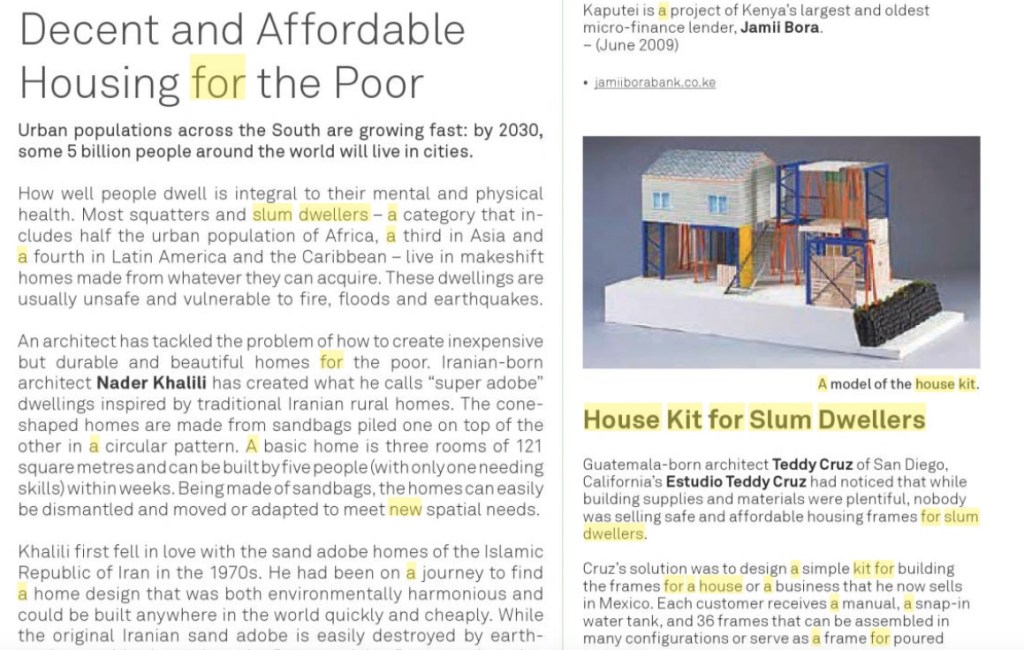
A New House Kit for Slum Dwellers that is Safe and Easy to Build

By David SouthDevelopment Challenges, South-South Solutions

SOUTH-SOUTH CASE STUDY

By 2030, some 5 billion people around the world will live in cities. Next year, 2008, is predicted to be the tipping point, when urban dwellers (3.3 billion people) will outnumber rural residents for the first time. These are the conclusions of UNFPA’s State of the World Population 2007 Report. Even more strikingly, the cities of Africa and Asia are growing by a million people a week. And 72 percent of the population in sub-Saharan Africa live in slum conditions.

But as populations grow — and most will be poor, unemployed and under 25 — it becomes critical that effective solutions are found to ensure people can live with dignity and comfort. And design is being used more and more to overcome this challenge.

George Martine, author of the UNFPA report, is blunt: “We’re at a crossroads and can still make decisions which will make cities sustainable. If we don’t make the right decisions the result will be chaos,” he told the UK newspaper The Independent.

Guatemala-born architect Teddy Cruz of Estudio Teddy Cruz in San Diego, California, joins a small but growing number of socially responsible architects. He applies a concept more associated with middle class shoppers at the furniture design emporium Ikea to the world’s estimated one billion urban slum dwellers (UN-Habitat). Without legal title to the land they live on, packed tightly into densely overcrowded shantytowns, most squatters and slum dwellers live in makeshift homes made from whatever they can get their hands on. This is estimated to include half the urban population of Africa, a third of Asia and a fourth of Latin America and the Caribbean (Click here for more information).

The ad-hoc shelters and houses they build can be dangerously unstable, and vulnerable to natural disaster from flash floods to earthquakes. Cruz had noticed that while building supplies and materials were plentiful, nobody was selling safe and affordable housing frames for slum dwellers. According to the International Labor Organization, formal housing markets in developing countries rarely supply more than 20 percent of housing stock.

Cruz’s solution was to design a simple kit for building the frames for a house or a business that he now sells in Mexico. Each customer receives a manual, a snap-in water tank, and 36 frames that can be assembled in many configurations, or serve as a frame for poured concrete. These sturdy frames can also be added to with locally found materials. Cruz said he was inspired by “the resourcefulness of poverty” and by the cheap and affordable pre-fabricated homes that once were sold by catalogue by the American retailer Sears.

Cruz has been testing the structures in Tijuana, Mexico – a rapidly growing city on the border with the United States and a destination for Mexico’s poor. His work as an architect has centred on exploring how informal settlements grow faster than the cities they surround. These settlements, he says, break the rules and blur the boundaries between what is urban, suburban and rural. Cruz’s frame kits can be used to build a home, or combination of home and business, acknowledging the fact many people need to use their home as a business for a livelihood.

“These start-up communities gradually evolve,” said Cruz., ”or violently explode out of conditions of social emergency, and are defined by the negotiation of territorial boundaries, the ingenious recycling of materials, and human resourcefulness.”

Published: July 2007

Resources

There are many ways to play around with your dwelling and architecture ideas. Here are some products available online:

  1. Arckit: Arckit is a tangible and hands-on design tool for spontaneously bringing your architectural ideas to life right before your eyes. Website: https://www.arckit.com
  2. SmartLab Archi-TECH Electronic Smart House: Build your house and power it up! This creative STEAM toy allows aspiring architects and engineers to design and build modular structures – and then power them up with lights, sounds, sensors, and motorized parts! Website: https://www.mastermindtoys.com/products/smart-lab-archi-tech-electronic-smart-house

Development Challenges, South-South Solutions was launched as an e-newsletter in 2006 by UNDP’s South-South Cooperation Unit (now the United Nations Office for South-South Cooperation) based in New York, USA. It led on profiling the rise of the global South as an economic powerhouse and was one of the first regular publications to champion the global South’s innovators, entrepreneurs, and pioneers. It tracked the key trends that are now so profoundly reshaping how development is seen and done. This includes the rapid take-up of mobile phones and information technology in the global South (as profiled in the first issue of magazine Southern Innovator), the move to becoming a majority urban world, a growing global innovator culture, and the plethora of solutions being developed in the global South to tackle its problems and improve living conditions and boost human development. The success of the e-newsletter led to the launch of the magazine Southern Innovator.  

Follow @SouthSouth1

Like this story? Here is a dirty secret: this website is packed with stories about global South innovators. We spent 7 years researching and documenting these stories around the world. We interviewed the innovators to learn from them and we visited them to see how they did it. Why not use the Search bar at the top and tap in a topic and see what stories come up? So, stick around and read some more!    

Archive.org: https://archive.org/details/Httpwww.slideshare.netDavidSouth1development-challengessouthsouthsolutionsjuly2007issue

Slideshare: http://www.slideshare.net/DavidSouth1/development-challengessouthsouthsolutionsjuly2007issue

Southern Innovator Issue 1: https://books.google.co.uk/books?id=Q1O54YSE2BgC&dq=southern+innovator&source=gbs_navlinks_s

Southern Innovator Issue 2: https://books.google.co.uk/books?id=Ty0N969dcssC&dq=southern+innovator&source=gbs_navlinks_s

Southern Innovator Issue 3: https://books.google.co.uk/books?id=AQNt4YmhZagC&dq=southern+innovator&source=gbs_navlinks_s

Southern Innovator Issue 4: https://books.google.co.uk/books?id=9T_n2tA7l4EC&dq=southern+innovator&source=gbs_navlinks_s

Southern Innovator Issue 5: https://books.google.co.uk/books?id=6ILdAgAAQBAJ&dq=southern+innovator&source=gbs_navlinks_s

Creative Commons License

This work is licensed under a
Creative Commons Attribution-Noncommercial-No Derivative Works 3.0 License.

ORCID iD: https://orcid.org/0000-0001-5311-1052.

© David South Consulting 2023
Categories
Archive Development Challenges, South-South Solutions Newsletters Southern Innovator magazine

Turning Human Waste to Fertilizer: An African Solution

By David SouthDevelopment Challenges, South-South Solutions

SOUTH-SOUTH CASE STUDY

While South Africa has been free of the racist Apartheid regime since the mid-1990s, the expected boost to living standards for the majority black population has not been as widespread and as quick as many had expected.

One important aspect of lifting living standards is making sure the entire population has access to adequate sanitation and hygiene services. Another is making sure they have access to adequate and healthy food sources. A bright idea based on intensive research is meeting both goals in an innovative way.

According to the Council for Scientific and Industrial Research (http://www.csir.co.za/), some 11 million South Africans have received access to basic sanitation services since 1994 – but 13.3 million still lacked basic sanitation services by 2008.

The Water Research Commission (WRC) (http://www.wrc.org.za/) believes there is a crisis with South Africa’s toilet pit latrines, which are quickly filling up past their original design capacity. WRC’s solution is to turn the human faeces or faecal sludge deposited in pit latrines into fertilizer for farming and agriculture. The Water Research Commission is advocating using the fertilizer either for fruit trees or for trees that will be turned to income sources like paper and fuel.

The WRC’s project and series of experiments are called “What happens when pit latrines get full?”

“Only one third of municipalities have a budget to maintain on-site sanitation,” WRC researcher and scientist David Still told Inter Press Service (IPS). “If pits fill up, all the hard work that was done to address the sanitation backlog will be wasted. Why not use faecal sludge to address the growing problem of food insecurity by planting fruit trees? Or use the sludge to cultivate trees for fuel or paper production?”

Human faecal sludge contains a variety of nutrients, such as nitrogen, phosphates and potassium. The WRC estimates the average person excretes enough human faecal sludge per year to fertilize 300 to 400 square metres of crops.

The big reason people are reluctant to use human waste as fertilizer is because of the pathogens it contains. Spreading this on edible crops is dangerous and it is also a risk to groundwater when it leaches in to the soil.

The WRC conducted research on two sites: Umlazi and Karkloof, both in KwaZulu-Natal, South Africa. They used property owned by the South African Paper and Pulp Industry (SAPPI) and the local municipality.

The first step in the experiments was to bury the sludge in pits and plant crops on top of it. The pathogens were contained using this method and in time died off.

The test trenches were 0.75 metres in depth and filled with different quantities of sludge. Two control sites did not use faecal sludge. The scientists found the sites where the human waste was used saw plant growth and volume increase by “as much as 80 per cent.”

They then tested for pathogens in the soil. This included looking for the eggs of the large roundworm (http://www.nhs.uk/conditions/Roundworm/Pages/Introduction.aspx), a parasite whose presence would be harmful to humans. The site was tested over a period of 30 months, but none could be found.

Tests for microbes at the Umlazi site also found none. The plants were found to have healthy dark green leaves and the trees grew larger with the sludge present.

Researchers also monitored the groundwater around the sites. They found in flat ground and sandy soil there was no impact. In the site with sloping and shallow soil, small increases in nitrate were observed in the groundwater after rainfall.

They concluded the best place to apply this technique is in places that are flat and where the soil is deep.

One local resident, Lindiwe Khoza, was selected to be part of the test. Citrus and peach trees were planted on top of the buried sludge.

She told IPS: “The fruit grows much faster and it seems to be tastier and juicier than fruit bought at supermarkets. We now enjoy fruit from our own garden.”

WRC’s clever solution to these twin problems could help make life much more pleasant in communities still grappling with poor hygiene services, while dramatically improving the health of crops and their yields.

Published: July 2012

Resources

1) World Bank guide to pit latrines. Website:http://water.worldbank.org/shwresource-guide/infrastructure/menu-technical-options/pit-latrines

2) A video on how to construct a ventilated pit latrine. Website: http://www.youtube.com/watch?v=n4yfAyhiV74

3) A Practical Guide for Building a Simple Pit Latrine: How to Build Your Latrine and Use It Hygienically, for the Dignity, Health, and Well Being of Your Family. Website: http://www.crsprogramquality.org/publications/2011/9/13/a-practical-guide-forbuilding-a-simple-pit-latrine-how-to-b.html

4) The Control of Pathogens from Human Waste and their Aquatic Vectors by L. E. Obeng. Website: http://www.jstor.org/discover/10.2307/4312882?uid=3738032&uid=2129&uid=2&uid=70&uid=4&sid=21100919752851

Development Challenges, South-South Solutions was launched as an e-newsletter in 2006 by UNDP’s South-South Cooperation Unit (now the United Nations Office for South-South Cooperation) based in New York, USA. It led on profiling the rise of the global South as an economic powerhouse and was one of the first regular publications to champion the global South’s innovators, entrepreneurs, and pioneers. It tracked the key trends that are now so profoundly reshaping how development is seen and done. This includes the rapid take-up of mobile phones and information technology in the global South (as profiled in the first issue of magazine Southern Innovator), the move to becoming a majority urban world, a growing global innovator culture, and the plethora of solutions being developed in the global South to tackle its problems and improve living conditions and boost human development. The success of the e-newsletter led to the launch of the magazine Southern Innovator.  

Follow @SouthSouth1

Google Books: https://books.google.co.uk/books?id=9fRcAwAAQBAJ&dq=development+challenges+july+2012&source=gbs_navlinks_s

Slideshare: http://www.slideshare.net/DavidSouth1/development-challenges-july-2012-issue

Southern Innovator Issue 1: https://books.google.co.uk/books?id=Q1O54YSE2BgC&dq=southern+innovator&source=gbs_navlinks_s

Southern Innovator Issue 2: https://books.google.co.uk/books?id=Ty0N969dcssC&dq=southern+innovator&source=gbs_navlinks_s

Southern Innovator Issue 3: https://books.google.co.uk/books?id=AQNt4YmhZagC&dq=southern+innovator&source=gbs_navlinks_s

Southern Innovator Issue 4: https://books.google.co.uk/books?id=9T_n2tA7l4EC&dq=southern+innovator&source=gbs_navlinks_s

Southern Innovator Issue 5: https://books.google.co.uk/books?id=6ILdAgAAQBAJ&dq=southern+innovator&source=gbs_navlinks_s

Creative Commons License

This work is licensed under a
Creative Commons Attribution-Noncommercial-No Derivative Works 3.0 License.

ORCID iD: https://orcid.org/0000-0001-5311-1052.

© David South Consulting 2023

Categories
Archive

Southern Innovator As A Knowledge And Learning Tool | November 2017

Why even bother printing (on paper) Southern Innovator as a magazine? “What about the trees and we live in the digital age!”, some might say.

There is evidence and science supporting the need to always publish Southern Innovator in print as well as online. First, a study of the World Bank’s online publications came to a shocking conclusion: A survey in 2014 found a third of World Bank publications are never downloaded, 40 per cent were downloaded just 100 times, and only 13 per cent were downloaded more than 250 times in their lifetime (The Washington Post). As The Washington Post pointed out, these are publicly funded publications with the intention of contributing to policy debates and providing solutions to the world’s problems. So, if nobody is reading them, or just a handful are, that actually does matter if you care about positive change in the world.

Secondly, a Norwegian study in 2014 from the Stavanger University (part of Europe-wide research into the impact of digitisation on the reading experience), found “… that paper readers did report higher on measures having to do with empathy and transportation and immersion, and narrative coherence, than iPad readers,” according to lead researcher Anne Mangen (The Guardian).

An earlier study the researchers did also found “students who read texts in print scored significantly better on the reading comprehension test than students who read the texts digitally” and that “Studies with students, for instance, have shown that they often prefer to read on paper”, continued Mangen in The Guardian.   

Another issue is Internet shutdowns, outages and censorship. All of these have been on the increase, especially in Africa (africanews.com). To put it simply, you cannot electronically shutdown a piece of paper. 

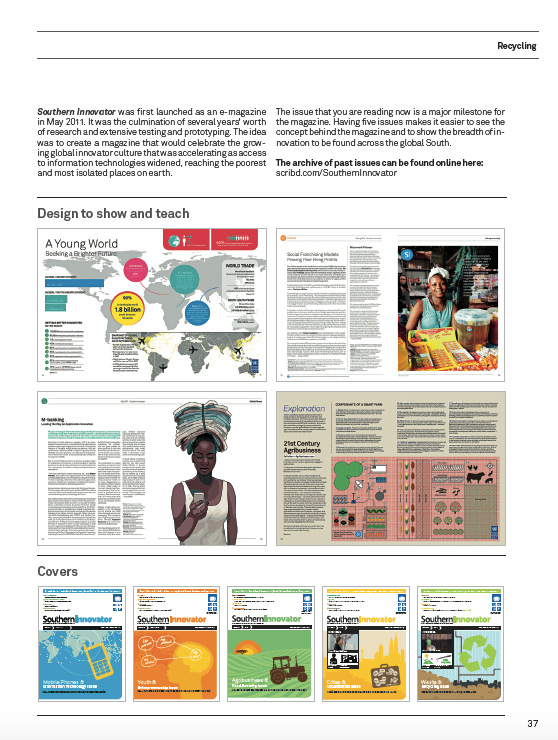
Design to show and teach.
Innovations Summary.
A fast-changing world.
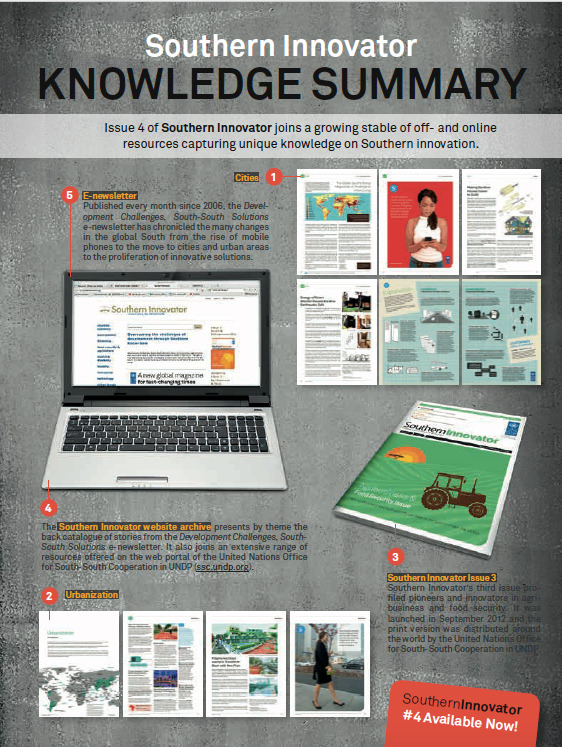
Knowledge Summary.
Knowledge Summary.
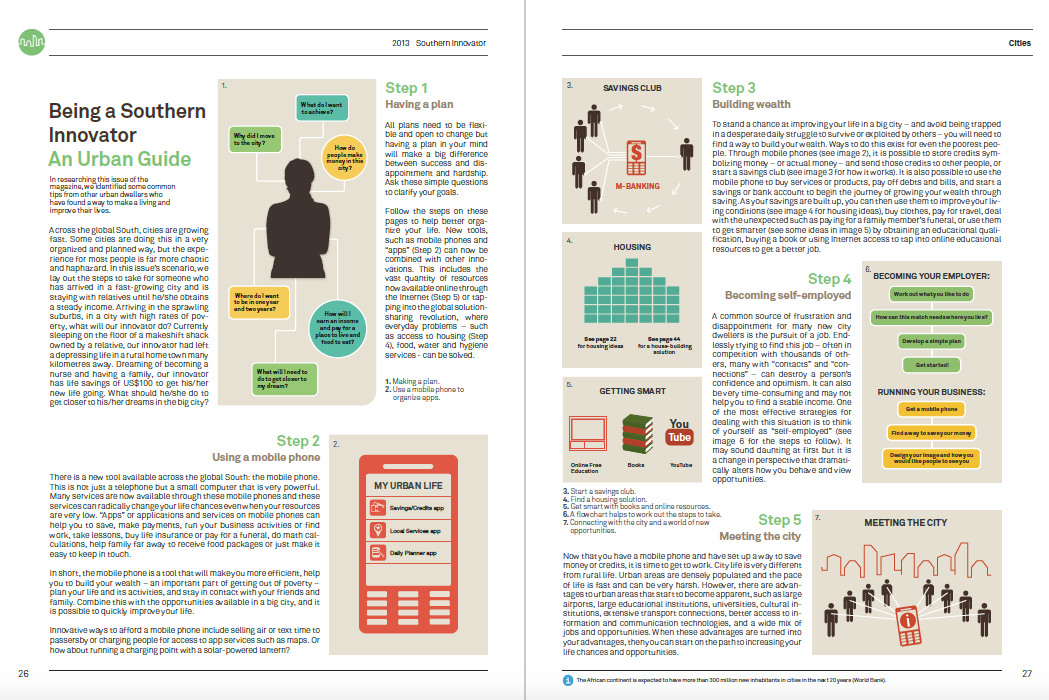
Being a Southern Innovator: An Urban Guide.
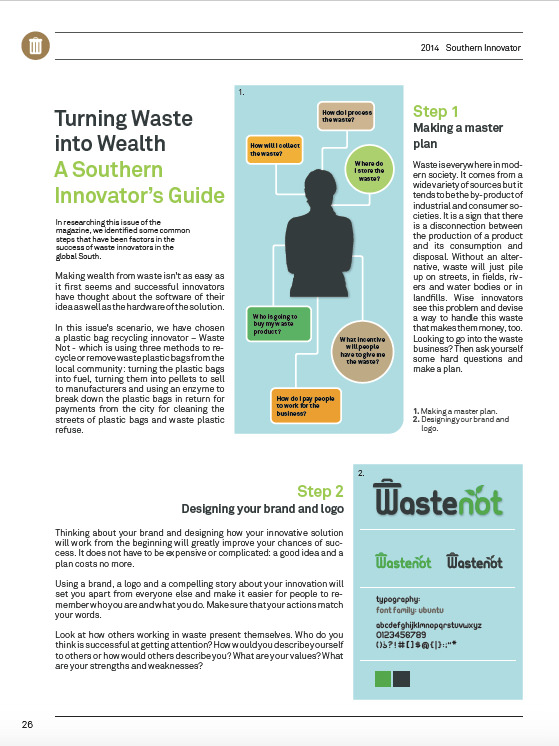
Turning Waste into Wealth: A Southern Innovator’s Guide.
Managing the workflow: Getting things done.

This work is licensed under a Creative Commons Attribution 4.0 International License.

ORCID iD: https://orcid.org/0000-0001-5311-1052.

© David South Consulting 2017

Categories
Archive United Nations Development Programme

UNDP Mongolia Handbooks And Books | 1997 – 1999

Publisher: UNDP Mongolia Communications Office

UNDP Mongolia Communications Coordinator: David South

Environmental Public Awareness Handbook: Case Studies and Lessons Learned in Mongolia

Environmental Public Awareness Handbook: Case Studies and Lessons Learned in Mongolia by Robert Ferguson.

The Asian Development Bank (ADB) (2002) said: ENVIRONMENTAL PUBLIC AWARENESS AND THE ROLE OF NGOS The Dutch / UNDP – funded Environmental Public Awareness Project ( EPAP ) has been among the most interesting and possibly effective to be implemented in Mongolia.”

Mongolian Green Book

Mongolian Green Book by Robert Ferguson et al.

More books by Rob Ferguson:

The Devil And The Disappearing Sea: Or, How I Tried To Stop The World’s Worst Ecological Catastrophe (Raincoast Books).

Mongolian Rock and Pop Book

Mongolian Rock and Pop Book: Mongolia Sings its Own Song by Peter Marsh.
Pop music helps fuel Mongolia’s market economy by Oyuntungalag.
As cited in the book Collaborative Nationalism: The Politics of Friendship on China’s Mongolian Frontier by Uradyn E. Bulag (Rowman & Littlefield Publishers, 2010).

Mongolia Update 1998

Mongolia Update 1998 by David South and G. Enkhtungalug.

Other

Wild East: Travels in the New Mongolia

Wild East: Travels in the New Mongolia by Jill Lawless (ECW Press, 2000) is one of many books featuring content and resources resulting from the two-year publishing programme of the UNDP Mongolia Communications Office (1997-1999). 

Wild East: Travels in the New Mongolia by Jill Lawless.
A review of Wild East: Travels in the New Mongolia in the journal Mongolian Studies (2002) by Alicia J. Campi.
“Yet Ulaanbaatar is often ignored or downplayed in Western accounts (see, for example, Croner (1999) and Severin (1991); but see Lawless (2000) for a partial exception). Most Westerners who visit Mongolia seem anxious to get out to the countryside, to see the “real” Mongolia of nomads …” from Truth, History and Politics in Mongolia by Christopher Kaplonski (2004).

In Their Own Words: Selected Writings by Journalists on Mongolia, 1997-1999

In their own words: Selected writings by journalists on Mongolia, 1997-1999 by David South and Julie Schneiderman.

ORCID iD: https://orcid.org/0000-0001-5311-1052.

© David South Consulting 2024