Categories
Archive Development Challenges, South-South Solutions Newsletters Southern Innovator magazine

Brazil Preserves Family Farms and Keeps Food Local and Healthy 

By David SouthDevelopment Challenges, South-South Solutions

(Havana, Cuba), November 2008

SOUTH-SOUTH CASE STUDY

Today’s global food crisis sparked by a toxic mix of events – high oil and commodity prices, food scarcity, growing populations, and environmental catastrophes – has woken many up to the urgent need to secure food supplies and help those who grow the world’s food. More and more countries are turning to local and small farms – or family farms – to offer food security when times get rough.

Right now there are more than 862 million undernourished people around the world (FAO), and U.N. Secretary- General Ban Ki-moon has called for food production to increase 50 percent by 2030 just to meet rising demand. Three-quarters of the world’s poorest people living on less than US $1 a day live in rural areas in developing countries and 85 percent of the world’s farms are of less than two hectares in size.

There has long been a tension between those who believe in very large farms, agribusiness and mono-crops (http://en.wikipedia.org/wiki/Mono-cropping), and those who believe in having a large number of smaller farms with a wide variety of crops and animals.

Family farming has been seen as doomed for a long time. In the 19th century, figures like philosopher Karl Marx believed they would be split into capitalist farms and proletarian labour. Most modern economists regard family farming as an archaic way to grow food, destined to give way to agribusiness. Most family farms refute this, saying family farmers have been able to operate with success in both developed and developing countries.

And small farms have endured. The livelihoods of more than 2 billion people depend on the 450 million smallholder farms across the world. With their families, they account for a third of the world’s population.

Family farms are critical to weathering economic crises and ensuring a steady and secure food supply. The International Fund for Agricultural Development (IFAD) (www.ifad.org) called earlier this year for small family farms to be put at the heart of the global response to high food prices and to improve food security. And in Brazil, this call is being answered by a bold initiative to create what they call a “social technology”, combining a house building programme with diverse family farms.

Brazil is currently buying up unused land and distributing it to people making land claims, including Brazil’s Landless Workers Movement (http://www.mstbrazil.org). When they receive land, family farmers often find there is no house on the land, or just a very basic dwelling.

This is where the Brazilian farmer’s cooperative Cooperhaf: Cooperativa de Habitacao dos Agricultores Familiares (http://www.cooperhaf.org.br/), steps in. It has put together what it calls a “social technology” combining housing and farm diversification to support family farmers.

“We see the house as the core issue,” said Adriana Paola Paredes Penafiel, a projects adviser with the Cooperhaf. “The farmers can improve their productivity but the starting point is the house.

“Family farming is very important for the country – 70 percent of food for Brazilians comes from family farming,” said Penafiel. “The government wants to keep people in rural areas.”

Started in 2001 by a federation of farmers unions, the Cooperhaf works in 14 Brazilian states with family farmers.

“Family farmers had to organize themselves to deal with housing,” said Penafiel. “The cooperative was formed to mediate between farmers and the government. The farmers have a right in the law to a house.

“We promote diversification to make farmers less vulnerable: if they lose a crop in macro farming, they lose everything. We encourage diversification and self-consumption to guarantee the family has food everyday. We help to set up a garden.”

The concept is simple: a good quality home acts as an anchor to the family farm, making them more productive as farmers. The farmers receive up to 6,000 reals (US $2,290) for a house, and can choose designs from a portfolio of options from the Cooperhaf.

As in other countries, the Cooperhaf and other coops encourage markets and certification programmes to promote family farmed food and raise awareness. Penafiel says promoting the fact that the food is family farmed is critical: to the consumer it is healthier, fresher and contains fewer chemicals than imported produce.

“We sell a livelihood not a product. If you get to know the product, you are more conscious of what you eat.”

In the US, there are almost 2 million farms, 80 percent of which are small farms, a large percentage family-owned. More and more of these farmers are now selling their products directly to the public.

In the UK, family farms are on course to provide 10 percent of the country’s food and drink and be worth £15 billion a year.

“If we forget them, we actually may get a situation where, while meeting the world’s immediate supply targets, we wind up with an even greater imbalance in the global supply system and greater food insecurity,” said IFAD President Lennart Båge.

“Most agri business is for export,” said Penafiel. “If we don’t have food in the country, food for poor communities would not be available. This enables farmers to be more autonomous, not having to buy fertilizers and equipment and take on too much debt. That approach is not sustainable as we saw with the so-called Green Revolution.”

Published: December 2008

https://davidsouthconsulting.org/2020/12/14/african-farming-wisdom-now-scientifically-proven/

https://davidsouthconsulting.org/2022/11/16/brazils-agricultural-success-teaches-south-how-to-grow/

https://davidsouthconsulting.org/2022/10/10/cheap-farming-kit-hopes-to-help-more-become-farmers/

https://davidsouthconsulting.org/2022/11/18/farmers-weather-fertilizer-crisis-by-going-organic/

https://davidsouthconsulting.org/2022/11/01/indonesian-food-company-helps-itself-by-making-farmers-more-efficient/

https://davidsouthconsulting.org/2022/11/23/kenyan-farmer-uses-internet-to-boost-potato-farm/

https://davidsouthconsulting.org/2021/11/09/pocket-friendly-solution-to-help-farmers-go-organic/

https://davidsouthconsulting.org/2021/09/16/small-fish-farming-opportunity-can-wipe-out-malnutrition/

https://davidsouthconsulting.org/2022/11/11/urban-farming-to-tackle-global-food-crisis/

https://davidsouthconsulting.org/2022/10/18/woman-wants-african-farming-to-be-cool/

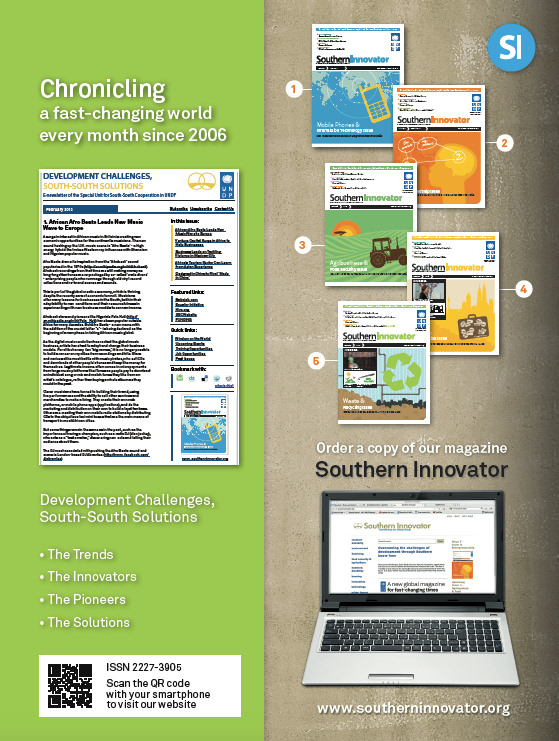
Development Challenges, South-South Solutions was launched as an e-newsletter in 2006 by UNDP’s South-South Cooperation Unit (now the United Nations Office for South-South Cooperation) based in New York, USA. It led on profiling the rise of the global South as an economic powerhouse and was one of the first regular publications to champion the global South’s innovators, entrepreneurs, and pioneers. It tracked the key trends that are now so profoundly reshaping how development is seen and done. This includes the rapid take-up of mobile phones and information technology in the global South (as profiled in the first issue of magazine Southern Innovator), the move to becoming a majority urban world, a growing global innovator culture, and the plethora of solutions being developed in the global South to tackle its problems and improve living conditions and boost human development. The success of the e-newsletter led to the launch of the magazine Southern Innovator.  

Follow @SouthSouth1

Google Books: https://books.google.co.uk/books?id=YtEgTdyZioUC&dq=development+challenges+december+2008&source=gbs_navlinks_s

Slideshare: http://www.slideshare.net/DavidSouth1/development-challengessouthsouthsolutionsdecember2008issue

Southern Innovator Issue 1: https://books.google.co.uk/books?id=Q1O54YSE2BgC&dq=southern+innovator&source=gbs_navlinks_s

Southern Innovator Issue 2: https://books.google.co.uk/books?id=Ty0N969dcssC&dq=southern+innovator&source=gbs_navlinks_s

Southern Innovator Issue 3: https://books.google.co.uk/books?id=AQNt4YmhZagC&dq=southern+innovator&source=gbs_navlinks_s

Southern Innovator Issue 4: https://books.google.co.uk/books?id=9T_n2tA7l4EC&dq=southern+innovator&source=gbs_navlinks_s

Southern Innovator Issue 5: https://books.google.co.uk/books?id=6ILdAgAAQBAJ&dq=southern+innovator&source=gbs_navlinks_s

https://davidsouthconsulting.org/2021/03/05/southern-innovator-issue-3/

Creative Commons License
This work is licensed under a
Creative Commons Attribution-Noncommercial-No Derivative Works 3.0 License.

ORCID iD: https://orcid.org/0000-0001-5311-1052.

© David South Consulting 2023
Categories
Archive Blogroll Development Challenges, South-South Solutions Newsletters Southern Innovator magazine

Growing A Southern Brand To Global Success: The Olam Story

By David SouthDevelopment Challenges, South-South Solutions

SOUTH-SOUTH CASE STUDY

Most people haven’t heard of Olam International, but they know the brands they work for and they more than likely eat their produce. The story of Olam (http://www.olamonline.com) – a global food supply company in ‘agri-products’ that got its start in Nigeria – shows how a Southern brand can grow and go global, and overcome the difficulties of cross-border trade.

Olam supplies well-known global food brands including Cadbury (chocolate), Nestle, Lavazza (coffee), Mars (chocolate), Tchibo and Planters (peanuts).

Olam not only survived its startup in Nigeria, it has thrived, trading around Africa and across the globe, becoming a major supplier to the world’s top food brands.

The quantity of agri-products harvested in the world is 5.2 billion metric tonnes. In that market, Olam is a significant producer of cashews, peanuts, spices, beans, coffee, cocoa, sheanuts, packaged foods, rice, wheat, barley, sugar, cotton, wood, and rubber. It is already the world’s largest supplier of cashew nuts and sesame nuts and in the top three for peanuts. Olam’s cashew business in Africa provides work for 17,000 people, 95 percent of whom are women.

Olam also uses its success to play a critical role in securing the world’s food supply and has specialized in meeting the food needs of the world’s rapidly growing population, especially in China and India. Between 2001 and 2007, annual increases in the global consumption of agricultural commodities were larger than during the 1980s and 1990s. Higher incomes are leading to higher consumption of proteins like meat. And as meat demand rises, so does the demand for grain and protein feeds to produce the meat. It takes two kilograms of grain to produce one kilogram of chicken, four kilograms of produce for one kilogram of pork, and eight kilograms of produce for one kilogram of beef.

Chris Brett, Olam’s senior vice president and head of corporate social responsibility and sustainability, said the company tries to blend business success with wider social goals.

“We are one of the few businesses investing in rural environments and am tackling the problem of urbanization,” said Brett in Olam’s London office – the company’s global headquarters is in Singapore.

In 2008, it won the World Business Development Award for its contribution to achieving the Millennium Development Goals (MDGs) (http://www.un.org/millenniumgoals/).

Olam also has been recognized for its contribution to global food security. By providing farmers with credit to help build their communities, it has also been able to revive declining rural economies and help stem the outflow of farmers to the big cities and urban slums.

“Many countries are afraid to lend to farmers,” Brett said. “We gather the farmers together in groups of 500 and Olam manages the loan while a local bank receives the money. Defaults have been low and farmers are building up a credit rating. In this way, farming becomes a business not just a subsistence existence.”

The dramatic changes taking place in African countries – especially rapid urbanization that has made the continent home to 25 of the world’s fastest growing cities (International Institute for Environment and Development) – means there is an urgent need to increase food production and stabilize rural economies to support farming.

Olam International, started in 1989 in Nigeria by its India-born CEO Sonny George Verghese has many lessons for any Southern entrepreneurs who have their sights set high.

After developing its skills in exporting cashew nuts from Nigeria, Olam moved into cotton, cocoa and sheanuts. From 1993 to 1995, the company explored ways of taking their skills into other countries and different products. It was a period of rapid expansion into other African countries including Benin, Togo, Ghana, Cote d’Ivoire, Burkina Faso and Senegal.

Olam now operates in 26 African countries.

There has been a renaissance in South-South trade in recent years before the current economic crisis, growing by an average of 13 percent per year between 1995 and 2007. By 2007, South-South trade made up 20 percent of world trade.

Olam started with one product, got its supply right, and then started looking around and seeing what other products and services it could offer, applying already-tested expertise and supply skills – what the company calls the ‘Olam DNA’.

Olam claims its success has come from building strong relationships with farmers to guarantee high standards for the food products. The company does this by tightly tracking its stock and its quality. Olam then uses the information to analyze risks to the supply network. The company also keeps both warehouses and field managers close to the farmers. Olam estimates 65 percent of its profit comes from managing the journey from farmer’s field to factory gate.

Its selling point to customers is the ability to guarantee the entire journey from farmer’s field to factory gate, taking on all the risk and stress for ensuring the product is of the right standard and delivered on time.

Its niche is to provide the food products required by some of the world’s top food brands. The company has grown from just one product in Nigeria and two employees in 1989, to directly employing over 10,000 people worldwide and supplying 20 products in 60 countries, according to Brett. He says the company, which had a total 2008 turnover of US $5.75 billion, was “born out of Africa.”

Brett says the company is now “investing heavily in Africa in processing and distribution centres” – proof that a success story feeds back into more success and investment. It has been able to use its profits to go back and buy up failing businesses and former state-run enterprises, and modernize them. Olam now grows the food, processes it, and transports it to market.

Olam actively works with international donors, global NGOs like Technoserve (farmer business development), WWF (environmental impact of supply chain), and the Bill and Melinda Gates Foundation (cocoa and cashew farmers).

Olam, however, has received criticisms for its past practices. The global environmental group Greenpeace attacked its logging in the Democratic Republic of Congo (DRC) (http://www.greenpeace.org.uk/tags/olam), and the International Finance Corporation (IFC) divested its holdings from Olam for it trading illegally cut timber.

Olam and the Gates Foundation project are working with 200,000 cocoa farmers in West Africa to double their incomes. In Ghana, cocoa farming has become synonymous with poverty and perceived as an occupation of last resort. The work force is rapidly aging and the industry will die out if it doesn’t become more profitable and attractive to young people.

“We want the farmers to be profitable, the transporters to be profitable,” Brett said. “We believe a supply chain does not work if one player takes too much.”

And what advice does Olam have for budding food producers and growers? “Catchy, simple brands work. Our Mama Mia pasta caught the wave of the Abba revival.”

“Our Tasty Tom brand became very popular in Africa so we extended the brand into other products than just tomato paste. You reduce the cost of advertising by extending the brand name.”

“We feel SMEs (small, medium enterprises) growth is critical because it would give us more support. If more people invested in SMEs, we would have more people to do business with. We want to be able to make deals: they could be entrepreneurs.

“If you can add extra value it costs nothing but time.”

Brett advises budding SMEs: “It’s all about quality: trust and shared business ethics like formal contracts. When you have those, the bigger brands will give you support.”

Published: October 2009

https://davidsouthconsulting.org/2022/11/21/africa/

https://davidsouthconsulting.org/2020/12/14/african-farming-wisdom-now-scientifically-proven/

https://davidsouthconsulting.org/2022/11/21/agribusiness-food-security/

https://davidsouthconsulting.org/2022/11/16/brazils-agricultural-success-teaches-south-how-to-grow/

https://davidsouthconsulting.org/2022/10/10/cheap-farming-kit-hopes-to-help-more-become-farmers/

https://davidsouthconsulting.org/2022/11/18/farmers-weather-fertilizer-crisis-by-going-organic/

https://davidsouthconsulting.org/2022/11/23/kenyan-farmer-uses-internet-to-boost-potato-farm/

https://davidsouthconsulting.org/2021/09/16/small-fish-farming-opportunity-can-wipe-out-malnutrition/

https://davidsouthconsulting.org/2021/09/16/ugandan-fish-sausages-transform-female-fortunes/

https://davidsouthconsulting.org/2022/11/11/urban-farming-to-tackle-global-food-crisis/

https://davidsouthconsulting.org/2022/10/10/us-1-trillion-opportunity-for-africas-agribusinesses-says-report/

https://davidsouthconsulting.org/2022/10/18/woman-wants-african-farming-to-be-cool/

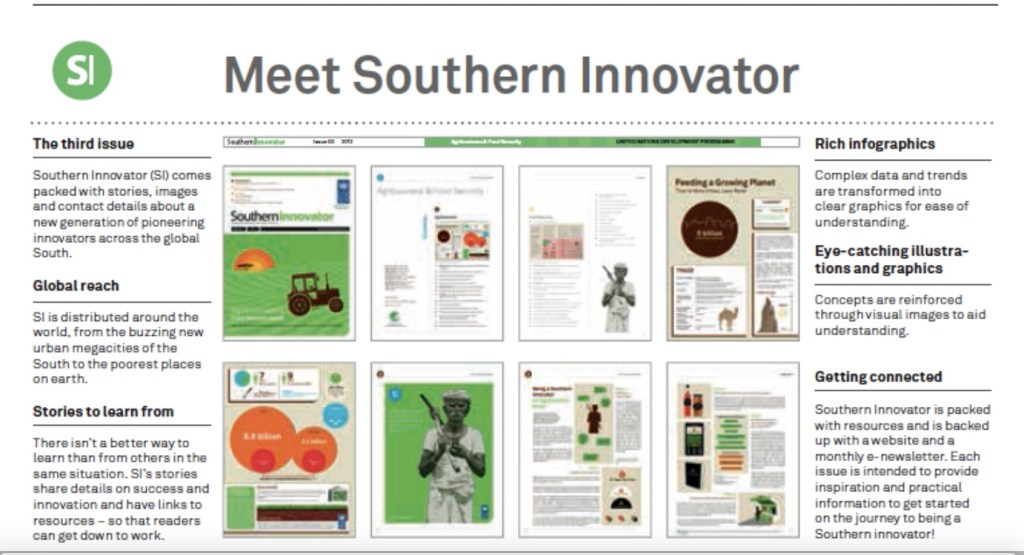
Development Challenges, South-South Solutions was launched as an e-newsletter in 2006 by UNDP’s South-South Cooperation Unit (now the United Nations Office for South-South Cooperation) based in New York, USA. It led on profiling the rise of the global South as an economic powerhouse and was one of the first regular publications to champion the global South’s innovators, entrepreneurs, and pioneers. It tracked the key trends that are now so profoundly reshaping how development is seen and done. This includes the rapid take-up of mobile phones and information technology in the global South (as profiled in the first issue of magazine Southern Innovator), the move to becoming a majority urban world, a growing global innovator culture, and the plethora of solutions being developed in the global South to tackle its problems and improve living conditions and boost human development. The success of the e-newsletter led to the launch of the magazine Southern Innovator.  

Follow @SouthSouth1

Google Books: https://books.google.co.uk/books?id=tRKYBgAAQBAJ&dq=development+challenges+october+2009&source=gbs_navlinks_s

Slideshare: http://www.slideshare.net/DavidSouth1/development-challengessouthsouthsolutionsoctober2009issue

Southern Innovator Issue 1: https://books.google.co.uk/books?id=Q1O54YSE2BgC&dq=southern+innovator&source=gbs_navlinks_s

Southern Innovator Issue 2: https://books.google.co.uk/books?id=Ty0N969dcssC&dq=southern+innovator&source=gbs_navlinks_s

Southern Innovator Issue 3: https://books.google.co.uk/books?id=AQNt4YmhZagC&dq=southern+innovator&source=gbs_navlinks_s

Southern Innovator Issue 4: https://books.google.co.uk/books?id=9T_n2tA7l4EC&dq=southern+innovator&source=gbs_navlinks_s

Southern Innovator Issue 5: https://books.google.co.uk/books?id=6ILdAgAAQBAJ&dq=southern+innovator&source=gbs_navlinks_s

https://davidsouthconsulting.org/2021/03/05/southern-innovator-issue-3/

https://davidsouthconsulting.org/2021/03/05/southern-innovator-issue-5/

Creative Commons License

This work is licensed under a
Creative Commons Attribution-Noncommercial-No Derivative Works 3.0 License.

ORCID iD: https://orcid.org/0000-0001-5311-1052.

© David South Consulting 2023