Tag: coffee beans

  • Civet Cat Coffee Brews Filipino Opportunity

    Civet Cat Coffee Brews Filipino Opportunity

    By David SouthDevelopment Challenges, South-South Solutions

    SOUTH-SOUTH CASE STUDY

    In the Philippines, one animal’s call of nature has become a business opportunity.

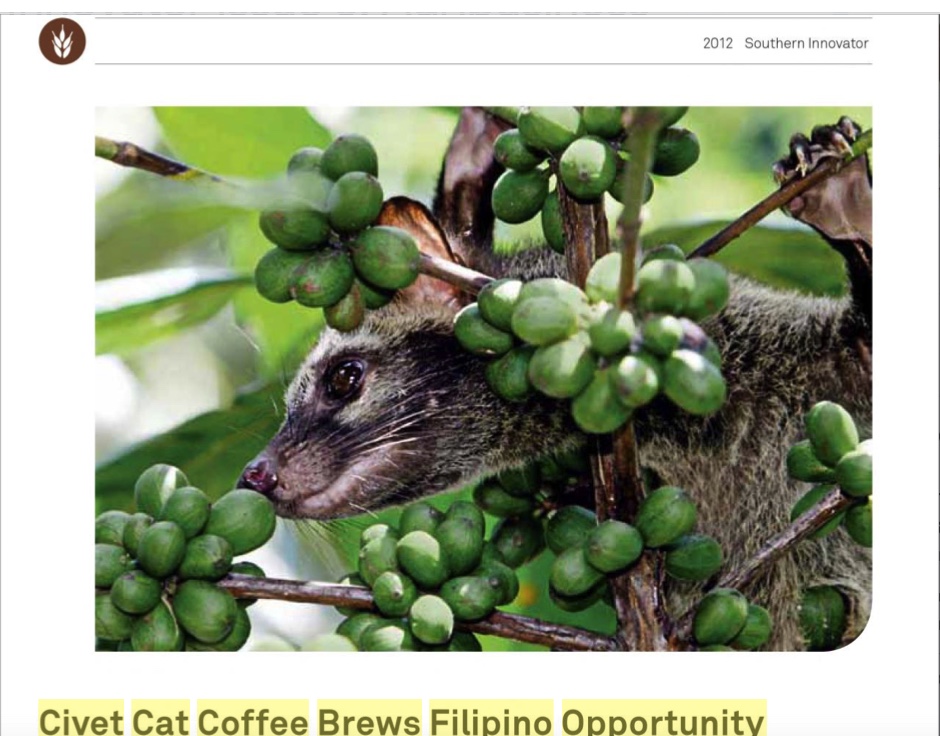
    The civet cat, a member of the mongoose family, ingests the fruit of coffee plants, and expels the beans. This has created an unexpected by-product – a prized beverage for the world’s savvy coffee drinkers seeking the next taste sensation. The partially digested coffee beans are gathered from the faeces of the cat and used to make a much-coveted, smooth-flavoured cup of coffee.

    It is a good example of how value can be added to a product, in this case coffee beans, producing a substantially higher income. The coffee is startlingly expensive: 50 grams cost US $70, 100 grams US $90, and 1 kilogram is a whopping US $870. The coffee is a blend of Arabica, Liberica and Exelsa beans, all of which have passed through the civet cats.

    The highly prized coffee is driving a growing market for these rare beans around the world. But as demand rises, it becomes clear it is a market needing quality control and ethical practices.

    One business that is trying to do this is Coffee Alamid (www.arengga.com), based in Las Pinas in the Philippines. It bills the coffee as the “World’s Rarest Brew. The Philippines’ Pride.”

    Coffee Alamid’s founders, Basil and Vie Reyes, call themselves “coffee entrepreneurs” who started in the business from scratch.

    “When we started Cafe Alamid, we were not even coffee drinkers,” they explain on the company’s website. “We didn’t know anything about coffee at all!”

    Experienced in making Arengga vinegar (http://www.arengga.com/index.php/arengga-pinnata-its-not-just-a-vinegar.mpc), they discovered the civet cats that lived among the sugar palm trees used for making the vinegar. They did some research and were inspired by the Kopi Luwak, the Indonesian variety of civet cat coffee and wondered why they couldn’t do the same thing in the Philippines.

    They consulted with the local forest-dwellers of Indang, Cavite and Batangas, who confirmed they gathered the civet cat droppings to make into coffee, part for personal consumption, with the rest sold in local markets. Gathering the civet droppings provides an income to the forest residents, who collect an average of one kilogram a day.

    Some were sceptical of the idea: why bother with such a time-consuming product? But the Reyeses were inspired by the success of civet coffee in Indonesia and it inspired them to try it in the Philippines. They see themselves as “enlightened entrepreneurs” who believe in marrying business with social development.

    The coffee is made from the wild civet cat droppings harvested from the forest floors of mountains in Malarayat, Lipa, Batangas and Mount Matutum, General Santos and South Cotabato in the Philippines. The beans are roasted and exported to Japan, Taiwan, Korea, Australia, the United States and Italy. The company produces between 1 and 1.5 tons of beans a year.

    A proud moment for the business was becoming the first Filipino firm to participate in the Tea and Coffee World Cup in Geneva, Switzerland in 2007.

    The brand’s name, Alamid, is the local name for the civet cat (Paradoxorus Philippinensis). It belongs to the mongoose family and forages for food at night, eating the ripest and sweetest coffee cherries during the coffee season.

    By morning the civet cats excrete the undigested beans. While inside the cat’s stomach, enzymes and stomach acids go to work on the beans, altering their structure. The beans ‘ferment’ in the cat’s stomach, a process that has been analyzed by Dr. Massimo Marcone, a scientist from Canada’s University of Guelph.

    Marcone traveled to Ethiopia and Indonesia in 2003 to collect the rare coffee beans. He found the beans’ taste – described as “earthy, musty, syrupy, smooth and rich with jungle and chocolate undertones” – was due to the lack of protein in the bean.

    “The civet beans are lower in total protein, indicating that during digestion, proteins are being broken down and are also leaked out of the bean,” Marcone told the Luwak Kopi website. “Since proteins are what make coffee bitter during the roasting process, the lower levels of proteins decrease the bitterness of Kopi Luwak coffee.”

    “Civet beans are typically extensively washed under running water after collection, which dislodges bacteria,” he said.

    Marcone published his research into the beans in the paper “Composition and properties of Indonesian palm civet coffee (Kopi Luwak) and Ethiopian civet coffee.” (http://www.sciencedirect.com/science/article/pii/S0963996904001309)

    The beans are greenish-brown when they come out in the cat faeces. Marcone found the process in the civet cat removes some of the caffeine, giving a strong cup of coffee less kick; this also makes the flavour smoother.

    Supply is tight and this has led to some people forging the coffee or using unethical practices to get their hands on the beans. It is a business that needs to be run in an ethical way to ensure the rich profits are shared with everyone involved.

    Marcone warns against imitations. “About 42 percent of all the kopi luwaks that are presently on sale are either adulterated or complete fakes, unfortunately,” he told the Los Angeles Times.

    Coffee Alamid’s parent company, Bote Central, started as a family-owned company in 2002, with the idea of using agro-forestry products to create sustainable livelihoods and help preserve the environment. It wanted to introduce Fair Trade principles to the Philippines coffee industry.

    Structurally, the company uses community roasting business units (CRBU) across the Philippines, in particular the countryside, to improve the way coffee is sold and make it more profitable for local economies. There are currently 12 such units, and more are planned. The company has put together a guide book on best practice for harvesting Arabica coffee beans based on their first-hand experience. It also explains how they maintain quality control (http://www.scribd.com/doc/19991462/Production-Guide-for-Arabica-Coffee-by-Bote-Central-Inc-Maker-of-Coffee-Alamid).

    The company deals directly with farmers to avoid middlemen gouging profits, and tries to use technology to make the business more efficient and sustainable.

    To keep quality improving, the company has also produced a manual on how to grow and harvest Arabica coffee beans. It is designed to tackle the practical realities of coffee production and show how to improve current methods to produce a better-quality bean. This is critical for the overall business as competition is fierce and quality has to constantly be improved.

    Coffee Alamid has successfully positioned itself as a high-end, high-cost product. It is sold by Japan Airlines and by department stores in Japan and specialty coffee shops around the world.

    Civet cat coffee continues to develop new fans. In Britain, the Birmingham-based Urban Coffee Company (http://www.urbancoffee.co.uk) has started selling the coffee.

    ‘It’s actually really nice,” sales manager Mark Bridgens told the Daily Mail newspaper. “It has a unique, soft taste. I’d definitely buy a cup of it, it’s very different.”

    Published: June 2011

    Resources

    1)Fair Trade Foundation: Fairtrade is about better prices, decent working conditions, local sustainability, and fair terms of trade for farmers and workers in the developing world. Website: http://www.fairtrade.org.uk/

    2) The red dot logo stands for belonging to the best in design and business. The red dot is an internationally recognized quality label for excellent design that is aimed at all those who would like to improve their business activities with the help of design. Website: http://www.red-dot.de

    3) Small businesses looking to develop their brand can find plenty of free advice and resources here. Website: www.brandingstrategyinsider.com

    4) Brandchannel: The world’s only online exchange about branding, packed with resources, debates and contacts to help businesses intelligently build their brand. Website: www.brandchannel.com

    Development Challenges, South-South Solutions was launched as an e-newsletter in 2006 by UNDP’s South-South Cooperation Unit (now the United Nations Office for South-South Cooperation) based in New York, USA. It led on profiling the rise of the global South as an economic powerhouse and was one of the first regular publications to champion the global South’s innovators, entrepreneurs, and pioneers. It tracked the key trends that are now so profoundly reshaping how development is seen and done. This includes the rapid take-up of mobile phones and information technology in the global South (as profiled in the first issue of magazine Southern Innovator), the move to becoming a majority urban world, a growing global innovator culture, and the plethora of solutions being developed in the global South to tackle its problems and improve living conditions and boost human development. The success of the e-newsletter led to the launch of the magazine Southern Innovator.  

    Follow @SouthSouth1

    Google Books: https://books.google.co.uk/books?id=JIKYBgAAQBAJ&dq=development+challenges+june+2011&source=gbs_navlinks_s

    Slideshare: http://www.slideshare.net/DavidSouth1/development-challengessouthsouthsolutionsjune2011issue

    Southern Innovator Issue 1: https://books.google.co.uk/books?id=Q1O54YSE2BgC&dq=southern+innovator&source=gbs_navlinks_s

    Southern Innovator Issue 2: https://books.google.co.uk/books?id=Ty0N969dcssC&dq=southern+innovator&source=gbs_navlinks_s

    Southern Innovator Issue 3: https://books.google.co.uk/books?id=AQNt4YmhZagC&dq=southern+innovator&source=gbs_navlinks_s

    Southern Innovator Issue 4: https://books.google.co.uk/books?id=9T_n2tA7l4EC&dq=southern+innovator&source=gbs_navlinks_s

    Southern Innovator Issue 5: https://books.google.co.uk/books?id=6ILdAgAAQBAJ&dq=southern+innovator&source=gbs_navlinks_s

    Creative Commons License

    This work is licensed under a
    Creative Commons Attribution-Noncommercial-No Derivative Works 3.0 License.

    ORCID iD: https://orcid.org/0000-0001-5311-1052.

    © David South Consulting 2023
  • Haitian Coffee Becoming a Hit with American Connoisseurs

    Haitian Coffee Becoming a Hit with American Connoisseurs

    By David SouthDevelopment Challenges, South-South Solutions

    SOUTH-SOUTH CASE STUDY

    The Caribbean country of Haiti has had to deal with the twin challenges of recovering from a devastating earthquake in 2010 while also pulling itself out of the economic and social chaos that has resulted in its status as the poorest place in the Western hemisphere.

    Violence has also led to a number of UN peacekeeping missions in Haiti over the years, and there is now a substantial international presence in the country to aid in stabilization and economic recovery (http://www.un.org/en/peacekeeping/missions/minustah/).

    Haiti has a lot of potential when it comes to agriculture, but this would require substantial changes in the way land and agriculture are managed.

    Haiti is ranked 77 out of 79 countries in the 2012 Global Hunger Index. Access to sufficient quantities of nutritious food remains an issue for millions of Haitians. An estimated 3.8 million Haitians, or 38 per cent of the population, is food insecure (WFP 2012). Despite its fertile potential, Haiti is dependent on food aid and imports to meet its food security needs.

    Fifty per cent of the country’s food requirements are imported, and food prices have been rising since the end of 2010, the year of Haiti’s devastating earthquake. This increase has led to an overall loss of purchasing power for the majority of Haitians. Low agricultural productivity and urban encroachment on arable land provide additional challenges for Haiti’s rural populations. Eighty per cent of farms fail to produce enough to feed their households (http://www.foodsecurityportal.org/haiti/resources).

    But some are trying to create a new market for Haiti’s agricultural products to help boost farmers and farming as an occupation and an industry.

    It’s hard to imagine now, but Haiti was once the world’s largest producer of coffee in the 18th century when it was a French colony. Today Haiti produces less than 1 per cent of the world’s coffee.

    The targeting of niche coffee drinkers in the United States has introduced a new market to the special taste of the Haitian brew. While the market at present is small, some are hoping, with the right measures, it could be grown significantly, boosting both the country’s revenue from agricultural exports and incomes for coffee farmers.

    Several US-based companies are carving out a market for Haitian coffee and boosting awareness about the country’s unique coffee beans. La Colombe Coffee Roasters (http://lacolombe.com/), based in the city of Philadelphia, has already been able to export four shipping containers of Haitian coffee to the United States since 2010. The company supplies high-end chefs such as Eric Ripert and Daniel Boulud.

    In Florida, Kafe Pa Nou (kafepanou.com) – “our coffee” in Haitian Creole – is owned by Haitian-American Jean René Faustin and sells online coffee from Haitian suppliers Rebo and Cafe Selecto.

    So far, Haitian coffee has not been able to gain wider distribution through mass buyers such as Starbucks because it has not been possible to supply the quantities required to fulfill such a contract.

    Haiti would need to boost its current average coffee yield of 250 kilograms per hectare to double or triple that yield to gain large-scale contracts.

    “Haiti was for a brief moment in time the biggest producer of coffee for export in the world,” Gilbert Gonzales, Vice President of coffee exporter Rebo (http://rebo.ht/The%20Technics.htm), told Medium for Haiti (https://medium.com/medium-for-haiti). But “right now, most people would say it’s impossible” for Haiti’s coffee sector to return to international prominence.

    “We’re not saying that it’s possible in the next two years, maybe not even in the next 12 years,” he said. “But it is possible.”

    The coffee cherries used to make the popular beverage are processed in one of two ways: a dry process and a wet process. In Haiti, the dry process is more commonly used to form a hard cocoon on the outside of the coffee cherries to help preserve them for a year or more.

    This enables farmers to preserve the coffee cherries so they can keep a portion of the crop back as a safety reserve.

    The wet processed beans are first immersed in water and then the pulp is washed away before the beans are dried (http://coffee.wikia.com/wiki/Wet_process). The superior flavor this creates has attracted fans in the United States, especially in the trendy neighbourhoods of Brooklyn, New York and San Francisco, California. By bucking the traditional Haitian dry processing method for the beans, it is possible to earn three times the market price by selling wet-processed beans.

    Haiti’s history of coffee growing goes back to the 1700s. At the time, the country grew half the world’s coffee. This helped to make the French colony highly profitable.

    This long heritage has left the country with a unique asset: original Arabica typica coffee trees first imported by Europeans to Haiti. These coffee trees are considered to be heirloom because they are so old and untainted by modern breeding methods. According to Douglas Weiner in Medium for Haiti, “when you drink coffee from Haiti, it’s like drinking coffee from 200 years ago.”

    Weiner is part of a family business, Geo Weiner (http://selectohaiti.com/home/), which has been selling Haitian coffee for four generations and is one of the few surviving coffee exporters in the country.

    The country has an estimated 200,000 coffee farmers. Because their methods have not changed much, they are effectively organic (https://en.wikipedia.org/wiki/Organic_food). Most farmers can not afford chemical fertilizers and pesticides.

    The coffee farms are located in mountain areas with a rich biodiversity of plants and trees. This stands in stark contrast with much of the rest of the country, where deforestation has left the country with just 2 per cent of virgin forest left. Coffee-producing areas are lush and green because coffee is one of the few cash crops that makes enough money to keep it worthwhile to preserve the trees and foliage. In other parts of the country, many are making money from turning trees into charcoal for cooking fuel, the most common fuel for most of the country’s population.

    Haiti’s coffee growers have had a hard time coping with the rise and fall of world coffee prices. The world market price for coffee dropped in the early 2000s as the markets were flooded with coffee from Brazil and Vietnam. In response, farmers then cut down the coffee trees and replaced them with subsistence crops such as corn and beans.

    With the amount of coffee grown in Haiti dropping quickly, the number of exporters in the country plummeted from 20 companies to two companies today, Geo Weiner and Rebo.

    Jobert Angrand, Executive Coordinator of the National Institute of Coffee (http://www.icefda.org/), believes coffee production declined in Haiti because of a wide range of problems, from diseases and pests to aging trees, too-small plots and inefficient production methods. Per-hectare coffee yields are as low as one-tenth of production in Latin America.

    The Vice President of coffee exporter Rebo says these problems are holding things back. “I don’t think today we’re looking into going mainstream,” said Gilbert Gonzales. “We can’t. There is not enough volume for that.”

    Because production will be small, Gonzales believes Haiti would be wise to target the higher end of the marketplace with American grocery stores such as Trader Joe’s and Whole Foods: “It’s looking into the higher-end gourmet shops, things like that,” he said, “so that we could really share with the rest of that world the quality available from Haiti.”

    Significant purchases of Haitian coffee have been made by various overseas companies, which does give hope that this plan could work. Irish coffee company Java Republic bought 97 tonnes of Haitian coffee from the Rebo exporter in 2010.

    Published: August 2013

    Resources

    1) National Coffee Association: Ten Steps to Coffee. Website: http://www.ncausa.org/i4a/pages/index.cfm?pageid=69

    2) International Coffee Organization: The International Coffee Organization (ICO) is the main intergovernmental organization for coffee, bringing together exporting and importing governments to tackle the challenges facing the world coffee sector through international cooperation. Its member governments represent 97 per cent of world coffee production and over 80 per cent of world consumption. Website: http://www.ico.org/

    3) Coffee Research: Growing Coffee Beans at Home. Website: http://www.coffeeresearch.org/coffee/homegrowing.htm

    4) Puro Fairtrade Coffee: Puro is a leading brand of Fairtrade and Fair Trade Organic coffee that works in partnership with the World Land Trust to purchase and protect areas of precious rainforest in South America. Website: http://www.purocoffee.com/

    More on Haiti here: State Of Decay: Haiti Turns To Free-Market Economics And The UN To Save Itself

    https://davidsouthconsulting.org/2021/10/28/ending-gang-violence-while-cleaning-the-streets-in-haiti/

    https://davidsouthconsulting.org/2021/09/01/haiti-earthquake-prompts-tech-aid/

    https://davidsouthconsulting.org/2021/10/28/milk-co-operatives-help-hungry-haiti/

    https://davidsouthconsulting.org/2020/04/22/state-of-decay-haiti-turns-to-free-market-economics-and-the-un-to-save-itself/

    Development Challenges, South-South Solutions was launched as an e-newsletter in 2006 by UNDP’s South-South Cooperation Unit (now the United Nations Office for South-South Cooperation) based in New York, USA. It led on profiling the rise of the global South as an economic powerhouse and was one of the first regular publications to champion the global South’s innovators, entrepreneurs, and pioneers. It tracked the key trends that are now so profoundly reshaping how development is seen and done. This includes the rapid take-up of mobile phones and information technology in the global South (as profiled in the first issue of magazine Southern Innovator), the move to becoming a majority urban world, a growing global innovator culture, and the plethora of solutions being developed in the global South to tackle its problems and improve living conditions and boost human development. The success of the e-newsletter led to the launch of the magazine Southern Innovator.

    https://davidsouthconsulting.org/2021/03/05/southern-innovator-issue-1/

    https://davidsouthconsulting.org/2021/03/05/southern-innovator-issue-3/

    Creative Commons License

    This work is licensed under a
    Creative Commons Attribution-Noncommercial-No Derivative Works 3.0 License.

    ORCID iD: https://orcid.org/0000-0001-5311-1052.

    © David South Consulting 2023