Categories
Ger Magazine UNDP Mongolia 1997-1999

The real Mongolian gets the nod from Western fashion designers

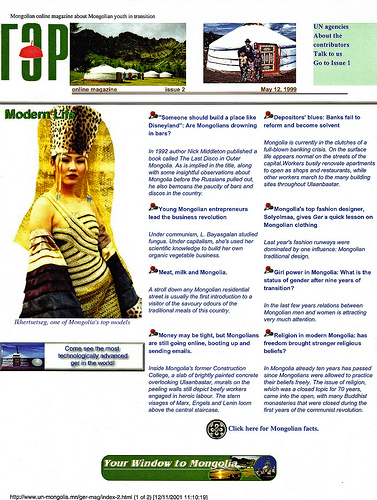
Mongolia’s top fashion designer, Solyolmaa, gives Ger a quick lesson on Mongolian clothing

Interview by A. Delgermaa, Ger Magazine, Modern Life, Issue 2, May 12, 1999

Last year’s fashion runways were dominated by one influence: Mongolian traditional design. If a designer wanted to show they were boldly embracing natural fibres and furs, then the refrain ” my show is all Mongolian” would be proudly boasted to the media. The country has become a synonym for sartorial flare and rugged beauty. It also doesn’t hurt that one of Mongolia’s top exports, cashmere wool, is in vogue, from Japan to Europe to the United States. After years of being isolated from the west under the umbrella of the Soviet Union, Mongolian fashion is proudly strutting the catwalks of the world.

Her square glasses reminiscent of Yves Saint Laurent (ysl.com), Mongolia’s top designer, Soyolmaa, talked to Ger about the ubiquitous nature of traditional clothes in the late 1990s. “There are few countries who still wear the national costume these days. Mongolia is one of them,” she says sitting regally in the studio of her home, surrounded by models draped in dresses for her latest collection: a tribute to the style and attitude of Mongolia’s ancient queens. 

“Because the design of Mongolian national clothes is highly developed, no further changes are needed.” As head of the Mongolian National Designers’ Union, she has spent many years trying to find ways to improve the national costume to “no effect” she adds.

Busy tailors come and go, checking designs. The studio is crowded with four tailors and the models (not to mention this reporter). Two clients patiently wait in the hallway to see her. In a country where the soldiers and police wear uniforms designed by Pierre Cardin, it is no surprise Mongolians aren’t slouches when it comes to clothes. While budgets may be tight and the shops far from world standard, people still find a way to dress with flair.

It is still common to see the traditional del – a cloak of either wool, leather or silk – worn by men and women of all ages, even in the capital. As herders are quick to say, the del serves many practical purposes. It is padding for long rides on the steppe, it is a makeshift tent in bad weather, it is a warm blanket, and for women, a nod to modesty when nature calls on the open steppe. While it is standard wear for older generations, younger urban Mongolians turn to the del on special occasions like school graduation ceremonies.

Last year collections by Christian Dior (Dior.com), Chanel (chanel.com), UNGARO and Pierre Cardin (pierrecardin.com) all paid homage to Mongolian design, typically characterized by variations on the del cloak, flamboyant displays of fur and knee-high boots.

“Asian styles are now having a big impact on world fashion design,” continues Soyolmaa. 

“It is because Asian clothes offer pure, simple patterns with eye-catching colours and adornments. There is a trend towards purism in the fashion world. They like high collars, askew lapels, loose sleeves and nudarga (long sleeves). The bright colors of Asia are showing up throughout Western design. You can see the askew lapel and high collar and bright colors from Christian Dior to Chanel.”

The Mongolian national costume is a classic example of purism. The pattern is very simple, with no separate sleeves or shoulder parts, and very economical with little waste of cloth.

And why did this style evolve over the generations? Soyolmaa has a simple answer: “It is because of the harsh weather of Mongolia.” The askew lapel doesn’t let wind pierce the body, nudarga or long sleeves don’t make arms cold in the minus 30 to 40 degrees Celsius winters. Winter dels have fur interiors, using wolf, fox, sheep or lamb’s wool. From ancient times to now, Mongolian men wear wolf fur coats in winter when guarding horses at night.

There are about a hundred styles of hat. Loovuus, made of fox fur with a cloth top, is a common hat in winter. The back part is open. “Fox fur is very dense. Without an open back one feels too hot and it causes high blood pressure and a headache,” according to Soyolmaa. The extraordinary design of boots with pointed toes is suitable for riding a horse while leaving enough dead air space to keep the toes warm.

Soyolmaa takes difference with those who claim “Fashion sense ends in Mongolia.” “It might because they have nothing to compare it with. But now that fashion shows are available on cable TV, Mongolians are learning how to compare Mongolian fashion and models with the global standard.” For Soyolmaa, as it is the time for Asian fashion, it is also the time for Asian models. 

“Irina Pantieva, the world’s top model is Mongolian. She is from the Buriat Republic (a province of Russia directly north of Mongolia and populated by a large number of people of Mongolian heritage).” She says Mongolian models are ready to take on the world.

To the soothing sounds of Enigma, Mongolia’s top models parade Soyolmaa’s tributes to Mongolian queens in early May at the Las Vegas Entertainment Centre, a former communist-era cinema. Long silk dresses are complemented with furs and enormous hats, at times evoking Cleopatra, at other times something from a Dr. Seus cartoon, some hats reaching a meter high. Judging by the audience’s reaction and the quality of Soyolmaa’s creations, the time has come for Mongolian designers to take centre stage on the world fashion scene.

Creative Commons License

This work is licensed under a
Creative Commons Attribution-Noncommercial-No Derivative Works 3.0 License.

ORCID iD: https://orcid.org/0000-0001-5311-1052.

© David South Consulting 2024

Categories
Archive Development Challenges, South-South Solutions Newsletters Southern Innovator magazine

Favela Fashion Brings Women Work

By David SouthDevelopment Challenges, South-South Solutions

SOUTH-SOUTH CASE STUDY

A highly successful cooperative of women in Brazil has shown that it is possible for outsiders to make it in the fast-paced world of fashion. Despite being based in one of Rio de Janerio’s slums, or favelas (http://en.wikipedia.org/wiki/Favela), the women have developed a reputation for high-quality merchandise and even put on fashion shows.

Fashion earns big money around the world: The global clothing industry is estimated to be worth more than US $900 billion a year. But fashion also has a reputation for relying on sweat shops, poor pay and poor working conditions. The poor are the most at risk of exploitation in the industry – upwards of 90 percent of sweatshop workers are women (www.feminist.org).

Yet the COOPA-ROCA cooperative (www.coopa-roca.org.br/en/index_en.html) – or Rocinha Seamstress and Craftwork Co-operative Ltd – has pioneered a way to involve poor women in the business, build their skills while creating high-quality products, and be flexible enough to make time for their families’ needs. It particularly helps single mothers.

The cooperative was founded by Maria Teresa Leal in Rocinha – the largest favela in Rio, home to over 180,000 people. After visiting her housekeeper’s home in the favela, Leal was impressed by the sewing skills of the women but found they weren’t making any money from their work. She decided to found the cooperative in 1981 and start making quilts and pillows. By the early 1990s, the cooperative had attracted the attention of Rio’s fashion scene. And in 1994, it jumped into making clothes for the fashion catwalks. Fashion designers in turn taught the women advanced production skills and about fashion trends.

Today, the coop has established a hard-won reputation for quality and sells its clothes to the wealthy elite of Rio. Its success has led to contracts with major clothing stores, including Europe’s C&A.

“Creativity is an important tool for transforming people and raising their consciousness,” Leal told Vital Voice. “My great passion is beauty. Beauty has the capacity to inspire, to touch individuals in a more subtle way. For this reason, I like to make beautiful things with the artisans of COOPA-ROCA.”

Leal realized that most small businesses helping the poor fail despite their best intentions. They often make the same mistakes: they fail to produce high quality goods, they fail to do market research and understand who they are selling to, they fail to develop the skills of their workers, and most importantly, they fail to see that they have to compete in a global economy with lots of other enterprises. How many people have seen crafts and knickknacks for sale that nobody really wants?

Slum dwellers are on the increase across the South. As the world becomes a more urban place – and 70 million people move every year to the world’s cities (UN) – the growing population of poor women and households presents a dilemma: how to provide meaningful work so they do not fall risk to exploitation? Without work opportunities, women can feel pressured to turn to prostitution, or even be trafficked by gangs for work or sex. And women in slums experience greater levels of unemployment than those who live elsewhere (UNHABITAT).

Women now make up the majority of the world’s poor: 70 percent of the world’s poor are women, as are a majority of the 1.5 billion living on less than US $1 a day (UNESCO).

Established in 1981 from a recycling project for local children, COOPA-ROCA started with finding ways to use thrown away scraps of cloth to make clothing. It eventually evolved into a cooperative. It focused on improving traditional Brazilian decorative craftwork skills like drawstring appliqué, crochet, knot work and patchwork.

“COOPA-ROCA works with traditional handicraft techniques that are widely used by women around the world,” explains Leal. “As COOPA-ROCA works with fashion, and fashion is always linked with media, the COOPA-ROCA artisans inspire other women who recognize in themselves the potential to do the kind of work that COOPA-ROCA does.”

For its first five years, COOPA-ROCA concentrated on building the organization and the skills of the artisans. Once a production structure was in place, quality control workshops were set up to increase the quality of the products so they could compete better in the marketplace.

“Many social projects believe that money is the only resource required to begin their work. The COOPA-ROCA case proves that social organizations must use a more entrepreneurial vision to understand the concept of resources.”

The cooperative’s mission statement is to “provide conditions for its members, female residents of Rocinha, to work from home and thereby contribute to their family budget, without having to neglect their childcare and domestic duties.”

By doing this to a high standard, the profile and reputation of traditional crafts has been raised.

The COOPA-ROCA hopes the work shows others how they can increase income in poor communities. The cooperative has 150 members and has partners in the wider fashion and decorative design markets.

The women equally share responsibility for production, administration and publicity. While they work at home, they come to the office to drop off the completed pieces and pick up more fabric.

The success of the cooperative has led to donations of funds to build a new headquarters designed by architect Joao Mauricio Pegorim.

Despite the cooperative’s success, it is still not easy to work with partners. “There are many negative preconceptions about Rocinha and the people who live there, both within and outside of Brazil. COOPA-ROCA is consistently rejected when it applies for loans,” Leal said. “Furthermore, the cooperative’s commercial partners usually do not enter the favela themselves, and I must serve as a bridge between the two worlds.”

But Leal is still ambitious for bigger things: “I envision COOPA-ROCA expanding to include 400 women artisans, producing for commercial partners, selling their own brand in Brazil and abroad, and carrying out fashion and design projects in the new headquarters in Rocinha.”

Published: March 2010

Resources

1) The online service CafePress is a specially designed one-stop shop that lets entrepreneurs upload their designs, and then sell them via their online payment and worldwide shipping service. Website:http://www.cafepress.com/cp/info/sell/

2) Tips on how to start your own t-shirt business. Website: http://www.pioneerthinking.com/dy_tshirt.html And how to do it online: Website:http://www.ehow.com/how_2135779_start-network-online-tshirt-company.html

3) Once inspired to get into the global fashion business, check out this business website for all the latest news, jobs and events. Website:http://us.fashionmag.com/news/index.php

4) iFashion: This web portal run from South Africa has all the latest business news on fashion in Africa and profiles of up-and-coming designers. Website:http://www.ifashion.co.za/index.php?option=com_frontpage&Itemid=1

5) Kiva: Kiva’s mission is to connect people, through lending, for the sake of alleviating poverty. Website:http://www.kiva.org/

6) Betterplace: Is another great way to solicit funds for NGOs or businesses in the developing world. Website: http://www.betterplace.org

7) Viva Favela: The first Internet portal in Brazil. Viva Favela has a team made up of journalists and “community correspondents” – favela residents qualified to act as reporters and photographers. Website:http://www.vivafavela.com.br/publique/cgi/cgilua.exe/sys/start.htm?infoid=40489&sid=74

8) Women in Poverty: A New Global Underclass by Mayra Buvinic (1998). Website: http://www.onlinewomeninpolitics.org/beijing12/womeninpoverty.pdf

Development Challenges, South-South Solutions was launched as an e-newsletter in 2006 by UNDP’s South-South Cooperation Unit (now the United Nations Office for South-South Cooperation) based in New York, USA. It led on profiling the rise of the global South as an economic powerhouse and was one of the first regular publications to champion the global South’s innovators, entrepreneurs, and pioneers. It tracked the key trends that are now so profoundly reshaping how development is seen and done. This includes the rapid take-up of mobile phones and information technology in the global South (as profiled in the first issue of magazine Southern Innovator), the move to becoming a majority urban world, a growing global innovator culture, and the plethora of solutions being developed in the global South to tackle its problems and improve living conditions and boost human development. The success of the e-newsletter led to the launch of the magazine Southern Innovator. 

Creative Commons License

This work is licensed under a
Creative Commons Attribution-Noncommercial-No Derivative Works 3.0 License.

ORCID iD: https://orcid.org/0000-0001-5311-1052.

© David South Consulting 2023

Categories
Archive

Cashing in on Old Wisdom

By David SouthDevelopment Challenges, South-South Solutions

SOUTH-SOUTH CASE STUDY

India’s traditional weavers, heirs to a 2,000-year-old textile industry, are turning to the ancient practice of ayurvedic medicine to make their products more appealing and boost sales. Drawing on recipes once used by weavers to the Indian royal courts, clothes are woven and infused with ayurvedic, herb-and-spice medicinal recipes to address various health problems. Strange as it may sound, the health-giving properties of the clothes have been backed up by clinical trials at the Government Ayurveda College in Thiruvanathapuram, southern India.

The college claims the trials were successful for 40 patients with rheumatism, allergies, hypertension, diabetes, psoriasis and other skin ailments. It is believed the healing properties of the herb-and-spice-infused clothes enter the skin and contribute to healing.

Modern India’s founding father, Mahatma Gandhi, championed hand-spun cloth and weaving. But India’s weavers have been hit hard by the rise in the rupee against the dollar and an inability to compete internationally. They are facing stiff competition from a flood of machine-made cheap clothing. According to Siddique Hassan of the Weaver and Artisans Rights Front (WARF), 1 million of India’s 5 million weavers have lost their jobs because of competition (Deutsche Presse-Agentur).

But rising interest in sustainability and natural healing is creating a growing global market for organic clothes – sales are set to triple to US $2.6 billion in 2008 (Organic Exchange).

Against this backdrop, local governments have turned to traditional ayurvedic medicine to help save the livelihoods of handloom weavers and develop a market niche for their eco-friendly fabrics.

In the technique called Ayurvastra, the clothes are dyed with herbal essences, infusing the cotton with the medicine. More than 200 herbs are used, mostly taken from roots, flowers, leaves, seeds and bark. Most of the clothes are made with cotton and silk, and some with wool and jute. A dress is marketed to people who suffer from hypertension. There are bedcovers, pillow covers, nightgowns, and even suits. It is believed the healing effect is best when the patient is sleeping.

The clothes are made in Balaramapuram, home to traditional weaving in Kerala, southern India, and sell for between 1,000 and 1,800 rupees (US $25 to US $45). Ayurvastra clothing is currently being exported to the Middle East, the US, Italy, Germany, Britain, Singapore, Malaysia and Jordan.

Acknowledging traditional medicine as a useful development tool goes back to the World Health Organisation’s Alma-Ata Declaration in 1978, which urged governments for the first time to include traditional medicine in their primary health systems and recognise traditional medicine practitioners as health workers. During the last 30 years there has been a considerable expansion in the use of traditional medicine across the world. Despite their ancient origins, it is still critical these medicines do meet efficacy and health standards and are proven to work.

Ayurvastra is a branch of the 5,000-years-old Indian ayurveda health system. Ayur means health in Sanskrit, veda means wisdom, and vastra is cloth or clothing. There are no synthetic chemicals and toxic irritants and the technique uses organic cotton that has been hand loomed.

“The entire process is organic,” said K. Rajan, chief technician at the Handloom Weavers Development Society in India, to Zee News. “The cloth is bleached with cow’s urine, which has high medicinal value. The dyeing gum too is herbal. It does not pollute like synthetic dye. And the waste is used as bio manure and to generate bio gas.”

Chaitanya Arora of Penchant Traders, an Indian company promoting and exporting ayurvastra cloth and clothing, tells how it works: “usage of the cloth is based on the principle of touch. By coming in contact with ayurvastra, the body loses toxins and its metabolism is enhanced.”

One clothes buyer, T D Kriplani, told Zee News, “Basically, I have read about the concept in newspapers… I was inquisitive and have also heard that it is in direct touch with body pores. I have come here after reading about it and hope it will benefit people.” It is even claimed the clothes can keep people cool.

Another seller of ayurvastra, Hitesh, is enthusiastic about its impact: “The medicinal clothes that we have launched is a new revolution in the textile industry. In there, we dye the clothes with ayurvedic dyes and the clothes have medicinal qualities, which hopefully are good for diseases.”

Published: February 2008

Resources

  • Think! Clothing: A stylish UK-based designer using fair-trade, hand woven clothes from Indian women from the ‘untouchable’ caste.
  • An online shopping site based in Kerala, India offers a wide range of the ayurvastra clothing: http://www.ayurvastraonline.com/
  • Fibre2Fashion: An excellent web portal can be found here to connect weavers with the wider fashion industry – basically an online marketplace for making deals.
  • Asia-Pacific Traditional Medicine and Herbal Technology Network: an excellent first stop for any entrepreneur, where they can find out standards and regulations and connect with education and training opportunities: www.apctt-tm.net

Creative Commons License

This work is licensed under a
Creative Commons Attribution-Noncommercial-No Derivative Works 3.0 License.

Southern Innovator was initially launched in 2011 with the goal of inspiring others (just as we had been so inspired by the innovators we contacted and met). The magazine seeks to profile stories, trends, ideas, innovations and innovators overlooked by other media. The magazine grew from the monthly e-newsletter Development Challenges, South-South Solutions published by the United Nations Office for South-South Cooperation (UNOSSC) since 2006.

Issue 6’s theme has been decided on: it will focus on Science, Technology and Innovation. For this issue, Southern Innovator is seeking invitations from cutting-edge knowledge and science innovators in the global South to view their work. Time is tight, so don’t miss this opportunity to let the whole global South know about your work. In the past, Southern Innovator has visited green pioneers in Cuba, a smart city in South Korea and an eco-city in China.

Contact me if you wish to receive a copy/copies of the magazine for distribution. Follow @SouthSouth1.

Southern Innovator Issue 1

Southern Innovator Issue 2

Southern Innovator Issue 3

Southern Innovator Issue 4

Southern Innovator Issue 5

Southern Innovator Issue 6

Innovator Stories and Profiles

Citing Southern Innovator

Finding Southern Innovator

Press Release 1

Press Release 2

Press Release 3

Southern Innovator Impact Summaries | 2012 – 2014

ORCID iD: https://orcid.org/0000-0001-5311-1052.

© David South Consulting 2021

Categories
Archive Blogroll Development Challenges, South-South Solutions Newsletters Southern Innovator magazine

Creating Green Fashion in China

By David SouthDevelopment Challenges, South-South Solutions

SOUTH-SOUTH CASE STUDY

China is the world’s largest manufacturer (Euromonitor) and the largest clothing maker, producing a quarter of all textiles and clothing. It is a global fashion production hub, and many major global clothing brands have their products made there – whether they admit it or not.

Although most people probably do not give it a second thought, the fashion and clothing industries can be highly polluting and exploitive. The use of toxic fertilizers to boost cotton yields leaves behind a legacy of contaminated soil and water tables. Dyes used to colour clothing also can be toxic and pollute water. For people working in this industry – many of whom are women – conditions can vary widely and include low pay and high stress.

According to the Ethical Fashion Forum, “it is difficult for companies sourcing from China to be sure of fair working practices. There have been many reports of low wages, long hours, and unfair working conditions in factories in China.”

But one innovative fashion brand is out to transform the way the garment business works in China and to develop a template that could be used in other places such as Africa.

The design duo of Hans Martin Galliker and Amihan Zemp has set up their clothing brand’s studio in one of Beijing’s historic hutong (alley) neighbourhoods – narrow streets of low-rise buildings that were the traditional urban dwelling environments for generations of Chinese people. The NEEMIC (neemic.com) brand, founded in 2011, makes sustainable fashions and champions green production methods in China.

The business’s belief is that the world has enough fabric already to meet the clothing needs of the population. In response, NEEMIC makes its clothing from a mix of recycled natural materials and new organic materials. According to its website, NEEMIC collaborates “with young designers from London to Tokyo to create a particular metropolitan aesthetic.”

“We use the finest natural fabrics for a perfectly comfortable feel,” Galliker said. “We pick the finest natural materials from leftovers of the industry, recycle used clothes, and strive to order new fabrics only from certified organic producers.”

Hans Martin Galliker began as a farming apprentice in his native Switzerland, and brings a practical bent to his approach to fashion. He draws on his knowledge of farming and agriculture to create a unique eco-conscious fashion product in China.

Galliker got his start in fashion working for a brand in Shenzhen, southern China. He worked with the organic farms there, and this inspired him to explore sustainability in fashion design and ways of introducing the principles of fair trade to the fashion and textile industries in China.

Galliker is passionate about taking a different attitude to fashion: “There are many fashion brands and many of them are … meaningless,” he told the China Daily newspaper. “They do fashion which looks more or less … the same, which has no creativity and does a lot of harm to the environment.

“Growing cotton is highly chemicals and labour-intensive, which degrades the soil and pays people very low salaries. And the dyeing and colouring processes pollute rivers and people receive low salaries but have to work long hours. The whole textile industry is really bad for the environment.”

NEEMIC has completed three collections of clothing since it was founded in 2011.

“We started selling some of our designs at a boutique in Beijing that focuses on upcycling fashion. People like it and want to buy more,” said Galliker.

Upcycling is the process of converting waste material into new products (http://en.wikipedia.org/wiki/Upcycling).

And to counter any negative perceptions that organic cotton clothing can only ever be unfashionable, Galliker is out to prove it is possible to create stylish organic clothing.

On top of building the brand, Galliker also works to educate the industry and change ways. He is also setting up a branch in China of the Hong Kong Organic Textile Association (http://neemic.asia/organic), which encourages fashion designers to jointly buy organic materials. He also publishes a website on sustainable agricultural practices in China, with details on current policies on organic farming.

“It is very normal for Chinese farmers to use many fertilizers, but the environment is going bad and consumers do not like this kind of farming,” Galliker points out. “For farmers, it’s not meaningful to produce only to make money to live a decent life. It should be more than that.”

The NEEMIC operation is lean: the Beijing studio does all the designing of the clothes, programming of the multilingual websites and runs the online shopping and payment sites.

For now, the goal is to not only increase the use of organically grown materials but also to introduce the fair trade concept into China.

“In two years we want to do fair trade production,” Galliker said.

And he has Africa in his sights with his green fashion template.

“In the long term we will have many successful projects here or non-profit companies … a lot of creative force and investment so that we can help rural regions in Africa to do sustainable agriculture projects.”

Published: December 2012

Resources

1) Ethical Fashion Forum: The Ethical Fashion Forum is the industry body dedicated to a sustainable future for fashion. A not for profit organisation, EFF aims to make it easy for fashion professionals to integrate sustainability at the heart of what they do. Website: http://www.ethicalfashionforum.com/

2) Hong Kong Organic Textile Association: Its mission is to promote organic textiles in Hong Kong Website: http://www.facebook.com/HKOrganicTextileAssociation

3) Tips on how to upcycle. Website: http://www.independent.co.uk/property/interiors/the-insider–how-to-upcycle-without-much-effort-2343100.html

4) How to create a Lookbook for a fashion brand. Website: http://noisetteacademy.com/2011/05/creating-a-lookbook/

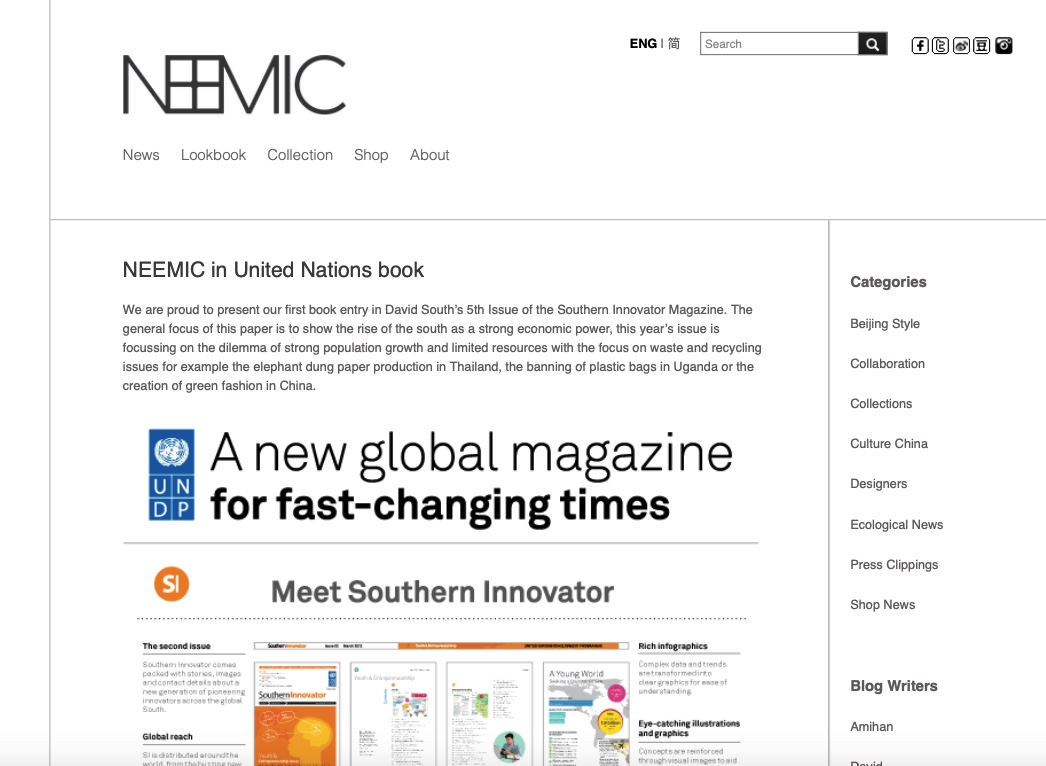
“We are proud to present our first book entry in David South’s 5th Issue of the Southern Innovator Magazine. The general focus of this paper is to show the rise of the south as a strong economic power, this year’s issue is focussing on the dilemma of strong population growth and limited resources with the focus on waste and recycling issues for example the elephant dung paper production in Thailand, the banning of plastic bags in Uganda or the creation of green fashion in China.” https://neemic.asia/ecological-news/neemic-southern-innovator-book

https://davidsouthconsulting.org/2021/02/09/african-fashions-growing-global-marketplace-profile/

https://davidsouthconsulting.org/2021/01/05/afropolitan-african-fashion-scene-bursting-with-energy/

https://davidsouthconsulting.org/2022/10/09/fashion-closes-gap-between-catwalk-and-crafts/

https://davidsouthconsulting.org/2022/11/17/fashion-recycling-how-southern-designers-are-re-using-and-making-money/

https://davidsouthconsulting.org/2022/11/16/favela-fashion-brings-women-work/

https://davidsouthconsulting.org/2020/04/30/local-fashions-pay-off-for-southern-designers/

https://davidsouthconsulting.org/2022/10/24/made-in-africa-fashion-brand-pioneers-aim-for-global-success/

https://davidsouthconsulting.org/2021/10/04/putting-quality-and-design-at-the-centre-of-chinese-fashion/

https://davidsouthconsulting.org/2021/03/05/southern-innovator-issue-5/

Development Challenges, South-South Solutions was launched as an e-newsletter in 2006 by UNDP’s South-South Cooperation Unit (now the United Nations Office for South-South Cooperation) based in New York, USA. It led on profiling the rise of the global South as an economic powerhouse and was one of the first regular publications to champion the global South’s innovators, entrepreneurs, and pioneers. It tracked the key trends that are now so profoundly reshaping how development is seen and done. This includes the rapid take-up of mobile phones and information technology in the global South (as profiled in the first issue of magazine Southern Innovator), the move to becoming a majority urban world, a growing global innovator culture, and the plethora of solutions being developed in the global South to tackle its problems and improve living conditions and boost human development. The success of the e-newsletter led to the launch of the magazine Southern Innovator.  

Follow @SouthSouth1

Google Books: https://books.google.co.uk/books?id=q1KeBgAAQBAJ&dq=development+challenges+december+2012&source=gbs_navlinks_s

Slideshare: http://www.slideshare.net/DavidSouth1/development-challengessouthsouthsolutionsdecember2012issue

Southern Innovator Issue 1: https://books.google.co.uk/books?id=Q1O54YSE2BgC&dq=southern+innovator&source=gbs_navlinks_s

Southern Innovator Issue 2: https://books.google.co.uk/books?id=Ty0N969dcssC&dq=southern+innovator&source=gbs_navlinks_s

Southern Innovator Issue 3: https://books.google.co.uk/books?id=AQNt4YmhZagC&dq=southern+innovator&source=gbs_navlinks_s

Southern Innovator Issue 4: https://books.google.co.uk/books?id=9T_n2tA7l4EC&dq=southern+innovator&source=gbs_navlinks_s

Southern Innovator Issue 5: https://books.google.co.uk/books?id=6ILdAgAAQBAJ&dq=southern+innovator&source=gbs_navlinks_s

Creative Commons License

This work is licensed under a
Creative Commons Attribution-Noncommercial-No Derivative Works 3.0 License.

ORCID iD: https://orcid.org/0000-0001-5311-1052.

© David South Consulting 2023