Environmental Public Awareness Handbook: Case Studies and Lessons Learned in Mongolia
Environmental Public Awareness Handbook: Case Studies and Lessons Learned in Mongolia by Robert Ferguson.Environmental Public Awareness Handbook: Case Studies and Lessons Learned in Mongolia by Robert Ferguson.
Mongolian Green Book by Robert Ferguson et al.Mongolian Green Book by Robert Ferguson et al.
More books by Rob Ferguson:
The Devil And The Disappearing Sea: Or, How I Tried To Stop The World’s Worst Ecological Catastrophe (Raincoast Books).
Mongolian Rock and Pop Book
Mongolian Rock and Pop Book: Mongolia Sings its Own Song by Peter Marsh.
Mongolian Rock and Pop Book: Mongolia Sings its Own Song by Peter Marsh.
Pop music helps fuel Mongolia’s market economy by Oyuntungalag.As cited in the book Collaborative Nationalism: The Politics of Friendship on China’s Mongolian Frontier by Uradyn E. Bulag (Rowman & Littlefield Publishers, 2010).
Mongolia Update 1998
Mongolia Update 1998 by David South and G. Enkhtungalug.
Other
Wild East: Travels in the New Mongolia
Wild East: Travels in the New Mongolia by Jill Lawless (ECW Press, 2000) is one of many books featuring content and resources resulting from the two-year publishing programme of the UNDP Mongolia Communications Office (1997-1999).
Wild East: Travels in the New Mongolia by Jill Lawless.Wild East: Travels in the New Mongolia by Jill Lawless.A review of Wild East: Travels in the New Mongolia in the journal Mongolian Studies (2002) by Alicia J. Campi.“Yet Ulaanbaatar is often ignored or downplayed in Western accounts (see, for example, Croner (1999) and Severin (1991); but see Lawless (2000) for a partial exception). Most Westerners who visit Mongolia seem anxious to get out to the countryside, to see the “real” Mongolia of nomads …” from Truth, History and Politics in Mongolia by Christopher Kaplonski (2004).
In Their Own Words: Selected Writings by Journalists on Mongolia, 1997-1999
In their own words: Selected writings by journalists on Mongolia, 1997-1999 by David South and Julie Schneiderman.
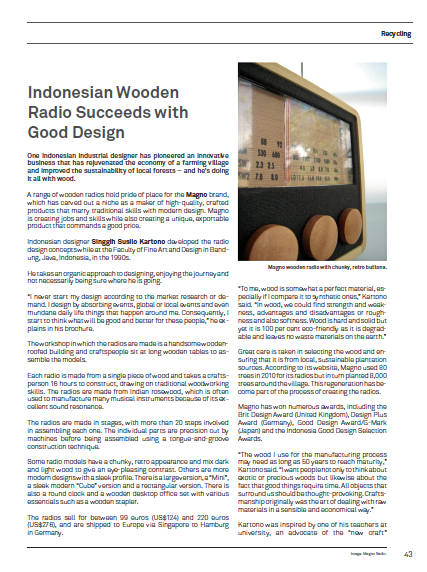
One Indonesian industrial designer has pioneered an innovative business that has rejuvenated the economy of a farming village and improved the sustainability of local forests – and he’s doing it all with wood.
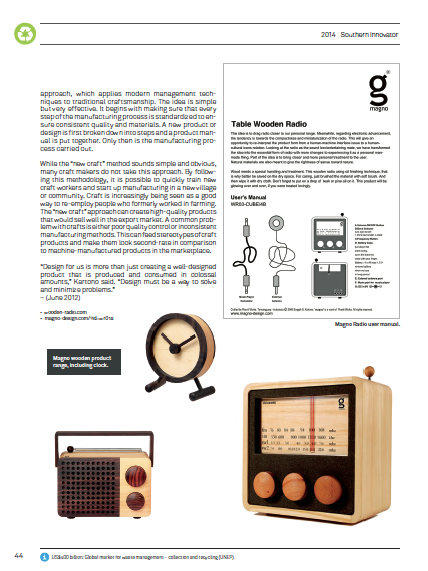
A range of wooden radios (wooden-radio.com) hold pride of place for the Magno brand (http://www.magno-design.com/?id=wr01a), which has carved out a niche as a maker of high-quality, crafted products that marry traditional skills with modern design. Magno is creating jobs and skills while also creating a unique, exportable product that commands a good price.
Indonesian designer Singgih Susilo Kartono developed the radio design concepts while at the Faculty of Fine Art and Design in Bandung, Java, Indonesia in the 1990s.
He takes an organic approach to designing, enjoying the journey and not necessarily being sure where he is going.
“I never start my design according to the market research or demand. I design by absorbing events, global or local events and even mundane daily life things that happen around me. Consequently, I start to think what will be good and better for these people,” he explains in his brochure.
The workshop in which the radios are made is a handsome wooden-roofed building and craftspeople sit at long wooden tables to assemble the models.
Each radio is made from a single piece of wood and takes a craftsperson 16 hours to construct, drawing on traditional woodworking skills. The radios are made from Indian rosewood, which is often used to manufacture many musical instruments because of its excellent sound resonance.
The radios are made in stages, with more than 20 steps involved in assembling each one. The individual parts are precision cut by machines before being assembled using a tongue and groove (http://en.wikipedia.org/wiki/Tongue_and_groove) construction technique.
Some radio models have a chunky, retro appearance and mix dark and light wood to give an eye-pleasing contrast. Others are more modern designs with a sleek profile. There is a large version, a ‘Mini’, a sleek modern Cube’ version and a rectangular version. There is also a round clock and a wooden desktop office set with various essentials like a wooden stapler.
The radios sell for between Euros 99 (US $124) and Euros 220 (US $276), and are shipped to Europe via Singapore to Hamburg in Germany.
“To me, wood is somewhat a perfect material – especially if I compare it to synthetic ones,” Kartono said. “In wood we could find strength and weakness, advantages and disadvantages or roughness and also softness. Wood is hard and solid but yet it is 100 per cent eco-friendly as it is degradable and leaves no waste materials on the earth.”
Great care is taken in selecting the wood and ensuring it is from local, sustainable plantation sources. According to its website, Magno used 80 trees in 2010 for its radios but in turn planted 8,000 trees around the village. This regeneration has become part of the process of creating the radios.
Magno has won numerous awards, including the Brit Design Award (UK), Design Plus Award (Germany), Good Design Award/G-Mark (Japan) and the Indonesia Good Design Selection Awards.
“The wood I use for the manufacturing process may need as long as 50 years to reach maturity,” Kartono said. “I want people not only to think about exotic or precious woods but likewise about the fact that good things require time. All objects that surround us should be thought-provoking. Craftsmanship originally was the art of dealing with raw materials in a sensible and economical way.”
As Kartono tells it, he faced the typical university graduate’s dilemma about his career path. Should he work as an in-house designer in a city or return to his home village of Kandangan and start a business? His choice was unusual. Once somebody with a university education leaves a small village, it is rare they return. And at first, Kartono did not.
But he was drawn back by the dire situation in the village, and decided to apply his knowledge of product design to revive its economic fortunes. He started by visiting just twice a year because that was all he could afford. This had the advantage of giving him perspective on the situation in the village.
“At first glance, these changes (happening to the village) were seen as a ‘progress,’” he said. “But when I looked more closely I concluded that it was only the ‘surface’ which experienced change. The basic structure of the village did not undergo any changes; moreover, some was actually deteriorating.”
He concluded that the village was being damaged by various government attempts to modernize agricultural practices. The debt problems this caused meant many farmers lost their farms and were forced to seek work in the city or look for another way to make money.
Craft work seemed to be the answer to this problem. It has many advantages, as Kartono sees it. It is something that can grow and fits well with village lifestyles. It is labour intensive, doesn’t need sophisticated technology and can use already existing local resources.
Kartono was inspired by one of his teachers at university, an advocate of the ‘New Craft’ approach, which applies modern management techniques to traditional craftsmanship. The idea is simple but very effective. It begins with making sure every step of the manufacturing process is standardized to ensure consistent quality and materials. A new product or design is first broken down into steps and a product manual is put together. Only then is the manufacturing process carried out.
While the New Craft method sounds simple and obvious, many craft makers do not take this approach. By following this methodology, it is possible to quickly train new craft workers and start up manufacturing in a new village or community. Craft is increasingly being seen as a good way to re-employ people who formerly worked in farming. The New Craft approach can create high-quality products that would sell well in the export market. A common problem with crafts is either poor quality control or inconsistent manufacturing methods. This can feed stereotypes of craft products and make them look second-rate in comparison to machine-manufactured products in the marketplace.
“Design for us is more than just creating a well-designed product that is produced and consumed in colossal amount,” Kartono said. “Design must be a way to solve and minimize problems.”
Published: June 2012
Resources
1) Cradle to Cradle: Remaking the Way We Make Things by William McDonough and Michael Braungart. It is a manifesto calling for the transformation of human industry through ecologically intelligent design. Website: http://www.mcdonough.com/cradle_to_cradle.htm
2) Rio+20: At the Rio+20 Conference, world leaders, along with thousands of participants from governments, the private sector, NGOs and other groups, will come together to shape how we can reduce poverty, advance social equity and ensure environmental protection on an ever more crowded planet to get to the future we want. Website: http://www.uncsd2012.org/
Sharp design throughout is key to this radio’s success. It confirms gaining the edge with a new product in the marketplace is achieved when the maker has considered aesthetics, quality assembly and clear, eye-catching graphics. Make sure to budget for the services of a good product designer and graphic designer to stand out from the crowd. Don’t let your source of income and profit fail to excite a potential customer.
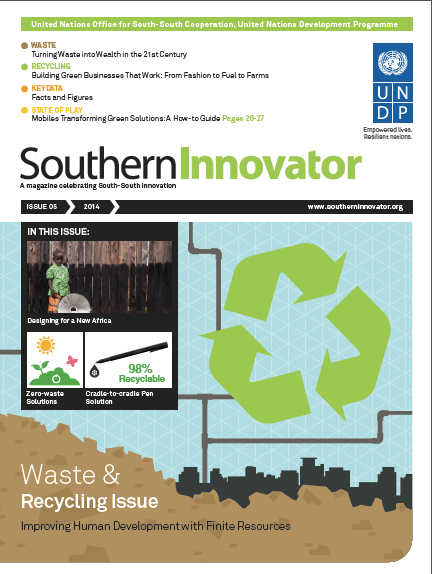
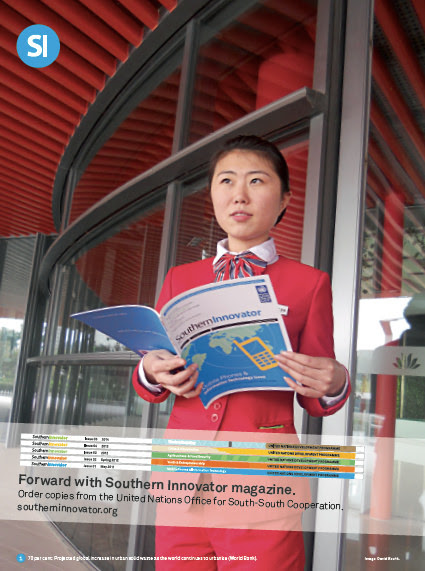
Development Challenges, South-South Solutions was launched as an e-newsletter in 2006 by UNDP’s South-South Cooperation Unit (now the United Nations Office for South-South Cooperation) based in New York, USA. It led on profiling the rise of the global South as an economic powerhouse and was one of the first regular publications to champion the global South’s innovators, entrepreneurs, and pioneers. It tracked the key trends that are now so profoundly reshaping how development is seen and done. This includes the rapid take-up of mobile phones and information technology in the global South (as profiled in the first issue of magazine Southern Innovator), the move to becoming a majority urban world, a growing global innovator culture, and the plethora of solutions being developed in the global South to tackle its problems and improve living conditions and boost human development. The success of the e-newsletter led to the launch of the magazine Southern Innovator.
Launched in May 2011, the new global magazine Southern Innovator (ISSN 2222-9280) is about the people across the global South shaping our new world, eradicating poverty and working towards the achievement of the Millennium Development Goals (MDGs).
I had read the other day the following headline from Bloomberg: World’s Worst Air Has Mongolians Seeing Red, Planning Action. As far back as 1999, such a health and environmental tragedy was foreseen by a highly successful UNDP environment project. As its Canadian adviser Robert Ferguson said to UNDP News at the time, “Mongolia’s environment is endangered by a range of problems that are on the brink of exploding.”
He knew what he was talking about: Ferguson and his Mongolian colleagues had spent two years mobilizing Mongolians across the country to take practical steps to address the country’s environmental problems as part of the Environmental Public Awareness Programme (EPAP). Few people had as much first-hand knowledge of the country and its environmental challenges as they did.
In its 2007 Needs Assessment, the Government of Mongolia found the EPAP projects “had a wide impact on limiting many environmental problems. Successful projects such as the Dutch/UNDP funded Environmental Awareness Project (EPAP), which was actually a multitude of small pilot projects (most costing less than [US] $5,000 each) which taught local populations easily and efficiently different ways of living and working that are low-impact on the environment.”
UNDP News: Networking Publication of UNDP Staff Worldwide April/May 1999
A UNDP Success Story
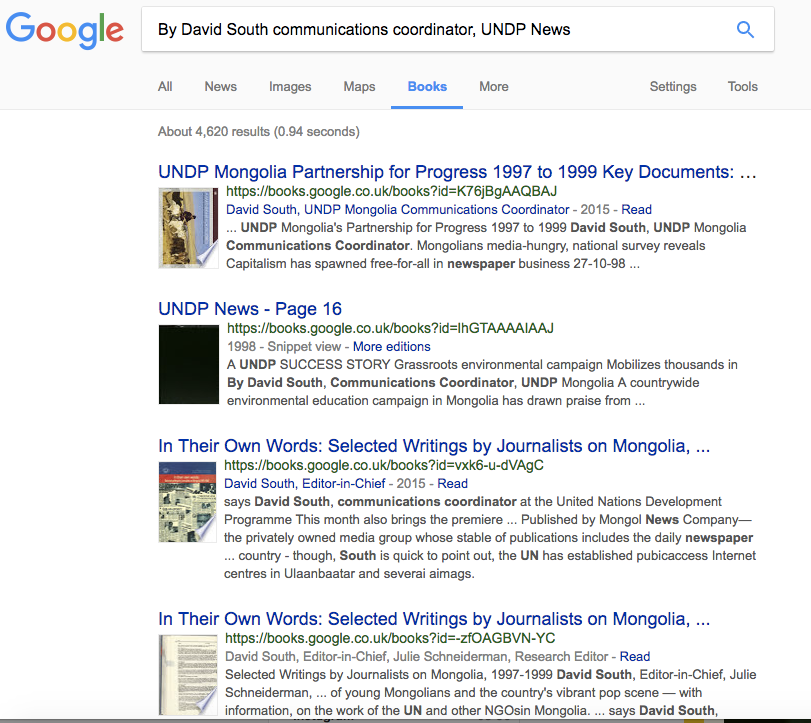
By David South, Communications Coordinator, UNDP Mongolia
Grassroots environmental campaign mobilizes thousands in Mongolia
A countrywide environmental education campaign in Mongolia has drawn praise from around the world, most especially for its ability to mobilize thousands of people and produce hundreds of advocacy materials.
Robert Ferguson, a UNV Information Specialist from Canada, has just finished a two-year assignment advising on the Environmental Public Awareness Programme. The project, implemented by UNDP, proved that civil society is alive and very well in Mongolia, despite 70 years of Communism and the hardships of transition to a free-market economy.
For the first-time visitor to Mongolia, it is easy to be dazzled by the view: the expansive steppe, the sparse population with a sprinkling of nomadic tents, the enormous herds of sheep, goats and cows. First impressions tend toward the belief that Mongolia is an unspoiled paradise where nomads have roamed for thousands of years. The reality is considerably different. The 600,000-plus capital of Ulaanbaatar, or Red Hero, is densely populated, urban and home to the country’s remaining factories and electrical power plants. In winter, pollution from power plants and coal stoves in the traditional tents, or gers, where half of the city’s population still lives, chokes the population and causes numerous respiratory problems.
While Mongolia has space to spare – the population is 2.4 million, plus 32 million head of livestock, in a territory the size of Western Europe – a long list of threats are taking their toll on this harsh but beautiful country.
“Mongolia’s environment is endangered by a range of problems that are on the brink of exploding,” says Robert Ferguson. “As these problems are not yet out of control, this country is in a very good position for grassroots initiatives that can help communities to realize their environmental problems and understand possible ways to keep them under control …
… On one cold autumn day, Ferguson and his colleagues are visiting a project in the shantytown of Chingeltei in the north of the capital. A majority of Ulannbaatar’s population live in neighbourhoods like this, where the mix of traditional gers, wooden cottages and newly built Mongolian monster homes gives a vivid example of the transition years. The population has exploded as more and more Mongolians seek out their dreams in the capital.
The Environmental Public Awareness Programme, or EPAP, uses small grants of between $1,000 and $2,000 to start awareness projects with local NGOs. After two years, nearly 100 small projects have been implemented – yet the original project document had only proposed 15 projects. According to Ferguson, the project team, which includes Sumiya and Davaasuren, were struck by the wellspring of enthusiasm they were tapping.
… Garbage is strewn liberally on the dusty streets. Inspired by recycling campaigns in his native Canada, Ferguson encouraged local women to start the Blue Bag Project. Local women proudly show off their streets – garbage-free – as they collect pop and beer bottles and animal bones to turn in for cash at the local recycler. This is just one EPAP project that has galvanized grassroots action. Back in the EPAP at the Stalinesque Ministry of Nature and Environment, Ferguson continues …
…. were all weak. What was needed was a means to take the right to public participation and an understanding of these laws to community organizations and let them develop public awareness campaigns that get the information out.”
The Programme has exceeded expectations …
…. “The response we got to our initial call for interested environmental groups was unexpected,” says Ferguson. “NGOs came from nowhere. And they embraced the idea …
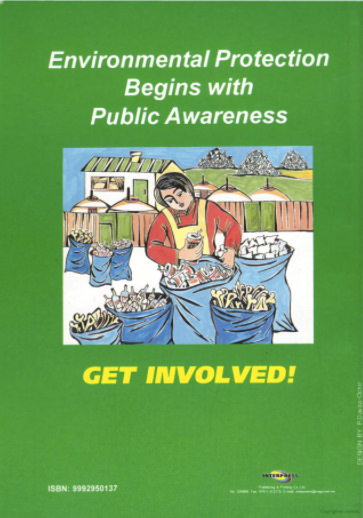
… In October last year, EPAP launched the Mongolian Green Book, a pocket-sized environmental awareness handbook for NGOs. More recently Ferguson completed a Handbook on Environmental Public Awareness to share Mongolia’s experiences with others who care about the environment…
… The workshop is an immediate follow-up to the launching of the network through a workshop attended by 12 members in December 1998…
… with such enthusiasm that we pursued more money and nearly doubled the funding for small public awareness problems.”
Note: This is just an excerpt from the story. This issue of UNDP News featured contributions from UN Secretary-General Kofi Annan, Danny Glover, Nadine Gordimer and Amartya Sen.
The highly successful EPAP project was profiled in UNDP News in April/May 1999. This issue of UNDP News featured contributions from then UN Secretary-General Kofi Annan, Danny Glover, Nadine Gordimer and Amartya Sen.
The highly successful EPAP project was profiled in UNDP News in April/May 1999. This issue of UNDP News featured contributions from then UN Secretary-General Kofi Annan, Danny Glover, Nadine Gordimer and Amartya Sen.Many resources are available online to explore Mongolia’s 1990s transition experience.The Environmental Public Awareness Handbook: Case Studies and Lessons Learned in Mongolia, published in 1999 by the UNDP Mongolia Communications Office.The Mongolian Green Book was published in 1999 by the UNDP Mongolia Communications Office.The EPAP Handbook and the Mongolian Green Book were published by the UNDP Mongolia Communications Office and funded by the European Union’s TACIS programme. European Union. europa.eu
Robert Ferguson’s The Devil and the Disappearing Sea: Or, How I Tried to Stop the World’s Worst Ecological Catastrophe (Publisher: Raincoast Books, 2004).
“The former head of the Communist Party in Inner Mongolia has been sentenced to life imprisonment for taking bribes that have led to pollution of the Mongolian steppe and the oppression of Mongolian herders. According to the judgment, published yesterday, by Beijing News, Liu Zhozhi, who had been expelled from the party before trial, used his eight years in power to pocket up to 8.17 million Yuan (over one million euros).”
Read more on the connection between corruption and air pollution levels here:
The story reports on a child health crisis in the country’s capital, Ulaanbaatar, because “Many ger households burn coal or even trash to keep warm and the smog they produce has led to a surge in respiratory and heart disease and stoked anger and protests.”
And “Pollution levels in Ulaanbaatar” have “become worse than that in cities such as Beijing and New Delhi”, according to the UNICEF report.
In 2018, Time published a story titled “Life in the Most Polluted Capital in the World”. This consequence of poor development policy stands in stark contrast to just a few years earlier, when the Mongolian President was awarded the 2012 Champions of the Earth award for “leadership that had a positive impact on the environment” and in 2013 was named as Global Host for World Environment Day 2013 because Mongolia “is prioritizing a Green Economy shift across its big economic sectors such as mining and promoting environmental awareness among youth”. Awards and meetings are clearly not enough. Update on Tuesday, August 28, 2018 at 3:35AM by David South
The importance of reducing exposure to urban air pollution is being backed up with more studies and evidence. What we have seen in the past 20 years of globalization has been a big push to encourage urbanization and denser urban living conditions. But, unfortunately for human health and well-being, this has not been connected to a strategy to reduce urban air pollution. In fact the opposite has been happening in many cities.
Urban air pollution has increased from various sources, in developed countries from vehicles, in particular those burning diesel fuel, and in developing countries, from not only vehicles but also households burning fuel for heating and cooking.
A new book to be launched in April 2019 by journalist Beth Gardiner (@Gardiner_Beth), “Choked: The Age of Air Pollution and the Fight for a Cleaner Future” (Granta) (University of Chicago Press), explores today’s global air pollution crisis in the world’s cities. Gardiner is an environmental journalist who writes for The New York Times, The Guardian and other publications (bethgardiner.com).
The UK cover for Choked: The Age of Air Pollution and the Fight for a Cleaner Future (Granta, 2019).
Listed in the Financial Times’ “What we’ll be reading in 2019”
“A compelling book about a critical subject” Elizabeth Kolbert, Pulitzer Prize-winning author of The Sixth Extinction
“Air pollution kills seven million people every year, causing heart attacks, strokes, cancer, dementia and more. In Choked, Beth Gardiner travels the world to tell the story of this modern-day plague, exposing the political decisions and economic forces that have kept so many of us breathing dirty air.”












 David South Consulting
You must be logged in to post a comment.