Categories
Archive Development Challenges, South-South Solutions Newsletters Southern Innovator magazine

Decent and Affordable Housing for the Poor

By David SouthDevelopment Challenges, South-South Solutions

SOUTH-SOUTH CASE STUDY

Urban populations across the South are growing fast: by 2030, some 5 billion people around the world will live in cities. This year will be the first year in which urban dwellers (3.3 billion people) will outnumber rural residents for the first time (UNFPA).

Africa now has a larger urban population than North America and 25 of the world’s fastest growing big cities. Asia and Africa’s cities are growing by an incredible 1 million people a week, with 72 per cent of the population in sub-Saharan Africa living in slum conditions.

How well people dwell is integral to their mental and physical health. Most squatters and slum dwellers – a category that includes half the urban population of Africa, a third in Asia and a fourth in Latin America and the Caribbean – live in makeshift homes made from whatever they can get their hands on. These dwellings are usually unsafe and vulnerable to fire, floods, and earthquakes. On top of this, these sprawling slums can be depressingly grim to look at for those living there.

In Brazil’s Sao Paulo neighbourhood of Heliopolis – the largest of the city’s 400 favelas, or shantytowns – the majority of its dwellings are made from cement and brick. It is stigmatised as the ugliest part of the city, yet a unique initiative has transformed perceptions of the area – and brought pride to its residents. The project offers a model for slum areas looking to make the next leap up the ladder of development. Heliopolis first sprang up in the 1970s, wedged between highways and roads. Plagued by crime, there is a wide spread in incomes and urbanisation among the 120,000 residents packed into the one-and-a-half square mile. Older parts have many services, while newer areas lack basics like plumbing and electricity.

Well-known Sao Paulo-based Brazilian architect Ruy Ohtake (http://www.geocities.com/capitolhill/3836/saopaulo.html) mobilised the 6,000 residents to use a fixed palette of six colours – from bright yellow to deep purples – to create a look described as akin to an Italian hill town.

“Ohtake told a newspaper that Heliopolis was the ugliest part of the city, so we went to him and asked him to figure out how to make it beautiful,” Geronino Barbosa, director of the Heliopolis community group UNAS, told the design magazine Dwell.

Ohtake, famous for his hotel designs and renovating former colonial areas, rose to the challenge: “I believe in beauty as a social function, so what better way to exercise that belief,” he said. To avoid the initiative feeling like something being imposed from on high, the plan did not go ahead until the residents were happy. And to make sure they felt they owned the results, they did all the painting themselves. The result is a river of colour running through a landscape of dreary, unfinished brick homes jammed between streets and factories. The Italian hill town-effect leaves pedestrians experiencing a surprise as they turn through the streets, happening upon hidden plazas and little bars.

“Our dream is to expand this project to the entire favela,” said Barbosa. “People love their painted houses. One of our participants told me that her house has been transformed into a sort of Carnival parade.”

“Who doesn’t want to live in a beautiful house?” said UNAS’ head, Joao Miranda, to Dwell. “We want the same things as everyone else.”

Another architect has tackled the problem of how to create inexpensive but durable and beautiful homes for the poor. Iranian-born architect Nader Khalili (http://www.calearth.org/) has created what he calls ‘super adobe’ dwellings inspired by traditional Iranian rural homes. The cone-shaped homes are made from sandbags piled one on top of the other in a circular pattern. A basic home is three rooms of 400 square feet, and can be built by five people (with only one needing skills), within weeks. Being sandbags, the homes can easily be dismantled and moved or adapted to meet new space needs.

Khalili first fell in love with the sand adobe homes of Iran in the 1970s. He had been on a journey to find a home design that was both environmentally harmonious and could be built anywhere in the world quickly and cheaply. But while the original Iranian sand adobe is easily destroyed by earthquakes and bad weather, the ‘super adobes’ are earthquake, hurricane and flood resistant. They are now being built across the Americas , Asia and Africa.

“You can never build one of these that doesn’t look beautiful,” he said. “Just as you have never seen an ugly tree or an ugly flower.”

Published: January 2008

Resources

  • Builders Without Borders: Is an international network of ecological builders who advocate the use of straw, earth and other local, affordable materials in construction. Website: http://builderswithoutborders.org/
  • World Hands Project: An NGO specialising in simple building techniques for the poor. Website:http://www.worldhandsproject.org
  • Tsunami-Safe House: A design for Prajnopaya Foundation: a project coordinated by the SENSEable City Laboratory, a new research initiative between the Department of Urban Studies and Planning and the Media Lab at the Massachusetts Institute of Technology in Boston. Website:http://senseable.mit.edu/tsunami-prajnopaya/
Creative Commons License

This work is licensed under a
Creative Commons Attribution-Noncommercial-No Derivative Works 3.0 License.

ORCID iD: https://orcid.org/0000-0001-5311-1052.

© David South Consulting 2021
Categories
Archive Development Challenges, South-South Solutions Newsletters

“Pocket-Friendly” Solution to Help Farmers Go Organic

By David SouthDevelopment Challenges, South-South Solutions

SOUTH-SOUTH CASE STUDY

Interest in organic food and farming is high, and organics have become a growing global industry. The worldwide market for organic food grew by more than 25 per cent between 2008 and 2011, to US $63 billion, according to pro-organic group the Soil Association. That is an impressive accomplishment given the backdrop of the global economic crisis, and evidence that people value quality food, even in tough times.

One Kenyan company is hoping to help farmers benefit from this global surge in interest in organic food. The company is selling a healthy alternative to chemical fertilizers and is hoping it will soon be able to source its products in Kenya, too.

BioDeposit (http://biodeposit.lv/index.php?page=elixir-3) sells soil conditioner and natural fertilizer made from two ingredients: peat found in marshlands and silt dredged up from lakes, which is called sapropel (http://en.wikipedia.org/wiki/Sapropel). This naturally occurring resource is rich in all the elements required for abundant crops and has the added benefit of not poisoning the soil and water table when used on farmer’s fields.

It is sold as a solution to the multiple pressures hitting farmers, from chaotic weather patterns to soil damage and decreasing yields. It offers a way to boost farm productivity without damaging the soil in the long term.

In 2011 the amount of farmland that was organic reached 37.2 million hectares in 162 countries – but this is still just 0.86 per cent of the world’s agricultural land (Research Institute of Organic Agriculture and International Federation of Organic Agriculture Movements). If BioDeposit has its way, Kenyan farmers could help to grow the number of hectares being farmed organically.

Presenting the solution in October 2013 at the Global South-South Development Expo (southsouthexpo.org) at the headquarters of the UN’s Environment Programme (UNEP) in Nairobi, Kenya, BioDeposit communications and media chief Nelly Makokha (http://ke.linkedin.com/pub/nelly-makokha/29/a08/634), explained that the company is hoping to bring the technology behind BioDeposit to Kenya, if they can get permission.

At present, the source materials for the products are dredged from lakes in Latvia in Eastern Europe. Because of the political structures of Kenya, it means a long political process is ahead to gain permission to dredge any of the country’s lakes. BioDeposit’s Latvian scientists conducted research on the potential for Lake Naivasha (http://en.wikipedia.org/wiki/Lake_Naivasha) in the Rift Valley and claim it has enough deposits to provide Kenya’s farmers with organic fertilizer for the next 200 years.

“If the government agrees, the fertilizer is basically cheaper than any other fertilizer the farmer [will] have ever used in a long time,” said Makokha. “It will be pocket-friendly for them. As they earn more money from the more yields, they are spending less on the fertilizer.

“Our slogan is ‘smart agriculture for health and wealth’  – health in terms of you become organically grown, and if you are looking for organic certification, we will organize that for the certifiers. Right now most countries are looking for organic food and cannot find it.

“So when you become organic that means you earn more money on your products so it means you are healthy and you are wealthy!”

The fertilizer comes in 12 milliliter packets that cost 200 Kenyan shillings (US $2.30). A farmer would need two packets for each quarter acre of farmland.

Based on a Russian discovery from the early 20th century, BioDeposit draws on naturally occurring resources.

Its products include BioDeposit Agro, described as a “biologically active soil conditioner,” and BioDeposit Elixir, described as a “humic plant growth stimulator.” The Elixir is a “sustainable, water-soluble” concentrate made from peat and can be used to soak seeds prior to planting, increasing the germination cycle. For the farmer, it means more seedlings in a shorter time. It also can be poured on compost piles to boost humic content to speed compost decay. Peat is formed from above-ground marsh plants, either on the surface or under a layer of water.

BioDeposit Agro is made from sapropel from the sediment at the bottom of freshwater lakes. It is a renewable, naturally-occurring resource as it has been formed from the accumulated settling of plants such as reeds, algae, trees, grasses and animals over time as they decay.

Unlike other chemical fertilizers, using the BioDeposit product does not require special protective clothing and does not harm human health. Children are also not at risk if they accidentally ingest the product.

“Most farmers have small farms – quarter acre, half acre, at most three acres,” said Makokha. “For a quarter acre you spend five dollars and you get more yields. Two of them would be approximately five dollars – that’s enough for a whole season – so it is pocket friendly.”

And if the company is able to harvest the material in Kenya, it would be even cheaper.

“You can imagine if we dredge here – probably (get the cost down to) a dollar – so it makes more sense for the farmers.”

The dredging has another positive impact: it helps with managing flooding by making the lake deeper once the silt is dredged out, making life better and safer for people living nearby.

BioDeposit has been operating in Kenya for a year and, Makokha said, “the response is awesome.”

BioDeposit organizes workshops for farmers through cooperative societies, helping to guide farmers through the whole process of becoming organically certified.

The company believes its products will help avert problems such as what happened recently when the European Union prevented some flowers – a major source of overseas income for Kenyan farmers – from entering the EU because of banned pesticides.

Cleverly, BioDeposit does most of its business digitally through mobile phones. It conducts its business with sales representatives by phone and conducts training by phone as well. All payments and bank transfers are done by phone using the M-PESA system (http://www.safaricom.co.ke/?id=257).

“It is the easiest way to do business in Kenya,” said Makokha. “Everybody right now owns a mobile phone. When we get the M-PESA, we transfer directly to the account. You get the money and transfer to the bank account and you are done, very easy for everybody … doing wonders for us.”

Published: March 2014

Resources

1) Soil health crisis threatens Africa’s food supply. Website: http://www.newscientist.com/article/dn8929-soilhealth-crisis-threatens-africas-food-supply.html

2) 2050: Africa’s Food Challenge: Prospects good, resources abundant, policy must improve: A discussion paper from the Food and Agricultural Organization (FAO). Website: http://www.fao.org/wsfs/forum2050/wsfs-background-documents/issues-briefs/en

3) State of the World 2011: Innovations that Nourish the Planet. Website: http://www.worldwatch.org/sow11

5) Integrating Ethno-Ecological and Scientific Knowledge of Termites for Sustainable Termite Management and Human Welfare in Africa by Gudeta W. Sileshi et al, Ecology and Society, Volume 14, Number 1. Website: http://www.ecologyandsociety.org/vol14/iss1/art48

6) Soil Association: The Soil Association was founded in 1946 by a group of farmers, scientists and nutritionists who observed a direct connection between farming practice and plant, animal, human and environmental health. Website: http://www.soilassociation.org/marketreport

7) Research Institute of Organic Agriculture: FiBL is an independent, non-profit, research institute with the aim of advancing cutting-edge science in the field of organic agriculture.  Website: http://www.fibl.org/en/fibl.html

International Federation of Organic Agriculture Movements: Since 1972, IFOAM has occupied an unchallenged position as the only international umbrella organization of the organic world, i.e. all stakeholders contributing to the organic vision. Website: http://www.ifoam.org/

9) BioDeposit on Facebook. Website: https://www.facebook.com/BioDepositAfrica

https://davidsouthconsulting.org/2022/11/21/africa/

https://davidsouthconsulting.org/2020/12/14/african-farming-wisdom-now-scientifically-proven/

https://davidsouthconsulting.org/2022/11/21/agribusiness-food-security/

https://davidsouthconsulting.org/2022/10/10/cheap-farming-kit-hopes-to-help-more-become-farmers/

https://davidsouthconsulting.org/2022/11/23/kenyan-farmer-uses-internet-to-boost-potato-farm/

https://davidsouthconsulting.org/2022/10/31/new-kenyan-services-to-innovate-mobile-health-and-farming/

https://davidsouthconsulting.org/2021/09/16/small-fish-farming-opportunity-can-wipe-out-malnutrition/

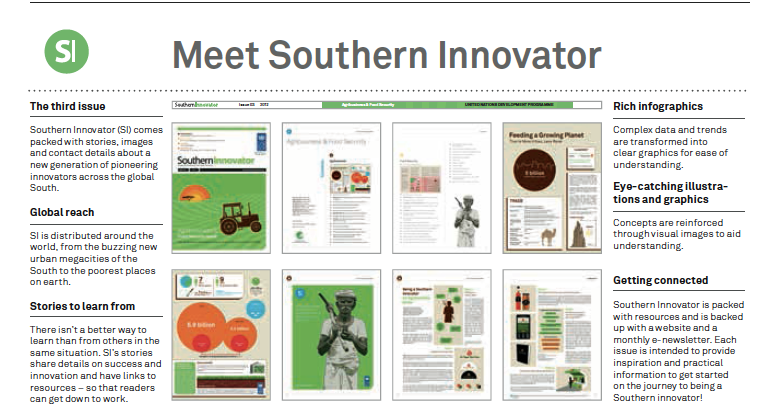
https://davidsouthconsulting.org/2021/03/05/southern-innovator-issue-3/

https://davidsouthconsulting.org/2022/11/11/urban-farming-to-tackle-global-food-crisis/

https://davidsouthconsulting.org/2022/10/18/woman-wants-african-farming-to-be-cool/

Development Challenges, South-South Solutions was launched as an e-newsletter in 2006 by UNDP’s South-South Cooperation Unit (now the United Nations Office for South-South Cooperation) based in New York, USA. It led on profiling the rise of the global South as an economic powerhouse and was one of the first regular publications to champion the global South’s innovators, entrepreneurs, and pioneers. It tracked the key trends that are now so profoundly reshaping how development is seen and done. This includes the rapid take-up of mobile phones and information technology in the global South (as profiled in the first issue of magazine Southern Innovator), the move to becoming a majority urban world, a growing global innovator culture, and the plethora of solutions being developed in the global South to tackle its problems and improve living conditions and boost human development. The success of the e-newsletter led to the launch of the magazine Southern Innovator.

Creative Commons License

This work is licensed under a
Creative Commons Attribution-Noncommercial-No Derivative Works 3.0 License.

ORCID iD: https://orcid.org/0000-0001-5311-1052.

© David South Consulting 2023


Categories
Archive Blogroll Southasiadisasters.net United Nations Office for South-South Cooperation

South–South Cooperation For Cities In Asia

Published: July 2014

Publisher: Southasiadisasters.net

Issue No. 114, July 2014

Theme: Towards Urban Resilience

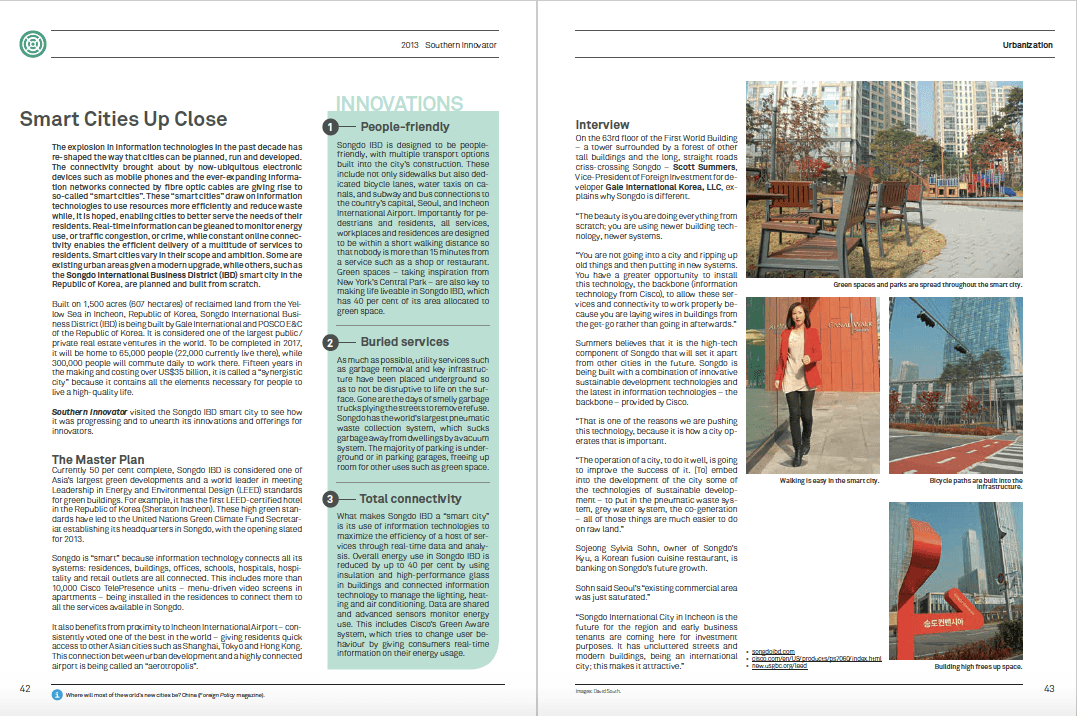
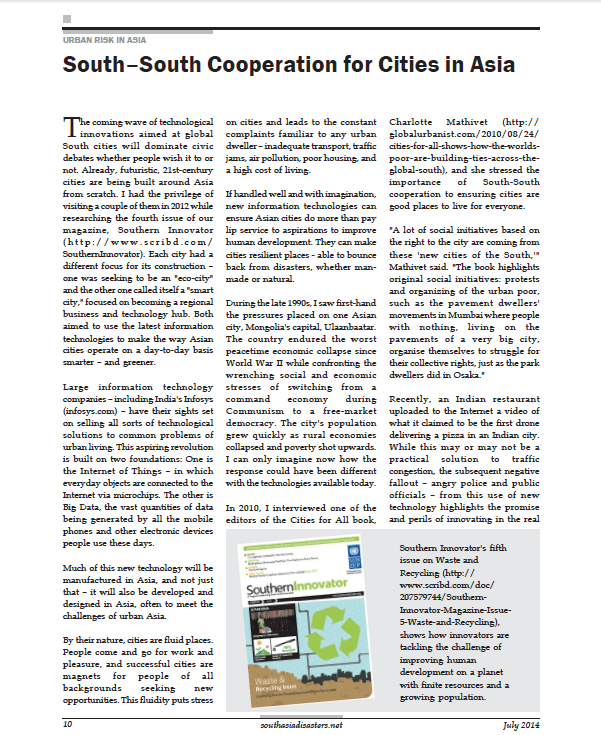
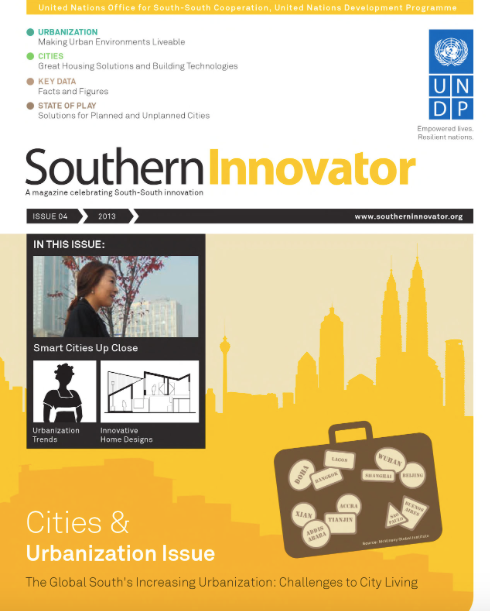
The coming wave of technological innovations aimed at global South cities will dominate civic debates whether people wish it to or not. Already, futuristic, 21st-century cities are being built around Asia from scratch. I had the privilege of visiting a couple of them in 2012 while researching the fourth issue of our magazine, Southern Innovator (  h t t p : / / w w w . s c r i b d . c o m / SouthernInnovator). Each city had a different focus for its construction – one was seeking to be an “eco-city” and the other one called itself a “smart city,” focused on becoming a regional business and technology hub. Both aimed to use the latest information technologies to make the way Asian cities operate on a day-to-day basis smarter – and greener.

Large information technology companies – including India’s Infosys (infosys.com) – have their sights set on selling all sorts of technological solutions to common problems of urban living. This aspiring revolution is built on two foundations: One is the Internet of Things – in which everyday objects are connected to the
Internet via microchips. The other is Big Data, the vast quantities of data being generated by all the mobile phones and other electronic devices people use these days.

Much of this new technology will be manufactured in Asia, and not just that – it will also be developed and designed in Asia, often to meet the challenges of urban Asia.

By their nature, cities are fluid places. People come and go for work and pleasure, and successful cities are magnets for people of all backgrounds seeking new opportunities. This fluidity puts stress on cities and leads to the constant complaints familiar to any urban dweller – inadequate transport, traffic jams, air pollution, poor housing, and a high cost of living.

If handled well and with imagination, new information technologies can ensure Asian cities do more than pay lip service to aspirations to improve human development. They can make cities resilient places – able to bounce back from disasters, whether man made or natural.

During the late 1990s, I saw first-hand the pressures placed on one Asian city, Mongolia’s capital, Ulaanbaatar. The country endured the worst peacetime economic collapse since World War II while confronting the wrenching social and economic stresses of switching from a command economy during Communism to a free-market democracy. The city’s population grew quickly as rural economies collapsed and poverty shot upwards. I can only imagine now how the response could have been different with the technologies available today.

In 2010, I interviewed one of the editors of the Cities for All book, Charlotte Mathivet (http://globalurbanist.com/2010/08/24/cities-for-all-shows-how-the-worldspoor-are-building-ties-across-theglobal-
south), and she stressed the importance of South-South cooperation to ensuring cities are good places to live for everyone.

“A lot of social initiatives based on the right to the city are coming from these ‘new cities of the South,'” Mathivet said. “The book highlights original social initiatives: protests and organizing of the urban poor, such as the pavement dwellers’ movements in Mumbai where people with nothing, living on the pavements of a very big city, organise themselves to struggle for their collective rights, just as the park dwellers did in Osaka.”

Recently, an Indian restaurant uploaded to the Internet a video of what it claimed to be the first drone delivering a pizza in an Indian city. While this may or may not be a practical solution to traffic congestion, the subsequent negative fallout – angry police and public officials – from this use of new technology highlights the promise
and perils of innovating in the real world of Asian cities (http:/
/www.bbc.co.uk/news/
b l o g s – n e w s – f r o m –
elsewhere-27537120).

Micro electronics are becoming cheaper and more powerful by the month. Small businesses armed with a only laptop computer, access to the Internet and/or mobile phone networks, and cloud computing services, can offer very powerful business and public services solutions. And sharing solutions across the global South via information technologies has never been easier.

The U.S. Pentagon published various reports and studies in the 2000s forecasting a dark future for cities in the global South. As author Mike Davis revealed in his seminal work, Planet of Slums (http://www.amazon.com/exec/obido/ASIN/1844670228/nationbooks08), the Pentagon saw the developing world’s cities as the “battlespace of the twenty-first century.” It imagined sprawling, crime ridden cities full of poverty and slums and needing tiny drones and robots darting back and forth, keeping an eye on everything and suppressing unrest. This threat-based view of future cities is one to be avoided. It is possible, through the right application of quick solutions to the challenges that arise as cities grow, to turn to cooperation across the cities of the global South to avoid this pessimistic fate.


David South, Editor,
United Nations Office for
South-South Cooperation
(UNOSSC), UK

https://reliefweb.int/report/india/southasiadisastersnet-issue-no114-july-2014-towards-urban-resilience

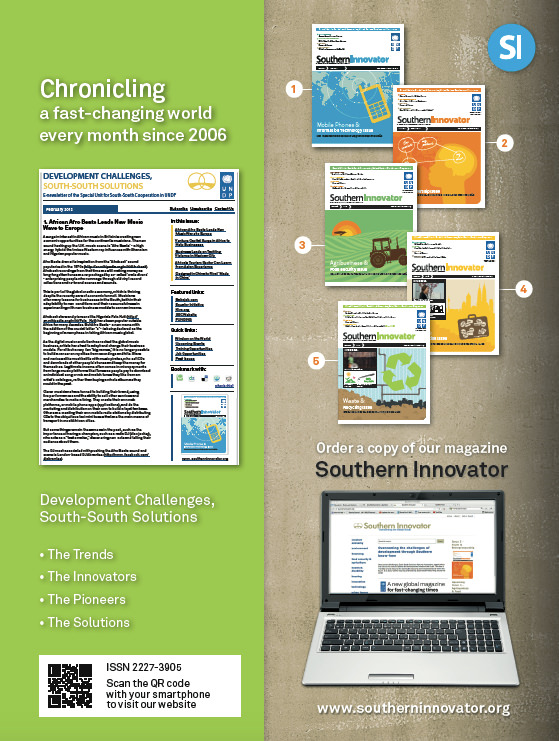
Southern Innovator’s fifth issue on Waste and Recycling (https://books.google.co.uk/books?id=6ILdAgAAQBAJ&dq=southern+innovator&source=gbs_navlinks_s), shows how innovators are tackling the challenge of improving human development on a planet with finite resources and a growing population.

https://davidsouthconsulting.org/2021/10/21/cities-for-all-shows-how-the-worlds-poor-are-building-ties-across-the-global-south/

https://davidsouthconsulting.org/2020/12/14/innovation-in-growing-cities-to-prevent-social-exclusion/

https://davidsouthconsulting.org/2021/10/22/innovations-in-green-economy-top-three-agenda/

https://davidsouthconsulting.org/2021/10/22/lima-to-delhi-what-can-be-learned-on-urban-resilience/

https://davidsouthconsulting.org/2021/02/23/southern-innovator-in-southasiadisasters-net/

https://davidsouthconsulting.org/2021/03/05/southern-innovator-issue-4/

https://davidsouthconsulting.org/2021/03/05/southern-innovator-issue-5/

https://davidsouthconsulting.org/2021/03/12/southern-innovator-magazine/

Creative Commons License

This work is licensed under a
Creative Commons Attribution-Noncommercial-No Derivative Works 3.0 License.

ORCID iD: https://orcid.org/0000-0001-5311-1052.

© David South Consulting 2023

Categories
Archive Development Challenges, South-South Solutions Newsletters Southern Innovator magazine

Turning Human Waste to Fertilizer: An African Solution

By David SouthDevelopment Challenges, South-South Solutions

SOUTH-SOUTH CASE STUDY

While South Africa has been free of the racist Apartheid regime since the mid-1990s, the expected boost to living standards for the majority black population has not been as widespread and as quick as many had expected.

One important aspect of lifting living standards is making sure the entire population has access to adequate sanitation and hygiene services. Another is making sure they have access to adequate and healthy food sources. A bright idea based on intensive research is meeting both goals in an innovative way.

According to the Council for Scientific and Industrial Research (http://www.csir.co.za/), some 11 million South Africans have received access to basic sanitation services since 1994 – but 13.3 million still lacked basic sanitation services by 2008.

The Water Research Commission (WRC) (http://www.wrc.org.za/) believes there is a crisis with South Africa’s toilet pit latrines, which are quickly filling up past their original design capacity. WRC’s solution is to turn the human faeces or faecal sludge deposited in pit latrines into fertilizer for farming and agriculture. The Water Research Commission is advocating using the fertilizer either for fruit trees or for trees that will be turned to income sources like paper and fuel.

The WRC’s project and series of experiments are called “What happens when pit latrines get full?”

“Only one third of municipalities have a budget to maintain on-site sanitation,” WRC researcher and scientist David Still told Inter Press Service (IPS). “If pits fill up, all the hard work that was done to address the sanitation backlog will be wasted. Why not use faecal sludge to address the growing problem of food insecurity by planting fruit trees? Or use the sludge to cultivate trees for fuel or paper production?”

Human faecal sludge contains a variety of nutrients, such as nitrogen, phosphates and potassium. The WRC estimates the average person excretes enough human faecal sludge per year to fertilize 300 to 400 square metres of crops.

The big reason people are reluctant to use human waste as fertilizer is because of the pathogens it contains. Spreading this on edible crops is dangerous and it is also a risk to groundwater when it leaches in to the soil.

The WRC conducted research on two sites: Umlazi and Karkloof, both in KwaZulu-Natal, South Africa. They used property owned by the South African Paper and Pulp Industry (SAPPI) and the local municipality.

The first step in the experiments was to bury the sludge in pits and plant crops on top of it. The pathogens were contained using this method and in time died off.

The test trenches were 0.75 metres in depth and filled with different quantities of sludge. Two control sites did not use faecal sludge. The scientists found the sites where the human waste was used saw plant growth and volume increase by “as much as 80 per cent.”

They then tested for pathogens in the soil. This included looking for the eggs of the large roundworm (http://www.nhs.uk/conditions/Roundworm/Pages/Introduction.aspx), a parasite whose presence would be harmful to humans. The site was tested over a period of 30 months, but none could be found.

Tests for microbes at the Umlazi site also found none. The plants were found to have healthy dark green leaves and the trees grew larger with the sludge present.

Researchers also monitored the groundwater around the sites. They found in flat ground and sandy soil there was no impact. In the site with sloping and shallow soil, small increases in nitrate were observed in the groundwater after rainfall.

They concluded the best place to apply this technique is in places that are flat and where the soil is deep.

One local resident, Lindiwe Khoza, was selected to be part of the test. Citrus and peach trees were planted on top of the buried sludge.

She told IPS: “The fruit grows much faster and it seems to be tastier and juicier than fruit bought at supermarkets. We now enjoy fruit from our own garden.”

WRC’s clever solution to these twin problems could help make life much more pleasant in communities still grappling with poor hygiene services, while dramatically improving the health of crops and their yields.

Published: July 2012

Resources

1) World Bank guide to pit latrines. Website:http://water.worldbank.org/shwresource-guide/infrastructure/menu-technical-options/pit-latrines

2) A video on how to construct a ventilated pit latrine. Website: http://www.youtube.com/watch?v=n4yfAyhiV74

3) A Practical Guide for Building a Simple Pit Latrine: How to Build Your Latrine and Use It Hygienically, for the Dignity, Health, and Well Being of Your Family. Website: http://www.crsprogramquality.org/publications/2011/9/13/a-practical-guide-forbuilding-a-simple-pit-latrine-how-to-b.html

4) The Control of Pathogens from Human Waste and their Aquatic Vectors by L. E. Obeng. Website: http://www.jstor.org/discover/10.2307/4312882?uid=3738032&uid=2129&uid=2&uid=70&uid=4&sid=21100919752851

Development Challenges, South-South Solutions was launched as an e-newsletter in 2006 by UNDP’s South-South Cooperation Unit (now the United Nations Office for South-South Cooperation) based in New York, USA. It led on profiling the rise of the global South as an economic powerhouse and was one of the first regular publications to champion the global South’s innovators, entrepreneurs, and pioneers. It tracked the key trends that are now so profoundly reshaping how development is seen and done. This includes the rapid take-up of mobile phones and information technology in the global South (as profiled in the first issue of magazine Southern Innovator), the move to becoming a majority urban world, a growing global innovator culture, and the plethora of solutions being developed in the global South to tackle its problems and improve living conditions and boost human development. The success of the e-newsletter led to the launch of the magazine Southern Innovator.  

Follow @SouthSouth1

Google Books: https://books.google.co.uk/books?id=9fRcAwAAQBAJ&dq=development+challenges+july+2012&source=gbs_navlinks_s

Slideshare: http://www.slideshare.net/DavidSouth1/development-challenges-july-2012-issue

Southern Innovator Issue 1: https://books.google.co.uk/books?id=Q1O54YSE2BgC&dq=southern+innovator&source=gbs_navlinks_s

Southern Innovator Issue 2: https://books.google.co.uk/books?id=Ty0N969dcssC&dq=southern+innovator&source=gbs_navlinks_s

Southern Innovator Issue 3: https://books.google.co.uk/books?id=AQNt4YmhZagC&dq=southern+innovator&source=gbs_navlinks_s

Southern Innovator Issue 4: https://books.google.co.uk/books?id=9T_n2tA7l4EC&dq=southern+innovator&source=gbs_navlinks_s

Southern Innovator Issue 5: https://books.google.co.uk/books?id=6ILdAgAAQBAJ&dq=southern+innovator&source=gbs_navlinks_s

Creative Commons License

This work is licensed under a
Creative Commons Attribution-Noncommercial-No Derivative Works 3.0 License.

ORCID iD: https://orcid.org/0000-0001-5311-1052.

© David South Consulting 2023