Categories
Archive Development Challenges, South-South Solutions Newsletters Southern Innovator magazine

Citing Southern Innovator: Books And Papers | 29 November 2015

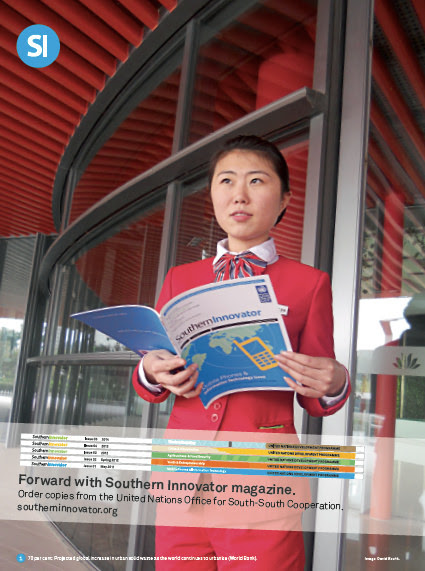
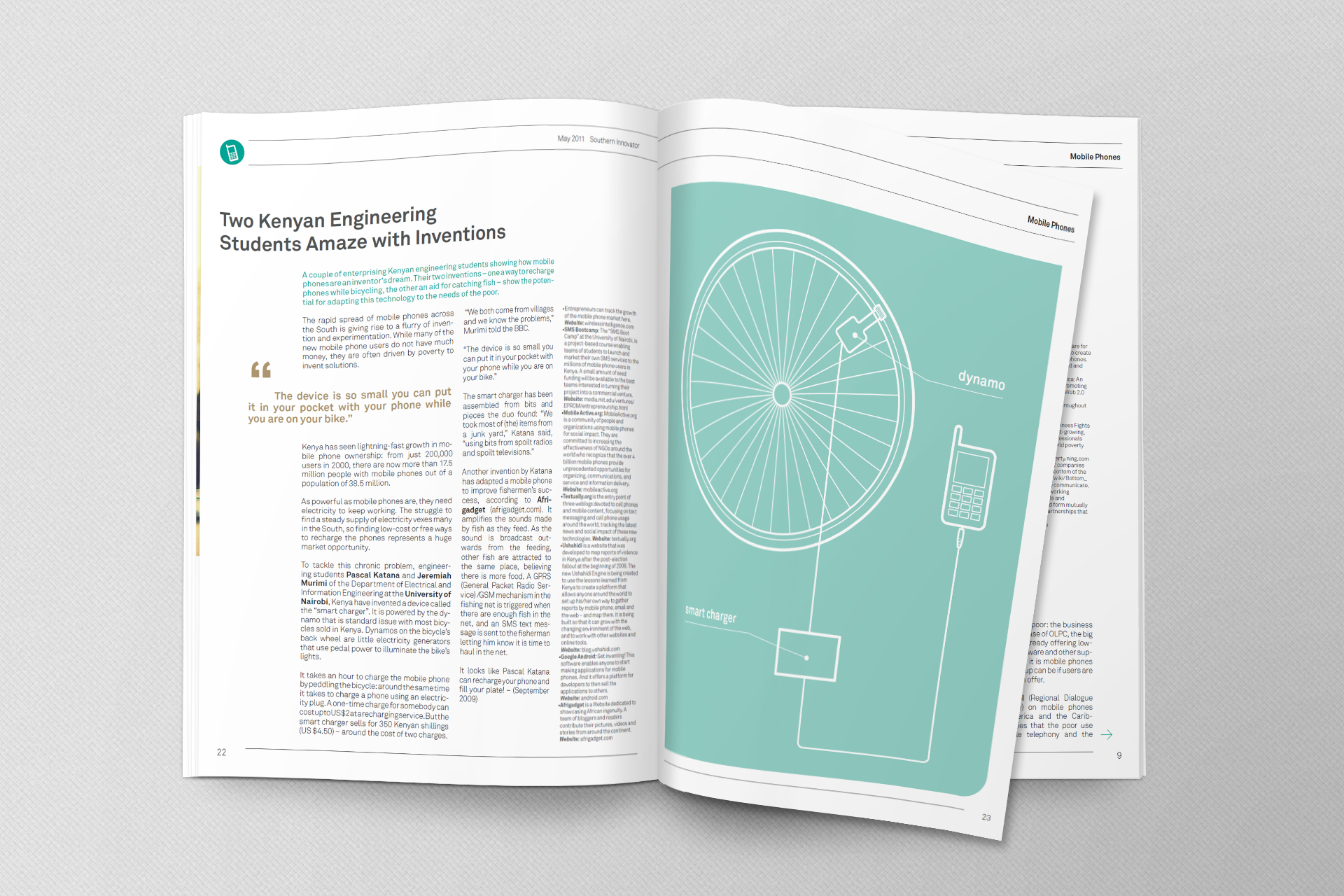
Southern Innovator was initially launched in 2011 with the goal of – hopefully – inspiring others (just as we had been so inspired by the innovators we contacted and met). The magazine seeks to profile stories, trends, ideas, innovations and innovators overlooked by other media. The magazine grew from the monthly e-newsletter Development Challenges, South-South Solutions published by the United Nations Office for South-South Cooperation (UNOSSC) since 2006. A selection of books and papers citing stories from the magazine are featured below to aid researchers, in particular those interested in health and human development and the role of innovators in international development. 
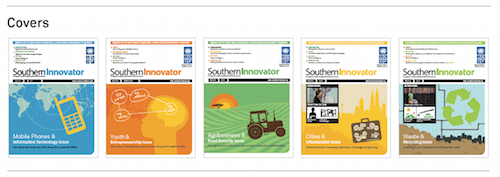
The first five issues of Southern Innovator from 2011 to 2014. Called a “Beautiful, inspiring magazine from UNDP on South-South innovation.”

Books

Innovation Africa: Emerging Hubs of Excellence edited by Olugbenga Adesida, Geci Karuri-Sebina and João Resende-Santos (Emerald Group Publishing: 2016)

“Innovation is critical to growth and development in Africa. In the context of a continent characterized by fast growing economies as well as an array of socioeconomic challenges, such as high levels of poverty and inequality, innovation in Africa must be understood in an encompassing manner. Africa needs to support the emergence of its own Silicon Valleys, but it must also foster the invention and adoption of cleaner technologies that limit respiratory illnesses, deforestation and combat climate change. This book contains a number of analytical case studies that examine the nature and origins of emerging high-end innovation hubs in Africa. These “hubs” or ecosystems are both understudied and little known inside and outside the continent. With this analysis, the book highlights and draws lessons from some of the most promising and successful innovation cases in Africa today, exploring the key factors driving their successful emergence, growth and future prospects. Relevant for scholars, policymakers, and business leaders, the book provides both inspiration and useful policy advice that can inform strategies and concrete measures to speed up the pace of innovation in Africa today.”
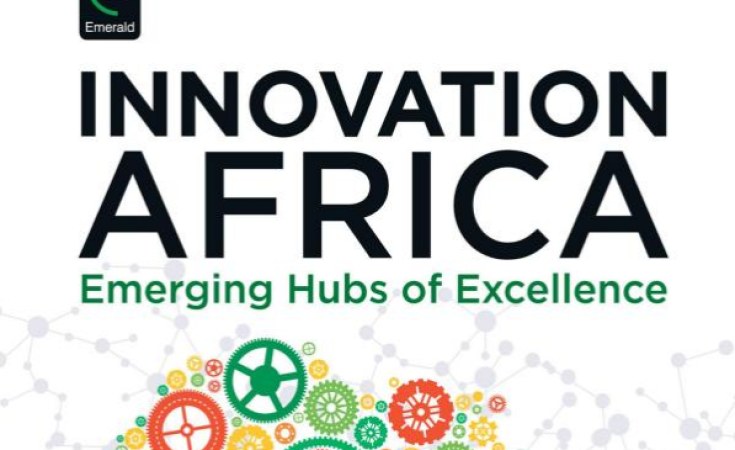
Innovation Africa: Emerging Hubs of Excellence.

Beyond Gated Communities edited by Samer Bagaeen and Ola Uduku (Routledge: 2015)

“Research on gated communities is moving away from the hard concept of a ‘gated community’ to the more fluid one of urban gating. The latter allows communities to be viewed through a new lens of soft boundaries, modern communication and networks of influence.

The book, written by an international team of experts, builds on the research of Bagaeen and Uduku’s previous edited publication, Gated Communities (Routledge 2010) and relates recent events to trends in urban research, showing how the discussion has moved from privatised to newly collectivised spaces, which have been the focal point for events such as the Occupy London movement and the Arab Spring.

Communities are now more mobilised and connected than ever, and Beyond Gated Communities shows how neighbourhoods can become part of a global network beyond their own gates. With chapters on Australia, Canada, Europe, South America, Asia, Africa and the Middle East, this is a truly international resource for scholars and students of urban studies interested in this dynamic, growing area of research.”

Chile in Transition: Prospects and Challenges for Latin America’s Forerunner of Development by Roland Benedikter and Katja Siepmann (Springer: 2015)

“The economic, political and social situation in Chile shows a country in transition. Some observers anticipate a broad “reboot” of the nation. While Chile is still seen by many as an example of progress in South America and of developmental potential in the global South, it faces a complex political constellation, particularly in the aftermath of the re-election of Michelle Bachelet. Many wonder how social and institutional innovations can be incepted without interrupting the country’s remarkable success over the past decades.

This book provides an interdisciplinary analysis of Chile’s situation and perspectives. In particular, it addresses the questions:

  • What is Chile’s real socio-political situation behind the curtains, irrespective of simplifications?
  • What are the nation’s main opportunities and problems?
  • What future strategies will be concretely applicable to improve social balance and mitigate ideological divisions?

The result is a provocative examination of a nation in search of identity and its role on the global stage.

Roland Benedikter, Dr., is Research Scholar at the Orfalea Center for Global and International Studies, University of California, Santa Barbara, Senior Research Scholar of the Council on Hemispheric Affairs Washington D.C., Trustee of the Toynbee Prize Foundation Boston and Full Member of the Club of Rome.

Katja Siepmann, MA, is Senior Research Fellow of the Council on Hemispheric Affairs Washington D.C., Member of the German Council on Foreign Relations, and Lecturer at the Faculty of Interdisciplinary Cultural Sciences of the European University Frankfurt/Oder.

The volume features a Foreword by Ned Strong, Executive Director of the David Rockefeller Center for Latin American Studies, Harvard University, and a Preface by Larry Birns, Director of the Council on Hemispheric Affairs, Washington D.C., and Former Senior Public Affairs Officer of the United Nations’ Economic Commission for Latin America (Santiago, Chile).”

A Sociological Approach to Health Determinants by Toni Schofield (Cambridge University Press: 2015)

“A Sociological Approach to Health Determinants investigates how the social works in determining health and health inequity. Taking a global perspective, the book shines a light on how experiences of health, illness and health care are shaped by a variety of complex social dynamics. Informed primarily by sociology, the book engages with the WHO’s social determinants of health approach and draws on contributions from history, political economy and policy analysis to examine issues such as class, gender, ethnicity and indigeneity, and the impact they have on health. A Sociological Approach to Health Determinants is a comprehensive resource that provides a new perspective on the influence of social structures on health, and how our understanding of the social can ensure improved health outcomes for people all over the globe. Toni Schofield is Associate Professor at the University of Sydney. She specialises in research and teaching in sociology, and public policy and administration.”

New Directions in Children’s and Adolescents’ Information Behavior Research edited by Dania Bilal and Jamshid Beheshti (Emerald Group Publishing: 2014)”This book comprises innovative research on the information behavior of various age groups. It also looks at special populations such as ethnic minorities, indigenous peoples, and users with disabilities. The book presents research and reflections on designing systems that help the new generation cope with a complex knowledge society.

Papers and Reports

Afro-futurism and the aesthetics of hope in Bekolo’s Les Saignantes and Kahiu’s Pumzi by Mich Nyawalo, Journal of the African Literature Association, Volume 10, 2016, Issue 2

Agribusiness strategy and rural development: A case study of Ihunga Sub County, Ntungamo District by Denis, Simpson Singahache, 2018

Autonomous Systems in the Intelligence Community: Many Possibilities and Challenges by Jenny R. Holzer, PhD, and Franklin L. Moses, PhD, Studies in Intelligence Vol 59, No. 1 (Extracts, March 2015)

Autonomous Systems in the Intelligence Community: Many Possibilities and Challenges by Jenny R. Holzer, PhD, and Franklin L. Moses, PhD, Studies in Intelligence Vol 59, No. 1 (Extracts, March 2015).

Decoding the Brand DNA: A Design Methodology Applied to Favela Fashion by Magali Olhats, Universidade Federal de Santa Catarina Florianopolis, 2012

Determinants of Capacity Utilization among Agribusiness Firms in Nigeria by Chukwuma Ume, Patience Ifeyinwa Opata, Kalu Uche Felix, Ukwuaba Charles Ikenna, Sunny Chukwuemeka Ume, Agu Amarachi Jacinta, Asian Journal of Managerial Science, Vol. 10 No. 2 (2021): July-December 2021 (DOI: https://doi.org/10.51983/ajms-2021.10.2.2926).

Determinants of Women Participation in Agribusiness Development Projects in Sotik Sub-County, Bomet County, Kenya by Caroline Chebet Koros, Dr. Moses M. M Otieno and John Bosco Kisimbii, International Journal of Advanced Engineering and Management Research (ISSN: 2456-3676), Vol. 2, Issue 6, 2017
Development of Luffa Cylindrica Nonwoven Structure and assessment of its suitability as a packaging and shopping bag material by C. Wetaka, Moi University School of Engineering, 2020

Economy Reports for APEC Economies on demographics, policies & ICT applications for people with Special Needs (Seniors and People with Disabilities), Asia-Pacific Economic Cooperation, APEC Telecommunications and Information Working Group, January 2013

Edible Insects and the Future of Food: A Foresight Scenario Exercise on Entomophagy and Global Food Security by Dominic Glover and Alexandra Sexton, Institute of Development Studies, King’s College London, Evidence Report No 149, September 2015

Evaluation of Kenyan Film Industry: Historical Perspective by Edwin Ngure Nyutho, School of Journalism and Mass Communication, University of Nairobi, 2015

Evaluation of the Regional Programme for Africa (2008-2013), UNDP Independent Evaluation Office, 2013

Evaluation of the Regional Programme for Africa (2008-2013), UNDP Independent Evaluation Office, 2013.

Evaluation of UNDP Contribution to South-South and Triangular Cooperation (2008-2011), Evaluation Office, UNDP 2013

Exploring the Concept of QR Code and the Benefits of Using QR Code for Companies, Ji Qianyu, School of Business and Culture Degree Programme in Business Information Technology, Lapin AMK Lapland University of Applied Sciences, 2014

Fashion: Tyranny and Revelation, Editor: Damayanthie Eluwawalage, Inter-Disciplinary Press, 2016

Financing Renewable Energy in Developing Countries: Analysis of Business Models and Best Practices, Resources Future Publication, Pakistan Office, July 2018

Gastrodiplomacy: foreign experience and potential of the republic of Uzbekistan by M. Abduazimov, International Relations: Politics, Economics, Law, 2017 

Guidance Note on Recovery: Environment, United Nations Development Programme

High-level Committee on South-South Cooperation Seventeenth Session: Framework of operational guidelines on United Nations support to South-South and triangular cooperation: Note by the Secretary-General22-25 May 2012, New York

Impact of Digital Strategy in Business for Small and Medium Enterprises in Developing Countries by Malik Mustafa, International Journal for Modern Trends in Science and Technology, 7 (09): 205-210, 2021

The Leapfrogging opportunity: role of education in sustainable development and climate change mitigation, Background paper prepared for the 2016 Global Education Monitoring Report: Education for people and planet: Creating sustainable futures for all, 2016
Local Economic Development and Growth Strategy for Prestea Huni-Valley Municipal Assembly by Dr. Steve Manteaw and Nicholas Adamtey, West Africa Governance and Economic Sustainability in Extractive Areas, Global Affairs Canada, World University Service of Canada (WUSC), April 2018

Milk Production Potential and Major Browse Species Consumed by Dromedary Camels in Tshabong by Katsane Kgaudi, Eyassu Seifu and Demel Teketay, A Special Issue on Botswana Notes and Records’ Golden Jubilee Volume in Honour of Sir Ketumile Masire, Volume 50, 2018

Mobilising Finance for Infrastructure: A Study for the UK Department for International Development (DFID), Cambridge Economic Policy Associates Ltd., August 2015

Modelo de Negocio para la Visibilizacion de Atributos Culturales Y Ambientales de Sistemas de Produccion Indigena. Caso de Estudio: Municipio de Puerto Narino – Amazonas (Colombia) by Juan Sebastian Romero Berbeo, Universidad Piloto de Colombia, Facultad de Ciencias Ambientales Programa en Administracion y Gestion Ambiental, 2016
The New Middle Class and Urban Transformation in Africa: A Case Study of Accra, Ghana by Komiete Tetteh, The University of British Colombia, 2016

Planet of slums by S. Cranby, Geodate, Volume 25, Issue 4, Pages 2-5, ISSN: 1835-5099, August 2012

Problems and Prospects of Development of Apitourism in Kazakhstan, Zh. N. Aliyeva, R. M. Baiburiyev, David D. Lorant, A. S. Shagyrbay, Z. K. Kaliaskarova, Al-Farabi Kazakh National University, Almaty, Kazakhstan, Eotvos Lorand University, Budapest, Hungary, Bulletin of National Academy of Sciences of the Republic of Kazakhstan, ISSN 1991-3494, Volume 6, Number 382 (2019), 45-53 (https://doi.org/10.32014/2019.2518-1467.144)

Propagating Gender Struggles Through Nollywood: Towards a Transformative Approach by Nita Byack George Iruobe, Geonita Initiative for Women and Child Development, 17 July 2015

Reberberation: Musicians and the Mobilization of Tradition in the Berber Culture Movement by TMG Wiedenkenner et al, The University of Arizona,  2013

Recasting ‘truisms’ of low carbon technology cooperation through innovation systems: insights from the developing world by Alexandra Mallett, Innovation and Development, 5:2, 297-311, DOI: 10.1080/2157930X.2015.1049851, Routledge Taylor & Francis Group, 2015

“Slam the Slums”: Understanding architecture through the poor by Malini Foobalan, November 26th, 2009

Song Lines: Mapping the South African Live Performance Landscape: Report of the CSA 2013 Live Mapping Project Compiled by Concerts South Africa, Samro Foundation, 2013 

Strategic Framework of the United Nations Office for South-South Cooperation, 2014-2017Executive Board of the United Nations Development Programme, the United Nations Population Fund and the United Nations Office for Project Services, 27 to 31 January 2014, New York

Taming the Tide: Stories from India by Claire Bentley, Vanessa Brombosz, Sofianne Gabrielli, Ga Eun Lee, Vaidehi Nafade, Lindsay Steele and Muhammad Wali, Global Health Case Studies: A Compilation from PPHS 511 Fundamentals of Global Health, McGill Global Health Programs, Case studies – Fall 2015, pages 23 to 32

Using Mobile-Enabled Devices for Engagement and Monitoring of Patient with Chronic Disease: Hypertensive Case by Akinwole A. K., Yekini N.A., Oloyede A.O., Ojo O., International Journal of Scientific & Engineering Research, Volume 10, Issue 4, April 2019, ISSN 2229-5518

Wearing Your Map on Your Sleeve: Practices of Identification in the Creation and Consumption of Philippine Map T-shirts 
by Pamela Gloria Cajilig, paper presented at the 6th Global Conference (2014): Fashion: Exploring Critical Issues, Mansfield College, Oxford, United Kingdom, 15th to 18th September 2014

Young Girls’ Affective Responses to Access and Use of Information and Communication Technology (ICT) in Information-Poor Societies by Dania Bilal et al, New Directions in Children’s and Adolescents’ Information Behavior Research, Library and Information Science, Volume 10, Emerald Group Publishing Limited, 2014

Youth Empowered as Catalysts for Sustainable Human Development: UNDP Youth Strategy 2014-2017United Nations Development Programme, Bureau for Development Policy

Online References

Gastrodiplomacynews: 5th November 2015
Online: https://archive.org/details/Httpsbooks.google.co.ukbooksidAQNt4YmhZagCdqsoutherninnovatorissue3sourcegbs_navlinks_s/page/n9/mode/2up?view=theater&q=gastrodiplomacy.

Southern Innovator can be read online here:

Scribd

Issue 1: http://www.scribd.com/doc/57980406/Southern-Innovator-Issue-1

Issue 2: http://www.scribd.com/doc/86451057/Southern-Innovator-Magazine-Issue-2

Issue 3: http://www.scribd.com/doc/106055665/Southern-Innovator-Magazine-Issue-3-Agribusiness-and-Food-Security

Issue 4: http://www.scribd.com/doc/128283953/Southern-Innovator-Magazine-Issue-4

Issue 5:  http://www.scribd.com/doc/207579744/Southern-Innovator-Magazine-Issue-5-Waste-and-Recycling

Google Books

Issue 1: https://books.google.co.uk/books?id=Q1O54YSE2BgC&dq=southern+innovator&source=gbs_navlinks_s

Issue 2: https://books.google.co.uk/books?id=Ty0N969dcssC&dq=southern+innovator&source=gbs_navlinks_s

Issue 3: https://books.google.co.uk/books?id=AQNt4YmhZagC&dq=southern+innovator&source=gbs_navlinks_s

Issue 4: https://books.google.co.uk/books?id=9T_n2tA7l4EC&dq=southern+innovator&source=gbs_navlinks_s

Issue 5: https://books.google.co.uk/books?id=6ILdAgAAQBAJ&dq=southern+innovator&source=gbs_navlinks_s

Southern Innovator is held in the following library collections:

Biblioteca Nationala a Republicii Moldova: http://cc.sibimol.bnrm.md/opac/bibliographic_view/399949;jsessionid=C516885A73E277718AE64598E869BC70

British Library: http://tinyurl.com/jfudl3z

Centre multimédia sur l’environnement et le développement Dakar, Senegal: http://www.enda-sigie.org/bases/sigie/format_liste.php?lang=fr&onglet=1&link=O&format=court&sort=Date%20DESC&Chp4=CONCEPTION+DE+BATIMENT

Library of Congress: http://catalog.loc.gov/vwebv/holdingsInfo?searchId=15784&recCount=25&recPointer=0&bibId=17462965

Malaysian Academic Library Union: http://malcat.uum.edu.my/kip/Record/ukm.vtls003513851

Princeton University Library: https://catalog.princeton.edu/catalog/9892864

Toronto Public Library: http://vc4kb8yf3q.search.serialssolutions.com/?V=1.0&N=100&L=VC4KB8YF3Q&S=AC_T_B&C=southern+innovator

Uganda Martyrs University: http://library.umu.ac.ug:81/cgi-bin/koha/opac-MARCdetail.pl?biblionumber=33335

United Nations Library Geneva: Issues 2, 4, 5: Click ‘Get It’: http://pmt-eu.hosted.exlibrisgroup.com/primo_library/libweb/action/search.do?SFGlobal=southern+innovator&submitGlobal=Go&fn=search&ct=search&initialSearch=true&mode=Basic&tab=default_tab&indx=1&dum=true&srt=rank&vid=41UNOG_V1&frbg=&vl%28freeText0%29=southern+innovator

Issue 1: http://pmt-eu.hosted.exlibrisgroup.com/primo_library/libweb/action/display.do?tabs=detailsTab&ct=display&fn=search&doc=41UNOG_Alma21105606680002391&indx=1&recIds=41UNOG_Alma21105606680002391&recIdxs=0&elementId=0&renderMode=poppedOut&displayMode=full&frbrVersion=&dscnt=0&frbg=&tab=default_tab&dstmp=1424959330694&srt=rank&mode=Basic&&dum=true&SFGlobal=southern+innovator&vl%28freeText0%29=southern%20innovator&vid=41UNOG_V1&submitGlobal=Go

Universiti Teknologi Malaysia Libraries: http://ent.library.utm.my/client/en_AU/main/search/detailnonmodal/ent:$002f$002fSD_ILS$002f820$002fSD_ILS:820407/ada?qu=Youth&rw=1200&ic=true&ps=300

University of Cape Town Libraries: http://aleph20.calico.ac.za/F/?local_base=uct01pub&func=find-b&find_code=OCLC&request=%28ocolc%29870179464

University of Saskatchewan: http://sundog.usask.ca/search/t?SEARCH=southern+innovator&sortdropdown=-&searchscope=8

If you would like hard copies of the magazine for distribution, then please contact the United Nations Office for South-South Cooperation: Website: https://unsouthsouth.org/2014/12/25/southern-innovator-magazine/.

If you would like to either sponsor an issue of Southern Innovator or place an advertisement in the magazine, then please contact southerninnovator@yahoo.co.uk.

We accept payments and donations. We use any funds received to keep content online, or to create new content. Thank you! https://www.paypal.me/davidsouthconsulting

Scan code with your phone and help us out.

ORCID iD: https://orcid.org/0000-0001-5311-1052

© David South Consulting 2023

Categories
Archive

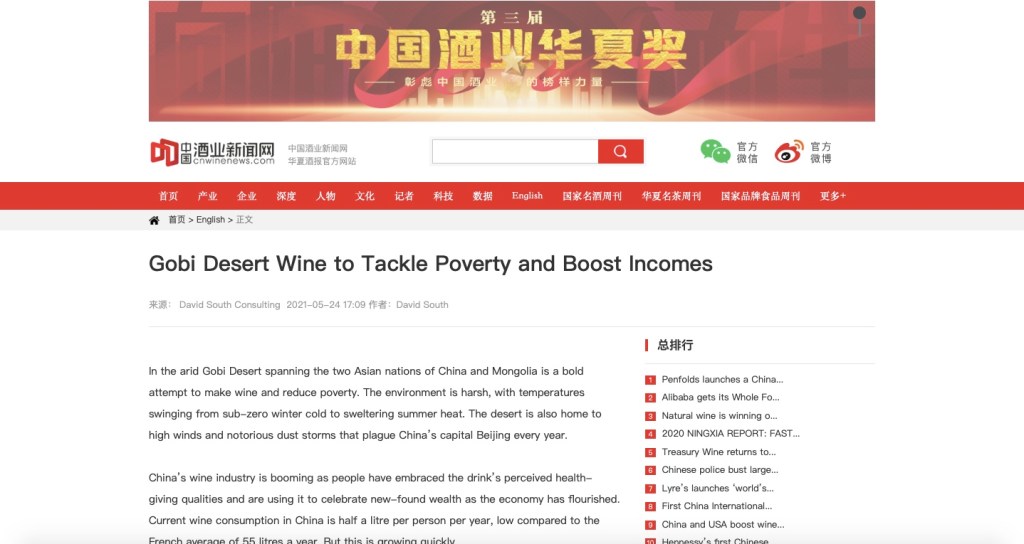
Gobi Desert Wine to Tackle Poverty and Boost Incomes

By David South, Development Challenges, South-South Solutions

SOUTH-SOUTH CASE STUDY

In the arid Gobi Desert spanning the two Asian nations of China and Mongolia is a bold attempt to make wine and reduce poverty. The environment is harsh, with temperatures swinging from sub-zero winter cold to sweltering summer heat. The desert is also home to high winds and notorious dust storms that plague China’s capital Beijing every year.

China’s wine industry is booming as people have embraced the drink’s perceived health-giving qualities and are using it to celebrate new-found wealth as the economy has flourished. Current wine consumption in China is half a litre per person per year, low compared to the French average of 55 litres a year. But this is growing quickly.

Well-known brands include Great Wall, Dynasty and Changyu (http://www.changyu.com.cn/english/index.html), which is considered the world’s 10th largest wine producer.

One innovative winery is using this wine boom to tackle poverty and increase local wealth.

Chateau Hansen (hansenwine.com) in Inner Mongolia has been operating since the 1980s, but recent expansion and modernization have significantly increased its earning power and the number of people it employs. Located in an area with high levels of poverty, it has developed a successful wine business in the desert by tapping the plentiful water supplies from the Yellow River. The area is now considered one of the best for growing wine grapes in China.

Located near Wuhai city (http://en.wikipedia.org/wiki/Wuhai), 670 kilometres west of Beijing, Chateau Hansen has 250 hectares of Merlot, Cabernet Sauvignon and Cabernet Gernischt grapevines.

The vines are buried under the sand to protect them from the harsh weather in the winter.

“The lowest temperature gets down to is below -20 degrees C (Celsius), but in summer, it can reach 38 or 40 degrees C (102 or 104 F),” Li Aixin, Chateau Hansen’s head of viticulture, told MSNBC. “Here the four seasons are good for the growth of the grapes, but in the winter we need to bury them in the earth” to keep them from freezing. Hansen has been ambitious in its approach. It has a European-style chateau, hotel and even a French wine expert, Bruno Paumard, on site to help with the wine making. The chateau’s cellar now stores 1,000 barrels of wine.

Paumard arrived in China in 2005. He has thrown himself into Chinese culture and tasted and tested the country’s wines. Hansen has produced 400,000 bottles of wine, mostly sold in China, where red wine drinking has become a big part of the culture of celebration.

Hansen sells the majority of its wine to government organizations and regional enterprises. It has seen its profits double to 100 million yuan (US $18 million) in 2011 and hopes sales will double again in 2012.

“Eighty per cent of the market in China is really the local governments who encourage the enterprises in their cities to consume red wine, of a certain brand, at their banquets in the place of Chinese ‘baijiu’ for their incessant and never-ending toasts,” said Paumard, referring to China’s home-grown rice wine. “So it’s actually a market that’s totally unique.”

Hansen’s Cotes du Fleuve Jaune du Desert de Gobi has become one of the biggest award-winning wines in China. It received a bronze medal from the International Wine Challenge of Blaye, near Bordeaux, France.

China now stands as the world’s fifth-largest consumer of wine (International Wine and Spirit Research study) (http://www.iwsr.co.uk/). The market in China is forecast to grow by 54 per cent from 2011 to 2015, adding up to a billion bottles.

A map of China’s vineyards and their terroir or soil conditions shows a diverse wine-making sector (http://www.hansenwine.com/english/vineyardlink.html).

In this busy marketplace, Hansen prides itself on being organic. It also has the goal of turning the arid desert into green vineyards using irrigation from the Yellow River and groundwater. It wants to create employment and raise living standards in the region and is fitting into a national strategy to raise living standards for poor regions.

There is a training programme for the around 400 workers employed by the winery. No pesticides are used and only sheep dung is used as a fertilizer provided by 3,000 sheep on site. Trees also play a role in providing humus (http://en.wikipedia.org/wiki/Humus) for the vines. There is also accommodation in a nearby village for the employees.

There are 250 hectares of vineyards and the grapes are harvested by hand. Expansion began in 2001 when the chateau and winery were built. It is strategically located just 500 metres from an airport and the chateau has a luxury hotel. Around 20,000 people visit a year, according to Hansen’s website, bringing in further income for the winery. The winery also uses Mongolian culture and cuisine as a selling point to attract tourists.

The chief executive of Hansen is Han Jianping, who made his first fortune in real estate development.

Han believes that “the momentum of growth in the wine industry is huge.”

“With a great foundation of more than 1 billion people as we have in China, and (the industry) growing at 20 or 30 per cent a year, there is a huge potential for more growth,” he said.

Republished in 2021 in cnwinenews.com.

Resources

1) China Wine Online: An information service that also produces the China Wine Business magazine and runs the China Wine Study Tour. Website: http://www.winechina.com/en/index.asp

2) The 10th Shanghai International Wine and Spirits Expo 2013: Website: http://www.winefair.com.cn/sugar/en/index.asp

Creative Commons License

This work is licensed under a
Creative Commons Attribution-Noncommercial-No Derivative Works 3.0 License.

We accept payments and donations. We use any funds received to keep content online, or to create new content. Thank you! https://www.paypal.me/davidsouthconsulting.

Scan code with your phone and help us out.

More on the Gobi Desert here:

Development Profile: UNDP In The Southern Gobi Desert | May-June 1998

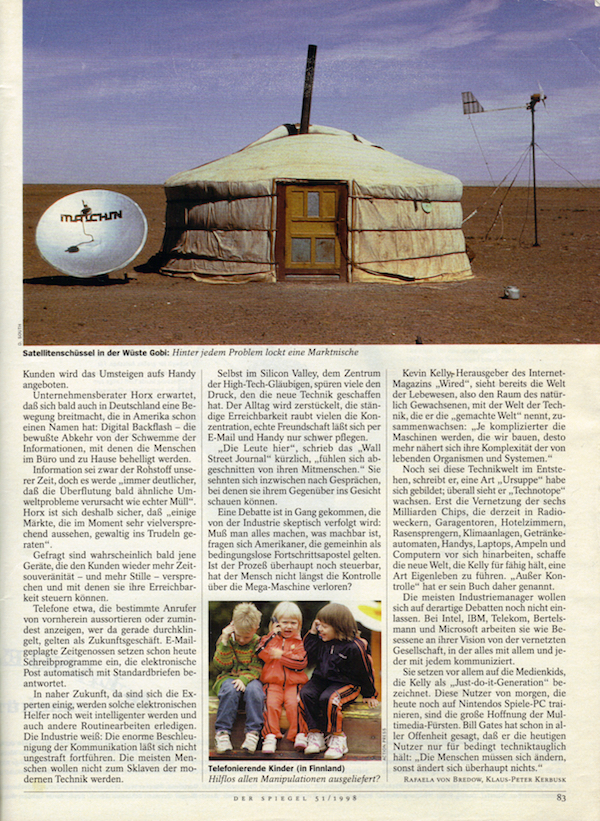
Kommunikation total: Der siebte Kontinent

Wild East 17 Years Later | 2000 – 2017

ORCID iD: https://orcid.org/0000-0001-5311-1052.

© David South Consulting 202421

Categories
Archive Development Challenges, South-South Solutions Newsletters Southern Innovator magazine

Computer ‘Gold Farming’ Turning Virtual Reality Into Real Profits

ByDavid South,Development Challenges, South-South Solutions

SOUTH-SOUTH CASE STUDY

The rapid spread of the internet around the global South is bringing with it new forms of work. One of these trends is so-called “gold farming”: making money in the virtual world of computer gaming by trading in virtual money, prizes and goods for busy gamers who don’t have time to do it themselves. This work now employs 400,000 people – mostly men and mostly in China, but also elsewhere in the South, according to new report.

Working out of internet centres where they can get access to high-speed or broadband internet connections, “gold farmers” use the global trade in virtual goods for online computer games in the same way stockbrokers trade shares on the world’s stock exchanges. The trade operates similarly to the stock market, with prices fluctuating based on demand and changing by the minute.

And as the report discovered, this trade is acting as a gateway into the world of information technology employment, where computer-literate young men are able to earn an income they could not have done otherwise.

It is a trade that can provide gold farmers with US $145 a month in income. They are often given free food and accommodation to do it, and many have few other economic choices.

“You can probably think of two models,” said the report’s author, Professor Richard Heeks of Manchester University’s Development Informatics Group. “They could play as an individual at a local cybercafe doing their own in-game farming and then selling to one of the trading sites (that buy from farmers at one price, then sell on to player-buyers at a higher price). Or they could be organized into a small/medium enterprise by an owner, all working together in a room full of computers.”

There is a dark side to gold farming too: there have been reports of youths forced to gold farm by gangs who make them work 12 hour days. Crime gangs sometimes become involved and scams proliferate.

Heeks says the downside is the result of governmental ignorance. “The main problem is a lack of understanding about ICT and ICT enterprise generally in some governments in developing countries and in particular a relative lack of understanding about the spread and implications of computer games.”

Supporters see gold farming as a flourishing Southern economy that is worth hundreds of millions of dollars, and exposes participants both to information technology skills and the wide horizons of the virtual computing world. Its defenders say it shows that those who dismiss the expansion of IT infrastructure as a waste of time are missing the emerging economic opportunities it is creating.

Heeks said we still know too little about this fast-evolving sector, but that “gold farming does seem to be providing income/livelihood for young men who would otherwise be unemployed. There are claims that it has helped mop up youths who had otherwise been involved in crime, but we don’t yet know how generalized such claims are.”

The number of players engaged in online gaming has grown by 80 percent per year, and Heeks sees the rise in gold farming as linked to a bigger trend: “in both North and South, we will spend increasing amounts of work and leisure time in cyberspace. Couple that with the growing penetration of ICTs into developing countries, including into poor communities, and there will be growing opportunities for this kind of ‘virtual outsourcing.’”

Currently, more than 300 million people worldwide have access to the internet through fast broadband connections (mostly in developed countries, although this is changing quickly), and more than 1.1 billion of the world’s estimated 6.6 billion people are online.

China is working hard to capture the economic power of the internet. The country’s economic boom has helped create an affluent urban middle class clamouring for the social aspects of internet access like chat rooms, while the government has been driving the roll-out of internet access in rural areas.

The country’s largest Cyber Park is under construction inWujin New and High-tech Development Zone of Changzhou. It will be a technology incubator, a research and development centre, and a place for small and medium-sized enterprises to innovate.

China’s most ambitious digital media industry development is the Beijing Cyber Recreation District (CRD), a collection of digital media academies and company incubators spread over 100 square kilometres, creating the world’s largest virtual world development. It is already home to more than 200 game and multimedia content producers in western Beijing.

And even in Africa, where broadband penetration rates are very poor, countries are now looking to the mobile phone companies to provide their populations with access to the internet, as they struggle to find a place at the digital table.

Mauritius, an island in the Indian Ocean strategically close to Africa and better known for tourism and luxury hotels, wants to become the world’s “cyber island”, and Africa’s e-gateway. Armed with the first 3G network in Africa (the third generation of mobile phone technology – offering high-speed internet access and video telephony), Mauritius is moving fast to make good on this advantage. And it is even moving to the next level of mobile-phone speed, High-speed Download Packet Access (HSDPA) – allowing even greater quantities of information to be exchanged.

Mauritius joins a select few countries, including Japan and South Korea, at the forefront of access to 3G. Wireless – or wi-fi – computer access is available in three-quarters of the island.

Published: September 2008

https://davidsouthconsulting.org/2022/11/21/asia/

https://davidsouthconsulting.org/2022/10/20/china-consumer-market-asian-perspective-helps/

https://davidsouthconsulting.org/2020/12/10/china-sets-sights-on-dominating-global-smartphone-market/

https://davidsouthconsulting.org/2020/12/11/cyber-cities-an-oasis-of-prosperity-in-the-south/

https://davidsouthconsulting.org/2021/01/26/designed-in-china-to-rival-made-in-china/

https://davidsouthconsulting.org/2022/10/04/popular-chinese-social-media-chase-new-markets/

https://davidsouthconsulting.org/2020/04/17/virtual-supermarket-shopping-takes-off-in-china/

Development Challenges, South-South Solutionswas launched as an e-newsletter in 2006 by UNDP’s South-South Cooperation Unit (now the United Nations Office for South-South Cooperation) based in New York, USA. It led on profiling the rise of the global South as an economic powerhouse and was one of the first regular publications to champion the global South’s innovators, entrepreneurs, and pioneers. It tracked the key trends that are now so profoundly reshaping how development is seen and done. This includes the rapid take-up of mobile phones and information technology in the global South (as profiled in the first issue of magazine Southern Innovator), the move to becoming a majority urban world, a growing global innovator culture, and the plethora of solutions being developed in the global South to tackle its problems and improve living conditions and boost human development. The success of the e-newsletter led to the launch of the magazine Southern Innovator.

Follow@SouthSouth1

Archive.org:https://archive.org/details/Httpwww.slideshare.netDavidSouth1development-challengessouthsouthsolutionsseptember2008issue

Slideshare:http://www.slideshare.net/DavidSouth1/development-challengessouthsouthsolutionsseptember2008issue

Southern Innovator Issue 1:https://books.google.co.uk/books?id=Q1O54YSE2BgC&dq=southern+innovator&source=gbs_navlinks_s

Southern InnovatorIssue 2: https://books.google.co.uk/books?id=Ty0N969dcssC&dq=southern+innovator&source=gbs_navlinks_s

Southern Innovator Issue 3:https://books.google.co.uk/books?id=AQNt4YmhZagC&dq=southern+innovator&source=gbs_navlinks_s

Southern Innovator Issue 4:https://books.google.co.uk/books?id=9T_n2tA7l4EC&dq=southern+innovator&source=gbs_navlinks_s

Southern Innovator Issue 5:https://books.google.co.uk/books?id=6ILdAgAAQBAJ&dq=southern+innovator&source=gbs_navlinks_s

Creative Commons License
This work is licensed under a
Creative Commons Attribution-Noncommercial-No Derivative Works 3.0 License.

ORCID iD:https://orcid.org/0000-0001-5311-1052.

© David South Consulting 2025

Categories
Archive Blogroll Development Challenges, South-South Solutions Newsletters Southern Innovator magazine

Rebuilding After Chinese Earthquake: Beautiful Bamboo Homes

By David SouthDevelopment Challenges, South-South Solutions

SOUTH-SOUTH CASE STUDY

It has been a year since the May 12, 2008 Sichuan earthquake in China that killed more than 70,000 people.

China’s strongest earthquake for more than half a century, with a magnitude of 8.0 (en.wikipedia.org), it devastated large parts of the province of Sichuan. More than 10 million people were made homeless, most of them poor and elderly villagers (cities were not badly damaged).

Getting Sichuan back to normal is critical for not only the province’s people, but for all of China. Sichuan is China’s rice bowl, growing more food than any other province. But despite the abundance of food, Sichuan remains poor and has seen its working age population move away for work. If it is to have a viable future then its communities need to get back to normal as fast as possible – and its farming economy back to full production.

The unprecedented media coverage of the disaster meant people across China saw the scenes of devastation and have since contributed large donations to help with the reconstruction. The Chinese government has pledged to spend US $151 billion on reconstruction projects.

Finding ways to re-house people after large disasters has become an urgent issue over the last five years. From the Asian tsunami to Hurricane Katrina in the United States and multiple hurricane disasters in the Caribbean, restoring communities is critical for the health of the people and the economies they rely on. Experience has shown that temporary shelters have many drawbacks, being usually of poor quality for long-term habitation and a source of health problems.

The temporary shelters erected for the Sichuan homeless are unsuitable for long-term housing: the 12 square metre grey boxes – two sheets of aluminium sandwiching a polystyrene core for insulation – have no heating. The occupants roast inside in the summer and freeze in the winter. They are also located away from the main source of income: the farms.

The dilemma is how to build new, long-term houses that will not cost too much. Inflation has increased the costs of conventional building materials: bricks, cement and steel.

But the use of traditional building materials and home designs offers an alternative. By drawing on the abundant bamboo and wood in Sichuan and by building to traditional designs, cheaper but sturdy and beautiful homes can be built.

An average home now costs around 80,000 yuan (US $11,688). The Chinese government estimates the price is now 820 yuan per square meter for a new home: bamboo homes cost between 300 and 400 yuan per square meter. Government compensation is between 16,000 yuan (US $2,337) and 23,000 yuan (US $3,360) per family. The bamboo houses range in size from 75 to 200 square metres, and in cost from 22,500 yuan to 80,000 yuan for a very large home.

In Daping village, Pengzhou Town, original homes destroyed by the earthquake sit at the edge of a forested hill. Their frames are more or less intact, but the walls and roofs have collapsed. The new houses replacing them are large, two stories high and have solid grey clay tile roofs. The beauty of the designs stands out and sits in stark contrast to the temporary shelters and concrete buildings.

“There are 43 houses and two public buildings being rebuilt in this project,” says team member Hu Rong Rong of the Green Building Research Centre of Xi’an University of Architecture and Technology. “The design and the main building material are based on the ecological and sustainable habitat idea. The place (Sichuan) is rich in bamboo and wood. These natural materials are cheap and friendly to the environment. In some buildings we use light steel which can be also recycled.”

The new homes are built to earthquake resistance standards. Led by Professor LiuJiaping, a team of 15 people from the research centre and two from a design institute developed the home designs and supervised the training of local people. They were joined by 10 people from an NGO called Global Village of Beijing, who managed the project to completion.

“All the designs were discussed with the local people,” continues Hu. “We trained a local construction team, which means the local people would build their own houses by themselves. Both our research center and the local people were involved in developing the home design.

“To get the trust from the local people is a challenge in the project. We resolved it by showing our respect to the local people. Before we started our design we discussed with the local people many times to know what kind of house they like. We built the first house to make them believe us.”

Hu believes it is possible to replicate the homes across Sichuan.

“The design is suitable for other villages in Sichuan which have a similar climate and culture with this village. To rebuild sustainable houses after a disaster we should know well about the local life, environment and culture – try to find the useful technique which was used in their traditional houses and upgrade the traditional house to meet the need of their modern life.”

Others have not been as lucky as these villagers. In the village of Yuan Bao, Chen Jingzhong, 66, has had to build a makeshift shack: “They wanted to get us to build our own houses but they didn’t give us enough money,” Chen told the Telegraph Magazine. “All we could afford was this shack, which we built ourselves, with our own hands and without any help from anyone.”

Published: May 2009

Resources

Architecture for Humanity: By tapping a network of more than 40,000 professionals willing to lend time and expertise to help those who would not otherwise be able to afford their services, they bring design, construction and development services where they are most critically needed. Website: www.architectureforhumanity.org

Chinese Red Cross: The Red Cross Society of China is accepting donations for disaster reconstruction and is coordinating rebuilding efforts in Sichuan Website: http://www.redcross.org.cn/ywzd/

Gerd Niemoeller has developed flat pack, cardboard homes that can be deployed quickly after a disaster and can become permanent homes.Website: http://tinyurl.com/6t6jtf and the company
Website: http://www.wall.de/en/home

Global Greenhouse Warming is a website that tracks extreme weather events around the world: drought, flooding, severe storms, severe winter, tropical cyclone, wildfires, and extreme heat waves.Website: www.global-greenhouse-warming.com

The Building and Social Housing Foundation: An independent research organization promoting sustainable development and innovation in housing through collaborative research and knowledge transfer. Website: www.bshf.org

https://davidsouthconsulting.org/2021/09/01/disaster-recovery-ten-years-after-the-gujarat-india-experience/

https://davidsouthconsulting.org/2021/11/12/energy-efficient-wooden-houses-are-also-earthquake-safe/

https://davidsouthconsulting.org/2021/09/01/haiti-earthquake-prompts-tech-aid/

https://davidsouthconsulting.org/2021/02/12/rammed-earth-houses-china-shows-how-to-improve-and-respect-traditional-homes/

https://davidsouthconsulting.org/2022/09/26/3d-home-printing-landmark-10-houses-in-a-day/

Development Challenges, South-South Solutions was launched as an e-newsletter in 2006 by UNDP’s South-South Cooperation Unit (now the United Nations Office for South-South Cooperation) based in New York, USA. It led on profiling the rise of the global South as an economic powerhouse and was one of the first regular publications to champion the global South’s innovators, entrepreneurs, and pioneers. It tracked the key trends that are now so profoundly reshaping how development is seen and done. This includes the rapid take-up of mobile phones and information technology in the global South (as profiled in the first issue of magazine Southern Innovator), the move to becoming a majority urban world, a growing global innovator culture, and the plethora of solutions being developed in the global South to tackle its problems and improve living conditions and boost human development. The success of the e-newsletter led to the launch of the magazine Southern Innovator.

https://davidsouthconsulting.org/2021/03/05/southern-innovator-issue-4/

Creative Commons License

This work is licensed under a
Creative Commons Attribution-Noncommercial-No Derivative Works 3.0 License.

ORCID iD: https://orcid.org/0000-0001-5311-1052.

© David South Consulting 2023