

By David South, Development Challenges, South-South Solutions

The proliferation of mobile phones across the global South, reaching even the poorest places on the planet, has given birth to whole new ways of making money. A phenomenon called ‘crowdsourcing’ – in which the power of individuals is harvested to achieve a goal – is now being used to create networks of people earning extra income.
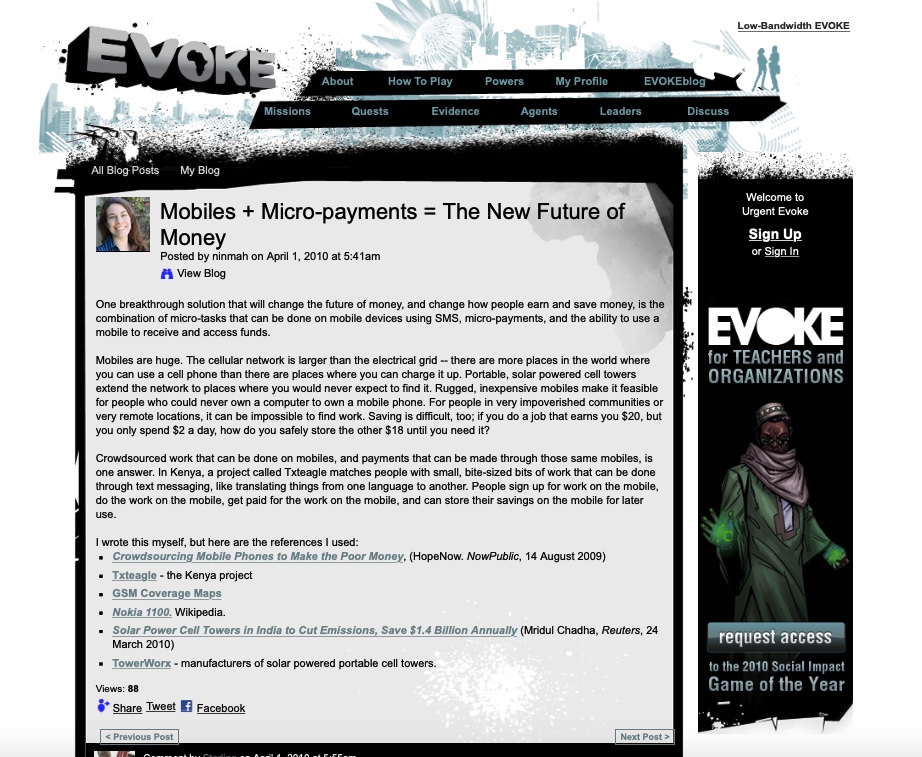
One technology called Txteagle (http://txteagle.com/index.html), works like this: somebody performs small tasks with their mobile phone, such as translating a document into a local language, and in return receives credits or cash, so-called ‘micro-payments.’ By having many people perform these tasks in their spare time or down time at work, a large project can be completed and people can top-up their income. The secret is that the task must be able to be broken up into bite size chunks: the elephant must be eaten with a small fork.
For the poor, or people who are just getting by in a poor country, this can be a much-needed survival top-up in hard economic times. It is also an opportunity for people normally frozen out of formal employment opportunities or living in slum conditions.
Txteagle is being pioneered in Kenya using text messages or a low bandwidth, interactive protocol known as USSD (http://en.wikipedia.org/wiki/USSD) (usually used to check prepaid phone balances).
The rapid growth in take-up has made mobile phones the big success story of the 21st century. With such reach, finding new applications for mobile phones that are relevant to the world’s poor and to developing countries is a huge growth area. It is estimated that by 2015, the global mobile phone content market could be worth over US $1 trillion: relegating basic voice phone calls to just 10 percent of the way people use mobile phones.
The technological success story of mobile phones is impressive: China is home to the same number of mobile-phone users (surpassing 650 million in 2009) as the whole of Europe. According to India’s telecoms regulator (http://www.trai.gov.in/Default.asp), half of all urban dwellers now have mobile – or fixed – telephone subscriptions and the number is growing by eight million a month. In Tanzania, mobile phone use grew by 1,600 percent between 2002 and 2008.
Txteagle is the brainchild of Nathan Eagle of EPROM (Entrepreneurial Programming and Research on Mobiles) (http://eprom.mit.edu/ ). He works on developing new mobile phone applications with computer science departments in 10 Sub-Saharan African countries including: the University of Nairobi (http://www.uonbi.ac.ke/) (Kenya), Makerere University (http://mak.ac.ug/makerere/) (Uganda), GSTIT (http://www.gstit.edu.et/) (Ethiopia), Ashesi University (http://www.ashesi.org/) (Ghana), and the Kigali Institute of Science and Technology (http://www.kist.ac.rw/) (Rwanda).
Eagle has pioneered Txteagle in Nairobi, Kenya with students at the University of Nairobi. Drawing on his experience in East Africa, where he has lived since 2006, Eagle has a powerful message about mobile phones in the South. “This is their technology. The mobile phone is theirs,” he told a conference in March of this year. “It has had a far greater impact on their lives than it has on ours.”
Eagle says typical Txteagle users are “literate people in Nairobi who have significant idle time, like taxi drivers, security guards” or high school students. Like many Southern countries, Kenya has a plethora of languages: 62 in all. It can be laborious and costly to translate into all these languages. But by using crowd-sourcing on mobile phones, mobile phone company Nokia’s (www.nokia.com) phone menus have been translated into 15 local languages.
Already there are more people wanting to earn money this way than there are tasks to do. Eagle has had to cap payments at US $1.50 a day. The service needs to grow, and it is looking to offer people in the United States the opportunity to have easily broken-up tasks done in Kenya. Eagle believes his algorithms (http://en.wikipedia.org/wiki/Algorithm) ensure a 95-percent accuracy rate. One possible market is the US $15 billion medical transcription industry.
Kenya, a nation of 32 million, relies on its small business sector for most employment. In 2005, the government’s Economic Survey (www.cbs.go.ke/) found the small business sector created 437,900 jobs – mostly because of the boom in mobile phones. According to the Massachusetts Institute of Technology (MIT), adding an additional 10 mobile phones per 100 people boosts a typical developing country’s GDP growth by 0.6 percent. The boost comes from the innovative use of mobile phone technology by local entrepreneurs.
Kenya is making significant headway on innovating with mobile phones. Already, 30 percent of Kenyans pay for their electricity with their mobile phones instead of waiting in line.
“We have transformed the majority of phones in East Africa into a platform that people can use to make money,” Eagle told the conference. “There are 15 million Africans ready to start working on their mobile phones.”
By David South, Development Challenges, South-South Solutions
Published: July 2009
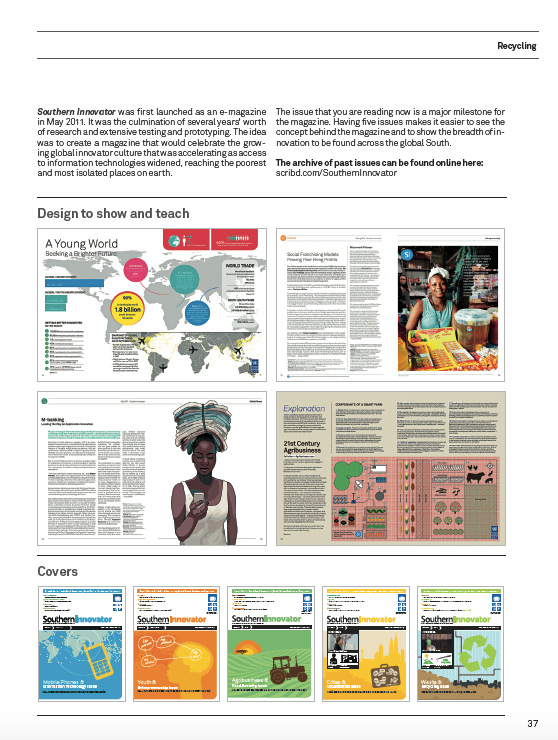
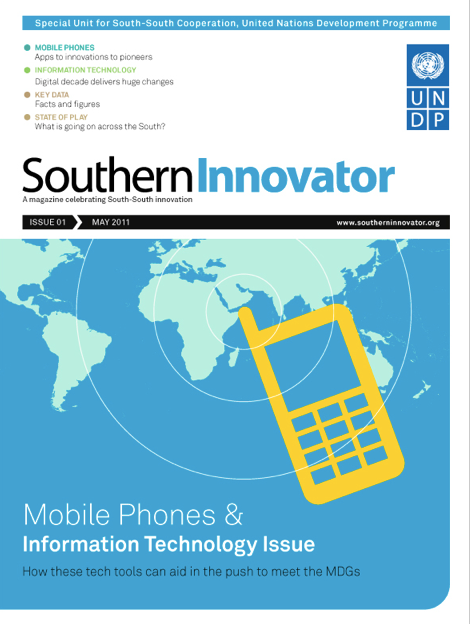
Development Challenges, South-South Solutions was launched as an e-newsletter in 2006 by UNDP’s South-South Cooperation Unit (now the United Nations Office for South-South Cooperation) based in New York, USA. It led on profiling the rise of the global South as an economic powerhouse and was one of the first regular publications to champion the global South’s innovators, entrepreneurs, and pioneers. It tracked the key trends that are now so profoundly reshaping how development is seen and done. This includes the rapid take-up of mobile phones and information technology in the global South (as profiled in the first issue of magazine Southern Innovator), the move to becoming a majority urban world, a growing global innovator culture, and the plethora of solutions being developed in the global South to tackle its problems and improve living conditions and boost human development. The success of the e-newsletter led to the launch of the magazine Southern Innovator.
Follow @SouthSouth1
Google Books: https://books.google.co.uk/books?id=_bgpEldq9JsC&dq=development+challenges+july+2009&source=gbs_navlinks_s
Slideshare: http://www.slideshare.net/DavidSouth1/development-challengessouthsouthsolutionsjuly2009issue
Southern Innovator Issue 1: https://books.google.co.uk/books?id=Q1O54YSE2BgC&dq=southern+innovator&source=gbs_navlinks_s
Southern Innovator Issue 2: https://books.google.co.uk/books?id=Ty0N969dcssC&dq=southern+innovator&source=gbs_navlinks_s
Southern Innovator Issue 3: https://books.google.co.uk/books?id=AQNt4YmhZagC&dq=southern+innovator&source=gbs_navlinks_s
Southern Innovator Issue 4: https://books.google.co.uk/books?id=9T_n2tA7l4EC&dq=southern+innovator&source=gbs_navlinks_s
Southern Innovator Issue 5: https://books.google.co.uk/books?id=6ILdAgAAQBAJ&dq=southern+innovator&source=gbs_navlinks_s

This work is licensed under a
Creative Commons Attribution-Noncommercial-No Derivative Works 3.0 License.
ORCID iD: https://orcid.org/0000-0001-5311-1052.
© David South Consulting 2023



 David South Consulting
You must be logged in to post a comment.