The global carbon credit trading schemes emanating from the Kyoto Protocol are now creating a multi-billion dollar market – the European carbon market was worth €14.6 billion in 2006 – and represents one of the fastest growing business opportunities in the world. Being green has finally come of age. Yet all the benefits of this are largely bypassing Africa despite more than 70 percent of the continent’s inhabitants earning a living off the land.
The World Agroforestry Centre – whose mission is to advance the science and practice of agroforestry to transform the lives and landscapes of the rural poor in developing countries – in partnership with Michigan State University has developed a method using satellite imagery and infrared sensing that measures carbon storage in African farmland. They have completed a pilot programme in western Kenya and are ready to encourage poor farmers to plant trees as soon as the European Union allows carbon credits under the Kyoto Protocol to be awarded for this kind of scheme. Further pilot projects will be rolled out in 2007 in partnership with CARE International and the WWF.
But European Union policies on carbon credits are holding back this significant opportunity to enhance African livelihoods. Europe’s Emissions Trading Scheme (ETS) is at present not willing to recognize the new method of verifying carbon storage in farmland. The ETS is the largest multi-country, multi-sector greenhouse gas emission trading scheme in the world. The issue of carbon storage, or carbon “sinks” as they are known, is very controversial in the world of Kyoto agreement implementation. Non-government organizations that advocate for forests and indigenous people have worked hard to exclude the use of forestry credits to offset fossil fuel burning, arguing that forestry offsets to date have been for big monoculture plantations of fast-growing eucalyptus or pine trees. It is claimed they are net carbon emitters over their lifetimes and also cause additional environmental and social problems.
But the World Agroforestry Centre’s approach is very different from a monoculture plantation. Their scheme is to help rural Africans to integrate more trees into their agricultural production systems, with benefits besides storing carbon. They argue that the right kinds of trees can increase the productivity and resilience of the land. Trees provide food, fuel, fertilizer, and medicine – medicinal trees are the main source of medication for 80 percent of Africa’s population.
Louis Verchon, the lead scientist for climate change at the World Agroforestry Centre, believes that if the EU would put in place a new scheme to credit farmers who capture carbon in their land, “millions of dollars in carbon credits could begin flowing to the world’s rural poor.” At present, Verchon says two-thirds of the carbon credit business is being captured by Asian countries who are mostly offering industrial solutions. “Africa has something to offer on this – it can’t compete with the likes of South Korea on industrial solutions, but it has plenty of land.”
In order to make the scheme work, two things will need to be improved: Africa’s institutional weakness and the paucity of qualified carbon credit verifiers. A network of verifiers would be required to inspect farm sites and make the calculations required to allocate carbon credits to poor farmers. At present, there are no qualified African-born verifiers in Africa according to Verchon.
The WAC are working with WWF and CARE to build up NGO capacity and start demonstration projects to prove it can work – two pilot projects are already up and running in Kenya. They are also automating much of the process by building a web portal.
Verchon says the WAC “are in it for the long-haul and we will see this grow over the next ten years.”
Kenya’s Greenbelt Movement: Founded by Nobel Peace Prize winner Wangari Maathai, it provides income and sustenance to millions of people in Kenya through the planting of trees.
The use of polluting fuel-burning stoves by half the world’s population – including 80 percent of rural households – is a documented contributor to a host of health problems. Poor households not only have to contend with the ill health effects of dirty water and poor sanitation, the fumes from burning dung, wood, coal or crop leftovers lead to the deaths of more than 1.6 million people a year from breathing toxic indoor air (WHO).
The polluting stoves have also been identified as major contributors to climate change. The soot from the fires produces black carbon, now considered a significant contributor to global warming. While carbon dioxide is the number one contributor to rising global temperatures, black carbon is second, causing 18 percent of warming.
Getting black carbon levels down is being seen as a relatively inexpensive way to reduce global warming while gaining another good: cleaner air for poor households. The soot only hangs around in the atmosphere for a few weeks while carbon dioxide lingers for years, so the impact can be seen quickly.
A flurry of initiatives across the South are now designing, developing and testing clean-burning stoves to tackle this problem. The number of initiatives is impressive (see list of clean-burning stove initiatives by country: http://www.bioenergylists.org/en/country), but the test will be who can develop stoves that poor households will actually use and find the right model to distribute them to half the world’s population.
In India, the Surya cookstove project is test marketing six prototypes of clean burning stoves with poor households. Developed by the Energy and Resources Institute (TERI) in New Delhi, the six stoves are still undergoing field testing. Initial criticisms from users have focused on the stoves’ durability and overly clinical appearance.
Cost will be critical to success no matter what the stove’s final design: “I’m sure they’d look nice, but I’d have to see them, to try them,” Chetram Jatrav in Kohlua, central India, told the New York Times. As her three children coughed, she continued that she would like a stove that “made less smoke and used less fuel” but she cannot afford one.
Envirofit India – founded in 2007 as a branch of the US-based Envirofit International – is at a more advanced stage, already selling clean-burning stoves across India and the Philippines. It claims to have already sold over 10,000 stoves to poor households.
They have developed high-quality stoves in four models: the B-110 Value Single Pot (a simple stove for one pot), S-2100 Deluxe Single Pot (a sturdier design), S-4150 Deluxe Double Pot (two burning surfaces), S-4150 Deluxe Double Pot with Chimney. They have been designed to be visually appealing for households – in tasteful colours like blue and green – and using high quality engineering for durability.
They have been tested by engineers at the Colorado State University’s Engines and Energy Conversion Laboratory and are certified for design and environmental standards.
The stoves are on sale in 1,000 villages in Karnataka, Tamil Nadu, Kerala, and Andhra Pradesh. The stoves have already successfully undergone pilot testing in Chitradurga and Dharmapuri. The manufacturer uses a network of dealers, distributors, village entrepreneurs and not-for-profit organizations to make the stoves commercially available for purchase. They hope to have 1,500 dealer outlets by the end of 2009.
“Envirofit clean cookstoves have received an overwhelming reception in India,” said Ron Bills, chairman and chief executive officer at Envirofit. “Our cookstoves are not only meticulously engineered to reduce toxic emissions and fuel use; they are also aesthetically designed and durable. Envirofit takes great pride in offering high-quality, affordable products to typically underserved global markets.”
But once again price comes up as a major issue: Envirofit’s stoves are designed to last five years, and thus they cost more than other stoves for sale in India. An Envirofit stove costs between 500 rupees (US $10) to 2,000 rupees (US $40): existing stoves sell for between 250 rupees (US $5) and 1,000 rupees (US $20), and last a year at most.
As one blogger complained: “The envirofit stoves … are way beyond the capacity of the low income households who form 65% of the Indian population. Only the 10% of the middle to higher income segment can go for them… perhaps the price can be brought down by reducing the showy part of the stove to help the poorest.”
Envirofit is part of the Shell Foundation’s Breathing Space program, established to tackle indoor air pollution from cooking fires in homes and hopes to sell and place 10 million clean-burning stoves in five countries over the next five years.
Published: May 2009
Resources
A video shows the installation of clean-burning stoves in Peru, South America. It also has links to many other videos of clean-burning stoves and how to build and install them. Website: http://www.youtube.com/watch?v=neZZvvnL8Lg
The global carbon credit trading schemes emanating from the Kyoto Protocol have created a multi-billion dollar market – the global carbon market was worth US $30 billion in 2007 (World Bank) – and represents one of the fastest growing business opportunities in the world. The bulk of this trading is with the European Union’s emissions trading scheme, some US $25 billion. But the big problem to date has been most of this investment is enriching stock brokers, and not the poor.
And this is a huge opportunity missed, as some point out: “These numbers are relevant because they demonstrate that the carbon market has become a valuable catalyst for leveraging substantial financial flows for clean energy in developing countries,” according to Warren Evans, the World Bank’s director of environment.
And the way to do this is through the Clean Development Mechanism (CDM) – where wealthy countries can meet their greenhouse gas targets by investing in clean energy projects in the South. But so far, it has been criticised for spending 4.6 billion Euros on projects that would have cost just 100 million Euros if implemented by development agencies.
But if done right, the CDM could become directly beneficial to the so-called Bottom of the Pyramid (BOP) – the four billion who live on less than US $2 a day. The CDM allows developed countries to offset their greenhouse gas emissions by paying projects targeting the poor to develop clean energy, or to create what are called carbon sinks (planting trees for example), to cut global emissions.
One mechanism to make all of this work is the CDM Bazaar: officially launched in September 2007, it is about linking together buyers and sellers. This is a place where people with business ideas or projects can go for start-up funding. It is also a place to share information, contacts and learn about how to tap the market.
And two Southern innovators are showing what can be achieved by tapping the power of the sun to help the poor.
One such initiative In India, owned by Mr. Deepak Gadhia and Dr Mrs. Shirin Gadhia, is targeting the 63 per cent of the BOP market that is with rural populations. All of these people need affordable and clean energy if their lives are to improve: most currently use firewood and kerosene for cooking and heating. The company Gadhia Solar is building and selling solar steam cook stoves in rural villages. The giant solar dishes which resemble satellite TV dishes, can fry and roast using the sun and come in Do-it-Yourself kits. The enormous silver dishes beam concentrated sunlight on to a black plate on the oven, reaching temperatures of over 450 Celsius.
In Morocco, the company Tenesol, an electric supply co-operative society, is using solar power to bring electricity to 60,000 poor households in 29 provinces. And it is making Morocco a world leader in the use of solar for rural electricity.
Each house is equipped with a solar home system comprising a solar panel, battery and controller. It is powerful enough to light four to eight lamps, and support a television, radio or mobile phone charger.
Customers pay a connection fee of US $80, and then a monthly service fee of between US $7.50 and US $17.50. The fee competes well with what rural households were spending on candles and batteries.
The initial outlay for equipment is mostly paid for by investors, with the hope that the money will be made back on the service fees.
Tenesol hopes to bring electricity to 101,500 households, and also wire them up and provide light bulbs.
UNDP has produced a free users guide introduction to the Clean Development Mechanism. Website: http://www.undp.org/
South South North has also produced a Practitioners’ Practical Toolkit. Website: http://www.cdmguide.com/
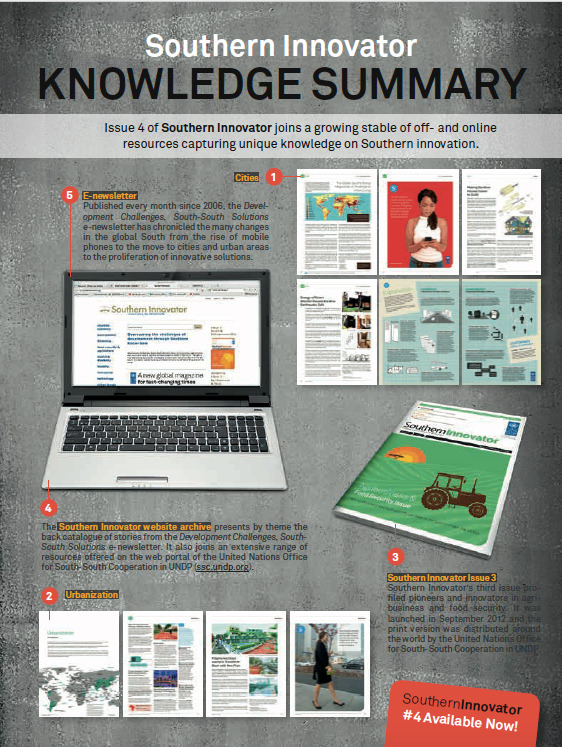
Development Challenges, South-South Solutions was launched as an e-newsletter in 2006 by UNDP’s South-South Cooperation Unit (now the United Nations Office for South-South Cooperation) based in New York, USA. It led on profiling the rise of the global South as an economic powerhouse and was one of the first regular publications to champion the global South’s innovators, entrepreneurs, and pioneers. It tracked the key trends that are now so profoundly reshaping how development is seen and done. This includes the rapid take-up of mobile phones and information technology in the global South (as profiled in the first issue of magazine Southern Innovator), the move to becoming a majority urban world, a growing global innovator culture, and the plethora of solutions being developed in the global South to tackle its problems and improve living conditions and boost human development. The success of the e-newsletter led to the launch of the magazine Southern Innovator.
An innovative social enterprise is using design to create an energy-efficient cookstove for Kenya. By turning to an experienced Swedish architecture and design firm, the people behind the Baker cookstove wanted to make sure the stove’s design was as efficient as possible and relevant to the customers’ needs, while also making sure it is visually appealing and something a person would proudly want in their home.
The Baker cookstove (bakerproduct.com) has been designed to be a high-quality and desirable product that also accomplishes the goal of saving money for the user. This unique product is being developed and made at the company’s factory in Nairobi, Kenya.
Baker’s owner is Top Third Ventures Global (topthirdventures.com), a social-impact company registered in Kenya and founded in 2011 by American Lucas Belenky and Björn Hammar, a Swedish/Finnish entrepreneur. Their goal is to make sure that everyone in the developing world has access to an affordable, high-quality efficient cookstove.
While cooking is a daily necessity for billions of people, it is also costly and polluting. By switching to energy-efficient cookstoves, families can reduce the cost of cooking daily meals and, if the stove is designed right, cut the amount of pollution generated. One of the great obstacles to the take-up of energy-efficient cookstoves to date has been the absence of sustainable business models to sell and distribute them.
The Baker cookstove, designed as an aspirational product and backed up with a seven-year guarantee, hopes to change this dynamic. If things go to plan, the company hopes to significantly scale up its production based on customers wanting to have a Baker cookstove proudly on display in their home.
The Baker cookstove is the product of a deliberate attempt to use design and a well-thought-out production life cycle to create an item that is eye-catching, effective, and manufactured consistently to a high standard.
Designed by Claesson Koivisto Rune (http://www.ckr.se/), a Swedish architecture and design firm, the Baker cookstove is a sleek, round, modern stove and comes in eye-catching colors such as orange. It could easily fit in with other kitchen products in a high-end design shop. And that is the point: they want people to want the Baker cookstove.
Quality is key, and engineering and design teams constantly monitor the product and make adjustments to the cookstove as they receive feedback from customers.
The Baker cookstove is benefiting from new financing being made available through carbon credits, which its founders believe will bring big changes to the energy-efficient cookstove market over the next 10 years.
Baker’s chief executive, Lucas Belenky, told Southern Innovator magazine – this newsletter’s sister publication – about the thinking behind the Baker cookstove.
SI: What role does design play in the Baker cookstove social enterprise? At what stage did Top Third Ventures start to think through the production life cycle for the Baker cookstove? What did you feel was missing in the other cookstove models currently available on the market?
The Baker cookstove is the cornerstone of the social enterprise. Top Third Ventures is at its core a product company. There are different aspects to the business model to make it work (i.e. carbon credits and big data) but everything depends on the success of the Baker product. We started thinking through the production life cycle from the day the company was founded in late 2011. The Baker is designed for usability, aspirational value, and performance, prioritized in that order. The most important thing is that the Baker is easy to use and does not require its users to change their daily routines or cooking habits. Cooking cultures vary greatly across the developing world so it is important to understand exactly who your customer is and focus on meeting their requirements. When you have a product that is easy to use it needs to be desirable as well. Beyond the service provided, the product should make the customer feel good about themselves. Finally, the Baker cooks the same food with half the fuel and much less smoke.
The priorities seem reversed for other cookstove models on the market. Efficiency comes first, then the aesthetic design, and cultural conformity is last. Hyper-efficient cookstoves are great for health and the environment on paper but the benefits are not realized because widespread adoption isn’t achieved. Most products are imposed through a top-down approach instead of starting with the customer and designing the stove around them.
SI: Why did you choose to have the Baker cookstove designed by Claesson Koivisto Rune, a Swedish architecture and design firm? What were some of the challenges encountered when designing the product and the production life cycle? What advice do you have for other social enterprises looking to offer an appealing product to low-income households?
We wanted the Baker cookstove to be an aspirational product that you use as much because of the performance (less fuel and less smoke) as because it is beautiful. Claesson Koivisto Rune believed in our vision at a very early stage and I doubt we could have gotten where we are today without them. Challenges around the design mainly involve keeping the costs down. Our customers do not have a lot of disposable income so balancing affordability with performance and world-class design is tough.
For other entrepreneurs selling to low-income households my advice is identify your customer, listen to them, and never stop listening. This is obvious to most businesses but for social enterprises sometimes the grant organizations or other dispersers of donor funding become the customer without you noticing.
Finally, often just because the consumer is in a developing country, enterprises neglect aesthetic appeal and branding. Do not do this. Your consumer behaves for the most part like their counterpart in the developed world. They want products that look nice and make them feel good.
SI: What role is information technology playing in the Baker cookstove’s development? How do mobile phones help with reaching customers in Africa? How does offering software products such as Top3Tracker help Baker cookstoves?
Information technology has a huge impact in decentralized areas because it enables cheap flow of information. For Top Third Ventures it allows us to track our sales in real-time, communicate with current and future customers instantly, and gain valuable insights about how to improve the sales pitch and marketing strategy. The Baker cookstoves also depends on carbon finance, which requires a dialogue with current customers to ensure the usage of the cookstove is accurately measured. Information technology such as our Top3 Tracker significantly reduces the cost of accessing carbon finance.
SI: It is said an innovator is somebody who disrupts existing products and ways of doing things. How is Top Third Ventures innovating and disrupting the current approach to energy-efficient cookstove distribution?
We hope to change the way products for low-income households are designed, marketed, and sold. Top Third Ventures’ Baker cookstove embodies our conviction that these products should be customer-centric, have aspirational value, and conform to local cultures. The success of our product will show that consumers in the developing world want the same thing as their counterparts in developed countries.
Top Third is a partner of the Global Alliance for Clean Cookstoves (cleancookstoves.org).
Published: December 2013
Resources
1) Baker cookstove: The website details how the cookstove was developed. Website: bakerproduct.com
2) Top Third Ventures: The company designs, manufactures, and sells its own unique efficient cookstoves made to fit the local cultures and traditions of their customers, supported by a strong brand and world-class customer communication. In addition, Top Third Ventures works with existing manufacturers and distributors to secure carbon financing for their activities through their programmatic CDM activity and electronic data management system. Website: topthirdventures.com
3) Global Alliance for Clean Cookstoves: The Global Alliance for Clean Cookstoves calls for 100 million homes to adopt clean and efficient stoves and fuels by 2020. Website: cleancookstoves.org
Like our content? Help contribute to the costs of keeping it online.







 David South Consulting
You must be logged in to post a comment.