Categories
Archive id magazine

Province For Sale: Step Right Up For An Opportunity To Buy What You Already Paid For

“This is not being driven by fiscal or ideological motivation, though that may seem funny.” Conservative advisor James Small

By David South

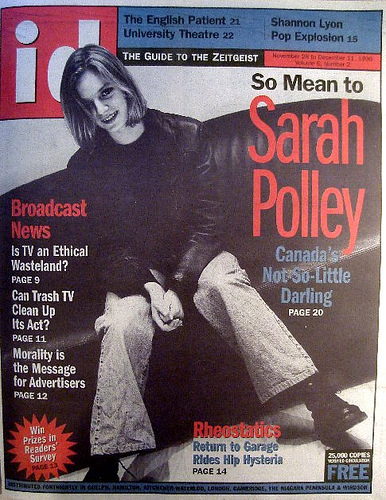
Id Magazine (Canada), December 12 to December 26, 1996

It is looking more and more like the Conservative government will launch a massive privatization campaign by the middle of next year. And it is becoming clear how key government assets such as Ontario Hydro, liquor stores and public broadcaster TVO will end up in private hands. The prevailing ideology of key advisors to the Harris government, including influential financial heavyweights at Canada’s top underwriters, is leaning towards a free-for-all where the highest bidder will win. 

To date, the government has been coy about its plans, occassionally making vague threats that certain services need to be “looked at.” Assets that could go on the block include road maintenance, jails and the Ontario Clean Water Agency. In August, the government appointed former banker Rob Sampson as the minister for privatization. His days as vice-president of corporate finance at Chase Manhattan make him a popular candidate with the suit, tie and blouse crowd on Toronto’s Bay Street. 

While Sampson is so far surrounded by only a handful of advisors, the plan is to create a privatization agency that will supervise each sell-off after getting the go-ahead from Cabinet. 

Sampson’s policy advisor James Small, sums up the government’s attitude: “This is not being driven by fiscal or ideological motivation, though that may seem funny. We can do better for less, even though that may sound trite.”

The government’s taxpayer-is-always-right attitude means it believes the best option is to float the newly privatized companies on the stock market, letting the highest bidder win. 

“We have sophisticated investors in Ontario,” continues Small. “[Privatization] is not driving us to expand shareholders in Ontario. Can we, as taxpayers, benefit? What will give the best results. It is not ideological. In Canada we have a consumer culture and a very mature social structure. The market will determine what people will pay for things. We didn’t get elected to sell the family silver.

“There has been 16 years of this happening. But is Margaret Thatcher the way to go? One of the advantages for Ontarians is that we can pick and choose the best approach. It’s difficult to point to one part of the world, one way we could provide better service.”

Shareholder Democracy

A concept popularized by British prime minsiter Margaret Thatcher in the 1980s, shareholder democracy actually saw the light of day in British Columbia back in 1979. Then, premier Bill Bennett embarked on an ambitious scheme to give every citizen of the province, including children, five shares in the British Columbia Resources Investment Corporation, a mining and logging company. Out of a population of 2.4 million, 2.07 million applied for the shares. While that idealistic experiment eventually failed as a series of bad deals pushed the share price down and arrogant executives pissed people off, it was a bold initiative. 

Similar schemes have been used in Eastern Europe to increase private ownership in the economy. 

But it is looking more and more like the government is going to try and avoid even a semblance of giving Ontarians a fair shake, by selling shares on the stock market to whoever can afford them. While the NDP and unions are opposed to privatization for some very good reasons, they are missing out on an opportunity to push the government to divide the shares up amongst all Ontarians (not necessarily a big stretch for the NDP, who brought us toll highways). 

Shareholder democracy has developed two broad – and opposing – interpretations. For the left, a shareholder democracy in its truest sense is public ownership. For right-wing idealists, it means a nation of share owners playing the stock market with all the aggressiveness and greed of free-market capitalists. 

Like any ideal, the reality is far more disappointing. Any small-time stock holder will tell you about arrogant CEOs and board members not listening to them. Ask any Ontarian on the street, and they will tell you about arrogant and incompetent civil servants who aren’t listening to them. 

There is a more radical and fairer approach to privatization that would suit the populist rhetoric of the Conservatives. It involves selling shares along the lines of WWII war bonds. This solution would satisfy left-wing concerns the rich would run away with all the loot, while massively increasing share ownership in Ontario and raising funds to improve services and infrastructure. By selling millions of shares cheaply, and forbidding the trading of those shares, millions of Ontarians could reap the benefits of profit-making assets. This scheme would be contingent on reorganizing those agencies to become profitable, but could avoid a fire sale of taxpayer-funded agencies to wealthy corporations and investors. If critics of the government took the opportunity to guide the Conservatives, when a privatization is announced, towards mass share ownership, some good would come of it. 

With all its scandals, bad publicity, grotesque executive salaries and inconsistent service that has turned privatization into a dirty word in the UK, the fact is share ownership did go up. In 1979 when Conservative prime minister Margaret Thatcher was elected, shares were owned by 2.5 million people; by 1992, 11 million people had shares or a quarter of the population. Narrowly defined, that is a success. 

But the mainstream financial community loathes the idea for obvious reasons. At consultants KPMG, corporate evaluater John Kingston symbolizes the opposition to anything other than a straight sell-off at the stock exchange. “Issuance of shares to employees doesn’t put any new money into the coffers, like in the Eastern European example of gifting shares,” he says. “But selling shares to the public does provide some compensation. They must satisfy taxpayers by getting the right amount.”

“I think if government is going to privatize then it is a good time to do it,” says Deloitte and Touche’s Jim Horvath, a veteran of privatizations in Argentina, Hungary and Brazil, who supports a quick sell. “The stock market is up. There are a lot of deep pockets looking for investments.”

The mantra for an open sale will get louder as each privatization approaches. But such a sale does have its disadvantages. 

Advantages of an open sale: 

Can get the highest price. Use the funds to pay down debt or a one-time only increase in funds for something like health care. Argue protecting taxpayers’ interests by selling for the best price. The asset could raise funds on the stock market to improve infrastructure/services. Once in private hands, future governments will have a hard time trying to buy assets back. 

Disadvantages of an open sale: 

Taxpayers are also consumers; they could get screwed by any increase in rates. There is no guarantee the government will use funds for public good (maybe they will build another casino?). Any pay-off is once only, whereas the LCBO for example, makes money every year. Government could make a mistake and sell for too low a price. 

Government Agenda

Two factors could significantly slow down the government’s ability to launch privatizations. The Conservatives have relished making cuts to government services despite labour unrest, but it has shown little skill at the more intellectual task of implementing a new philosophy. Major planks of their Common Sense Revolution, such as workfare, are bogged down and in chaos. Privatization will need a sophisticated sales job to counter-attack the slick television and newspaper ads unions have been running for the past year attacking privatization. Encouraging mass share ownership would show that leadership the government sorely needs. 

The second liability is its own ambitious agenda. Already the Legislature has had to extend its term to try and deal with a backlog in reforms, including chopping another $3 billion, rearranging how government services are delivered and fighting the province’s doctors. But if it must privatize, then the honourable thing to do is to offer mass ownership. To do otherwise will show Ontario isn’t even capable of the heights of imagination some of Eastern Europe’s new democracies have shown. 

Note: I debated this topic on CBC TV’s Face Off after this was published. 

Cover headline: “The Harris Tories have an opportunity to turn Ontario into a shareholder democracy. Will they take it?”

This work is licensed under a Creative Commons Attribution 4.0 International License.

ORCID iD: https://orcid.org/0000-0001-5311-1052.

© David South Consulting 2025

Categories
Archive UNDP Mongolia 1997-1999 United Nations Development Programme

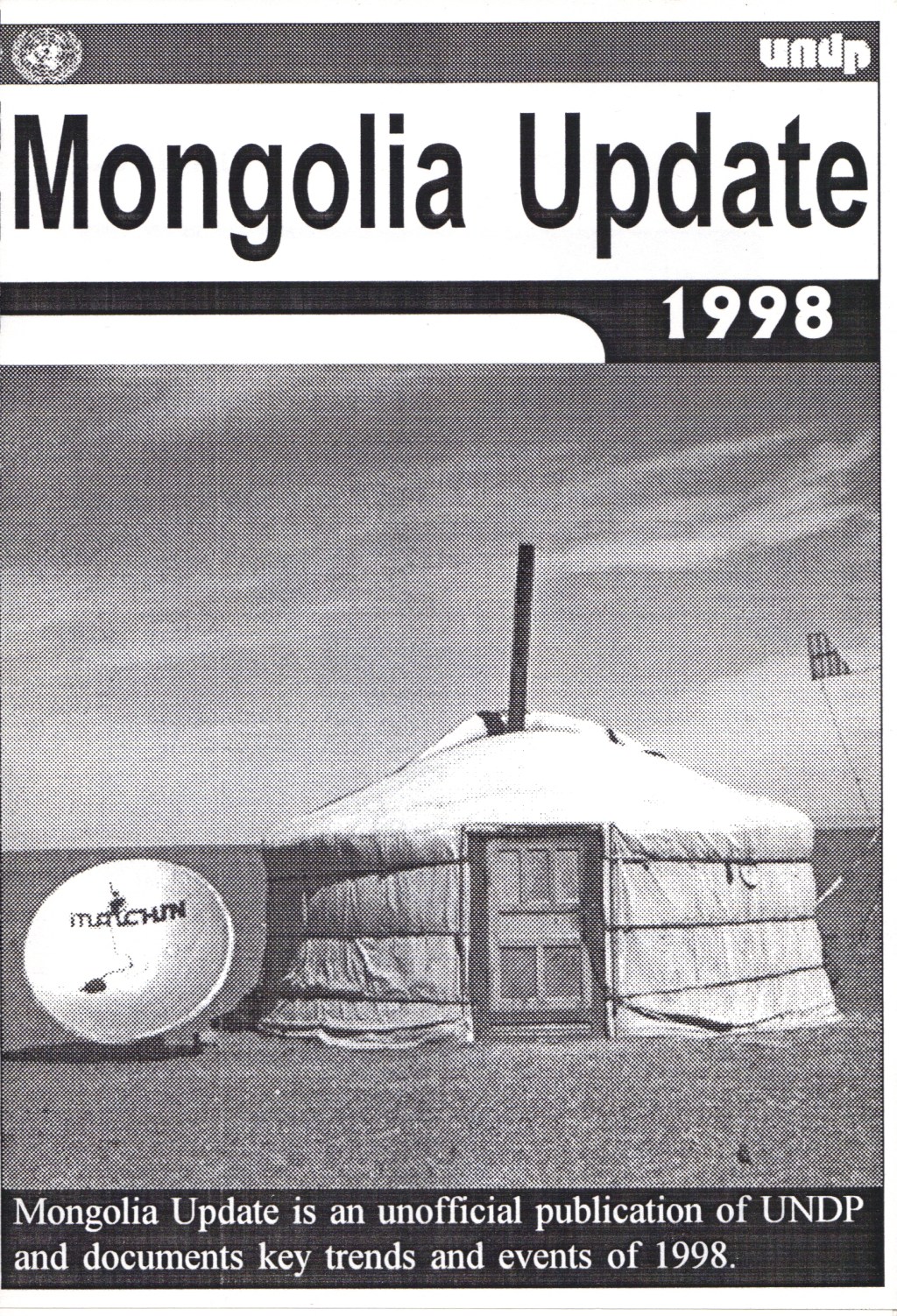
Mongolia Update – Coverage Of 1998 Political Changes | 1999

Editor and Writer: David South

Researcher: G. Enkhtungalug

Publisher: UNDP Mongolia Communications Office

Published: February 1999

Background: Mongolia Update – Coverage of 1998 Political Changes was a one-off special edition of Mongolia Update to help explain a politically turbulent year where three governments and three prime ministers came and went. At the time, Mongolia was in the grips of a severe crisis, called one of “the biggest peacetime economic collapses ever”. By 2012, Mongolia was called the “fastest growing economy in the world”. It is proof the foundations for Mongolia’s recovery from crisis were laid in the late 1990s. The success of the peaceful transition stands in stark contrast to many other international interventions post-2001. 

Mongolia Outlook 2012: World’s Fastest Growing Economy (Publisher: Eurasia Capital), 31 January 2012.

This is an unofficial publication of UNDP. Views presented in this document do not necessarily reflect those of UNDP. Mongolia Update is provided as a service to those who are interested in the rapid changes taking place in today’s Mongolia. A note about Mongolia Update: The Mongolia Update has proven to be one of the more popular documents produced by the UNDP Mongolia office. Since the autumn of 1997 UNDP has been able to offer two more frequently updated sources of information: the UNDP homepage and our monthly newsletter, the Blue Sky Bulletin (available from our office if you are not already receiving it). Please use the United Nations Homepage at http://www.un-mongolia.mn to keep abreast of the latest political, economic and social developments in Mongolia. Mongolia Update is an unofficial document of UNDP and is designed to periodically keep our partners outside of Ulaanbaatar apprised of issues in the country. 

A year of political divisionsWho is who in the cabinet
A government of technocrats

Background — a year of political divisions

Divisions in the ruling Democratic Coalition Government in 1998 led to the fall and rise of three governments and three prime ministers. From the beginning of 1998 cracks within the Coalition intensified. A number of Democrats were dissatisfied with the system whereby the Prime Minister and the Cabinet were not parliamentarians, but “experts” appointed from outside and perceived to be aloof from Parliament. On January 15, 1998, after several weeks of wrangling Parliament ruled that under the Mongolian constitution MPs could serve as Cabinet ministers. It was to prove a fateful decision for the year-and-a-half old M. Enkhsaikhan Government.

A faction within the Coalition Government became more vociferous, with its complaints that the Democrat’s election promises would not be fulfilled without better coordination between the Government and the Parliament. Things came to a head when the General Council of the Mongolian National Democratic Party (MNDP) called for the resignation of its own Government. The move was led by the 35-year-old Speaker of the Parliament and MNDP caucus leader Ts. Elbegdorj – a natural Prime Minister in a Government of MPs. After a joint meeting of the ruling councils of the Mongolian Social Democratic Party (MSDP) and the MNDP, Prime Minister Enkhsaikhan handed in his resignation to Mongolian People’s Revolutionary Party (MPRP) President Bagabandi. The new Prime Minister, Ts. Elbegdorj, was sworn into office on April 23, vowing to chart the same economic course as his predecessor. While trying to form his Cabinet, Elbegdorj quickly ran into trouble.

The opposition MPRP was emboldened, exploiting the fissures in the Democratic Coalition. They started to launch attacks against the new Government. Elbegdorj’s attempts at forming a Cabinet were delayed as one candidate after another was rejected.

The Cabinet was not composed until May 28, when 28-year-old CH. Saikhanbileg became Education Minister – the fifth nominee put forward for the post. The new Government faced an opposition boycott of Parliament by the beginning of June, in the wake of the merging of a state bank with a private bank amidst charges of conflict of interest. On July 25 Ts. Elbegdorj and his entire Cabinet resigned after losing a no-confidence vote in Parliament. The Elbegdorj cabinet continued to work as an acting Government. The murder of prominent democrat and minister of infrastructure S. Zorig shocked the nation October 2. Poised to become a candidate for Prime Minister, Zorig was axed to death in his apartment by two assailants. The crime remains unsolved and grabbed international headlines in what had been seen as the most peaceful country making the transition from communism to democracy. In November the Constitutional Court ruled MPs holding Cabinet posts as unconstitutional. This effectively reversed the aforementioned Parliament decision of January 15, 1998. Throughout the year opinion polls showed a growing weariness and disillusionment creeping into the body politic over the political indecision.

By December a compromise Prime Minister was found, in the form of the mayor of the capital city, Ulaanbaatar. On December 9 Prime Minister Narantsatsralt took office. As 1998 turned into 1999, Narantsatralt was still trying to have his Cabinet approved by both the Parliament and the President.

External economic turmoil started to have its affect on Mongolia in 1998. Many thought the country could ride out the Asian crisis unscathed, but Prime Minister Ts. Elbegdorj admitted in June it was unavoidable. Copper prices, Mongolia’s largest foreign currency earner continued to plummet to record lows. Prices for cashmere and gold, major exports for Mongolia, also declined. The picture for the domestic economy had some bright spots in 1998, with inflation under control and an expansion in the informal service sectors. The Government’s Green Revolution campaign was able to significantly boost the production of vegetables by encouraging home gardening. The economy was still supported by foreign aid, which totaled US $205 million in commitments for the year.

Instability in Russia has also had an impact on Mongolia. For example, in May Russian coal miners blocked the Trans-Siberian train that passes through the capital Ulaanbaatar on its way to China. In August a severe benzene shortage prompted the reintroduction of rationing. At its worst all gas supplies for the country were pulled back to the capital, leaving many stranded and unable to drive cars and run gas-powered electricity generators. The delays were due to job actions by Russian workers. Russia accounts for 30 per cent of Mongolia’s imports and 13.5 per cent of its exports. On the plus side, foodstuffs from Russia became cheaper with the decline of the rouble.

Who is who in the Cabinet

Prime Minister R.Amarjargal, 38 year old Moscow educated economist. He graduated from Economic Institute of Moscow as an economist and a teacher in 1982 and  earned a master’s degree at Bradford University in 1994-1995. 

1982-1983, he was an instructor in Mongolian Trade Union, 1983-1990, he worked as a teacher in Military Institute, 1991-1996 has served as Director of the Economics College. He was a popular Foreign Relations Minister before resigning with the entire cabinet on July 24, 1998. A member of MNDP, he speaks fluent Russian and English.

Finance Minister Yansangiin Ochirsukh. Born in Ulaanbaatar, economist Ochirsukh graduated from the Mongolian National University and did postgraduate work at Columbia University in the United States. He worked as a lecturer and researcher at the University before moving to the Mongol Bank, where since 1997 he has been in charge of foreign exchange and reserve policy. A member of the Mongolian Social Democratic Party, he speaks Russian, English and Chinese.

Minister of External Relations Nyamosoriin Tuya, 40, was born in 1958 in Ulaanbaatar. Studied in the Institute of External Relations in Moscow, Russia in international journalism. From 1984 to1985 she studied French culture and civilisation at the Sorbon University and did a Masters degree on the ” Theory of Democracy” at Leeds University, England. Ms.Tuya speaks English and French. Married with two sons and a girl, she worked as editor of the foreign programming service of Mongolian Radio. After 1996, she was working as Head of the Department for Common Policy at the Ministry of External Relations.

Minister of Environment Sonomtserengiin Mendsaikhan, 39, was born in Ulaanbaatar, and completed degrees at the Mongolian State University and the State University of Irkutsk, Russia in mathematics. S.Mendsaikhan speaks German and Russian. Married, he has a daughter. Started his career as a math teacher at an Ulaanbaatar school, he also worked as a lecturer at the Mongolian State University and later become general secretary of the Social-Democratic Party. From 1992 to1993 he worked as a manager in the Unuudur (Today) private newspaper. From1993 to 1997 he worked as a private company director, and in 1997 he was assigned as advisor to the Parliament’s Speaker.

Minister of Defence Sh.Tuvdendorj, 32, graduated from the Army Academy of Mongolia and the Otgontenger Language School. He worked as an army officer, technician and laboratory engineer at the State Telecommunications Utilisation Committee. He started a political career in 1994, working as secretary in charge of local affairs. In 1997, he was elected as general secretary of the Mongolian National Revolutionary party.

Minister of Agriculture Choinzongiin Sodnomtseren, 46, was born in Ulaanbaatar and is married with three children.After attending Mongolian State Agricultural University, he acquired a Ph.D. in Saint Petersburg, Russia. He also has a Ph.D. degree in veterinarian sciences.

While spending many years of his career on research studies, he worked as a lecturer at the State agricultural University. Sodnomtseren became later Principal and Rector of the State Agricultural University.

Minister of Health and Social Welfare Sodoviin Sonin. Born in Ulaanbaatar in 1956, S.Sonin graduated from the Medical University of Irkutsk and Mongolia’s State Administration and Management Development Institute. A doctor and professor of medicine, he has taught surgery at the Mongolian Medical University, worked at the Central Clinical Hospital and served as a department chair at the Ministry of Health and Social Welfare. Since 1991 he has headed the Asian Development Bank-backed Health Sector Development project. Sonin, who speaks Russian and English, does not belong to any political party.

Minister of Infrastructure, Gavaagiin Bathuu, 39, born in Hujirt county of Uvurhangai province. Married with two sons and a daughter, he graduated from the Economics Institute of Harikof, Russia as an auto engineer and economist. He speaks Russian and English. He started his career as a repairman and dispatcher at the state auto-engineering company.From 1986 to 1992, he worked at the Ministry of Infrastructure as an officer and senior officer and from 1992 to 1996 he worked as Director of Shunklai Company. Since1996 he was working as a head of the Department for Road and Transportation at the Ministry of Infrastructure.

Minister of Justice, Logiin Tsog, 47, was born in Ulaanbaatar. He graduated from the State University in Irkutsk, and from the Social Science Academy in Russia. A lawyer with high education in politics, he speaks Russian and English. He worked as the prosecutor for the department at the Ministry of Justice. From 1988 to 1989, he worked as inspector at the Mongolian Revolutionary Party’s Inspection Committee. From 1990 to 1991, he was assigned as the Head of the Standing Committee of the State Baga Hural (parliament of that time) on legal issues. From 1991 to 1996 he was general director of the “Golden Button” Co. Ltd and in 1996 he was elected as general secretary

Minister of Enlightenment A.Battur was born in 1965 in Hovd aimag. Battur is a career diplomat who graduated from Russia’s Institute for International Affairs and completed a postgraduate course at France’s Institute for International Affairs. He worked as an attaché in the Foreign Ministry between 1989 and 1992, and spent 1992 to 1996 as the cultural attaché at the Mongolian Embassy in France-where he also worked with UNESCO- before returning to senior administrative positions at the Ministry in 1996.

A member of the Mongolian National Democratic Party, he speaks English, French and Russian and is married with two children.

A government of technocrats

By January 15, 1999 Mongolia had its first complete Government in six months. All nine members of the Mongolian Cabinet have been approved and appointed. Like Prime Minister Narantsatsralt, they are not Members of Parliament. Since all nine Cabinet Ministers were chosen for their experience, many expect a more stable course to be charted for the remainder of the Democratic Coalition’s term in office (until 2000). However, the new Government might experience the same sort of complaints the Enkhsaikhan Government received, when Parliament accused those ministers of being aloof. It is also unclear if the MPRP will continue to offer a vigorous opposition. For the time being its seems the political forces have exhausted themselves and there is a genuine desire for stability in 1999. The new Government is expected to follow the same reform directions of the two previous Democratic Coalition Governments and details will emerge over the coming weeks.

Further explore this turbulent period in Mongolia’s history here: Wild East 17 Years Later | 2000 – 2017

UN Mongolia Annual Report 1998
The UNDP Mongolia Communications Office oversaw a busy online and offline publishing programme from 1997 to 1999.

https://davidsouthconsulting.org/2023/01/09/mongolia-update-1998/

ORCID iD: https://orcid.org/0000-0001-5311-1052.

© David South Consulting 2018

Categories
Archive Birkbeck University of London Blogroll

A Steppe Back?: Economic Liberalisation And Poverty Reduction In Mongolia

Paper delivered to the School of Politics and Government, Birkbeck College, University of London, London, UK, 2000

“… the neo-liberal claim that transition is most successful in situations where state organs wither away is highly problematic. The state, it seems, is required as a fundamental regulatory formation in transition (Pickles and Smith 1998: 15).”

By David South

This paper will explore the profound weaknesses of economic liberalisation as a tool of poverty reduction in the developing world. I have chosen to explore the experience of the Northeast Asian nation of Mongolia; a country sandwiched between Russia and China which has been held up as an example of how economic liberalisation policies and strong personal freedoms can help a country make the transition from a command-based Communist country to free markets and democracy (UNDP Mongolia: The Guide 1997-1999). I argue that the slate of policies that constitute economic liberalisation (or “shock therapy”) in the 1990s – privatisation, price liberalisation and a free-floating currency – are, by themselves, poor mechanisms for the alleviation of poverty; that in fact they increase poverty rates and leave a legacy of weak institutions that are either unwilling to, or incapable of, helping the poor. The author will also draw on firsthand evidence gained while working in the United Nations mission in Mongolia for two years.

Economic liberalisation policies have been inhibited from alleviating poverty by the cultural legacy of Mongolia’s economic development, which has de-emphasised private property and a money-based economy and placed a high emphasis on wealth being held in herds of animals and goods exchanged by barter.

Mongolia, with its relative isolation and small population of 2.4 million (Human Development Report Mongolia 2000: 55), has been seen as a self-contained petri dish by economic liberalisers hoping to incubate a robust transition to free markets and democracy that can serve as an example to other post-Communist states.

Mongolia’s journey towards neo-liberal ideas is unique. Unlike many other developing nations, Mongolia’s lively democratic movement that emerged at the end of the 1980s actively sought out these policies, and has enjoyed strong and widespread public support for them (though this has ebbed and flowed with the economic fortunes of the country). The 1996 election was fought and won by the Democratic Coalition based on these policies; the Coalition won 50 of the 76 seats in Mongolia’s parliament, and voter turnout was more than 90 per cent (Far Eastern Economic Review 1997: March 27). Thus, this is not a case of international institutions forcing upon a country policies against its wishes: the door was opened and the economic liberalisers were effectively invited in for a big bowl of fermented mare’s milk.

However, it is also a country in which economic liberalisation has failed to deliver anticipated reductions in poverty for the majority of the population, and a strong case exists that it has made things worse.

As the Human Development Report Mongolia 2000 states:

In recent years however, the predominant vision has been neo-liberal. Backed by some international donors, reformers have argued that the best thing the state can do is to largely withdraw from the economy – by rapidly privatising state enterprises, and dismantling as many regulations and controls as possible, and allowing market forces to determine the production and allocation of goods and services. (Human Development Report Mongolia 2000: 13)

Liberalisation policies in Mongolia: A potted history

With the fall of the Soviet Union at the beginning of the 1990s, Mongolia woke up to find itself without its financial benefactor for most of the 20th century, Russia, and in the grip of a severe economic decline (Rossabi 2000: 9).

But a new “big brother” was at hand. In 1991, economic liberaliser Jeffrey Sachs arrived in Mongolia (Fortune 1998: December 7). The arrival of Sachs and his ideas were to have a profound impact on the lives of Mongolians. He gathered a group of well-educated Mongolian economists to test economic liberalisation theories.

Smith and Swain neatly summerise the source of economic ideas for the transition states:

The roles played by Francis Fukuyama (1992), formerly of the US State Department, and Jeffrey Sachs (1990), as policy adviser … translated this agenda into the all too familiar programme of so-called ‘shock therapy’. Shock therapy has been based on the view that capitalism could be … imposed by fiat and that the unleashing of the power of capital will inevitably allow the institutions, regulations, habits and practices associated with the ‘normal’ functioning of a capitalist market economy to emerge (Smith and Swain 1998)

The economic liberalisation project in Mongolia can be split into two distinct phases. The first more tentative phase under the Communist government extended from 1990 to 1992 and included privatisation of some state firms, the issuing of stock-market vouchers to most of the population and a failed attempt to enter the foreign currency markets (as a result of which 80 per cent of the country’s reserves were lost). This phase coincided with a new constitution, democratic elections and significant improvements in personal freedoms.

The economic liberalisation project encountered serious difficulties from the start, and when all aid and subsidies from the Soviet Union were removed, the economy collapsed, with inflation spiralling to 320 per cent (Human Development Report Mongolia 2000: 13). Pro-economic liberalisation factions in the Communist government lost influence and the reforms stalled from 1992 until 1996, when they were re-started with a vengeance with the election of the Democratic Coalition. The Coalition was assembled from a hitherto fragmented opposition by the Washington-based International Republican Institute and mimicked the policies of the American Republican Party, including distributing a Newt Gingrich-style “Contract with the Mongolian Voter.”

The second phase of reforms, under Democratic Coalition Prime Minister M. Enkhsaikhan, was launched with the removal of price controls on fuel and electricity, increasing prices by 50 per cent (Rossabi 2000: 11). This phase of economic liberalisation also ran into difficulties, but its most successful policy achievements have been the privatisation of public housing, the removal of trade tariffs and the reining in of inflation.

Poverty and economic liberalisation

Prior to the introduction of economic liberalisation, there was no extreme poverty in Mongolia, though it is difficult to gauge relative poverty since this information was not gathered. Rossabi notes, however, an extensive public welfare system was spread throughout the country:

The Mongol economy required substantial subsidies from the Soviet Union. This command economy produced inefficient industries, few consumer goods, and scant increases in the size of the Mongol herds. The one-party system limited dissent and contributed to human rights abuses. On the other hand, the government provided extensive medical, educational, and welfare benefits to the young, women, the elderly, and indeed much of society. A growth in population, a longer life span, and high rate of literacy were byproducts of such state policies. (Rossabi 2000: 6)

All research data has shown an increase in poverty levels for a large portion of the population after 1990. Estimates vary wildly, but the United Nations Development Programme reports that 38.4 per cent of urban dwellers – and 32.6 per cent of rural residents – were poor in 1998 (Human Development Report Mongolia 2000: 23). School attendance is down, regional disparities have become more extreme, with the capital experiencing a boom fuelled by international aid (this totalled US $180 million in 1998 (Mongolia Update 1999: 27) and an expanding service sector. Provincial towns and smaller communities have seen local state-run businesses collapse, communications weaken, and a leaching of the population, either to the countryside to herd animals or to the capital to seek work.

To cite one graphic anecdotal example of the process, a consulant for the Asian Development Bank told a 1998 donor agencies meeting of the irony of going into former factory towns, and telling the well-educated residents to turn to small crafts and itinerant vegetable growing rather than restarting the existing factory.

Mongolia’s transition: theoretical dilemmas

As Pickles and Smith note in their work of political economy Theorising Transition: the Political Economy of Post-Communist Transformations, it is a profound mistake to ignore the distinctive evolution of each of the former Communist states. Mongolia’s attempts at transition to a market economy have been deeply marked by its cultural legacy, in spite of attempts to transcend this. While Ohmae may assert that “This movement up the ladder of development has nothing to do with culture and everything to do with the region’s ability to put the right policies, institutions, and infrastructure in place at the right time (Ohmae 1994: 21),” culture is crucial. It is simplistic to depend on a “stock set of policies to enable the supposed transition to capitalism at the end of the twentieth century to be achieved (Pickles and Smith 1998: 10).”

As Pickles and Smith add about post-Communist Eastern Europe:

Treating post-communist Eastern Europe as a whole fails to recognise the ever-present diversity of some 27 states and 270 million people. Even at the end of the nineteenth century, such political-economic diversity was central to what was unfolding in the region … The diversity of historical experiences was replicated under state socialism, and while we would not argue for some form of historical determination, the state socialist economy in part relied upon these spatial divisions of labour and forms of social organization and institutionalised practices, albeit that large-scale attempts at forced industrialisation were made to eradicate the legacies of ‘peasant societies’ and uneven capitalist development. (Pickles and Smith 1998: 12)

Historically, Mongolia had never experienced capitalism, even in its most basic and embryonic form. Prior to the 1921 revolution which made Mongolia the world’s second Communist country, the vast majority of its citizens were divided between two occupations: nomadic herding, and the herding of souls as Buddhist monks. There was a small trading community, including a tiny community of Jewish traders – a legacy of the long-gone silk route that once plied its way through the Mongol Empire. But modern, urban, industrial capitalism as was present at this time in Europe was nonexistent in Mongolia. Concepts of capitalism, market economics and private property were introduced anew after 1990.

Urbanisation, modernisation and industrialisation were wholly communist concepts in Mongolia prior to 1990. The traditional nomadic way of life measures wealth in terms of the size of the herd and places a high value on the ability to roam unencumbered by private property divisions and the ability to trade animals for other goods (though these needs are simple since a nomadic herder can only carry around a limited quantity of possessions).

Economic liberalisation policies have, ironically, only exacerbated this trend, driving more of the economy into barter relations and actually pushing a portion of the population out of urban areas and into subsistance herding in order to survive (Partnership for Progress 1998: 2-3).

Mongolia also offers some anomalies to theories of economic and democratic liberalisation. Lewis contends that democracy gives a nation a distinct economic advantage. “Average wealth, the degree of industrialisation and urbanisation and level of education are perceived to be much higher for countries which are democratic, education being of particular importance in this respect (Lewis: 1997).”

Yet as Fortune magazine noted, “No other Asian country enjoys more political freedom today than Mongolia. And no other Asian country has shown greater commitment to open markets. But Mongolia has received little reward for its efforts (Fortune 1998: December 7).”

The role of the state

Broad, Cavanagh and Bello see a strong argument for clear state direction in underdeveloped economies in the beginning stages, before allowing market mechanisms to dominate:

The South Korean economy’s resumption of growth after a brief period of stagnation at the onset of the 1980s and Eastern Europe’s slowdown after rapid growth in the 1960s confirm a more complex truth than the purveyed by free-market ideologues. Communist economies may propel societies through the first stages of development, but further growth into a more sophisticated economy necessitates a greater role for market mechanisms. (Broad/Bello/Cavanagh 2000: 392)

Strong state direction in economic development has been abandoned in Mongolia (it remains to be seen whether the re-election of the former Communist party in the summer of 2000 will alter this), and it can be argued that the over-dependence on market mechanisms has been premature.

In fact, “the neo-liberal claim that transition is most successful in situations where state organs wither away is highly problematic. The state, it seems, is required as a fundamental regulatory formation in transition (Pickles and Smith 1998: 15).”

The absence of this regulation in Mongolia means that where once economic transactions were transparent, they have now gone underground. The example of cashmere exports (one of the country’s major foreign-currency earners) is particularly interesting. In 1998 the Mongolian government, faced with ever-dwindling tax revenues, introduced a tax on cashmere exports, ostensibly to protect the domestic cashmere-manufacturing industry. Whatever the true intention, the result was catastrophic for government revenues. Recorded exports fell by more than 98 per cent, to US $306,000 in 1998 from US $16 million in 1997 (Far Eastern Economic Review: 1999). The trade went underground and a handful of customs officials could not make a dent in a border as vast as Mongolia’s. It is a graphic example of how weak the central government had become, unable to raise revenues when necessary.

Economic liberalisation also tends to pull economic activity into the capital, as has been witnessed across the transition states. Centrifugal forces leave great swathes of poverty in rural areas and drain marginal urban centres of their skilled workers (Pickles and Smith 1998: 17). Mongolia is no exception to this pattern (Rossabi 2000: 10).

Forces outside the market

After investigating the role economic liberalisers in non-communist developing nations, Robert Bates found that market-oriented economists routinely overlook the role politics and political power plays in wealth distribution:

One reason that market-oriented economists tend to deny the centrality of politics to the development process is that they tend to discount problems of distribution. Those who adhere to the efficiency-and-growth position counter that if development produces a maldistribution of income, those who are losers in the short run could become winners in the longer run … From this viewpoint, governments are not just irrelevant to the development process, the actually impede it. (Bates 1988: 239-240)

There is scant contemporary research into the role of clan or family elites in modern Mongolia, but Rossabi, a Mongolia historian, believes they wield significant influence to this day, and have glided from communism to capitalism with ease (Rossabi 2000: 12). He asks, “Has there been sufficient turnover in the political elite, or does it represent the same consitutency as in the past? Has it expanded sufficiently to make itself more broadly representative of the Mongol population, including the herders and the countryside in general?”

In search of a purpose

Mongolia today is undergoing a basic economic dilemma familiar to Ricardo. It is at once transforming political and economic relations while also exploring what advantages it has to offer to the world markets, that old chestnut of absolute and comparative advantage. To date, its absolute advantage has been to be the source of raw materials, the two key foreign currency earners being copper and cashmere wool (Human Development Report Mongolia 2000: 30).

Its large herds of animals (some 34 million) are under-utilised as foreign-currency earners, and for the most part provide food for domestic consumption. One of the main reasons for this has been the rudimentary livestock techniques that exclude these vast meat and dairy resources from foreign markets (while the herds are raised without any use of chemicals, there is no quality control – a service once provided by the state before 1990). The distortions to the economy caused by these policies are highlighted in the Gross Domestic Product (GDP). In 1985, agriculture accounted for 14.3 per cent of GDP, and industry was 31.8 per cent. By 1998, agriculture (now mostly nomadic herding) accounted for 32.8 per cent of GDP and industry shrank to 24.1 per cent (Human Development Report Mongolia 2000: 56). The economy had contracted and was more focused on meeting basic domestic food needs.

Mongolia has a number of strengths it can draw on, however, with its impressive steps at building democracy and personal freedom chief among them. Lewis categorises former communist states into two groups, with group two taking an undemocratic route. Mongolia would rank in group one, since these countries have: “relatively rapidly established a reasonably viable constitutional order and multiparty system, having held free elections, seen unequivocal changes of government and generally established civil liberties (Lewis: 1997).”

The economic model used by the Democratic Coalition was the United States; Mongolia’s new leaders, dismissed other Asian nations – with their stoic, thrifty populations taking direction from the state – as poor examples for Mongolia. Like the US, Mongolia’s nomadic heritage values freedom and individual effort over the state, assert government advisers such as Tserenpuntsag Batbold, an economic adviser to the Mongolian prime minister’s office.

Batbold is sanguine about finding a purpose for the country’s economy: “I’m always thinking about this, but I can’t give you an answer. This is exactly why we have to create a nondistortive economic environment, one which will show us the true comparative advantages of this nation (Asian Wall Street Journal 1997: May 27).”

Yet the process has been a difficult one. At a June 1998 international investors’ conference in Ulaanbaatar, the World Bank variously called Mongolia the “gateway to Russia”, the “gateway to China”, and the “gateway to Central Asia” (UB Post: 1998), giving the impression that both the global institutions and the Mongolian government would try anything in a desperate search for a purpose for the country’s economy. In fact, efforts in the 1990s to attract foreign direct investment (FDI) have not been fruitful. In 1999, FDI stood at US $70 million; it was US $200 million for all of the 1990s (Human Development Report Mongolia 2000). The belief that foreign private companies would pay for the country’s infrastructure improvements has run up against a wall: most foreign companies find it hard to see the benefits in investing in a country that only has a market of 2.4 million people and very high start-up costs.

By 1998, even Sachs was striking a pessimistic note. He told Fortune magazine he disagreed with the pace of reforms and insisted infrastructure improvements – more roads, improved livestock breeding, investment in information technology – were the only things that would improve the country’s economy (Fortune 1998: December 7).

Conclusion

Political power in Mongolia has switched from the hegemonic control of the Communist Party (and its overlords in Moscow) to be dispersed amongst a plethora of actors, including international aid organizations. Economic liberalisation has destroyed the state’s ability to guarantee a minimum standard of living. However, it has also expanded the number of small businesses in the country, and the GNP generated from the private sector has grown from 10 per cent of the total in 1990 to 64 per cent in 1999 (Human Development Report Mongolia 2000: 31). In spite of this, poverty rates remain stubbornly high, undermining assertions that free markets alone will generate wealth for the disadvantaged.

Unfortunately, Mongolia has significantly misdiagnosed the origins of prosperity in its current role model, the United States. Economic liberalisation policies cling to simplistic notions of the evolution of capitalist markets in the US, ignoring the complex relationship between state-funded or regulated infrastructure development and economic growth. Post-communist countries have been ill-advised on what policies will actually reduce poverty rates. These societies do not fit into conventional ideas of underdevelopment; on the whole their populations are highly literate and skilled. While products produced by these countries may not be able to compete head-on with more technologically sophisticated equivalents in Western markets, there is little evidence that wholesale destruction of these industries will spurn economic growth and reduce poverty.

Pax Chaotica: A Re-evaluation of Post-WWII Economic and Political Order

In The Interests Of The Exploited?: The Role Of Development Pressure Groups In The UK

The Sweet Smell Of Failure: The World Bank And The Persistence Of Poverty

ORCID iD: https://orcid.org/0000-0001-5311-1052.

© David South Consulting 2017

Categories
Archive Blogroll id magazine

Man Out Of Time: The World Once Turned On The Ideas Of This Guelph Grad, But Does The Economist John Kenneth Galbraith Know The Way Forward?

By David South

Id Magazine (Canada), January 23 to February 5, 1997

John Kenneth Galbraith was photographed by David South at the University of Toronto.

It was with hungry enthusiasm that I rushed to hear the great liberal economist John Kenneth Galbraith speak. It was with enormous disappointment that I found a genius emptied of solutions to the current political battles in today’s Ontario.

For those unfamiliar with Galbraith, think of him as a hybrid of the liberalism of former prime minister Pierre Trudeau and the manner of Jimmy Stewart. Now 88, the former Guelph agricultural economist became a servant of the US government just as president Franklin Roosevelt was beginning to introduce the New Deal – today’s rusting welfare state – as a solution to the cruel hardships imposed on Americans as a result of the Great Depression. Galbraith rode out the Second World War in a senior government position as Roosevelt’s price-control czar. He later advised Democratic presidents John F. Kennedy and Lyndon Johnson, before seeing his influence in American economic thought wane under Ronald Reagan’s Republicans.

Galbraith has long followed the ideas of British economist John Maynard Keynes, who believed goverments should keep money tight in good times, but should spend their way out of bad times to avoid undue hardship. Galbraith also made the plight of the poor one of the pillars of his economic theory, and criticized the unnecessary appetites and demands created by the goliath American advertizing industry. He has supported wage and price controls and once, in the 1930s, even wanted to join the American Communist Party.

Last week, Galbraith breezed into Toronto with his ivy league roadshow. Speaking to a stodgy crowd of liberals (and Liberals, including former prime minister Pierre Trudeau and failed Ontario leadership candidate Gerrard Kennedy) at the University of Toronto, Galbraith was at an institution that comes as close as Canada gets to his current stomping ground, Harvard.

Symbolically, Galbraith couldn’t have visited Ontario at a better time. The Conservative government of Mike Harris is in the middle of an ambitious campaign to reverse everything that Galbraith has stood for: budget deficits to avoid depressions; social programmes to prevent poverty; taxes on the rich to fund those programmes; government policy subservient to public good. Harris oozes contempt out of every pore for the pillars of Galbraith’s thinking. In fact Ontario, once the bedrock of Canadian liberalism, is now joining Alberta in dismantling the welfare state.

A graduate of the University of Guelph when it was still the Ontario Agricultural School, Galbraith took his bitter memories of farming in southern Ontario to the University of California, Berkeley and subsequently to the Roosevelt government.

In his day, Galbraith was amongst a rare species of mainstream economists that earned respect from the once-abundant Marxists who cluttered universities. Not that the Marxists liked his compromises and complicity with the American government, or his assertions that he could save capitalism. But they thought he softened up the system for some body blows to be delivered by the workers’ revolution.

I am a member of a generation that grew up on government largesse, well-funded public schools, family allowance, university grants, and make-work progammes. But we have seen a lot of that eroded over the past eight years, during a period of high unemployment not seen since the Depression. It was time to see if this titan of liberal thought had something new to say.

Galbraith’s talk had two main points: the market economy is the best system going; he supports a guaranted minimum salary to prevent poverty. Other than that, Galbraith’s speech was a rehash of the same ideas he has been mulling over for the past 50-plus years. It could be called Liberalism 101.

His speech was peppered with euphamisms like the “socially concerned.” Perhaps he was pulling his punches so as not to offend the “distinguished” audience. The most exciting moments displayed his dry wit: “In the United States , the war against the poor having now been won,” or “We, the socially concerned, do not seek the euthanasia of the rentier class.”

He struck out against annual balanced budgets because they have been used as an excuse in the US to cut off benefits to the poor. He also slammed the globalization-uber-alles philosophy that sees welfare policies as uncompetitive – a sentiment that doesn’t seem to be in vogue these days with liberals. Last week, Prime Minister Jean Chretien told the South Koreans they need to remove jobs-for-life provisions to join the global marketplace.

His ideas and his approach to communicating those ideas come from a special historical time. A time when governments under pressure from trade unions and the far-left and right political parties decided to make capitalism a little friendlier. But they needed advisers who could speak the language of the elite. Eloquent, confident, pragmatic – advisers who felt comfortable in the courts of the democratic government. They didn’t want hot-headed union guys or hectoring left-wing demagogues.

Galbraith takes credit for civilizing capitalism and ensuring its survival: “It would not have survived had it not been for our successful civilizing efforts. We, the socially concerned, are the custodians of the political tradition and action that saved classical capitalism from itself. We are frequently told to give credit where credit is due. Let us accept it when it is ours.”

Galbriath’s economic theories have always been grounded by morality, preferring to avoid being a servant to flow charts. It is his most insightful side. When many fear to speak in broad terms about current economic problems, where many fear to make connections, Galbraith has pieced the complex puzzle together, much to the frustration of those who believe capitalism should be left unfettered. It is his worthiest legacy.

The Galbraith Interview

You point out it is reforms that have given capitalism a new lease on life. What policies would alleviate the worst aspects of today’s capitalism?

We still have the oldest problem. (That is) to eliminate the cruelties that are inherent in the system. In the United States, and I imagine also in Canada, we still have the terrible problems of the urban poor, of the people who do not make it. I see one of the central tasks of our time is to do two things: to provide a safety net so that in a modern rich society we don’t let people starve, and that we provide the means for escape from urban poverty.

How would you elliminate poverty?

No novelty about that. Two things are absolutely essential. One, that there be a basic safety net. That we accept in a modern society that there has to be a level of income below which people are not allowed to go. I do not join this attack on welfare, this notion the poor should be allowed to starve. Another thing is a strong educational system, which allows people to escape from poverty in the next generation. Those are the two absolute essentials.

Should government just concentrate on ending poverty and abandon universal programmes like public health care?

You can always have a conversation that separates itself from the reality. I think in Canada if some politician or some political group wanted to repeal the health system, they would soon find themselves in considerable disfavour. If they were committed to allowing the poor to starve, they would get a reputation for cruelty that no civilized society would tolerate. And if they started saving money on the schools, as some already have, we would find out how absolutely essential good education is for economic and social well-being. So we have a difference between what is possible in oratory and what is possible in reality … When the axing comes, it is a good deal less popular than it is in the previous rhetoric.

Who do you think, within or outside political movements, represents the socially concerned today?

I don’t speak generally on this. There is in all countries a substantial voting and politically expressive group. In the United States it is the political left, in Britain it is the Labour Party, in France it is the socialists, in Germany the social democrats. They are broadly committed to the welfare state and I think will remain so.

Would you include the Liberal Party in Canada amongst those?

I would include a substantial part of the Liberal Party in the United States. The Liberal Party in Canada, like the Democrats in the United States, have a double orientation, on one hand to the welfare state and on the other hand a more centrist attitude. Both parties have an internal problem to resolve.

Do you think they have lost interest in the welfare state?

To some extent I regret that. We must take some responsibility for human suffering and human well-being.

You don’t see that with the Democrat Party?

I prefer it to the Republicans.

Are some of these policies like welfare reform in the US making it harder for the poor?

I was not in favour of welfare reform.

I grew up in a very poor household but was able to go to the University of Toronto because of various government policies. In fact, they have kept me from destitution. You have written about a culture of contentment that prevents further social reforms. Will it whither?

Those of us who have been associated with the welfare state have made a lot of people comfortable, happy and conservative. We have undermined our own political influence by our success.

Do you think current levels of high unemployment and economic stagnation might erode that contentment?

No, if we suffer another recession there will be a desperate effort to have the government do something about it. The present conservatism is an aspect of good times. We had it in the 1980s under Reagan.

Are we still in good times?

We still have a lot of people who have a problem. We should have sympathy.

Do you see any political parties in Canada who defend the welfare state?

I’ve lived all my life in the the United States and I’ve always avoided coming back to give Canada advice. As I said in my lecture, anybody who does that should have stayed in Canada for his own lifetime. Let Canadians look after their affairs in Canada.

You said the socially concerned don’t seek income equality. I guess that is where you split with socialists?

I accept the inevitable, that people are going to be different in aspirations, ability and luck and probably different in parentage. All of this is going to mean differences in income.

Citations

Political Governance of Capitalism: A Reassessment Beyond the Global Crisis by Helmut WillkeGerhard Willke, Edward Elgar, 2012

https://davidsouthconsulting.org/2021/07/20/case-study-3-id-magazine-1996-1997-2/

https://davidsouthconsulting.org/2022/11/16/canadian-magazines-newspapers-1990s/

This work is licensed under a Creative Commons Attribution 4.0 International License.

ORCID iD: https://orcid.org/0000-0001-5311-1052.

© David South Consulting 2023