Tag: Canada

  • Arab World Domain Name Opportunity Huge Economic Help

    Arab World Domain Name Opportunity Huge Economic Help

    By David SouthDevelopment Challenges, South-South Solutions

    SOUTH-SOUTH CASE STUDY

    With the so-called Arab Spring still unfolding across much of the Arabic-speaking world, it is easy to miss a rising new economic opportunity: The introduction of an Arabic domain name system for the Internet.

    The explosion in mobile phones in the Arab world has dramatically increased the number of people who can now access the Internet. One Arabic financial website put the number of people who can now access the Internet in one way or another in the Arab world as 75 million (www.nuqudy.com). As highlighted in the 2003 Arab Human Development Report (AHDR), Arabic-speaking countries have been at a knowledge disadvantage for some time: more than 270 million citizens have access to fewer books than other languages, slower growth economies, and greater illiteracy than the faster-growing emerging economies. At the time, the AHDR found there were just 18 computers per 1,000 people compared to a global average of 78. And just 1.6 percent of Arabs had Internet access, one of the lowest ratios in the world (AHDR 2003).

    Since the dawn of the Internet, Latin script has been used exclusively for top-level web domain names, the addresses that end .com, .org and so on. That has been a big obstacle for users of non-Latin script languages like Arabic. It is estimated just 10 percent of people in the Arab world speak English. Many of the resources on the Internet and its utility have been lost to these people. But by using Arabic domain names, there will be a consistency and no more guesswork.

    A typical problem in Latin transliterations of Arabic is the conundrum as to either using El or Al as the prefix to a word. This problem is eliminated when Arabic is used.

    The Arab world is also very mixed, including the resource-rich, cash-rich Gulf States – Kuwait, Qatar, United Arab Emirates, Saudi Arabia, Oman and Bahrain – and states with high rates of poverty such as Egypt, Djibouti and Yemen.

    The protests and uprisings this year in Tunisia, Egypt and elsewhere – with their Facebook pages and Twitter streams – have shown that a growing group of highly Internet-savvy young people is emerging in the Arab world. But for many without the education or the resources, access to knowledge still remains weak. But armed with Internet-capable mobile phones and Arabic language domain names, rapid change is now possible.

    The number of books published in Arabic is notoriously relatively low, and print runs are small. Arabic language books make up just 1.1 percent of world production.

    The AHDR reports have called this knowledge deficit a direct obstacle to human development in Arab countries.

    But things are changing and the rise of Arabic domain names offers the potential for an explosion in Arabic language Internet content.

    In May 2010 ICANN, the world’s Internet domain authority, decided to allow top-level domains in non-Latin script. For Arabic speakers, it started this program in Egypt, Saudi Arabia and the United Arab Emirates.

    As a sign of the importance of Arabic participation in future growth of the Internet, this year’s World Summit for the Information Society (WSIS) held in Geneva, Switzerland in May 2011 was sponsored by the United Arab Emirates (UAE).

    A catchy domain name has many advantages. For Arabic speakers, this means they can type in Arabic domain names for websites and even do it right to left, as they do in print.

    In 2009, the first Arabic domain name was grabbed by Egypt. As the Internet naming authority, the Internet Corporation for Assigned Names and Numbers (ICANN) (www.icann.org), started to allow the registering of non-Latin script names. The domain was for the Arabic word for Egypt or “.masr”.

    As an early adopter, Egypt sees it as an important part of bringing more Arabic speakers online. George Victor, from the Egyptian National Telecom Regulatory Authority, told the BBC: “We believe that this is a great step that will open new horizons for many e-services in Egypt, and it will have its direct impact, enlarging the number of online users.”

    Victor believes using Arabic builds trust.

    “Having a domain name in your own language is a point of having a local identity,” he said.

    “When talking about Arabic domain names, we are talking about having users which are not online now. People with languages disabilities – people who are having language as a barrier to connect online.”

    From now on Internet address names will be able to end with almost any word in any language, offering organizations around the world the opportunity to market their brand, products, community or cause in new and innovative ways.

    The advantages of registering an Arabic domain name are numerous. They include clear improvements to business and trade: an ability to protect a trademark, better communication with Arabic customers, better Arabic-language advertising opportunities, better memorability for Arabic domain names because they will be in the Arabic language, and greater access to Arabic customers.

    But there are also significant improvements to how the Internet functions in the Arabic world. Search results on Arabic search engines will be more precise with Arabic domain names; catchy, memorable domain names will be a spur to the advertising and marketing industries; and a more Arab-friendly Internet will draw in more Arabic-speaking Internet users, helping them to enjoy the fruits of this great technological advance just as speakers of other languages have.

    In March 2011, the Gulf state of Qatar enthusiastically started to offer Arabic domain names.

    “The launch of Qatar’s Arabic top-level domain names is a major milestone as we work to build a more digitally inclusive society,” said Dr. Hessa Al Jaber, Secretary General of the Supreme Council of Information and Communication Technology, which will manage Qatar’s Internet domain names through the Qatar Domains Registry.

    “As more organizations and individuals begin adopting Arabic domain names, the Internet will literally be opened up to broad new audiences. The Arab world represents a region with enormous potential for growth both in terms of usage and the creation of new digital content, especially Arabic content.”

    ICANN’s President and Chief Executive, Rod Beckstrom, sees this as a new phase for the Internet: “ICANN has opened the Internet’s naming system to unleash the global human imagination. Today’s decision respects the rights of groups to create new Top Level Domains in any language or script. We hope this allows the domain system to better serve all of mankind.”

    Published: July 2011

    Resources

    1) Watch the ICANN educational video “Get Ready for the Next Big Thing”, explaining how domain names work and what the changes mean. Website: http://www.icann.org

    https://davidsouthconsulting.org/2022/10/26/africa-to-get-own-internet-domain/

    https://davidsouthconsulting.org/2022/11/11/berber-hip-hop-helps-re-ignite-culture-and-economy/

    https://davidsouthconsulting.org/2020/12/04/data-surge-across-global-south-promises-to-re-shape-the-internet/

    https://davidsouthconsulting.org/2022/02/11/egyptian-youth-turns-plastic-waste-into-fuel/

    https://davidsouthconsulting.org/2022/11/11/innovation-cairos-green-technology-pioneers/

    https://davidsouthconsulting.org/2022/10/29/new-apps-make-driving-and-travelling-in-egypt-easier-safer/

    https://davidsouthconsulting.org/2022/10/21/preserving-beekeeping-livelihoods-in-morocco/

    https://davidsouthconsulting.org/2022/10/21/social-networking-websites-a-way-out-of-poverty/

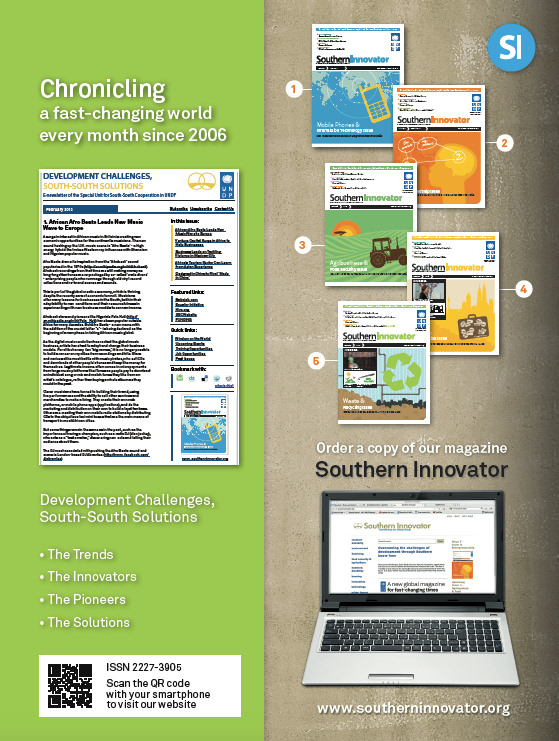
    Development Challenges, South-South Solutions was launched as an e-newsletter in 2006 by UNDP’s South-South Cooperation Unit (now the United Nations Office for South-South Cooperation) based in New York, USA. It led on profiling the rise of the global South as an economic powerhouse and was one of the first regular publications to champion the global South’s innovators, entrepreneurs, and pioneers. It tracked the key trends that are now so profoundly reshaping how development is seen and done. This includes the rapid take-up of mobile phones and information technology in the global South (as profiled in the first issue of magazine Southern Innovator), the move to becoming a majority urban world, a growing global innovator culture, and the plethora of solutions being developed in the global South to tackle its problems and improve living conditions and boost human development. The success of the e-newsletter led to the launch of the magazine Southern Innovator. 

    Creative Commons License

    This work is licensed under a
    Creative Commons Attribution-Noncommercial-No Derivative Works 3.0 License.

    ORCID iD: https://orcid.org/0000-0001-5311-1052.

    © David South Consulting 2023

  • Colombian Architect Proving Strength and Beauty of Bamboo

    Colombian Architect Proving Strength and Beauty of Bamboo

    By David SouthDevelopment Challenges, South-South Solutions

    SOUTH-SOUTH CASE STUDY

    Fast-growing bamboo grass (http://en.wikipedia.org/wiki/Bamboo) has become a cause celebre amongst those looking for a sustainable and tough building material.

    In the last five years, more and more construction projects have turned to bamboo. It has many advantages: it grows quickly, is super-strong yet also supple enough to bend in a hurricane or earthquake and has a high tensile strength (http://en.wikipedia.org/wiki/Ultimate_tensile_strength) equivalent to steel. It is, of course, green since it is grown in forests, and is cheap and plentiful in many countries of the South, especially across Asia and Latin America.

    It is also aesthetically pleasing and makes beautiful structures with intricate patterns.

    But despite all these advantages, it has been a hard sales job to get people to choose bamboo as a building material rather than traditional woods, steel or concrete. Many people wrongly think green means not strong. But as many a construction worker knows in Asia, where scaffolding made from bamboo is commonplace, it is tough and stands on its own.

    Pioneers are working hard to prove bamboo deserves respect as a building material for a greener future.

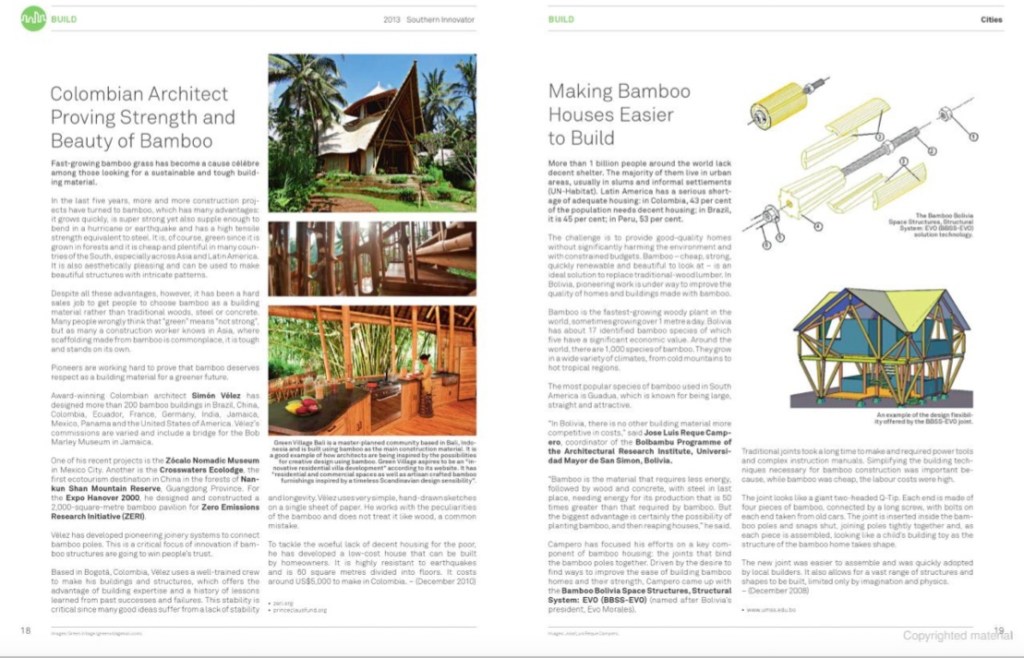
    Award-winning Colombian architect Simón Vélez has designed more than 200 bamboo buildings in Germany, France, the United States, Brazil, Mexico, China, Jamaica, Colombia, Panama, Ecuador, and India.

    Vélez’s commissions are varied, and include a bridge for the Bob Marley Museum in Jamaica.

    One of his recent projects is the Zócalo Nomadic Museum (http://en.wikipedia.org/wiki/Nomadic_Museum) in Mexico City. Another is the Crosswaters Ecolodge (http://www.asla.org/2010awards/370.html), the first ecotourism destination in China in the forests of Nankun Shan Mountain Reserve, Guangdong Province. For the Expo Hanover 2000, he designed and constructed a 2000-square-meter bamboo pavilion for ZERI (Zero Emissions
    Research Initiative) (http://www.zeri.org/).

    Vélez has developed pioneering joinery systems to connect bamboo poles together. This is a critical focus of innovation if bamboo structures are going to win people’s trust.

    Based in Bogotá, Colombia, Vélez uses a well-trained crew to make his buildings and structures. This has the advantage of building expertise and a history of lessons learned from past successes and failures. That stability is a critical insight: many good ideas suffer from a lack of stability and longevity. He uses very simple, hand-drawn sketches on a single sheet of paper. He works with the peculiarities of the bamboo and does not treat it like wood: a common mistake.

    To tackle the woeful lack of decent housing for the poor, he has developed a low-cost house that can be built by home-owners. It is highly resistant to earthquakes and is 60 square metres divided on two floors. It costs
    around US $5,000 to make in Colombia.

    Winner of the Prince Claus Fund (http://www.princeclausfund.org/en/index.html), Vélez’s work promotes sustainable development, introducing new ideas on ecological issues and questions. The Fund calls him an architect “whose aesthetic and technical innovations have considerably expanded the possibilities of bamboo as a building material, providing a challenge to prevailing architectural trends.”

    With more than 1 billion people around the world lacking decent shelter, many see plentiful bamboo as a key part of the solution. Most people with poor quality housing live in urban areas, usually in slums and informal settlements (UN-HABITAT). Latin America has a serious shortage of adequate housing: in Colombia, 43 percent of the population needs decent housing; in Brazil, 45 percent; Peru, 53 percent.

    The challenge is to provide good quality homes without significantly harming the environment – and with constrained budgets. Bamboo – cheap, strong, quickly renewable and beautiful – is an ideal solution to replace traditional wood lumber.

    Bamboo is the fastest growing woody plant in the world, sometimes growing over 1 metre a day. Around the world, there are 1,000 species of bamboo. They grow in a wide variety of climates, from cold mountains to hot tropical regions.

    Once called the “poor man’s timber” – a temporary building material to replace once there is more money – bamboo is now getting the respect it deserves. Bamboo for housing has a long history in Latin America, stretching back 4,500 years to ancient civilizations. In Asia, it has long been a traditional construction material. But most of the existing bamboo dwellings in Latin America are 50 to 100 years old.

    The most popular species of bamboo used in South America is Guadua, which is known for being large, straight and attractive.

    Thoughtful and methodical pioneers like Vélez are proving bamboo has a viable future as a building material that will tackle the housing needs of the world’s poor and the fast-growing cities of the South.

    Published: December 2010

    Resources

    Development Challenges, South-South Solutions was launched as an e-newsletter in 2006 by UNDP’s South-South Cooperation Unit (now the United Nations Office for South-South Cooperation) based in New York, USA. It led on profiling the rise of the global South as an economic powerhouse and was one of the first regular publications to champion the global South’s innovators, entrepreneurs, and pioneers. It tracked the key trends that are now so profoundly reshaping how development is seen and done. This includes the rapid take-up of mobile phones and information technology in the global South (as profiled in the first issue of magazine Southern Innovator), the move to becoming a majority urban world, a growing global innovator culture, and the plethora of solutions being developed in the global South to tackle its problems and improve living conditions and boost human development. The success of the e-newsletter led to the launch of the magazine Southern Innovator. 
    Creative Commons License

    This work is licensed under a
    Creative Commons Attribution-Noncommercial-No Derivative Works 3.0 License.

    ORCID iD: https://orcid.org/0000-0001-5311-1052.

    © David South Consulting 2023

  • Iranian Savings Funds to Tackle Loan Drought

    Iranian Savings Funds to Tackle Loan Drought

    By David SouthDevelopment Challenges, South-South Solutions

    SOUTH-SOUTH CASE STUDY

    For entrepreneurs around the world, acquiring finance to start or expand a small business has become harder and harder as the global financial crisis has bitten hard. Across the globe, people with good ideas or successful businesses that need funds to expand are finding the door closed by traditional banks.

    As banks and governments have focused on reducing debt and building up cash reserves, it is small businesses and small-scale entrepreneurs – often without business or family connections – who suffer the most. Opportunities are being missed to create new jobs and enterprises and lift poor communities out of poverty.

    In that climate, the search is on for alternative ways to build up wealth. In Iran, a new phenomenon has arisen to address the lack of bank loans for small businesses brought about by the economic crisis. Iran is suffering under international sanctions as well as outstanding bank loans exceeding US $45 billion, according to the Financial Times.

    The domestic banking crisis this has provoked has resulted in a tightening of credit for loans.

    But in response, middle class Iranians are forming their own savings clubs to help each other with loans.

    The savings clubs work like this: each member buys a share in the club costing around US $2 per day (around US $620 over 10 months). Each share makes the saver eligible for one loan during the year. For example in a club of 30 Tehran taxi drivers, every month four members of the club receive US $600 each in loans. The fund lasts 10 months and each member is guaranteed one loan per share.

    “It is a savings fund and doesn’t have the uncertainty of the banking system, which might or might not give you a loan,” club member Ahmad told the Financial Times newspaper. As one of the drivers, he has four shares and is eligible for four loans.

    “My mother is also saving money in a fund of housewives among our female relatives.”

    The fund is managed by the head of the taxi agency and a driver who is a retired teacher. Both are trusted. “The retired teacher receives the money every day and puts a check mark by the names of those who pay. He is trusted by the head of the taxi agency, while other drivers respect him as an educated, honest man.”

    Savings clubs are also good for the local economy, helping people to be able to buy goods on loans they would never be able to purchase otherwise. Another driver used the fund to “buy the things we cannot afford under normal conditions, like a washing machine, for instance, for which we have zero chance to get bank loans.”

    Overdue loans by Iran’s banks grew by 66 percent from last year according to Asghar Abolhassani, the deputy economy minister.

    The Financial Times reported that an estimated 25 percent of bank loans are outstanding, making Iran’s banking system technically bankrupt. International sanctions are also blocking the country’s banks from accessing global financial markets for support.

    “Stagnation has gripped many parts of the economy,” said Hamid Tehranfar, the central bank’s director-general for banking supervision.

    Turning to savings clubs can be an excellent alternative saving and loans model, but it requires very specific trust guarantees in place to ensure the holder of the funds doesn’t just take the money. For those who can’t find somebody local they trust, there are a number of online social lending and fundraising alternatives for raising funds and borrowing money. These include Kiva (www.kiva.org), which connects poor people looking for loans with people around the world willing to lend.

    As the crisis continues and banks and governments hoard wealth for their own needs to pay down debt, alternative sources of loans will become ever more important for the poor.

    Published: April 2010

    Resources

    1) Zopa: “Where people meet to lend and borrow money.” Website: www.zopa.com

    2) Kiva: Kiva’s mission is to connect people, through lending, for the sake of alleviating poverty. Website: www.kiva.org

    3) Betterplace: Started in 2007, Betterplace is an online marketplace for projects to raise funds. It is free, and it passes on 100 percent of the money raised on the platform to the projects. Website: www.betterplace.org

    4) Kickstarter: Kickstarter is a funding platform for artists, designers, filmmakers, musicians, journalists, inventors, and explorers. Website: http://www.kickstarter.com/

    Development Challenges, South-South Solutions was launched as an e-newsletter in 2006 by UNDP’s South-South Cooperation Unit (now the United Nations Office for South-South Cooperation) based in New York, USA. It led on profiling the rise of the global South as an economic powerhouse and was one of the first regular publications to champion the global South’s innovators, entrepreneurs, and pioneers. It tracked the key trends that are now so profoundly reshaping how development is seen and done. This includes the rapid take-up of mobile phones and information technology in the global South (as profiled in the first issue of magazine Southern Innovator), the move to becoming a majority urban world, a growing global innovator culture, and the plethora of solutions being developed in the global South to tackle its problems and improve living conditions and boost human development. The success of the e-newsletter led to the launch of the magazine Southern Innovator. 

    Creative Commons License

    This work is licensed under a
    Creative Commons Attribution-Noncommercial-No Derivative Works 3.0 License.

    ORCID iD: https://orcid.org/0000-0001-5311-1052.

    © David South Consulting 2023

  • Latin American Food Renaissance Excites Diners

    Latin American Food Renaissance Excites Diners

    By David SouthDevelopment Challenges, South-South Solutions

    SOUTH-SOUTH CASE STUDY

    Food is essential for a good life and plays a critical part in overall human health and development. The better the quality of food available to the population, the better each individual’s overall health will be, and this will have a direct impact on mental and physical performance (http://www.sciencedirect.com/science/article/pii/S2213453012000055).

    An innovative restaurant can be the beginning of a taste and flavors renaissance as new foods are discovered and the recipes and foods are cross-marketed. It is an effective strategy that has worked around the world. The restaurant’s brand, in turn, becomes a valuable commodity that can be used to promote a range of products. For example, Brazil’s D.O.M. Restaurante has successfully used its strong reputation to help promote a range of food products drawn from the Amazon rainforest. There is money to be made in this and it can be a major boost to the incomes of food producers, especially small-scale farmers.

    As is being found across South America, a rediscovered love of local cuisines and indigenous culinary culture can also lead to profits and a growing global awareness of the continent’s varied foods and recipes.

    Innovators are playing with traditional cooking and locally available foods to come up with a modern Latin American cuisine that is getting people very excited.

    The latest country to benefit from this is Peru. The first Michelin star awarded to a Peruvian restaurant in Europe went to a restaurant in London, UK. The Michelin (http://travel.michelin.co.uk/michelin-guides-105-c.asp) star is awarded to a restaurant based on the quality of its food and its overall atmosphere and service.

    The London restaurant Lima (limalondon.com) is part of the global rise in awareness of Latin American food. It was launched by Venezuelan brothers Gabriel and Jose Luis Gonzalez in partnership with Peruvian chef Virgilio Martinez. Their signature dishes include sea bream ceviche (a lime-preserved raw fish dish) and suckling pig done in the “Andes” style.

    Martinez is also a chef consultant for the Central Restaurante (http://centralrestaurante.com.pe/es/) in Lima, Peru. It was named one of The World’s 50 Best Restaurants by S. Pellegrino (theworlds50best.com).

    Gabriel Gonzalez moved to London from Paris two years ago, and is surprised at how quickly he and his colleagues have made an impact.

    “It was definitely not expected. … It’s just incredible, it definitely sets a precedent for Peruvian food and gives it a stamp of credibility and a lot of promise, it’s just amazing,” he told the London Evening Standard.

    As another mark of the rising profile of Latin American food, the first edition of Latin America’s 50 Best Restaurants was held in Lima in September 2013 (theworlds50best.com/latinamerica/en/). In its press release, it said: “The evolution and robustness of gastronomy in Latin America has demanded recognition.”

    It comes after the first expansion of the awards to Asia with Asia’s 50 Best Restaurants, held in Singapore in February 2013.

    The ceremony in Peru is being seen as another vote of confidence in Peru’s innovative restaurant scene. Other acknowledgements of the country’s culinary success include winning in 2012 the World’s Best Culinary Destination by the World Travel Awards. The Organization of American States (OAS) also declared Peru’s cuisine part of America’s World Heritage (oas.org).

    The number of South American restaurants on the The World’s 50 Best Restaurants list increased to six in 2013, two more than in 2012. This year’s winners include the innovative Brazilian restaurant D.O.M  in Sao Paulo, and Astrid y Gaston (http://astridygaston.com/en/) in Lima.

    D.O.M. Restaurante’s (http://domrestaurante.com.br/pt-br/home.html) chef Alex Atala is a passionate champion of Brazil’s traditional ingredients and dishes. He trawls the Amazon rainforest for new taste sensations and then deploys them in his inventive dishes in the restaurant. D.O.M. was named the best restaurant in South America for four years in a row by The World’s 50 Best Restaurants.

    At Astrid y Gaston in Lima, an innovative take on menus shows how the restaurant stands out from the rest. The restaurant uses storytelling techniques to build up interest in its various menus. One example is the Winter 2013 Tasting Menu with its title El Viaje, meaning trip or journey. “It is a story told through a long sequence of courses divided into five acts, a mise en scène where we attempt to take the life experiences of a restaurant beyond its traditional gastronomic limits,” the restaurant says on its website.

    “During each of the five acts, the dishes, the music, the clothing, the decoration, the tableware and the book that accompanies this experience, will narrate the turning points that define this life journey”

    Astrid y Gaston is a partnership between a German and a Peruvian who set out to challenge the dominance of French haute cuisine and started the restaurant in 1994.

    “Twenty years later, much has happened with Peru and Peruvian cuisine. Unlike those times when inspiration was sought in foreign ingredients and recipes, when cooks locked themselves up in their kitchens and lived with suspicion of their peers, ignoring the farmers’ work and the social and ecological challenges of the environment, today’s cooking is fortunately getting a breath of fresh and beautiful air.”

    Another cuisine pioneer is Pujol (pujol.com.mx) in Mexico City, Mexico. It serves Mexican cuisine focused on local ingredients blending ancient and modern culinary techniques. The food is original and exciting: for starters, there is baby corn and chicatana ant, aguachile with chia seeds and avocado, suckling lamb taco, and for desert, fermented plantain, macadamia nuts, plantain vinegar and chamomile flower petals.

    The potential is enormous for marrying these restaurant innovators with the many small-scale farmers and food producers to boost awareness of their products and increase incomes across South and Central America.

    Published: November 2013

    Resources

    1) Latin American food pyramid: A guide to eating a healthy diet using common foods from Latin America. Website: http://www.foodpyramid.com/food-pyramids/latin-american-pyramid/

    2) Visit Peru: Peru Tourism Bureau: Includes extensive information on Peruvian food and cuisine. Website: http://visitperu.com/

    3) How functional foods play critical roles in human health by Guangchang Pang, Junbo Xie, Qingsen Chen and Zhihe Hu. Website: http://www.sciencedirect.com/science/article/pii/S2213453012000055

    Southern Innovator Issue 3: Agribusiness and Food Security: Website: http://books.google.com.au/books?id=-Y6Gnqx9PIcC&source=gbs_similarbooks_r&cad=2

    Development Challenges, South-South Solutions was launched as an e-newsletter in 2006 by UNDP’s South-South Cooperation Unit (now the United Nations Office for South-South Cooperation) based in New York, USA. It led on profiling the rise of the global South as an economic powerhouse and was one of the first regular publications to champion the global South’s innovators, entrepreneurs, and pioneers. It tracked the key trends that are now so profoundly reshaping how development is seen and done. This includes the rapid take-up of mobile phones and information technology in the global South (as profiled in the first issue of magazine Southern Innovator), the move to becoming a majority urban world, a growing global innovator culture, and the plethora of solutions being developed in the global South to tackle its problems and improve living conditions and boost human development. The success of the e-newsletter led to the launch of the magazine Southern Innovator. 

    Creative Commons License

    This work is licensed under a
    Creative Commons Attribution-Noncommercial-No Derivative Works 3.0 License.

    ORCID iD: https://orcid.org/0000-0001-5311-1052.

    © David South Consulting 2023