Tag: Canada

  • African Online Supermarket Set to Boost Trade

    African Online Supermarket Set to Boost Trade

    By David SouthDevelopment Challenges, South-South Solutions

    SOUTH-SOUTH CASE STUDY

    Online retailing and marketing strategies are revolutionizing how people around the world buy products and services – but so far they have not benefited most of Africa’s small businesses and traders. On a continent where trading for survival is the norm, very few people are reaping the benefits of selling on the Internet.

    Not only has limited access to the Internet and the lack of high bandwidth in Africa impeded communication within the continent, it has restricted African businesses from taking advantage of the most profound change in global business for decades: e-retailing (also known as e-tailing or e-commerce).

    But the African information technology pioneers of Ghana – a country that has already gained a reputation as an IT leader in West Africa (www.ghanaictawards.com) – are setting out to change this situation, and in turn to change the way people access African goods and services.

    Pledging in its motto to reach “every African nook and cranny,” ShopAfrica53 is an online shopping portal similar to famous brands like Amazon or eBay, but focused entirely on giving African traders the ability to sell across the continent and to the world online.

    The one-stop shopping site – taking its name from the 53 countries on the continent – can be accessed by Internet users, or better still, by the enormous number of mobile phone users not only in Africa but around the world.

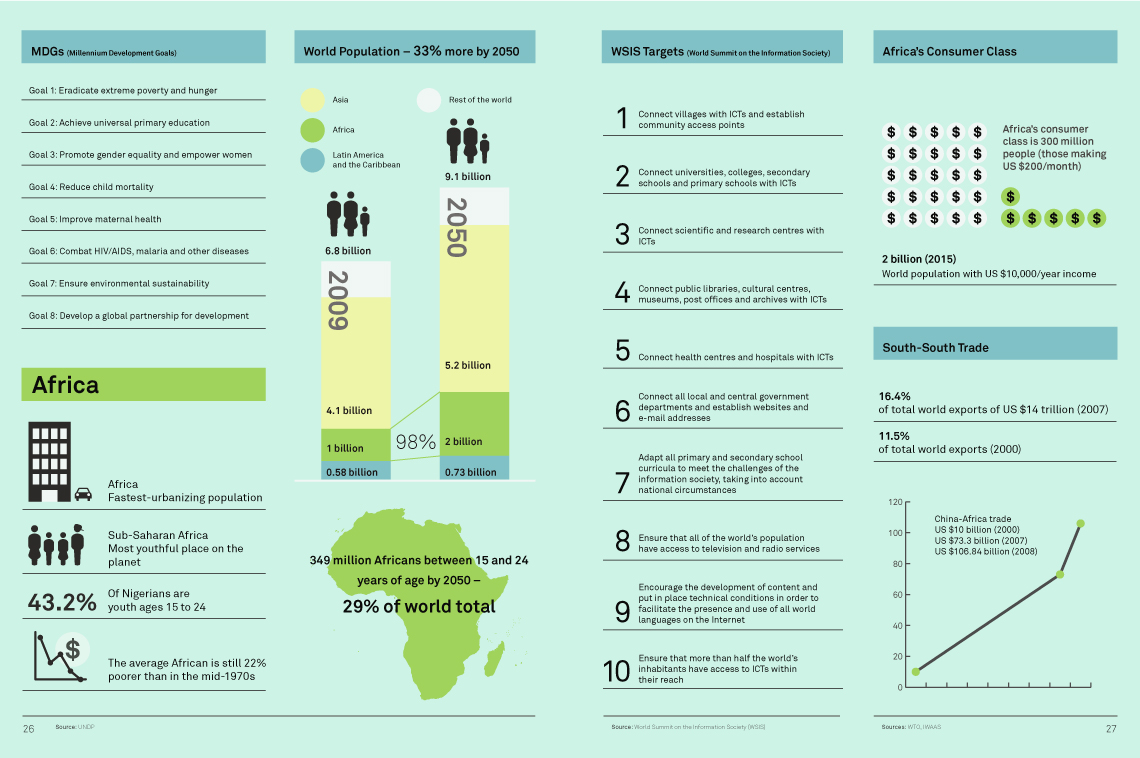
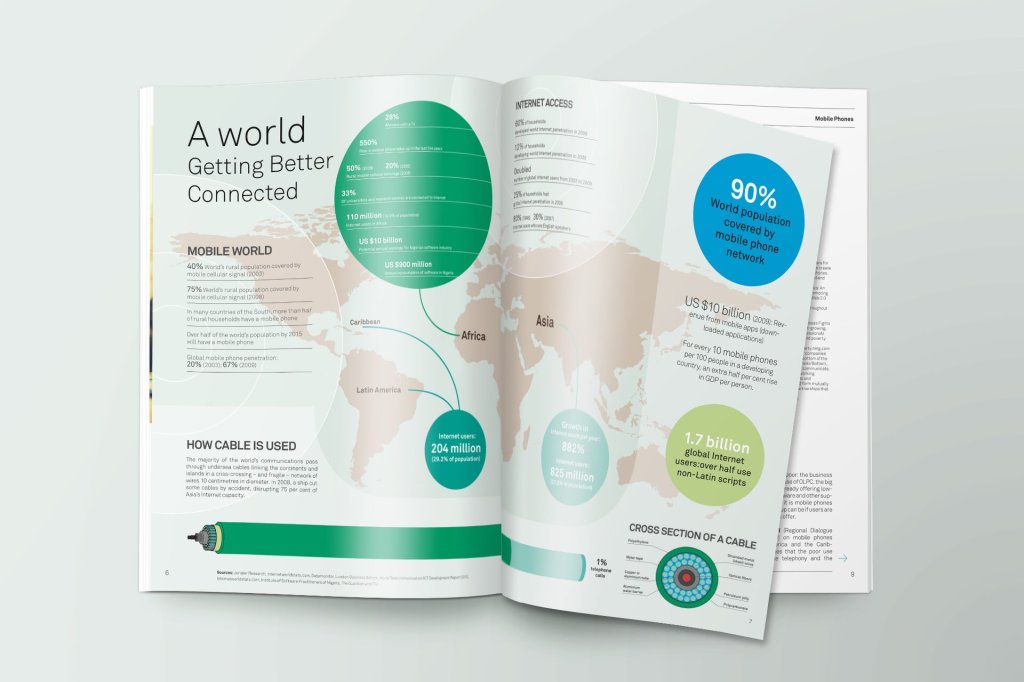
    The number of mobile phone subscribers in Africa surpassed 300 million in 2008 (ITU), representing a significant market in their own right. Research group Informa Telecoms and Media estimates mobile networks now cover 90 per cent of the world’s population – 40 per cent of whom are covered but not connected.

    ShopAfrica53 works like this: merchants first fill out an online form on the ShopAfrica53 website. They are then contacted by ShopAfrica, and an account is set up.

    People wanting to buy goods and services on the website use the African Liberty Card to ensure the transactions are safe and not at risk from hackers and fraudsters. The disposable pre-paid scratch card can be used on mobile phones and the Internet and is purchased from store outlets.

    ShopAfrica handles the logistical hassles of shipping to customers around the world, facilitates payment transfers, and helps with record keeping for merchants.

    ShopAfrica offers an eclectic selection of goods: apparel and accessories, books and stationery, groceries, handicraft, health and personal care, home and garden, machinery and tools, technology and entertainment. It promises to offer the “best selection of African products, anywhere, worldwide” – everything from building supplies, household items and electronics to processed foods and fabrics.

    One Ghanaian merchant, Mohammed Salifu, promises to deliver in two days a “large brown cow for delivery or collection. The size, colour and weight of animal will vary. This merchant provides live goats, sheep, cattle for special occasions and festivities and can also provide a slaughtering service for clients.”

    Then there is Vera Ami Kpogli, who is selling a ‘Beyonce’ Electric Blue necklace. Tse-Lee Fashions offers Batik/Tie and Dye Print Shirt in aqua and navy. And for the ‘king’ of the house, Ama Afrique Designs is selling Men’s Royal Rulers, sandals “worn many centuries ago by African kings.”

    The potential of this service to boost incomes is considerable: in the United Kingdom, online sales now make up 15 percent of all retail spending, reaching £43.8 billion (US $66.12 billion) in 2008 (IMRG).

    As has been seen with other countries of the Global South, trade in high quality goods boosts incomes. South-South trade grew by an average of 13 percent per year between 1995 and 2007. By 2007, South-South trade made up 20 percent of world trade. And over a third of South-South commerce is in high-skill manufacturing. Making finished goods, rather than just selling raw materials, improves workers’ skill levels and increases the return on trade.

    The rapid changes to African countries – the tilt to being more urban than rural, and being home to a larger urban population than North America, with 25 of the world’s fastest growing cities (International Institute for Environment and Development) – means there is an urgent need to boost incomes and better connect traders and manufacturers to the global economy.

    ShopAfrica53 could be the start of a very big thing for African trade.

    Published: May 2009

    Resources

    • The red dot logo stands for belonging to the best in design and business. The red dot is an internationally recognised quality label for excellent design that is aimed at all those who would like to improve their business activities with the help of design.
      Website: www.red-dot.de
    • BOP Source is a platform for companies and individuals at the BOP (bottom of the pyramid) to directly communicate, ultimately fostering close working relationships, and for NGOs and companies to dialogue and form mutually valuable public-private partnerships that serve the BOP.
      Website: http://bopsource.ning.com/
    • Business Fights Poverty: Business Fights Poverty is the free-to-join, fast-growing, international network for professionals passionate about fighting world poverty through good business.
      Website: businessfightspoverty.ning.com
    • Dutch Design in Development: As a matchmaker, DDiD puts together European clients, Dutch designers and small and medium-sized enterprises in developing countries. The designers share their knowledge of European consumer tastes, product development, design and quality standards
      Website: www.ddid.nl
    • Afriville is a Web 2.0 service and an African Caribbean social network. Afriville is a community website along the lines of the famous MySpace. Users are free to message and post profiles. The difference is that the user is able to choose how closed or open the networks are. The site features a state of the art music management system which allows African and Caribbean artists to get straight in touch with their fans.
      Website: www.afriville.com
    • Business Action for Africa: Business Action for Africa is an international network of businesses and business organisations from Africa and elsewhere, coming together in support of three objectives: to positively influence policies for growth and poverty reduction, to promote a more balanced view of Africa, and to develop and showcase good business practice in Africa
      Website: www.businessactionforafrica.org
    • Interactive Media in Retail Group (IMRG) is a membership community for the e-retail industry, whose vision is to maximise the commercial potential of online shopping
      Website: www.imrg.org

    https://davidsouthconsulting.org/2021/03/20/accessing-global-markets-via-design-solutions/

    https://davidsouthconsulting.org/2022/06/02/afghanistans-juicy-solution-to-drug-trade/

    https://davidsouthconsulting.org/2022/10/26/african-trade-hub-in-china-brings-mutual-profits-2/

    https://davidsouthconsulting.org/2021/03/20/carbon-markets-need-to-help-the-poor/

    https://davidsouthconsulting.org/2022/11/21/chinese-trade-in-angola-helps-recovery/

    https://davidsouthconsulting.org/2021/03/20/computer-gold-farming-turning-virtual-reality-into-real-profits/

    https://davidsouthconsulting.org/2022/04/12/djibouti-re-shapes-itself-as-african-trade-hub/

    https://davidsouthconsulting.org/2021/07/19/global-south-trade-boosted-with-increasing-china-africa-trade-in-2013/

    https://davidsouthconsulting.org/2020/12/12/mobile-phone-shopping-to-create-efficient-markets-across-borders/

    https://davidsouthconsulting.org/2021/12/08/new-media-markets-and-screen-finance/

    https://davidsouthconsulting.org/2022/10/26/perfume-of-peace-helps-farmers-switch-from-drug-trade/

    https://davidsouthconsulting.org/2022/10/04/popular-chinese-social-media-chase-new-markets/

    https://davidsouthconsulting.org/2021/07/19/south-south-trade-helping-countries-during-economic-crisis/

    https://davidsouthconsulting.org/2022/11/17/sos-shops-keep-food-affordable-for-poor-unemployed/

    https://davidsouthconsulting.org/2022/11/16/thai-organic-supermarkets-seek-to-improve-health/

    https://davidsouthconsulting.org/2022/10/20/trade-to-benefit-the-poor-up-in-2006-and-to-grow-in-2007/

    https://davidsouthconsulting.org/2020/04/17/virtual-supermarket-shopping-takes-off-in-china/

    https://davidsouthconsulting.org/2022/10/05/women-empowered-by-fair-trade-manufacturer/

    https://davidsouthconsulting.org/2022/06/16/women-mastering-trade-rules/

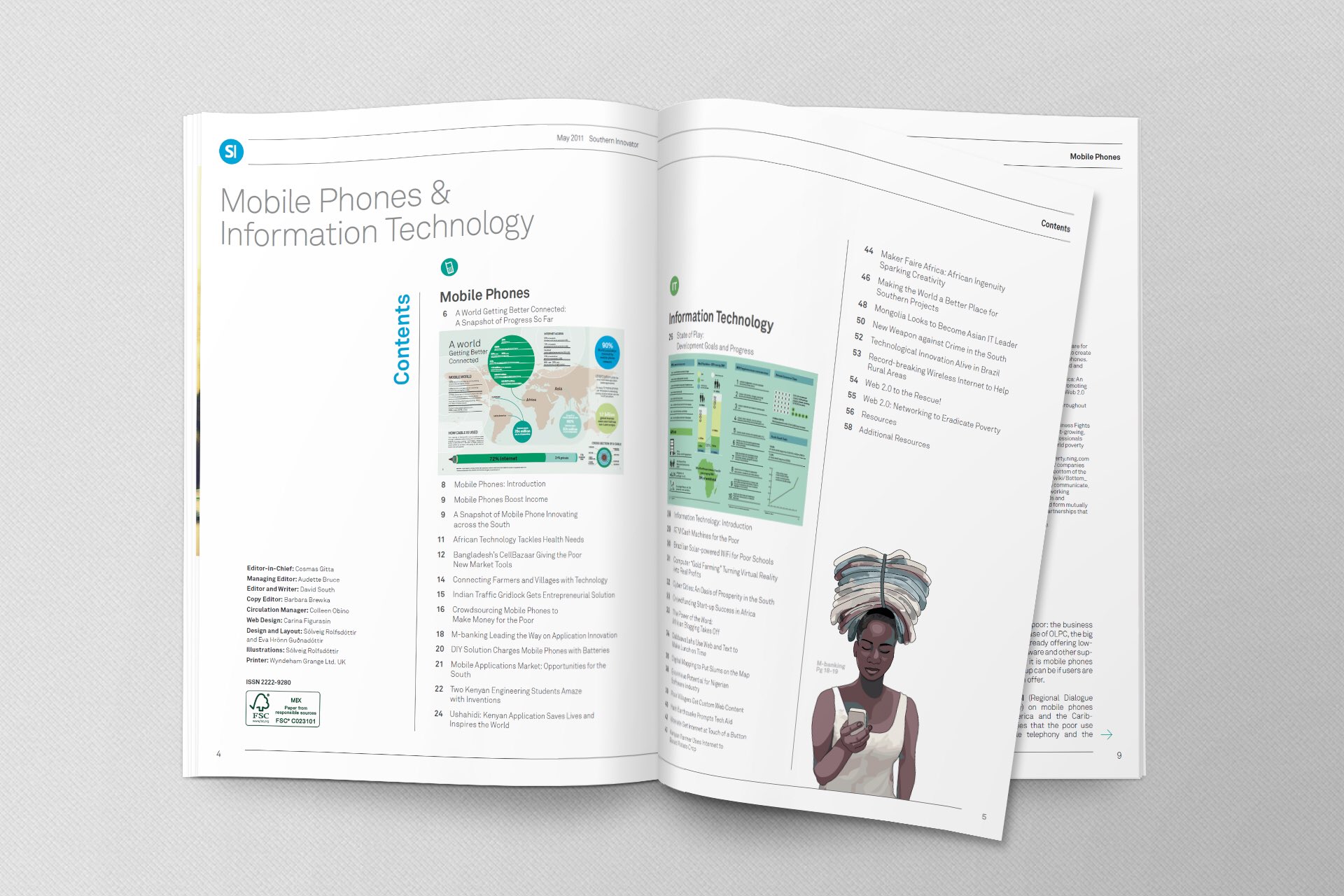
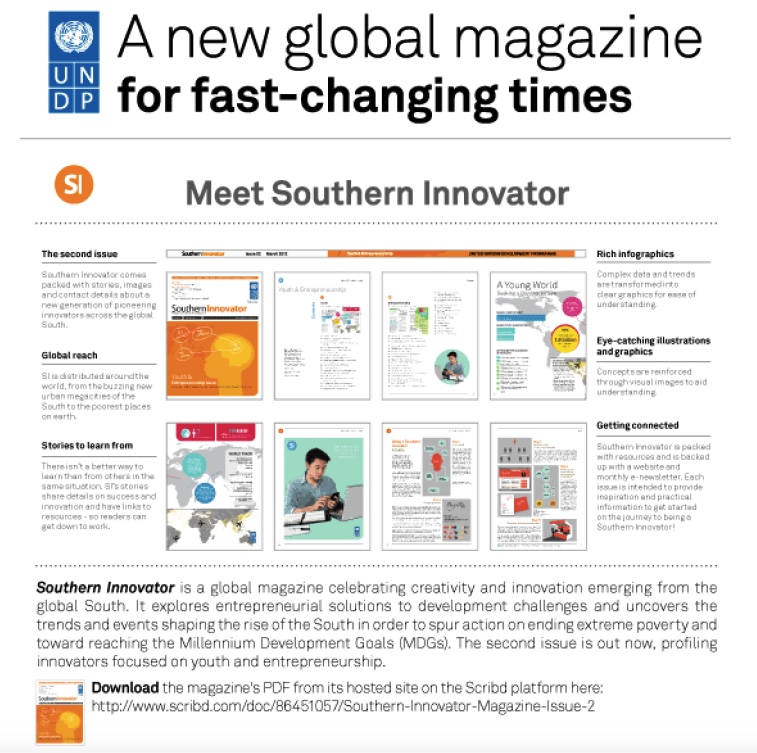
    Development Challenges, South-South Solutions was launched as an e-newsletter in 2006 by UNDP’s South-South Cooperation Unit (now the United Nations Office for South-South Cooperation) based in New York, USA. It led on profiling the rise of the global South as an economic powerhouse and was one of the first regular publications to champion the global South’s innovators, entrepreneurs, and pioneers. It tracked the key trends that are now so profoundly reshaping how development is seen and done. This includes the rapid take-up of mobile phones and information technology in the global South (as profiled in the first issue of magazine Southern Innovator), the move to becoming a majority urban world, a growing global innovator culture, and the plethora of solutions being developed in the global South to tackle its problems and improve living conditions and boost human development. The success of the e-newsletter led to the launch of the magazine Southern Innovator. 
    https://davidsouthconsulting.org/2021/03/05/southern-innovator-issue-2/

    Creative Commons License

    This work is licensed under a
    Creative Commons Attribution-Noncommercial-No Derivative Works 3.0 License.

    ORCID iD: https://orcid.org/0000-0001-5311-1052.

    © David South Consulting 2023

  • New Journal Celebrates Vibrancy of Modern Africa

    New Journal Celebrates Vibrancy of Modern Africa

    By David SouthDevelopment Challenges, South-South Solutions

    SOUTH-SOUTH CASE STUDY

    Africa has seen huge changes to its communications and media in the past five years. The rise and rise of mobile phones, the expansion of the Internet and the explosion in African blogging and social media, on top of flourishing print and broadcast media, all bring an increasing range of options for telling African stories and increasing dialogue.

    With all this new media creating new communications channels – and all the turmoil and change affecting millions as economies and countries change – people need the ability to make sense of it all. One magazine is trying to play that role.

    An entrepreneur and multimedia innovator has created a unique publication that is capturing the spirit, ideas and stories of modern Africa. It is a high-quality product, has gathered together talented writers and photographers and is gaining a growing global audience. Chimurenga Magazine (http://www.chimurenga.co.za/) based in Cape Town, South Africa, calls itself a “pan African publication of writing, art and politics.” Named for the Zimbabwean Shona word for “revolutionary struggle,” it is published three times a year. Editor Ntone Edjabe is from Cameroon and came to Cape Town in the 1990s after the end of South Africa’s racist Apartheid regime.

    With more than 100 contributors, the magazine offers insight into contemporary Africa, what occupies people’s thoughts and how their lives are actually lived.

    It is involved in a wide range of other activities, including co-curating a Global South Dialogue Series. And its readership is truly diverse.

    “We have readers who are long-term prisoners at Pretoria Central Prison, who have subscriptions that they get to us in coins, and readers who are successful businessmen,” Edjabe said to The Financial Times Magazine.

    Chimurenga is out to challenge perceptions of Africa. Practicing the art of long-form journalism more associated with established high-end publications like The New Yorker (newyorker.com), the magazine sets out to challenge perceptions about Africa.

    “Discourse on Africa is geared towards simplicity,” Edjabe told CNN. “Everything must be simple – ‘he’s a poor black man, he’s a victim’ – like there has to be a simple story, in a way this is what signifies Africa and global consciousness.

    “The moment you bring a degree of complexity to it, it kind of throws people off, they just don’t know where to look anymore. It’s like, ‘what’s going on?’ So Chimurenga in a way does not try to maintain the superficiality of this narrative – we engage with life, we try to present life as complex as it really is.”

    Stories in the journal include Billy Kahora writing on the decay of a neighbourhood in Nairobi, Kenya, Michael Abrahams writing about his time in the Cape Town mental hospital after a suicide attempt, and Sean O’Toole following a Zimbabwean immigrant on his journey into South Africa.

    The magazine’s website carries back issues of the journal, along with a shop selling magazines, books and t-shirts and the “Chimurenga Library,” an archive of pan-African, independent periodicals. There’s also live online streaming of music – “from ancient techno to future roots” – through the Pan African Space Station radio station, there is a biennial publication of urban life it calls “Africa-style,” and the writings of 14 African writers who visited 14 African cities to check-up on life in urban areas.

    As an example of the creativity of Chimurenga’s talent, a special issue of the magazine tried to better understand the impact of violence in South Africa in May 2008 that led to the deaths of 62 people. It did this by creating a fictitious newspaper called The Chimurenga Chronic (http://www.chimurenga.co.za/chimurenga-magazine/current-issue) set during the violence.

    The writers are a mix of Anglophones and Francophones, all based in Africa. Common subjects focus on the world of lower-middle class Africa. Examples of past issues show the variety of its content: Conversations With Poets Who Refuse To Speak, Futbol, Politricks & Ostentatious Cripples, Conversations in Luanda and Other Graphic Stories, *We’re all Nigerian!

    Well-travelled editor Edjabe has studied and lived in Lagos, Nigeria and Johannesburg, South Africa. He has worked as a disc jockey, music writer and basketball coach. He launched Chimurenga in 2002. He told The Financial Times Magazine “I printed 1,000 copies, which I carried around in my bag. I sold it mainly to friends.”

    It was supposed to be a one-off publication but became a journal, initially written mostly by his friends.

    “I found out later that this is how most journals actually begin,” he said. “At the time I thought it was unique.”

    He aspired to get Africans writing about the Africa they saw and lived in. The challenge was changing the dynamic he found of writers only considering something worth writing about if it had been featured in non-African media.

    Edjabe had already made his mark with an innovative initiative to show the diversity of what Africa has to offer. Three years after arriving in South Africa he started the Pan African Market (PAM) in Cape Town. An African cultural centre, it began as a craft market with various traders able to run their individual businesses and leasing stall space from the market. PAM became very successful because it brought together Africans from across the continent and offered a vibrant mix of artists, small businesses and food. It now has 33 stores and stalls from 14 countries of Africa. Shoppers can find arts and crafts, hair dressing, tailoring, holistic healing and catering.

    Hard copies of Chimurenga are distributed around Africa and sent to Europe, the United States and India.

    “There’s a feeling about writing something, sharing something that is beautiful and truthful from one’s perspective,” Edjabe told CNN.

    Published: June 2012

    Resources

    1) How to Start a Magazine: Simple online advice on starting and running a magazine. Website: http://www.ehow.com/how_16579_start-magazine.html

    2) Venture Capital for Africa: VC4Africa is the largest online community of investors, angels and entrepreneurs working to build businesses on the continent. Website: http://vc4africa.biz/landing/?redir_to=%2F

    https://davidsouthconsulting.org/2022/10/21/african-media-changing-to-reach-growing-middle-class/

    https://davidsouthconsulting.org/2021/01/05/development-challenges-south-south-solutions-newsletter/

    https://davidsouthconsulting.org/2021/07/14/freedom-of-expression-introducing-investigative-journalism-to-local-media-in-mongolia-1999-25-january-2016/

    https://davidsouthconsulting.org/2021/05/25/ger-mongolias-first-web-magazine-and-a-pioneering-web-project-for-the-united-nations-12-january-2016/

    https://davidsouthconsulting.org/2022/11/01/indian-newspapers-thrive-with-economy/

    https://davidsouthconsulting.org/2022/10/04/popular-chinese-social-media-chase-new-markets/

    https://davidsouthconsulting.org/2022/11/01/southern-innovator-magazine-2010-2014/

    Development Challenges, South-South Solutions was launched as an e-newsletter in 2006 by UNDP’s South-South Cooperation Unit (now the United Nations Office for South-South Cooperation) based in New York, USA. It led on profiling the rise of the global South as an economic powerhouse and was one of the first regular publications to champion the global South’s innovators, entrepreneurs, and pioneers. It tracked the key trends that are now so profoundly reshaping how development is seen and done. This includes the rapid take-up of mobile phones and information technology in the global South (as profiled in the first issue of magazine Southern Innovator), the move to becoming a majority urban world, a growing global innovator culture, and the plethora of solutions being developed in the global South to tackle its problems and improve living conditions and boost human development. The success of the e-newsletter led to the launch of the magazine Southern Innovator. 

    https://davidsouthconsulting.org/2021/03/05/southern-innovator-issue-1/

    Creative Commons License

    This work is licensed under a
    Creative Commons Attribution-Noncommercial-No Derivative Works 3.0 License.

    ORCID iD: https://orcid.org/0000-0001-5311-1052.

    © David South Consulting 2022

  • Kenyan Bank Helps the Poor and Gets Rich

    Kenyan Bank Helps the Poor and Gets Rich

    By David SouthDevelopment Challenges, South-South Solutions

    SOUTH-SOUTH CASE STUDY

    Good quality banking services are a basic building block to rising incomes. Yet the poor across the South are often overlooked and denied access to savings accounts and loans. Many low-income people are openly discriminated against as ‘bad risks’ by banks, and denied the sort of banking services middle and higher income people take for granted. Yet it is a myth that the poor do not have money or do not wish to save and invest for their future or for business.

    The so-called Bottom of the Pyramid (BOP) – the 4 billion people around the world who live on less than US $2 a day – are being targeted by a wide range of businesses. Indian business consultant and professor CK Prahalad (http://en.wikipedia.org/wiki/C.K._Prahalad) , the man who coined the term BOP, has gone so far as to claim this is a market potentially worth US $13 trillion, while the World Resources Institute puts it at US $5 trillion in its report, “The Next 4 Billion” (http://www.nextbillion.net/thenext4billion).

    A Kenyan commercial bank has proven it is possible to target the BOP and become successful doing it; so successful that they have seen off foreign rivals and were voted Kenya’s third most respected company.

    By offering Kenya’s poor people savings accounts and microloans, Equity Bank (http://www.equitybank.co.ke/) has captured 50 percent of the Kenyan bank market. It now has more than 3 million customers and 2.8 million account holders and opens 4,000 new accounts a day.

    Its chief executive officer, James Mwangi, said Equity Bank built its success by doing the opposite of what other banks have done – it doesn’t target the middle and upper classes, but the “the watchmen, tomato sellers and small-scale farmers”.

    The Kenyan banking sector in the past was dominated by foreign banks. But by investing in the 46 percent of the population who still live below the food poverty line, Equity has become the third most profitable bank in the country. Its approach was once considered odd. Most of the bank’s borrowers work in the informal sector and have few assets to use as collateral for the loans. So Equity uses what it calls ‘social collateral’. This includes a mix of measures: in some cases, account holders join together to guarantee a person’s debt. Even more unusually, women offer their matrimonial beds as security – it would be shameful for a woman to admit her bed has been taken to pay for the debt.

    “For us it’s psychological security. Nobody wants to be excommunicated and lose their inheritance,” said Mwangi.

    “By focusing on the previously excluded, Equity has revolutionized the banking sector,” James Shikwati, a director of Kenyan think tank the Inter Region Economic Network (http://www.irenkenya.com/), told The Guardian newspaper. “It has forced the multinational banks to change their business strategies.”

    Started in 1984, the bank was still insolvent by 1994, when Mwangi joined as an accountant. Things were looking grim as Kenya’s economy was in a slump and foreign banks like Barclays were closing branches outside big centres.

    Mwangi and other Equity Bank managers realized there were millions of low-paid poor in Kenya – all BOP – but who wanted to save and borrow but had nowhere to go.

    “Banking was the only industry in Kenya led by supply rather than demand,” said Mwangi. “There was no ‘bottom of the pyramid bank’.”

    While absolute poverty in Kenya has declined in recent years, inequality remains high. The population of 37 million people make on average a per capita income of US $580.

    By 2003, as the economy picked up, Equity Bank gained 256,000 account holders. It now has 100 branches across the country and 500 automatic teller machines (ATMs). It uses armoured trucks to go into rural areas so that the people can receive banking services. While traditional banks require pay slips and utility bills as proof of a person’s address before letting them open an account, and charge high monthly fees, Equity only requires an identity card.

    Within just one year, the bank saw the number of account holders jump to 600,000. Mwangi likes to say that the bank’s competition is the bed mattress, since most people have never had a bank account before. Most savers have around US $148 in their savings account.

    The bank’s micro credit operation makes loans of less than US $7 and gives borrowers a few months to repay them.

    The bank claims loan defaults are less than 3 percent on 600,000 outstanding loans – the banking industry average is 15 percent.

    It keeps its transaction costs down by using the latest in information technology. These efficiencies enabled the bank to earn pre-tax profits of more than US $40 million in 2007.

    Equity does face competition, as its success attracts mainstream banks into the BOP market.

    In Africa these days, banking is hot: a South African research and analysis company BMI-TechKnowledge (http://www.bmi-t.co.za/) in a report identifies a boom in banking services across Africa. In particular, South Africa, Botswana, Namibia, Angola, Mauritius, Tanzania, Kenya, Ghana, Nigeria, Egypt and Morocco – all have seen surges in profit and services as a result of improving banking regulations and political conditions.

    Mwangi isn’t worried, however, since the number of people still without bank accounts is huge. Equity Bank is expanding its operations into Uganda, Rwanda and Sudan.

    Elsewhere, mobile phone banking in Kenya is proving highly successful. Equity has a service, but so does Safaricom with M-PESA (http://www.safaricom.co.ke/index.php?id=745). Customers can deposit, transfer and withdraw money using their phones. Over 4 million are now using the service.

    Published: January 2009

    Resources

    1) NextBillion.net: Hosted by the World Resources Institute, it identifies sustainable business models that address the needs of the world’s poorest citizens.
    Websites: http://www.nextbillion.net/ and World Resources Institute

    Development Challenges, South-South Solutions was launched as an e-newsletter in 2006 by UNDP’s South-South Cooperation Unit (now the United Nations Office for South-South Cooperation) based in New York, USA. It led on profiling the rise of the global South as an economic powerhouse and was one of the first regular publications to champion the global South’s innovators, entrepreneurs, and pioneers. It tracked the key trends that are now so profoundly reshaping how development is seen and done. This includes the rapid take-up of mobile phones and information technology in the global South (as profiled in the first issue of magazine Southern Innovator), the move to becoming a majority urban world, a growing global innovator culture, and the plethora of solutions being developed in the global South to tackle its problems and improve living conditions and boost human development. The success of the e-newsletter led to the launch of the magazine Southern Innovator. 
    Creative Commons License

    This work is licensed under a
    Creative Commons Attribution-Noncommercial-No Derivative Works 3.0 License.

    ORCID iD: https://orcid.org/0000-0001-5311-1052.

    © David South Consulting 2023

  • Tapping the Power of Child Play

    Tapping the Power of Child Play

    By David SouthDevelopment Challenges, South-South Solutions

    SOUTH-SOUTH CASE STUDY

    Children are an amazing source of energy. Each generation fizzes with the restlessness and optimism of youth. But all that energy is expended in the playground, leaving behind nothing but the sound of laughter. What if that energy could actually be harnessed and turned into electricity? And electricity to power the cash-strapped school the children need to attend to get a good head start in life?

    Meeting the Millennium Development Goal of achieving universal primary education would be significantly helped if schools had electricity and in turn the ability to use computers and the Internet. As well, school buildings can be used to their maximum if they have lights for night schools, and expand to secondary and adult education. It is typical practice in Africa to use schools in the evenings for older students. But usually they only have kerosene lamps to turn to for light.

    The need is urgent for electricity for schools in Africa: even sub-Saharan Africa’s richest nation, South Africa, has 5,131 schools without electricity. And in the battle for energy, schools have to compete with businesses and cities, as increasing demand makes power outages more common.

    Child-power is currently used to run Playpumps’ merry-go-rounds, drawing water from wells. But a children’s see-saw hopes to use the same principle to bring light to power-starved African schools. Children in Uganda are involved in a pilot test of a see-saw that generates electricity with the simple up-and-down motion of the playground ride. The electricity generated is sent to a storage battery via an underground cable. Just five to 10 minutes on the see-saw can generate enough electricity to light a classroom for an evening.

    The see-saw is being tested in the Ugandan city of Jinja, made from locally sourced parts, and has been designed by 23-year-old British design student Daniel Sheridan. He was inspired after volunteering on a school trip to the island of Wasimi, south of Mombasa, Kenya, while building a school and teaching.

    “The number of children we saw there that loved to play, and their vibrancy, I thought it would be great if I could somehow make use of this,” he told the BBC. “They don’t have Gameboys and all the rest. They are just so genuine and keen to help – they would grab the wheelbarrows we were working with given the chance.”

    Sheridan won £5,500 (US $10,930) to further develop the idea at various university student enterprise award schemes. The money is being used for prototype development.

    “The current need for electricity in sub-Saharan Africa is staggering. Without power, development is extremely difficult. The potential for this product is huge and the design could be of benefit to numerous communities in Africa and beyond.”

    After the prototype testing in Uganda he hopes to either start a business or charity to manufacture the see-saws. His dream?

    “Ultimately I would love to design a whole playground of different pieces of equipment that could generate enough electricity to power a whole village.”

    Published: April 2008

    Resources

    • Playpumps International: More child-powered ways to make a difference: these water pumps draw water from a well while children spin on the merry-go-round. Website: www.playpumps.org
    • OUiP! Or Optimized Universal Interface Platform: This white plastic handheld electronic bar uses the child’s play motion to power it, while it makes noises and displays images. Website: www.thinkthing.net
    • Sprig Toys: Electro-mechanical toys made from wood and recycled plastic that are run on child-power only. Website: www.sprigtoys.com

    Development Challenges, South-South Solutions was launched as an e-newsletter in 2006 by UNDP’s South-South Cooperation Unit (now the United Nations Office for South-South Cooperation) based in New York, USA. It led on profiling the rise of the global South as an economic powerhouse and was one of the first regular publications to champion the global South’s innovators, entrepreneurs, and pioneers. It tracked the key trends that are now so profoundly reshaping how development is seen and done. This includes the rapid take-up of mobile phones and information technology in the global South (as profiled in the first issue of magazine Southern Innovator), the move to becoming a majority urban world, a growing global innovator culture, and the plethora of solutions being developed in the global South to tackle its problems and improve living conditions and boost human development. The success of the e-newsletter led to the launch of the magazine Southern Innovator. 
    Creative Commons License

    This work is licensed under a
    Creative Commons Attribution-Noncommercial-No Derivative Works 3.0 License.

    ORCID iD: https://orcid.org/0000-0001-5311-1052.

    © David South Consulting 2023