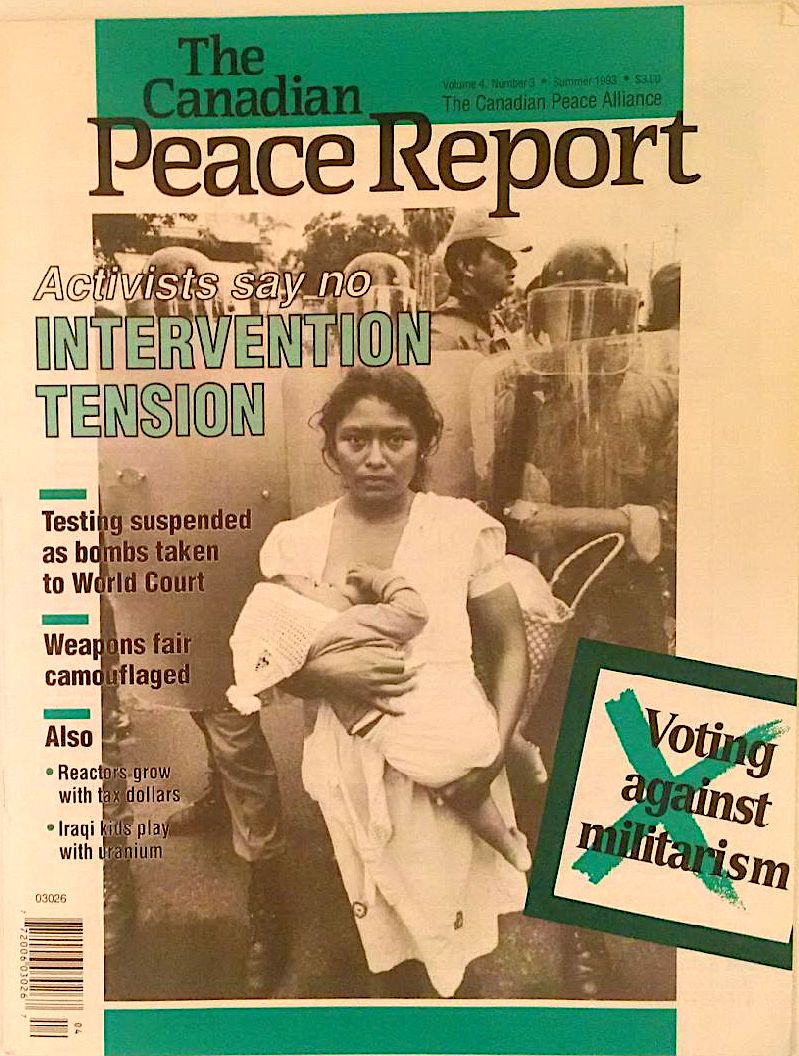
Tag: Canada

  • Elect Peace

    Elect Peace

    By David South

    The Canadian Peace Report, Summer 1993

    More than 80,000 people swarmed Parliament Hill on May 15 at an Action Canada Network and Canadian Labour Congress rally against free trade and other federal policies. In a paper issued just before, the Canadian Centre for Policy Alternatives criticizes Canadian military spending as “carried over from a cold war that no longer exists. At the same time, our assistance to poor nations is actually falling.” 

    When a federal election is called, peace groups across Canada plan to be heard. They see the defence department’s $11.3-billion yearly budget – amidst cuts to social programs and calls for even more restraint – as ripe for a hot election battle over government priorities. 

    A recent Gallup poll conducted for the Canadian Peace Alliance found broad support across all political allegiances for cutbacks to military spending. The CPA also wants daily life demilitarized, with duties like search and rescue turned over to civilian agencies. 

    Local groups are mostly awaiting a date for the election, expected about late October, but national groups are already planning. Some groups will fight the Conservative Party’s backing of the North American Free Trade Agreement (NAFTA), which they fear will lead to further military integration of Canada and the United States. 

    The Peace Alliance is working on action and information kits targetting military spending versus social needs, and is developing an election logo. It’s also building up to a national action day. 

    The idea is to stimulate local and regional activity, coordinator Gideon Forman says. “Kits will help member groups organize actions during the election campaign. They will have information on, among other things, the plan to buy deluxe helicopters, military spending in general and the cost of social needs. 

    “We will give local groups suggestions for local events and assist with media work.”

    Project Ploughshares has produced a short booklet of questions to ask candidates, “but not a repeat of the Election Priorities Project” of the 1988 election, says researcher Bill Robinson. The booklet suggests calling for cuts in military spending, cancelling the EH-101, limiting Canada’s participation in military operations, and abolishing nuclear weapons. 

    Also nationally, the Action Canada Network (to which the Peace Alliance belongs) met with groups from across the country in Winnipeg in mid-June to finalize election plans, which may include a radio ad campaign. National chair Tony Clarke would like local activists to dog the party leaders across the country, as progressive groups did to Ontario’s Liberals during the province’s 1990 election. 

    “We will definitely make the link between a range of issues and the (Canada-U.S.) Free Trade Agreement and NAFTA, which we have to get rid of,” says Clarke. “We will be working very hard on jobs and arguing for a job strategy.”

    Responding to the Gulf War two years ago (Action Canada Dossier #30), Clarke warned that Canada is “tied in closer than we have ever been before to the permanent war economy” of the U.S.. With a quarter of its output related to the military, the U.S. used militaristic diplomacy to justify maintaining defence budgets, he says. The trade agreements’ guarantees of U.S. access to Canadian energy resources confirm that “we are locking ourselves into what can only be described as Fortress North America.”

    Maude Barlow of the Council of Canadians, a network ally, denounced the helicopter purchase during the Peace Alliance’s March 8 lobby of Parliament. Soon after, then defence minister Kim Campbell appeared to waver on the number of helicopters to be bought, but succeeded in winning the Tory leadership without it becoming a major issue. However, Liberal leader Jean Chretien promises to cancel the contract.

    At CUSO’s national office, Marc Allain says the development agency will work with the CPA around military spending and the ‘copter purchase. 

    To Peter Davison of the Halifax Peace Action Network, the stakes are clear and the passion to fight the issues simply awaits a polling date. 

    “Never has the guns-or-butter issue been more prominent in our society,” says Davison. “Conservative economic policies have been collapsing around the globe. We’re seeing desperate restraint and universal trusts being violated – health care, education, pensions.

    “It’s bizarre that we can still conceptualize $6 billion for helicopters to fight submarines – an absurd twist away from meeting human needs.”

    Terry Gardner says Science for Peace’s mandate bars entering the election fray, but says the group is planning a high-level panel in the fall on NAFTA and militarization of Canadian culture. 

    “We’re going to be asking candidates in our area for conversion and reduction in military spending,” says J.J. Verigin of the Doukhobour peace and disarmament committe in British Columbia. He says his MP has been supportive of chopping the choppers. 

    Verigin found fact sheets helpful and says the CPA does a good job of getting out beyond the urban areas. But he would like the Alliance “to propose something that engages the electorate’s intellect as the gut.”

    “We have a general intent to intervene in the election, but we’re not quite clear exactly how,” says North Bay Peace Alliance organizer Brennain Lloyd. “We’re considering a regional information package, something like the Election Priorities Project, that our groups could use.”

    Being armed with the facts helps reach the public and pins down candidates, Lloyd says. She applauds the CPA’s idea of producing action kits that her group could integrate into its own. 

    Toronto’s ACT for Disarmament won’t be working specifically on the election, but may participate in actions, says organizer Maggie Helwig. “Groups have certain things they focus on, and certain ways of operating. Other people do better at elections.”

    In Montreal, Judith Berlyn of Westmount Initiative for Peace says, “We will be doing locally what has been developed by the Canadian Peace Alliance as a whole – go to all-candidates meetings, get the mike and ask the questions. We will be raising issues. Last time our candidate had never heard of low-level flying.”

    Berlyn feels many people, including activists, often think they don’t know enough to speak publicly. But with information kits, “we know more than the candidates do.”

    While approving the CPA’s focus on military spending, Berlyn says it would be a mistake to over-emphasize the helicopters. “Everybody has [already] picked up on that; it’s a good concrete example of insane military spending.”

    She also finds the public receptive to informative and succinct pamphlets advocating alternatives to a militarized economy. A Coalition to Oppose the Arms Trade pamphlet is a good model, she says. 

    “It has four concrete proposals of what the government can do to convert military industries – money that now goes to subsidizing the manufacturing of weapons can be turned into conversion subsidies.”

    https://davidsouthconsulting.org/2020/12/15/continental-drift-and-military-complexities/

    https://davidsouthconsulting.org/2022/04/06/mobile-phone-peacekeeping/

    https://davidsouthconsulting.org/2021/07/28/pavlovs-army-this-magazine-august-1992/

    https://davidsouthconsulting.org/2023/01/17/war-peace-and-development-may-2018/

    Creative Commons License

    This work is licensed under a
    Creative Commons Attribution-Noncommercial-No Derivative Works 3.0 License.

    ORCID iD: https://orcid.org/0000-0001-5311-1052.

    © David South Consulting 2023

  • Continental Drift And Military Complexities

    Continental Drift And Military Complexities

    By David South

    The Canadian Peace Report, Summer 1993

    A cornerstone of the Conservative government since 1984 has been the Free Trade Agreement (FTA) between the United States and Canada, soon to be followed by a North American version (NAFTA), which adds Mexico. 

    Peace researchers differ over how much the deals could further militarize Canada’s economy. 

    “The Canadian government can invest in any military-related pursuit without fearing the U.S. or Mexico will say it is an unfair subsidy,” Kaye says. 

    Under the Canada-US deal, articles 907, 1308 and 2003 immunize trade that fosters “national security” from charges of unfair subsidies. A free trade tribunal could deem subsidies to farmers or toilet-seat manufacturers as unfair competition – but not subsidies to weapons manufacturers. Articles 1018 and 2102 of NAFTA maintain the exemptions. 

    CPA membership coordinator Gary Kaye argues that FTA, and NAFTA even more so, bind Canadian governments at all levels to military regional development. The United States has relied on investment in military industries as a regional development tool more than any other Western country, he says. 

    “The Canadian government can invest in any military-related pursuit without fearing the U.S. or Mexico will say it is an unfair subsidy,” Kaye says. 

    Ken Epps, a researcher with Project Ploughshares in Waterloo, Ont., agrees one reason the government insists on buying $5.8 billion helicopters in the face of overwhelming public opposition is that it’s a regional development program protected under the FTA. 

    “Any other [subsidy] program of that size could well be protested by the Americans. The whole thing has been set up with new plants being built in different parts of Canada to build parts for the helicopters.”

    But Epps disagrees that the trade agreements will integrate Canada much further into the U.S. war machine. De facto free trade in arms has existed since Canada and the U.S. signed the Defence Production Sharing Agreement in 1959, he points out, following the scrapping of Canada’s Avro Arrow jet plane. There-after Canada specialized in making military components rather than complete systems.

    Epps and others say Ottawa’s high-tech hardware binge – including the 50 high-ticket EH-101 helicopters – and the Canadian military industries’ desire to sell to booming Pacific Rim and Middle East markets would exist even without the trade agreements. Epps sees the U.S. favouring its own defence industry at the expense of Canadian suppliers, which will increase Canadian businesses’ desire for foreign sales. 

    Retired U.S. admiral Eugene Carroll, director of the Washington-based Center for Defense Information, says every nation is interested in boosting its own national prestige throught the military, and Western industrialized countries are looking to sustain exports by selling weapons to the Third World. 

    “That’s just plain old profit-driven commercial activity,” says Carroll. “I don’t think trade agreements extend control onto military-related activities.”

    Kaye, however, stresses that NAFTA will ensure the bilaterial agreements between Canada and the United States on military trade will continue untouched. “Under those agreements, we are committed to balance military imports and exports with the United States. 1992 figures show a $4-billion deficit; therefore we will be buying much more in the way of arms than anyone could imagine would be needed for Canada’s direct security.”

    Many peace groups are worried about the implications. 

    “NAFTA reveals an agenda for the military and the transnational corporations that binds the Canadian economy more to the U.S. military machine,” Marion Frank wrote for the Peace Alliance in Action Canada Network’s Action Dossier (Dec. 1992), drawing on a position reached by the CPA Steering Committee last fall.

    “Under NAFTA, as under FTA, the only areas where government subsidies are allowed are in the military and energy sectors … Wide-ranging expansion of ‘intellectual property rights’ in NAFTA increases monopoly product protection for the transnationals here in Canada, and aids in the privatization of high-tech capacity, all of which ties us more closely to the U.S. military-industrial complex …

    “In the U.S., trade strategy is linked to security strategy,” Frank adds, “The military tells U.S. industry what equipment to plan for and buy in order to meet U.S. strategic objectives. As we become more integrated into the North American [trading] bloc, our ability to develop our own strategies will disappear.”

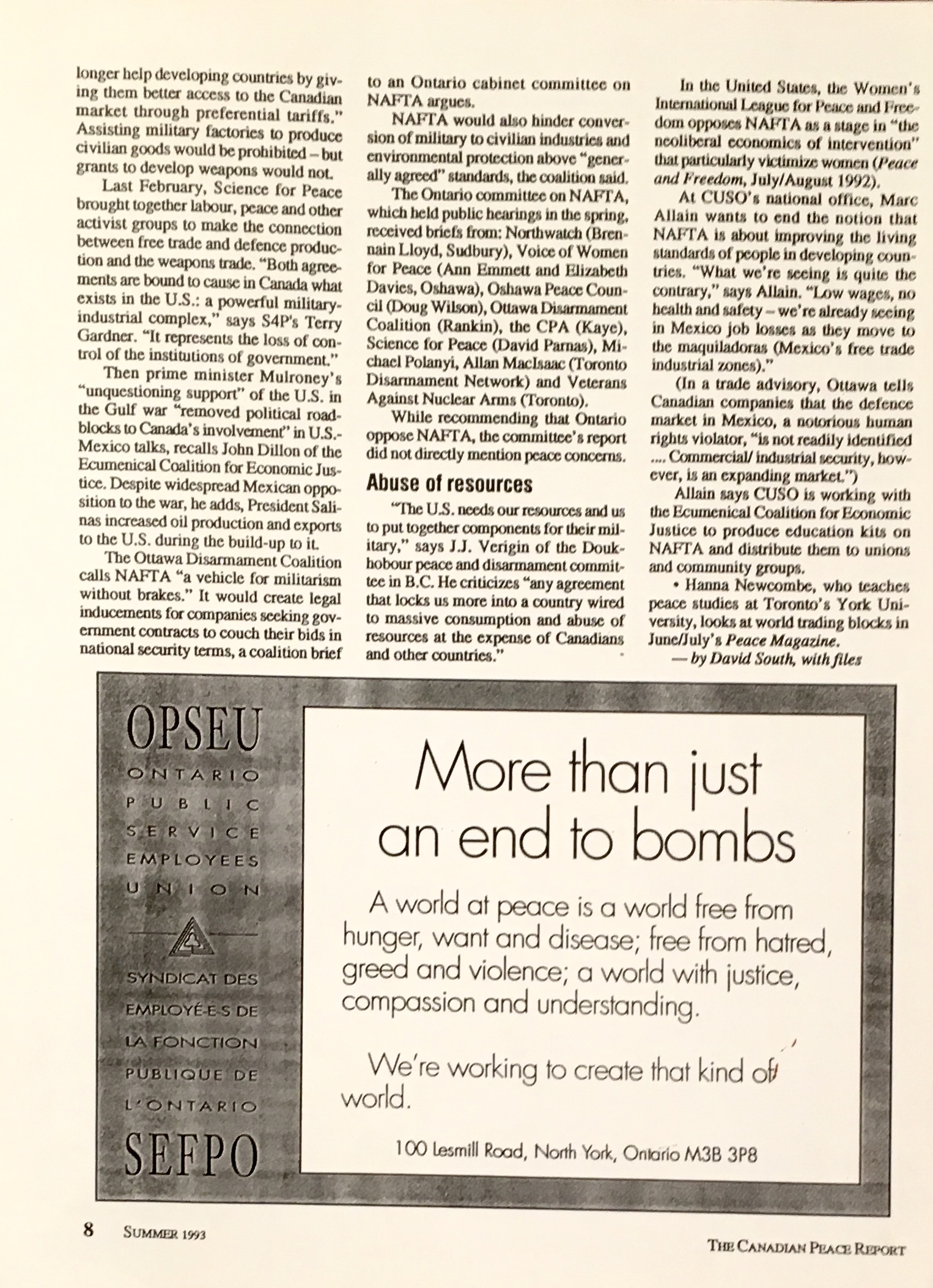
    Recommendations from the Peace Alliance-facilitated Citizens’ Inquiry into Peace and Security would be difficult to implement under NAFTA, contends Darrell Rankin of the Ottawa Disarmament Coalition. “Canada could no longer help developing countries by giving them better access to the Canadian market through preferrential tariffs.” Assisting military factories to produce civilian goods would be prohibited – but grants to develop weapons would not.

    Last February, Science for Peace brought together labour, peace and other activist groups to make the connection between free trade and defence production and the weapons trade. “Both agreements are bound to cause in Canada what exists in the U.S.: a poweful military-industrial complex,” says S4P’s Terry Gardner. “It represents the loss of control of the institutions of government.”

    Then prime minister Mulroney’s “unquestioning support” of the U.S. in the Gulf War “removed political roadblocks to Canada’s involvement” in U.S.-Mexico talks, recalls John Dillon of the Ecumenical Coalition for Economic Justice. Despite widespread Mexican opposition to the war, he adds, President Salinas increased oil production and exports to the U.S. during the build-up to it. 

    The Ottawa Disarmament Coalition calls NAFTA “a vehicle for militarism without brakes.” It would create legal inducements for companies seeking government contracts to couch their bids in national security terms, a coalition brief to an Ontario cabinet committee on NAFTA argues. 

    NAFTA would also hinder conversion of military to civilian industries and environmental protection above “generally agreed” standards, the coalition said.

    The Ontario committee on NAFTA, which held public hearings in the spring, received briefs from: Northwatch (Brennain Lloyd, Sudbury), Voice of Women for Peace (Ann Emmett and Elizabeth Davies, Oshawa), Oshawa Peace Council (Doug Wilson), Ottawa Disarmament Coalition (Rankin), the CPA (Kaye), Science for Peace (David Parnas), Michael Polanyi, Allan MacIssac (Toronto Disarmament Network) and Veterans Against Nuclear Arms (Toronto). 

    While recommending that Ontario oppose NAFTA, the committee’s report did not directly mention peace concerns. 

    “The U.S. needs our resources and us to put together components for their military,” says J.J. Verigin of the Doukhobour peace and disarmament committee in B.C.

    Abuse of resources

    “The U.S. needs our resources and us to put together components for their military,” says J.J. Verigin of the Doukhobour peace and disarmament committee in B.C. He criticises “any agreement that locks us more into a country wired to massive consumption and abuse of resources at the expense of Canadians and other countries.”

    In the United States, the Women’s International League for Peace and Freedom opposes NAFTA as a stage in “the neoliberal economics of intervention” that particularly victimize women (Peace and Freedom, July/August 1992). 

    At CUSO’s national office, Marc Allain wants to end the notion that NAFTA is about improving the living standards of people in developing countries. “What we’re seeing is quite the contrary,” says Allain. “Low wages, no health and safety – we’re already seeing in Mexico job losses as they move to the maquiladoras (Mexico’s free trade industrial zones).”

    (In a trade advisory, Ottawa tells Canadian companies that the defence market in Mexico, a notorious human rights violator, “is not readily identified … Commercial/industrial security, however, is an expanding market.”)

    Allain says CUSO is working with the Ecumenical Coalition for Economic Justice to produce education kits on NAFTA and distribute them to unions and community groups. 

    The Canadian Peace Report, Summer 1993

    https://davidsouthconsulting.org/2020/12/15/elect-peace/

    https://davidsouthconsulting.org/2022/04/06/mobile-phone-peacekeeping/

    https://davidsouthconsulting.org/2021/07/28/pavlovs-army-this-magazine-august-1992/

    https://davidsouthconsulting.org/2023/01/17/war-peace-and-development-may-2018/

    Creative Commons License

    This work is licensed under a
    Creative Commons Attribution-Noncommercial-No Derivative Works 3.0 License.

    ORCID iD: https://orcid.org/0000-0001-5311-1052.

    © David South Consulting 2023
  • Somali Killings Reveal Ugly Side Of Elite Regiment

    Somali Killings Reveal Ugly Side Of Elite Regiment

    By David South

    Now Magazine (Toronto, Canada), May 6-12, 1993

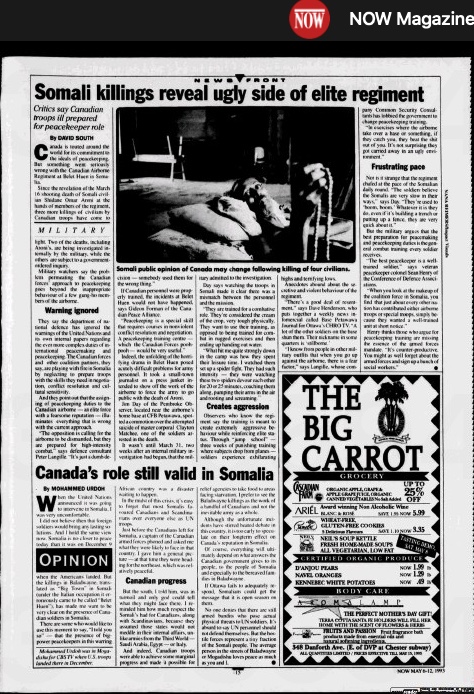
    Canada is touted around the world for its commitment to the ideals of peacekeeping. But something went seriously wrong with the Canadian Airborne Regiment at Belet Huen in Somalia.

    Since the revelation of the March 16 shooting death of Somali civilian Shidane Omar Aroni at the hands of members of the regiment, three more killings of civilians by Canadian troops have come to light. Two of the deaths, including Aroni’s, are being investigated internally by the military, while others are subject to a government-ordered inquiry.

    Military watchers say the problem permeating the Canadian Armed Forces’ approach to peacekeeping goes beyond the inappropriate behaviour of a few gung-ho members of the airborne.

    Warning ignored

    They say the department of national defence has ignored the warnings of the United Nations and its own internal papers regarding the ever more complex duties of international peacemaking and peacekeeping. The Canadian forces and other coaltion partners, they say, are playing with fire in Somalia by neglecting to prepare troops with the skills they need in negotiation, conflict resolution and cultural sensitivity.

    And they point out that the assigning of peacekeeping duties to the Canadian airborne – an elite force with a fearsome reputation – illuminates everything that is wrong with the current approach.

    “The opposition is calling for the airborne to be dismantled, but they are prepared for high-intensity combat,” says defence consultant Peter Langille. “It’s just a dumb decision – somebody used them for the wrong thing.”

    “The opposition is calling for the airborne to be dismantled, but they are prepared for high-intensity combat,” says defence consultant Peter Langille. “It’s just a dumb decision – somebody used them for the wrong thing.”

    If Canadian personnel were properly trained, the incidents at Belet Huen would not have happened, says Gideon Forman of the Canadian Peace Alliance.

    “Peacekeeping is a special skill that requires courses in non-violent conflict resolution and negotiation. A peacekeeping training centre – which the Canadian Forces pooh-pooh – would be very useful.”

    Indeed, the unfolding of the horrifying drama in Belet Huen posed acutely difficult problems for army personnel. It took a small-town journalist on a press junket intended to show off the work of the airborne to force the army to go public with the death of Aroni.

    Jim Day of the Pembroke Observer, located near the airborne’s home base at CFB Petawawa, spotted a commotion over the attempted suicide of master corporal Clayton Matchee, one of the soldiers arrested in the death.

    It wasn’t until March 31, two weeks after an internal military investigation had begun, that the military admitted to the investigation.

    Day says watching the troops in Somalia made it clear there was a mismatch between the personnel and the mission.

    “They are trained for a combative role. They’re considered the cream of the crop, very tough physically. They want to use their training, as opposed to being trained for combat in rugged exercises and then ending up handing out water.

    “What hit me quite strongly down in the camp was how they spent their leisure time. I watched them set up a spider fight. They had such intensity – they were watching these two spiders devour each other for 20 or 25 minutes, coaching them along, pumping their arms in the air and rooting and screaming.”

    Creates aggression

    Observers who know the regiment say the training is meant to create extremely aggressive behaviour while reinforcing elite status. Through “jump school” – three weeks of punishing training where subjects drop from planes – soldiers experience exhilarating highs and terrifying lows.

    Anecdotes abound about the secretive and violent behaviour of the regiment.

    “There’s a good deal of resentment,” says Dave Henderson, who puts together a weekly news infomercial called Base Petawawa Journal for Ottawa’s CHRO TV. “A lot of the other soldiers on the base shun them. Their nickname in some quarters is ‘stillborne.’

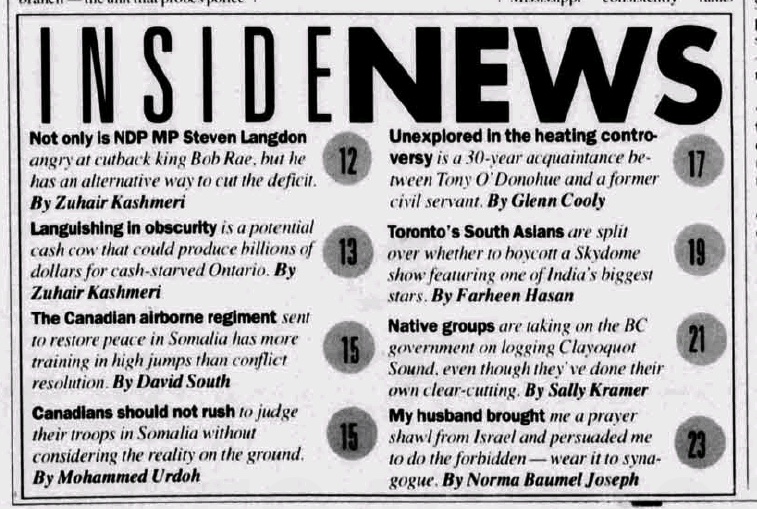
    “I know from people in other military outfits that when you go up against the airborne, there is a fear factor,” says Langille, whose company Common Security Consultants, has lobbied the government to change peacekeeping training.

    “In exercises where the airborne take over a base or something, if they catch you, they bet the shit out of you. It’s not surprising they got carried away in an ugly environment.”

    Frustrating pace

    Nor is it strange that the regiment chafed at the pace of the Somalian daily round. “The soldiers believe the Somalis are very slow in their ways,” says Day. “They’re used to ‘boom, boom.’ Whatever it is they do, even if it’s building a trench or putting up a fence, they are very quick about it.”

    But the military argues that the best preparation for peacemaking and peacekeeping duties is the general combat training every soldier receives.

    “The best peacekeeper is a well-trained soldier,” says veteran peacekeeper colonel Sean Henry of the Conference of Defence Associations.

    “When you look at the make-up of the coalition force in Somalia, you find that just about every other nation has contributed either airborne troops or special troops, simply because they wanted a well-trained unit at short notice.”

    “When you look at the make-up of the coalition force in Somalia, you find that just about every other nation has contributed either airborne troops or special troops, simply because they wanted a well-trained unit at short notice.”

    Henry thinks those who argue for peacekeeping training are missing the essence of the armed forces’ mandate. “It’s counter-productive. You might as well forget about the armed forces and sign up a bunch of social workers.”

    Does the UN know what it’s doing?

    Now Magazine (Toronto, Canada), July 22-28, 1993. This incident was the basis of the 2001 film Black Hawk Down. 

    By David South

    Now Magazine (Toronto, Canada), July 22-28, 1993

    The United Nations’ bloody hunt for elusive Mogadishu warlord general Mohamed Farah Aideed has many observers wondering whether the world body is making up the rules as it goes along.

    Some critics, such as George Cram of the Canadian Council for International Cooperation, an influential umbrella group for Canadian non-governmental organizations of NGOs, question if the obsession with Aideed isn’t just burying the UN in a deeper image problem with the Third World.

    Critics point to the fallout of growing resentment from the July 12 attack on Aideed’s compound – killing more than 70 civilians – boding ill for a peaceful reconstruction of Somali society.

    The fact that among those killed within the compound were clan elders who were negotiating a peace has upset Somalis even more, says Cram, a Horn of Africa researcher.

    “The UN has lost its credibility, its moral authority, lost its blue-beret neutrality,” says Cram bluntly.

    The degree to which Aideed should be the main focus of current UN actions has some relief agencies scratching their heads. Aideed has become Somalian bogey man number one with UNOSOM’s (United Nations Operations in Somalia) head, US Admiral Johnathon Howe. He has placed a $25,000 price on Aideed for an arrest.

    “I don’t recall the UN ever going out and actually attempting to arrest individuals – they certainly haven’t done it in other conflict zones,” says reverend David Hardy of Saskatoon-based Lutheran Relief, who has organized relief flights into Somalia.

    Cambodian example

    He cites the example of Cambodia, where the UN brokered a controversial peace with those purveyors of the genocidal killing fields, the Khmer Rouge, in order to secure free elections.

    David Isenverg of the Center for Defense Information, a liberal Washington-based think tank, worries that doggedly going after Aideed while ignoring the other factions will paint the UN as siding with one faction over another.

    “The protracted effect is to turn the US and UN into partisans to the conflict.”

    Hardy believes Aideed, who is adept at seeing which way the wind blows, has inflated his stature as an opponent of the UN as foreign invader.

    Then there are other criticisms. Some observers wonder whether the UN is too proud or too blind, or simple oblivious when it comes to seeking advice from the locals it went in to protect.

    Even Canada, while supporting the UN’s military effort since Aideed “is obstructing relief supplies,” believes that national reconciliation should be a main focus, says external affairs spokesperson Rodney Moore.

    He says Canada continues to urge the UN to move quickly on national reconciliation, bringing together women’s groups, clan elders and other non-warlord groups.

    “One of the areas where the UN operation went wrong is the tendency to deal with the ‘superpowers’ of Somalia while ignoring groups like women’s collectives,” says World Visions’ Philip Maher, who has just returned from Somalia.

    “Part of the problem is misunderstanding,” Maher says. “The UN hasn’t done a great job of telling Somalis what they are doing.”

    Many point to the peaceful north, where the as yet internationally unrecognized Somaliland offers a successful model, combining women’s groups and elders to wrest control.

    Update: War crimes: former minister reveals why Canada disbanded its special airborne force after scandal: The drastic step was judged the best way to fix systemic problems after an affair similar to allegations against Australian forces in Afghanistan (Wed 2 Dec 2020)

    Further reading: 

    Canada evolves from peacekeeper to war-fighter by A. Walter Dorn, The Toronto Star, Dec. 21, 2013

    IS CANADA A NATION OF WARRIORS OR PEACEKEEPERS? HOW TO REFOCUS ON UNITED NATIONS PEACE OPERATIONS by Maj M.C.C. Lafortune, Canadian Forces College, 2016-2017

    Law in Times of Crisis: Emergency Powers in Theory and Practice by Oren Gross and Fionnuala Ní Aoláin  (2006)

    Manitoba Law Journal: The New Emergencies Act: Four Times the War Measures Act, 1991 CanLIIDocs 129

    Doug Ford declared a state of emergency. Should Justin Trudeau do the same? 

    October 1970 by Louis Hamelin (Publisher: House of Anansi, 2013). “October 1970 is a thrilling fictional account of the events that shaped one of the most volatile moments in recent history.”

    Trudeau’s Darkest Hour: War Measures in Time of Peace, October 1970 Editors: Guy Bouthillier, Édouard Cloutier (2010)

    Warrior Nation: Rebranding Canada in an Age of Anxiety by Ian McKayJamie Swift (2012)

    Warriors Or Peacekeepers? Building Military Cultural Competence, Editors: Kjetil EnstadPaula Holmes-Eber (2020)

    Canadian Peacekeeping Is Under the Gun by Craig Turner, Los Angeles Times, Aug. 1, 1996

    My journalism:

    1992

    Top Reporters Offer Military Media Handling Tips

    1993

    Continental Drift And Military Complexities

    Somali Killings Reveal Ugly Side Of Elite Regiment

    Does the UN know what it’s doing?

    Peaceniks Questioning Air-Raid Strategy In Bosnia

    1996

    State Of Decay: Haiti Turns To Free-Market Economics And The UN To Save Itself

    U.S. Elections Update: Clinton is using Canada to keep control of Haiti

    Creative Commons License

    This work is licensed under a
    Creative Commons Attribution-Noncommercial-No Derivative Works 3.0 License.

    ORCID iD: https://orcid.org/0000-0001-5311-1052.

    © David South Consulting 2023

  • Top Reporters Offer Military Media Handling Tips

    Top Reporters Offer Military Media Handling Tips

    Ryerson’s course on handling media has raised eyebrows

    By David South

    Now Magazine (Toronto, Canada), November 12-18, 1992

    The whimsical Certificate of Military Achievement hanging in the offices of the Ryersonian newspaper at Ryerson journalism school is testament to the warm relationship between the armed forces and one of Canada’s top journalism schools.

    But a two-month crash course in journalism for military public affairs officers hosted by Ryerson this summer has left a bad taste in the mouths of some participants and critics.

    The course, which involved 18 soldiers, included two weeks of classes in each of print, radio and TV journalism, wrapping up with two weeks of “crisis management” training. The 60 instructures included such prominent journalists as Ann Medina and Pamela Wallin.

    According to an administration newsletter, the course netted Ryerson more than $350,000. Organizers say the course was merely an exercise in familiarizing soldiers with the needs of working journalists. But given the often conflicting roles of the military and the media, some fear journalistic ethics may have taken some collateral damage.

    “The course had nothing to do with national defence or the armed forces,” says course teacher and organizer Shelley Robertson. “They just wanted to understand the roles of journalists from the other side. The military didn’t ask us to teach what we teach our students.”

    Robertson says the course also benefited the participating journalists by giving them contacts in the military.

    But according to media critic Barrie Zwicker, the exercise blurs what should be the distinctly different interests of journalists and the military. “It’s similar to press and politicians. By getting close to the politician, journalists can get information they couldn’t normally obtain. The negative side is that the media can get sucked in and lose a larger perspective. The same tensions exist with covering the military.

    Managing media

    “It’s up to the media to break the rules and try and get the story. The military always wants to hide its victims. If a Ryerson journalist strikes up a friendship with a public affairs officer, will the reporter be true to their journalistic tradition?”

    Colloquially known as spin doctors, hype-meisters and flak catchers, public affairs officers perform much the same tasks in the military as their civilian counterparts in industry and government – including managing information that gets to the public or media.

    In the past, Canadian soldiers had to go to the US for special training at the Defense Information School at Fort Benjamin Harrison. But, according to Robertson, the armed forces were looking for a Canadian spin.

    With 4,600 Canadian peacekeepers now stationed around the world, including a contingent in the dangerous and volatile former Yugoslav republics, the chances for conflict – and casualties – have increased.

    Lieutenant-commander Glen Chamberlain, who helped coordinate the course, says the military’s increased profile means that the forces have to become more adept at media relations. “There is a great desire among Canadians to know what troops on peacekeeping duties are up to. We have a wonderful story to tell.”

    Chamberlain says he works on journalists’ behalf with stubborn military commanders. “The armed forces are finding there is a real benefit to having specialized PA officers. We want to help journalists to tell our story well.”

    The crisis management section of the course offered participants a hands-on approach to managing journalists. The officers were presented with two scenarios – a murder at Moss Park armoury and a highway helicopter crash – and then practised handling a group of journalists investigating the events.

    Course lecturer Kevin Donovan, who covered the Gulf war for the Toronto Star, remembers the effectiveness and sophistication of PA officers in the field.

    “When I was in Riyadh, Saudi Arabia, I walked into a hotel and on the wall were pool reports – news briefs written by US military public affairs officers – that journalists were encouraged to use for stories. There were some journalists going out into the field to cover stories, but a huge number just sat in this beautiful hotel.”

    “Canadian journalists are ignorant of the military and could do with getting closer. You almost never find a full-time journalist in Canada who knows anything about them. The more you know about the military, the less you will be manipulated.”

    Stop information

    Donovan feels uncomfortable about teaching on the course.

    “I was asked by Ryerson to give a talk on my experiences in Saudi Arabia, Kuwait and Iraq,” he says. “My initial reaction was no. I hate the existance of public affairs people with a passion. Their job is to stop information.

    “I’m uncomfortable with Ryerson being hired by the department of national defence. One officer in the course got very upset when I told them to make contacts with the media and leak stories.”

    Course organizer Clive Vanderburgh admits organizers had concerns about conflicts between the role of journalists and military officers. “There was a lot of discussion concerning the potential for conflict – especially that the people hired to teach might think they were there to help the department of national defence to avoid the media

    “But we were trying to give a general understanding of the media’s needs. We didn’t sell the country down the drain.”

    Another teacher was Robert Fulford, the well-known writer and lecturer on journalistic ethics. “I don’t have a problem with Ryerson teaching the military,” says Fulford. “It’s a way of spreading journalistic technique to people in the DND. It seems to be a natural extension of the work of Ryerson.

    “Canadian journalists are ignorant of the military and could do with getting closer. You almost never find a full-time journalist in Canada who knows anything about them. The more you know about the military, the less you will be manipulated.”

    But Gideon Forman, coordinator of the Canadian Peace Alliance, fears Ryerson may be helping the military mislead the public.

    “Why do these guys practise handling the media so much of there’s nothing to hide? This is just better packaging for the military so they can get what they want from the public.

    “I have problems with public money being spent teaching the military to be more effective with the media, while other organizations have their budgets cut or eliminated.

    “Is there a similar program for food banks or women’s shelters?”

    Note on story context: This story was researched and written after two key events involving Canada’s military: the first Gulf War from 1990-1991; and the Oka Crisis in 1990, where the Canadian Armed Forces confronted an armed group of Mohawk “Warriors” in Oka, Quebec.

    More investigative journalism here: 

    Peaceniks Questioning Air-Raid Strategy In Bosnia

    Somali Killings Reveal Ugly Side Of Elite Regiment

    Study Says Jetliner Air Quality Poses Health Risks: CUPE Takes On Airline Industry With Findings Of Survey

    Creative Commons License

    This work is licensed under a
    Creative Commons Attribution-Noncommercial-No Derivative Works 3.0 License.

    ORCID iD: https://orcid.org/0000-0001-5311-1052.

    © David South Consulting 2023