UK regulations on what can be shown on sex channels are tougher than in most countries of the European Union. Channels such as the hard-core Swedish TV Erotica and the recently-launched French Rendezvous are licensed in their respective countries and transmit explicit scenes of sexual intercourse, straight and gay, featuring close-up shots of copulating genitals.
Graff Pay-Per-View, the experienced US sex channel operator, consciously decided to exclude the UK as a market for its hard-core Eurotica channel which is licensed in Denmark and, like the other hard-core channels, transmits via a Eutelsat satellite. But pirate smart cards for the channel, as for the other channels, are available in the UK in specialist satellite shops.
Graff’s seeming respect for the UK regulations may not be unconnected with the fact that it owns the Adult Channel and would be wary of upsetting the ITC. Broadcasting unacceptable material into the UK could provoke the ITC into seeing Graff as a body unfit to hold a licence, thereby threatening the Adult Channel.
The ITC’s guidelines on sexually explicit material state that representations of sexual intercourse can be shown only after 9pm and that “the portrayal of sexual behaviour, and of nudity, needs to be defensible in context and presented with tact and discretion.”
There has been some relaxation of the rule. The ITC will, on an experimental basis, allow the watershed to be broken by a ppv or video-on-demand service. It is not, however, prepared to give this freedom to a porn channel, at least not in the early days, because it does not want to be seen to be licensing pornography. The relaxation will affect only general services.
The ITC will also monitor any ppv service to ensure that there are no cases of children accessing the programming before deciding if the programme code should be revised.
The transmission of 18-rated films on terrestrial or new-media channels is not permitted before 10pm. Films with a 15-rating are not allowed before 9pm on terrestrial channels such as BSkyB’s Sky Movies or the Movie Channel. These are minimum requirements. Some 15-rated films, for instance those which show scenes of sexual intercourse or drug-taking, would not be deemed suitable for transmission even on an encrypted channel at 8pm.
In practice, the ITC does not permit depictions of erect penises, anal intercourse, close-ups of genitalia or ejaculation.
Where channels have overstepped the mark and gone abroad to get licences from less strict authorities – the late Red Hot Dutch and TV Erotica – the ITC has recommended that the channels be proscribed, action which has subsequently been taken by the Department of National Heritage. The ITC is now monitoring the Rendezvous channel, which shows a mix of gay and heterosexual hard-core pornography with graphic scenes of sexual intercourse.
The DNH issues proscription orders under Sections 177 and 178 of the Broadcasting Act. The orders make it a criminal offence to supply equipment to receive the channels or to market and advertise them.
The European Union directive on transfrontier broadcasting lays down that one country cannot prevent the reception of channels licensed by other European Union countries. However, it allows individual governments to take action against any broadcast which could damage the physical, mental or moral development of minors.
Update: It is over 20 years since this Special Report was published. The Internet now plays a significant role in the growth of sex content and the sex industry and vice versa. Here is an interesting overview of the situation in 2020. The Internet is for Porn – It always was, it always will be.
“One of the biggest and most interesting things happening in the consumer web right now is running almost completely under the radar. It has virtually zero Silicon Valley involvement. There are no boastful VCs getting rich. It is utterly absent from tech’s plethora of twitters, fora and media (at least, as they say, “on main”). Indeed, the true extent of its incredible success has gone almost completely unnoticed, even by its many, many, many customers.
Harnessing the power of design to improve products and the way they are manufactured is a critical component of successful economic development. And the high export value of designing and making “computer equipment, office equipment, telecommunication equipment, electric circuit equipment, and valves and transistors” was flagged up as a priority for developing nations back in 2005 at a meeting looking for “New and Dynamic Sectors of World Trade” (UNCTAD).
One country taking up this challenge is China. It now boasts twice as many Internet users as the United States, and is the main global maker of computers and consumer electronics, from toys to games consoles to digital everything.
China is also on course to become the world’s largest market for Internet commerce and computing.
The centre of gravity is very much moving China’s way: One study of 769 firms investing in 2,203 Chinese companies by Stanford University in California, found “the same firms that were successful in Silicon Valley … have transplanted their expertise to China,” according to Marguerite Gong Hancock in The New York Times.
But the country wants to move from ‘Made in China’ to ‘Designed in China’. This is critical because the majority of the profits to be made are actually in the designing, patenting and marketing of products. Manufacturing, as has been shown in the recent media controversy over the products made by Apple (apple.com), is not the main profit centre.
Apple employs 43,000 people in the United States and 20,000 overseas. But through its network of sub-contractors, the number employed overseas in Asia, Europe and elsewhere is around 700,000 (The New York Times). This includes around 200,000 assembly jobs in China. These workers can make US $17 a day or less.
Apple makes hundreds of dollars in profit for each of its iPhones. Apple can do this because it is the designer of the phones and holds the copyright, and it is the branded company that has built up its reputation and developed a highly sophisticated marketing and distribution network around the world. Through clever use of design, Apple created products that look distinctive in the marketplace. And those are the factors that determine the ability to make this profit. As has been noted, it isn’t just cheap wages that keep Apple’s profits high.
Getting consumers to desire and buy your products is a challenge for any company. Design plays a major part in understanding the unique demands of countries and markets, and what people find appealing or repellent.
A product that has both a successful design and is produced efficiently will generate a good profit.
The classic example from the past is Japan. Devastated during World War II, Japan set about re-building its manufacturing prowess from scratch. It brought in American innovators to introduce new concepts in manufacturing.
Japan’s openness to the new ways enabled it to re-fashion its manufacturing industries to exporting to the developed Western nations, in particular the United States. At first, quality control was an issue and Japan was mocked for making cheap quality trinkets, toys, automobiles and motorcycles. But it quickly changed from this to a reputation for making quality, affordable products and moving quickly into the burgeoning micro-electronics and consumer products markets. It also was a pioneer in computer gaming and entertainment.
The recent achievements in supercomputing in China are pointing to where things can go. China has developed the Sunway Bluelight MPP supercomputer (http://en.wikipedia.org/wiki/ShenWei). It is able to do a quadrillion calculations per second: making the Sunway Bluelight one of the 20 fastest supercomputers in the world. It was built with a Chinese-made microprocessor, and importantly, uses lower amounts of power than other supercomputers.
The clever bit is the ratio of computing power to wattage used. Energy-efficient computing is critical if computers are to make the jump to the next level in processing power.
All these trends coming together hint at big changes in the coming years.
In the past two decades, the electronics sector has enabled a number of developing countries to improve trade performance, in particular East and Southeast Asian nations.
Improving education is critical to the growth strategy. Improving education, like encouraging the pursuit of engineering as a profession, as China has done – it now has more than half a million estimated graduates, the most in the world – means new skills and ideas are coming to the industry (engineeringinchina.net).
But this is not enough. New ideas are essentially a creative process and this needs connections to business and the ability to experiment and play with ideas. Start-up incubators have proven a successful way to do this.
Thailand is a good example: Around US $4.5 billion was invested in the country’s electronics industry between 1986 and 2001. This created 300,000 jobs. The sector became so important it made up a third of the country’s exports.
Realizing that much of the work was assembly manufacturing, the government set up the Thailand IC Design Incubator (http://www.nectec.or.th/rd/electronics/be204-45/be204-45.php) to work on hard disk drive development and move up the value chain.
“In 1978, I saw workers stringing together computer memories with sewing needles,” Patrick J. McGovern explained to The New York Times. McGovern is the founder of the International Data Group, which invests in Chinese enterprises.
“Now innovation is accelerating, and in the future, patents on smartphones and tablets will be originated by the Chinese people.”
In the past, China was not able to make significant progress on this development for two main reasons. The first is copyright piracy and theft of intellectual property rights. During China’s economic rise, this theft was rampant and the country developed a reputation for being home to a vast marketplace of knock-offs of major Western brands. And the second reason was the heavy hand of the government, which scared off many entrepreneurs.
But China is re-structuring its industries to focus on innovation. In 2011, China surpassed South Korea and Europe in total patents and was in a neck and neck race with Japan and the United States. As fuel for the innovation rocket,venture capital is critical. And China is now the world’s second largest venture capital market, with the total jumping from US $2.2 billion in 2005 to US $7.6 billion in 2011.
It is this journey up the manufacturing ‘value chain’ that many countries look to with admiration and jealousy. And the secret to being able to move up this value chain is design – savvy product design combined with savvy design of manufacturing methods to continually drive down costs and drive up quality. How long until China has its own Apple and not just an Apple knock-off (http://www.bbc.co.uk/news/technology-14503724)?
Published: February 2012
Resources
1) Red Dot: The red dot logo stands for belonging to the best in design and business. The red dot is an internationally recognised quality label for excellent design that is aimed at all those who would like to improve their business activities with the help of design.Website: http://www.red-dot.de
2) Dutch Design in Development: DDiD is the agency for eco design, sustainable production and fair trade. They work with Dutch importers and designers and connect them to local producers in developing countries and emerging markets. Together products are made that are both profitable and socially and environmentally sustainable. Website: http://www.ddid.nl/english/index.html
3) C3: C3 offers product design and product engineering services in Shanghai, China. Their strong point is managing innovative design processes from scratch (market research) until production: a one shop service: Website: chinacreativecompany.com
4) Dahua: Zhejiang Dahua Technology Co., Ltd. is a partially state-owned publicly traded company based in Hangzhou which sells video surveillance products and services. Leading video surveillance product and solution provider in IP camera, NVR, HD cctv camera, Analog, PTZ and other vertical solutions. Website: https://www.dahuasecurity.com/uk
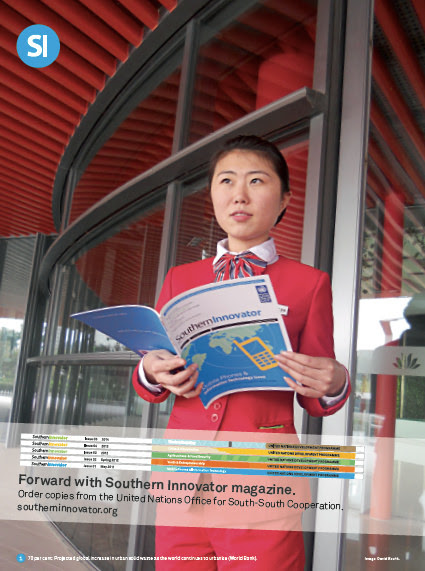
Development Challenges, South-South Solutions was launched as an e-newsletter in 2006 by UNDP’s South-South Cooperation Unit (now the United Nations Office for South-South Cooperation) based in New York, USA. It led on profiling the rise of the global South as an economic powerhouse and was one of the first regular publications to champion the global South’s innovators, entrepreneurs, and pioneers. It tracked the key trends that are now so profoundly reshaping how development is seen and done. This includes the rapid take-up of mobile phones and information technology in the global South (as profiled in the first issue of magazine Southern Innovator), the move to becoming a majority urban world, a growing global innovator culture, and the plethora of solutions being developed in the global South to tackle its problems and improve living conditions and boost human development. The success of the e-newsletter led to the launch of the magazine Southern Innovator.
Canadian troops are not only on the frontline of peacekeeping in Haiti but also the frontline of U.S. foreign policy – a policy that is unravelling during the run-up to the November 5 presidential election. While the living standards of Haitians in the poorest country in the Western Hemisphere continue to decline despite free elections, Canadian troops are charged with keeping the island nation peaceful. It’s a task that is proving more and more difficult as Haiti suffers a crime wave and violent political unrest.
While American president Bill Clinton tries to snatch another victory from a grumpy U.S. electorate, his advisors are desperately trying to keep the lid on his foreign policy “victories” in Bosnia and Haiti.
Things are so bad, Clinton sent his secretary of state, Strobe Talbott, and his national security advisor, Anthony Lake, to Haiti on August 30 in response to high-profile assassinations of right-wing leaders.
“The administration are hoping, with fingers crossed, nothing will happen before November 5,” says Larry Birn of the Washington-based Centre for Hemispheric Affairs. “What the United States would like to do is cryogenically freeze all its foreign policy engagements so they don’t produce any problems. But we are losing very valuable time in Haiti because of Washington’s paralysis over negative developments occurring there.
“Washington didn’t realize an economic success story had to be bred there in a couple of years. The USAID programme is a scandal waiting for an investigation.”
There is also another election-year factor: Republicans are not fond of anything that whiffs of a humanitarian approach to Haiti. Since they dominate Congress, this is also Clinton’s problem.
Given the history of American support for dictatorships in Haiti, the Clinton administration has chosen a low-key approach. After the 1994 invasion, the Americans pulled out the vast majority of their troops within a year, handing over responsibility for internal security to a UN peacekeeping force. But the U.S. never fully cut itself off from interfering in Haiti, keeping a military base operating in the country’s only industrial park in Port-au-Prince.
And Canada is key to U.S. plans because of that sour legacy. Canadians are seen as free from the burden of colonialism, and as a plus, our 700 mostly French-speaking troops can communicate better with the local population.
This policy has gone as far as hiring a Canadian public relations company to promote structural adjustment programmes that are conditional upon Haiti receiving any foreign aid from the International Monetary Fund and the World Bank, both based in Washington.
Gilles Morin is co-ordinating manager for Montreal firm Gervais-Gagnon-Covington Associates, who won the contract. Morin says, while his company did win the contract, like many other things to do with Haiti, they have heard nothing since Fall 1995 because of disorganization.
“On a personal basis there was a strong anti-American feeling among the population because of the past,” says Morin. “A lot of the financial institutions are based in Washington and they needed international support because banks in Washington are seen as American.”
But there is a risk that a switch in U.S. priorities during the heat of an election will endanger Canadian troops.
“If the president feels he has political risk in Haiti, he’s not going to take Canadian concerns into consideration,” warns Birns. “The UN mission gets caught up in the wake of U.S. efforts and it’s not able to define an independent course. Right now, the problem really is the USAID mission in Haiti is a total failure. The international donor function, you couldn’t exaggerate how disappointing it’s been in terms of almost no relief. The unemployment rate of 80 per cent is exactly what the unemployment rate was when the UN arrived.”
On August 28, American troops from the 82nd Airborne plopped down on the streets of Port-au-Prince to spend a week patrolling. Many observers questioned the motives for this intervention. Was it to say to Haitians the UN isn’t the real deal, and if they get out of line, the Americans will kick their butts? Why doesn’t Canada protest the U.S. undermining the credibility of our peacekeeping mission?
To Birn, sending in the 82nd was the foreign-policy equivalent of fast-food. “Sending in the 82nd Airborne merely aimed at getting a one-day headline,” he says. “The administration’s position has been staked on the fact there has been a number of foreign policy wins. But each of these victories is held together by corn starch and could unravel at any moment.”
Birn sees an escalation in political violence just around the corner. He fears the current economic crisis will help the formation of a violent left-wing guerrilla movement to rival existing right-wing paramilitaries.
“Without former president Jean Bertrand Aristide,” he explains, “there is growing apprehension that president Rene Preval will not be able to project a sufficient leadership to keep the average Haitian, who is sacrificing with no expectation of an improved standard of living, happy.”
While it has been almost two years since Haiti was the media’s darling, observers point out the cycle of violence has returned to the country’s streets despite the presence of UN peacekeepers and American troops.
When id reported from the Haitian capital of Port-au-Prince in July (id July 11 to 24, Number 18), it was obvious no progress had been made to improve the standard of living or rebuild the country’s crumbling infrastructure.
In an ironic twist, attempts to step up deportations of Haitian-Americans convicted of crimes in the U.S. has led to an increase in killings in Haiti according to the October 22 issue of New York weekly, The Village Voice.
More and more, the UN troops are propping up an increasingly unpopular government. A government that is seen by many Haitians to be getting its orders from Washington, not Port-au-Prince. Canadian troops lead the UN mission in Haiti and make up 700 of the 1500 soldiers stationed there (the rest are from Pakistan and Bangladesh).
There is a serious danger Canadian troops will be caught in the crossfire of any uprising or coup attempt, since Canadian troops shadow president Rene Preval 24 hours a day and also guard the National Palace, which was attacked August 20, killing two Haitians.
“U.S. Elections Update: Clinton is using Canada to control Haiti”.
Doling out diet supplements to recipients of food aid may sound bizarre, but that’s what US diet giant Slim-Fast has been doing.
The company’s cans of powder have been distributed to the conflict-ridden former Soviet republic of Georgia and other parts of the collapsed Soviet Union by the aid agency Americares.
Critics say Slim-Fast is far from appropriate and is, at best, in bad taste. New York-based food-aid critic and writer Michael Maren says such contributions are simply the result of agencies being used as dumping grounds for tax write-offs.
As an example, he cites Somalia, where he recenly spent time researching an upcoming book critical of aid programs. Pharmaceutical firms, he charges, are dumping unnecessary drugs in that country.
“If you want to help people, give them what they need, not the crap we have around here. That a so-called aid agency would bring over Slim-Fast is absurd.
“The attitude that they should take any shit we give them – it’s arrogance,” says Maren, who believes many donors have a beggars-can’t-be-choosers attitude to people in need of help.
At Slim-Fast’s corporate headquarters in New York, Adena Pruzansky acknowledges that the donations are tax write-offs, but insists that their product is very nutritious. No one, she says, has complained about their contribution.
Powdered cure
“If you look at our powdered products, there is a lot of nutrition in there. Certainly for people who don’t have food, this is something that could be useful to them.”
A spokesperson for Connecticut-based Americares, which directs surpluses donated by 1,100 firms to relief operations in 80 countries, praises Slim-Fast.
“They are a fine group of humanitarians,” says Elizabeth Close.
“Americares was just written up in Money magazine as the most cost-effective nonprofit agency,” she says of the organization, whose donations consist of overstocked, discontinued or obsolete items.
“We only accept a product for donation when we know we have a home for it. So we are not giving something inappropriate,” she says.
Close provides no details, however, about Slim-Fast’s participation. “Without their permission, I’m not really supposed to go into any further description of what they donated,” she says.
But those who see the devastating effects of eating disorders on women say Americares exercises poor judgement when it accepts such diet supplements.
“I think it’s quite bizarre,” says Merryl Bear of the National Eating Disorder Information Centre. “Many of these diet plans are starvation diets. In many of the diets, the caloric intake is less than or equivalent to what the Nazi concentration camps delivered.”
Slim-Fast’s chocolate drink powder, for instance, is made of skim milk powder, sugar, whey powder, cocoa, fibre, calcium caseinate, corn oil, fructose, lecithin, salt and carrageenan. It relies on mixing with milk to gets its nutrition.
Lynne Martin of the Toronto Hospital’s eating disorder clinic says Americares is encouraging dieting among starving people who need calories first.
“Women need a minimum of 1,800 to 2,100 calories per day – to meet that requirement with Slim-Fast, you would need eight glasses per day,” she says.
Low calories
Martin says the low calories available in the supplement become even lower if recipients don’t have access to milk and try to mix it with water.
“The protein level isn’t given without the milk, so you don’t know how much is in the powder, but certainly the calories would change if one were to mix it with water.”
At food relief agency CARE in Ottawa, program officer Ivan Connoir says what “the hungry need isn’t Slim-Fast but what is called a human daily ration (HDR).
“It is prepared in the United States especially for emergencies. It has no pork, so it can go to any country,” he says. “It is a kind of lentil stew and vegetable soup – just add water and it’s ready to eat. You even find bread in it. It can last for years.
“Of course the best thing is family food parcels that last one month.”
Now Magazine (Toronto, Canada), December 2-8, 1993.


















 David South Consulting
You must be logged in to post a comment.