Tag: Canada

  • 2010: Development Challenges, South-South Solutions

    2010: Development Challenges, South-South Solutions

    By David SouthDevelopment Challenges, South-South Solutions

    SOUTH-SOUTH CASE STUDY

    ISSN 2227-3905

    December

    Ghanaian Coffins Prove Design and Craftsmanship Boost Incomes Development Challenges: In many parts of the world, indigenous ingenuity and craft skills are finally getting the recognition they deserve. The quirky but very inventive gadgets and solutions featured on the Afrigadget blog (http://www.afrigadget.com) never fail to inspire and amaze.

    Colombian Architect Proving Strength and Beauty of Bamboo Development Challenges: Fast-growing bamboo grass (http://en.wikipedia.org/wiki/Bamboo) has become a cause celebre amongst those looking for a sustainable and tough building material.

    Djibouti Re-shapes Itself as African Trade HubDevelopment Challenges: Trade hubs can prove to be decisive in boosting regional growth. Trade hubs are places where commerce congregates, for a mix of geographical, cultural and economic reasons.

    Food Diplomacy Next Front for South’s NationsDevelopment Challenges: The meal is a universal bonding ritual, a time for families or friends to socialize and catch up on the day’s activities. Food has the ability to transcend cultures and societies when humour, the arts, and diplomacy cannot. A person may know nothing about a particular country or culture, but they know what their appetite and palate likes.

    November

    African Health Data Revolution Development Challenges:A pioneering tool for gathering health data now being used in Kenya could herald a revolution in the way diseases are tracked and defeated around the world. It uses mobile phones to better connect patients with medical and health personnel, and allows data to be gathered in real-time and used to track health and improve the delivery of services, especially to remote and under-serviced areas.

    African Megacity Makeovers Tackle Rising Populations Development Challenges: Nigeria’s largest, busiest and most congested city, Lagos, has long had a reputation for dynamism mixed with chaos. Its sprawling slums and ballooning population have for decades stretched governments’ ability to provide services.

    Ugandan Project Pioneers Transparent Development Development Challenges: A pioneering experiment in the community of Katine (www.guardian.co.uk/katine) in the East African nation of Uganda recently came to its official end. A unique three-year project to try and transform the development outcomes of this rural community, it pioneered a new model of communicating aid and development.

    Mongolian Enterprises Target Healthy Urban Lifestyles Development Challenges: In the Northeast Asian nation of Mongolia – landlocked between Russia and China – the traditional diet is based on the nomadic ways of its herders. Rich in meat and milk products, it is a diet that has evolved from the need to survive in a harsh climate doing hard physical labour – winter temperatures can drop below minus 50 degrees Celsius.

    October

    South African Wine Industry Uncorks Opportunities Development Challenges: Wine-making is one of South Africa’s oldest industries and plays a key part in the country’s economy. And now both wine making and production are being transformed and creating new economic opportunities. Once seen only as the preserve of the country’s white minority population, wine is slowly becoming a black thing too.

    Chinese Trade in Angola Helps Recovery Development Challenges: Two-way trade between Africa and China has been an outstanding success story of the past decade. It has led to significant new investment in the continent and brought many new job opportunities. The Chinese community in Africa comprises a mix of entrepreneurs and workers. In formerly war-torn Angola, Chinese workers and investors have led an economic boom as the country recovers from decades of conflict.

    Palestinian Olive Oil’s Peaceful Prosperity Development Challenges: The economic devastation of the conflict between Israel and the Palestinians (http://en.wikipedia.org/wiki/Palestine) has brought much hardship to the Palestinian people. The United Nations under the UNRWA mission has been working to lesson the hardship for over 60 years (http://www.unrwa.org). But there is only so much it can do.

    Indian Newspapers Thrive with Economy Development Challenges: The onslaught of digital media in the developed countries of the world regularly brings pronouncements of the death of the traditional newspaper. But this assumption of digital triumph misses out on the reality in countries across the global South.

    September

    Maker Faire and the R&D Rise in the South Development Challenges: The majority of the world’s research and development (R & D) in science and technology is now shifting to the global South. Powerhouses like China boast vast numbers of published papers in peer-reviewed journals and hefty cash inputs into research and development.

    Wireless Internet Culture Helping Zimbabwe Economy Recover Development Challenges: Zimbabwe’s turbulent descent into hyperinflation at the beginning of the 2000s – and the food crisis it caused as prices soared and purchasing power shrank – captured the world’s attention. From refugees fleeing the country to widespread hunger and poverty, the impact of hyperinflation was stark and distressing. Since the country’s economy stabilized in 2009, various signals are showing that Zimbabwe is slowly making its way back to growth and stability.

    African Technology Tackles Health Needs Development Challenges: Africa is becoming a world leader in mobile phone applications for health and healthcare. Despite dramatic improvements to the quality of hospitals and the number of qualified doctors, the continent’s healthcare services are still a patchwork, with rural and slum dwellers poorly served and the stresses of treating patients with contagious diseases like HIV/AIDS and malaria pushing resources to the limit.

    African Media Changing to Reach Growing Middle ClassDevelopment Challenges: Africa’s growing middle classes are being targeted by a new generation of media entrepreneurs. This growing group of Africans is ambitious and intelligent, and they want media that matches their aspirational ways. Clever media people are stepping up to feed this trend.

    Brazil’s Agriculture Success Teaches South How to GrowDevelopment Challenges: Inflation, environmental stresses and population and economic growth are testing the world’s food supply systems. There is a strong need to boost yields and improve the quality of food. Between now and 2050 the world’s population will rise from 7 billion to 9 billion. Urban populations will probably double and incomes will rise. City dwellers tend to eat more meat and this will boost demand.

    August

    Indians Fighting Inflation with Technology Development Challenges: Despite the global economic downturn, many countries of the South are seeing rapid economic growth. That can have a down side: inflation (http://en.wikipedia.org/wiki/Inflation). Inflation can be caused by variety of factors – too much money chasing too few goods, deliberate government policies to increase demand for goods and services, environmental disasters creating scarcity, or poor investment in infrastructure straining against rapid economic growth. But when it gets out of control for life-essential goods like food, then people need solutions to survive.

    Mobile Applications Market: Opportunities for SouthDevelopment Challenges: As the number of mobile phone users around the world mushrooms, so does the mobile phone applications market. Revenue from downloads of applications, or apps, topped US $10 billion in 2009, according to market analyst firm Juniper (http://juniperresearch.com).

    Rwandan Coffee Brand Boost Development Challenges: A successful Rwandan company is using coffee shops to promote the nation’s high-quality coffee brands at home and abroad. Started by two Rwandan entrepreneurs three years ago, Bourbon Coffee (http://www.bourboncoffeeusa.com/) now has three shops in the country’s capital, Kigali, and a savvily positioned shop in Washington DC.

    Technological Innovation Alive in Brazil Development Challenges: The growing digital economy in the global South is giving rise to a new generation of entrepreneurs and innovators. A University of California paper by Naazneen Barma found explosive potential in poorer countries to innovate, and challenged the view of developing countries as passive market places for products innovated in the industrialized world.

    July

    Mongolia Looks to Become Asian IT Leader Development Challenges: A Mongolian information technology company founded by a woman has shown a way to thrive in the country’s often-chaotic economic environment. With the global economic crisis moving into its third year, Intec’s strategies to survive and thrive offer lessons for other IT start-ups in the South.

    African Trade Hub in China Brings Mutual ProfitsDevelopment Challenges: South-South trade is the great economic success story of the past decade. World Trade Organization (WTO) (www.wto.org)  figures show South-South trade accounted for 16.4 percent of the US $14 trillion in total world exports in 2007, up from 11.5 percent of the total in 2000. While the global economic crisis has slowed things down, the overall trend is firmly established.

    Innovation in Growing Cities to Prevent Social ExclusionDevelopment Challenges: A new book launched during this year’s World Urban Forum in Rio de Janeiro, Brazil highlights ways in which people across the South are shaping how their cities evolve, insisting that they will not accept social exclusion and demanding a “right to the city”.

    June

    South Gets Reading Bug with more Festivals Development Challenges: There is no better indicator of significant economic progress than the rise and rise of book festivals across the South. These symbols of intellectually curious and globally aware middle classes are also boosting economies and contributing to a bigger, more sophisticated creative economy – something that will drive future growth across many sectors.

    Housing Innovation in South’s Urban Areas Development Challenges: As urban populations around the South increase, the quality of city housing will be critical to the quality of life and sustainability of improvements to living standards.

    Crowdfunding Technology Start-up Success in AfricaDevelopment Challenges: Technology is the future for the South, and South African start-up culture is trying to get a foothold on the African continent and forge a more supportive environment for entrepreneurs and innovators.

    Kenyan Products a Global Success Story Development Challenges: The East African nation of Kenya has become synonymous with high-quality agricultural products, and offers lessons for other countries across the South. The country has been able to combine innovation in new technologies (it is a pioneer in mobile phone applications like m-banking), with quality control for its products like the Coffee Kenya Brand logo (http://www.coffeeboardkenya.org) and ease of access to information on Kenyan products and resources via the internet – crucial to drumming up international business – like the SME Toolkit Kenya (http://kenya.smetoolkit.org/kenya/en).

    May

    Indian Solar Economy Brings New Vocation for WomenDevelopment Challenges: India has started to make significant advances in developing solar power technologies for the poor. There are now whole villages using solar energy and improving their standard of living. Various companies and projects are selling inexpensive solar appliances – from cooking stoves to lanterns and power generators – across the country. This new solar power ‘grid’ is also bringing further economic opportunities: jobs for people to repair and maintain the new equipment.

    Woman Wants African Farming to be Cool Development Challenges: Can farming be cool? Especially on a continent where it has long been associated with hardship and poverty, can agriculture be attractive to a young generation looking for big opportunities? A young woman in Nigeria thinks so and is on a mission to show farming is a great way to get ahead in modern Africa. And she hopes more people attracted to farming will boost the continent’s food security and reduce costly imports.

    Açaí Berry Brazil’s Boon Development Challenges: A formerly obscure berry from the Amazon rainforest in Brazil has become a global marketing success. The açaí berry – a dark, small fruit similar in appearance to blueberries – has surged in popularity around the world and brought newfound prosperity to poor communities.

    Book Boom Rides Growing Economies and Cities Development Challenges: Along with growing economies, the global South is seeing growing numbers of readers and a newly flourishing publishing industry. The creative economy – of which book publishing is part – is experiencing a jolt from a combination of expanding economies and urbanizing cities. Just as the first settled cities of ancient Mesopotamia (today’s Iraq) spawned literature and learning, so the rapidly urbanizing South is changing dynamics and creating the space and demand for books.

    April

    Kenyan Farmer Uses Internet to Boost Potato FarmDevelopment Challenges: The rise of social networking websites (http://en.wikipedia.org/wiki/List_of_social_networking_websites) during the past few years has swept across the internet. The popular Facebook (www.facebook.com) site alone has over 350 million users worldwide. In Africa, there are more than 67 million people with access to the internet – just over 6 percent of the population (http://www.internetworldstats.com/stats1.htm).

    West African Chocolate Success Story Development Challenges: A Ghanaian chocolate company has become a big success in the United Kingdom and shown how it is possible to develop and market a high-quality product grown in West Africa. While the chocolate bars are manufactured in the Netherlands, the cooperative that owns the company initiated the push into producing a mass-market chocolate brand – and shares in the profits.

    The Battle for India’s Coffee Drinkers in Buzzing EconomyDevelopment Challenges: A showdown in India over coffee is creating new opportunities. It is also demonstrating how the country is changing, with rising incomes in some places and great disparities in others.

    Iranian Savings Funds to Tackle Loan DroughtDevelopment Challenges: For entrepreneurs around the world, acquiring finance to start or expand a small business has become harder and harder as the global financial crisis has bitten hard. Across the globe, people with good ideas or successful businesses that need funds to expand are finding the door closed by traditional banks.

    Electric Bicycles Become Urban Transport SuccessDevelopment Challenges: A money-saving way to get about has emerged in China: the electric bicycle. It seems an excellent solution to the travel needs of people in fast-growing metropolises. The bikes are good at navigating traffic gridlock, and since they are electric they do not emit air pollution, a big problem in many cities.

    March

    A Local Drink Beats Global Competition Development Challenges: For many decades, strong American and multinational food brands have penetrated markets in the South. This is a global business success story for those companies, but the downside has been the marginalizing of local alternatives. This not only reduces wealth-creating opportunities for local entrepreneurs, but also leads to products like sugary soda pops (http://tinyurl.com/yzwal98) pushing aside healthier, local alternatives like tea.

    Indonesian Middle Class Recycle Wealth Back into Domestic Economy Development Challenges: The global downturn and economic crisis is now into its third year. Economic growth has dropped across the South, as the knock-on effect of shrinking credit and slowing global markets took its toll.  One solution to re-starting growth and building up domestic industries is to target local products at the existing middle class, which in turn grows the middle class by creating better paying jobs.

    Favela Fashion Brings Women Work Development Challenges: A highly successful cooperative of women in Brazil has shown that it is possible for outsiders to make it in the fast-paced world of fashion. Despite being based in one of Rio de Janerio’s slums, or favelas (http://en.wikipedia.org/wiki/Favela), the women have developed a reputation for high-quality merchandise and even put on fashion shows.

    A Solution to Stop Garbage Destroying Tourism Development Challenges: Tourism is an essential source of income for countries across the South. But many put that livelihood in jeopardy when they lose control of garbage collection. A popular tourist spot can represent a ‘paradise’ to visitors, but when it becomes too popular and local garbage collection systems collapse under the burden, ‘paradise’ can soon turn to an environmental hell.

    February

    Haiti Earthquake Prompts Tech Aid Development Challenges: The devastating earthquake that hit the Caribbean nation of Haiti on January 12 was a huge tragedy for the country’s people and for the large international aid community, including the United Nations. But the disaster has seen the use of new information technologies – often assembled by volunteers – to bridge the gaps in critical information and bring a semblance of order to the chaos of a large disaster.

    Housing Solution for World’s Growing Urban Population Development Challenges: Across the South, cities are expanding and urban populations growing at a phenomenal rate — the cities of Africa and Asia are growing by a million people a week. Megacities and sprawling slums will be the hallmarks of this majority urban world. In sub-Saharan Africa, 72 percent of the population already lives in slum conditions. How people will be housed is an urgent problem. There are many ways to build a dwelling, from scavenged materials, to labour-intensive and expensive custom-built construction, yet affordable and safe construction techniques for the poor are sorely needed.

    Enormous Potential for Nigerian Software IndustryDevelopment Challenges: Nigeria has an unfortunate global reputation as the home of 419 scams (http://en..wikipedia.org/wiki/Advance-fee_fraud). A typical 419 scam involves sending emails to people around the world in order to extort money from them. Online scams may show an unexpected technical sophistication for a country associated with poverty, but are a sign that some of Nigeria’s plentiful talents are being turned to illegal activities rather than building legitimate businesses.

    Indian Solar Power Pack Powers Villages Development Challenges: Developments in India are showing the way forward for low-cost solar power for the poor. The Duron Solar Home Power System (http://www.duronenergy.com/product_info/) is now enabling the rural poor to generate and store solar electricity. It is powerful enough to charge gadgets and appliances and run LED lights. It allows people to do their household chores into the dark hours and to study or earn extra income.

    January

    Shoes with Sole: Ethiopian Web Success Story Development Challenges: Ethiopia’s bustling capital, Addis Ababa, is experiencing a building and business boom. Foreign investors and Ethiopia’s entrepreneurial and widespread global diaspora are investing again in the country. But Ethiopia still relies for most of its foreign currency wealth on exports of unprocessed coffee beans and leather hides — a model that leaves the bulk of the profits made outside of Ethiopia.

    Cool Food for the Poor Development Challenges: A whole wave of high-tech, innovative products are now being developed and marketed for the world’s poor. These products are designed to raise the quality of life of poor people and treat them as a market with real needs, rather than a mass of people to be ignored.

    Innovation: Cairo’s Green Technology PioneersDevelopment Challenges: One thing is ubiquitous to every country, community and society: garbage. It’s a social and environmental problem, but far from being mere waste, rubbish has its uses. This by-product of the goods and foods consumed can also be a source of fuel. As such it has many advantages, including providing free fuel to cash-strapped households, independence from unreliable municipal services and a way to dispose of waste.

    Many Positive Trends for Africa in 2010 Development Challenges: While 2009 saw the global economic crisis spread around the world, the story is more complex and more hopeful than many believe. For Africa, various trends are pointing to positive economic development in 2010, despite the continent’s numerous political, social and environmental challenges. Pragmatism is driving stronger economic ties between Africa and the rest of the world, while long-running trends are delivering opportunity to millions despite setbacks.

    Back Issues

    Development Challenges, South-South Solutions Newsletter | 2011-2014

    Development Challenges, South-South Solutions Newsletter | 2007-2010

    2013

    2012

    2011

    2010

    2009

    2008

    2007

    Development Challenges, South-South Solutions was launched as an e-newsletter in 2006 by UNDP’s South-South Cooperation Unit (now the United Nations Office for South-South Cooperation) based in New York, USA. It led on profiling the rise of the global South as an economic powerhouse and was one of the first regular publications to champion the global South’s innovators, entrepreneurs, and pioneers. It tracked the key trends that are now so profoundly reshaping how development is seen and done. This includes the rapid take-up of mobile phones and information technology in the global South (as profiled in the first issue of magazine Southern Innovator), the move to becoming a majority urban world, a growing global innovator culture, and the plethora of solutions being developed in the global South to tackle its problems and improve living conditions and boost human development. The success of the e-newsletter led to the launch of the magazine Southern Innovator.

    Creative Commons License

    This work is licensed under a
    Creative Commons Attribution-Noncommercial-No Derivative Works 3.0 License.

    ORCID iD: https://orcid.org/0000-0001-5311-1052.

    © David South Consulting 2022

  • 2013: Development Challenges, South-South Solutions

    2013: Development Challenges, South-South Solutions

    By David SouthDevelopment Challenges, South-South Solutions

    SOUTH-SOUTH CASE STUDY

    ISSN 2227-3905

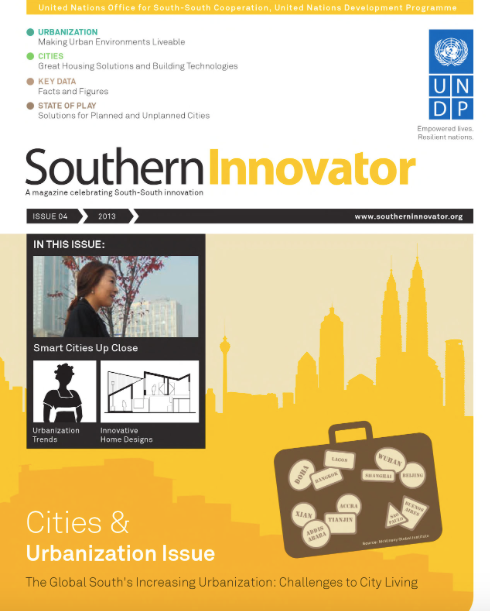
    The  fourth issue of Southern Innovator has launched online and in print. Order copies now for distribution. Email: southerninnovator@yahoo.co.uk.

    December

    Baker Cookstoves – Designing for the African Customer Development Challenges: An innovative social enterprise is using design to create an energy-efficient cookstove for Kenya. By turning to an experienced Swedish architecture and design firm, the people behind the Baker cookstove wanted to make sure the stove’s design was as efficient as possible and relevant to the customers’ needs, while also making sure it is visually appealing and something a person would proudly want in their home.

    Texting for Cheaper Marketplace Food with SokoText Development Challenges: An international group of graduate-social entrepreneurs from the London School of Economics (LSE) is pioneering a way to reduce food prices in Kenya using mobile phones.

    Ethiopia and Djibouti Join Push to Tap Geothermal Sources for Green Energy Development Challenges:Ethiopia and Djibouti are the latest global South countries to make a significant commitment to developing geothermal energy – a green energy source that draws on the heat below the earth’s surface (http://en.wikipedia.org/wiki/Geothermal_energy) – to meet future development goals.

    Tackling China’s Air Pollution Crisis: An Innovative Solution Development Challenges: China reached an undesired landmark in 2013. While the country’s impressive economic growth has amazed the world, it has come at a price: pollution. China recorded record levels of smog in 2013, with some cities suffering air pollution many times above what is acceptable for human health.

    November

    Ghana Wants to Tap Global Trendy Party Scene Development Challenges: Tourism is big business – and one of the most resilient parts of the global economy. Despite the international economic crisis that has wreaked havoc and increased unemployment and poverty in many countries since 2007, tourism is still going strong.

    China Pushing Frontiers of Medical Research Development Challenges: Cutting-edge medical research in China is promising to boost human health and development. Futuristic science is being conducted on a large scale and it is hoped this will increase the pace of discovery.

    Latin American Food Renaissance Excites Diners Development Challenges: Food is essential for a good life and plays a critical part in overall human health and development. The better the quality of food available to the population, the better each individual’s overall health will be, and this will have a direct impact on mental and physical performance (http://www.sciencedirect.com/science/article/pii/S2213453012000055).

    Perfume of Peace Helps Farmers Switch From Drug Trade Development Challenges: A tragedy in a time of war has led to a social enterprise that is creating jobs – and making the world smell a little better, too.

    US $450 Million Pledged for Green Economy Investments at Kenyan Expo Development Challenges: Innovators working in the global green economy could benefit from over US $450 million in investment recently pledged at the UN’s Global South-South Development Expo held in Nairobi, Kenya.

    October

    African Fashion’s Growing Global Marketplace Profile Development Challenges: Tales of African global fashion successes have multiplied in the last few years. African fashion is seeing its profile rise as more and more shows and festivals boost awareness of the continent’s designs, designers and models. In turn, African fashion and design is being taken more seriously as an income and job generator, and as a sector able to weather the ups and downs of the global economy: people always need to wear clothes.

    Cuban Entrepreneurs Embracing Changes to Economy Development Challenges: The Caribbean island of Cuba has gone its own way economically and socially since its revolution in 1959. The country has seen significant gains in its human development in the decades since, and can boast impressive education levels and good public health care.

    Radical Drone Solution to Woeful Infrastructure in Poor Countries Development Challenges: Drones – unpiloted aircraft, formally called Unmanned Aerial Vehicles (UAV) or Unmanned Aircraft Systems (UAS) – have long been used for military purposes. The U.S. military claims to have 7,500 drones – a massive growth from just 50 a decade ago – and has used them for surveillance and combat in conflicts from Afghanistan to Iraq.

    Pioneering African Airlines Help to Expand Routes Development Challenges: The last decade has seen a revolution in African air travel. The number of air routes has grown and this has paralleled the economic growth across the continent. As demand has been strong for Africa’s resources, it has also fueled a consumer boom that is benefiting an increasing number of people.

    September

    Affordable Space Programmes Becoming Part of South’s Development Development Challenges: Space: the final frontier. At least that was how heading off into the stars was portrayed in cult television and film series Star Trek. While many countries are working to raise living standards and eradicate poverty on earth, some are also looking to space for solutions to earth-bound problems.

    Solar Bottle Bulbs Light Up Dark Homes Development Challenges: Finding ways to generate low-cost or free light has captured the imagination of innovators across the global South. The desire for light is strong: Light gives an immediate boost to income-making opportunities and quality of life when the sun goes down or in dark homes with few windows.

    China Sets Sights on Dominating Global Smartphone Market Development Challenges: The rise of smartphones – mobile phones capable of Internet access and able to run ‘apps’ or applications – is the latest wave of the global connectivity revolution. Mobile phones rapidly made their way around the world to become almost ubiquitous – the most successful take-up of a piece of communications technology in history – and now smartphones are set to do the same. The number of mobile phone subscriptions in the world surpassed 6 billion in 2012 (out of a population of 7 billion) and, according to the International Telecommunications Union (ITU), the number of mobile phones will exceed the world’s population by 2014.

    Poorest Countries Being Harmed by Euro Currency Crisis Development Challenges: The ongoing economic crisis in Europe is forecast to harm the economies of the world’s poorest countries if it continues, according to a study by the United Kingdom’s Overseas Development Institute (ODI) (odi.org.uk).

    August

    Solar-Powered Mobile Clinics to Boost Rural Healthcare in Africa Development Challenges: Around the world, innovative thinking is finding new ways of using solar power technology to bring electricity to underserved areas of the global South. Innovators are experimenting with new technologies, new business models and new ways to finance getting solar power into the hands of the poor.

    Vietnamese Google Rival Challenging Global Giant Development Challenges: Information technologies are creating new business opportunities across the global South. As more and more people gain access to the Internet in one form or another, opportunities to offer them services also increase.

    More Futuristic African Cities in the Works Development Challenges: It has been well documented that China is undergoing the largest migration in human history from rural areas to cities. But this urbanization trend is occurring across the global South, including in Africa, as well. According to the UN, more than half the world’s population already lives in cities, and 70 per cent will live in urban areas by 2050. Most of the world’s population growth is concentrated in urban areas in the global South.

    Story cited in Beyond Gated Communities by Samer Bagaeen and Ola Uduku, Taylor & Francis, ISBN 9781317659051, 2015

    On Google Books: https://www.google.co.in/books/edition/Beyond_Gated_Communities/PVfeCQAAQBAJ?hl=en&gbpv=0.

    Haitian Coffee Becoming a Hit with American Connoisseurs Development Challenges: The Caribbean country of Haiti has had to deal with the twin challenges of recovering from a devastating earthquake in 2010 while also pulling itself out of the economic and social chaos that has resulted in its status as the poorest place in the Western hemisphere.

    New 3D Technology Makes Innovation Breakthrough and Puts Mind over Matter Development Challenges:Revolutions in technology are placing more and more power into the hands of the individual, and 3D printing and fabrication machines are opening a whole new chapter. These devices come in many forms, but they all do one thing: they can manufacture pretty well any three-dimensional object on the spot, from digital plans. These machines come in many sizes, from factory scale to smaller, home versions which are no bigger than personal computer printers, such as the well-known MakerBot Replicator 2 (makerbot.com).

    July

    African Infrastructure Dreams Back on Agenda Development Challenges: Africa’s patchy infrastructure is not keeping pace with the continent’s economic growth. Satellite photos of Africa at night show a place where light is concentrated overwhelmingly in the South – primarily South Africa – and in the North, with a sprinkling of lights on the west and east coasts (http://geology.com/articles/satellite-photo-earth-at-night.shtml).

    Mobile Phone Microscopes to Revolutionize Health Diagnostics Development Challenges: Mobile phone usage has increased hugely across the global South in the past five years. In Africa, the number of mobile phone subscribers reached 545 million in 2013, while there are 3.5 billion mobile phone users in Asia and the Pacific (ITU). Some 93 million people in Africa and 895 million in Asia and the Pacific have mobile phone Internet access (ITU).

    Small Fish Farming Opportunity Can Wipe Out Malnutrition Development Challenges: Pioneering work to boost diets across the global South is turning to the smallest of fish. While small in size, tiny fish are packed with nutrition when eaten whole, as they are in many cultures. Often these fish come packed with vitamin A, iron, zinc, calcium, protein and essential fats – all necessary elements to eradicate malnutrition and hidden hunger, especially among women and children.

    Burgeoning African E-commerce Industry Full of Opportunity Development Challenges: Africa has seen huge change since 2000 in the way people access information and do business electronically. The most championed accomplishment has been the widespread take-up of mobile phones. This has given birth to countless entrepreneurs and innovators who are using  phones to help people, do business and sell goods and services.

    Staple Foods Are Becoming More Secure in the South Development Challenges: Finding ways to ensure food security in countries experiencing profound economic and social change and stress is critical to achievement of development goals. Food security is crucial to ensuring economic development is sustainable, and it is vital to long-term human health. Just one bout of famine can damage a generation of youth, stunting brain development and leaving bodies smaller and weaker than they should be.

    June

    African Innovators Celebrated in Prize Development Challenges: Innovation is increasingly being recognized as the key to tackling long-standing development problems in Africa, as well as across the developing and developed world. While it is easy to draw up a list of challenges facing the global South, it takes a special person to see not problems but solutions.

    New Beer Helping to Protect Elephants Development Challenges: How to match the often conflicting goals of protecting animal habitats and supporting local economies? One clever solution may draw amusement but is actually a sharp marketing strategy to get attention for a product that is helping to preserve the elephants of Thailand’s Golden Triangle (http://en.wikipedia.org/wiki/Golden_Triangle_(Southeast_Asia).

    Solar Solution to Lack of Electricity in Africa Development Challenges: Electricity is critical to improving human development and living standards. Yet, for many in the global South, electricity is either non-existent or its provision is patchy, erratic, unreliable or expensive.

    Time-Tested Iranian Solutions to Cool and Refrigerate Development Challenges: Keeping food cool is critical for human health. No matter what the climate, a cool environment will prolong food preservation, stave off spoilage and lower the risk of food poisoning. This is crucial for the poor because it means they can reduce food waste and avoid illnesses caused by food poisoning. Diarrhea is a common problem when people do not have access to refrigeration for their food.

    May

    US $1 Trillion Opportunity for Africa’s Agribusinesses Says Report Development Challenges: As the world’s population continues to grow – surpassing 9 billion people by 2050, the United Nations estimates – and more and more people move to urban areas, producing enough food to feed this population will be one of the biggest economic challenges and opportunities in the global South.

    Ambitious Schemes Hope to Advance Economic Development Development Challenges: Sometimes it takes a bold, fresh start to speed up economic and human development goals. Taking a large-scale approach has been used around the world, either establishing new trade zones or even a new city.

    Indian Initiatives to Make Travel Safer for Women Development Challenges: Shocking assaults on women traveling in India have galvanized innovators to find solutions. One solution that is proving successful is to establish specialist taxi services for women. As a happy additional benefit, these taxi innovators are transforming the taxi experience, introducing more ethical practices such as honest fares, professional and safe driving habits and clean, hygienic and comfortable taxis.

    Kenya Reaches Mobile Phone Banking Landmark Development Challenges: Financial transactions and banking with mobile phones have been a Kenyan success story.

    April

    Online Education Could Boost African Development
 
Development Challenges: Education is recognized as a major catalyst for human development. During a high-level meeting on the Millennium Development Goals (MDGs) (http://www.undp.org/content/undp/en/home/mdgoverview.html) in 2010, UNESCO – the United Nations Educational, Scientific and Cultural Organization – pointed out the necessity of making rapid gains in education if all the MDGs are to be achieved. The goals deadline is 2015 – just two years away.

    African Digital Laser Breakthrough Promises Future Innovation Development Challenges:
 
For decades many African countries have experienced low investment in research and development (R&D) and scientific innovation. One of the few nations to benefit from a sophisticated university network and research and development sector was South Africa. It still ranks top on the continent for funding R&D and its high number of scientific journals.

    Preserving Beekeeping Livelihoods in Morocco Development Challenges: The clever combining of tourism and long-standing beekeeping skills has revived a local craft and is also helping to preserve the ecology of Morocco. Beekeeping, or apiculture (http://en.wikipedia.org/wiki/Beekeeping), has two clear benefits. Bee products, including honey, beeswax, propolis, pollen and royal jelly can be a valuable source of income. The other benefit is the critical role bees play in the ecology by pollinating flowers and plants as they go about their daily business.

    A New African Beer Helps Smallholder Farmers. Development Challenges: Africa’s growth in the past decade has held steady despite the trauma of the global economic crisis and the tumult of the “Arab Spring” in several countries of North Africa. African economies are growing because of a number of resilient trends. These include growing regional trade links, greater investment in infrastructure and the remarkable rise of China to become Africa’s number one trade partner, pushing the United States to second place (Technology + Policy). This has given birth to a growing consumer marketplace and consumer class – some 300 million people earning about US $200 a month (Africa Rising).

    Boosting Tourism in India with Surfing Culture Development Challenges: Tourism has experienced decades of growth and diversification and is now considered one of the fastest-growing economic sectors in the world. According to the UNWTO – the United Nations World Tourism Organization – modern tourism is “a key driver for socio-economic progress.”

    March

    Made-in-Africa Fashion Brand Pioneers Aim for Global Success Development Challenges: African fashion brands have not always been the first place fashionistas turned to when shopping for new clothes or shoes in developed economies. While Africa has long been a source of inspiration in contemporary and traditional fashion, the continent has had a weak reputation for manufacturing and selling mass market global fashion brands.

    Kenyan Book Company Brings Online Sales to East Africa Development Challenges: The Internet has revolutionized retail sales in many developed countries – and nowhere more so than for booksellers. The ability to offer an almost unlimited supply of books through a website is revolutionizing the way people shop and giving life to books long out of print or by unknown authors.

    African Innovation Helps Make Banking Transactions Safer Development Challenges: As economies grow in Africa, more and more people are conducting their financial transactions electronically. This can be either through mobile phones and digital devices, or through the hole-in-the-wall of the automatic teller machine, or ATM.

    New Apps Make Driving and Travelling in Egypt Easier, Safer Development Challenges: Mobile phones are ubiquitous across the global South. They have spawned whole new business opportunities and changed the way people solve problems and find solutions.

    Bangladesh Coffin-Maker Offers an Ethical Ending Development Challenges: Few people want to think about death, and many are ill-prepared when it happens to a loved one or friend. But it will happen to us all – and growing ethical and environmental concerns are reshaping the way many deal with the inevitable event. More and more people are seeking a lower-cost option for being disposed of that also does not harm the environment.

    February

    Thai Organic Supermarkets Seek to Improve Health
 Development Challenges: 
A Thai business is working hard to expand access to organic food in the country. It sees this as part of a wider campaign to improve health in the country – and its success has caught the attention of the government, which wants to turn Thailand into a global health destination.

    Global South Experiencing Transportation Revolution
 
Development Challenges: Away from the news headlines, a quiet revolution has been taking place in public transportation across the global South. As cities have expanded and grown, they have also been putting in place public transport systems to help people get around and get to work.

    Global South’s Middle Class is Increasing Prosperity Development Challenges: The global middle class is on the rise – and this is creating both challenges and opportunities. As poverty rates have come down across the global South, many countries have seen a rise in the proportion of their population categorized as “middle class”. Globally, being middle class is defined as a person able to consume between US $4 a day and US $13 a day (ILO).

    Angolan Film Grabs Attention at Film Festival Development Challenges: The power of the creative economy to transform lives, livelihoods – and perceptions – should never be underestimated. Creativity can transform the image of places and situations often seen in a negative light. A film from Angola is shining a light on the country’s music scene and showing the vitality of the nation in the wake of a long-running civil war.

    Back Issues

    Development Challenges, South-South Solutions Newsletter | 2011-2014

    Development Challenges, South-South Solutions Newsletter | 2007-2010

    2013

    2012

    2011

    2010

    2009

    2008

    2007

    Development Challenges, South-South Solutions was launched as an e-newsletter in 2006 by UNDP’s South-South Cooperation Unit (now the United Nations Office for South-South Cooperation) based in New York, USA. It led on profiling the rise of the global South as an economic powerhouse and was one of the first regular publications to champion the global South’s innovators, entrepreneurs, and pioneers. It tracked the key trends that are now so profoundly reshaping how development is seen and done. This includes the rapid take-up of mobile phones and information technology in the global South (as profiled in the first issue of magazine Southern Innovator), the move to becoming a majority urban world, a growing global innovator culture, and the plethora of solutions being developed in the global South to tackle its problems and improve living conditions and boost human development. The success of the e-newsletter led to the launch of the magazine Southern Innovator.

    Creative Commons License

    This work is licensed under a
    Creative Commons Attribution-Noncommercial-No Derivative Works 3.0 License.

    ORCID iD: https://orcid.org/0000-0001-5311-1052.

    © David South Consulting 2022

  • Milk Co-operatives Help Hungry Haiti

    Milk Co-operatives Help Hungry Haiti

    By David SouthDevelopment Challenges, South-South Solutions

    SOUTH-SOUTH CASE STUDY

    The global food crisis has hit the impoverished Caribbean country of Haiti especially hard. Already suffering from decades of food crises brought on by the collapse of domestic farming, the country has become notorious for its people being reduced to eating cakes made of mud to stave off hunger pains. It is the poorest country of Latin America and the Caribbean and one of the poorest in the world.

    Haiti imports some 52 percent of its food, including over 80 percent of its rice. Local food production only covers 43 percent of the country’s demand and food aid supplies only 5 percent of its needs. Of the estimated 9.8 million Haitians, 5.1 million live on less than US $1 a day and 7.6 million on less than US $2 a day. At current prices, one dollar buys only half a meal per day (Source: United Nations Country Team in Haiti).

    Haiti’s problems are made worse by a global food crisis. So-called agflation (agricultural inflation) has seen spiralling food prices around the world, which in turn are causing food shortages, hunger and malnutrition. On international commodity markets, food prices have gone up 54 percent over the last year, with cereal prices soaring 92 percent (FAO – World Food Situation). U.N. Secretary General Ban Ki-moon has called for food production to increase 50 percent by 2030 just to meet rising demand – and right now there are 862 million people worldwide who are undernourished (FAO).

    In Haiti, most agriculture is done on a small scale by about 700,000 family farmers. Few belong to any production association or mechanism to market and distribute their products, and local produce has been pushed out of the market by imports.

    Subsidized U.S. rice began flooding in 30 years ago, becoming so cheap that Haitians began eating it instead of the corn, sweet potatoes, cassava and domestic rice they grew. The U.S. imports drove rice farmers out of business and incited a rural exodus that swelled the slums of the capital, Port-au-Prince. That dependence on imports has caused dangerous food insecurity. Today, the U.S. rice that is the staple of many Haitians’ diet has doubled in price in little more than a year.

    “The problem is that Haiti doesn’t have the land to give every peasant family enough to allow them to make a living,” said Bernard Etheart, head of the National Institute for Agrarian Reform. Etheart estimates that if all arable land was planted, each farmer would have no more than half a hectare, or 1.25 acres.

    A cooperative of dairy farmers is doing its bit to revive domestic production of milk products and reduce the crippling costs of importing milk for Haiti. Importing 85,000 tonnes of milk from Europe and the United States costs Haiti US $40 million a year. A walk through the capital, Port-au-Prince, will reveal how much milk is imported in one form or another: tiny cans of evaporated milk are sold in the street markets, while the wealthy can buy powdered and long-life milk in the air conditioned supermarkets of the upscale neighbourhood of Petionville.

    Dairy production in Haiti was in decline for 20 years until, in 2002, the country ceased to produce any milk at all. The urgent need for milk in Haiti is shown in the average consumption: per child, only 110 ml is consumed per day. In Uruguay, for example, it is 520 ml a day (190 litres per head of population per year).

    Lèt Agogo (Creole for Unlimited Milk) is a cooperative using small-scale farmers to bring milk to the hungry. Founded by the NGO Veterimed six years ago, it now has a network of 13 dairies across the island.

    Lèt Agogo is hoping to get Haiti’s milk production up to 145,000 tons a year from the current 45,000 tons. So far, the product’s single biggest client is the Haitian government. It buys bottles of sterilized milk below cost and distributes them to 130,000 school children in 44 government-funded schools. Dr. Michel Chancy told the Miami Herald that the government would like to expand the distribution to 800 schools.

    “Haiti is a country where we consume a lot of milk,” said Chancy, a veterinarian and one of the visionaries behind Lèt Agogo. “After rice, milk is the second-largest import.”

    At present, Haiti has 500,000 dairy cows out of more than a million head of cattle. The problem came down to marketing and distributing the dairy products. With no structure in place, few farmers bothered milking their animals. But by the end of 2007, 600 farmers had joined the network and 400 producers in dairy product making and grass pasture management. In 2007, they turned 540,000 litres into yoghurt and sterilised milk that can stay on the shelf for six to nine months without refrigeration. Made from sterilized milk, the yogurt comes in 280 ml bottles and sells in stores throughout the country and has a shelf life of nine months.

    The farmers have seen their income almost double, from 4 (US 10 cents) to 8 (US 20 cents) gourdes per litre, from 10 (US 25 cents) to 12 (US 30 cents) gourdes per litre.

    Farmers walk to processing centres with their litres of milk and receive US $2.20 for each US gallon (4.55 litres).

    “The milk is here,” Chancy said, but the lack of roads and electricity in the country pose huge challenges. “The problem is transporting it.”

    Haiti’s president, Rene Preval, has cited Lèt Agogo as an excellent example of how Haiti can recover its domestic food production capability. The scheme won a US $10,000 first prize in the W.K. Kellogg Foundation and Economic Commission for Latin America and the Caribbean Experiences in Social Innovation Award.

    Lèt Agogo believes it will take 100 dairies throughout Haiti’s rugged terrain to truly take over the import market, and would cost US $10 million to set up. ”Normally in five to ten years, a dairy would pay for itself. But you need the investments,” Chancy said.

    “It’s not the production of milk that is important here… It’s accomplishing it together,” said Philippe Mathieu, from Oxfam International in Quebec, Canada, who is working on helping the brand produce cheese, noting that Haiti is at a difficult crossroads with today’s global price hikes. “The goal is to show Haitians there is a way to do things — a way to construct something collectively.

    “Haitian peasants have always taken care of their cattle; tying them, feeding them and giving them water to drink,” Mathieu said. ”The cow has always been their bank book, something they could sell for money during hard times. Now it has become a revenue source for them.”

    Published: August 2008

    Resources

    Development Challenges, South-South Solutions was launched as an e-newsletter in 2006 by UNDP’s South-South Cooperation Unit (now the United Nations Office for South-South Cooperation) based in New York, USA. It led on profiling the rise of the global South as an economic powerhouse and was one of the first regular publications to champion the global South’s innovators, entrepreneurs, and pioneers. It tracked the key trends that are now so profoundly reshaping how development is seen and done. This includes the rapid take-up of mobile phones and information technology in the global South (as profiled in the first issue of magazine Southern Innovator), the move to becoming a majority urban world, a growing global innovator culture, and the plethora of solutions being developed in the global South to tackle its problems and improve living conditions and boost human development. The success of the e-newsletter led to the launch of the magazine Southern Innovator.  

    Follow @SouthSouth1

    Google Books: https://books.google.co.uk/books?id=oEP1Obs4gxYC&dq=development+challenges+august+2008&source=gbs_navlinks_s

    Slideshare: http://www.slideshare.net/DavidSouth1/development-challengessouthsouthsolutionsaugust2008issue

    Southern Innovator Issue 1: https://books.google.co.uk/books?id=Q1O54YSE2BgC&dq=southern+innovator&source=gbs_navlinks_s

    Southern Innovator Issue 2: https://books.google.co.uk/books?id=Ty0N969dcssC&dq=southern+innovator&source=gbs_navlinks_s

    Southern Innovator Issue 3: https://books.google.co.uk/books?id=AQNt4YmhZagC&dq=southern+innovator&source=gbs_navlinks_s

    Southern Innovator Issue 4: https://books.google.co.uk/books?id=9T_n2tA7l4EC&dq=southern+innovator&source=gbs_navlinks_s

    Southern Innovator Issue 5: https://books.google.co.uk/books?id=6ILdAgAAQBAJ&dq=southern+innovator&source=gbs_navlinks_s

    Creative Commons License

    This work is licensed under a
    Creative Commons Attribution-Noncommercial-No Derivative Works 3.0 License.

    ORCID iD: https://orcid.org/0000-0001-5311-1052.

    © David South Consulting 2023

  • Lima To Delhi: What Can Be Learned On Urban Resilience?

    Lima To Delhi: What Can Be Learned On Urban Resilience?

    Published: March 2015

    Publisher: Southasiadisasters.net

    Issue No. 128, March 2015

    Theme: Challenges of Urban Resilience in India

    Fast-growing cities and urban areas in the global South can be vulnerable because they lack the web of structures and institutions that enable more long-established cities to mitigate risks and, when a disaster does strike, to bounce back quickly.
    But thanks to many new technologies, and some smart new thinking, it is possible to bring resilience to even the poorest and most deprived urban communities.

    The essence of resilience is to build into plans and daily activities a
    community’s ability to weather any disaster, small or large. All cities, rich or poor, can experience a disaster of some sort, be it weather, civil unrest, war, earthquakes, shortages, or economic, financial and health crises. New technologies make it possible for all cities, no matter how poor and overcrowded, to build in urban resilience. The ubiquity of mobile phones introduces a powerful city and urban planning tool. Mapping chaotic and unplanned areas is already underway in many cities of the global South (in Brazil and Kenya for example (http://tinyurl.com/qgba8kb).

    Impressively, innovators in the South are using affordable microelectronics in the form of mobile phones and laptops to gather data and map it. This computing capability was once the sole domain of big information technology companies such as IBM. Now, a single laptop computer combined with a smartphone equipped with the right software can manage a large urban area, a task that once required rooms full of computers. The data can then be used to manage growth today and re-build after a disaster. Any excuse not to be resilient has been wiped out with this technological leap.

    But how to deal with the common reality of feeling overwhelmed by the many obstacles to rational planning and building for urban growth in the South? Innovators have stepped in to take matters into their own hands with simple construction technologies as the solution. One example is the Moladi system of recycled plastic moulds (moladi.net). Anybody can master this simple building technique, as the mortar-filled moulds are designed to fit easily together to construct an earthquake-resistant, beautiful home.

    This approach has the advantage of bypassing the failings of authorities to enforce building codes and standards in poor, urban communities, creating safer places to live and preventing the growth of unregulated shanty towns at risk to fire and earthquakes.

    Others have found social ways to organize people, even in the most desperate of conditions, providing services and laying down the groundwork for an upgrading of an urban area to improve living conditions and long-term opportunities. The
    concept of ‘cities for all’ has inspired many to re-energize civic organizations and networking in poor areas to ensure they are not left out of economic growth. In Colombia, a famous example of this is the escalator in the city of Medellin, which connects a hillside slum to the centre of the city, opening up economic opportunities to all (http://tinyurl.com/nm47d3u).

    Still more exciting, new technologies are in the works to simplify construction of major infrastructure and new buildings. A future city will be able to gather extensive data on an expanding urban area, make detailed development plans with architects and engineers, and then have robots and 3D fabricating machines quickly lay down infrastructure and erect buildings. Sounds far-fetched?
    Well, in China one company recently used a 3D machine to make 10 houses
    in a single day (http://www.yhbm.com/index.aspx).

    An infographic from Southern Innovator’s fourth issue (http://
    tinyurl.com/m9vfwur) shows 10 ways any urban area – either planned or unplanned – can build in resilience. All are proven approaches from cities
    in the global South.

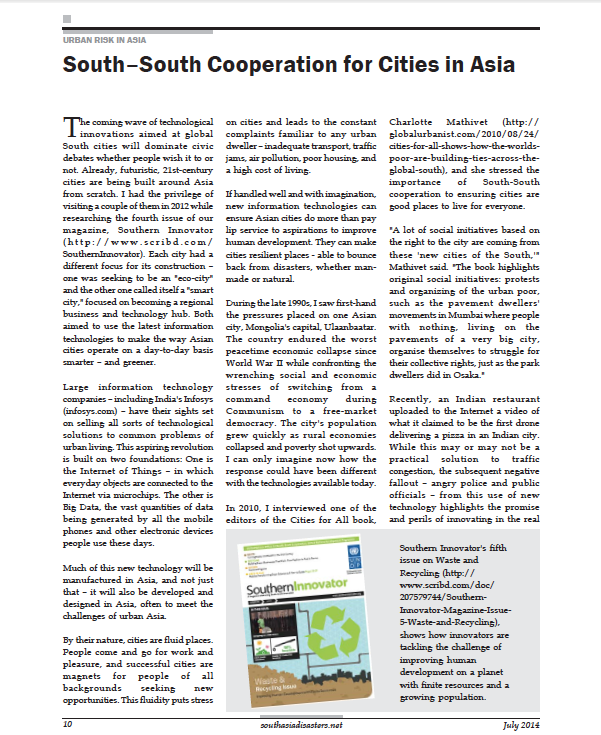
    Southern Innovator’s upcoming sixth issue will explore the interplay
    of science, technology and innovation in the global South and how people are making the most of 21st century advances to increase wealth and improve human
    development. Hopefully, all of this innovation will lead to more resilient cities in the future!


    David South,
    Editor, Southern Innovator, UNOSSC

    www.davidsouthconsulting.com

    https://www.preventionweb.net/publication/challenges-urban-resilience-india

    https://www.preventionweb.net/publication/challenges-urban-resilience-india

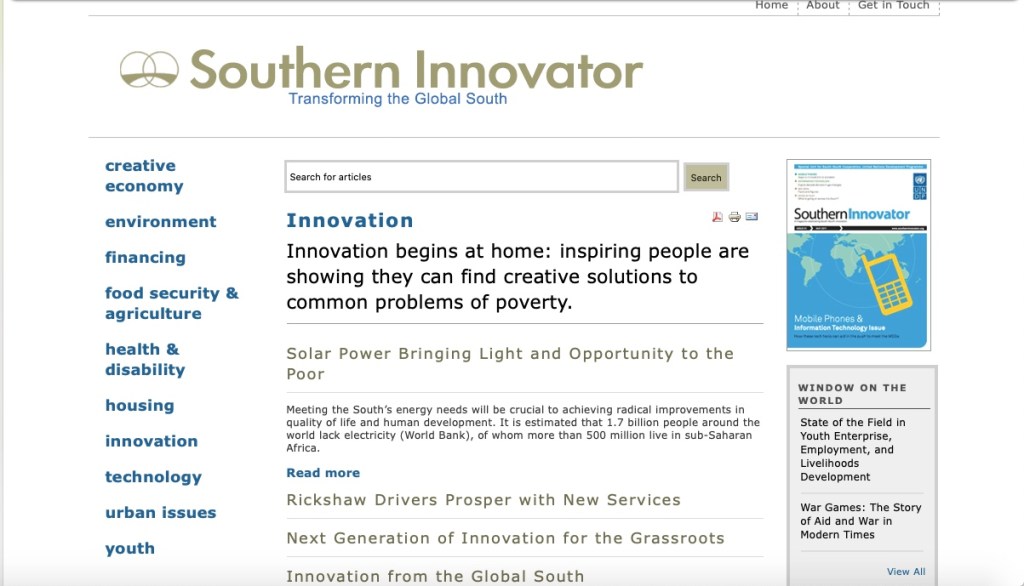
    Southern Innovator’s first web portal archiving stories from the e-newsletter Development Challenges, South-South Solutions and Southern Innovator Magazine.
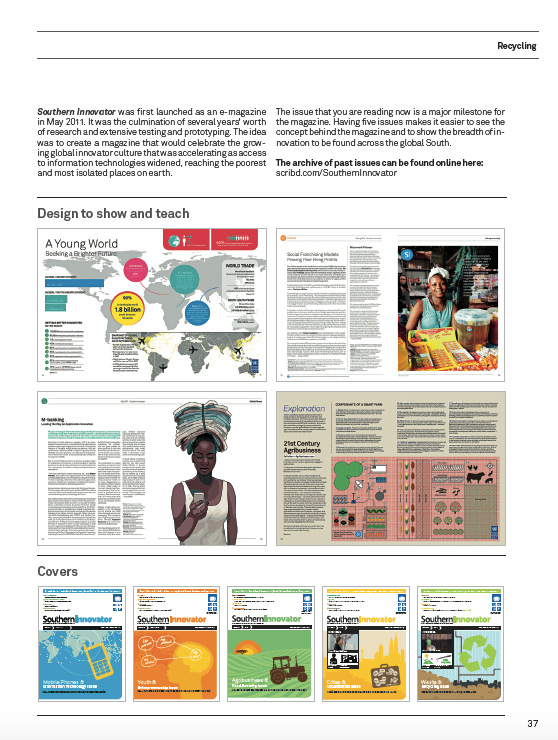
    Archived issues of Southern Innovator Magazine can be downloaded from the web portal of the United Nations Office for South-South Cooperation (UNOSSC).

    https://davidsouthconsulting.org/2021/10/21/cities-for-all-shows-how-the-worlds-poor-are-building-ties-across-the-global-south/

    https://davidsouthconsulting.org/2020/12/14/innovation-in-growing-cities-to-prevent-social-exclusion/

    https://davidsouthconsulting.org/2021/10/22/innovations-in-green-economy-top-three-agenda/

    https://davidsouthconsulting.org/2021/10/22/south-south-cooperation-for-cities-in-asia/

    https://davidsouthconsulting.org/2021/02/23/southern-innovator-in-southasiadisasters-net/

    https://davidsouthconsulting.org/2021/03/05/southern-innovator-issue-4/

    https://davidsouthconsulting.org/2021/03/05/southern-innovator-issue-5/

    https://davidsouthconsulting.org/2021/03/12/southern-innovator-magazine/

    Creative Commons License

    This work is licensed under a
    Creative Commons Attribution-Noncommercial-No Derivative Works 3.0 License.

    ORCID iD: https://orcid.org/0000-0001-5311-1052.

    © David South Consulting 2023