Tag: Canada

  • Debt-free Homes For the Poor

    Debt-free Homes For the Poor

    By David SouthDevelopment Challenges, South-South Solutions

    SOUTH-SOUTH CASE STUDY

    As the population around the world’s cities grows, and slums grow larger and more prevalent, the urgent need for affordable and decent housing becomes more pressing. The world’s megacities – like Buenos Aires, Argentina, where more than 13 million live in the metropolitan region – have to find a way to provide housing that is both cheap and does the minimum possible amount of harm to the environment.

    About one-third of the world’s urban dwellers live in slums, and the United Nations estimates that the number of people living in such conditions will double by 2030 as a result of rapid urbanization in developing countries. Latin America is already the most urbanized region in the developing world.

    “Throughout Latin America you have economies that are growing and doing well, but the way the economies are growing is actually generating more shanty towns,” said Erik Vittrup, senior adviser on Latin America and the Caribbean for the U.N. Human Settlements Program. “It’s a growth that is just generating wealth for those who (already) have it.”

    How well people dwell is integral to their mental and physical health. Most squatters and slum dwellers live in makeshift homes made from whatever they can get their hands on. These dwellings are usually unsafe and vulnerable to fire, floods, and earthquakes.

    But across the South, initiatives are proving it is possible to build good quality homes for the poor while avoiding burdening them with debt. Pioneering ways are being developed for the poor to build their own high-quality houses using recycled materials and environmentally friendly products.

    In Colombia , Alejandro Salazar, a chemical engineer, professor at the Universidad del Valle (http://www.univalle.edu.co/english/) and innovator running several companies pioneering new building technologies using recycled waste, is building high-quality, inexpensive houses for the poor.  By combining free building materials recovered from waste, a government grant and the voluntary labour of the homeowners, Salazar’s company is able to build homes for the poor that don’t leave them with ongoing bank debt from mortgages.

    Based in Cali, Colombia (http://gosouthamerica.about.com/od/cali/p/Cali.htm), his companies Ecoingenieria (product and material research and development), Ecomat SA (production of eco-materials using industrial waste and construction rubble), Constructora Paez, (social housing construction using eco-products) and Wassh SA (environmental management and transformation of dangerous solid waste into non-dangerous materials), are focused on pioneering new technologies for housing.

    “Our company uses two basic technologies,” said Salazar. “The production of eco-materials from solid waste and demolition waste, and the implementation of an agile building system, which does not require skilled labour and is hand-transportable. All the pieces are produced in a prefabrication plant that uses the eco-materials.”

    Salazar has found a way to provide homes quicker than existing NGOs – Popular Housing Organizations (OPV), as they are called – established to address homelessness in Colombia. The homeless poor are caught in a Catch-22: they need to have a formal job to receive homebuilding assistance from the government, and they usually can not save up enough money for a down payment on the home.

    Salazar’s solution is to take the maximum grant given by the central government, which is US $4,730, and combine it with the recycled building materials and homeowners’ own labour. He says this allows a house to be built for roughly half the price of a similarly sized one that uses conventional materials: the eco-materials house costs around US $ 6,590, compared to US $12,000 using conventional materials. Land is often either donated by the municipality or the family already owns it. And in Salazar’s experience, the whole family chips in with the building: husbands, sons, brothers, fathers, wives.

    The training takes just three days on eco-materials and a day in construction techniques for house building.

    “To date, we have built with this method 306 houses,” said Salazar. “For the coming year, we expect to deliver around 500 houses or more. To build a house, after acquiring the land, we need three people working eight hours a day to build it in four weeks – all under the supervision of a workforce teacher and the supervision of an engineer or architect.

    “The houses are designed by architects with the participation of the community or families. They do some workshops and the design conforms to their vision and expectation. In Colombia, there is an earthquake resistance code which is binding in law and provides detailed specifications of the materials, foundations, structure and roof.”

    The pre-fabricated building materials are made from recovered waste from a wide variety of sources: ceramic red brick, coarse ash and fly ash, slag from steel, copper slag, porcelain insulators used for electrical power lines, nickel slag, sludge from sugar and alcohol plants and water treatment plants.

    “The raw materials we use are industrial solid waste and demolition waste. It costs the industry a lot to throw away this waste,” Salazar said.

    He said the biggest obstacle to the new homes is psychological: many people initially “tend to reject at first-hand the technology.”

    “When visiting the factory and then visiting the homes – or model homes – they then compare it with a traditional house, and realize that the best eco-homes when finished meet the standards of Colombian earthquake resistance and are also cheaper,” he said.

    Compared to using conventional building materials, the eco-materials reduce the cost of a new home. And the company still makes a profit from it!

    In Paraguay, Elsa Zaldivar is using recycled plastic, cotton netting, corn husks, and loofah sponges (http://en.wikipedia.org/wiki/Luffa) to make cheap, lightweight construction panels for housing. This has a double benefit: it makes for cheap housing and it is good for the environment.

    “That’s very important in Paraguay,” said Zaldivar, “because we’ve already reduced our original forest to less than 10 percent of the national territory.”

    Zaldivar got her experience working with people in the impoverished area of Caaguazú, where in the past she helped with the building of toilets and making stoves. She found that involving local people in this work made a huge difference: “They told me: ‘Now we feel like we’re people with dignity.’”

    She encourages local women to grow loofah – a plant that once flourished but was being ignored. While the fruit is edible she was more interested in the crusty sponge that is left over when the plant is dried. The women started a cooperative selling loofah sponges, mats and slippers. But there was a lot of waste in the process, with a third not suitable for export. She then came up with the idea to use the loofahs for wall and roof panels for cheap housing.

    Along with industrial engineer Pedro Padros, she developed a way to combine loofah with plastic waste. Padros invented a machine to melt the recycled plastic and mix the molten plastic with loofah, vegetable fibres and chopped corn husks. It has produced a building panel that is lighter and easier to move around than lumber or brick. With a grant from the Inter-American Development Bank, design improvements have been made and the cost-per-panel brought down from US $6 per square meter. It is now competitive with the cost of wood panels. The great thing about the panels is that they can be recycled again when they wear out, completing the cycle.

    “To have a decent home liberates people,” said Zaldivar.

    Published: January 2009

    Resources

    • Cradle to Cradle: Remaking the Way We Make Things: This radical concept is about how products, can be used, recycled, and used again without losing any material quality—in cradle to cradle cycles. Website: http://www.mcdonough.com/cradle_to_cradle.htm
    • Builders Without Borders: Is an international network of ecological builders who advocate the use of straw, earth and other local, affordable materials in construction. Website: http://builderswithoutborders.org/
    • World Hands Project: An NGO specialising in simple building techniques for the poor. Website: www.worldhandsproject.org
    • CIDEM and Ecosur specialise in building low-cost community housing using eco-materials. They have projects around the world and are based in Cuba. Website: http://www.ecosur.org

    Follow @SouthSouth1

    Slideshare: http://www.slideshare.net/DavidSouth1/development-challengessouthsouthsolutionsnovember2010issue

    Southern Innovator Issue 1: https://books.google.co.uk/books?id=Q1O54YSE2BgC&dq=southern+innovator&source=gbs_navlinks_s

    Southern Innovator Issue 2: https://books.google.co.uk/books?id=Ty0N969dcssC&dq=southern+innovator&source=gbs_navlinks_s

    Southern Innovator Issue 3: https://books.google.co.uk/books?id=AQNt4YmhZagC&dq=southern+innovator&source=gbs_navlinks_s

    Southern Innovator Issue 4: https://books.google.co.uk/books?id=9T_n2tA7l4EC&dq=southern+innovator&source=gbs_navlinks_s

    Southern Innovator Issue 5: https://books.google.co.uk/books?id=6ILdAgAAQBAJ&dq=southern+innovator&source=gbs_navlinks_s

    https://davidsouthconsulting.org/2021/02/04/cubas-hurricane-recovery-solution/

    https://davidsouthconsulting.org/2021/11/11/decent-and-affordable-housing-for-the-poor/

    https://davidsouthconsulting.org/2022/11/16/housing-innovation-in-souths-urban-areas/

    https://davidsouthconsulting.org/2021/11/11/housing-solution-for-worlds-growing-urban-population/

    https://davidsouthconsulting.org/2021/02/12/rammed-earth-houses-china-shows-how-to-improve-and-respect-traditional-homes/

    https://davidsouthconsulting.org/2021/02/12/rebuilding-after-chinese-earthquake-beautiful-bamboo-homes/

    https://davidsouthconsulting.org/2022/11/19/securing-land-rights-for-the-poor-now-reaping-rewards/

    https://davidsouthconsulting.org/2022/05/23/solar-bottle-bulbs-light-up-dark-homes/

    https://davidsouthconsulting.org/2021/03/05/southern-innovator-issue-4/

    https://davidsouthconsulting.org/2021/03/05/southern-innovator-issue-5/

    https://davidsouthconsulting.org/2022/11/17/tiny-homes-to-meet-global-housing-crisis/

    Creative Commons License

    This work is licensed under a
    Creative Commons Attribution-Noncommercial-No Derivative Works 3.0 License.

    ORCID iD: https://orcid.org/0000-0001-5311-1052.

    © David South Consulting 2023

  • High Impact Communications In A Major Crisis: UNDP Mongolia 1997-1999 | 18 February 2016

    High Impact Communications In A Major Crisis: UNDP Mongolia 1997-1999 | 18 February 2016

    I was head of communications for the United Nations mission in Mongolia from 1997 to 1999. The mission had to primarily tackle three major crises: the country’s turbulent transition from Communism to free markets and democracy, the social and economic crash this caused, and the Asian Financial Crisis (Pomfret 2000) (Quah 2003)*.

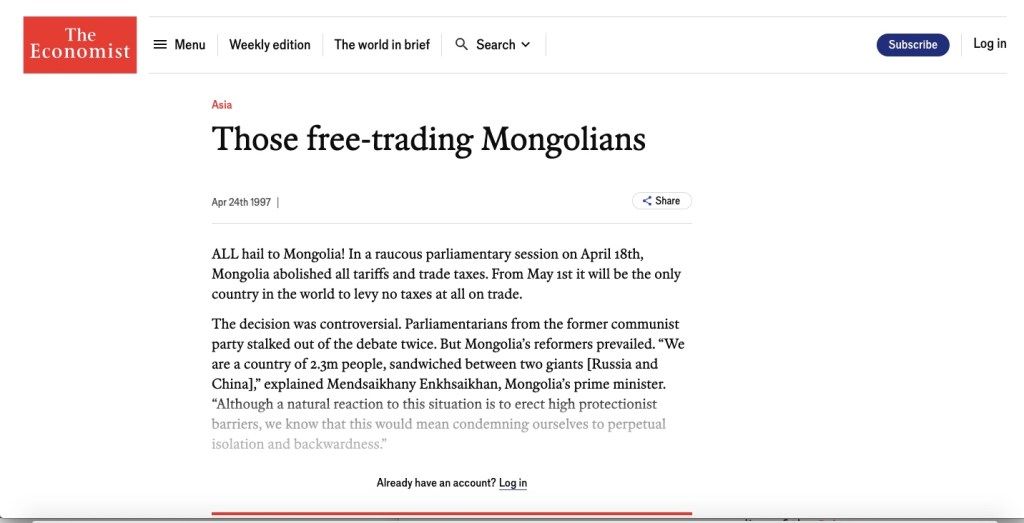
    The Economist: “Those free-trading Mongolians” was published Apr 24th 1997. I arrived in May of 1997 to find a country on the cusp of great and turbulent change.

    Richard Pomfret said in 1994 “In 1991 Mongolia suffered one of the biggest peacetime economic collapses ever (Mongolia’s Economic Reforms: Background, Content and Prospects, Richard Pomfret, University of Adelaide, 1994).”

    From Curbing Corruption in Asia: A Comparative Study of Six Countries by Jon S. T. Quah: “The combined effect of these three shocks was devastating as ‘Mongolia suffered the most serious peacetime economic collapse any nation has faced during this century’. Indeed, Mongolia’s economic collapse ‘was possibly the greatest of all the (peaceful) formerly’” Communist countries. 

    “The years 1998 and 1999 have been volatile ones for Mongolia, with revolving door governments, the assassination of a minister, emerging corruption, a banking scandal, in-fighting within the ruling Democratic Coalition, frequent paralysis within the Parliament, and disputes over the Constitution. Economically, the period was unstable and rife with controversies.” Mongolia in 1998 and 1999: Past, Present, and Future at the New Millennium by Sheldon R. Severinghaus, Asian Survey, Vol. 40, No. 1, A Survey of Asia in 1999 (Jan. – Feb., 2000), pp. 130-139 (Publisher: University of California)

    Writing in 2018, author John West  found, in a chapter titled Mongolia’s Corruption Curse (Transparency International and the World Bank had found corruption worsened in Mongolia after 2001), “In many ways, Mongolia has everything going for it. After being a satellite state of the former Soviet Union for much of the twentieth century, Mongolia regained its independence with the end of the Cold War. A relatively peaceful political revolution in the early 1990s ushered in a multi-party democracy and open society which have remained in place. … And it is blessed with vast reserves of copper, gold, coal, molybdenum, fluorspar, uranium, tin and tungsten deposits. True, Mongolia experienced great upheavals as the breakup of the Soviet Union saw its trade decline by 80%. But Mongolia was also perfectly placed to benefit from the commodity super cycle driven by China, which is now the destination for the vast majority of its exports.

    “However, despite much hype about the Mongolian “wolf economy”, this country of so much promise is being dragged down by massive corruption. …

    “Mongolia’s corruption is greatly weakening its attractiveness as an investment destination, is fracturing society and weakening its fragile political institutions. Its culture of corruption has also fed its love-hate relationship with foreign investors, which has destabilized the economy.” Asian Century … on a Knife-edge: A 360 Degree Analysis of Asia’s Recent Economic Development by John West, Springer, 24 January 2018.  

    In this role, I pioneered innovative use of the Internet and digital resources to communicate the UN’s work and Mongolia’s unfolding crises. The UN called this work a “role model” for the wider UN and country offices. A survey of United Nations country office websites in 2000 ranked the UN Mongolia website I launched in 1997 and oversaw for two years (1997-1999), third best in the world, saying: “A UN System site. A very nice, complete, professional site. Lots of information, easily accessible and well laid out. The information is comprehensive and up-to-date. This is a model of what a UNDP CO web site should be.” (https://www.scribd.com/document/35249986/United-Nations-2000-Survey-of-Country-Office-Websites)

    As part of a strategic plan to raise awareness of Mongolia’s development challenges and to spur action on meeting them, a Communications Office was established for the UN mission in 1997. Acting as a strategic hub, the Communications Office and its dynamic and talented team, were able to leverage the existing budget to spur action on many fronts, including: 

    Media

    Working with journalists and media both within Mongolia and outside – including organising frequent cross-country media tours – the Communications Office was able to significantly raise awareness of Mongolia and its development challenges. This was reflected in a substantial increase in media coverage of the country and in the numerous books and other publications that emerged post-1997. The book In Their Own Words: Selected Writings by Journalists on Mongolia, 1997-1999 (ISBN 99929-5-043-9) archived the stories by theme.  

    Top journalists covering Asia in the late 1990s contributed to the book.
    The BBC’s Charu Shahane joined other journalists on a UNDP Mongolia media tour in 1998.

    Ger Magazine

    Ger Magazine (the Mongolian word for home and traditional tent dwelling) was published as the country’s first e-magazine in 1998. There were four issues in total from 1998 to 2000. The launch issue was on the theme of youth in the transition. Mongolia was transitioning from Communism to free markets and democracy and this had been both an exhilarating time and a wrenching time for young people. The magazine drew on talented journalists from Mongolia and the handful of international journalists based there to create a mix of content, from stories about life adapting to free markets to stories on various aspects of Mongolian culture and life. 

    The second issue of the magazine proved particularly effective, with its modern life theme and cover story on a thriving Mongolian fashion scene.

    Archived issues of the magazine can be found at the Wayback Machine here: https://archive.org/. Just type in the UN Mongolia website address for the years 1997 to 1999: http://www.un-mongolia.mn.


    Blue Sky Bulletin

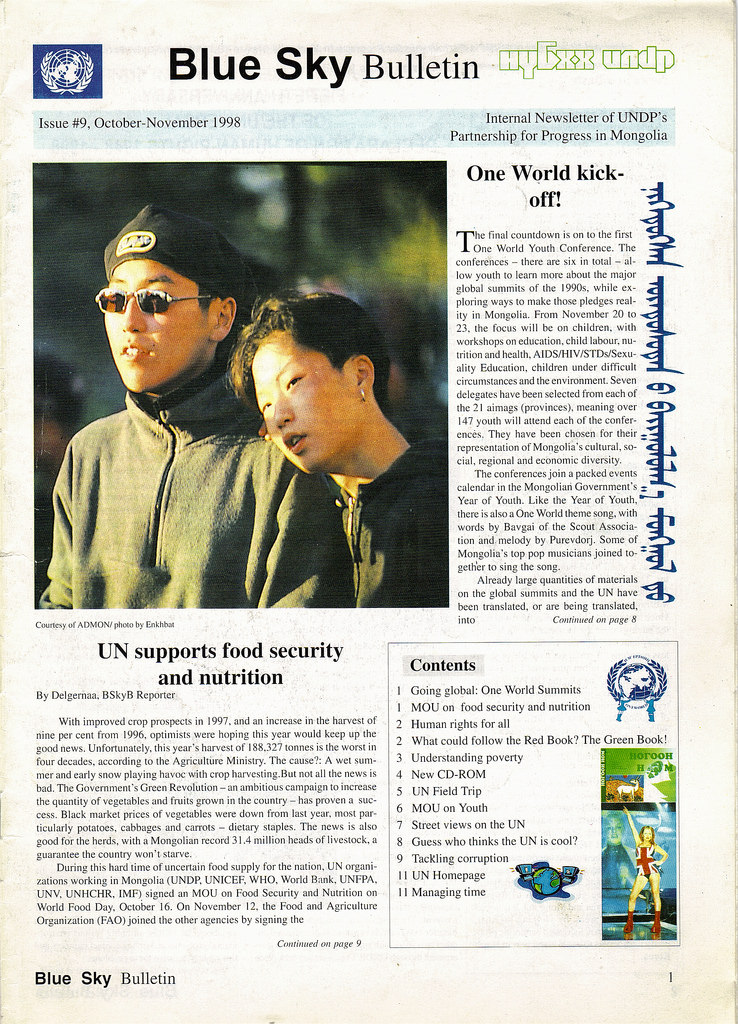
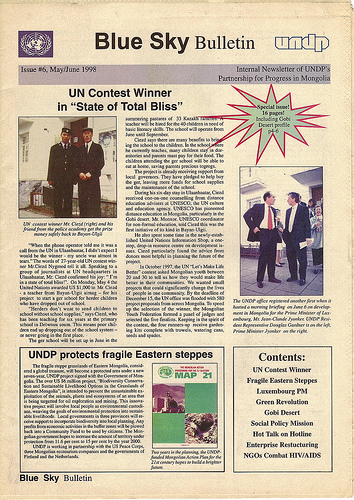
    The Blue Sky Bulletin newsletter was launched in 1997 initially as a simple, photocopied handout. It quickly founds its purpose and its audience, becoming a key way to communicate what was happening in the country and a crucial resource for the global development community, scholars, the media and anyone trying to figure out what was happening in a crazy and chaotic time. Blue Sky Bulletin was distributed via email and by post and proved to be a popular and oft-cited resource on the country. The quality of its production also paralleled Mongolia’s growing capacity to publish to international standards, as desktop publishing software became available and printers switched to modern print technologies. Blue Sky Bulletin evolved from a rough, newsprint black and white publication to becoming a glossy, full-colour, bilingual newsletter distributed around Mongolia and the world.

    Archived issues can be found online here:

    Blue Sky Bulletin Issue 1

    Blue Sky Bulletin Issue 2

    Blue Sky Bulletin Issue 3

    Blue Sky Bulletin Issue 4

    Blue Sky Bulletin Issue 5

    Blue Sky Bulletin Issue 6 

    Blue Sky Bulletin Issue 7 

    Blue Sky Bulletin Issue 8

    Blue Sky Bulletin Issue 9

    Blue Sky Bulletin Issue 10


    Publishing

    MHDR 1997

    The Mongolian Human Development Report 1997 (MHDR), the country’s first, placed the story of the Mongolian people during the transition years (post-1989) at its heart, using photographs, stories and case studies to detail the bigger narrative at play.

    This groundbreaking Mongolian Human Development Report went beyond just chronicling Mongolia’s state of development in statistics and graphs. Designed, laid out and published in Mongolia, the report broke with the practices of many other international organisations, who would publish outside of Mongolia – denying local companies much-needed work and the opportunity to develop their skills. The report’s costs helped to kick-start a publishing boom in the country and significantly raised standards in design and layout in the country. The foundations laid down by the project producing the report ushered in a new age in publishing for Mongolia.

    The report’s launch was innovative, not only being distributed for free across the country, but also part of a multimedia campaign including television programming, public posters, town hall meetings and a ‘roadshow’ featuring the report’s researchers and writers.

    The initial print run of 10,000 copies was doubled as demand for the report increased. To the surprise of many, once hearing about the free report, herders would travel to the capital, Ulaanbaatar, to pick up their copy. The report proved people cared passionately about the development of their country and that development concepts are not to be the secret domain of ‘development practitioners’. The report also became an English language learning tool as readers compared the Mongolian and English-language versions. 

    You can read the report’s pdf here: http://www.mn.undp.org/content/mongolia/en/home/library/National-Human-Development-Reports/Mongolia-Human-Development-Report-1997.html

    Mongolian AIDS Bulletin

    Assembled by a team of health experts after the Fourth International Congress on AIDS in Asia and the Pacific, the Mongolian AIDS Bulletin was published in 1997 in the middle of an HIV/AIDS crisis. It provided timely information and health resources in the Mongolian language and was distributed across the country.
     
    “Mongolia’s first AIDS Bulletin marked the beginning of the UNDP Response to HIV/AIDS/STDs Project back in the autumn of 1997. Over 5,000 copies of the magazine were distributed across the country, offering accurate information on the HIV/AIDS situation. The project has been pivotal in the formulation of a national information, education and communication (IEC) strategy, bringing together NGOs, donors, UN agencies and the government.”
     
    Source: YouandAids: The HIV/AIDS Portal for Asia Pacific 

    Green Book

    In the Mongolian language, the Mongolian Green Book details effective ways to live in harmony with the environment while achieving development goals. Based on three years’ work in Mongolia – a Northeast Asian nation coping with desertification, mining, and climate change – the book presents tested strategies.  

    EPAP Handbook

    The Environmental Public Awareness Handbook was published in 1999 and features the case studies and lessons learned by UNDP’s Mongolian Environmental Public Awareness Programme (EPAP). The handbook draws on the close to 100 small environmental projects the Programme oversaw during a two-year period. These projects stretched across Mongolia, and operated in a time of great upheaval and social, economic and environmental distress. The handbook is intended for training purposes and the practice of public participation in environmental protection.

    In its 2007 Needs Assessment, the Government of Mongolia found the EPAP projects “had a wide impact on limiting many environmental problems. Successful projects such as the Dutch/UNDP funded Environmental Awareness Project (EPAP), which was actually a multitude of small pilot projects (most costing less than $5,000 each) which taught local populations easily and efficiently different ways of living and working that are low-impact on the environment.”

    Mongolia Updates 1997, 1998, 1999

    Mongolia Update 1998 detailed how the country was coping with its hyperinflation and the Asian economic crisis.

    The mission simultaneously had to deal with the 1997 Asian Crisis (http://en.wikipedia.org/wiki/1997_Asian_Financial_Crisis) and the worst peacetime economic collapse in post-WWII history (http://www.jstor.org/pss/153756).  

    Mongolia Update 1998 – Political Changes

    1998 proved a tumultuous year for Mongolia. The country’s existing economic crisis caused by the transition from Communism to free markets was made worse by the wider Asian Crisis. The government was destabilised, leading to an often-confusing revolving door of political figures. In order to help readers better understand the political changes in the country, a special edition of Mongolia Update was published that year.  

    UNDP Mongolia: The Guide

    The Guide, first published in 1997, provided a rolling update on UNDP’s programmes and projects in Mongolia during a turbulent time (1997-1999). The mission simultaneously had to deal with the 1997 Asian Crisis (http://en.wikipedia.org/wiki/1997_Asian_financial_crisis) and the worst peacetime economic collapse in post-WWII history.

    Each edition came with short project and context summaries, key staff contacts, and facts and figures on how the country was changing. For the first time, any member of the public could grasp what the UN was up to in the country and be able to contact the project staff. An unusual level of transparency at the time for a UN mission.

    Memoranda of Understanding

    Three Memoranda of Understanding were negotiated with the Mongolian Government to help focus efforts and aid the attainment of internationally-agreed resolutions. This was affirmed by a series of youth conferences, One World, held in 1998 and 1999.

    Strategy and Leadership in a Crisis

    The scale and gravity of the crisis that struck Mongolia in the early 1990s was only slowly shaken off by the late 1990s. The economic and social crisis brought on by the collapse of Communism and the ending of subsidies and supports from the Soviet Union, led to a sharp rise in job losses, poverty, hunger, and family and community breakdowns. 

    The challenge was to find inspiring ways out of the crisis, while building confidence and hope. The sort of challenges confronted by the UNDP Mongolia Communications Office included: 

    1) A food crisis: agricultural production was down sharply, and the traditional nomadic herding economy, while at peak herd, was failing to get the meat to markets and to a high enough standard to restore export levels to where they once were. As a result, a cross-border trading frenzy became the solution to falling domestic food production and availability.

    2) HIV/AIDS/STDs crisis

    3) A major banking crisis

    4) Both the Asian Financial Crisis and the Russia Crisis.

    5) An ongoing political crisis and an inability to form stable governments.

    “Mongolia is not an easy country to live in and David [South] showed a keen ability to adapt in difficult circumstances. He was sensitive to the local habits and cultures and was highly respected by his Mongolian colleagues. … David’s journalism background served him well in his position as Director of the Communications Unit. … A major accomplishment … was the establishment of the UNDP web site. He had the artistic flare, solid writing talent and organizational skills that made this a success. … we greatly appreciated the talents and contributions of David South to the work of UNDP in Mongolia.” Douglas Gardner, UN Resident Coordinator and UNDP Resident Representative Mongolia

    UNDP: Country Cooperation Frameworks and Related Matters – First Country Cooperation Framework for Mongolia (1997-2001).

    Citations

    The response by the Communications Office has been cited in numerous articles, stories, publications and books. It has also contributed to the development of the human development concept and understanding of human resilience in a crisis and innovation in a crisis. Book citations include: 

    Modern Mongolia: From Khans to Commissars to Capitalists

    Wild East: Travels in the New Mongolia

    A more detailed list of citations can be found here: http://www.davidsouthconsulting.com/about/

    For research purposes, key documents were compiled together and published online here: https://books.google.ca/books?id=K76jBgAAQBAJ&dq=undp+mongolia+key+documents&source=gbs_navlinks_s

    In 2001, the UN won the Nobel Peace Prize for “their work for a better organized and more peaceful world” and its communications innovations, with work such as that in Mongolia being cited as a contributing factor to the awarding of the Prize

    In 2000, the Millennium Development Goals (MDGs) were launched in a 15-year bid to use a focused approach to development centred around eight goals to accelerate improvements to human development. From 2000 to 2005, work was undertaken in various UN missions (Mongolia, South Africa, Turkmenistan, Ukraine) to communicate the goals and to reshape communications activities around the goals.

    *Curbing Corruption in Asia: A Comparative Study of Six Countries by Jon S. T. Quah, Eastern Universities Press, 2003 

    Transition and Democracy in Mongolia by Richard Pomfret, Europe-Asia Studies, Vol. 52, No. 1 (Jan., 2000), pp. 149-160, published by Taylor & Francis, Ltd. (http://www.jstor.org/stable/153756?seq=1#page_scan_tab_contents

    UNDP Mongolia team photo in 1997. I am sitting front row centre left of the UN Resident Coordinator Douglas Gardner.
    Creative Commons License

    This work is licensed under a
    Creative Commons Attribution-Noncommercial-No Derivative Works 3.0 License.

    ORCID iD: https://orcid.org/0000-0001-5311-1052.

    © David South Consulting 2023
  • Innovation in the Slums can bring Peace and Prosperity

    Innovation in the Slums can bring Peace and Prosperity

    By David SouthDevelopment Challenges, South-South Solutions

    SOUTH-SOUTH CASE STUDY

    Rioting in Kenya has once again reminded people of the volatility of urban slums and the price to be paid if the dreams of those who live there are not met. As documented by urban development expert Jeb Brugmann, “mismanaged urban migrations have been a central part of political revolutions in our world since the 1960s.” In Kenya, “as elsewhere, these slums have effectively become huge, parallel cities, with their own economies, governance and social dynamics. Two-thirds of Nairobi’s slum dwellers eke a living in the underground informal sector. Ninety per cent of them are tenants. The poverty rate in Nairobi doubled, for instance, between 1992 and 1997.”

    Slums are usually despised by the local urban authorities around the world. They end up either being totally ignored and seen as an embarrassment, or in more extreme circumstances like Zimbabwe’s slum clearance in 2005 – “Operation Clean Up Trash” – they are swept away (only to pop up somewhere else). Recently in Ghana, slums were cleared with flame-throwers, as residents were quickly cleared out of their homes to make way for a football stadium. Schoolteacher Ibrahim Addalah, who lost his home, said: “My school is gone. The community had bought us a blackboard; we had made a small school. It took us a long time to get all those things: the benches, the books. They gave us no time to leave; they just burnt our homes and our future to the ground. Now we are living in the rubble with nowhere to go.”

    Over 900 million people – almost a sixth of the world’s population – now live in urban slums (UN). Improving conditions for these people is a Millennium Development Goal target. And half the world’s population will soon live in cities: already, in developing countries 43 per cent of urban dwellers live in slums – and in the least-developed countries the figure is 78 per cent. The UN has estimated it will take US $18 billion a year to improve living conditions for these people – and most of it will have to come from the people themselves.

    An essential route to improving the situation is to give people living in slums the dignity and respect they deserve as human beings. Initiatives across the South seek to do this and turn the situation on its head: seeing slum dwellers as a valuable asset, not an urban blight.

    The concept of ‘slum networking’ has been developed by Indian engineer Himanshu Parikh of Ahmedabad , a winner of the Aga Khan award for architecture. He starts from the point of believing there is no need for slum conditions to exist in India, but that slums do not need to be moved, just upgraded; and that good change can happen quickly.

    He also sees the residents’ involvement and financial contribution as critical to the sustainability of any improvements. His approach has already helped one million people overall, including 8,703 families (43,515 people) in Ahmedabad in 41 slum communities. Slum networking does not depend on aid funds but is a self-reliant approach, in which residents make a partnership with private suppliers to get access to the most important services first: clean water and hygiene and sanitation.

    Parikh’s approach involves providing channels for sewage, water supply and roadways in existing slum areas by exploiting the natural topography and pattern of development to provide the new infrastructure.

    Parikh makes a detailed survey plan of the existing houses and divides them into groups based on the quality of construction. If they are of reasonable quality, they are left in place. Where possible, slum dwellers are allowed to buy the land they are squatting on. By buying the land, the owner now has a direct stake in its development.

    “Working inside out, i.e. starting with quality infrastructure in the poor areas and working outwards to produce larger networks for the city or village, not only integrates the two levels, but actually produces far cheaper infrastructure at both levels,” Parikh told Architecture Week magazine.

    In the slums of the Indian city of Indore, 181 slums were networked, giving the city 360 kilometres of new roads, 300 kilometres of new sewer lines, 240 kilometres of new water lines, 120 community halls and 120,000 trees. This transformed the two local rivers from open sewers back to water. According to the World Bank, fatal water diseases fell by 90 per cent.

    “No project for their rehabilitation could be successful until they were involved as the capital partners,” Parikh told India’s The Tribune. Upgrading “the civic amenities, including sewerage, roads and water supply, was the need of the hour for better living conditions of the slum dwellers.” In South Africa, the country’s fast-growing tourism trade is being directed towards its slums, not just its game parks, wineries and cities.

    The sprawling Soweto district on the outskirts of Johannesburg – the heart of the struggle against the former apartheid regime – has lured tourists to come and stay with its network of bed and breakfasts (http://www.sowetonights.co.uk/snaccom_vhavenda.htm): home-based places to stay run by families. Like many slums, Soweto is a heady mix of contrasts: from wealthy suburban homes, to makeshift tin shacks to outright squalor and destitution. But the B and Bs ensure tourists stick around and spend more money, creating lasting jobs.

    Over 200,000 visitors a year tour Soweto to see where Nelson Mandela and Bishop Desmond Tutu once lived. And as with all success, it attracts more success: the international hotel chain Holiday Inn has just opened a 48-room hotel in Soweto.
    Giving dignity to the lives of slum dwellers is the work of a do-it-yourself “TV station” in Kenya. Kenya’s dramatic turn to violence after recent elections has led to a myopic view of the country, according to the young filmmakers and photographers behind Slum TV (http://www.slum-tv.info/). Based deep inside Nairobi’s largest slum, Mathare, they have been seeking out the stories of hope where international media only see violence and gloom.

    “We look at what is good and what is bad. We see what is behind the scenes. The international media only shows the negative side,” said Benson Kamau of Slum TV.

    Slum TV is a group of young men in Mathare with only a two-week workshop in the basics of film shooting and editing. They pay their bills by doing odd jobs. A grant from Austria paid for their one camera and a computer.

    They screen their films every month to the residents of Mathare on a giant white sheet hanging over some vacant land. They illegally tap an overhanging electricity line for power – few can afford electricity. The films document everyday life in the slum – a man selling dougnuts, women frying potatoes – and the locals can see their lives recorded and acknowledged.

    Resources 

    1. Shelter Associates: established by Indian architect Pratima Joshi, it is an NGO working on slum rehabilitation. http://www.shelter-associates.org

    2. SPARC: one of the largest Indian NGOs working on housing and infrastructure issues for slum dwellers. http://www.sparcindia.org

    3. Improving the Lives of Slum Dwellers: published by the Millennium Project. http://www.unmillenniumproject.org/reports/tf_slum.htm

    4. For local bed and breakfasts in South Africa, click here sa-venues.com, tourist information at http://www.southafrica.net/

    5. Slum Networking: Innovative Approach to Urban Development by Diane Diacon (editor). Website: http://www.amazon.co.uk

    https://davidsouthconsulting.org/2022/02/17/digital-mapping-to-put-slums-on-the-map/

    https://davidsouthconsulting.org/2022/04/28/envisioning-better-slums/

    https://davidsouthconsulting.org/2022/11/16/housing-innovation-in-souths-urban-areas/

    https://davidsouthconsulting.org/2020/12/14/innovation-in-growing-cities-to-prevent-social-exclusion/

    https://davidsouthconsulting.org/2021/03/05/southern-innovator-issue-4/

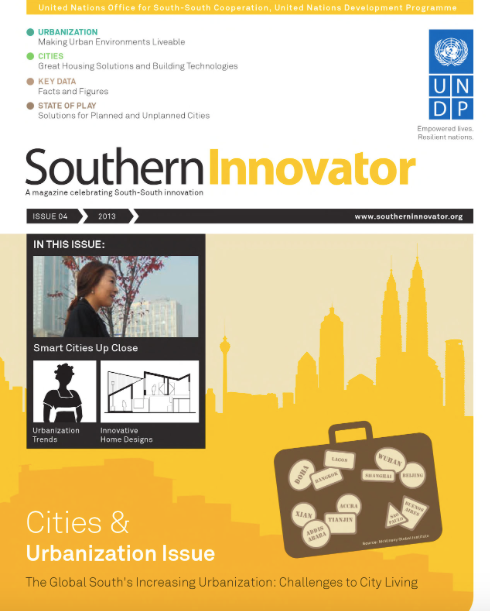
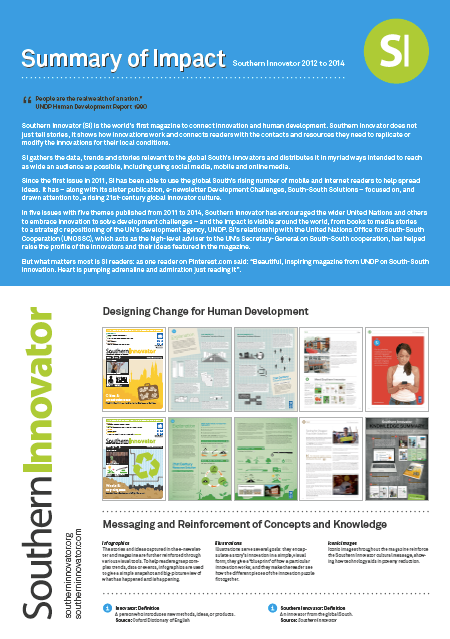
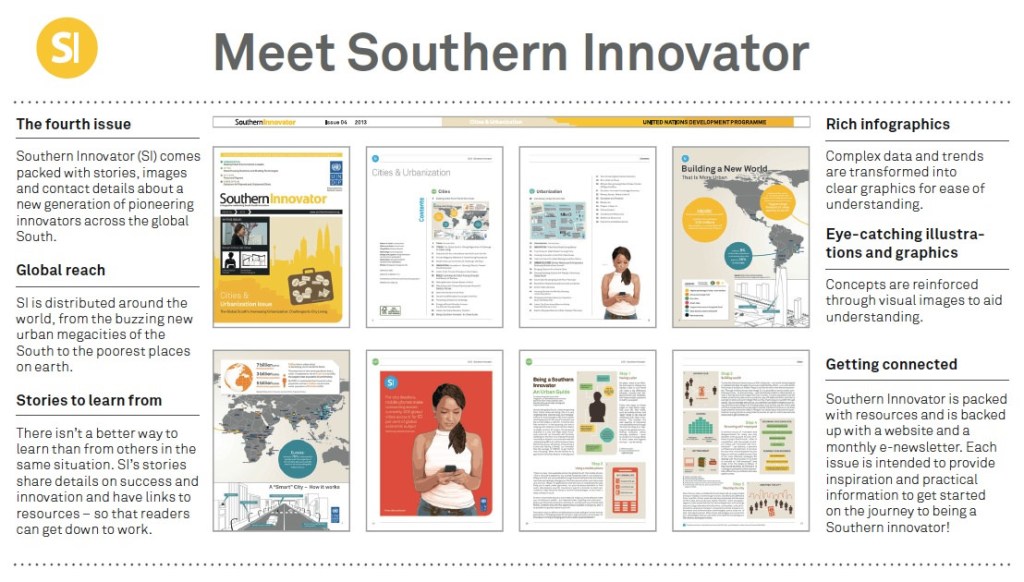
    Development Challenges, South-South Solutions was launched as an e-newsletter in 2006 by UNDP’s South-South Cooperation Unit (now the United Nations Office for South-South Cooperation) based in New York, USA. It led on profiling the rise of the global South as an economic powerhouse and was one of the first regular publications to champion the global South’s innovators, entrepreneurs, and pioneers. It tracked the key trends that are now so profoundly reshaping how development is seen and done. This includes the rapid take-up of mobile phones and information technology in the global South (as profiled in the first issue of magazine Southern Innovator), the move to becoming a majority urban world, a growing global innovator culture, and the plethora of solutions being developed in the global South to tackle its problems and improve living conditions and boost human development. The success of the e-newsletter led to the launch of the magazine Southern Innovator. 

    Creative Commons License

    This work is licensed under a
    Creative Commons Attribution-Noncommercial-No Derivative Works 3.0 License.

    ORCID iD: https://orcid.org/0000-0001-5311-1052.

    © David South Consulting 2023

  • Health Care In Danger

    Health Care In Danger

    Worrying breakdown in Ontario reforms

    By David South

    This Magazine (Canada), October-November, 1992

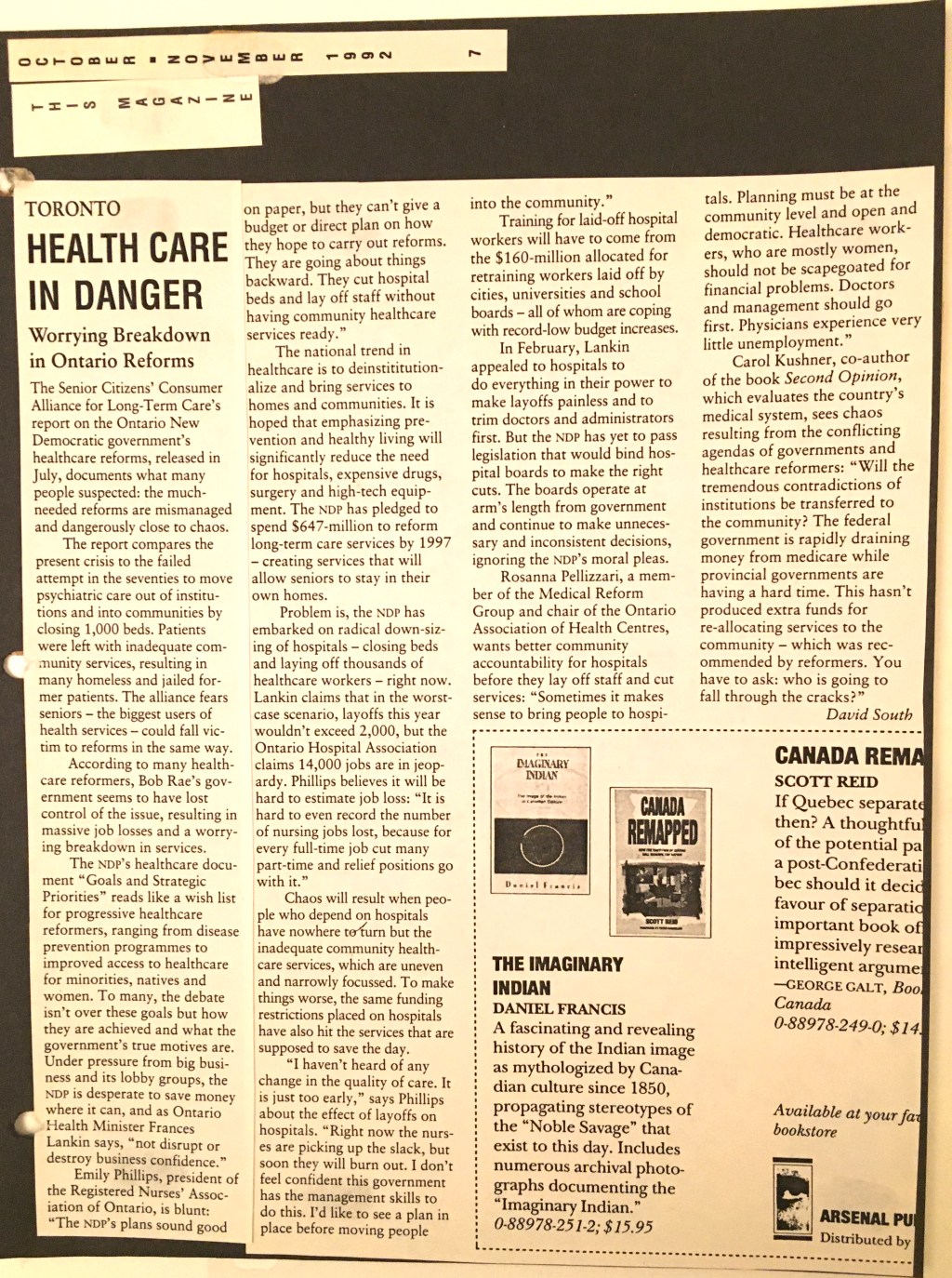
    The Senior Citizens’ Consumer Alliance for Long-Term Care’s report on the Ontario New Democratic government’s health care reforms, released in July, documents what many people suspected: the much-needed reforms are mismanaged and dangerously close to chaos.

    The report compares the present crisis to the failed attempt in the seventies to move psychiatric care out of institutions and into communities by closing 1,000 beds. Patients were left with inadequate community services, resulting in many homeless and jailed former patients. The alliance fears seniors – the biggest users of health services – could fall victim to reforms in the same way.

    According to many health care reformers, Bob Rae’s government seems to have lost control of the issue, resulting in massive job losses and a worrying breakdown in services.

    The NDP’s health care document “Goals and Strategic Priorities” reads like a wish list for progressive health care reformers, ranging from disease prevention programmes to improved access to health care for minorities, natives and women. To many, the debate isn’t over these goals but how they are achieved and what the government’s true motives are. Under pressure from big business and its lobby groups, the NDP is desperate to save money where it can, and as Ontario Health Minister Francis Lankin says, “not disrupt or destroy business confidence.”

    Emily Phillips, president of the Registered Nurses’ Association of Ontario, is blunt: “The NDP’s plans sound good on paper, but they can’t give a budget or direct plan on how they hope to carry out reforms. They are going about things backward. They cut hospital beds and lay off staff without having community health care services ready.”

    The national trend in health care is to deinstitutionalize and bring services to homes and communities. It is hoped that emphasizing prevention and healthy living will significantly reduce the need for hospitals, expensive drugs, surgery and high-tech equipment. The NDP has pledged to spend $647 million to reform long-term care services by 1997 – creating services that will allow seniors to stay in their own homes.

    Problem is, the NDP has embarked on radical down-sizing of hospitals – closing beds and laying off thousands of health care workers – right now. Lankin claims that in the worst-case scenario, layoffs this year wouldn’t exceed 2,000, but the Ontario Hospital Association claims 14,000 jobs are in jeopardy. Phillips believes it will be hard to estimate job loss: “It is hard to even record the number of nursing jobs lost, because for every full-time job cut many part-time and relief positions go with it.”

    Chaos will result when people who depend on hospitals have nowhere to turn but the inadequate community health care services, which are uneven and narrowly focussed. To make things worse, the same funding restrictions placed on hospitals have also hit the services that are supposed to save the day.

    “I haven’t heard of any change in the quality of care. It is just too early,” says Phillips about the effect of layoffs on hospitals. “Right now the nurses are picking up the slack, but soon they will burn out. I don’t feel confident this government has the management skills to do this. I’d like to see a plan in place before moving people into the community.”

    Training for laid-off hospital workers will have to come from the $160-million allocated for retraining workers laid off by cities, universities and school boards – all of whom are coping with record-low budget increases.

    In February, Lankin appealed to hospitals to do everything in their power to make layoffs painless and to trim doctors and administrators first. But the NDP has yet to pass legislation that would bind hospital boards to make the right cuts. The boards operate at arm’s length from government and continue to make unnecessary decisions, ignoring the NDP’s moral pleas.

    Rosana Pellizzari, a member of the Medical Reform Group and chair of the Ontario Association of Health Centres, wants better community accountability for hospitals before they lay off staff and cut services: “Sometimes it makes sense to bring people to hospitals. Planning must be at the community level and open and democratic. Health care workers, who are mostly women, should not be scapegoated for financial problems. Doctors and management should go first. Physicians experience very little unemployment.”

    Carol Kushner, co-author of the book Second Opinion, which evaluates the country’s medical system, sees chaos resulting from the conflicting agendas of governments and health care reformers: “Will the tremendous contradictions of institutions be transferred to the community? The federal government is rapidly draining money from medicare while provincial governments are having a hard time. This hasn’t produced extra funds for re-allocating services to the community – which was recommended by reformers. You have to ask: who is going to fall through the cracks?”

    Find in a library:

    Worldcat.org: Health care in danger: worrying breakdown in Ontario reforms, This Magazine, 26, Oct-Nov 1992, 6

    ISSN: 1491-2678

    OCLC Number / Unique Identifier: 8250614985

    Available to subscribers to Gale In Context: College database.

    https://davidsouthconsulting.org/2022/02/09/african-health-data-revolution/

    https://davidsouthconsulting.org/2022/10/06/african-technology-tackles-health-needs/

    https://davidsouthconsulting.org/2021/06/02/case-study-5-gosh-ich-child-health-portal-2001-2003/

    https://davidsouthconsulting.org/2021/02/05/changing-health-care-careers-a-sign-of-the-times/

    https://davidsouthconsulting.org/2022/10/08/dodging-the-health-insurance-minefield/

    https://davidsouthconsulting.org/2022/11/18/finding-fortune-in-traditional-medicine/

    https://davidsouthconsulting.org/2017/10/18/hannah-institute-for-the-history-of-medicine-1992-1994/

    https://davidsouthconsulting.org/2022/11/22/happy-nigeria-west-african-nation-has-good-attitude/

    https://davidsouthconsulting.org/2021/07/13/health-human-development-communicator-1991-2017/

    https://davidsouthconsulting.org/2021/02/05/health-care-on-the-cutting-block-ministry-hopes-for-efficiency-with-search-and-destroy-tactics/

    https://davidsouthconsulting.org/2022/03/08/mobile-phone-microscopes-to-revolutionize-health-diagnostics/

    https://davidsouthconsulting.org/2022/02/05/mongolian-enterprises-target-healthy-urban-lifestyles/

    https://davidsouthconsulting.org/2022/10/31/new-kenyan-services-to-innovate-mobile-health-and-farming/

    https://davidsouthconsulting.org/2021/10/20/research-reviews-2001-2002/

    https://davidsouthconsulting.org/2022/10/19/safe-healthcare-is-good-business-and-good-health/

    https://davidsouthconsulting.org/2021/03/24/solar-powered-mobile-clinics-to-boost-rural-healthcare-in-africa/

    https://davidsouthconsulting.org/2022/10/19/south-africa-innovates-healthcare-with-prepay-phone-vouchers/

    https://davidsouthconsulting.org/2020/04/20/take-two-big-doses-of-humanity-and-call-me-in-the-morning/

    https://davidsouthconsulting.org/2020/04/17/taking-medicine-to-the-people-four-innovators-in-community-health/

    https://davidsouthconsulting.org/2022/11/16/thai-organic-supermarkets-seek-to-improve-health/

    https://davidsouthconsulting.org/2022/11/19/traditional-healers-can-heal-the-mind-as-well-as-body/

    https://davidsouthconsulting.org/2022/11/19/traditional-medicine-is-now-a-proven-remedy/

    https://davidsouthconsulting.org/2021/02/05/us-health-care-businesses-chasing-profits-into-canada/

    Creative Commons License

    This work is licensed under a
    Creative Commons Attribution-Noncommercial-No Derivative Works 3.0 License.

    ORCID iD: https://orcid.org/0000-0001-5311-1052.

    © David South Consulting 2023