Tag: Canada

  • New Seniors’ Group Boosts ‘Grey Power’: Grey Panthers Chapter Opens With A Canadian Touch

    New Seniors’ Group Boosts ‘Grey Power’: Grey Panthers Chapter Opens With A Canadian Touch

    By David South

    Today’s Seniors (Canada), April 1993

    Check your prejudices at the door, look beyond your self-interest, and open your mind, because the Grey Panthers are here in Canada.

    Joe Moniz, the 26-year-old founder of the Canadian Grey Panthers, is confident that his ambitious plans for a new national seniors’ organization are just what Canadian seniors need. 

    That’s right: 26-years-old. Modelled on the U.S. Grey Panthers, the Canadian Grey Panthers believe in harnessing the power of all age groups, making the connection that everybody will eventually be a senior and that seniors benefit from a better society for everyone. 

    “The major difference between us and any other organization is our slogan, “Age and Youth Working Together,” he says. “Look at our pension fund. It’s depleting. I’m concerned about my future as a senior citizen – will there be a pension fund? We want to act now, to bring youth and age together to improve the situation of seniors today and improve our situation in the future. 

    “Membership is open to all age groups. We want to bring seniors into day care to interact with children. We want to deal with the universities, give people the opportunity to discuss and unite. It’s a different approach, but it can make a huge difference.”

    Moniz has already organized the group’s first chapter, in Hamilton, complete with a board of retired university professors and doctors. The group has put together insurance packages that will “blow the others out of the water.”

    “All seniors’ attempts at lobbying in the past have been short term,” says a blunt Moniz. “We are the organization that will make the difference. We will lobby provincially, federally, and municipally, and we are non-partisan.

    “The reason I’m introducing the Grey Panthers is to keep grey power alive in Canada, and to provide the necessary channels to do so through lobbying efforts. If anyone has problems with local politicians, they can call us, and we in turn let them know the channels they should use. There are a lot of seniors out there being cheated, and it is up to us to help them.”

    The Canadian Grey Panthers (which uses the British spelling, as opposed to its American counterpart) will initially concentrate on four issues: pensions, drug plans, affordable housing and long-term care, and will communicate information through newsletters, surveys and meetings. 

    Moniz promises to make the Panthers accessible to all, no matter what their income. He plans to hit the streets and visit institutions to inform seniors of the group’s presence. As if to prove the group’s potential for excitement, an enthusiastic gentleman from a local retirement home interrupts Moniz during a coffee shop interview. “That’s the best thing I’ve heard from a young person in Toronto,” he says. 

    The U.S. Panthers were formed by political activist Maggie Kuhn and five friends in 1970. Back then, their name wasn’t as exciting. It was the convoluted and unsexy “Consultation of Older and Younger Adults for Social Change.” In 1972, they adopted the media’s pet name – a grey twist on radical African-American rights organization the Black Panthers. 

    The radical milieu of political activism was contagious – and the Panthers symbolized its jump from the youth of America to other generations. 

    “When we formed, we were an intergenerational group,” says Panthers’ U.S. national chair, Charlotte Flynn. “The first issue the group addressed was mandatory retirement. We combat the stigma of ageism, which is making decisions about people based on chronological age. Ageism isn’t just confined to the elderly – ageism exists for young people as well.”

    The agenda of the Panthers is just as radical today. Flynn, who is candid about the group’s failures as well as its successes, admits that it isn’t the easiest route to popularity. With membership at about 45,000, the U.S. Panthers have spoken out on now-popular issues like health care, the environment, affordable housing – and taken brave stands against mainstream opinion when it came to the Gulf War and the invasion of Panama. 

    And they think big. Not content with just influencing the American political scene, the Panthers have taken on the world, gaining official advisor status at the United Nations. 

    Although involved in a broad range of issues, Flynn says the Panthers are primarily seen as a strong voice for the rights of American seniors. 

    “We have tried very hard to let people know we are not a special interest group for the elderly,” says Flynn. “But we are always getting called upon to highlight what any legislation is doing to older people.” 

    With Panther groups sprouting in Europe and now in Canada, the important issue of maintaining the integrity of the Panther name has arisen, says Flynn. She points to the flip side of having a reputation for action: people want to start branches without being interested in the full agenda of the Panthers, using the name for shock value. At the last convention in November 1992, the Panthers formed a committee to act as quality control monitors for the name. 

    One thing is clear from the ambitious agenda of the Grey Panthers – they aren’t for everyone. 

    But Moniz’s pragmatic approach seems distinct from the American Panthers. He shies away from some of the American group’s positions, emphasizing a balance between insurance policies and political policies. 

    “If you read the American Panthers’ position sheet, it’s anti-this and anti-that,” he says. “We aren’t going to take that approach. It would be suicide.”

    But he is quick in his praise of the group and its founder Maggie Kuhn. “People may consider her actions to be radical, but they’re not. Look at the achievements. She is one of the top 25 active women in the U.S.

    “The Gray Panthers are achievers. They have proven the effectiveness of intergenerational attempts at social justice.”

    A quick call to seniors’ groups drew many surpised faces. 

    “I can’t say anything about them – I don’t know who they are,” responded Murray Morgenthau, executive director of the Canadian Association of Retired Persons (CARP). 

    Jane Leitch at the United Senior Citizens of Ontario had heard something was happening but wonders why a new group is forming “with so many groups out there.”

    One Voice spokesperson Andrew Aitkens says his group is closer to the American Association of Retired Persons than the Panthers in their approach, and that they “have found that there are much more effective ways for advocacy. We don’t march on the Hill at the drop of the hat.”

    But Flynn says the Panthers embody a philosophy distinct from all other seniors’ groups. “As Maggie Kuhn said, ‘those of us who are older are the elders of the tribe and should be concerned about survival.’ We look at all issues that deny people the ability to realize their full potential, whether young or old. We are really interested in empowering people rather than being a special interest for the elderly.” 

    More from Canada’s Today’s Seniors

    Feds Call For AIDS, Blood System Inquiry: Some Seniors Infected

    https://davidsouthconsulting.org/2020/12/18/feds-call-for-aids-blood-system-inquiry-some-seniors-infected/

    Government Urged To Limit Free Drugs For Seniors

    https://davidsouthconsulting.org/2020/06/14/government-urged-to-limit-free-drugs-for-seniors/

    Health Care On The Cutting Block: Ministry Hopes For Efficiency With Search And Destroy Tactics

    https://davidsouthconsulting.org/2021/02/05/health-care-on-the-cutting-block-ministry-hopes-for-efficiency-with-search-and-destroy-tactics/

    Seniors Falling Through The Health Care Cost Cracks

    https://davidsouthconsulting.org/2020/06/14/seniors-falling-through-the-health-care-cost-cracks/

    Creative Commons License

    This work is licensed under a
    Creative Commons Attribution-Noncommercial-No Derivative Works 3.0 License.

    ORCID iD: https://orcid.org/0000-0001-5311-1052.

    © David South Consulting 2023

  • UNDP Travelling Seminar: Environment and Development | Mongolia 1998

    UNDP Travelling Seminar: Environment and Development | Mongolia 1998

    As head of communications for UNDP/UN Mongolia, I organised and led press tours across the country for international journalists in 1997 and 1998.

    Library catalogue description: https://www.e-varamu.ee/item/NG6OSO3DWRMB4NGGULKHVE434XN4KJ4R

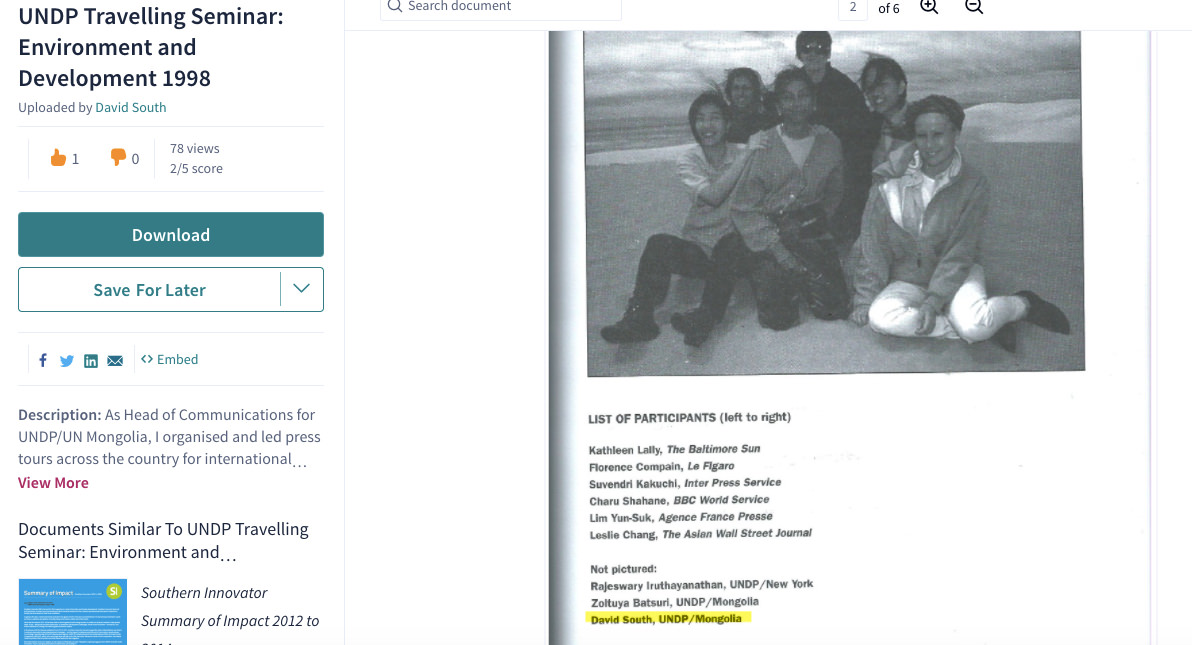
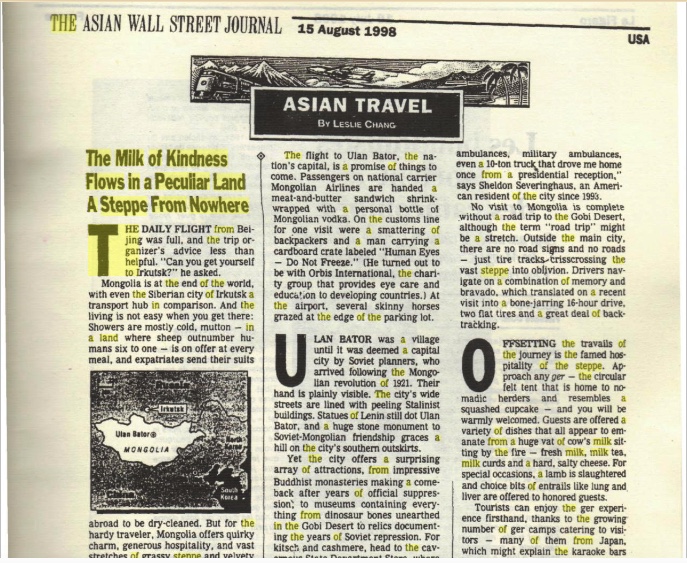
    The media tour of Mongolia included the following journalists: Kathleen Lally (The Baltimore Sun), Florence Compain (Le Figaro), Suvendrini Kakuchi (Inter Press Service), Charu Shahane (BBC World Service), Lim Yun-Suk (Agency France Presse), Leslie Chang (The Asian Wall Street Journal).
    An Interoffice Memorandum from Djibril Diallo, Director, Division of Public Affairs, UNDP, to Mr. Nay Htun, Assistant Administrator and Director, Regional Bureau for Asia and the Pacific.
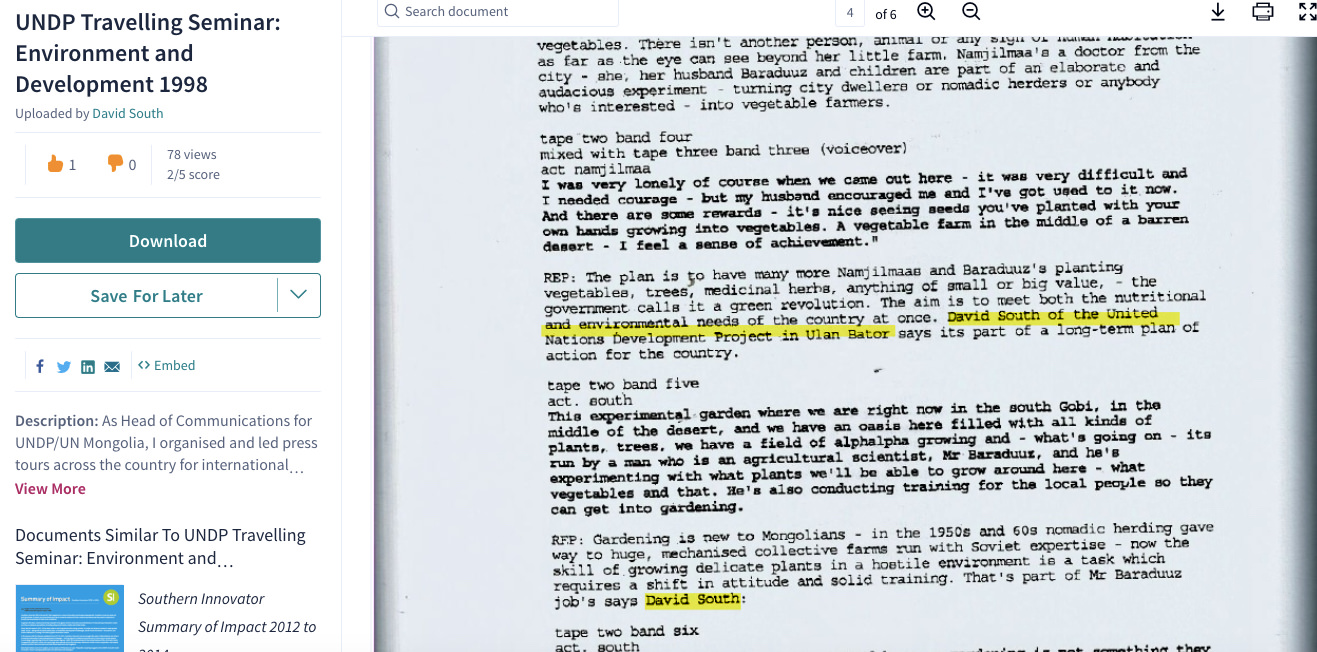
    An interview with the BBC World Service while visiting gardens in the Gobi Desert, 1998. I led media tours of Mongolia while serving as the UN/UNDP Mongolia Communications Coordinator from 1997-1999.
    The UNDP Mongolia Communications Office would reach out to journalists to help tell the story of Mongolia’s late 1990s transition to free markets and democracy.
    The BBC’s Charu Shahane joined other journalists on a UNDP Mongolia media tour in 1998.
    UNDP Mongolia staff photo 1997. I served for two years as the UNDP Mongolia Head of Communications (1997-1999).

    “Mongolia is not an easy country to live in and David [South] showed a keen ability to adapt in difficult circumstances. He was sensitive to the local habits and cultures and was highly respected by his Mongolian colleagues. … David’s journalism background served him well in his position as Director of the Communications Unit. … A major accomplishment … was the establishment of the UNDP web site. He had the artistic flare, solid writing talent and organizational skills that made this a success. … we greatly appreciated the talents and contributions of David South to the work of UNDP in Mongolia.” Douglas Gardner, UN Resident Coordinator and UNDP Resident Representative Mongolia

    ORCID iD: https://orcid.org/0000-0001-5311-1052.

    © David South Consulting 2023

    Creative Commons License

    This work is licensed under a
    Creative Commons Attribution-Noncommercial-No Derivative Works 3.0 License.

  • Awards 1998-2003 | February 2020

    Awards 1998-2003 | February 2020

    UN/UNDP Mongolia Development Portal (www.un-mongolia.mn) 

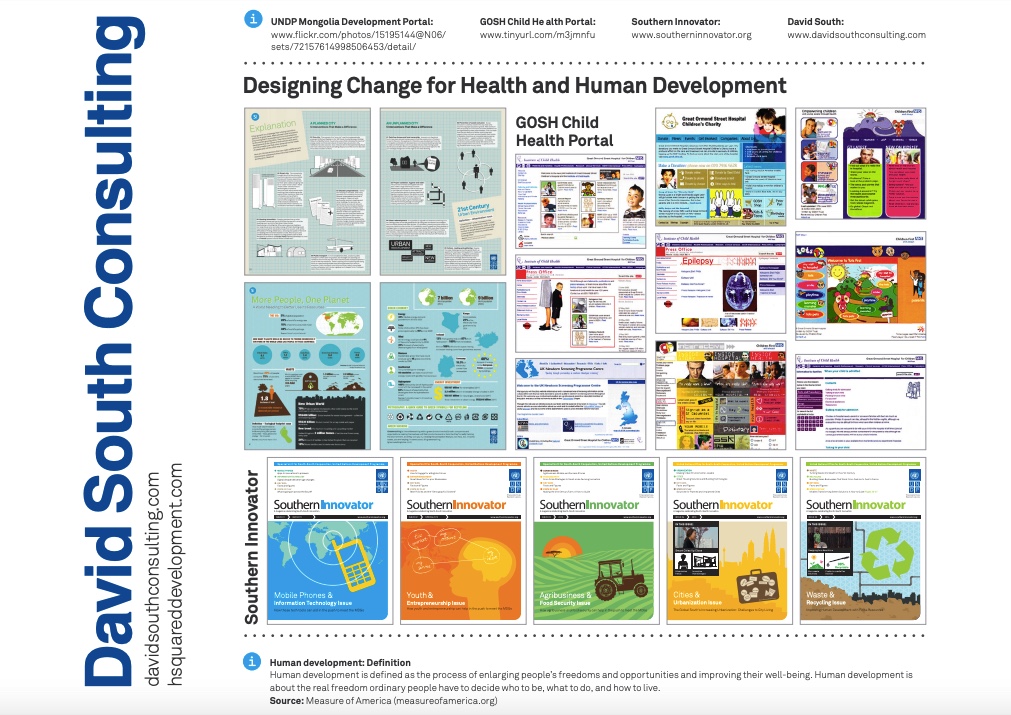
    I launched this portal in 1997, in the middle of a major economic crisis in Mongolia. This award-winning (winner in 1998 of the People’s Choice WebSite 500 award and the CyberTeddy Top 500 Website award) and pioneering United Nations Mongolia development web portal was singled out by UN headquarters as an example of what a country office website should be like.

    At this time, Mongolia was still recovering from the chaotic and turbulent transition from Communism to free markets and democracy begun at the start of the 1990s, called by some “one of the biggest peacetime economic collapses ever” (Mongolia’s Economic Reforms: Background, Content and Prospects, Richard Pomfret, University of Adelaide, 1994). There was a thirst for information: access to the Internet was still limited and access to mobile phones was just the preserve of the rich. As a legacy of the past, information, especially that about the outside world and the country’s true economic and social conditions, was restricted. During the years of Communism, even simple travel from one place to the next was strictly regulated.

    While today we can take it for granted that the Internet, and mobile and smart phones, deliver the world’s information in seconds, this just was not the case in the late 1990s in Mongolia.

    “Cyber-Teddy’s Top 500 Web Site” was an online award from the late 1990s.
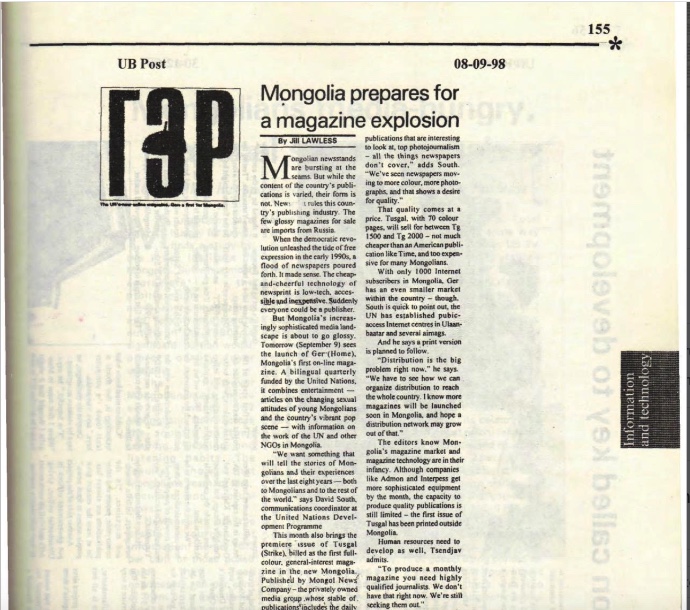
    The UN/UNDP Mongolia development web portal addressed the urgent need to communicate what was happening in the country during a major crisis, and to transparently show what the UN was doing to address the crisis. It made critical data on the country’s development easy to find, and informed the wider world about the country and its people and culture. While the Internet had only just arrived in Mongolia, from the start the UNDP Mongolia Communications Office was experimenting with this powerful new technology to reach a global audience. This included Mongolia’s first web magazine, Ger (launched in 1998). After the http://www.un-mongolia.mn website launched in 1997, a media campaign began to inform readers of its presence. This ad appeared regularly in magazines, newsletters and newspapers.
    “A UN System site. A very nice, complete, professional site. Lots of information, easily accessible and well laid out. The information is comprehensive and up-to-date. This is a model of what a UNDP CO web site should be.”

    I was head of communications for the United Nations mission in Mongolia from 1997 to 1999. The mission had to primarily tackle three major crises: the country’s turbulent transition from Communism to free markets and democracy, the social and economic crash this caused, and the Asian Financial Crisis (Pomfret 2000) (Quah 2003)*.

    UNDP Mongolia staff photo 1997. I served for two years as the UNDP Mongolia head of communications (1997-1999). I am sitting front row centre left of the UN Resident Coordinator Douglas Gardner.

    Richard Pomfret said in 1994 “In 1991 Mongolia suffered one of the biggest peacetime economic collapses ever (Mongolia’s Economic Reforms: Background, Content and Prospects, Richard Pomfret, University of Adelaide, 1994).”

    From Curbing Corruption in Asia: A Comparative Study of Six Countries by Jon S. T. Quah: “The combined effect of these three shocks was devastating as ‘Mongolia suffered the most serious peacetime economic collapse any nation has faced during this century’. Indeed, Mongolia’s economic collapse ‘was possibly the greatest of all the (peaceful) formerly’” Communist countries. 

    “The years 1998 and 1999 have been volatile ones for Mongolia, with revolving door governments, the assassination of a minister, emerging corruption, a banking scandal, in-fighting within the ruling Democratic Coalition, frequent paralysis within the Parliament, and disputes over the Constitution. Economically, the period was unstable and rife with controversies.” Mongolia in 1998 and 1999: Past, Present, and Future at the New Millennium by Sheldon R. Severinghaus, Asian Survey, Vol. 40, No. 1, A Survey of Asia in 1999 (Jan. – Feb., 2000), pp. 130-139 (Publisher: University of California)

    Writing in 2018, author John West  found, in a chapter titled Mongolia’s Corruption Curse (Transparency International and the World Bank had found corruption worsened in Mongolia after 2001), “In many ways, Mongolia has everything going for it. After being a satellite state of the former Soviet Union for much of the twentieth century, Mongolia regained its independence with the end of the Cold War. A relatively peaceful political revolution in the early 1990s ushered in a multi-party democracy and open society which have remained in place. … And it is blessed with vast reserves of copper, gold, coal, molybdenum, fluorspar, uranium, tin and tungsten deposits. True, Mongolia experienced great upheavals as the breakup of the Soviet Union saw its trade decline by 80%. But Mongolia was also perfectly placed to benefit from the commodity super cycle driven by China, which is now the destination for the vast majority of its exports.

    “However, despite much hype about the Mongolian “wolf economy”, this country of so much promise is being dragged down by massive corruption. …

    “Mongolia’s corruption is greatly weakening its attractiveness as an investment destination, is fracturing society and weakening its fragile political institutions. Its culture of corruption has also fed its love-hate relationship with foreign investors, which has destabilized the economy.” Asian Century … on a Knife-edge: A 360 Degree Analysis of Asia’s Recent Economic Development by John West, Springer, 24 January 2018.  

    In this role, I pioneered innovative use of the Internet and digital resources to communicate the UN’s work and Mongolia’s unfolding crises. The UN called this work a “role model” for the wider UN and country offices. A survey of United Nations country office websites in 2000 ranked the UN Mongolia website I launched in 1997 and oversaw for two years (1997-1999), third best in the world, saying: “A UN System site. A very nice, complete, professional site. Lots of information, easily accessible and well laid out. The information is comprehensive and up-to-date. This is a model of what a UNDP CO web site should be.” (http://www.scribd.com/doc/274319690/UNDP-Mongolia-United-Nations-2000-Survey-of-Country-Office-Websites)

    As part of a strategic plan to raise awareness of Mongolia’s development challenges and to spur action on meeting them, a Communications Office was established for the UN mission in 1997. Acting as a strategic hub, the Communications Office and its dynamic and talented team, were able to leverage the existing budget to spur action on many fronts.

    In 2001, the UN won the Nobel Peace Prize for “their work for a better organized and more peaceful world” and its communications innovations, with work such as that in Mongolia being cited as a contributing factor to the awarding of the Prize

    The Nobel Peace Prize 2001 joint winners.

    GOSH Child Health Portal (www.gosh.nhs.uk)

    In 2001 I undertook a two-year contract to modernise the online resources for the Great Ormond Street Hospital for Children NHS Trust (GOSH)/Institute of Child Health (ICH). My strategy was inspired and informed by initiatives encountered while working as a health and medical journalist in 1990s Canada – a time where government austerity spurred a need to experiment and try new ways of doing things.

    Having seen the impact first-hand of pilot experiments in Toronto aimed at widening access to information and resources for patients and their families, I applied this knowledge to the GOSH Child Health Portal Project (2001 to 2003). Drawing on the wider NHS Modernisation Plan, and a multi-year consultation process undertaken by the hospital, the Project was launched in three phases. 

    How far the UK had fallen out of step with global developments with the Internet became clear from the start. The distance that had to be traveled in the span of two years was vast. Essentially, to go from being a web laggard to a web leader. 

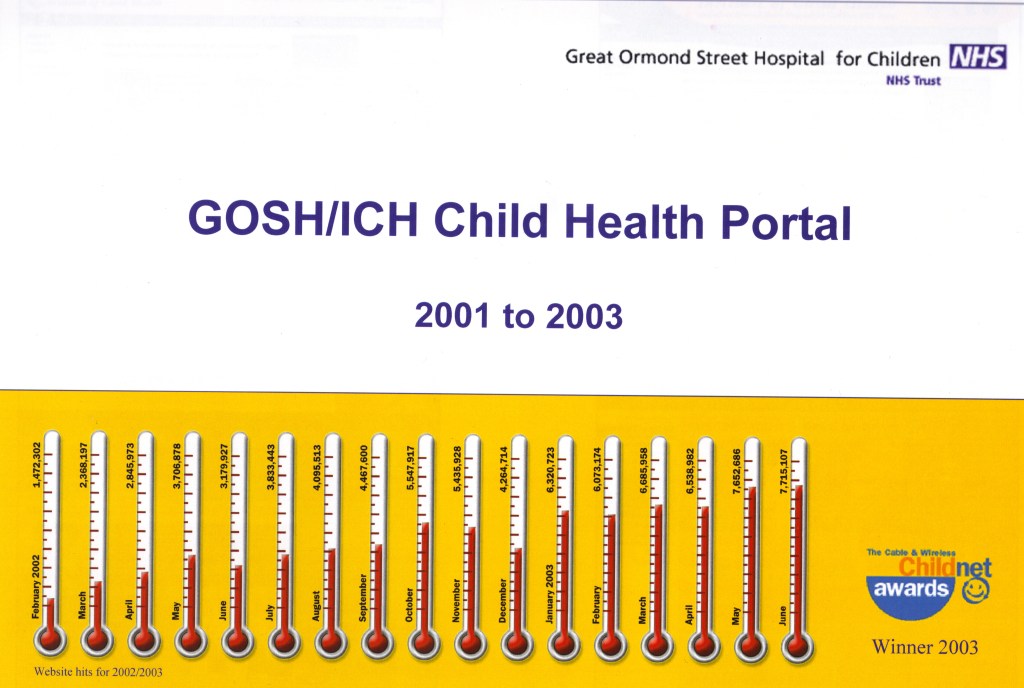
    Award-winning (http://www.scribd.com/doc/35249271/Childnet-Awards-2003-Brochure), the GOSH Child Health Portal was called by The Guardian newspaper one of the “three most admired websites in the UK public and voluntary sectors,” and a UK government assessment called the overall GOSH child health web portal a role model for the NHS. At the time, Prime Minister Tony Blair (whose wife, Cherie Blair, was an early supporter and champion of the project) had this to say: “Making sure that your child has helpful, easy-to-read information will make a significant difference to their time in hospital. I am sure that this website will prove very useful for children and their families.”

    The project was delivered in three phases. At every stage, progress was communicated to the wider public and colleagues in various ways, via in-house media and through constant engagement with British news outlets. Screen grabs and other resources from the project can be found online here: 

    Phase 1: https://books.google.co.uk/books?id=g826gFjEXWsC&printsec=frontcover&dq=gosh+health+phase+1a&hl=en&sa=X&ved=0ahUKEwj5u__dqIHLAhVJOxoKHZ3IDZcQ6AEIJTAA#v=onepage&q=gosh%20health%20phase%201a&f=false 

    Phase 2: https://books.google.co.uk/books?id=E2ZVlFbrCzsC&printsec=frontcover&dq=gosh+health+phase+2a&hl=en&sa=X&ved=0ahUKEwjEodr0qIHLAhWK2BoKHStJB7QQ6AEIJjAA#v=onepage&q=gosh%20health%20phase%202a&f=false

    Phase 3: https://books.google.co.uk/books?id=KVE6QqDp1HsC&printsec=frontcover&dq=gosh+health+phase+3&hl=en&sa=X&ved=0ahUKEwiXwe-FqYHLAhVBvxoKHXhOCooQ6AEIJjAA#v=onepage&q=gosh%20health%20phase%203&f=false

    Project documents: https://books.google.ca/books?id=4aeDBgAAQBAJ&dq=gosh+child+health+portal+key+documents&source=gbs_navlinks_s

    The Cable and Wireless Childnet Award called Children First “an outstanding example of how a hospital can create quality, authoritative information on issues relating to health in a fun, child-centered and accessible way.”

    More here from The Guardian and CBS: Hospital unveils international website for children and Web Projects For Kids Get Their Due 

    The Childnet Awards in 2003 were awarded by Trond Waage, the Norwegian Ombudsman for Children, at the Science Museum in London.
    The GOSH Child Health Portal team receive the Childnet Award in 2003 at London’s Science Museum (Photo: CBBC Newsround).
    “Web Projects For Kids Get Their Due.”
    “Hospital unveils international website for children.”
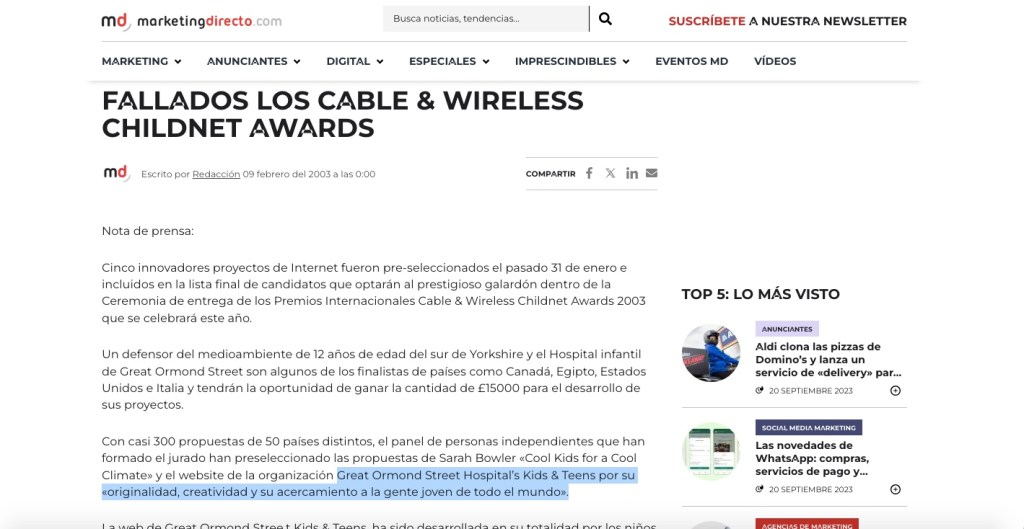
    “… Great Ormond Street Hospital’s Kids & Teens por su «originalidad, creatividad y su acercamiento a la gente joven de todo el mundo». La web de Great Ormond Street Kids & Teens, ha sido desarrollada en su totalidad por los niños del hospital de mayor tamaño de Gran Bretaña.”

    ORCID iD: https://orcid.org/0000-0001-5311-1052.

    © David South Consulting 2024